10 Proven Strategies for Marketing a New Product in Web3 for 2026
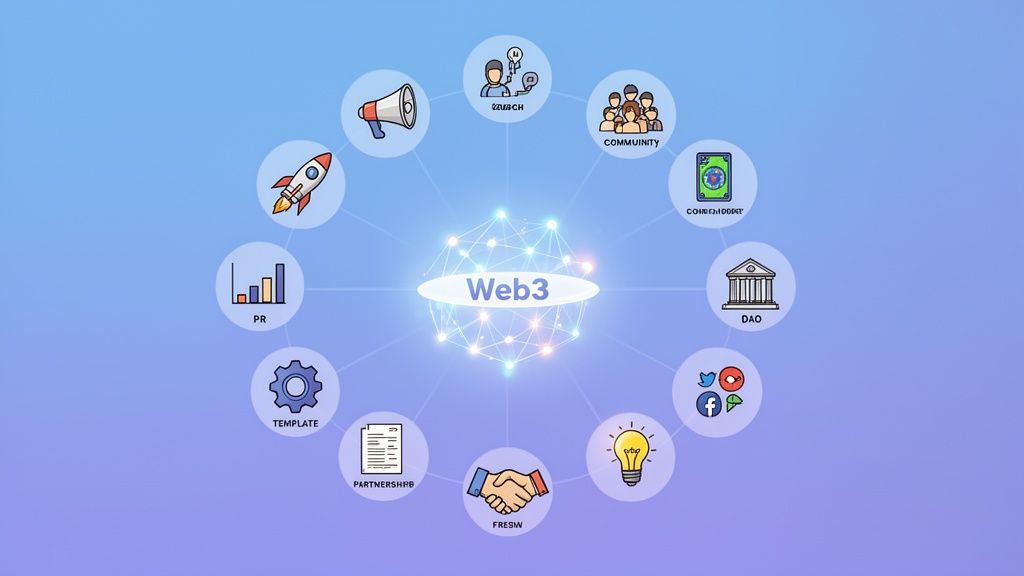
Launching a new product in the fast-paced Web3 space feels like trying to catch lightning in a bottle. Traditional marketing rules don't quite apply, and the community is everything. So, how do you cut through the noise, build a dedicated following, and drive real adoption for your crypto, NFT, or DAO project? It's not about shouting the loudest; it's about building genuine connections and providing tangible value from day one.
While the fundamentals of a go-to-market strategy are universal, the Web3 ecosystem demands a unique approach. For instance, a comprehensive understanding of how to launch a new product effectively is fundamental, but applying those principles requires a native Web3 toolkit. You can't just run Facebook ads and call it a day. Success hinges on mobilizing your community, incentivizing participation, and creating experiences that resonate with the culture of decentralization and ownership.
This guide unpacks 10 powerful, battle-tested strategies for marketing a new product specifically tailored for the world of crypto. We're moving beyond the hype to give you the actionable, step-by-step tactics you need. For each strategy, we’ll cover:
- What it is: A clear, concise explanation.
- Why it works for Web3: The specific reason it resonates with the crypto audience.
- How to implement it: Actionable steps to get you started.
- Metrics to track: What to measure to know if it's working.
- Domino templates: Concrete examples to show you exactly how to execute.
This isn't just theory. This is your playbook for turning a product launch into a legendary, community-powered event. Let’s dive in and build some serious momentum.
1. Community-Driven Quest Gamification
Gamified quests are one of the most powerful strategies for marketing a new product in Web3. Instead of just asking people to follow you on social media or join a Discord, you turn these marketing activities into an interactive game. Users complete specific "quests" and earn rewards like points, badges, exclusive roles, NFTs, or even token airdrops. It’s a win-win: users get tangible rewards for their time, and you get a highly engaged community that actively contributes to your growth.
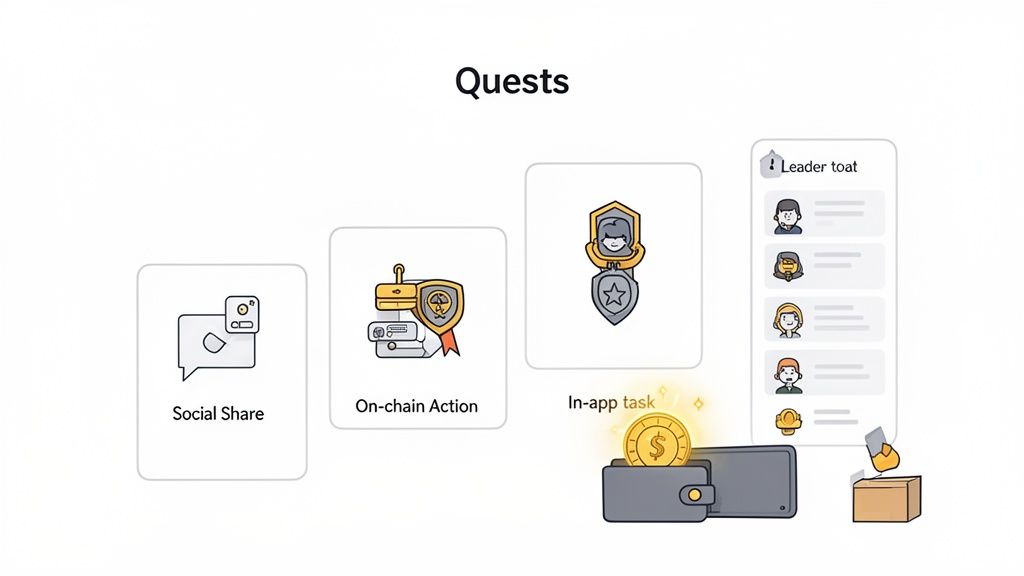
This strategy works exceptionally well in Web3 because it aligns perfectly with the ecosystem's ethos of participation and ownership. It’s not just about passive consumption; it’s about active contribution. Projects like Arbitrum and Optimism have used quest campaigns to drive massive mainnet adoption and governance participation, proving the model at scale. For a deeper dive into the mechanics, explore our complete guide on community gamification.
How to Implement It
Getting started is simpler than you think. You can create a compelling quest program by focusing on high-impact actions that directly support your launch goals.
- Step 1: Define Your Core Quests. Start small with 3-5 essential tasks. These could include joining your Discord, following on X (formerly Twitter), retweeting a key announcement, or visiting your landing page.
- Step 2: Set Up Tiered Rewards. Not all actions are equal. Assign more points or better rewards for high-effort quests, like creating a video tutorial or interacting with your smart contract on a testnet. This helps you identify and reward your most dedicated community members.
- Step 3: Launch & Promote. Announce your questboard across all your channels. Use leaderboards to create friendly competition and highlight top contributors weekly to maintain momentum.
- Step 4: Analyze and Iterate. Track key metrics like quest completion rates, user acquisition costs, and on-chain activity. Use this data to refine your quests, weed out low-performing tasks, and double down on what works.
2. Influencer and Ambassador Activation Programs
One of the most effective strategies for marketing a new product is to partner with trusted voices who already have the attention and respect of your target audience. Influencer and ambassador programs leverage the credibility of crypto thought leaders, creators, and super-fans to generate authentic awareness and drive adoption. Instead of you shouting about your product, you empower influential community members to share your story for you. This creates social proof and cuts through the noise in a crowded market.
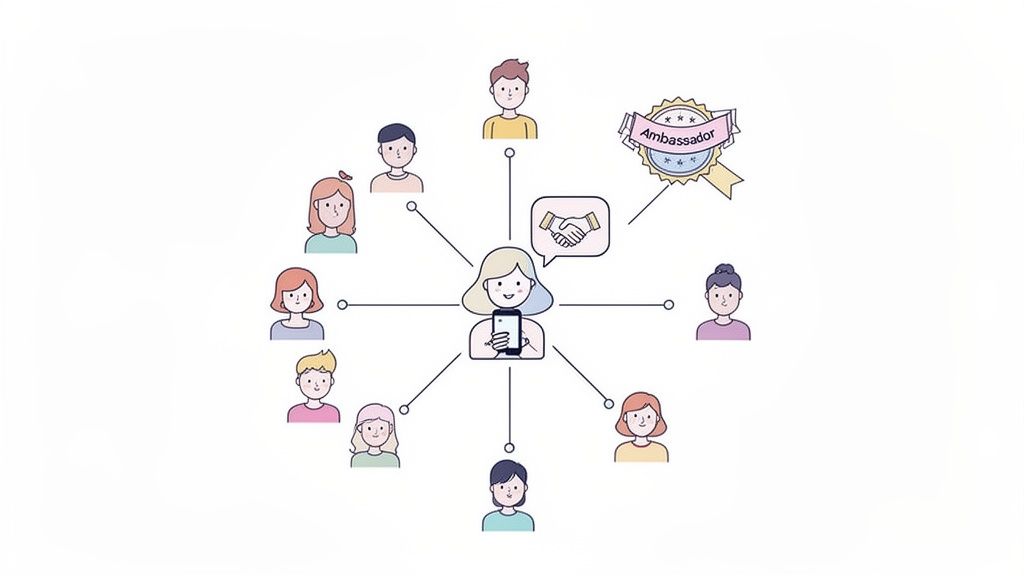
This strategy is especially powerful in Web3, where community trust is paramount. A genuine recommendation from a respected developer advocate or a niche NFT creator often carries more weight than a dozen paid ads. Projects like Chainlink and Solana have successfully used developer advocates and creator partnerships to build massive, engaged ecosystems. The key is to focus on authentic alignment rather than just follower counts, ensuring your partners genuinely believe in what you're building.
How to Implement It
You can launch a high-impact ambassador program by structuring it around clear, trackable actions that benefit both your project and your partners.
- Step 1: Identify Aligned Partners. Look for micro-influencers and community leaders whose content and values genuinely align with your product. Prioritize engagement rates and audience relevance over raw follower numbers.
- Step 2: Create a Structured Program. Define clear roles, expectations, and rewards. Build a tiered system where ambassadors can level up by completing more impactful tasks, such as hosting a Twitter Space, creating educational content, or referring new users.
- Step 3: Equip Them for Success. Provide your ambassadors with a dedicated toolkit, including key messaging, brand assets, and early access to new features. Use unique referral links to track their performance, which is a core component of any effective Web3 referral program.
- Step 4: Nurture Long-Term Relationships. Treat your ambassadors like true partners. Offer exclusive perks, feature them in your content, and solicit their feedback. A one-off campaign is good, but a long-term advocacy network is a game-changer.
3. Multi-Channel Community Engagement and Cross-Platform Quests
Your community doesn't live in one place, so your marketing shouldn't either. Multi-channel engagement is one of the most effective strategies for marketing a new product because it meets your audience where they already are. Instead of forcing everyone into a single Discord server, you create a unified campaign that spans Discord, X (formerly Twitter), Telegram, and even your own app. This approach ensures maximum reach and turns siloed audiences into a cohesive, engaged community.
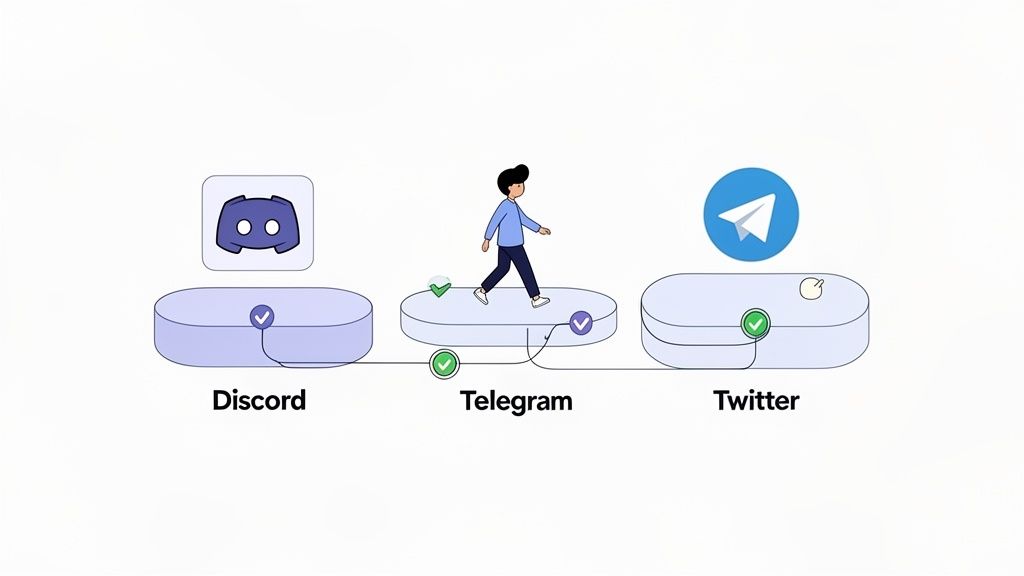
This strategy is powerful in Web3 because the community is inherently fragmented across different platforms. Projects like Arbitrum and Polygon have successfully used multi-channel quests to drive massive ecosystem growth and participation. By bridging these platforms, you create a seamless user journey, allowing people to engage on their preferred channel without missing out on rewards. For a deeper look, check out our guide on multi-channel campaign management.
How to Implement It
Executing a coordinated cross-platform campaign is all about creating a unified experience that feels connected, not disjointed.
- Step 1: Map Your Community Channels. Identify where your audience is most active. Is it a developer-heavy Discord, a trader-focused Telegram, or a broad audience on X? Prioritize the top 2-3 platforms for your initial campaign.
- Step 2: Create Platform-Specific Quests. Tailor tasks to fit the native behavior of each platform. For example, use Discord role-gate quests, "like and retweet" quests on X, or coordinated "raids" in Telegram. This feels more natural and boosts completion rates.
- Step 3: Implement Cross-Platform Bonuses. Encourage users to connect with you everywhere by offering bonus rewards. Create a "super quest" that requires completing one task on Discord, one on Telegram, and one on X to unlock a special NFT or extra points.
- Step 4: Centralize Your Analytics. Use a tool to track engagement and conversion rates across all channels from a single dashboard. This allows you to see which platforms drive the most valuable users and where to allocate your resources for the best ROI.
4. Incentivized Referral and Affiliate Marketing
Referral programs are a classic growth hack, but they become supercharged in Web3. This strategy turns your existing users into your most effective marketers by rewarding them for bringing new people into your ecosystem. Instead of paying for ads, you reward your community directly with tokens, NFTs, or protocol revenue shares for successful referrals. It’s a powerful, cost-effective way to drive viral growth from the ground up.
This approach is one of the most effective strategies for marketing a new product in the crypto space because it builds on trust. A recommendation from a friend or trusted community member is far more powerful than a banner ad. For Web3 projects, on-chain referral tracking and automated token rewards create a transparent, trustless system. Protocols like Aave and Lido have used referral mechanisms to rapidly acquire liquidity providers and stakers, proving this model’s effectiveness in driving core protocol actions.
How to Implement It
You can launch a powerful referral program by creating clear incentives and making it incredibly easy for users to share.
- Step 1: Define Your Referral Rewards. Decide what a successful referral is worth. A common starting point is offering 10-20% of the referred user's first action value, such as a percentage of their first deposit or swap fee. Make the reward compelling enough to motivate sharing.
- Step 2: Generate Unique Referral Links. Give each user a unique, shareable link or code. This is crucial for tracking who referred whom. You can use tools like Domino to generate these links and automatically track on-chain and off-chain conversions tied to each user.
- Step 3: Create Competitive Elements. Introduce leaderboards and referral challenges to gamify the process. Offer bonus rewards for top referrers or for reaching specific milestones, like bringing in 10 new active users. This friendly competition can significantly boost participation.
- Step 4: Monitor and Prevent Fraud. Referral programs can be susceptible to Sybil attacks, where one person creates multiple fake accounts. Implement anti-fraud measures, such as requiring a minimum wallet age, on-chain activity, or using analytics to spot suspicious patterns and ensure your rewards go to genuine advocates.
5. Educational Content and Thought Leadership
Establishing your project as a go-to educational resource is one of the most sustainable strategies for marketing a new product in the long run. Instead of just shilling your token or features, you create high-value content that helps users understand the underlying technology, market trends, and how your product fits into the bigger picture. This builds trust, establishes authority, and attracts an audience that is genuinely interested in the space.
This approach is incredibly effective in Web3 because the industry is still complex and intimidating for many newcomers. By simplifying difficult concepts and providing clear guidance, you lower the barrier to entry, making it easier for users to feel confident enough to try your product. It’s not just marketing; it’s community building through empowerment. Projects like the Ethereum Foundation and Polygon have built massive, loyal ecosystems by consistently publishing developer guides, technical deep dives, and accessible explainers that serve the entire community.
How to Implement It
You can become a thought leader by consistently producing content that educates, informs, and adds real value to your audience. This strategy helps with organic discoverability and positions you as a trusted voice.
- Step 1: Identify Your Niche. Focus on topics where your team has genuine expertise. This could be DeFi risk management, NFT metadata standards, or DAO governance models. Don’t try to be everything to everyone.
- Step 2: Create a Content Cadence. Consistency is key. Start with a weekly blog post on platforms like Mirror or Medium, or host a regular Twitter Space or AMA on Discord. Create a mix of beginner-friendly guides and technical articles to serve different audience segments.
- Step 3: Integrate Content into Onboarding. Don’t let your great content sit on a blog. Turn educational articles into interactive quests where users must read a guide and answer a short quiz to earn rewards. This gamifies the learning process and ensures your community understands your product’s value.
- Step 4: Amplify and Repurpose. Promote your content across all channels. Turn a detailed blog post into a Twitter thread, a short video, or an infographic. Repurposing content maximizes its reach and impact without requiring you to constantly create from scratch.
6. Strategic Partnerships and Ecosystem Integration
No product is an island in Web3. One of the most effective strategies for marketing a new product is to embed it directly into the existing ecosystem through strategic partnerships. This involves collaborating with complementary projects, protocols, and platforms to tap into their communities, share user bases, and create integrated value propositions. Instead of building your audience from scratch, you leverage the network effects of established players.
This strategy is native to the composable and open-source nature of Web3. It’s not just about co-marketing; it’s about creating genuine, symbiotic relationships where the whole is greater than the sum of its parts. For example, Lido’s partnerships with major DEXs were crucial for establishing stETH’s liquidity, while Arbitrum’s explosive growth was fueled by its deep integration with over 200 ecosystem partners. This approach accelerates go-to-market efforts and builds powerful moats through network effects.
How to Implement It
Successful partnerships are built on mutual value and clear execution. Here’s a simple framework to get started and turn collaborations into a core growth engine.
- Step 1: Identify Aligned Partners. Look for projects that share a similar target audience but are not direct competitors. Think about technical alignment too; for instance, a new DeFi protocol on Arbitrum should partner with other popular Arbitrum-native dApps.
- Step 2: Propose a Clear Win-Win. Don't just ask for a shoutout. Propose a tangible collaboration like a technical integration, a co-branded quest campaign, or a joint liquidity pool. Clearly articulate how the partnership benefits their users and metrics.
- Step 3: Co-Launch and Cross-Promote. Structure a joint marketing push. This could involve synchronized announcements, AMAs with both communities, and shared educational content. The goal is to present a unified front that introduces both communities to new value.
- Step 4: Measure and Scale. Define and track shared KPIs from the start, such as referral traffic, new user acquisition from the partner’s community, or joint protocol volume. Use this data to prove the partnership's value and identify opportunities to deepen the collaboration.
7. Limited-Time Launch Events and Seasonal Campaigns
Creating a sense of urgency is one of the oldest and most effective strategies for marketing a new product. Limited-time launch events or seasonal campaigns concentrate your marketing firepower into a short, high-impact window. This generates a massive spike in buzz, user acquisition, and on-chain activity by making people feel they’ll miss out if they don't act now. It's about turning your launch from a single moment into an unmissable event.
This approach is particularly powerful in Web3, where the fear of missing out (FOMO) is a significant driver of user behavior. Projects can tie these events to exclusive NFT drops, special token rewards, or access to new features, creating powerful incentives for immediate participation. Campaigns like Arbitrum's Odyssey, which guided users through its ecosystem with weekly tasks and rewards, created a massive wave of adoption and set a gold standard for event-driven growth.
How to Implement It
A successful limited-time campaign requires careful planning to build and sustain momentum. The goal is to create a crescendo of excitement that peaks during the event.
- Step 1: Define the Event Theme and Timeline. Anchor your campaign to a specific milestone, like a mainnet launch, a major upgrade, or a seasonal theme. Plan a 4-6 week timeline, with at least two weeks dedicated to pre-launch hype.
- Step 2: Design Escalating Rewards. Structure your event with rewards that increase in value as users progress. For example, completing week one's tasks unlocks a basic POAP, while finishing the entire month-long campaign grants a rare NFT or a larger token allocation. This encourages sustained engagement.
- Step 3: Build Hype with Countdown Timers. Use countdown timers on your website, social media, and community platforms. This simple visual cue creates a powerful sense of urgency and constantly reminds your audience that time is running out.
- Step 4: Plan for Post-Event Retention. The work isn't over when the campaign ends. Have a plan to keep your newly acquired users engaged. This could involve rolling them into a long-term loyalty program, granting them a special Discord role, or giving them early access to your next feature.
8. Social Proof, User-Generated Content, and Community Showcase
Nothing sells a new product faster than seeing real people use it and love it. This strategy is all about leveraging authentic user testimonials, case studies, and community-created content to build trust and credibility. Instead of you telling everyone how great your product is, you let your community do the talking. It transforms your earliest adopters into powerful advocates, showcasing real success stories that resonate far more than traditional marketing.
This approach is particularly effective in Web3, where trust is paramount and community is everything. Seeing other developers build cool projects with your protocol or traders sharing their winning strategies using your dApp provides powerful social proof. It demonstrates genuine adoption and engagement, proving your project has value beyond just the marketing hype. Projects like Polygon and OpenSea have mastered this by consistently featuring developer success stories and creator spotlights.
How to Implement It
You can systematically encourage and amplify user-generated content to make it a cornerstone of your marketing efforts.
- Step 1: Incentivize Testimonials and Case Studies. Create a dedicated quest tier or reward program for users who share detailed testimonials or case studies. Offer tangible rewards like tokens, NFTs, or exclusive roles for well-documented success stories.
- Step 2: Launch a Community Showcase. Host a monthly or weekly showcase on X (formerly Twitter), Discord, or your blog. Feature the best community-created content, such as tutorials, memes, fan art, or data dashboards, and publicly recognize the creators.
- Step 3: Curate and Amplify. Actively monitor social channels for mentions and user-generated content. Curate the best posts and reshare them across your official channels, always giving credit to the original creator. This encourages more people to contribute.
- Step 4: Create Easy-to-Use Templates. Lower the barrier to entry by providing simple templates for testimonials or case studies. This helps users structure their thoughts and ensures you get the specific information you need to create compelling marketing assets.
9. Paid Advertising and Performance Marketing
While organic growth is the holy grail in Web3, paid advertising is one of the most effective strategies for marketing a new product when you need immediate, scalable results. This approach involves deploying targeted paid campaigns across crypto-native ad networks, major social media platforms, and search engines. Unlike organic strategies that take time to build momentum, paid performance marketing provides a direct lever to accelerate user acquisition during critical launch and growth phases.
This strategy is powerful because it allows you to reach highly specific, crypto-curious audiences who are actively looking for new projects. Platforms like X (formerly Twitter), Reddit, and specialized crypto newsletters have powerful targeting tools that let you get your message in front of users based on their interests, online behavior, and even the accounts they follow. It's a direct line to potential users who are already primed to engage with your product.
How to Implement It
A successful paid advertising campaign is built on data, testing, and continuous optimization. You can start small and scale your budget as you identify what works best for your project.
- Step 1: Identify Key Channels. Don’t spread your budget too thin. Start with one or two platforms where your target audience is most active. For most Web3 projects, this means X (Twitter), Reddit (in subreddits like r/cryptocurrency), and crypto newsletters like Bankless or The Block.
- Step 2: Define and Target Your Audience. Create specific audience profiles. Target users who follow major protocols like Polygon or interact with competitors. Use keyword targeting for people searching for terms related to your product category, such as "new NFT marketplace" or "decentralized exchange."
- Step 3: A/B Test Your Creatives. Create multiple versions of your ad copy and visuals. Test different hooks: one might highlight token rewards, another might focus on product utility. A/B testing is crucial for discovering which message resonates most and lowers your cost per acquisition.
- Step 4: Track, Analyze, and Scale. Use tracking pixels and analytics to measure what matters most: conversions. A conversion could be a wallet connection, a Discord join, or a quest completion. Allocate more budget to the campaigns, audiences, and creatives that deliver the best results, and cut the ones that don't.
10. Data-Driven Analytics and Continuous Optimization
Launching a product without tracking its performance is like navigating without a map. Data-driven analytics is one of the most critical strategies for marketing a new product, as it provides the insights needed to make informed decisions. Instead of relying on guesswork, you establish a clear framework to measure campaign effectiveness, user behavior, and overall marketing ROI. This allows you to rapidly iterate, cut what isn't working, and double down on what is, ensuring your marketing spend is always optimized for the best results.
This approach is especially powerful in Web3, where on-chain analytics offer a transparent and granular view of user actions. You can directly measure the impact of your marketing efforts on tangible outcomes like smart contract interactions, token swaps, or governance votes. Projects like Arbitrum and Uniswap consistently use deep analytics to understand user retention, track ecosystem growth, and refine their strategies based on real-world data, not just vanity metrics.
How to Implement It
Building a data-driven marketing engine involves setting up the right tools and processes from day one. You can start small and build complexity as your project grows.
- Step 1: Establish Baseline Metrics. Before you launch any campaign, define what success looks like. Key metrics could include Monthly Active Users (MAU), quest completion rates, and on-chain transaction volume. This baseline gives you a clear benchmark to measure against.
- Step 2: Track Macro and Micro Conversions. Monitor high-level goals like user acquisition alongside smaller, vital actions like Discord role claims or a specific quest completion. This helps you understand your entire user journey and identify potential friction points in your funnel.
- Step 3: Implement UTMs and On-Chain Tracking. Use UTM parameters across all your marketing channels (X, Discord, blog posts) to trace traffic sources accurately. Combine this with on-chain data to see which channels drive the most valuable user actions, like actual product usage.
- Step 4: Create a Feedback Loop. Schedule weekly or bi-weekly performance reviews to analyze your data. Use these insights to refine your campaigns, adjust your messaging, and optimize your reward structures. This continuous optimization cycle is the key to sustained growth.
10-Strategy Comparison for New Product Marketing
| Strategy | Implementation complexity | Resource requirements | Expected outcomes | Ideal use cases | Key advantages |
|---|---|---|---|---|---|
| Community-Driven Quest Gamification | Medium — design + verification + automation | Platform integrations, dev for reward distribution, analytics | Higher engagement, measurable completions, viral loops | Onboarding, governance participation, acquisition funnels | Wallet-native rewards, real-time tracking, high engagement |
| Influencer and Ambassador Activation Programs | Low–Medium — relationship management and content coordination | Outreach, influencer compensation, content support | Increased awareness, trusted endorsements, conversions | Creator launches, credibility boosts, community growth | Authentic endorsements, access to engaged audiences |
| Multi-Channel Community Engagement & Cross-Platform Quests | High — multi-platform integration and orchestration | Cross-platform APIs, moderation, unified analytics | Broader reach, higher participation, cohesive campaigns | Distributed communities, omnichannel launches | Reach users on preferred platforms, unified campaign view |
| Incentivized Referral & Affiliate Marketing | Medium — tracking, settlement, anti-fraud systems | Referral infrastructure, on-chain settlement, fraud mitigation | Viral user acquisition, low CAC, network effects | Growth scaling, peer-to-peer acquisition | Exponential reach, transparent on-chain tracking |
| Educational Content & Thought Leadership | Medium–High — consistent high-quality content creation | Subject experts, content production, distribution channels | Long-term credibility, organic discovery, reduced support load | Complex products, developer onboarding, trust building | Authority, SEO benefits, sustained community trust |
| Strategic Partnerships & Ecosystem Integration | High — legal, commercial, and technical alignment | Partner management, integration engineering, co-marketing | Accelerated adoption, shared users, enhanced product value | Cross-protocol features, co-marketing, bundled offerings | Access to partner user base, shared costs, composability |
| Limited-Time Launch Events & Seasonal Campaigns | Medium — event planning and logistics | Creative assets, rewards budget, PR/comms coordination | Short-term acquisition spikes, media buzz, high engagement | Product launches, token/NFT drops, milestone campaigns | Creates urgency (FOMO), clear measurement windows |
| Social Proof, UGC & Community Showcase | Low–Medium — curation and moderation workflow | Community managers, curation tools, incentive prizes | Increased credibility, shareable content, organic advocacy | Showcasing success stories, creator communities | Authentic testimonials, low content creation cost |
| Paid Advertising & Performance Marketing | Medium — targeting, tracking, optimization | Ad budget, creative production, tracking pixels | Immediate reach, scalable acquisition, measurable ROI | Rapid scaling, targeted conversions, launch amplification | Fast results, precise targeting, clear attribution |
| Data-Driven Analytics & Continuous Optimization | High — analytics stack and experimentation framework | Analytics tools, data engineers, tracking integrations | Improved efficiency, optimized spend, actionable insights | Iterative growth, budget allocation, campaign refinement | Evidence-based decisions, identifies scalable tactics |
Launch Smarter, Not Harder, with the Right Strategy Mix
You've just navigated a deep dive into ten powerful strategies for marketing a new product in the wild west of Web3. From building vibrant communities with gamified quests to leveraging the authentic voices of influencers and the power of strategic partnerships, the path to a successful launch is clear. It’s not about finding a single, secret-sauce tactic that works for everyone. Instead, it’s about architecting a dynamic, interconnected growth engine.
Think of each strategy we covered not as a standalone option, but as a component in a larger machine. Your community quests fuel user-generated content. Your educational content attracts the right partners. Your data analytics inform how you tweak your paid ad spend. When these elements work in concert, they create a powerful flywheel effect, where each rotation builds more momentum than the last.
Your Launch Flywheel: Key Takeaways
The secret to a blockbuster Web3 launch isn't brute force; it's a carefully orchestrated blend of community, content, and data. The most successful projects don't just shout into the void. They build, listen, and iterate.
Here are the most critical takeaways to remember as you build your go-to-market plan:
- Community is Your Cornerstone: Strategies like gamification, ambassador programs, and multi-channel engagement aren't just about acquisition. They are about building a core of dedicated advocates who will champion your project long after the initial hype fades. They are your first users, your loudest evangelists, and your most valuable source of feedback.
- Authenticity Trumps Everything: Web3 users are notoriously resistant to traditional, top-down marketing. This is why influencer collaborations, user-generated content showcases, and genuine thought leadership resonate so deeply. Your marketing should feel less like an advertisement and more like a contribution to the ecosystem.
- Data-Driven Decisions are Non-Negotiable: Intuition is great, but data is undeniable. The ability to track which quests drive the most engagement, which referral channels have the highest conversion rates, and which content pieces resonate with your ideal user is what separates a lucky launch from a repeatable success story. Continuous optimization is the name of the game.
Your Actionable Next Steps
Feeling overwhelmed by the options? Don't be. You don't need to implement all ten of these strategies for marketing a new product at once. The key is to start smart and build from there.
- Pick Your Power Trio: Choose two or three strategies that align most closely with your project's strengths and immediate goals. A new DeFi protocol might prioritize educational content and strategic partnerships, while a PFP NFT project might lean into influencer activation and community quests.
- Define Your "Win" Condition: For each strategy you choose, set a clear, measurable goal. Is it to gain 1,000 new, active Discord members? Generate 500 pieces of user-generated content? Secure three integration partners? Knowing what success looks like is the first step to achieving it.
- Execute and Measure Relentlessly: Launch your initial campaigns and immediately start tracking the metrics you defined. Use a platform that simplifies this process, allowing you to see what’s working and what’s not in real time. The initial launch isn't the finish line; it’s the starting point for a cycle of continuous learning and improvement.
Ultimately, mastering these approaches is about more than just a successful launch day. It's about building a sustainable, resilient project that can thrive in the ever-shifting Web3 landscape. By creating a self-reinforcing system of growth, you're not just acquiring users; you're building a true, engaged, and invested ecosystem. Now, go build that flywheel.
Ready to put these strategies into action without the technical headache? Domino is the all-in-one growth platform that makes it easy to launch gamified quests, referral programs, and influencer campaigns, all while tracking your results. Stop juggling spreadsheets and start building your Web3 community the smart way at Domino.