Unlocking Engagement with Community Gamification
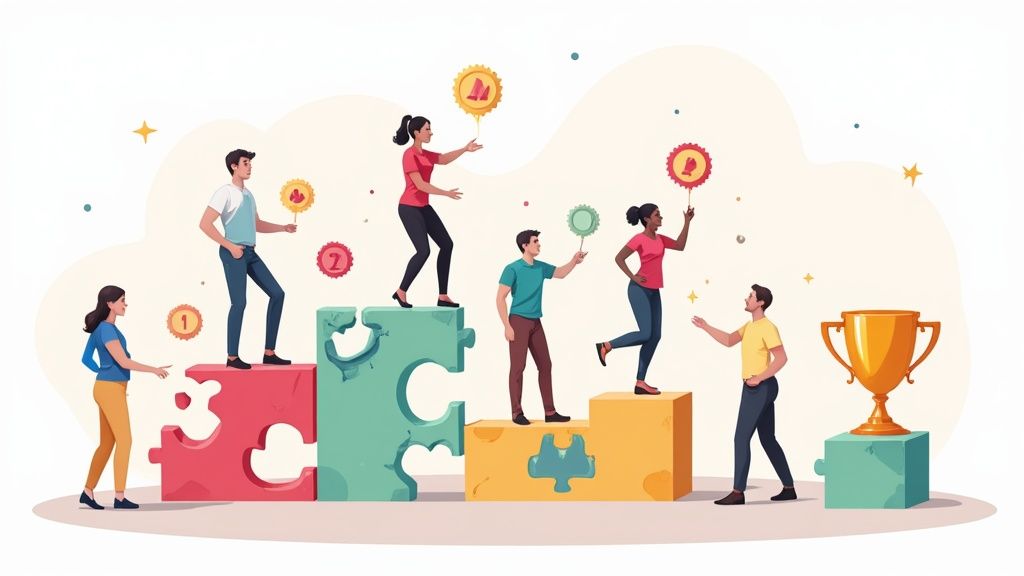
Think of community gamification as the secret ingredient that transforms a quiet online space into a buzzing, interactive hub. We’re not talking about building a full-blown video game. Instead, it’s about borrowing the elements that make games so addictive—like points, badges, and a little friendly competition—to get members excited about connecting, contributing, and feeling like they're part of something special.
What Is Community Gamification Anyway?

Let’s skip the jargon. Imagine your online community is a library. It’s full of great stuff, but most people just pop in, grab what they need, and slip out without a word. Quiet, right?
Now, picture that same library running a "Bookworm Challenge." Members earn points for every book review they write or get a "Top Contributor" badge for helping others find a hidden gem. All of a sudden, that library isn't just a quiet building anymore. It's a lively festival of shared ideas and connection.
That’s community gamification in a nutshell.
It's really just the art of using game-like mechanics in a non-game setting to encourage people to take specific actions. The goal isn't just to make things "fun" for fun's sake; it's a smart strategy for building genuine engagement and nudging members toward behaviors that make the whole community better.
To get a clearer picture, here’s a quick breakdown of what this looks like in practice.
Community Gamification At a Glance
| Concept | Primary Benefit | Common Mechanics |
|---|---|---|
| Applying Game Elements | Motivates desired actions | Points, Badges, Leaderboards |
| Progressive Engagement | Encourages deeper contribution | Quests, Levels, Missions |
| Social Recognition | Fosters a sense of belonging | Ranks, Trophies, Team Challenges |
Essentially, you're creating a system that acknowledges and rewards the effort your members put in, making them want to come back for more.
Why It Matters More Than Ever
In a world overflowing with digital noise, just getting someone's attention—and keeping it—is a massive win. It’s no longer enough to just create a space and hope people show up. You have to give them a real reason to stick around, participate, and invest their time.
Gamification works because it taps directly into core human drivers:
- Progress: Watching your points stack up or a progress bar fill gives you a satisfying feeling of moving forward.
- Achievement: Earning that rare badge for a tough task? That’s a powerful dopamine hit.
- Recognition: Seeing your name on the weekly leaderboard is great social proof and a public high-five.
- Connection: Teaming up for a group quest builds real camaraderie and a sense of shared purpose.
This isn’t just a passing fad; it's a proven strategy. The global gamification market exploded from $6.33 billion in 2019 to $18.64 billion in 2023 and is on track to hit nearly $30.7 billion by 2025. That kind of growth tells you one thing: this stuff works.
By rewarding actions—from answering a question to welcoming a new member—you create a self-sustaining cycle of positive reinforcement. Members feel valued, their contributions are recognized, and the entire community becomes more helpful and active.
To really nail this, you have to understand what makes groups tick. Diving into resources on community initiatives can give you a better grasp of why people join and stay. Armed with that knowledge, you can build a system that aligns with human nature, not against it. A great place to start is with a simple but effective points system, which you can learn all about in our guide to racking up points and driving positive behavior.
The Psychology Behind Why Gamification Works
Ever wonder why earning a simple, digital badge for answering a question online feels so good? Or why seeing your name climb a leaderboard sparks a competitive drive you didn't know you had? It’s not just about the points or prizes. It's psychology, plain and simple. Community gamification is so effective because it plugs directly into the core drivers that have motivated people for centuries.
When you boil it down, gamification is just a framework for making things more satisfying. It speaks to our natural human desires for progress, mastery, connection, and recognition. When you build this into your community, you’re not just creating a rewards program—you're engineering a better human experience. That’s what separates a buzzing, active community from a digital ghost town.
The Two Engines of Motivation
To really get why this stuff works, you have to understand the two forces that drive us: extrinsic and intrinsic motivation. A solid gamification strategy needs both, but the real art is getting one to lead to the other.
Extrinsic Motivation: This is the stuff that comes from the outside world. Think of it as the hook. It’s the tangible rewards like points, exclusive swag, discounts, or crypto tokens. These are the carrots that get someone to take that first step. A new member might complete their profile just to snag their first 100 points, for example.
Intrinsic Motivation: This is the deep, self-sustaining drive that comes from within. It’s the pure joy of solving a tough problem, the pride of becoming a recognized expert, or the simple satisfaction of helping someone else out. This is the long-term fuel that keeps people coming back, long after the novelty of the initial rewards has worn off.
The real goal of community gamification is to use extrinsic rewards to build a bridge toward deep-seated intrinsic motivation. A badge might get a member to write their first guide, but the feeling of being genuinely helpful is what will inspire them to write ten more.
Tapping Into Core Psychological Drivers
A well-designed gamification system doesn't just throw rewards around. It strategically targets specific psychological triggers that encourage people to stick around and contribute in meaningful ways.
1. The Need for Competence and Mastery We all have a deep-seated desire to feel capable and skilled. Gamification gives people a clear path to get there.
Imagine a new user dropping into a complex Web3 community. They're lost. An "Onboarding Quest" that breaks down the first few steps—like connecting a wallet or making a first post—gives them a structured way to learn the ropes. Each little task they complete delivers a small hit of satisfaction, building their confidence one step at a time. That feeling of "I get it now" is an incredibly powerful intrinsic reward.
2. The Drive for Autonomy While quests provide structure, great gamification also offers freedom. Giving members the ability to choose which challenges to tackle or which learning path to follow gives them a sense of control. This autonomy is key. It makes participation feel like a genuine choice rather than a chore, which keeps engagement from fizzling out. For instance, you could offer separate "Creator" and "Supporter" badge tracks so people can engage in ways that actually play to their strengths.
3. The Desire for Social Connection Let's face it, humans are social creatures. We want to belong, and we want to be recognized by our peers. Leaderboards, team-based challenges, and public shout-outs tap directly into this need. When a member's awesome contribution gets highlighted on a weekly "Top Helpers" list, it does more than just reward them—it cements their reputation within the group. This social validation creates a powerful feedback loop, encouraging more of the exact behaviors you want to see. In fact, one study found that adding social elements to gamification can boost user activity by over 60%. Turns out, we all try a little harder when we know people are watching.
How to Build Your Gamification Strategy
Jumping into community gamification without a solid plan is a recipe for disaster. It’s like trying to build a house without a blueprint—you might end up with something standing, but it’s definitely not going to be the dream home you imagined. A real strategy is what makes your points, badges, and quests work together toward a clear, meaningful goal.
Building one doesn't have to feel like rocket science. It really just boils down to a few practical steps that put your community's needs and your members' motivations front and center. Let's walk through the four key stages to get you from a rough idea to a fully functioning system.
Step 1: Define Your Community Win
Okay, before you even think about leaderboards or shiny badges, you have to answer one critical question: what does a "win" actually look like for your community? I'm not talking about game mechanics here. I mean your core business objective. Are you trying to get new members up to speed faster? Boost product adoption? Or maybe you want to spark more user-generated content.
Whatever it is, your "win" has to be specific and measurable. Fuzzy goals like "increase engagement" just won't cut it.
- Bad Goal: Get more people to be active.
- Good Goal: Increase the number of new members who complete their profile and make their first post within 48 hours by 25%.
Getting this North Star metric right is the most important part of the entire process. Every single decision you make from here on out will flow from this one objective.
Step 2: Identify Key Member Actions
Once you know your destination, it's time to map out the road. The next step is to pinpoint the specific, repeatable actions that will actually get you to that "win" condition. These are the exact behaviors you need to encourage, celebrate, and reward.
For example, if your big goal is to slash the number of support tickets, your key actions might be things like:
- Answering another member's question in the support channel.
- Marking a peer's response as the "correct answer."
- Writing a short, helpful guide on a common issue.
These actions have to be valuable, easy to spot, and directly connected to your main goal. Don't just reward activity for the sake of it—reward contributions that make the whole community better.
Step 3: Choose the Right Game Mechanics
Now we get to the fun part. With your goals and key actions locked in, you can finally start picking the game mechanics that will light a fire under your members. Think of these as the tools in your toolbox for nudging people in the right direction.
This whole flow is about turning an initial spark into genuine, long-term motivation.

You can see how an external trigger, like getting a badge (extrinsic motivation), can lead a member to feel a real sense of accomplishment and belonging (intrinsic motivation). That's the magic.
You need to match the mechanic to the action:
- For simple, repeatable tasks: Use Points for instant feedback. It's like a little pat on the back.
- For milestone achievements: Award Badges to recognize big contributions. These are your trophies.
- To foster friendly competition: Set up Leaderboards that reset weekly or monthly to keep things fresh.
- For structured onboarding: Create Quests to guide new members through their first essential steps.
As you build this out, remember that it should feel like a natural part of your community, not something bolted on. Weaving these mechanics into your broader effective member engagement strategies is what makes the experience feel cohesive and rewarding.
Step 4: Map the Member Journey
Your community isn't just one big group of identical people. It's a mix of curious newcomers, active contributors, and seasoned experts. A great gamification strategy needs to work for everyone, no matter where they are on their journey.
A well-designed member journey makes everyone feel like they can win. It gives newcomers easy first steps and offers veterans aspirational challenges that recognize their expertise and status.
This means you have to start small. Don’t hit a new member with a hundred different things to do. A simple "Welcome Quest" can work wonders. As they get more involved, they can unlock more advanced challenges and earn bigger rewards. This creates a progressive path that keeps people hooked for the long haul.
Start Small and Iterate
Finally, please resist the temptation to build a massive, perfect, all-encompassing system on day one. It's a trap. Your best move is to launch a small pilot program to test your ideas and see what actually works. It's a fantastic way to get real feedback before you commit to a full-scale rollout. For some ideas on how to set this up, check out our guide on creating a successful beta tester program.
This approach saves you a ton of time and makes sure your final system is built on what your members actually do, not just what you think they'll do.
If you want to move fast, a platform like Domino is a lifesaver. With proven templates and automated campaign workflows, you can get a polished pilot program up and running in minutes, not months. This frees you up to focus on the strategy instead of getting lost in the technical weeds.
Choosing the Right Tools for Your Community
Alright, you’ve got your strategy sketched out. Now it's time to get your hands dirty and pick the right tools for the job. Choosing your gamification mechanics is a bit like a chef picking their knives—you need the right one for the right cut. Each tool taps into a different psychological trigger to get your members moving.
The goal here isn't just to throw points and badges at everything. It’s about building a thoughtful toolkit that’s perfectly tuned to what you want to achieve with your community. Let's break down the most effective mechanics, from the classic building blocks to more dynamic elements that can really spark engagement.
The Foundational Trio: Points, Badges, and Leaderboards
These three are the bread and butter of most community gamification for a simple reason: they just work. They’re easy to understand and incredibly effective at establishing a baseline of engagement.
Points: Think of these as the currency of your community. They provide that quick, satisfying hit of positive feedback for small actions. When a member gets 10 points for a helpful comment or 50 for sharing a resource, it’s a digital high-five. It tells them, "Hey, we see you, and we appreciate what you're doing." This constant reinforcement is key to building good habits.
Badges: If points are the currency, badges are the trophies. They’re visual markers for major milestones and achievements. A "First Post" badge makes a newcomer feel welcome, while an "Answer Guru" badge signals real expertise. Badges turn abstract contributions into something tangible and create a clear progression path for members to follow.
Leaderboards: This is where you bring in a little friendly competition. Leaderboards tap into our natural desire for social status and recognition by showing everyone who the top contributors are. A quick pro-tip: to keep things fresh and avoid discouraging new members, use leaderboards that reset weekly or monthly. This gives everyone a fair shot at climbing to the top.
Beyond the Basics: Quests and Challenges
While the foundational trio is great for rewarding general participation, quests and challenges are what you pull out when you need to guide people toward specific, high-value actions.
Imagine a DeFi protocol with a slightly tricky onboarding flow. Instead of just hoping new users figure it out, they could launch an "Onboarding Quest." This quest would break the entire process into small, easy-to-digest steps:
- Connect Your Wallet: Bam, 50 points.
- Make Your First Swap: Nice! Here's 100 points and a "First Swap" badge.
- Deposit into a Liquidity Pool: Awesome, take 200 points and unlock the "Liquidity Provider" role in Discord.
Suddenly, what was a confusing chore becomes a guided, rewarding adventure. This is a game-changer for improving onboarding, driving adoption of a new feature, or teaching your community a new skill. Challenges, which are usually time-sensitive, create a sense of urgency and rally everyone around a shared objective, like a week-long "Bug Squashing" event.
Matching Gamification Mechanics to Community Goals
The real magic happens when you stop thinking about these tools individually and start strategically matching them to your goals. A mechanic that’s great for getting more content created might be totally wrong for improving new member retention.
Here’s a practical table to help you pick the right tool for the job.
Matching Gamification Mechanics to Community Goals
| Community Goal | Best-Fit Mechanic | Example Use Case |
|---|---|---|
| Improve New Member Onboarding | Quests | A step-by-step "Welcome Quest" that walks users through setting up their profile, making a first post, and joining a key channel. |
| Increase Content Creation | Points and Badges | Awarding points for every post and giving a special "Creator" badge after someone writes five high-quality articles. |
| Boost Peer-to-Peer Support | Leaderboards | A weekly "Top Helpers" leaderboard that celebrates members who answer the most questions, with the winner getting a public shout-out. |
| Drive Product Adoption | Challenges | A month-long challenge to see who can use a new feature in the most creative way, with prizes for the best ideas. |
The most powerful community gamification systems don’t just reward activity; they guide members toward actions that create real value for everyone. Your toolkit should be a direct reflection of your community’s North Star metric.
Ultimately, you want to build a system that feels both rewarding and natural. For Web3 communities, this often means bridging off-chain social actions with on-chain results. A well-designed system might use quests to encourage Discord activity, which then leads members to stake a token or mint an NFT. For a deeper dive into making that connection, check out our guide on creating a token board app that rewards community members for their contributions.
Platforms like Domino make this whole process way simpler by providing over 130 customizable quest templates right out of the box. Instead of building everything from scratch, you can launch proven campaigns for specific goals like social media engagement or on-chain actions in minutes. That lets you focus on the creative strategy instead of getting bogged down in the technical setup.
How to Measure Success and Avoid Common Pitfalls
Alright, so you’ve launched your community gamification program. High five! But that was the easy part. The real work starts now: figuring out if your shiny new system is actually doing its job or just making noise.
Think of it like tending a garden. You don't just throw some seeds in the ground and hope for the best. You have to water, weed, and check on things constantly to make sure everything is growing. The same goes for your community. You need to monitor, adjust, and give your members what they need to thrive.
This means looking beyond the obvious "vanity metrics." Sure, seeing a huge number of points awarded might feel good, but does it actually mean people are more engaged? Or are they just gaming the system? We need to focus on what truly reflects the health and vibrancy of your community.
Key Metrics That Actually Matter
To get a real sense of your program's impact, you have to track the right stuff. Forget the surface-level stats and zero in on the numbers that show real, meaningful changes in how people behave. These are the true signals that your strategy is working.
Active User Rate: This is your community's pulse. What percentage of your members are completing at least one rewarded action each week or month? If this number is climbing, you know your system is encouraging people to come back again and again.
Content Contribution Ratio: Look at the number of answers, guides, or helpful resources being created versus the number of questions being asked. A rising ratio is a fantastic sign that your incentives are successfully motivating people to share what they know and help their peers.
New Member Retention: How many newcomers are still around after their first week? A great way to measure this is by tracking how many complete a "Welcome Quest" or earn their first badge. Getting people hooked early is a huge predictor of whether they'll stick around for the long haul.
This is exactly what platforms like Domino are built for. With simple, built-in dashboards, you can keep an eye on these vital signs in real-time. No data science degree required. It lets you see what’s landing and what’s not, so you can make smart adjustments on the fly.
Common Pitfalls and How to Sidestep Them
Even the best-laid plans can go sideways. Most gamification programs that fail stumble into one of a few common traps. Knowing what they are ahead of time is your best defense.
1. Creating a System That Feels Like a Chore Nothing kills fun faster than turning it into an obligation. If your gamification feels like a boring to-do list that members have to complete, they'll check out in a heartbeat. The whole point is to make participation feel like a fun discovery, not extra homework.
How to fix it: Tie rewards to actions that are already genuinely satisfying. Instead of just giving points for "logging in daily," reward a member when someone they helped replies with a "thank you." This connects the reward to a real, positive human interaction.
2. Having Rules That Are Too Confusing If people can't figure out how the system works, they're not going to bother trying. Complexity is the ultimate enemy of engagement. A new member should be able to grasp the basics in less than a minute. Keep it simple.
3. Offering Rewards Nobody Wants What's the point of climbing a leaderboard if you don't care about who's on it? Or earning a badge that doesn't mean anything? The rewards have to feel valuable to your community. Sometimes, a special role in Discord or a shout-out from the founders is worth more than any gift card.
Launch Your First Gamified Campaign This Week

All this theory is great, but the best way to really get the power of community gamification is to see it in action. And the good news is, you don't need a six-month roadmap to get something off the ground. You can go from a simple idea to a live, engaging campaign in just a few days.
Let’s walk through a simple but incredibly effective scenario: a “Welcome Quest” for new members. A confusing first week is one of the biggest reasons people bounce from a new community. A quest turns that critical onboarding period into a guided, rewarding adventure instead of a confusing mess.
Building Your Welcome Quest
The goal here is simple: give newcomers a clear path to their first "aha!" moment. You'll set up some automated rewards for a few key actions that get them invested right away.
Here’s what that might look like:
- Introduce Yourself: Ask them to drop a post in the introductions channel. Reward: 50 Points.
- Complete Your Profile: Prompt them to add a profile picture and a short bio. Reward: 75 Points.
- Join the Conversation: Nudge them to react to three different posts. Reward: 100 Points + "Icebreaker" Badge.
This simple three-step journey immediately makes new members feel accomplished and connected. They’ve learned the layout, met a few people, and earned their first rewards. You’ve successfully turned a passive lurker into an active participant.
The most impactful community gamification starts small. It focuses on solving a single, high-value problem—like new member churn—before you try to boil the ocean. A successful Welcome Quest gives you the momentum and the data you need to build bigger things with confidence.
Go from Idea to Launch in Minutes
Building this kind of campaign from scratch can feel pretty daunting. This is where a no-code platform like Domino becomes your secret weapon. Instead of trying to wrangle code or clunky spreadsheets, you can grab a proven template and have your Welcome Quest designed and ready to launch in minutes.
With Domino, the whole process is automated, from verifying that someone completed a task to dishing out the rewards. It frees you up to focus on creating an amazing community experience, not managing a bunch of manual busywork.
Ready to see just how easy it is to unlock your community’s real potential? Explore Domino’s templates and get your first gamified campaign live this week.
Got Questions About Gamification? We’ve Got Answers.
Jumping into community gamification can bring up a few common questions. Let's break down some of the big ones to get you started on the right foot.
Wait, Isn't This Just a Rewards Program?
It's an easy mistake to make, but there’s a crucial difference. A rewards program is purely a transaction. Do this, get that. Think of a simple "buy 10 coffees, get one free" punch card. The focus is entirely on the prize at the end.
Gamification is different. It’s all about making the process of participating in your community more engaging and fun. We’re talking about using things like leaderboards, progress bars, and quests to create a sense of achievement and friendly competition. It’s less about the carrot at the end of the stick and more about enjoying the journey of contributing and climbing the ranks.
What's This Going to Cost Me?
Honestly, it can range from almost free to a serious investment. You could totally MacGyver a system with spreadsheets and manual tracking, but be prepared for a ton of hands-on work. It's cheap upfront, but your time is valuable.
Then you have dedicated platforms that automate the entire process. These tools do the heavy lifting—tracking contributions, updating leaderboards, and even handling reward distribution. It's an investment, for sure, but it saves you countless hours and gives your members a much slicker, more professional experience.
Could This Come Across as Manipulative?
This is a super important point, and the answer is yes, it absolutely can… if it’s done poorly. When a gamification system feels like a glorified to-do list designed only to squeeze activity out of members, people see right through it. And they won’t like it.
The secret to doing it right is making sure the system provides real value to the member. It should feel like a fun layer on top of their community experience, not a set of arbitrary hoops they have to jump through for a reward.
Great gamification makes people feel recognized, helps them build a reputation, and deepens their sense of belonging. When you nail it, you’re not manipulating anyone; you’re just making your community a more fun, active, and rewarding place to be.
Ready to roll out a gamification strategy that your community will actually love? With Domino, you can launch proven, automated campaigns in just a few minutes using our library of over 130 templates. Start building your engaged community today.