Whitelabel Crypto Quests: Scale Web3 Growth with Ready-to-Launch Campaigns
Ever wonder how some Web3 projects spin up incredible community campaigns so fast?There's a good chance they're not building everything from scratch. They're likely using white-label crypto quests—a ready-made platform that lets them slap their brand on it and launch in a fraction of the time.
Think of it as the smart way to roll out customized, gamified campaigns without the headache of building a reward system from the ground up. You can start driving real user actions, like social shares or on-chain activity, almost immediately.
What Are Whitelabel Crypto Quests Anyway?
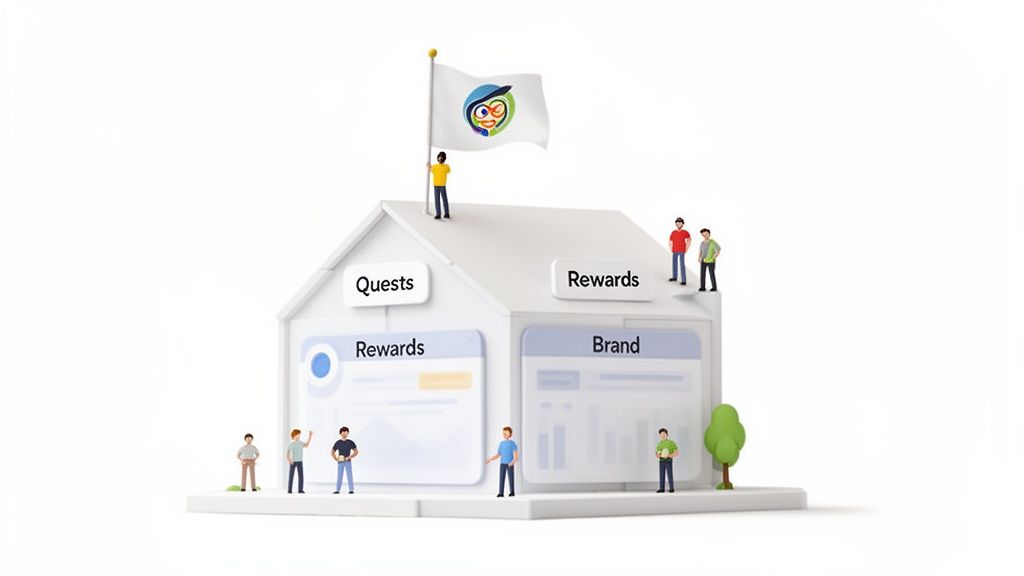
Let's break this down with a simple analogy. Imagine you want to build a house. You could spend the next year sourcing every single brick, nail, and wire yourself to build it from the foundation up. That’s the custom-build route.
Or, you could start with a top-tier, prefabricated design that’s already built and just needs your personal touch—the paint, the furniture, the landscaping. You get to move in way, way sooner.
White-label crypto quests are that second option. They give you a powerful, pre-built "community engagement engine" that you can make your own. You get to skip the insane time and cost of developing a questing system from scratch.
The Core Idea Behind Whitelabeling
Instead of burying your developers in code to track user actions, verify that tasks are done, and then figure out how to distribute rewards, you’re using a platform that’s already perfected all of that. All you have to do is decide what quests you want your community to complete.
These tools are built for marketers and community managers, not engineers. This frees you up to focus on what really matters: coming up with creative growth campaigns.
A whitelabel solution gives you the speed and reliability of a system that's already been battle-tested. It lets you launch complex campaigns without pulling your engineers off the core product. It's all about using proven infrastructure to grow your community faster.
This approach is becoming a go-to for community-led growth, cutting deployment times by up to 2X compared to a custom build. We're not talking small numbers here; these platforms have already powered over 25 million completed quests around the world.
To see just how much of a difference this can make, you can find more details on why teams choose these solutions from experts at Antier Solutions.
Whitelabel vs Custom Built Quest Platforms
So, when does a whitelabel solution make sense over a fully custom build? Here’s a quick breakdown of what you're getting with each approach.
| Feature | Whitelabel Solution | Custom Built Solution |
|---|---|---|
| Speed to Market | Extremely fast (hours to days) | Very slow (months to a year) |
| Upfront Cost | Low (usually a subscription fee) | Very high (developer salaries, infrastructure) |
| Technical Expertise | Minimal; designed for marketers | Requires a dedicated engineering team |
| Maintenance | Handled by the provider | Your team's responsibility (bugs, updates) |
| Customization | Good (branding, quest design) | Unlimited (but you have to build it) |
| Security | Audited and tested across many clients | Depends entirely on your team's expertise |
While building your own platform offers total control, a whitelabel solution gives you 90% of what you need right out of the box, letting you focus on execution rather than development.
Practical Benefits for Web3 Teams
For any project in the space—whether you're a DeFi protocol, a P2E game, or an NFT collection—the perks are pretty obvious from day one. To get a feel for the kind of communities that benefit most, check out these examples of websites specializing in crypto.
Here’s what your team gets by using a whitelabel solution:
- Launch Faster: Go from a campaign idea to having it live in a few hours or days, not months. This is huge in a market that moves as fast as crypto.
- Slash Your Costs: You get to dodge the massive upfront cost of hiring developers and the ongoing expense of maintaining custom software.
- Focus on What Matters: Your team can pour its energy into crafting awesome campaigns and actually talking to your community, not managing a tech product.
- Sleep Better at Night: You’re using a platform that's been tested and hardened across thousands of other campaigns, so you know it's stable and secure.
What’s Under the Hood of a Great Quest Platform?
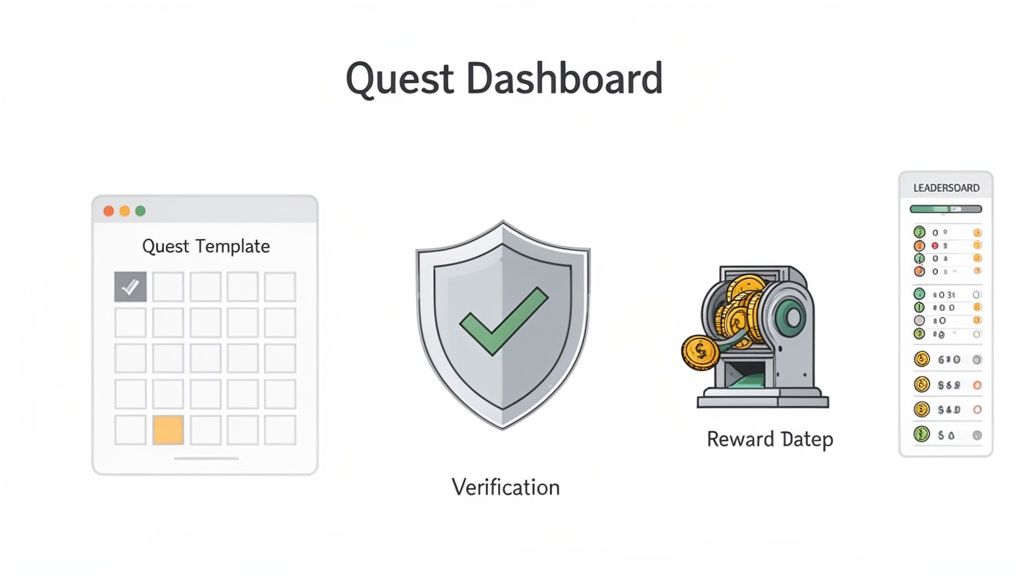
A top-notch white-label crypto quest platform is way more than just a glorified to-do list for your community. Think of it as a powerful engine built to put your engagement on autopilot and hit specific growth targets. Once you understand the key pieces working together, you’ll see why these tools are such a game-changer.
The heart of the whole operation is the quest designer. This is your command center for spinning up new campaigns. Instead of coding everything from the ground up, you get a library of pre-built templates for common goals, like getting more action on social media, sparking on-chain activity, or getting your community to create awesome content.
This means you can get a campaign out the door in minutes, not weeks. You can lay out the tasks, decide on the rewards, and set a schedule, all without bugging a developer. A good quest designer makes the whole process feel as simple as putting together a slideshow.
The Brains of the Operation: Verification and Rewards
Once your quests are out in the wild, the platform’s verification engine jumps into action. This is the real magic—it’s what confirms a user actually did what they were supposed to do. It works flawlessly for both off-chain social tasks and on-chain crypto transactions, making sure every action is legit before any rewards go out.
- Off-Chain Verification: It hooks into platforms like Twitter, Discord, and Telegram through APIs. This lets it automatically check for things like retweets, server joins, or messages. Some platforms even use AI to scan user-submitted content like memes or articles.
- On-Chain Verification: This part talks directly to the blockchain. It can confirm if a user swapped a token, staked an NFT, or interacted with a specific smart contract. It’s a completely trustless and automated process.
Right after a task is verified, the automated reward distribution system takes over. This piece of the puzzle handles sending rewards—whether it's your project's token, an NFT, or a special Discord role—straight to the user's wallet. It completely eliminates the massive headache of manually sending out thousands of individual rewards.
A solid platform handles the entire cycle, from creating a task to paying out the reward. This frees your team up to focus on the big picture, not get stuck doing manual busywork.
The User Experience: Dashboard and Gamification
Finally, any great platform has an intuitive user dashboard. This is the front door for your community, where they can find new quests, see how they’re doing, and check out the rewards they’ve racked up. It needs to be clean, fun to use, and dead simple to navigate.
The dashboard is also where all the fun and games happen. Features like leaderboards are absolutely essential for sparking some friendly competition and keeping people coming back for more. Users can see their rank, which pushes them to complete more quests to climb to the top. To see exactly how this can supercharge your community, check out our guide on building a Web3 whitelabel leaderboard. It’s what turns a simple checklist into a genuinely fun experience, creating a much more energetic and loyal community.
2. Why Your Web3 Project Needs Crypto Quests
Let's be real. No matter how brilliant your tech is, every Web3 project boils down to three make-or-break goals: get new users, keep your community engaged, and actually grow the thing. Crypto quests are designed to hit all three, turning passive lurkers into active players.
Think about it. A new person lands in your Discord, maybe looks around for a minute, and then... crickets. What's their next step? Quests give them one. They offer a clear, rewarding path for someone to actually learn your protocol, mess around with your dApp, and become a true believer in what you're building.
This isn't just about tossing rewards into the void. It’s a smart way to steer user behavior and hit your most important growth targets.
Drive Real User Acquisition
Old-school marketing funnels feel clunky and out of place in Web3. Crypto quests are the native solution. Instead of just crossing your fingers and hoping for engagement, you can create incentives around the exact actions that move the needle.
An NFT project, for instance, could create a quest that rewards users for making a trade on a secondary marketplace, which directly pumps up trading volume. A DeFi protocol might set up tasks that walk users through staking or adding liquidity for the first time, boosting Total Value Locked (TVL) while teaching them how the platform works.
That's the magic of whitelabel crypto quests—they turn the whole acquisition process into a game. You don't just get more users; you get higher-quality users who are genuinely interested from the get-go.
Build a Community That Actually Cares
A silent Discord is a project's worst nightmare. Quests are the perfect way to get the conversation started and stir up some friendly competition. When you reward people for everything from sharing content on Twitter to casting a vote in governance, you create a buzzing hub where everyone feels like they have a stake in the game.
Quests flip the script on your community, turning them from a passive audience into an active, contributing part of your project. It creates a powerful feedback loop: they participate, they get rewarded, and that loyalty snowballs.
This simple diagram breaks down how quests fuel your project's growth engine.
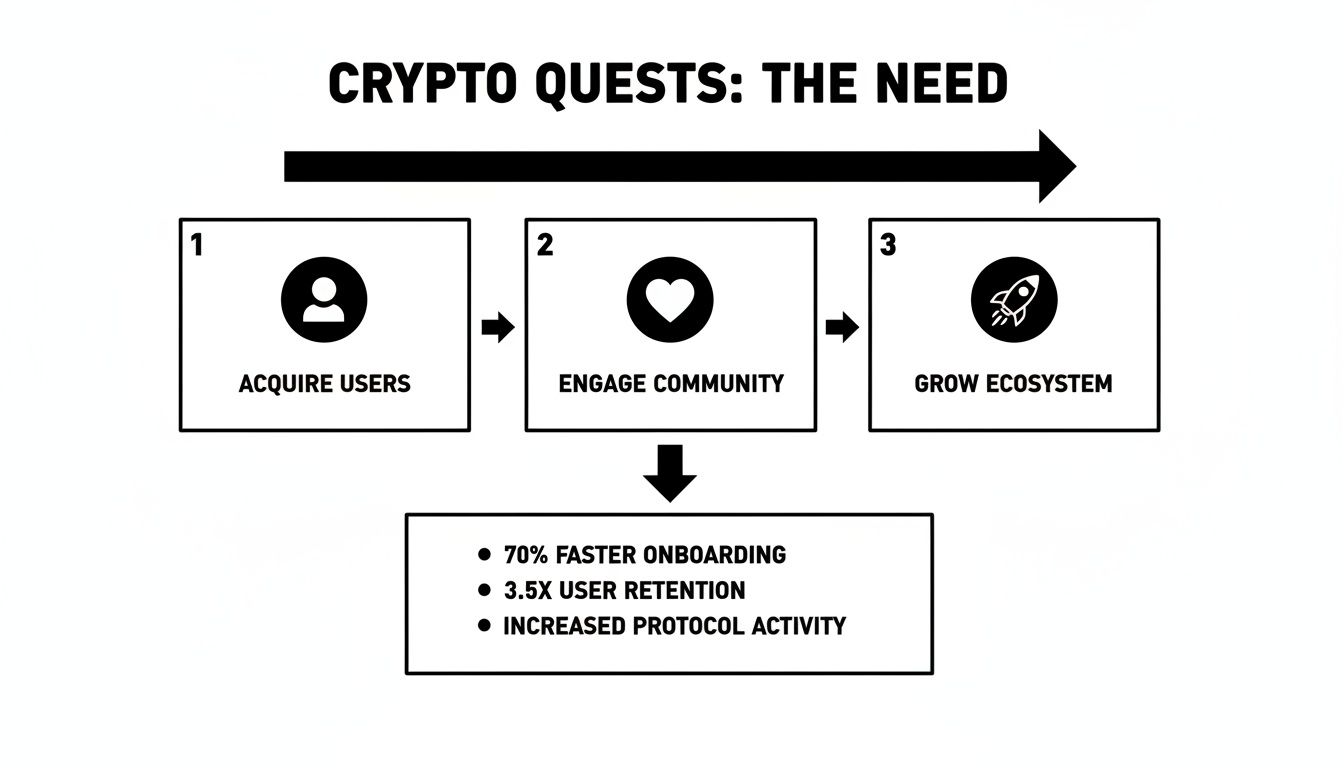
As you can see, quests aren't just one-off tasks. They're part of a connected strategy to bring people in, get them hooked, and scale your entire ecosystem.
Scale Your Growth, Not Your Engineering Bill
Let’s face it: building a questing system from scratch is a massive resource sink. That’s precious time and money your dev team could be spending on your core product. This is where the "whitelabel" part is a total game-changer. You get a secure, feature-packed platform that’s already been battle-tested, and you can slap your own brand on it and go live in minutes.
The best platforms out there have powered over 13,000 campaigns, using a mix of automated tools and API integrations to verify everything from a simple tweet to complex on-chain actions. This approach is a proven growth lever, and you can dive deeper into how it all works in our guide to crypto gamification strategies.
Ultimately, it lets you scale your marketing and community efforts without bloating your engineering budget.
How On-Chain and Off-Chain Quests Actually Get Verified
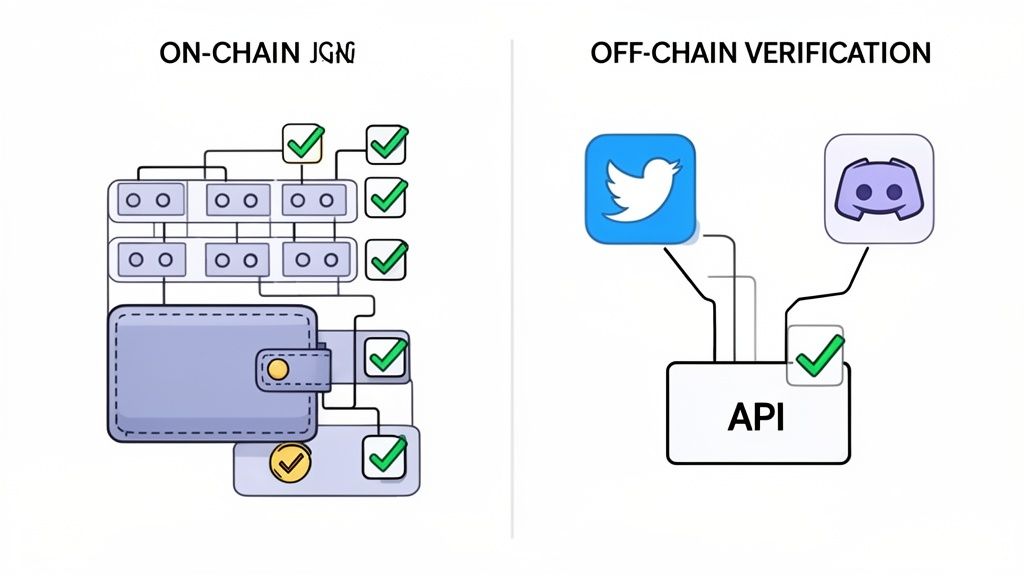
This is where the real magic happens. So, how does a questing platform know someone actually retweeted your announcement or staked your token? It all comes down to a slick, automated verification engine working behind the scenes. Its only job is to make sure every action is legit before any rewards go out.
Think of this engine as having two different toolkits: one for the social media world and another for the decentralized world of the blockchain. Both are critical for running a successful whitelabel crypto quests campaign. This automated system is precisely what gets rid of the tedious, manual checking that used to eat up a community manager's entire day.
Checking Off-Chain Social Tasks
When a task happens off the blockchain—like on Twitter or Discord—verification is all about talking directly to those platforms. This is done using APIs (Application Programming Interfaces), which are basically secure messengers that let different apps chat with each other.
Let's say you create a quest asking users to follow your Twitter account. The quest platform uses the Twitter API to ping them and ask, "Hey, did this user just follow us?" Twitter's system sends back a simple "yes" or "no." It's a quick, reliable, and completely hands-off check.
- Social Actions: For things like retweets, likes, or joining a Discord server, the platform makes a direct API call to get confirmation that the right user completed the action.
- Content Submissions: For more creative quests, like asking users to submit a meme or write a thread, better platforms use AI-powered tools. These tools can scan submissions for keywords, check if an image is relevant, or even gauge sentiment to make sure everything lines up with your campaign goals.
This system means every social quest gets checked instantly. It’s a smooth ride for your users and gives you data you can actually trust.
Validating On-Chain Wallet Actions
Verifying what happens on-chain is a completely different ballgame. It takes advantage of the blockchain's transparent nature. Instead of asking a third-party company for permission via an API, the quest platform reads public data straight from the blockchain ledger itself.
On-chain verification is trustless by design. The platform simply queries the blockchain—a public, unchangeable record—to confirm if a specific transaction or state change occurred. There's no need to trust an intermediary.
For example, if a quest asks a user to stake 100 of your project's tokens, the verification engine scans the blockchain. It looks to see if the user's connected wallet address really did interact with your staking smart contract and lock up the right amount. This same process works beautifully for all sorts of on-chain tasks, from holding a specific NFT to swapping tokens on a DEX or casting a vote in a DAO proposal.
Designing Quests Your Community Will Actually Love
Having a great platform is one thing, but it's only half the battle. If your quests feel like a chore, you'll lose people, no matter how good the rewards are. The real goal is to create campaigns that are genuinely fun—not just another checklist to grind through. A great place to start is by wrapping everything in a compelling story.
Forget the boring "Click this, follow that." Think bigger. Frame your quests as part of a grand adventure. Maybe your community is on a mission to uncover a secret feature, or perhaps they're all banding together to fight off a common enemy (like FUD!). This narrative spin turns a simple to-do list into a shared experience that people actually want to be a part of.
Balancing Effort and Reward
The heart of any good quest is striking that perfect balance between how hard a task is and how valuable the reward feels. If a quest is a huge pain for a tiny prize, people will just skip it. On the other hand, if you offer a massive reward for a single click, you're just inviting bots to flood your community.
Here’s a simple way to think about it:
- Low-Effort Quests: Think simple social follows or likes. These should come with small, quick rewards like XP or a starter badge.
- Medium-Effort Quests: This is for things that require a bit more commitment, like joining your Discord and actually chatting. The rewards should be a step up—maybe a small token drop or a special community role. We actually did a deep dive on how to nail this in our guide to Discord engagement.
- High-Effort Quests: These are the big ones. On-chain actions like staking, or creative tasks like making fan art, are incredibly valuable to your project. The rewards need to match, so think exclusive NFTs or a hefty airdrop.
Creating a Frictionless User Experience
Finally, you have to make the whole process smooth as butter. Your interface needs to be clean, dead simple to navigate, and work perfectly on a phone. Users should know exactly what to do, how to do it, and what they’ll get for their time, without any guesswork.
The best quest designs feel effortless. They guide the user from one task to the next without confusion, making participation feel like a game rather than a job.
It's no secret that many crypto quests borrow heavily from the world of gaming to keep people hooked. If you really want to design captivating experiences, it pays to understand the principles of online multiplayer games. By creating a journey that’s seamless, engaging, and fairly rewarded, you build a loyal community that's excited to show up day after day.
Common Mistakes to Avoid With Your First Quest Campaign
Launching your first quest campaign is a huge step, but I've seen a few common slip-ups trip up even the most promising projects. Let's walk through them so you can sidestep these issues and build a genuinely engaged community, not just a list of temporary reward hunters.
One of the biggest traps is getting the rewards wrong. If the prize is completely out of whack with the effort required, you're asking for trouble. Offering a massive airdrop for a simple Twitter follow is like putting out a welcome mat for bots. Sure, you'll see a huge spike in follower numbers, but 90% of them will be low-quality accounts that vanish the moment the campaign is over. You'll be left with a ton of noise and very few real people.
Creating Overly Complex Quests
Another classic mistake? Making the quests way too complicated. If a user needs to jump through twelve different hoops, connect three wallets, and write an essay to earn a tiny reward, they’re just going to bail. User friction is the ultimate campaign killer.
The best whitelabel crypto quests feel easy and almost guide the user by the hand. If someone has to pop into your Discord to ask how to do the first step, you’ve already lost. Simplicity wins, every time.
Keep your instructions crystal clear. Make your tasks straightforward. Each quest should feel like an easy next step, not a brick wall, pulling users deeper into what you're building.
Forgetting to Actually Promote Your Campaign
Finally, you can't just build it and hope for the best. It sounds obvious, but you'd be surprised how many projects design an amazing campaign and then completely drop the ball on telling people about it. A single post in your Discord isn't a launch strategy.
You need to shout it from the rooftops with a real multi-channel plan:
- Announce it everywhere: Hit up Twitter, Telegram, your blog, and any other channel where your community actually hangs out.
- Team up with others: Partner with influencers or other projects in your niche to get the word out to their audiences.
- Make it interesting: Create short videos or engaging threads that show people how the quests work and what kind of cool rewards are up for grabs.
Without a solid promotional push, even the most brilliantly designed quest is just going to fizzle out. Nail these basics, and you'll be well on your way to a campaign that delivers real, lasting growth.
Got Questions About Crypto Quests? We've Got Answers.
Jumping into the world of white-label crypto quests can feel like a big step, so it's natural to have a few questions. We've rounded up some of the most common ones we hear from Web3 teams to give you the straight scoop.
How Much Technical Skill Do I Actually Need?
Honestly? Almost none. Modern no-code questing platforms are built for marketers and community managers, not engineers. You can put together and run entire campaigns using a simple drag-and-drop interface, all without touching a single line of code.
Think of it this way: the platform is doing all the heavy lifting for you. It handles the complicated stuff like smart contract calls and API connections behind the scenes, so you can just focus on dreaming up cool campaigns and growing your project.
Can White-Label Quests Really Stop Bots and Sybil Attacks?
They can make a huge difference, yes. A solid platform will have several anti-bot tools built right in. While no system is ever going to be 100% perfect, these features are incredibly effective at weeding out fake accounts and low-effort spam.
You'll typically see a few layers of defense:
- AI-Powered Review: Smart tech that automatically flags junk submissions and spammy content.
- On-Chain Hurdles: Making users perform actions that cost a little gas. This small cost is a massive deterrent for bots trying to scale.
- Social Account Vetting: Requiring participants to connect established social media profiles, not burner accounts created five minutes ago.
This multi-pronged strategy makes sure the people joining your quests are real, potential community members—not just scripts farming for rewards.
A well-designed white-label platform makes it too expensive and difficult for bots to even bother. By mixing on-chain costs with smart off-chain checks, you create an environment where genuine users always win.
What Are the Best Rewards to Offer for Quests?
The best rewards are a smart mix of things that offer real, tangible value while also tying back to your project’s goals. It’s about more than just tossing tokens at people; it’s about giving them something that fosters genuine loyalty.
Try mixing and matching from this list:
- Project Tokens: This is the most direct incentive. It literally gives people a piece of the action and a stake in your success.
- Exclusive NFTs: Who doesn't love a unique digital collectible? These can signal a user's status in the community or unlock special perks down the road.
- Community Access: Think entry into a token-gated Discord channel or an invitation to a private AMA with the founders.
- Leaderboard Glory: Never underestimate the power of public recognition. Awarding points for a leaderboard gives top performers some serious bragging rights.
The secret sauce is balancing the reward with the effort. A simple social follow shouldn't get the same prize as a complex on-chain task. Getting that balance right is what drives people to participate.
How Can I Tell if My Quest Campaign Is Actually Working?
You measure success by looking at the goals you set from the very beginning. Any good white-label crypto quests platform will come with an analytics dashboard that lets you see exactly how you're performing on the metrics that count.
Keep a close eye on a few key areas:
- User Acquisition: How many new wallets connected? How many new followers did you get?
- Community Growth: Did your active user count in Discord or Telegram go up?
- On-Chain Activity: Are more people making transactions, swapping tokens, or adding to your TVL?
- Social Engagement: Are you seeing more likes, retweets, and general chatter about your project?
These data points paint a clear picture of your campaign's impact and show you exactly what kind of return you're getting on your investment.
Ready to turn your community into a powerful growth engine without all the technical headaches? With Domino, you can design and launch engaging crypto quests in minutes, not months. Start building your campaign today.