Build a Web3 Whitelabel Leaderboard That Wins
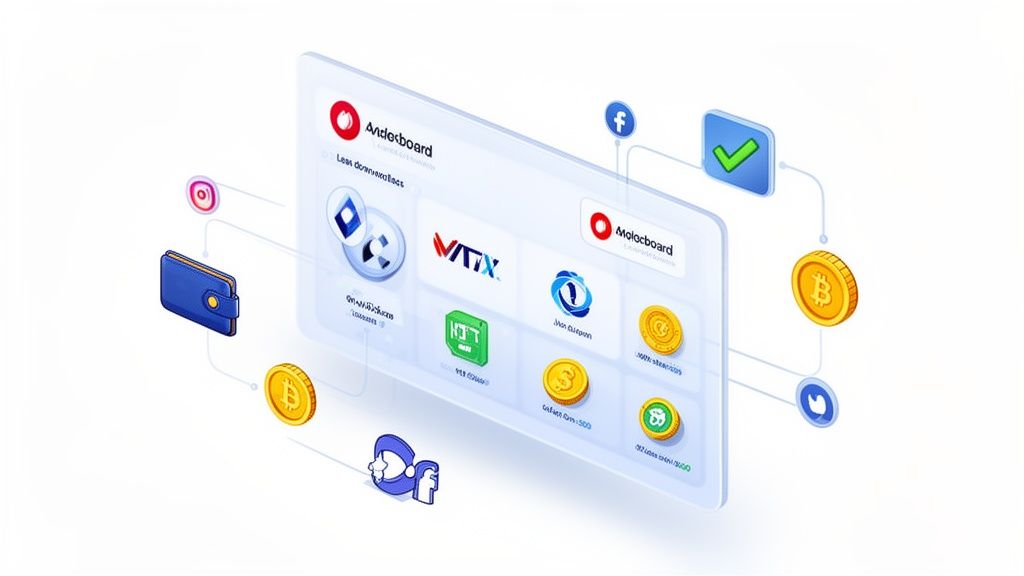
Hopping on a generic quest platform is a decent first step, but a branded web3 whitelabel leaderboard is where you actually start building a community. This isn't just a minor upgrade; it's a huge leap from borrowing a platform to owning your user experience.
You’re turning one-off participants into die-hard fans and making your leaderboard a core part of your brand, not just another marketing channel. Think of it as the difference between renting a booth at a crowded convention versus building your own flagship store.
Why Your Project Needs Its Own Leaderboard
Look, using a shared questing platform like Zealy is a super common starting point for Web3 projects. It’s quick and easy. But that convenience comes with a major catch: your brand gets completely lost in the noise. Every quest, every point, every single interaction happens on their turf, pushing their brand just as much as yours.
Moving to a white-label solution is a sign that you're taking your community seriously. It’s about creating a seamless, branded home where everything—from the logo down to the button colors—screams your project. That control over the user experience builds a ton of trust and shows your community you're in it for the long haul.
From Borrowed Platform to Branded Experience
When you own the leaderboard, you own the data. That’s a game-changer. Instead of getting spoon-fed limited analytics from a shared platform, you get raw, direct insights into how your users behave.
You can finally see which quests are actually working, who your true power users are, and where people are dropping off. This kind of first-party data is gold for tweaking your strategy and figuring out what really makes your audience tick.
Here’s a quick rundown of why making the switch is a no-brainer:
- Real Brand Recognition: Your logo, your colors, your voice. The whole journey feels like you.
- Stronger User Trust: A polished, custom platform just feels more legit and secure, which gets people to participate more deeply.
- You Own Your Data: Stop guessing. Make smart, data-backed decisions to boost engagement and keep people coming back.
- Total Customization: You can tailor everything to fit your project’s goals, from unique quest types to specific reward mechanics.
This screenshot gives you a feel for how a clean, branded interface can pull everything together into a single, cohesive experience.
By weaving the leaderboard right into your ecosystem, you kickstart a powerful flywheel that just keeps pulling in more community growth.
The Strategic Value of a Dedicated Leaderboard
To get a sense of how powerful this is, just look at how successful fantasy sports leaderboards work. They create an addictive, competitive loop that has users checking in daily. A web3 whitelabel leaderboard brings that same psychological drive to your project, turning passive lurkers into active players.
The numbers don't lie. The global Web3 market was valued at USD 6.63 billion in 2024 and is expected to absolutely explode to USD 177.58 billion by 2033. That’s a wild 44.1% CAGR. This growth means you need tools that make you stand out in a seriously crowded space. For a deeper dive into the data, you can check out the full market analysis.
To put it into perspective, here's how the two approaches stack up.
Generic Platform vs Whitelabel Leaderboard
| Feature | Generic Quest Platform (e.g., Zealy) | Web3 Whitelabel Leaderboard |
|---|---|---|
| Brand Identity | Diluted; shared with the platform's brand. | Fully customized to your brand, creating a seamless user experience. |
| User Data | Limited access to aggregated, third-party data. | Full ownership of first-party data for deep user insights. |
| Community Trust | Perceived as a temporary marketing campaign. | Seen as a long-term investment, building legitimacy and trust. |
| Customization | Restricted to pre-set quest formats and UI. | Complete freedom to design unique quests, rewards, and UI/UX. |
| Strategic Asset | A rented marketing channel. | A core, owned brand asset that drives long-term value. |
The choice is pretty clear if you're serious about building a lasting community.
A whitelabel leaderboard isn’t just a cosmetic upgrade; it's a strategic investment in your community’s infrastructure. It provides the foundation for sustainable growth by aligning user incentives directly with your project's objectives.
When you run your own leaderboard, you're not just tracking points—you're crafting a story of contribution, status, and recognition. Understanding the psychology behind this is crucial, and you can learn more about Web3 gamification strategies in our detailed guide.
At the end of the day, owning your leaderboard means owning the relationship with your community. Period.
Mapping Out Your Leaderboard Architecture
Getting your web3 whitelabel leaderboard architecture right from the jump is a game-changer. This isn't just about throwing some tech together; it's about building the central nervous system for your entire community engagement strategy. The goal is to create a setup that pulls in both on-chain and off-chain data so seamlessly that you never have to think about it.
When it works, it's magic. A user completes an action—whether it’s a simple retweet or a more complex on-chain transaction—and the data flows instantly. It gets captured, verified, and displayed as points on the leaderboard without any lag. That immediate feedback loop is what gets people hooked and keeps them coming back for more.
This is all about moving from a generic, borrowed platform to a true, branded community asset.
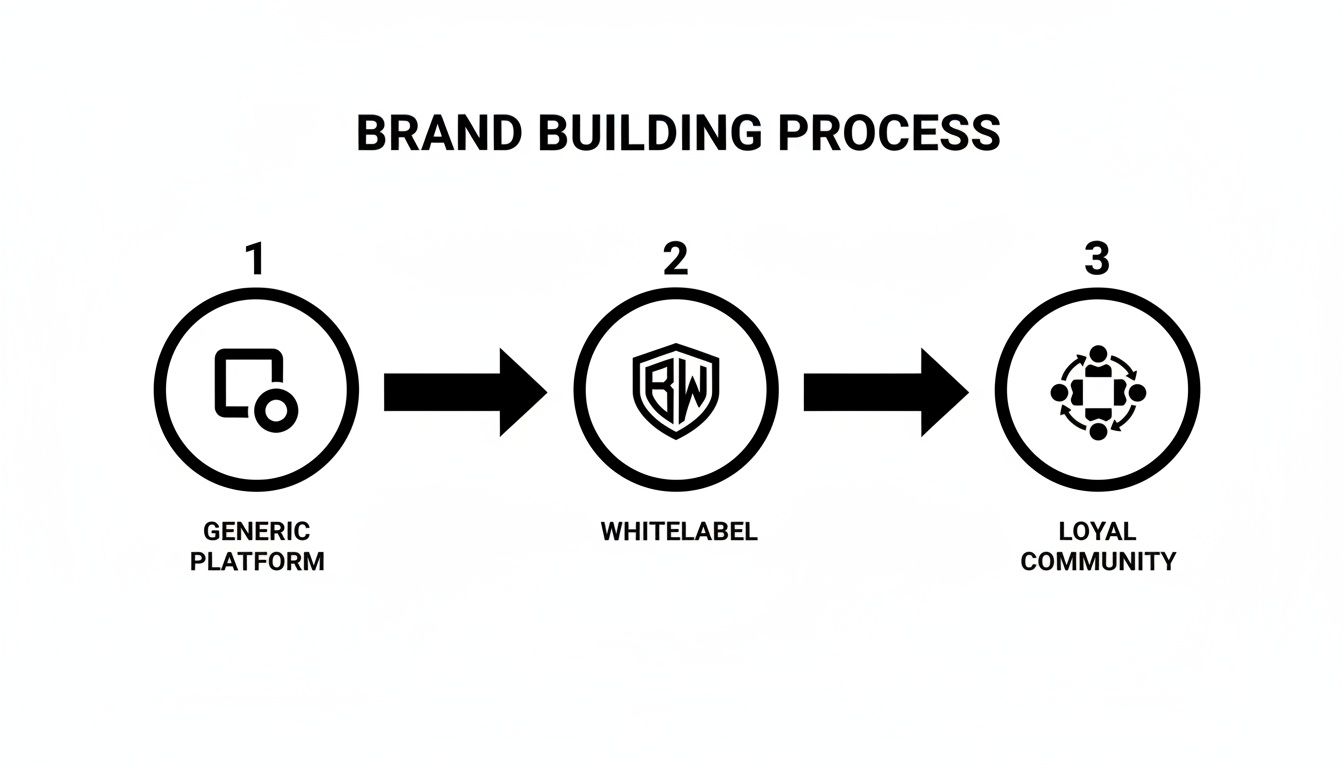
A whitelabel solution is the bridge that gets you there, turning a temporary campaign into a long-term, loyal community hub.
Designing Your Core Data Flow
At its heart, your leaderboard is just a data processing engine. It needs three core pieces working together perfectly: data ingestion, verification, and presentation.
Data Ingestion: This is how your system "listens" for user actions. You need to set up triggers that catch events from all over the place. For social media, you’ll be tapping into APIs to watch for mentions, hashtags, or likes. For on-chain stuff, you'll use a blockchain indexer or RPC nodes to keep an eye on specific smart contract interactions.
Verification Engine: Once an action is flagged, you have to make sure it's legit. This is your anti-fraud layer. Did the tweet come from the right account? Was the transaction actually successful? Thankfully, modern platforms automate this, saving you from a manual review nightmare that would otherwise drive you crazy.
Presentation Layer: This is the fun part—the front-end leaderboard your users actually see. The key here is making sure it updates in near real-time to deliver that satisfying, instant gratification. This layer just grabs the verified data, crunches the numbers for points, and ranks everyone accordingly.
When this flow is designed well, the experience stays snappy and reliable, even if you have thousands of people participating at once.
Balancing Scalability and Simplicity
The good news? You don't have to build this entire system from scratch. No-code platforms like Domino are literally built to handle the heavy lifting for you, providing the pre-built connectors and verification logic you need to get off the ground fast.
The real challenge for you is deciding what data to track. You'll want a healthy mix of easy, entry-level quests to get people in the door and more complex, high-value actions for your power users.
Your architecture shouldn’t just track activity; it should guide it. By assigning higher point values to on-chain actions that directly support your protocol's growth—like staking or adding liquidity—you align community incentives with your core business goals.
For instance, a simple "Follow us on X" quest might be worth 10 points, while something like "Stake 100 of our tokens" could be worth 1,000 points. This structure naturally nudges people toward deeper, more meaningful engagement over time.
Integrating with Your Existing Stack
Your leaderboard can't be an island. A huge piece of the puzzle is figuring out how it plugs into the tools you're already using every day. This is where integrations are absolutely critical.
For example, connecting your leaderboard to Discord or Telegram lets you post real-time updates, give shout-outs to top performers, and drive users back to new quests. Hooking it into a CRM helps you build out rich profiles of your most dedicated community members. The whole point is to create a unified ecosystem where data flows freely.
Many projects start out tracking quests on a platform like Zealy before graduating to a full whitelabel solution. If that's you, you can easily export your Zealy leaderboard to a Google Sheet to analyze and migrate your community's progress. This makes the transition smooth and ensures you don't lose all that valuable history.
By thinking through these connections from day one, you build a powerful, interconnected system that doesn't just track engagement but actively drives it. This kind of thoughtful architecture is what separates a forgettable campaign from a truly legendary one.
Weaving Together On-Chain and Off-Chain Quests
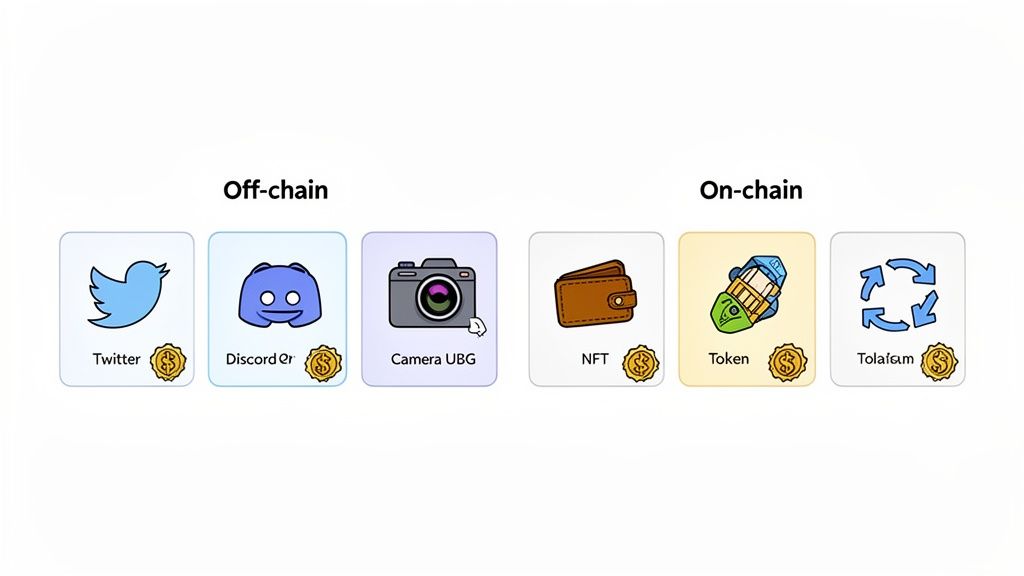
The best leaderboards I've seen don't just reward one type of activity. They create a rich mix of both on-chain and off-chain quests. This is how you build a community that feels alive and includes everyone, from the crypto-curious newcomer to your most hardcore on-chain users.
Think about it: if all your quests demand on-chain actions like swaps or staking, you're immediately putting up a wall for anyone who's still learning the ropes or doesn't have a loaded wallet. But if you only focus on social media likes and follows, you're not rewarding the loyalists who are actually using your product and driving its value.
The goal is to create a journey. You want to guide people from simple, low-stakes social tasks toward the deeper, more meaningful on-chain interactions.
Getting Creative with Off-Chain Quests
Off-chain quests are your welcome mat. They're your top-of-funnel play—low friction, easy to get started, and perfect for generating that initial buzz.
But "easy" shouldn't mean "boring." We’ve all seen the endless "like and retweet" quests. It's time to move past that and design tasks that actually build a real community.
Here are a few ideas that work:
- Meaningful Discord Engagement: Instead of just tracking messages, reward people for dropping specific emoji reactions in your announcements channel or for getting a "helpful" role by answering questions. This encourages quality over quantity.
- User-Generated Content (UGC): Nothing beats authentic social proof. Run a quest asking your community to create and share memes or short video explainers about your project.
- Coordinated Raids: Organize friendly "raids" on X posts or in other Telegram groups where your community can share positive thoughts about what you're building.
For this kind of thing, a platform like Zealy is fantastic, especially when you're just starting out. It gamifies the whole experience and makes it easy to track who your most enthusiastic supporters are.
Rewarding High-Value On-Chain Actions
This is where the rubber meets the road. On-chain quests are for rewarding the actions that directly impact your protocol's bottom line. These are your power-user tasks, and they should carry a much heavier weight on the leaderboard.
You need to reward people for more than just connecting their wallets. The whole point is to encourage real, meaningful interaction with your protocol.
Think of your on-chain quests as a direct line between community activity and your project's core KPIs. Each completed task should be a small win for both the user and the protocol.
Here are some on-chain quests that drive real value:
- Holding an NFT: Award a chunk of points to anyone holding your project's NFT for a certain period. This is a great way to incentivize holding and reduce sell pressure.
- Voting in the DAO: Give points to members who participate in a governance vote. It’s a direct boost to decentralization and makes people feel like true owners.
- Providing Liquidity: This is a big one. Offer a massive point bonus for users who add liquidity to your token's pool on a DEX. It’s absolutely critical for token health.
- Swapping for Your Token: Create quests that require users to swap for your native token, which helps increase on-chain volume and your total number of holders.
The fact that no-code tools are making these integrations easier is a sign of a maturing market. This is all part of a huge shift, with the Web3 sector projected to explode from USD 4.4 billion in 2023 to USD 171.19 billion by 2032. The platforms leading this charge are the ones that blend on-chain and off-chain worlds seamlessly, a need highlighted by the 84.2% market dominance of public networks. You can dig into more of these numbers and Web3 market projections on SkyQuestt.
By getting this mix right, you build on two fronts. You cast a wide net with accessible off-chain tasks to grow your audience, while simultaneously building a dedicated core of on-chain power users who drive real, measurable value for your protocol.
Automating Verification and Stopping Fraud
Let's be real: manually checking thousands of quest submissions is a one-way ticket to burning out your community team. If you want your web3 whitelabel leaderboard to scale, a smart, automated verification system isn't a "nice-to-have"—it's a necessity. This is about more than just saving time; it's about building a foundation of trust and fairness.
When your community sees that the rules are enforced consistently and cheaters get caught, their confidence in your project skyrockets. This automated layer is your first and best defense against the chaos of a rewards campaign.
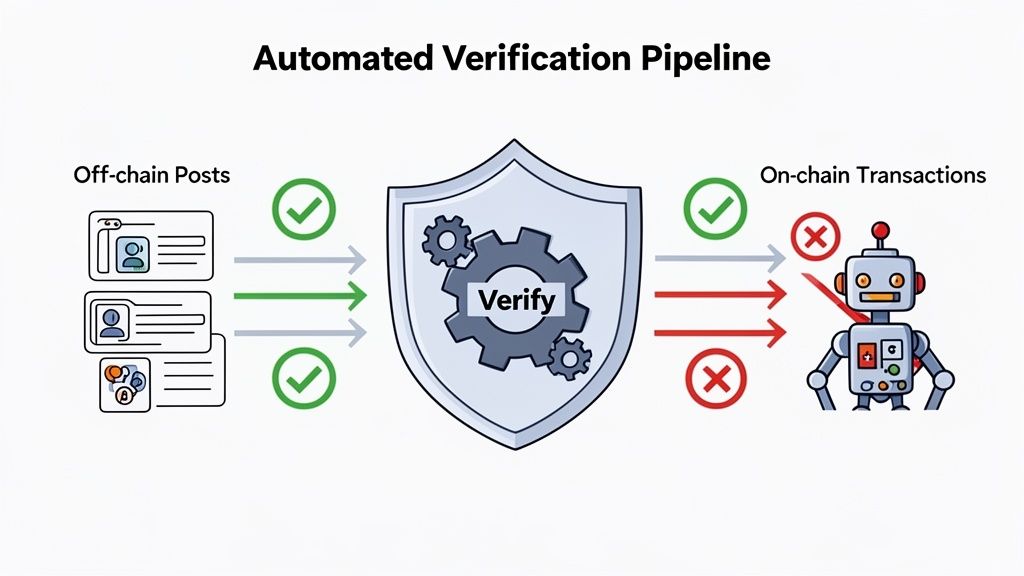
Smart Verification for Off-Chain Actions
Off-chain quests, especially anything happening on social media, are a magnet for spam and low-effort posts. This is where AI-powered content review can be a total game-changer. Instead of someone's eyeballs having to scan every single tweet, you can set up automation to do the heavy lifting.
Modern platforms can check for your rules in a split second. Think of it like a bouncer for your campaign:
- Keyword and Hashtag Matching: The system instantly scans a user's tweet to make sure it contains the required hashtag (like
#MyProject) and tags your official account. No tag, no entry. - Content Authenticity: Some tools even do basic sentiment analysis. This helps filter out negative or completely irrelevant posts, keeping the content aligned with your campaign’s vibe.
- Link Verification: If a quest needs users to share a specific link, the system confirms the right URL is there—not some sketchy, shortened one.
This automated first pass catches the vast majority of submissions. It frees up your team to actually engage with the community instead of getting buried in administrative tasks. It's the difference between building a community and just managing a spreadsheet.
Bulletproof On-Chain Verification
On-chain verification is much more black-and-white, but just as crucial. Here, the system simply asks the blockchain for proof that a specific action happened. The data doesn't lie; the transaction either exists or it doesn't.
Your verification engine will typically check for things like:
- Transaction Hash Confirmation: It validates that a transaction hash a user submits is real and was successfully finalized in a block.
- Smart Contract Interaction: It confirms the user’s wallet actually called the right smart contract address, whether that's your staking pool or a DAO governance contract.
- Parameter Validation: For more complex quests, it can dig deeper. For instance, it can verify a token swap was for a minimum amount or that an NFT was minted from your official collection.
This stuff is nearly impossible to fake, giving you a rock-solid basis for awarding those high-value points and rewards.
The integrity of your leaderboard is everything. To protect it, you absolutely have to shut down artificially inflated metrics, such as purchased Twitter likes. This keeps the competition fair and ensures you're rewarding genuine participants, not just the best cheaters.
Combating Bots and Sybil Attacks
The single biggest threat to any rewards campaign is a Sybil attack. This is where one person spins up hundreds or thousands of fake accounts to gobble up all the rewards. Fighting this takes a multi-layered defense that goes way beyond simple verification.
A good system actively hunts for patterns of shady behavior. It can, for example, flag a group of wallets that were all funded from the same source in rapid succession or a bunch of social media accounts that were all created on the same day. These are huge red flags.
Another powerful tactic is setting some reputation-based goalposts. You might require a user's X (Twitter) account to be at least 90 days old with a minimum of 50 followers to even be eligible. This simple filter weeds out an enormous number of brand-new bot accounts. By combining on-chain history with off-chain reputation, you build a much more complete user profile, making it significantly harder for bots to game your system.
Making Your Leaderboard an Extension of Your Brand
A leaderboard is so much more than a simple point-tracking tool. When done right, it becomes a core part of your brand's experience. The moment someone lands on your leaderboard, it needs to feel like your space—a natural, seamless part of your project, not some bolted-on, generic widget. This is your chance to turn a utility into a real community hub.
The real goal here is to nail the UI and UX. You want it to be dead simple to use, visually exciting, and genuinely stoke that competitive fire in your community. This isn't about just slapping your logo on a pre-made template. It's about weaving your brand’s DNA into every single pixel.
Crafting a Front-End That People Actually Want to Use
Let’s be honest: if your leaderboard looks clunky or uninspired, people will ignore it. A slick, well-branded experience, on the other hand, actively pulls people in and keeps them coming back.
It all starts with the visual fundamentals:
- Logo and Colors: Your logo needs to be the star of the show. Use your brand’s color palette for everything—backgrounds, buttons, text—to create that instant feeling of familiarity.
- Custom Fonts: If you have a specific font you use everywhere else, bring it into the leaderboard. It’s a small touch that reinforces your identity and makes the whole thing feel more professional and put-together.
- Intuitive Layout: Keep it clean and simple. People should immediately see their rank, their points, and the quests they've crushed without needing a user manual.
This isn’t just about aesthetics; it’s about driving real engagement. We're seeing white-label platforms become the engine behind a huge surge in DeFi and NFT transactions. While banking and finance took a 38.3% slice of the Web3 market in 2024, it's the token-based loyalty programs in retail—often running on these exact kinds of branded portals—that are set to explode with 46.7% projected growth. You can see the full breakdown in Mordor Intelligence's Web3 market report. This proves just how much a great user experience matters.
A well-designed white-label leaderboard does more than just look pretty. It builds trust. It makes your community feel like they’re part of something official and built to last, not just another short-lived marketing gimmick.
Hooking Your Leaderboard Into Your Marketing Stack
A powerful leaderboard can't live on an island. You unlock its true potential when you connect it to the marketing and community tools your team already lives in every day. This is how you create an ecosystem where your leaderboard is an active participant in the community conversation, not just a passive scoreboard.
Think of these integrations as bridges. They let data flow automatically between your platforms, creating feedback loops that keep users hooked without you having to manually poke them all the time. If you want to dive deeper into building this kind of system, check out our guide on white-label loyalty in Web3.
Key Marketing Stack Integrations
Connecting your tools is what turns a static leaderboard into a dynamic community engagement engine. Here are the essential integrations I always recommend starting with.
| Platform | Integration Purpose | Key Benefit |
|---|---|---|
| Discord / Telegram | Set up automated bots to announce new quests, celebrate top performers, and post real-time rank updates in dedicated channels. | Drives users back to the leaderboard and keeps the competitive energy high within your core community hubs. |
| CRM (e.g., HubSpot) | Sync user data from the leaderboard to your CRM to build detailed profiles of your most engaged community members. | Enables targeted communication and helps identify potential ambassadors or power users for special perks. |
| Email Marketing | Send personalized email notifications for things like quest completions, rank changes, or reminders about expiring quests. | Re-engages users who may have become inactive and provides another touchpoint to keep them in the loop. |
By weaving your leaderboard directly into your marketing stack, you transform it. It’s no longer just a place to check points; it becomes an automated, active driver of community growth. Each integration builds on the last, creating a powerful flywheel that fuels engagement for the long haul.
So, You've Launched. Now What? Keeping the Momentum Going.
Getting your web3 whitelabel leaderboard live is a fantastic first step, but let's be real—that’s just the starting gun. The real race is turning that launch day excitement into a lasting, engaged community. This is where you shift from builder to strategist, using data to figure out what actually keeps people coming back.
Honestly, a leaderboard without analytics is just a fancy list of names. But when you start digging into the data, it becomes the command center for your entire community strategy. It’ll show you exactly what makes your users tick, where they’re hitting roadblocks, and how to keep that competitive spirit alive and well.
Ditching Vanity Metrics for Real Insights
First things first, you need to track what actually matters. The total number of quests completed? That's a feel-good number, but it doesn't tell you much. We need to go deeper to understand what’s really happening.
To get a true pulse on your campaign, keep a close eye on these KPIs:
- Active User Rate: Forget total sign-ups. How many people are completing at least one quest per week? This is your core, engaged audience.
- Task Completion Funnel: This is huge. If you see that 90% of users start the "Join our Discord" quest but only 50% manage to finish the "Swap a Token" quest, you’ve just found a major friction point that needs fixing.
- Quest-Type Popularity: Are people all over your on-chain tasks but ignoring the social media ones? That's pure gold. It tells you exactly what kind of content your community actually enjoys.
When you focus on these numbers, you stop guessing and start making smart, data-driven decisions that actually improve your campaign.
Reading Between the Lines
Once the data starts rolling in, the next step is to figure out what it's telling you. Seeing a huge spike in activity whenever you offer a specific type of reward? That’s a massive hint to offer more of that. Noticing a slump in engagement mid-week? Maybe it’s time to launch a limited-time "Hump Day" bonus quest to get people logging back in.
Think of your analytics as a direct conversation with your community. They're telling you what they love, what’s too confusing, and what they couldn't care less about. All you have to do is listen.
Let's say you notice a high drop-off rate on one of your most valuable on-chain quests. The problem might not be the quest itself. It could be that your instructions are confusing or your tutorial is lacking. This kind of insight helps you fix the real problem instead of just randomly changing point values.
Playing the Long Game: Retention Tactics That Work
With these insights in hand, you can start rolling out strategies to keep people engaged for weeks and months, not just days. The key is to build a living, breathing ecosystem where there’s always a new challenge on the horizon.
Here are a few tactics I’ve seen work wonders:
- Tiered Rewards: Don’t just reward the #1 spot. Create Bronze, Silver, and Gold tiers. This gives everyone something to aim for and recognizes consistent effort, not just top-tier performance.
- Seasonal Resets: Nothing kills motivation like an untouchable leader. Introduce "seasons" and reset the leaderboard every quarter. This gives newcomers a fighting chance and prevents "leaderboard fatigue" among your loyal users.
- Surprise! Bonus Quests: Keep things fresh by dropping unexpected, high-value quests out of the blue. A "flash quest" for the next 50 people to complete a task can send a jolt of energy through the whole community.
By constantly checking your data and tweaking your approach, your leaderboard stops being a one-off campaign. It evolves into a powerful engine for building real, sustainable community loyalty.
Got Questions? We've Got Answers
You've got the blueprint, but a few questions might still be bubbling up. Let's tackle some of the most common things people ask when they're diving into building a Web3 whitelabel leaderboard.
So, How Quickly Can I Get a Leaderboard Live?
Honestly, the tech setup can be surprisingly fast. Using a no-code platform means you're looking at a matter of hours, not weeks of development hell. A simple campaign? You could literally have it up and running by the end of the day.
The real work—and where you should spend your time—is in the strategy. Thinking through your first batch of quests, figuring out a reward system that actually gets people excited, and hooking everything into your marketing tools like Discord or Telegram... that's where the magic happens.
Can I Actually Track the ROI on This Thing?
You bet. And you absolutely should. Measuring the return on your efforts goes way beyond just looking at how many quests were completed.
Here’s what to keep an eye on:
- Community Growth: Are you seeing a real uptick in your Discord or Telegram numbers?
- On-Chain Action: Look at the hard data. Are you getting new token holders? Is transaction volume climbing because of your on-chain quests?
- Social Buzz: Is your brand getting more love on social media? Track the likes, shares, and overall engagement that your campaign is sparking.
Here's a pro tip: The best way to see a clear ROI is to link your quests directly to your project's main goals. If you need more people staking, make that the most rewarding action on your leaderboard. The cause-and-effect becomes crystal clear.
Is a Whitelabel Leaderboard Going to Break the Bank?
It's way more affordable than you'd think. The alternative is hiring developers for a custom build, which can easily cost tens of thousands of dollars and take months. No-code platforms completely change the game.
Most are subscription-based, so you can find a plan that fits your budget. The cost usually scales with how many active users you have and the features you need. This means you can start lean and invest more as your community blows up, making it a smart move for projects of any size.
Ready to build a leaderboard that your community will actually get excited about? With a tool like Domino, you can design and launch a fully branded questing experience in minutes, not months. Start building for free and see for yourself.