Mastering discord quests: Grow Your Web3 Community with Engaging Campaigns
So, what exactly are Discord quests?
Let’s get straight to it. Think of them as interactive, rewarded challenges that live right inside your community’s server. Instead of just vaguely asking people to "be active," you're giving them a fun, clear path to contribute and earn something real for their efforts. It’s how you turn those silent lurkers into your most active fans.
What Are Discord Quests Anyway?
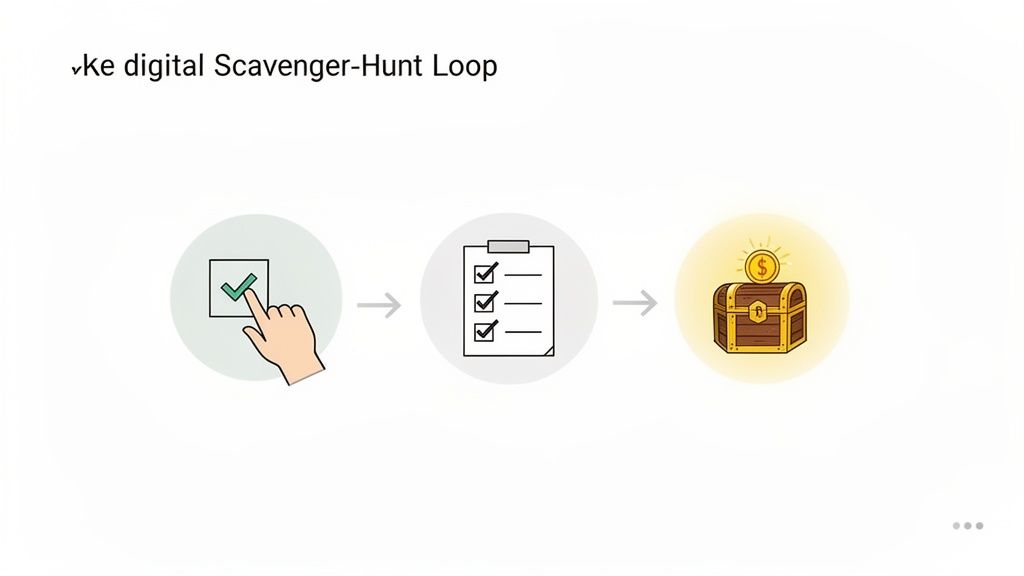
Forget the jargon. At their core, Discord quests are a gamified loyalty program built for the Web3 space. Picture a digital scavenger hunt where your community members are the adventurers, and your project’s goals are the treasure they’re chasing.
This simple idea has a huge impact. It turns passive server members into valuable contributors by giving them a structured way to get involved. That could mean following your X (formerly Twitter) account, testing a new dApp feature, or even just reacting to an announcement. It's all about guiding them toward meaningful actions.
The Core Quest Loop
Every quest, no matter how complex, runs on a super simple and satisfying three-step loop. This cycle is designed to be second nature, making it easy for people to jump in again and again.
Here’s the basic rhythm:
- Accept: A user spots a new quest in a channel and decides to opt-in.
- Complete Action: They go and do the thing—maybe it's an off-chain social share or an on-chain transaction.
- Claim Reward: Once their action is confirmed, they get their prize. This could be anything from an exclusive role and NFTs to project tokens.
This flow just works. It’s clear, provides instant gratification, and keeps the momentum going. And the potential scale is massive; Discord itself has over 200 million monthly game players. For example, a video quest for the game developer Supercell got nearly a million full views. That's some serious social proof.
By turning community engagement into a game, you create a system where members are intrinsically motivated to help your project grow. They aren’t just completing tasks; they're leveling up their status and investment in the ecosystem.
This little table breaks down the essential parts of a typical Discord Quest, giving you a quick look at how they're structured.
The Core Components of a Discord Quest
| Component | Purpose | Example |
|---|---|---|
| Task | The specific action you want the user to perform. | "Follow our project on X (formerly Twitter)." |
| Verification | The mechanism to confirm the task was completed. | A bot checks if the user's connected X account is following. |
| Reward | The incentive a user receives for completing the task. | 100 XP points, an exclusive Discord role, or a free NFT mint. |
| Conditions | Any prerequisites a user must meet to participate. | "Must hold at least one project NFT to start the quest." |
As you can see, the structure is straightforward but gives you a ton of flexibility to design quests that fit your goals perfectly.
Why This Is a Game Changer
This whole approach is a world away from old-school community management, which often just begs people to "be active." Quests give members a real purpose. Instead of just hoping people find ways to contribute, you're pointing them directly toward high-value actions that help you grow.
It's not just better for your users; it's way more measurable for your team. Every completed quest is a hard data point showing real engagement and commitment. If you're curious what this looks like from the other side, check out our guide on how to join a Discord quest to see it from a user's perspective.
Why Discord Quests Are a Web3 Superpower
Let's be real: building a thriving Web3 community is tough. Getting thousands of people into a Discord server is one thing, but getting them to actually do something meaningful? That’s where most projects hit a wall. This is exactly why Discord quests are more than just a fun gimmick—they're a genuine superpower.
Quests give you a way to gamify participation and guide your community toward actions that actually move the needle for your project. It's the difference between just hoping people will engage and actively designing a path for them to do so.
Turning Lurkers Into Lifelong Fans
The magic of Discord quests is how they completely change the vibe of your community. Instead of your team just shouting announcements into the void, quests create a real back-and-forth. They give members a clear roadmap of what to do next, encouraging them to explore your world one step at a time.
This process is a fantastic, non-intrusive way to educate people on what makes your project special. A well-thought-out quest can take a total newbie and walk them through a critical journey:
- The Handshake: A super simple quest like "React to our welcome message" gets a new member to take their first action right away.
- The Deep Dive: A quest could then guide them to read your litepaper, watch a quick tutorial, and maybe answer a simple quiz to make sure it all sunk in.
- The Real Deal: From there, you can ramp up to quests that drive high-value actions, like testing a new dApp feature or casting a vote in governance.
This guided experience makes people feel like they’re part of something. They're not just consuming content; they're actively participating, earning rewards, and finding their place. This is how you turn a passive lurker into a passionate fan who truly gets what you're building.
Connecting Community Activity to Project Goals
Every Web3 project has a wish list. Maybe you need to boost liquidity, get more eyes on your social media, or stress-test a new feature before it goes live. Discord quests create a direct pipeline to mobilize your community to make these things happen.
Quests are the bridge between your project’s roadmap and your community's daily clicks. They translate high-level goals into simple, rewarding tasks that anyone can complete.
Think about how powerful that is. Need to get a big announcement trending on X? A "Like & Retweet" quest can create an instant signal boost. Launching a new mint? A quest to join the allowlist builds immediate hype. You’re literally aligning thousands of individual actions with your most important objectives.
Driving Real, Measurable Growth
At the end of the day, all this community building has to translate into results you can actually measure. The game-like structure of quests is a natural fit for Discord, which reports having over 200M+ monthly game players. On top of that, 93% of its users have played a game in the last 30 days. This is an audience that is already wired for this kind of engagement. You can dig into more of these fascinating Discord user statistics and trends to see just how primed they are.
This built-in enthusiasm for gamification leads to tangible wins for your project:
- Lower User Acquisition Cost (UAC): Instead of pouring money into ads, you can use quests to turn your community into a growth engine. Rewarding users for inviting their friends is an organic and much cheaper way to find new, high-quality members.
- Sky-High Retention: Quests give people a reason to check in and participate every single day. This constant loop builds habits and loyalty, keeping people around for the long haul—something that’s notoriously hard in communities without any structured activities.
- A Killer Competitive Edge: An engaged, educated, and mobilized community is one of the strongest defenses you can have in Web3. When your members are actively helping you build and grow, you create a kind of momentum that your competitors simply can't buy.
Designing Your First Quest Campaign
Alright, enough theory. Time to roll up our sleeves and actually build something. This is where the real fun begins—turning those big strategic goals into a series of fun, rewarding tasks for your community. Think of yourself as a game designer. You're creating an adventure that's genuinely exciting for your members and, at the same time, incredibly valuable for your project.
The first step is always the same: know your "why." What is the single most important thing you want this campaign to achieve? Don't try to boil the ocean. A focused objective is a successful one.
Define Your Campaign Objective
Before you even dream up rewards or tasks, you need a crystal-clear goal. A vague objective like "increase engagement" is just a recipe for a messy, ineffective campaign. You have to get specific and, more importantly, measurable. This goal will be the North Star for every single decision you make from here on out.
A solid objective might look something like this:
- User Acquisition: Grow our Discord server by 1,000 new, active members in the next 30 days.
- Education and Onboarding: Get 500 new users to read the litepaper and pass a short quiz on the project's core value.
- Driving High-Value Actions: Motivate 200 wallet holders to test a new dApp feature by completing a specific on-chain transaction.
- Social Amplification: Generate 5,000 retweets on our product launch announcement to blow up our reach on X.
See how specific those are? They aren't just vague hopes; they're measurable outcomes. That kind of clarity makes it so much easier to design tasks that directly push you toward success.
Choose Rewards That Actually Motivate
Once you know what you're aiming for, it's time to answer the all-important question from your user's perspective: "What's in it for me?" The right reward can make or break a quest. It has to be valuable enough to get people to act but also sustainable for your project.
And please, don't just throw project tokens at every little thing. Get creative and match the reward to the effort required.
A great reward feels earned, not just given. It should line up with your community's values and make people feel like they've gained something exclusive or unlocked a new level of status in your ecosystem.
For lower-effort tasks, think about rewards like:
- Exclusive Discord Roles: A simple but surprisingly powerful way to grant status.
- XP or Points: Perfect for fueling a leaderboard system and sparking some friendly competition.
- Allowlist Spots: These are often highly sought after for upcoming mints or big releases.
For more complex or high-value actions, you can obviously offer more substantial incentives. If you want to dig deeper into structuring these, our guide on how to set up a join Discord reward system offers a much closer look at creating real value for new members.
Select the Right Types of Quests
With your goal and rewards locked in, you can finally design the actual tasks. The best campaigns almost always use a mix of quest types to keep things interesting and appeal to different kinds of users. A great flow might start with simple social tasks to warm people up before asking them to dive into more involved on-chain actions.
Here are a few common quest types you can mix and match:
Off-Chain Quests (Low Barrier to Entry)
- Social Follows: The classic "Follow us on X" or "Join our Telegram." These are great for building your social footprint quickly.
- Content Engagement: Tasks like "Like & Retweet this post" or "Comment on our latest YouTube video."
- Content Creation: Ask users to create a meme, write a short thread, or share a testimonial about their experience.
On-Chain Quests (High-Value Actions)
- Token Swaps: Require users to perform a swap on a specific decentralized exchange.
- NFT Mints: A perfect way to drive participation in your latest collection.
- Staking or Providing Liquidity: Encourage users to interact directly with your protocol's most important functions.
By building a real narrative around these tasks, you can transform a simple checklist into an exciting adventure. Try framing your campaign as a journey where each quest unlocks the next chapter of your project's story. This approach makes participation feel far more meaningful and keeps users hooked from start to finish, eager to see what comes next.
How Quest Verification Actually Works
So, you've designed some awesome Discord quests. That's great, but how do you know people actually did the thing you asked them to do?
That's where verification comes in. It's the trust layer of your whole campaign. Without a solid verification process, you're basically just handing out freebies and hoping for the best. Let's break down the two main ways projects make sure quests are completed fairly and automatically, so you're not getting played.
This whole process starts with your goals. What are you trying to achieve? That goal shapes the quests, and the quests determine the rewards. It's a simple, powerful loop.

As you can see, a clear objective is the foundation. It tells you what kind of quests to build and what rewards will get people excited enough to finish them.
Off-Chain Verification: The API Handshake
Most campaigns start here. Off-chain verification covers all the stuff that happens outside of a blockchain—think social media follows, app sign-ups, and the like. It's like a digital bouncer checking an ID at the door.
The whole thing runs on Application Programming Interfaces (APIs). Don't let the name intimidate you; an API is just a way for two different software programs to talk to each other. When a user says they completed a quest (like following you on X), your questing tool uses the X API to ask, "Hey X, is this user really following this account?" X sends back a simple "yes" or "no," and boom—quest verified.
It's the perfect fit for straightforward, top-of-funnel tasks:
- Social stuff: Checking for follows, likes, retweets, and comments on platforms like X, YouTube, or TikTok.
- Submissions: Making sure someone submitted a specific link or piece of text.
- Sign-ups: Confirming a new account was created on your website.
Off-chain verification is fast, cheap, and dead simple for users. It’s the go-to for building brand awareness and growing your audience without making them jump through a bunch of crypto hoops.
The only real downside? It can be gamed. Savvy users can spin up bots to automate these actions. It's a fantastic tool for casting a wide net, but for your high-value rewards, you'll want to pair it with something a bit more bulletproof.
On-Chain Verification: The Public Ledger Audit
Now we're getting to the good stuff. This is where web3 really flexes its muscles. On-chain verification checks actions that are permanently stamped onto a blockchain, whether it's Ethereum, Solana, or Polygon.
Think of the blockchain as a giant, transparent public book that anyone can read but no one can change. When you ask someone to do something on-chain, you don't have to take their word for it. Your quest platform can just scan this public ledger and find undeniable proof.
This method is incredibly secure and opens up a ton of possibilities. By just looking at a user's wallet address, you can confirm all sorts of things:
- Token Holdings: Does this wallet hold at least 100 of your project's tokens?
- NFT Ownership: Is a specific NFT from your collection sitting in their wallet?
- Transactions: Did they just swap a token on Uniswap?
- Staking: Are their tokens locked up in your staking contract?
Because this data is public and immutable, on-chain verification is virtually impossible to fake. For instance, if you want to gatekeep a quest for genuine community members, you can use a template to verify Discord membership by checking for a specific token or role.
And when quests require visual proof, like memes or screenshots, you have to be careful. It's worth looking into methods for verifying images for authenticity in the AI era to keep things legit. The only trade-offs are that it can be a bit more complex for new users (they'll need to connect a wallet) and sometimes involves gas fees.
How to Measure Your Quest Campaign's Success
So you've launched your first Discord quests campaign. That’s awesome! But hitting the “go” button is just the start. Now for the important part: how do you know if it’s actually working? To figure that out, you need to look beyond the flashy numbers and dig into the metrics that really matter for growth.
It's super easy to get caught up in seeing thousands of people complete a quest, but honestly, that number alone doesn't mean much. A great campaign actually moves the needle on your project's main goals. That means you need to track key performance indicators (KPIs) that tie directly back to your success.
Moving Beyond Vanity Metrics
Right from the get-go, your mission is to measure the real impact of your quests, not just the surface-level buzz. A ton of participants is nice, but what you really want to know is if those people are sticking around and becoming genuine members of your community.
Here are the essential metrics you should have your eyes on from day one:
- User Acquisition Cost (UAC): Let's get real about the cost. How much did you spend to get each new, active member through your quest campaign? You can figure this out by dividing your total campaign spend (rewards included!) by the number of new users who finished a key onboarding quest.
- Conversion Rate: What percentage of people who did a quest actually took the next important step? Maybe that was connecting to your dApp and making a transaction, or maybe it was buying your token. This metric is huge because it shows if your quests are actually guiding people where you want them to go.
- Long-Term Retention: This one is the real test. Of all the users who completed a quest in week one, how many are still hanging out in your Discord 30 or 60 days later? This tells you if you’re attracting quality community members or just drive-by reward hunters.
A low UAC paired with high conversion and retention rates? That’s the holy grail of a killer quest campaign. It's solid proof you're not just renting attention—you're building a real community.
Keeping track of these KPIs gives you a crystal-clear view of how your campaign is doing and helps you prove it was worth the investment. To really get a handle on the financial side of things, it’s worth learning how to measure marketing campaign ROI and applying those principles to your quests.
Setting Up Your Analytics Dashboard
You don’t need some crazy expensive analytics tool to get started. Honestly, a simple dashboard in a spreadsheet will do the trick. The most important thing is just to be consistent with it.
Think of your dashboard as your single source of truth for the campaign, letting you see how things are trending over time. You’ll want to set it up so you can answer your biggest questions with a quick glance.
Key Dashboard Components:
- Top-Level KPIs: Stick your big three—UAC, Conversion Rate, and 30-Day Retention—right at the very top. This is your at-a-glance health check.
- Quest-Specific Performance: Make a simple table that breaks down how each individual quest is doing. Have columns for total participants, completion rate, and cost per completion. This will quickly show you which quests are your heavy hitters and which ones are duds.
- User Segmentation: If you can, try to compare the behavior of people who did quests versus those who didn't. Are the questers more active in chat? Do they join community calls more often? Do they hold your project's NFT? This comparison will prove the real value your quests are bringing to the table.
Taking this data-first approach turns your quest strategy from a guessing game into a reliable growth machine. It gives you the power to double down on what’s working, ditch what isn’t, and make every future campaign even better.
Common Quest Mistakes and How to Avoid Them
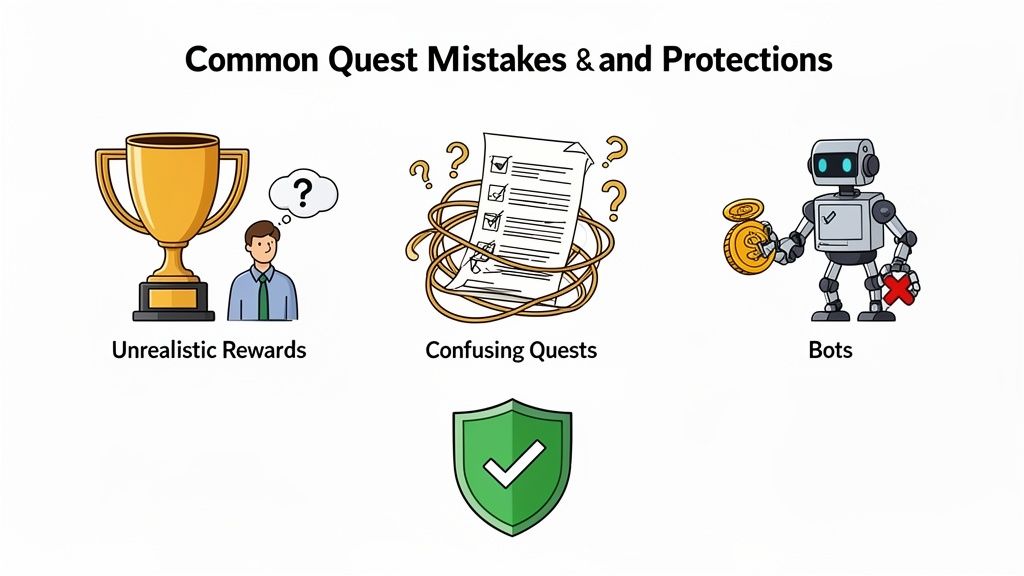
While Discord quests can be a game-changer for community growth, they aren't magic. I've seen plenty of projects dive in headfirst, full of enthusiasm, only to watch their campaigns fizzle out, burn through their budget, or—worst of all—annoy the very people they were trying to attract.
But here’s the good news: most of these failures come down to a few predictable traps. If you know what they are ahead of time, you can sidestep them and build a quest program that actually works. Let's walk through the biggest pitfalls I see and how you can steer clear of them.
Overly Complex or Confusing Quests
The number one engagement killer? Confusion. It’s that simple. If someone has to read your quest instructions three times and still feels like they're solving a riddle, you've already lost them.
Your quests should be so straightforward that a total newcomer can grasp them in seconds. That means breaking down big goals into tiny, manageable steps. Ditch the internal jargon and use plain language. Before you launch, grab someone who isn't on your core team and have them try it out. If they hesitate, it’s too complicated.
Your goal is to remove every single ounce of friction between a user seeing a quest and finishing it. Every extra click, every confusing sentence, is a chance for them to give up and just scroll away.
Misaligned Rewards and Effort
Another classic blunder is getting the reward-to-effort ratio completely wrong. Asking a member to complete a ten-step, on-chain process just for a basic Discord role is a fast track to disappointment. On the flip side, offering a massive token reward for a simple retweet is like putting out a welcome mat for reward hunters and bots.
The key is to make the prize fit the task. Think of it like this:
- Low-Effort Tasks: Simple stuff like following on social media or reacting to an announcement should get you small rewards, like XP or a fun server role.
- High-Effort Tasks: For more involved actions, like providing liquidity or testing a new feature, the reward needs to be worth their time. We're talking allowlist spots, a decent token prize, or a rare NFT.
Getting this balance right shows your community you respect their time and encourages them to tackle the quests that really matter to your project.
Ignoring Bots and Sybil Attacks
Finally, you can't just ignore the bad actors. If you don't protect your campaign, you're essentially leaving the cookie jar open for bots and sybil attackers (people using tons of fake accounts). They'll drain your rewards, skew your metrics, and add absolutely zero value.
You have to build your defenses in from day one. This means choosing a quest platform with solid anti-bot features and designing quests that are a pain to automate.
Simple Anti-Bot Strategies:
- Verified Roles: Make quests available only to users who hold a specific role, which they can get by verifying their wallet through a tool like Guild.xyz or Collab.Land.
- On-Chain Requirements: Gate your high-value quests. Require users to hold a specific NFT, have a minimum token balance, or have a certain amount of on-chain activity. Bots usually can't fake this.
- Manual Reviews: If a quest involves user-generated content (like creating a meme), have someone on your team give it a quick once-over. It's a simple way to weed out low-effort spam.
By thinking about these issues from the start, you'll build a quest program that feels fair, secure, and genuinely builds trust with your community.
Your Top Discord Quest Questions, Answered
Alright, so you've got the big picture down. But when it's time to actually launch a campaign, the practical questions always start to bubble up. Let's walk through some of the most common ones I hear, so you can get started with total confidence.
How Much Should I Actually Budget for Rewards?
This is the big one, right? There's no single magic number, but a good rule of thumb is to start small and see what works. Think about it this way: the reward should match the value of the action you're asking someone to take. A simple Twitter follow is worth a bit of XP, but a significant on-chain transaction? That might justify a reward worth a few dollars.
A smart way to approach your budget is to:
- Create Reward Tiers: Don't offer the same reward for every task. Match the prize to the effort and its importance to your project.
- Lean on "Free" Incentives: Don't underestimate the power of non-monetary rewards. Exclusive Discord roles, allowlist spots, or even just XP points can be incredibly motivating and cost you absolutely nothing.
- Watch Your CPA: Keep a close eye on your cost per acquisition for each quest. If one quest is bringing in high-value users for cheap, that’s your signal to double down and put more budget behind it.
Can I Put My Quests on Autopilot?
For the most part, yes—and you absolutely should. The whole point of modern questing platforms is to automate the cycle: user sees a task, completes it, the platform verifies it, and the reward is sent instantly. You can’t scale to thousands of users without this.
That said, a human touch still matters. For anything involving user-generated content—like a meme contest or written feedback—a quick manual review is smart. It helps you weed out spam and reward genuine effort. I like to think of it as 95% automation, with a final human quality check where it counts.
Complete automation is perfect for verification and doling out rewards. But for tasks that need creativity or a bit of subjective judgment, a quick manual review ensures you're rewarding real quality, not just button-clicks.
What's the Best Way to Stop Cheaters and Bots?
Sybil resistance is a massive challenge. Nothing kills a campaign faster than bots draining your reward pool. The best defense is a layered one. Start by putting your most valuable quests behind a gate that's tough for bots to get through.
For instance, you could require users to:
- Hold a specific NFT from your collection in their wallet.
- Have a minimum balance of a certain token.
- Have a verified Discord role from a tool like Collab.Land.
When you combine on-chain requirements with verified roles, it suddenly becomes way too expensive and complicated for most bot farms to target your campaign.
How Long Should a Quest Campaign Last?
This completely depends on your goal. Are you trying to create a massive explosion of hype, or are you building a slow, steady fire?
- Short Sprints (1-2 weeks): These are perfect for building excitement around a specific event. Think NFT mints, major product announcements, or conference appearances. It's all about maximum noise in a short window.
- Marathons (1 month or longer): Use these for ongoing, evergreen goals like onboarding new users or educating your community. This creates a continuous loop of engagement that keeps people active month after month.
Ready to stop managing tasks and start building a real community? With over 130 quest templates and AI-powered verification, Domino makes it easy to launch engaging campaigns in minutes, not weeks. Build your first quest for free on domino.run.