White Label Loyalty Web3: Scale Branded Rewards with white label loyalty web3

Think of a white-label loyalty Web3 solution as a shortcut to the future of customer rewards. It's essentially a pre-built, unbranded platform that a company can slap its own logo on and launch. This setup blends the speed of an off-the-shelf system with the real power of blockchain, letting brands offer rewards that customers actually own as digital assets, without the headache and high cost of building a Web3 program from the ground up.
What Exactly Is White Label Loyalty Web3?
Let’s use an analogy. Imagine you’re a brilliant chef who wants to open a new restaurant. You could spend years building the kitchen from scratch—installing ovens, figuring out the plumbing, and wading through permits. Or, you could lease a fully-equipped, top-of-the-line professional kitchen that’s ready to go from day one. You just bring your recipes, your staff, and your brand, and you can start cooking immediately.
A white-label loyalty Web3 platform is that professional kitchen. It hands you all the complicated backend stuff—the blockchain connections, smart contracts, and user verification—so you don't have to become a crypto developer overnight. You get to focus on the fun part: applying your branding, dreaming up unique rewards, and launching a seriously cool, blockchain-powered loyalty program.
The Two Core Components
At its core, this whole model is a mashup of two powerful concepts:
- White Label Solution: This is your "ready-made kitchen." It's a product or service built by one company that other businesses can rebrand and present as their own. It’s a massive time and money saver.
- Web3 Technology: This is the "secret sauce." By using the blockchain, it creates a rewards system that’s more transparent, secure, and centered around the user. Instead of points living in a company database, customers get digital assets (like tokens or NFTs) that they control in their personal wallets.
This combination gives businesses a fresh, powerful way to connect with their community.

Platforms that offer no-code toolkits are making this even more accessible for marketing teams, allowing them to design reward-based quests that blend on-chain and off-chain activities through a simple, visual interface.
To give you a clearer picture, here's a quick rundown of the essential elements.
White Label Loyalty Web3 at a Glance
| Concept | Description |
|---|---|
| Core Idea | A ready-to-use, customizable loyalty platform built on blockchain technology. |
| Main Benefit | Faster launch, lower cost, and access to advanced Web3 features without in-house expertise. |
| Customer Reward | Customers receive digital assets (tokens, NFTs) they truly own and control. |
| Who It's For | Brands of all sizes looking to create deeper community engagement and innovative rewards. |
This table neatly sums up why this approach is turning heads—it makes advanced tech practical and achievable.
Why This Model Is Gaining Traction
The appeal is pretty obvious. Building a secure, scalable Web3 application from scratch is a huge project. To even begin, you need a deep understanding of blockchain development, which requires specialized skills most marketing departments just don't have.
A white-label approach hides all that technical complexity. It frees up brands to focus on what they're good at: creating amazing campaigns and building real relationships with customers, not worrying about managing blockchain nodes.
This model is breaking down barriers. Suddenly, any brand—from your favorite local coffee shop to a massive global retailer—can roll out a loyalty program with features that were once only possible for tech giants with bottomless budgets. It’s all about using proven technology without having to do all the heavy lifting yourself.
Why Old-School Loyalty Programs Feel Broken

Before we jump into the future of rewards, let’s get real about the past. We've all been there—the clunky, forgettable experience of a typical loyalty program. Just think about your wallet. Is it stuffed with plastic cards you haven’t touched in years? Or maybe it's your phone, cluttered with dozens of apps, each one holding a few sad, lonely points.
These programs were designed for a world that doesn’t exist anymore. They’re closed loops, trapping your hard-earned points with a single brand. You can't move them, trade them, or do much of anything outside of that company's strict, self-serving rules. The result? A fragmented and frustrating mess for the very people they're meant to appreciate.
The whole value exchange feels off because, a lot of the time, it is. The rewards are often just plain boring, and the hoops you have to jump through make you wonder if they even want you to redeem them.
The Problem of Trapped Value
The biggest flaw in old-school loyalty is what I call "siloed value." Picture this: every coffee shop you go to gives you its own special currency, but you can only spend it right there. You’d end up with a pocket full of useless coins, with none of them being enough to actually buy you a coffee.
That’s exactly how traditional points systems work today. They create these little walled gardens of value that help the company way more than they help you.
- Expiring Rewards: Points often vanish just before you get a chance to use them, which feels more like a penalty than a reward.
- Limited Utility: The points you earned buying a new pair of shoes are useless when you want a latte, even if both brands would love to have you as a customer.
- Lack of Ownership: Here's the kicker—you don’t actually own your points. They live in a company's database, and the company can change the rules, devalue them, or take them away whenever they feel like it.
This model is completely one-sided. It's no surprise that over 54% of loyalty memberships are inactive. People are tired of joining programs that don’t inspire them or give them real value. To really grasp what Web3 brings to the table, you have to see why the old way is failing, because most traditional reward programs are stuck in the past.
A Disconnected Customer Experience
It’s not just about the points, either. The whole experience often feels clunky and disconnected. Nobody wants to juggle ten different apps, remember another password, or track a bunch of tiny balances that never seem to add up to anything good. The link between your actions and a worthwhile reward just isn't there.
These programs treat loyalty like a basic transaction—you spend, you get points. But real loyalty is about a relationship, a feeling of being part of something. A digital punch card can't build that.
This massive disconnect is where the opportunity lies. Customers are craving something better. They want programs that offer real value, flexibility, and a true sense of ownership over their rewards. This is exactly why the move to white label loyalty Web3 solutions isn't just a minor upgrade—it's a complete rethink that puts the customer back in the driver's seat.
So, What's the Big Deal with a Web3 Approach?
We've all seen how old-school loyalty programs are showing their age. The points feel worthless, and the experience is clunky. But what if you could fix that? Combining a white-label model with Web3 tech isn't just a minor update; it’s a complete overhaul that solves the biggest headaches for both brands and customers—namely, trapped value and a lousy user experience.
Think of it like this: the white-label part is your shortcut to getting on the road, and Web3 is the supercharged engine. One gets you moving fast, while the other gives you a whole new level of performance you couldn't get before. The result is a loyalty program that feels less like a corporate chore and more like a real partnership.
Launch at Lightning Speed with Full Brand Control
Let's be honest, building new tech is a massive drain on time and money. A secure, scalable Web3 app? You could be looking at years of development and a budget that makes your eyes water. This is precisely where the white-label model saves the day.
Instead of building from the ground up, you're starting with a proven, road-tested foundation. This slashes your launch time from years down to weeks, or sometimes even days. You get to skip the nightmare of the development cycle and go straight to the fun part: customizing the look, feel, and rules of your program.
- Your Brand, Your Rules: Every single touchpoint—from the app's interface to the reward notifications—is 100% your brand. Your customers stay in your world, not some third-party platform.
- Focus on Creativity, Not Code: This frees up your team to do what they do best: dream up killer campaigns and rewards that people actually want, instead of getting buried in technical debt.
- Cost-Effective Innovation: You get all the benefits of advanced blockchain features without the sky-high cost of hiring specialized dev teams or paying for your own expensive smart contract audits.
This agility is everything in today's market. The global loyalty management market was valued at around $6.47 billion in 2023 and is projected to explode to over $28 billion in the next decade. A huge driver of that growth? Brands using white-label solutions to get to market faster. You can explore more customer loyalty statistics and insights to see just how big this trend is.
From Points to True Digital Ownership
Okay, this is where the Web3 magic really kicks in. Traditional loyalty points are just numbers in a spreadsheet somewhere, totally controlled by the company. They can be changed or deleted in a heartbeat. Web3 rewards, on the other hand, are actual digital assets, like tokens or NFTs, that live on the blockchain.
This means your customers genuinely own their rewards. The assets sit in their personal crypto wallets, completely separate from your company’s servers. This one change completely flips the script and rebalances the power dynamic.
By giving customers true ownership, you're not just giving them a discount; you're giving them a tangible piece of value they can control. This transforms the relationship from a simple transaction into a shared ecosystem.
This idea of ownership is a game-changer. It opens the door to interoperability, where rewards from your brand could one day be used with another, creating a much more useful and valuable experience for your customers. It also makes the rewards feel more real and permanent, forging a much stronger emotional bond with your brand. For a deeper dive, our guide on designing effective community rewards programs has some great, practical strategies.
Enhanced Security and Unprecedented Transparency
Web3 injects a whole new level of trust into the loyalty game. Every transaction and reward is recorded on the blockchain, which is basically a public, unchangeable digital receipt book. The whole system is out in the open for anyone to see.
Your customers can verify their rewards on their own, check the total supply of a reward token, and see for themselves that you’re playing by the rules you set. This gets rid of any doubt or confusion about how the program works.
That transparency, backed by the rock-solid security of the blockchain, builds incredible trust. Customers don't have to just take your word for it anymore; they have verifiable proof. This is how a white-label loyalty Web3 program goes beyond collecting points and starts building a genuine community that sticks around for the long haul.
Your Step-By-Step Launch Playbook
So, you're ready to move from idea to a real, live loyalty program? Awesome. It can feel like a massive jump, but breaking it down into a clear plan makes it way more manageable than you'd think. This playbook walks you through the whole process, from sketching out your strategy to flipping the switch on your white label loyalty Web3 program.
The great thing about a white-label solution is that it does most of the heavy lifting for you. Think of it like getting the pre-built foundation for a house; you get to focus on designing the rooms and picking the paint colors, not mixing and pouring the concrete yourself. This lets you zero in on what really matters—your strategy and your customers' experience—instead of getting bogged down in complex blockchain code.
No-code platforms like Domino take this even further. They give marketing teams the power to launch incredible reward campaigns with simple drag-and-drop tools, turning a once developer-heavy job into a fun, creative marketing task.
Phase 1: Nail Down Your Core Strategy
Before you even think about technology, you need a rock-solid vision. What are you actually trying to accomplish? This foundation will guide every single decision you make, from the rewards you dream up to the partner you choose. Seriously, don't skip this part—it's the most important.
Start by asking yourself a few key questions:
- What's our main goal? Are you trying to get customers to stick around longer, drive more first-time sales, blow up your social media, or just build a buzzing community? Get specific.
- Who are we talking to? Are they crypto natives who know their way around a wallet, or are they everyday customers who need things to be super simple? This will completely shape your user interface and how you talk about the program.
- What actions will we reward? Think bigger than just purchases. You could reward people for sharing on social media, creating cool content, showing up to events, or leaving product reviews.
Answering these questions gives your program a real purpose. For example, a local coffee shop might give out tokens for daily check-ins, while a fashion brand could offer exclusive NFTs to people who attend a virtual runway show.
Phase 2: Choose Your White Label Partner
With a clear strategy in your back pocket, it’s time to find the right platform to make it all happen. This is your biggest technical decision, so choose wisely. The right partner becomes an extension of your team, giving you the tools and support you need to launch smoothly and keep growing.
Here's what to look for when you're evaluating options:
- No-Code Customization: How easily can your marketing team build and tweak campaigns without calling a developer? Look for visual builders and ready-to-go templates.
- Easy Integrations: Does the platform play nice with the tools you already use, like your CRM, e-commerce site, or social media manager?
- Scalability and Security: Can it handle your growth? Make sure they have a solid security history and properly audited smart contracts.
- Frontend Flexibility: Can you embed the program right on your website? Or maybe run it inside apps your community already uses, like Telegram and Discord?
This diagram breaks down the key benefits a strong white-label partner brings to the table, showing how they help you get from concept to launch in no time.
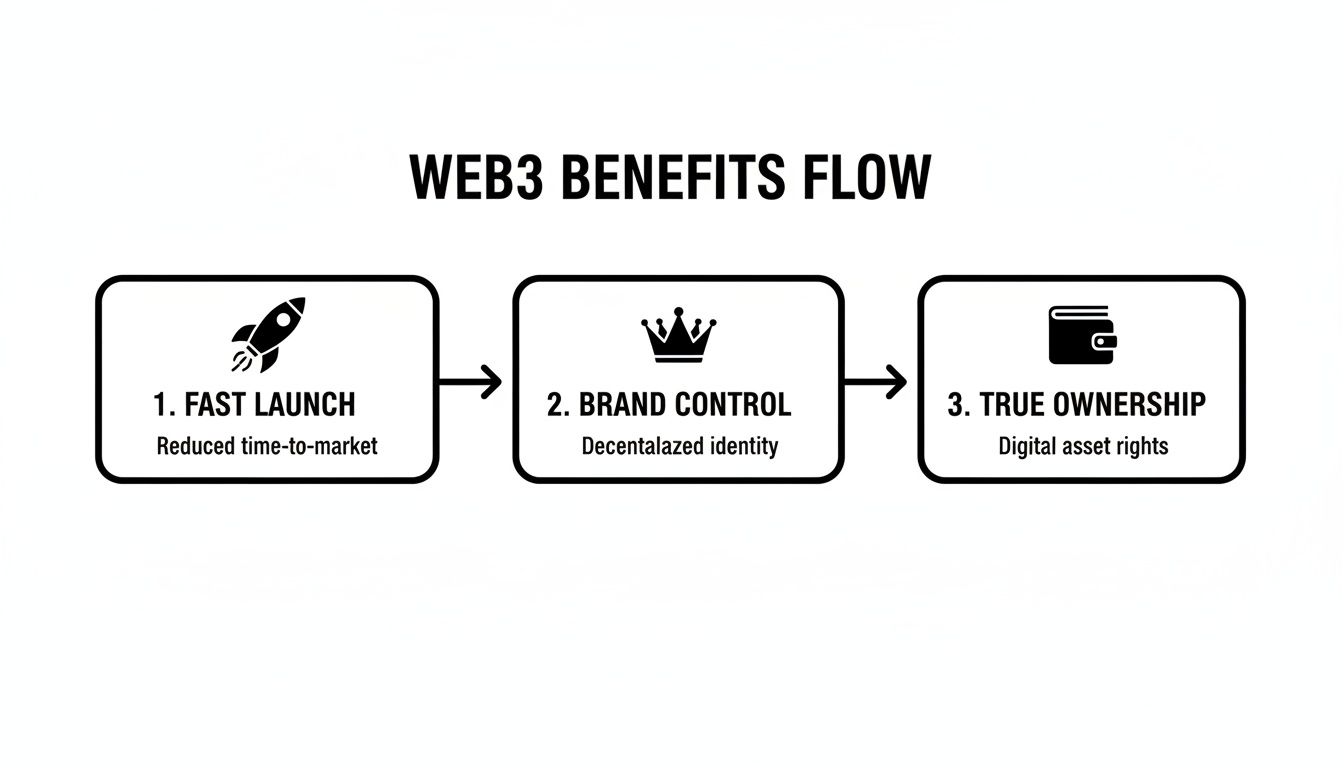
As you can see, these platforms are all about speeding up your launch while making sure your brand stays front-and-center and your customers get the cool perks of true digital ownership.
Phase 3: Implement and Integrate
Alright, time to roll up your sleeves and get to work. This is where you actually set up your program, customize how it looks and feels, and connect it to your existing systems. We can split these jobs into two main buckets: on-chain (the blockchain stuff) and off-chain (your traditional systems).
To keep things clear, let's look at what needs to happen on both sides. The best white-label platforms hide most of the on-chain complexity, but it’s still good to know what’s going on under the hood.
On-Chain vs Off-Chain Launch Checklist
| Task Category | On-Chain Tasks (Blockchain) | Off-Chain Tasks (Your Systems) |
|---|---|---|
| Asset Creation | Define and deploy your reward token or NFT collection (e.g., "BRANDCoin"). | Design the visual assets and branding for your rewards. |
| User Access | Set up a smooth wallet connection or creation process for users. | Integrate with your existing user login/authentication system. |
| Program Logic | Configure the smart contract rules for earning and redeeming rewards. | Build your first reward campaigns and quests in the no-code editor. |
| System Connection | --- | Connect the platform to your CRM and other tools via APIs to sync data. |
| User Interface | --- | Customize the loyalty program's widget or portal with your brand's logo and colors. |
This checklist gives you a practical look at where the work happens. While the on-chain part sounds intimidating, your partner should handle almost all of it for you.
Once everything is connected and customized, you're ready to launch your first campaign and start rewarding your community! This step-by-step approach keeps a potentially complex project organized into a series of clear, simple tasks. For more inspiration on how to structure your rewards, check out our guide to building a crypto points program.
How Real Brands Are Winning with Web3 Loyalty

The theory is great, but seeing how this stuff works in the real world is where things get interesting. Brands are already using white-label Web3 loyalty to move past boring old points systems and build communities that actually have a pulse. They're proving that tokenized rewards can forge much deeper connections with customers and create real, tangible value.
These aren't just pie-in-the-sky ideas; they're being tested and fine-tuned right now. Early pilots in major markets like the US, UK, and South Korea are already showing solid results. Brands are reporting real bumps in member retention and are even seeing their tokenized rewards pop up on secondary markets. This proves that a white label loyalty web3 strategy can have a measurable impact.
From Coffee Shops to High Fashion
Let's make this concrete. Imagine your favorite local coffee shop tries something new. Instead of a flimsy paper punch card, they drop a limited collection of "Free Coffee for Life" NFTs. All of a sudden, a simple loyalty perk is a valuable, tradable digital asset. The shop owner gets a nice chunk of capital upfront, and customers get a reward they actually own—one they could even sell down the road.
Or picture a high-fashion label. Instead of another 10% off coupon, they could airdrop exclusive digital tokens to their most loyal shoppers. These tokens become a key, unlocking access to secret online sales, virtual runway shows, or even a private Discord channel where they can chat directly with the brand's designers.
These examples show a huge shift in thinking:
- From Transaction to Membership: A reward is no longer just a "thank you" for a purchase. It's an invitation to join an exclusive club.
- From Passive Points to Active Assets: Customers aren't just hoarding points they'll forget to use. They're holding a digital asset with genuine utility and potential value.
This model is incredibly effective for building a rock-solid, engaged community. If you want to get into the nitty-gritty of getting one off the ground, our guide to creating a successful Web3 community program lays out the practical steps.
Real-World Impact and Measurable Wins
These creative campaigns are way more than just clever marketing—they're driving actual results. One of the best examples comes from professional sports, where fan engagement is the name of the game.
Uptop, a white-label loyalty platform, teamed up with NBA teams like the Cleveland Cavaliers to create a more direct and rewarding fan experience. Now, instead of just liking a post on social media, fans can earn real rewards straight from the team for their engagement.
"We're completely behind the scenes. We abstract away all complexity... Teams just get to promote programming, not our brand." - John Timoney Gomez, Founder of Uptop
This approach keeps the team's brand front and center. In Cleveland, this strategy has pulled in over 22,000 dedicated fans and generated millions in new sponsorship revenue. It’s solid proof that a white-label solution lets brands build a much stronger relationship with their audience, without a third-party platform getting in the way.
Why This Approach Works So Well
The success of these programs really comes down to a few key things that a white label loyalty web3 solution is uniquely positioned to deliver. First, it gives the brand total control over the user journey, making the whole thing feel seamless and natural.
Second, it turns passive followers into active participants by giving them something of real value that they truly own. This creates a powerful feedback loop: more engagement leads to better rewards, which inspires even more engagement. Finally, by handling all the complicated tech behind the curtain, these platforms let brands focus on what they do best: creating amazing experiences for their community.
Choosing the Right Partner and Measuring Success
Picking the right partner for your white-label Web3 loyalty program is probably the most important decision you'll make in this entire process. You’re not just buying a piece of software; you're choosing the engine that’s going to power your community and customer engagement. Get it right, and it feels like a seamless extension of your team. Get it wrong, and you're in for a world of technical headaches and a clunky user experience.
Think of it like hiring a co-pilot. You need someone who is reliable, flexible, and knows how to navigate the terrain. A great platform partner handles all the blockchain complexity behind the scenes, freeing up your marketing team to do what they do best: get creative and launch amazing campaigns, not wrestle with code.
What to Look for in a Platform
When you start looking at different vendors, try to see past the flashy sales decks and focus on what will actually matter day-to-day. You're looking for that sweet spot: a solution that's powerful under the hood but dead simple for a non-technical person to drive.
Here’s a practical checklist of what to grill them on:
- No-Code Customization: Can your marketing team actually use it? We're talking intuitive, drag-and-drop tools. Can they spin up a new quest and launch it in a few minutes without calling a developer?
- Flexible Integrations: How well does it play with the tools you already use? You’ll want to see smooth API connections to your CRM, e-commerce platform (like Shopify or Magento), and social media tools.
- Proven Security: This is non-negotiable. The platform must be built on rigorously audited smart contracts. Don't be shy—ask to see their security audits and track record. You need to know your program and your customers' assets are safe.
- Scalability: Can the tech keep up as you grow? Make sure it can handle your community scaling from a few hundred early adopters to hundreds of thousands of engaged fans.
Measuring What Truly Matters
Okay, so your program is live. Now what? How do you tell if it’s actually working? Success in Web3 loyalty isn't just about one set of numbers; it's a mix of the classic business metrics you already know and some new on-chain indicators. Looking at both gives you the full story.
The point isn't just to launch a cool, innovative program. It's to prove its value. When you track the right KPIs, you can draw a straight line from your Web3 efforts to real business growth, which makes it much easier to justify the investment and plan your next move.
To get a clear picture of your program's impact, start by tracking these key performance indicators (KPIs).
Web2 KPIs (The Classics)
- Customer Retention Rate: Are your loyalty members sticking around longer than everyone else? This is the ultimate test.
- Average Order Value (AOV): Are your program members spending more each time they check out?
- Customer Lifetime Value (CLV): Is the program increasing how much a customer is worth to your brand over their entire relationship with you?
Web3 KPIs (The New Essentials)
- Wallet Adoption Rate: What percentage of your customers have connected a crypto wallet to join in? This tells you how well you're bridging the Web2-to-Web3 gap.
- Token Transaction Volume: How often are rewards being claimed, used, or even traded? High activity here means people are genuinely engaged with the Web3 elements.
- Quest Completion Rate: Are people actually doing the things you ask them to do? This is a direct measure of how compelling your campaigns are.
Answering Your Top Web3 Loyalty Questions
Let's be honest, jumping into something like white-label Web3 loyalty can feel a bit like stepping into a new world. It’s a totally different way to think about customer rewards, so it's natural to have questions. Let's clear the air and tackle the most common ones.
Getting these answers straight will show you just how practical and powerful this approach can be.
Is This Hard to Manage for a Non-Technical Team?
Not at all, especially if you pick the right platform. Modern white-label solutions, particularly the no-code toolkits, are built for marketers, not engineers. All the complex blockchain stuff hums away quietly in the background.
What you get is a clean, simple dashboard where you can dream up campaigns, check your results, and manage rewards without ever touching a line of code. You get to focus on strategy and creativity, not server maintenance or smart contracts.
Are Tokenized Rewards Safe for My Customers?
Absolutely. Security and stability are the name of the game for any platform worth its salt. These systems are built on heavily audited smart contracts designed to keep digital assets locked down tight.
And what about the infamous crypto price swings? Most programs neatly sidestep that volatility by using branded tokens or stablecoins pegged to a fixed value (think: 100 points = $1). This keeps the reward experience predictable and reliable, so your customers always know exactly what they’re earning.
The goal is to give customers the benefits of ownership without the risks of volatility. A well-designed Web3 loyalty program delivers predictable value, ensuring a reward earned today is worth the same tomorrow.
What Makes a Web3 Token Better Than a Digital Punch Card?
It boils down to two things: true ownership and flexibility. A traditional punch card or a bunch of points are stuck inside your brand’s ecosystem. You make the rules, and the customer’s value is locked in a silo they can't control.
A Web3 token, on the other hand, is a digital asset the customer actually owns in their personal wallet. This opens up a world of possibilities. They could trade it, sell it, or even use it with partner brands in a bigger, connected network. It creates real-world utility that a simple point system just can't match.
How Quickly Can We Launch a Program?
This is where going white-label really shines. Building a secure Web3 loyalty program from the ground up can easily take a year, maybe more. A white-label solution absolutely crushes that timeline.
Depending on how deep you need to integrate with your current systems (like your CRM or e-commerce platform), you can get a powerful, fully branded program off the ground in a matter of weeks. Not years.
Ready to stop wrestling with spreadsheets and start building a real community? With a toolkit like Domino, you can design, launch, and scale reward-based quests in minutes, all without writing a single line of code. Start building your Web3 loyalty program today.