Your Guide to Building a Web3 Community Program
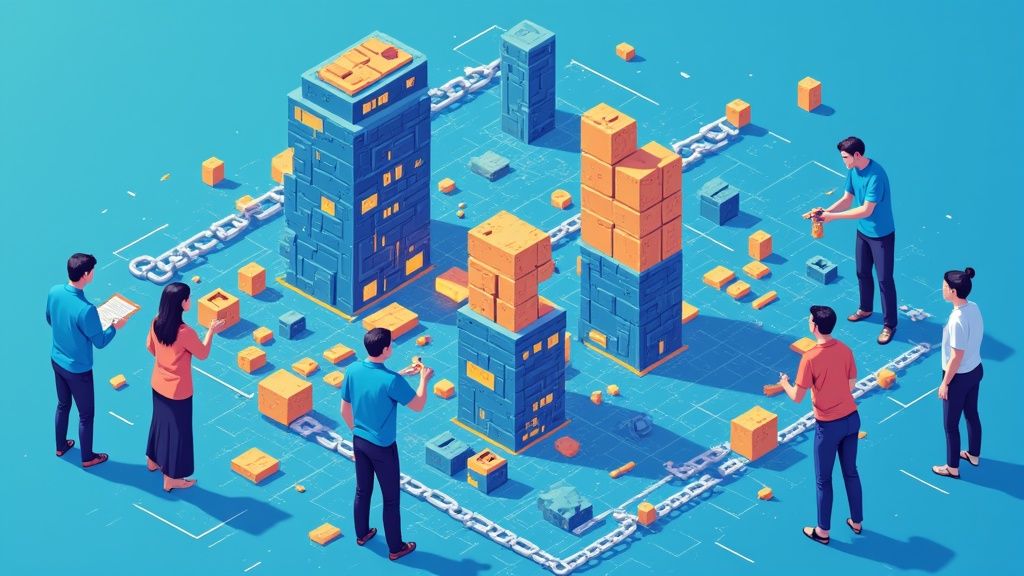
Let's cut right to it. A Web3 community program isn't your standard marketing campaign. It’s a carefully designed system that uses incentives—think tokens, NFTs, and reputation points—to get your community members actively involved in building your project.
Instead of just having a passive audience, you're creating a team of active contributors. This approach turns your community into a genuine growth engine, driving everything from user acquisition to decentralized governance.
What Is a Web3 Community Program, Really?
In Web3, your community is everything. They're not just consumers; they're your co-builders, your most vocal supporters, and your most valuable asset. A community program is the framework you use to unlock that potential. It's about moving people from simply "liking" a post to taking meaningful actions that push the entire project forward.
Here’s an analogy: Imagine you’re building a new city. You could just lay down roads and put up buildings, then hope people move in. That’s the old way.
Or, you could give the first residents a real stake in the city's future. Reward them for building homes, opening shops, and even participating in the city council. This creates a vibrant, self-sustaining ecosystem where everyone is invested. That's exactly what a good community program does.
This isn't some niche idea, either. The market for community platforms is exploding, on track to grow from $454 million in 2021 to over $2.67 billion by 2033. That massive jump tells you something big is happening in how projects connect with their people.
From Lurkers to Leaders
The primary goal here is to turn passive lurkers—the folks who just hang out in your Discord or follow you on X (formerly Twitter)—into active, engaged contributors. You do this by creating a clear "give-and-get." The community completes tasks that add value, and in return, the project provides rewards that have value.
A solid program is built on three core pillars:
- Quests: These are the specific tasks you want people to do. They can be simple things like sharing content on social media or more involved on-chain actions like staking tokens or providing liquidity.
- Rewards: This is the "what's in it for me?" part. Rewards can be anything from project tokens and exclusive NFTs to special Discord roles or a top spot on a leaderboard.
- Verification: You need a reliable, often automated, way to confirm that tasks were actually completed. This keeps the program fair, prevents gaming the system, and ensures rewards go to the right people.
This diagram shows how these pieces fit together to create a powerful feedback loop.
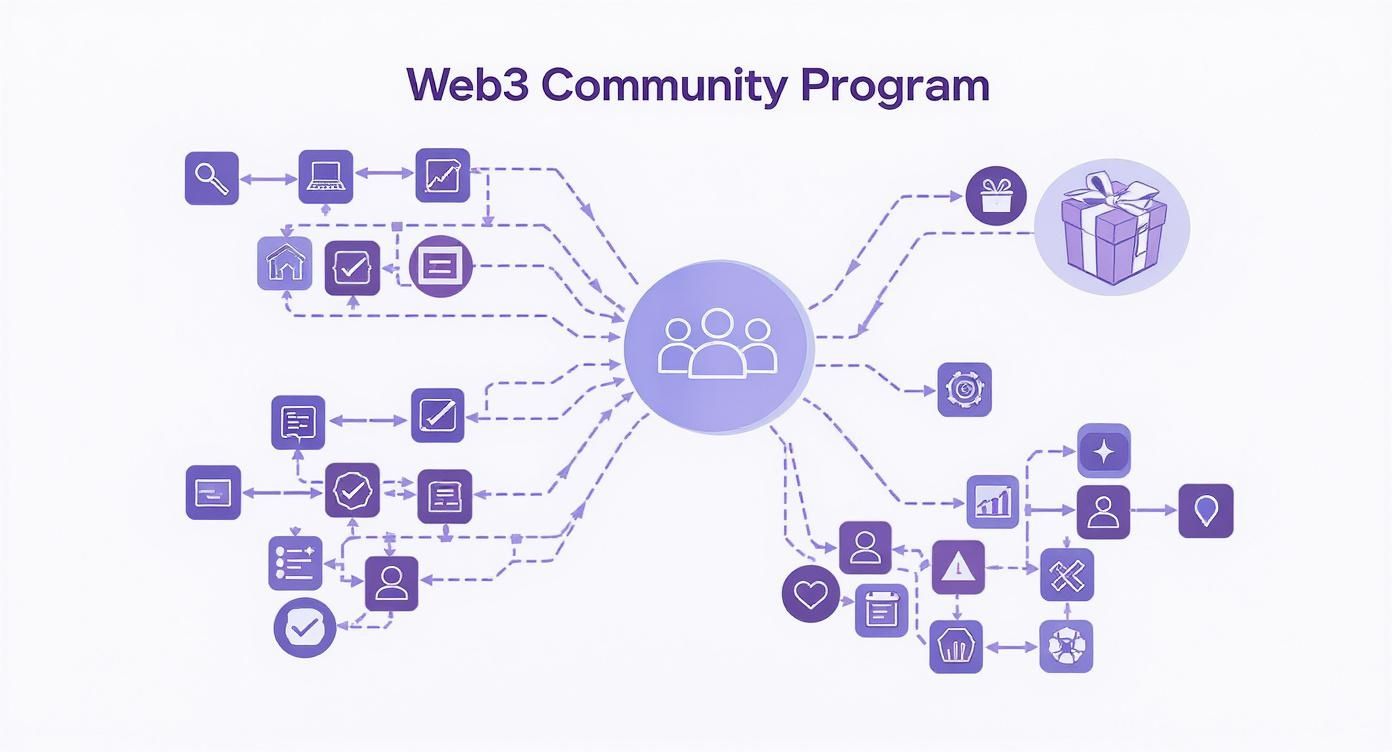
As you can see, it's a cycle. Members are consistently motivated to contribute, which drives real, measurable growth for the project.
Why This Is Non-Negotiable in Web3
The whole point of decentralization is to move away from top-down control and toward community-led growth. In that context, a community program isn't just a "nice-to-have" marketing tactic—it's a core strategic function.
It’s how you align thousands of different people around a shared goal. It's how you scale actions that would be impossible to coordinate otherwise. To get a better handle on the psychology behind this, check out our guide on community gamification. This approach makes sure your project grows in a way that’s sustainable, decentralized, and powered by the people who believe in it most.
Setting Goals That Actually Drive Growth
A community program without a clear destination is just a collection of busywork. You can have all the activity in the world, but if it's not pushing your project forward, you're just spinning your wheels. The first, most critical step is to look past the vanity metrics. Sure, a 100,000-member Discord server looks great in a pitch deck, but if 99% of them are silent, what have you actually built?
Your community goals need to be bolted directly to your project's core mission. What's the end game here? Are you a new DeFi protocol desperate for liquidity? Or are you launching a new NFT collection where cultural hype and holder loyalty are everything? Your answer changes the entire playbook.
Ditching Vanity for Value
Let’s get real. Meaningful growth isn't about how many people are in your Telegram; it’s about how many of them are actively staking, voting, or building. It’s not about the raw number of followers, but how many of them become true evangelists for your project.
Think of your community program as a gentle guide, nudging members toward actions that add real, sustainable value to the ecosystem. This simple shift in perspective is what separates projects that generate a massive return on their community spend from those that just burn cash on airdrops.
The most important mindset shift you can make is from asking "How big is our community?" to "How active and impactful is our community?" Real growth comes from the depth of engagement, not just the width of your reach.
This means every quest, every reward, and every campaign needs to be designed backwards from a key business objective. Before you build a single thing, ask yourself: "What specific, measurable thing do we want our community to do, and why does that action matter for our long-term survival?"
Aligning Goals with Your Project's Mission
Your project’s mission sets the community’s mission. A community program for a Layer 1 blockchain is going to look completely different from one for a Web3 social app. The key is to integrate proven community building strategies that are custom-fit for what you're trying to accomplish.
Here’s how that plays out for different types of projects:
For a DeFi Protocol: Your holy grail is probably Total Value Locked (TVL). So, your program should reward people for providing liquidity, staking tokens, or borrowing assets. The main Key Performance Indicator (KPI) is simple: is our TVL going up because of what our community is doing?
For a Developer Platform: Your success is measured by the health of your builder ecosystem. Your goals should focus on attracting devs, getting them to build cool stuff on your platform, and contributing to documentation. You'd track KPIs like new GitHub repos created, smart contracts deployed, or the number of active developers in your forums.
For a DAO or Governance Protocol: Here, it's all about active, decentralized participation. You want to reward members for writing proposals, voting on important issues, and engaging in thoughtful debate. Success is measured by metrics like voter turnout percentage and the number of unique proposal authors.
Nailing down these objectives from the very beginning gives you a laser-focused community program. It ensures every bit of effort and budget is spent moving the needle on what truly matters, transforming your community from a cost center into your most powerful growth engine. This clarity makes it infinitely easier to design quests that work and, just as importantly, to prove that they're working.
Community Program Goals and Corresponding KPIs
To make this more concrete, let's break down how specific goals map to measurable KPIs. This table helps you connect the "what" (your goal) with the "how" (the metrics you'll track to see if you're succeeding).
| Program Goal | Primary KPI | Secondary KPIs | Example Action |
|---|---|---|---|
| Increase On-Chain Activity | Daily Active Wallets (DAW) | Transaction Volume, Total Value Locked (TVL), Smart Contract Calls | Reward users for completing their first on-chain swap or providing liquidity. |
| Boost Social Engagement | Social Mentions & Reach | Follower Growth, Engagement Rate (likes, replies), Sentiment Analysis | Run a meme contest on X (Twitter) or reward users for sharing a product update. |
| Drive Product Adoption | New User Sign-Ups / App Installs | User Retention Rate, Feature Adoption Rate, Conversion Rate | Offer an incentive for users who connect their wallet and complete an in-app tutorial. |
| Grow Developer Ecosystem | Number of Active Developers | New Repos Created, Smart Contracts Deployed, API Calls | Launch a hackathon or create quests for developers who submit a bug fix on GitHub. |
| Strengthen Governance | Voter Turnout Percentage | Number of Proposals Submitted, Unique Voters, Delegation Rate | Reward members for casting their first vote or delegating their voting power. |
Think of this table as a starting menu. Pick the goals that align with your project's current stage and use the KPIs to build a dashboard that gives you a clear, honest picture of your community's impact.
Designing Your Reward System Without Creating Mercenaries
Rewards are the lifeblood of any good community program, but man, are they a double-edged sword. Nail the reward system, and you'll spark a fire in a passionate, loyal user base. Get it wrong, and you'll find yourself overrun by mercenaries—users who are only there to extract value and then vanish the second the rewards dry up.
The secret is to design a system where incentives are perfectly aligned with long-term value. This means getting away from the simple, high-volume token handouts that just encourage a “farm-and-dump” mentality. A truly great reward structure should feel more like earning equity in the project, not just cashing a paycheck. It’s all about rewarding the consistent, meaningful contributions that actually help the ecosystem grow, not just the noisy, low-effort social media spam.
Beyond Tokens: The Spectrum of Rewards
Look, tokens are a fantastic incentive, but they can't be the only tool in your toolbox. A diverse reward system speaks to different motivations, which in turn creates a much more resilient and genuinely engaged community. The real goal here is to layer different kinds of rewards so people stay invested for all sorts of reasons.
Here are a few models to play with:
- Points and Leaderboards: This is classic gamification for a reason—it works. It's especially great for driving high-frequency, lower-effort tasks. Points give people a real sense of progression and a little friendly competition. We actually wrote a whole guide on racking up points in Web3 programs if you want to go deeper.
- Reputation and Roles: Not every reward has to have a dollar sign attached to it. Things like exclusive Discord roles, special badges, or a "Community OG" title can be incredibly powerful motivators. They signal status and recognize the people who are truly adding value.
- Milestone-Based NFTs: Instead of just another fungible token, why not reward significant achievements with unique, soulbound (non-transferable) NFTs? This creates a permanent, on-chain record of someone's contributions and gives them a serious sense of pride and belonging.
- Access and Privileges: This one is huge. Offer your top contributors early access to new features, exclusive AMAs with the core team, or even a seat on a community council. You're rewarding their loyalty with real influence, not just cash.
Structuring Incentives for Long-Term Loyalty
How you structure your reward system is just as crucial as what the rewards are. A poorly planned system can drain your treasury in a heartbeat and attract exactly the wrong kind of people. To build a sustainable community program, you really need to start thinking like an economist.
Vesting schedules are your absolute best friend. Seriously. Instead of dropping a massive token reward on someone all at once, release it over time—say, over 6-12 months. This simple little mechanism gives recipients a compelling reason to stick around and keep contributing to the project's long-term success.
A reward system's success isn't measured by the initial hype it generates, but by the percentage of rewarded users who are still active six months later. Longevity is the ultimate metric of a healthy incentive structure.
On top of that, you should absolutely consider tiered rewards. Your most valuable contributors—the ones writing code, creating in-depth tutorials, or leading governance discussions—should get disproportionately larger rewards than someone who just retweets your announcements. This sends a crystal-clear signal about what actions your project truly values.
Navigating Legal and User Experience Hurdles
Before you even think about launching, you have to get your head around the legal and user experience (UX) side of things. It's critical. On the legal front, regulations around securities, taxes, and promotional contests can be a minefield and vary wildly depending on where you are. Always, always consult with legal counsel to make sure your program is compliant and to understand the implications of giving out tokens that might be seen as securities.
From a UX perspective, complexity is the enemy. The entire process for earning and claiming rewards has to be dead simple, transparent, and intuitive. If users have to jump through a dozen hoops or can't figure out how the system works, they're going to lose interest and walk away. Clear communication and a seamless user interface aren't just nice-to-haves; they are non-negotiable for keeping your community engaged and fired up.
Choosing the Right Tools to Automate and Scale
Trying to run a community program by hand is a fast track to burnout. Seriously, can you imagine trying to manually verify thousands of tweets, track Discord messages, and airdrop rewards with just a Google Sheet and pure grit? It’s not just a headache; it’s completely unscalable.
The right tech stack is the difference between a program that takes off and one that collapses under its own weight. Good tools handle all the repetitive, soul-crushing tasks for you. This frees you up to focus on what actually matters: strategy, building real relationships, and creating cool experiences for your members. Without automation, you're not a community manager—you're an admin.
The Core Components of Your Tech Stack
To build a program that runs like a well-oiled machine, you need a few key tools that play nicely together. The idea is to create a seamless flow from the moment a member sees a quest to the second they get their reward, all with as little manual poking as possible.
Your tech stack will generally need to cover these bases:
- Questing and Engagement Platforms: This is your command center. It’s where your community finds tasks, submits their work, and tracks their progress.
- Analytics and Dashboards: You have to know what's working and what's not. These tools help you track your KPIs, watch on-chain activity, and get a real sense of what your members are doing.
- Anti-Bot and Verification Systems: To keep things fair and legitimate, you need a solid way to filter out bots and prevent Sybil attacks. This usually involves checking social accounts or on-chain credentials.
- Communication Hubs: Your community lives on platforms like Discord, Telegram, and X (formerly Twitter). Your tools have to integrate directly with these channels to meet people where they are.
This whole ecosystem can get complicated, which is why a central platform is so crucial for tying it all together into a single, manageable workflow.
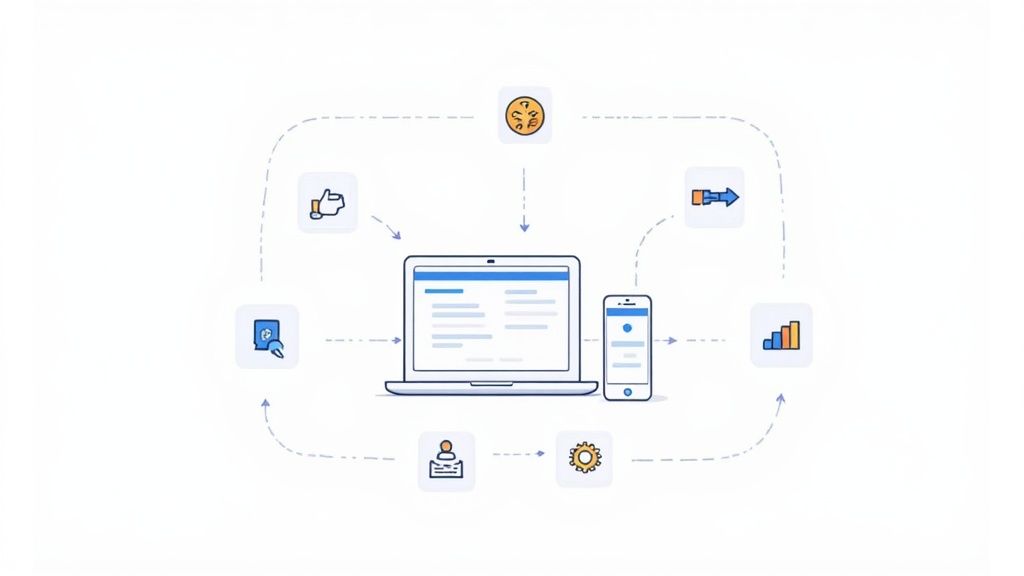
Think of a platform like Domino as the central nervous system connecting everything you do off-chain with the results you want to see on-chain.
Streamlining Your Operations with an Integrated Platform
Sure, you could try to stitch together a bunch of different tools, but an all-in-one platform saves so much time and provides a much cleaner user experience. These integrated solutions are designed to handle the entire lifecycle of a quest—from creation and promotion all the way to verification and reward payouts. They turn a clunky, multi-step process into one fluid motion.
For instance, a platform like Domino can automatically check if a user retweeted a specific post, joined your Telegram, and staked a certain number of tokens. Trying to verify that combination of actions manually across thousands of users is a nightmare. With the right tooling, it’s effortless.
An integrated questing platform doesn't just save you time; it unlocks new strategic possibilities. When you're not buried in manual verification, you can design more complex, high-value campaigns that would otherwise be unthinkable.
If you're serious about building a sustainable community program, this kind of platform is a must-have. It gives you the foundation to run sophisticated growth campaigns without needing to hire a huge operations team. For a deeper dive into what's out there, check out our complete guide to Web3 quest platforms. This automation ensures your program can grow right alongside your community, keeping things fair and efficient no matter how big you get.
Measuring Success and Optimizing for the Long Haul
So, you’ve launched your community program. Congratulations! But don't pop the champagne just yet—this is the starting line, not the finish. The real work, the part that separates legendary communities from forgotten ones, begins now.
Think of it as steering a ship across the ocean. You have a destination in mind (your goals), but you can't just point the bow and hope for the best. You need to constantly check your compass, read the weather, and adjust your sails. A "set it and forget it" attitude is a guaranteed way to end up adrift. Your community is alive, always changing, and your program needs to change with it.
Building Your Program Dashboard
You can't fix what you can't see. The first order of business is setting up a simple dashboard to track the key performance indicators (KPIs) you decided on earlier. This doesn't need to be some over-the-top, enterprise-grade analytics suite. A clean, straightforward dashboard showing your most important numbers is all you need for a quick health check.
Your dashboard should give you fast answers to crucial questions:
- Who are my power users? Pinpoint the top 5% of members who are driving real on-chain activity or creating the most valuable content. These are your champions.
- Which quests are actually working? Figure out which tasks people are completing most often and which ones are leading to the actions you want to see.
- Are the rewards motivating people? See if your token rewards, NFTs, or special Discord roles are actually getting people to participate.
Keeping an eye on these metrics lets you double down on what’s working and ditch the stuff that isn’t. It’s all about putting your time and resources where they’ll have the biggest impact.
Creating a Powerful Feedback Loop
Numbers tell you what is happening, but they don't always tell you why. That's where your community comes in. Marrying the hard data from your dashboard with direct feedback from your members creates a super-powerful loop for improvement.
This isn't just about making people feel heard; it’s a core strategy. Look at global health initiatives for a massive real-world example. Since 2002, The Global Fund has poured $27.6 billion into HIV programs, and a huge part of their success came from deep community engagement. By listening to local communities, they scaled up prevention and treatment in ways that actually worked on the ground. You can see the full results of their community-driven approach right here. It's a powerful lesson: listening to and empowering your people leads to incredible results.
Your goal is to get into a rhythm: Listen > Analyze > Adjust > Repeat. This simple cycle is the secret to keeping your program fresh, relevant, and valuable as your project grows up.
Turning Insights into Action
Okay, you've got the data and you've heard the feedback. Now for the most important part: doing something with it. Information without action is just noise.
Did you find out a certain type of quest is a huge hit? Make more of them. Are your most dedicated members clamoring for a specific reward? Give it a shot. Is a particular task confusing people? Clarify the instructions or scrap it.
This constant tweaking is what turns a static campaign into a living, breathing engine for growth. By consistently measuring, listening, and optimizing, you’re not just hitting your initial targets—you're building a resilient program that can adapt to whatever comes next for your project and its community.
Got Questions About Web3 Community Programs? We've Got Answers.
When you're first diving into community building in Web3, a few big questions always seem to pop up. Let's walk through some of the most common ones I hear from teams, so you can get clear answers and avoid some early mistakes.
How Much Should I Actually Budget for Rewards?
This is the million-dollar question, isn't it? While there's no single magic number, a healthy starting point is to set aside 1-5% of your total token supply for your community rewards pool.
For early-stage projects, that budget should be laser-focused on actions that move the needle on your most critical goals—whether that’s bringing in new users, deepening on-chain liquidity, or sparking user-generated content.
The key is to think long-term. Don't just dump it all at once. You need to model out how you'll distribute these rewards over a sustainable timeframe, say 24-36 months. This prevents you from burning through your incentive runway too fast. And remember, it’s not just about tokens. You also need to account for costs like NFT minting, platform fees, and the people-power required to actually run the program.
My advice? Start small, see what works, and then pour more fuel on the fire as you prove the ROI.
Airdrop vs. Community Program—What’s the Real Difference?
It’s easy to get these two mixed up, but the distinction is actually pretty simple.
An airdrop is a one-time event that rewards past actions. A community program is an ongoing engine for driving future growth.
Think of an airdrop as a look in the rearview mirror. It's usually a one-off token drop to thank early users or decentralize your token supply based on what people have already done.
A community program, on the other hand, is all about the road ahead. It's a structured, long-term system of quests and incentives designed to encourage specific, valuable behaviors moving forward—things like staking, participating in governance, or creating tutorials.
How Do I Stop Bots and Sybil Attacks from Ruining Everything?
Keeping bots out is critical. If you don't, you’re just lighting your rewards budget on fire. There’s no silver bullet here; you need to build a layered defense.
- Social Proof: Make users connect real, established accounts from places like X (formerly Twitter), Discord, or GitHub. A brand new account is a huge red flag.
- On-Chain History: Require participants to hold a minimum number of tokens or have a verifiable transaction history. Real users leave footprints.
- Proof of Humanity: This is a big one. Use tools like Gitcoin Passport, BrightID, or even Worldcoin to verify that a participant is a unique human being.
- Design Smarter Quests: Create tasks that are a nightmare for bots to automate. Think high-quality content creation, nuanced participation in a governance discussion, or something that requires genuine human creativity.
Your best bet is to combine a few of these methods. That way, you can be confident your rewards are going to the real people who are actually adding value to your ecosystem.
Ready to ditch the spreadsheets and start building a community that truly scales? Domino gives you a no-code toolkit to design, launch, and automate your entire program in minutes. Build your first quest today.