Your Guide to Crypto Points Programs and Airdrops

You’ve probably heard of crypto points programs. At their core, they’re just a modern spin on the classic loyalty system, used by Web3 projects to track and reward the people who actually use their platform.
Think airline miles or the punch card at your local coffee shop. But instead of a free flight or a latte, your points often lead to something much more exciting: a future token airdrop. This gives you a real, tangible stake in the project you're helping to build.
What Exactly Is a Crypto Points Program?

Simply put, a crypto points program is a way for projects to see who’s contributing and to encourage the right kinds of behavior. This isn't just about buying something once. The actions can be anything from engaging with them on social media to executing complex financial transactions on their platform. The main goal? To cultivate a genuinely active and dedicated community long before a token ever hits the market.
It’s all about building an ongoing relationship. These programs encourage people to stick around for weeks or even months, transforming them from passive observers into true fans. That kind of long-term engagement is what really builds a healthy, sustainable ecosystem.
The Coffee Shop Analogy for Web3
Let's stick with that coffee shop idea for a second. Imagine your favorite spot gives you a digital stamp for every coffee you buy. Collect ten, and you get a free one. Crypto points programs run on the same basic idea, just with a Web3 twist.
- Buying Coffee: This is the equivalent of doing something on a crypto protocol—maybe you swapped some tokens, lent out an asset, or staked an NFT.
- Getting a Stamp: For every action you take, the protocol gives you points, which it tracks in a database tied to your wallet.
- The Free Drink: This is the big prize at the end, which is usually a token airdrop when the project finally launches.
The big difference here is that the "stamps" (your points) aren't just for one thing. Projects will often reward you for a whole range of activities, creating a dynamic system that recognizes all kinds of different contributions.
Key Takeaway: Points are just a way to measure your loyalty and contribution to a project's growth. They act as a transparent, non-financial scorecard of your engagement that often comes before a valuable token distribution.
Why It's More Than Just a Game
Sure, these programs can feel like a game. You've got leaderboards, special multipliers, and bonus quests. But underneath it all, their purpose is incredibly strategic. They help projects pinpoint their most committed early supporters, making sure that when the token does launch, it lands in the hands of people who actively helped the community grow from the ground up.
A lot of these systems borrow ideas from the world of gamification to make otherwise complex financial actions feel more fun and approachable. If you're curious about the tools behind this, you can look into different types of gamification software.
Ultimately, it all comes down to aligning incentives. When you participate, you aren’t just chasing a potential payday. You're actively helping a new network succeed, and the points system is just how the project keeps score and eventually says thank you.
Why Points Are Taking Over Web3
Let's be honest, the old airdrop model was kind of a mess. It was a one-and-done deal, a snapshot in time that rewarded a single action. While exciting, it often attracted the wrong crowd: short-term flippers who would dump their tokens and vanish, leaving projects with a ghost town for a community.
Projects quickly caught on that this approach was unsustainable. It was like throwing a huge, expensive party for a bunch of strangers who leave the second the free food runs out. There had to be a better way to build a real, lasting community, and that's where points came in.
From Airdrop Hunters to Loyal Contributors
The biggest headache with the old model? Sybil attacks. This is where one person spins up hundreds, or even thousands, of fake wallets to game the system and snag a massive chunk of the airdrop. It punished real users and left projects with bloated, fake communities.
Points programs flip this script entirely. Instead of rewarding a single moment, they reward a continuous stream of activity over weeks or months. This makes it a massive pain for Sybil attackers to keep up the facade. For genuine users, though, it’s a natural way to get recognized for their ongoing support.
A well-designed points system acts as a filter. It’s built to reward genuine contribution over short-term opportunism, shifting the focus from who can cheat the system to who actually adds value.
This changes the entire vibe. People aren't just showing up for a quick payday anymore; they're becoming part of the project's journey. This builds a strong base of users who actually get the protocol, believe in the vision, and are far more likely to stick around after the token goes live.
Building a Community Before the Token
One of the smartest things about a points program is that it lets you build a thriving community before you even have a token. It’s a genius way to get a pre-launch feedback loop going. You can watch how people use your product, see which features are a hit, and tweak things based on real engagement.
This strategy pays off in a few huge ways:
- Identifies Power Users: You can immediately spot your most dedicated community members and make sure they get rewarded for their efforts.
- Encourages Deeper Engagement: It motivates people to do more than just one transaction. They start exploring everything your protocol offers, from lending and borrowing to weighing in on governance.
- Generates Organic Hype: Nothing gets people talking like a public leaderboard. A little friendly competition and the constant drip of earning points creates a natural buzz that marketing dollars can't buy.
The proof is in the numbers. This model is clearly resonating. A recent report found that over 45 million users have jumped into crypto points programs, which is a whopping 60% increase from the year before. One major exchange's program, for example, pulled in over 12 million active participants in just six months, with people earning an average of $180 in rewards. You can dig into more data on crypto adoption trends to see the full picture.
At the end of the day, points are winning because they just make more sense. They align everyone's incentives way better than old-school airdrops. They offer a clear, fair way to reward real participation, building a tougher, more loyal community from the get-go. This turns the token launch from a wild, speculative gamble into a celebration of a community's hard work.
How a Points Program Actually Works
So, we know crypto points programs are all about tracking and rewarding user actions. But what's really going on under the hood? It’s not magic—it's a deliberate design choice that balances things like speed, cost, and how much you can trust the system.
At its core, any points program is just a big ledger answering one simple question: who did what, and how many points do they get for it? The real fork in the road is where that ledger lives. That single decision shapes the entire experience for both the project and its users.
The Off-Chain Approach: All About Speed and Simplicity
The most common way to build a crypto points program is with an off-chain system. This just means all the point data—who earned what, for what action—is stored in a private database, just like your Amazon order history. It's fast, simple, and sits on the project's own servers.
This approach is popular for a few really good reasons:
- It’s Fast: Actions and points get updated instantly. No waiting around for a block to confirm. This makes the user experience feel snappy and responsive.
- It’s Cheap: Since you aren't paying gas fees to record every little action on a blockchain, the operational costs for the project are next to nothing. This lets them reward tons of small, frequent actions without going broke.
- It’s Flexible: The team can easily tweak point values, add new ways to earn, or fix a mistake without the headache of dealing with an unchangeable blockchain.
The catch? Transparency. You have to trust that the project is keeping score accurately behind the curtain. It's a system built on faith in the team running the show.
The On-Chain Method: Built on Trust and Transparency
On the other side of the coin, you have the on-chain approach. Here, every point is recorded directly on a blockchain, usually as a special kind of token or as data inside a smart contract. Every point awarded is a public transaction anyone can go look up and verify.
This method is all about trustlessness. You don't have to trust the team; you can just trust the code. It’s the Web3 ethos in action.
But, that level of transparency isn't free. Every point update is a blockchain transaction, which means it can be slow and expensive, especially on a busy network like Ethereum. This makes on-chain systems a tough sell for tracking high-frequency, low-value stuff like liking a tweet or joining a Discord.
The Big Takeaway: The choice between on-chain and off-chain isn't about which one is "better." It's a strategic trade-off. Do you prioritize the speed and low cost of a private database, or the verifiable trust of a public blockchain?
This diagram really nails down how user engagement flows from individual actions, through incentives, and ultimately into building a powerful community.
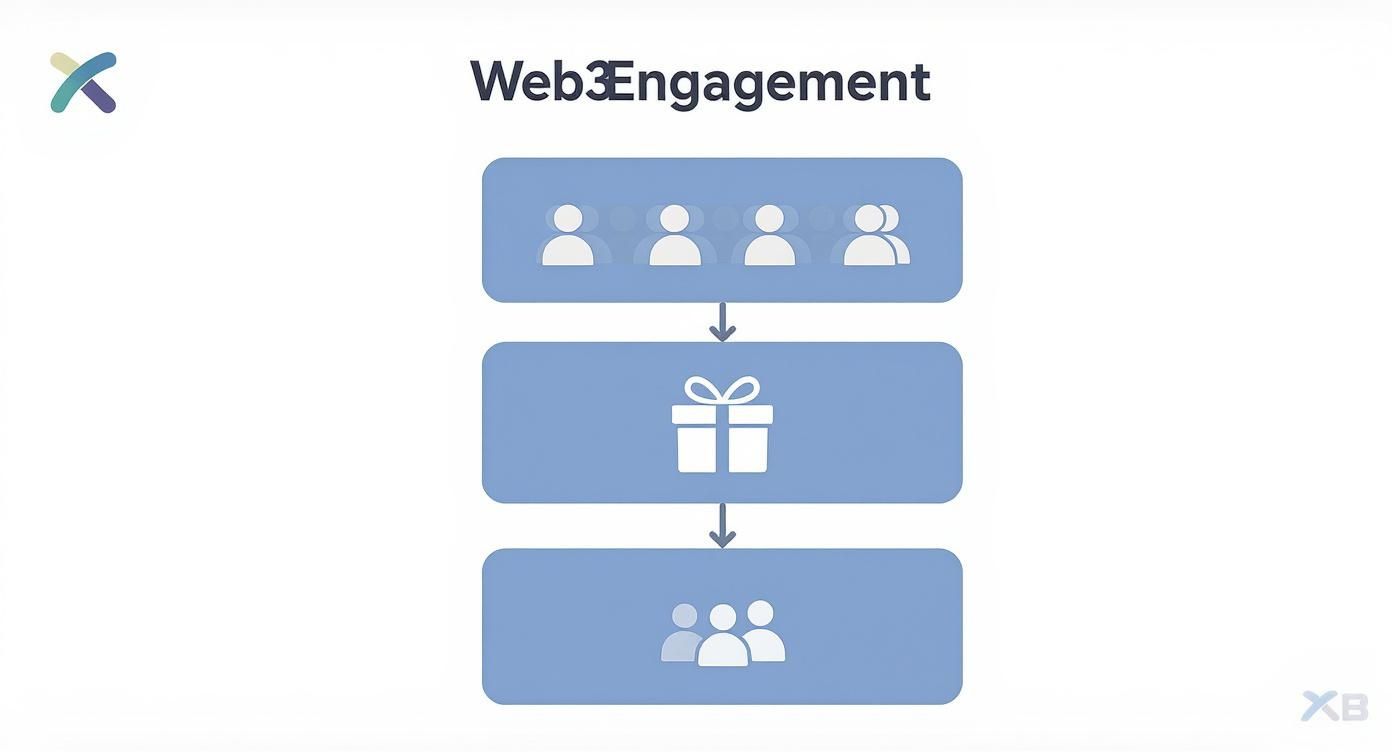
The whole point is to use these incentives as the bridge that turns a bunch of individual users into a cohesive and motivated community.
To make the differences crystal clear, let's break down how these two systems stack up side-by-side.
On-Chain vs Off-Chain Points Systems Compared
| Feature | On-Chain System | Off-Chain System |
|---|---|---|
| Data Storage | Public Blockchain (e.g., Ethereum, Solana) | Private, Centralized Database |
| Transparency | Fully transparent. Anyone can verify all transactions. | Opaque. Users must trust the project's records. |
| Speed | Slow. Limited by blockchain confirmation times. | Instant. Updates happen in real-time. |
| Cost | High. Every action requires a gas fee. | Very low to free. No on-chain transaction costs. |
| User Experience | Can be clunky, with transaction delays. | Smooth, fast, and feels like a Web2 app. |
| Security | Inherits the security of the underlying blockchain. | Depends on the project's internal security measures. |
| Flexibility | Rigid. Changes are difficult and costly to implement. | Highly flexible. Easy to add/change rules or fix errors. |
| Best For | High-value, low-frequency actions; building trust. | High-frequency actions; user acquisition and engagement loops. |
As you can see, there are clear pros and cons to each. This is exactly why a third option has become so popular.
Finding a Middle Ground with Hybrid Models
Smart projects know that it doesn't have to be an all-or-nothing decision. Many are now using a hybrid model that grabs the best of both worlds.
Here’s how it usually works:
- Track everything off-chain first: All the day-to-day stuff—swaps, social likes, referrals—is tallied up in a speedy private database. This keeps the user experience buttery smooth.
- Sync to the blockchain later: Then, at regular intervals (like once a week or at the end of a "season"), the project takes a snapshot of all those off-chain points and pushes a summary of the totals on-chain.
This approach gives you the responsive feel of an off-chain system while still providing those crucial, verifiable checkpoints for transparency. It's a practical compromise that keeps users happy without totally abandoning the trustless principles of Web3.
Proven Strategies to Maximize Your Points

Just showing up is easy. The real skill is learning how to game the system to maximize what you get back. Experienced airdrop hunters don't just click around randomly; they have a playbook for getting the most bang for their buck out of every single transaction. It’s all about working smarter.
Your first move? Play detective. Before you even think about connecting your wallet, dig into the project’s official documents and announcements. Teams often leave breadcrumbs, hinting at the actions they value most—be it trading volume, providing liquidity, or just logging in every day.
Figuring out their priorities gives you a treasure map. By focusing on what the project says it wants, you can be sure your time and money are going exactly where they’ll make the biggest difference to your final point count.
Pinpoint High-Multiplier Actions
Let's be clear: not all actions are created equal. Most points programs weigh tasks differently, and your job is to sniff out the ones with the biggest multipliers. Think of it like a video game—some quests give you 10 XP, but the boss battle nets you 1,000 XP. You want the boss battle.
So, what actions usually carry the most weight?
- Financial Commitment: Anything that involves locking up capital—like staking, providing liquidity, or lending assets—is almost always a high-value move. It shows the team you have long-term skin in the game.
- Core Functionality: Actually using the platform for its main purpose is a no-brainer. For a DEX, that means swapping tokens. For a lending protocol, it’s borrowing and supplying.
- Sustained Engagement: Daily check-ins, holding a position over time, or consistent trading activity often unlock loyalty bonuses that can really stack up.
For instance, a project might give you 1 point per dollar traded but offer a 2x multiplier on any liquidity you provide over $1,000. Finding these sweet spots early lets you allocate your funds way more effectively.
Master the Art of Consistency
A classic mistake is going hard for one day and then ghosting the project for weeks. But here’s the thing: these points programs are often designed specifically to filter out that kind of hit-and-run behavior. They're looking for real, sustained engagement.
Key Insight: Consistency is often a hidden multiplier. Protocols reward users who show up day after day because it proves genuine interest and helps build a stable, active community.
Get yourself into a simple routine. It could be as easy as logging in daily for a bonus, making one small trade a week, or making sure to participate in every governance vote. These small, steady actions often add up to way more points over time than one massive, one-off transaction. It shows you’re a real user, not just a mercenary.
Leverage Advanced Farming Techniques
Once you have the basics down, you can start exploring the more advanced strategies that the pros use to rocket up the leaderboards. These techniques can carry more risk, but they can also seriously amplify your points.
A popular method on lending protocols is "looping." Here's the rundown:
- Supply an Asset: You start by depositing an asset like ETH into the protocol.
- Borrow Against It: Then, you borrow another asset (usually a stablecoin) against your ETH collateral.
- Swap and Repeat: You take that stablecoin, swap it back to ETH, and deposit it right back into the protocol.
Each loop cranks up your total supplied and borrowed volume, which are often the key metrics for earning points. A word of caution, though: this strategy massively increases your liquidation risk if prices swing the wrong way.
Another pro-level tactic is getting involved in governance. Many projects throw bonus points at users who vote on proposals. This move has almost zero financial risk but signals that you're invested in the protocol's future—something core teams love to see.
To really get into the nitty-gritty of how these systems work and track your progress, check out our guide on racking up points and claiming your rewards. It's the perfect next step for anyone serious about this game.
Common Pitfalls and How to Avoid Them
While racking up points can be a rush, the airdrop farming game is riddled with traps. It’s a minefield for both the people chasing the rewards and the projects handing them out. If you don't watch your step, you can get burned.
For farmers, the biggest danger is getting starry-eyed about a potential payday. It's easy to get swept up in the hype and start making wild moves, completely forgetting that points have zero guaranteed value until a token officially exists. That kind of thinking is a fast track to losing money.
For projects, a clumsy points program can blow up in your face. If your rules are murky or easy to game, you'll end up attracting bots and mercenaries who will drain your resources, not the loyal community you wanted to build in the first place.
Dangers for Airdrop Farmers
The classic mistake farmers make is over-leveraging. People get so desperate to shoot up the leaderboard that they'll borrow huge sums to boost their activity. This puts them at enormous risk of getting liquidated if the market even hiccups. What good are a million points if you lose your entire bag getting them?
Another massive risk? Getting hit by slick phishing scams. Scammers are masters at creating pixel-perfect copies of official project websites or social media profiles. They trick you into connecting your wallet, and poof—your funds are gone. Always, always double-check URLs and be deeply suspicious of any "special offers" that sound too good to be true.
Critical Reminder: Points are not money. Think of them as in-game achievements, not a bank account. Giving them a dollar value before the project announces an official conversion rate is just asking for trouble.
Here are a few other blunders to steer clear of:
- Ignoring Gas Fees: On chains like Ethereum, transaction fees can eat you alive. Mindlessly chasing low-value points with high-cost transactions is a surefire way to end up in the red.
- Connecting to Shady Protocols: Do your homework. Before you let any smart contract near your wallet, look for security audits, a real community, and clear communication from the team.
- Putting All Your Eggs in One Basket: Spread the love! It’s much smarter to diversify your efforts across a few promising projects rather than going all-in on a single airdrop that might never happen.
Perils for Project Teams
If you're launching a points program, the number one pitfall is a poorly designed incentive structure. For example, if you only reward trading volume, you're just inviting wash traders to create fake activity without bringing any real value to your protocol. A smart program rewards a mix of actions that show a user is in it for the long haul.
You also absolutely need clear and consistent communication. If your community is confused about the rules or feels like you're constantly changing them, you’re just breeding resentment. Be upfront from day one about what the points are for—and what they're not. Managing expectations is everything.
Finally, if you don't have solid anti-Sybil measures, your whole campaign is basically worthless. Without good bot detection, you’ll end up rewarding a few clever farmers operating thousands of wallets instead of the thousands of real users you were trying to attract. This also means educating your users on how to properly receive an airdrop and keep it secure is vital for a fair and safe launch.
Building a Points Program with No-Code Tools
For the builders and creators out there, crypto points programs are a massive opportunity. But let's be real—the thought of building one from the ground up is daunting. Coding smart contracts, setting up secure databases, and managing all the verification logic? That’s a full-time job for an engineering team, pulling them away from what they should be doing: building your core product.
Thankfully, a new wave of no-code platforms is completely changing the game. Think of them as a powerful set of building blocks that let you design, launch, and scale a sophisticated crypto points program without writing a single line of code. This is a huge unlock for smaller teams and marketers who want to focus on brilliant strategy, not tedious server maintenance.
From Idea to Launch in Minutes
Let's say you're launching a new DeFi protocol. You want to reward early birds for things like providing liquidity, swapping tokens, and bringing their friends into the fold. In the old days, this would have kicked off a development cycle that could easily stretch for months.
With a no-code toolkit, the process is worlds apart. You can use a simple visual interface to spell out exactly which actions, both on-chain and off, earn points.
- Action: A user swaps over $100 in one go. Reward: 50 points.
- Action: A user provides liquidity for more than 7 days. Reward: 200 points plus a 1.5x multiplier.
- Action: A user refers a friend who makes a swap. Reward: 100 points for both of them.
You’re not coding; you’re just setting these rules up through dropdown menus and input fields. In minutes, you’ve built a complex and dynamic rewards system. If you want to understand the nuts and bolts behind this, it’s worth exploring what no-code automation entails and how it makes complicated workflows simple. This whole approach shatters the technical bottleneck, letting your team test ideas and launch campaigns in hours, not months.
This screenshot from a no-code platform shows just how easy it is to cook up a points-based quest.
You can see clear, straightforward options for defining tasks, setting rewards, and automating the check-ins—all inside a clean, user-friendly dashboard.
Automating Verification and Distribution
Honestly, one of the biggest headaches of running a points program is verification. How do you prove someone actually did the thing they said they did? Trying to do that by hand is a recipe for disaster at scale. This is where no-code platforms really shine, by integrating directly with blockchains and social media APIs to handle it all for you.
When a user says they’ve completed a task, the system instantly checks for the transaction on-chain or verifies the social media post through an API. This keeps everything fair and makes it much harder to game the system. Once the points are all tallied up, these platforms can even help with what comes next. For example, you can explore templates for how to distribute token rewards based on leaderboard points, which closes the loop from user action to real reward.
Key Advantage: No-code tools handle all the tedious backend grunt work—verification, anti-bot measures, and leaderboard updates—so you can focus on the fun stuff: creating awesome campaigns and growing your community.
This push for simplicity is even spilling over into the mainstream. We're seeing more and more crypto points programs integrated with traditional loyalty systems, especially in North America and Europe. In the United States, over 30% of top e-commerce sites now offer crypto points in their loyalty programs, with an estimated 15 million users already participating. This isn't just a niche trend; it shows a clear demand for reward systems that are easy to access and use. No-code platforms are perfectly positioned to meet this need for Web3 projects, tearing down the technical walls and empowering more creators to build the next generation of loyalty.
Got Questions? We've Got Answers
Still have a few things you're wondering about crypto points? Let's clear up some of the most common questions that pop up.
Are Crypto Points and Tokens the Same Thing?
Nope, not at all. It's a common point of confusion, but they are fundamentally different.
Think of points as a project's internal leaderboard score. They're usually just numbers in a database, tracked off-chain, and they don't have any real-world monetary value on their own. You can't just go and sell them on an exchange.
Their whole job is to act as a yardstick, measuring how much you're contributing and engaging with a project. The hope, of course, is that these points will eventually lead to a real token airdrop, but that's entirely up to the project team—they decide if, when, and how that conversion happens.
Where Can I Find New Points Programs to Join?
Getting in early is the name of the game, and finding the right programs is half the battle. Your best bet is to stay plugged into the crypto scene. Follow well-known crypto news sites and the airdrop hunters who live and breathe this stuff on social media, especially X.
Another great move is to jump directly into the community hubs—the Discord and Telegram channels of new projects. Keep a close eye on protocols that just announced a big funding round; they're often the next ones to launch a points program. Just remember the golden rule: always do your own research to make sure a project is legit before you even think about connecting your wallet.
Can I Actually Lose Money Farming Points?
Yes, 100%. This is a critical point to understand. While the points themselves are worthless, the activities you have to do to earn them can carry very real financial risks.
For instance, if you’re providing liquidity to a new protocol, you're exposing yourself to potential smart contract bugs or the dreaded impermanent loss. If you borrow assets to supercharge your activity, a sudden market downturn could get you liquidated. Before you jump in, make sure you fully grasp the risks of whatever on-chain actions you're taking.
Ready to kick off your own crypto points program and build a thriving community? With Domino, you can create and manage reward-based quests in just a few minutes, no coding needed. Start building your campaign today at domino.run.