community rewards: Build lasting Web3 engagement with loyalty programs

Think of community rewards as a way to thank and motivate the people who actually help your project grow. It’s a complete shift from the old model of just getting people to buy stuff. Instead of only rewarding purchases, you're rewarding actions that build a stronger, more vibrant ecosystem. This is about recognizing real ownership and influence.
Why Community Rewards Are the New Loyalty in Web3
Forget the old punch cards and forgettable points systems. In the Web3 world, your community members aren't just customers waiting for a discount—they're your co-creators, your biggest fans, and your stakeholders. A smart rewards program gets this.
Imagine it's a massive, open-world video game. You wouldn't just reward players for buying things from the in-game store, right? Of course not. You'd give them experience points, rare items, and status for exploring new territories, helping out fellow players, or adding to the game's story. That's what makes them feel invested—like they're a part of the world's success, not just a consumer passing through.
From Consumption to Contribution
This is a fundamental pivot from "buy more, get more" to a "contribute more, earn more" way of thinking. It might sound like a small change, but it completely transforms how members feel about your project. It’s the difference between being a fan in the stands and being a player on the field.
The real goals here go way beyond just boosting sales. A good program is designed to:
- Spark genuine engagement by rewarding actions that actually move the needle, like creating killer content, giving sharp feedback, or bringing new people into the fold.
- Decentralize project growth and let your community take the reins on things like marketing, user support, and even innovation.
- Build a tough, resilient ecosystem full of dedicated people who are truly in it for the long haul.
And the data backs this up. A whopping 70% of people say they prefer loyalty programs that have an active community component. This need for social connection is especially true for younger crowds, who value shared experiences way more than a simple discount.
The most powerful Web3 projects are built with their communities, not just for them. Community rewards are the mechanism that transforms passive users into an army of active builders, turning your project into a movement.
At the end of the day, this strategy is about building real relationships, not just processing transactions. To see how this trend is playing out across the board, check out this guide on data-driven loyalty marketing. When you reward meaningful contributions, you create a powerful flywheel where every member's action adds value for everyone, fueling sustainable growth and a fiercely loyal community.
Using Psychology to Design Rewards People Actually Want
What makes a rewards program so good that people can't stop coming back? It's not just about the size of the prize. The best programs are built on a solid understanding of what makes us tick, turning basic tasks into experiences that feel genuinely compelling.
At the end of the day, motivation isn't just a transaction. It's fueled by powerful internal drivers. When you design your community rewards to tap into these core human needs, you create a system that feels less like a checklist and more like a shared mission.
Tap into Autonomy, Mastery, and Purpose
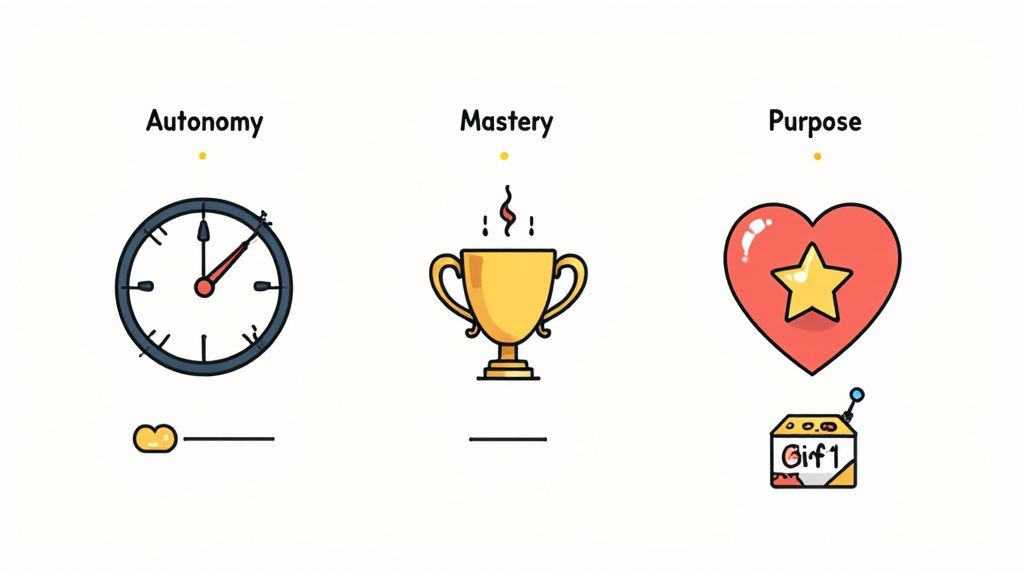
These three pillars are the foundation of intrinsic motivation—that powerful drive to do something simply because you enjoy it. A great rewards system gives members a sense of control, helps them feel like they're getting better at something, and shows them they're part of a bigger picture.
Here's a quick breakdown of how to bake these motivators into your program:
- Autonomy: Give your members a choice. Let them decide which quests to complete or how they want to pitch in. That feeling of control makes participation feel empowering, not like a chore.
- Mastery: Show them a path forward. Think tiered roles, skill-based challenges, or leaderboards that let people see their progress. It's all about that satisfying feeling of leveling up.
- Purpose: Connect their actions to a meaningful outcome. Make it crystal clear how their content, feedback, or ambassadorship is actually pushing the project forward.
Keep Them Hooked with Variable Rewards
Let's be honest: predictable rewards get boring fast. If you know you’ll get exactly 10 points for every tweet, the thrill disappears. This is where the magic of variable rewards comes in—it’s the same psychological kick that makes slot machines so addictive.
By adding a little randomness, you keep things exciting. A member might complete a task expecting the usual reward, but then—bam!—they get a surprise NFT, a bonus token drop, or a rare role. That unpredictability triggers a dopamine rush and gives them a powerful reason to keep going, just in case the next action is the big one.
The key is to shift the focus from a purely transactional relationship to a relational one. When members feel a sense of belonging and see their status grow, the community itself becomes the ultimate reward.
Leverage Powerful Social Motivators
Cash and tokens are great, but they aren't the whole story. In many cases, social and status-based rewards create a much deeper, more lasting sense of loyalty. Why? Because they tap into our fundamental human desire for recognition and belonging.
Try pulling these powerful psychological levers:
- The Endowed Progress Effect: Give new members a head start. By awarding them their first few points or a "Welcome" badge right after they join, the next milestone suddenly feels much more achievable. This dramatically boosts their motivation to keep going.
- Public Recognition: Never underestimate the power of a simple shout-out. Highlighting your top contributors in a Discord announcement, on Twitter, or during a community call is a free reward that feels incredibly valuable.
- Unique Roles and Status: Titles like "OG," "Guardian," or "Ambassador" give people an identity and a status that money just can't buy. These roles transform passive members into true stakeholders who feel responsible for the community's success.
When you start weaving these psychological principles together, you build a program that practically fuels itself. For a deeper dive, check out our guide to community gamification to see how game mechanics can drive long-term engagement. Ultimately, the goal is to create an ecosystem where contributing feels good, progress is always visible, and belonging is the real prize.
2. Your Toolkit: Picking the Right Web3 Rewards
Alright, now that we've covered the "why" behind community engagement, let's get into the "what." It's time to stock your toolkit. A truly magnetic rewards program isn't about throwing random perks at people; it's about picking the right tools for the right job.
Your options boil down to two main categories: on-chain rewards that live on the blockchain and off-chain rewards that exist in your community spaces and the real world.
Think of it like building a custom toolbox. You need your heavy-duty power tools (on-chain assets) for the big, structural jobs, but you also need your reliable, everyday hand tools (off-chain perks) for the fine-tuning and daily upkeep. The best strategies blend both to create an experience that feels balanced, exciting, and genuinely rewarding.
On-chain rewards are assets recorded on a public ledger, making them transparent, verifiable, and truly ownable by your members. Off-chain rewards are the special privileges and access you grant outside the blockchain, like inside your Discord or at an exclusive event.
Let's break them down.
The Power of On-Chain Rewards
On-chain rewards are the heart and soul of many Web3 projects. Why? Because they give your community members a real, tangible stake in the game. These aren't just points in a spreadsheet; they're digital assets with genuine utility and potential value.
Here are a few heavy-hitters:
- Governance Tokens: Want to turn passive users into active co-creators? Give them a voice. These tokens grant holders voting rights on key project decisions, empowering them to help steer the ship. Think of a DeFi protocol airdropping tokens to early supporters so they can help shape its future.
- Exclusive NFTs: Non-fungible tokens are perfect digital trophies. A Web3 game could reward its top players with rare, tradable NFT gear that screams "I'm a legend." It’s verifiable bragging rights.
- Soulbound Tokens (SBTs): These are a bit different. SBTs are non-transferable tokens tied to a specific wallet, acting as a permanent, verifiable record of someone's reputation, skills, or accomplishments. Since they can't be sold, they're an amazing way to build a real identity within your ecosystem.
Don't Sleep on Off-Chain Perks
While on-chain assets are powerful, don't underestimate the impact of off-chain rewards. These are often the secret sauce to building a vibrant daily culture and making your members feel like true insiders. Plus, they’re usually much easier and faster to roll out.
Some classic off-chain rewards include:
- Exclusive Discord Roles: It might sound simple, but a special role like "OG" or "Core Contributor" is a powerful status symbol. It creates a visible social layer and makes people feel seen and valued.
- Early Access: Giving your loyal members a sneak peek at new features, beta tests, or unreleased content is a high-value, low-cost way to make them feel like part of the inner circle.
- Limited-Edition Merch: There’s something special about bringing your digital community into the physical world. Custom hoodies, hats, or other swag turn your members into walking ambassadors for your brand.
- Private AMAs: Offering direct, unfiltered access to the founding team or industry experts is an incredible perk. It builds trust, deepens connection, and shows you respect your community's curiosity.
The most effective community rewards programs blend the digital and the real. Combining on-chain ownership with exclusive off-chain experiences creates a holistic system where every type of contribution feels recognized and valued.
Ultimately, the goal is to make your rewards feel meaningful. When loyalty rewards are personalized and tied to community experiences, members spend, on average, 4.3 times more than those who redeem generic rewards. That's a huge difference, and it proves that community-focused perks are a massive driver of long-term value. For a deeper dive, check out the full loyalty program report from Open Loyalty.
On-Chain vs. Off-Chain Community Rewards
So, when should you use which? Here's a quick comparison of the two primary categories of rewards, highlighting their best use cases, technical needs, and strategic advantages.
| Attribute | On-Chain Rewards (e.g., Tokens, NFTs) | Off-Chain Rewards (e.g., Discord Roles, Merch) |
|---|---|---|
| Primary Goal | Drive long-term investment, governance, and provable ownership. | Foster daily engagement, social status, and a sense of belonging. |
| Implementation | Requires smart contract development and can be complex. | Simpler and faster to implement through platforms like Discord or custom tools. |
| Cost | Can be expensive due to gas fees and development costs. | Generally lower cost and easier to scale quickly. |
| Tangibility | Members have true, verifiable ownership of a digital asset. | Rewards are often experiential, social, or physical. |
| Best For | Rewarding significant contributions, decentralizing governance, creating an ecosystem economy. | Recognizing consistent participation, building culture, offering immediate gratification. |
Deciding between them isn't an either/or choice. The magic happens when you combine them.
The best approach is often a hybrid one. A fantastic example is using an off-chain points system where members rack up points for completing various tasks—both on and off-chain. Once they hit a certain threshold, they can cash those points in for a valuable on-chain asset like an NFT.
We wrote a complete guide on designing these kinds of systems, so if you're curious, check out our article on racking up points for community rewards. By understanding the full spectrum of tools at your disposal, you can design a program that truly hits home with your audience and perfectly aligns with your project's goals.
Building Your Rewards Campaign From the Ground Up
Alright, we've talked about the psychology and the different kinds of rewards you can offer. Now, let's get our hands dirty and actually build something. A great rewards program isn't just about throwing freebies at people; it's a carefully designed system that starts with a clear goal and ends with a community that's genuinely excited to stick around.
Think of this as your blueprint for building a campaign that actually works.
Step 1: Figure Out What "Winning" Looks Like
Before you dream up a single quest or mint an NFT, you have to answer one simple question: What are we trying to accomplish? Seriously. Without a clear goal, you're just giving away assets without any real purpose.
Are you trying to get your Discord chat to buzz with activity? Or maybe you want to flood social media with user-generated content? Perhaps the goal is more concrete, like getting people to stake their tokens. Whatever it is, get specific.
Don't try to boil the ocean. Pick one or two main objectives for your first campaign. A few common starting points are:
- Boost Engagement: Get people talking, showing up to community calls, and smashing that like button on Twitter.
- Fuel Growth: Turn your members into evangelists who bring their friends into the fold.
- Keep People Around: Reward the OGs who stick with you, hold your token, or contribute week after week.
- Educate Your Community: Pay people to actually read your docs or learn how a new feature works.
Step 2: Pinpoint the Exact Behaviors You Want
Once your goal is set, you need to break it down into the specific, measurable actions you want your community to take. If your goal is "boost engagement," the target behaviors might be things like "react to 5 announcements" or "ask a great question during an AMA."
Let's imagine you're launching a new NFT marketplace.
Goal: Drive early adoption and get some liquidity flowing.
Target Behaviors:
- Connect a wallet for the very first time.
- List an NFT on the marketplace.
- Buy an NFT—any NFT.
- Refer a friend who lists their first NFT.
See how that works? We just turned a fuzzy goal into a crystal-clear checklist of actions you can directly reward.
Step 3: Design Your Reward System
Now for the fun part. This is where you connect those behaviors to the rewards. You'll need to decide on the core mechanics—are you using a points system, a tiered program, or a series of one-off quests?
Points are super flexible and fantastic for ongoing engagement. Quests, on the other hand, are perfect for walking new users through a specific journey, like an onboarding flow.
For our NFT marketplace example, a simple quest-based system is a no-brainer:
- Quest 1: Connect your wallet, get 50 points.
- Quest 2: List your first NFT, get 100 points.
- Quest 3: Refer a friend who lists an NFT, and you both get 200 points.
This structure isn't just a list of tasks; it’s a clear path. It guides new users from their first click to becoming an active participant, giving them a little hit of dopamine every step of the way.
Your rewards program should feel like a guided journey, not a random to-do list. Each action should logically build on the last, helping new members feel like they truly belong.
Step 4: Set a Budget You Can Actually Stick To
This is the step everyone forgets, and it’s a killer. You absolutely must figure out how many rewards you can give away without wrecking your project's economy. If you’re handing out tokens, being too generous can cause inflation and make the rewards worthless for everyone.
Start small. Calculate a "rewards budget" based on what your treasury and tokenomics can handle. Trust me, it's way easier to increase rewards down the line than it is to claw them back. And remember, not every reward has to cost you money. Off-chain perks like special Discord roles or early access to a new feature can feel incredibly valuable.
This is where you blend your on-chain and off-chain options into one cohesive toolkit.
When you mix these two approaches, the results can be powerful. Just look at Lululemon’s loyalty program, which pulled in over 9 million sign-ups in just five months by blending real-world perks with community activities. Their program isn't just about discounts; it’s a social hub where people write reviews, take quizzes, and interact with each other. It’s a masterclass in engagement. If you want to see how they did it, you can explore detailed insights on their loyalty renaissance.
Measuring What Matters for Community Growth
If you can’t measure it, you can’t improve it. That old saying is gospel here. Launching a community rewards program without tracking its impact is like flying blind. You might feel busy, but you have no idea if you're actually gaining altitude. To really prove your program is working, you have to look past the easy, surface-level numbers.
Sure, a massive Discord server with 100,000 members looks impressive on a slide deck. But what does that number actually tell you? A server full of silent lurkers isn't a community; it's just a glorified mailing list. The real story, the one that points to a healthy and loyal ecosystem, is always in the data.
Focusing on Engagement KPIs
Engagement is the heartbeat of any community. It’s the most direct signal you have that people are actually paying attention and getting involved every single day. Tracking the right Key Performance Indicators (KPIs) here will tell you if your rewards are genuinely turning passive observers into active contributors.
Don't just count heads. You need to focus on metrics that show real activity:
- Daily Active Users (DAU): How many unique members took a meaningful action today, like sending a message, reacting, or completing a quest? A rising DAU means your community is becoming a daily habit for people.
- Quest Completion Rate: Of the people who start a quest, what percentage actually finish it? A high rate here means your tasks are hitting the mark—they're clear, engaging, and properly incentivized.
- Message and Reaction Volume: It might sound simple, but tracking the number of messages and reactions in your core channels is a powerful indicator of a buzzing, interactive space.
A truly successful rewards program doesn’t just attract new members; it convinces them to stick around and contribute. Retention is the ultimate proof that your community provides lasting value beyond the initial hype.
Tracking Growth and Retention
While engagement is critical, you also need to know if your program is bringing new people in the door and, more importantly, convincing them to stay. Growth KPIs show you’re expanding your reach, while retention KPIs prove you’ve built something worth being a part of long-term.
When it comes to growth, look beyond simple invite counts. The referral conversion rate is a much smarter metric. It tells you how many of those invited users actually join and go on to complete their first meaningful action. This is how you find your real evangelists.
For retention, the gold standard is token holder loyalty. Are the members who participate in your rewards program holding your token longer than those who don't? You can use on-chain analytics tools like Dune or Nansen to dig into this by tracking wallet activity over time. A low sell rate among your most active community members is a powerful sign that you’re building a base of true believers, not just a revolving door of short-term speculators.
By pulling all these different KPIs together, you get a full 360-degree view of your community’s health. This data-first approach lets you double down on what’s working, ditch what isn’t, and show anyone who asks exactly how your community rewards are fueling real, sustainable growth.
Putting Your Rewards Program on Autopilot
Let’s be honest: manually tracking contributions, verifying every single tweet, and sending out rewards one by one is a recipe for burnout. When your community is small, you can muscle through it. But as you grow, that hands-on approach becomes a massive time-sink, pulling you into a vortex of repetitive tasks instead of letting you focus on strategy.
This is where automation becomes your new best friend. Modern tools are built to do the heavy lifting for you, transforming your rewards program from a manual slog into a self-running engine. Instead of getting lost in spreadsheets, you can design automated workflows that operate around the clock. This frees you up to do what you do best: build real relationships and dream up your next big community initiative.
Solving the Biggest Operational Headaches
The hardest part of a community rewards program isn't the ideas—it's the execution. How can you possibly track a thousand retweets or verify that 500 new people actually joined your Telegram? This is exactly where a dedicated tool makes all the difference, plugging directly into your ecosystem to solve these common headaches.
Platforms like Domino are designed to connect directly to the places your community hangs out:
- Social Platforms: Hook up your Twitter account to automatically verify likes, retweets, and new followers. No more manual checking.
- Community Hubs: Integrate with Discord and Telegram to keep tabs on messages, reactions, and who shows up for events.
- On-Chain Wallets: Connect directly to the blockchain to confirm actions like token staking, swaps, or just holding a specific NFT.
This kind of seamless integration means the system validates actions the moment they happen. Every contribution gets logged accurately without you having to lift a finger.
The screenshot below gives you a peek at how a platform like Domino brings all these moving parts together into a single, clean dashboard.
This visual approach turns what could be a messy, technical process into something anyone can manage. You can launch and monitor entire campaigns without needing a developer on standby.
Launching Campaigns in Minutes with Templates
Staring at a blank screen can be paralyzing. What should your first quest be? How do you even structure a good onboarding flow? Pre-built templates take all the guesswork out of the equation. They give you a launchpad for proven campaigns that you can get live in just a few minutes.
Automation isn’t about replacing the human side of community management; it’s about amplifying it. By automating the grunt work, you free up your time for more meaningful, high-impact conversations with your members.
These templates aren't just random ideas; they're based on successful strategies from other top-tier projects, so you don't have to reinvent the wheel. You can find ready-to-go workflows for all the common goals:
- User Onboarding Quests: A perfect way to guide new members through their first crucial steps.
- Content Creation Bounties: Get your community fired up to create and share awesome content.
- Social Engagement Sprints: Need a quick burst of activity? Launch a sprint to get people talking on Twitter or Farcaster.
For example, you could easily set up a campaign to automatically send rewards to winners of a Zealy sprint without touching a spreadsheet. Just connect your accounts, pick the template, and you're good to go.
Using AI for Fair and Effortless Verification
Verification might be the trickiest part of the whole process. How do you really know if that meme someone submitted is original? Or if a tweet actually meets your campaign's criteria? This is where AI steps in to play a huge role.
AI-powered verification can automatically scan user submissions to make sure they meet your standards. It can check for duplicate content, sniff out bot activity, and even get a sense of the quality of a submission. This ensures rewards are handed out fairly and stops people from gaming the system.
Think of this AI layer as your tireless moderator, working 24/7 to review thousands of submissions with perfect consistency. It’s the final piece of the puzzle that makes a truly automated, scalable, and fair rewards program not just possible, but easy.
Answering Your Toughest Community Rewards Questions
Let's be real, diving into Web3 rewards brings up some tricky questions. How do you reward your community without accidentally tanking your token’s value? And what are you supposed to do if you're a brand-new project with a shoestring budget?
It’s easy to get stuck here. So, let’s walk through the most common hurdles and get you some straight, practical answers.
How Do I Budget Rewards Without Causing Inflation?
This is the big one, isn't it? The fear of giving away too many tokens and watching their value plummet is real. If you're not careful, you can end up hurting the very people you’re trying to reward.
The secret is to think of it as a balanced "rewards economy," one that doesn't just hand out liquid tokens for every little thing.
Instead of just doing token drops, try mixing up your strategy:
- Vesting Schedules: Don't dump all the tokens at once. Release them over a set period. This simple step prevents a massive sell-off and gets people to stick around for the long haul.
- Non-Monetary Perks: We've touched on this, but it’s worth repeating. Off-chain rewards like exclusive Discord roles, early access to new features, or a public shout-out from the founders are incredibly valuable and cost you absolutely nothing.
- Tiered Unlocks: Save the big on-chain rewards for big, high-effort contributions. The community member who organizes an entire AMA series has earned something more substantial than someone who just hits the retweet button.
The classic mistake is creating a system that feels purely transactional. If your program only attracts people hunting for a quick payday, you're renting mercenaries, not building a loyal community.
These so-called “mercenaries” will vanish the second a better offer appears, leaving you with a hollowed-out community. The goal is to build a system where the social and experiential rewards feel just as good—if not better—than the financial ones.
How Can Early-Stage Projects Reward on a Tight Budget?
You don’t need a seven-figure treasury to build a passionate community from the ground up. In the beginning, your most powerful rewards are often the ones that cost the least but offer the most in status and access.
Concentrate on high-leverage, low-cost incentives that make your first 100 supporters feel like true insiders:
- Public Recognition: Create an "OG" role in Discord. Give weekly shout-outs on Twitter to your top contributors. Acknowledgment from the core team is a huge motivator.
- Exclusive Access: Set up a private channel for your most active members to chat directly with the founders. Give them sneak peeks of what you’re building. Make them feel like part of the inner circle.
- Future Promises: Give your earliest contributors a guaranteed spot on a future allowlist or promise them the very first community NFT. It costs you nothing today but builds incredible loyalty for tomorrow.
When you focus on these relational perks, you attract people who are genuinely bought into your project's vision, not just its tokens. That’s how you build a strong, resilient foundation that will pay off long after your treasury is full.
Ready to put these ideas into action without all the manual work? Domino is your no-code toolkit for launching powerful community reward campaigns in minutes. Automate verification, connect your favorite platforms, and start building a loyal community today at https://domino.run.