A Guide to Web3 Loyalty Programs That Boost Engagement
So, what exactly is a Web3 loyalty program? In simple terms, it's a new way for brands to reward you using blockchain technology. Instead of giving you points that they control, they give you digital assets like tokens or NFTs that you truly own. This makes the whole loyalty game more transparent, valuable, and a heck of a lot more engaging.
Beyond Points Cards: The New Era of Customer Loyalty
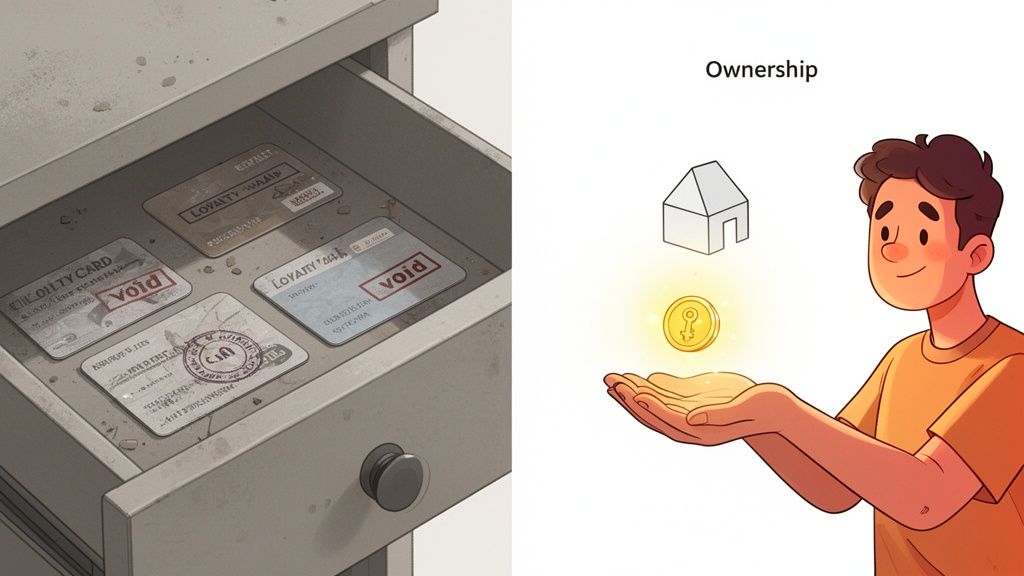
Let’s be honest. Think about that stack of plastic loyalty cards collecting dust in a drawer or the countless points you have scattered across a dozen different apps. They’re basically worthless until you redeem them, if you even remember to.
The old-school loyalty model is fundamentally broken. Brands call all the shots. They can devalue your points overnight, change the rules on a whim, or just let your hard-earned rewards expire. You never actually own them. It’s like renting an apartment—you get to use the space, but you can't paint the walls, sell it, or take the cool light fixtures with you when you move out. The landlord holds all the keys.
Shifting from Renting to Owning
Web3 loyalty programs completely flip that script. The big idea here is true digital ownership. Instead of flimsy points that live in a company's private database, brands issue rewards as unique digital assets—tokens or NFTs—that go directly into your personal crypto wallet.
This is the difference between renting that apartment and owning your own house. Suddenly, you have the deed. You can renovate, sell it, or pass it down. This simple shift puts the power back where it belongs: with the customer. It helps build a much deeper, more honest connection between a brand and its community.
By giving users real ownership, brands are no longer just rewarding transactions. They’re inviting customers to become genuine stakeholders in the brand's ecosystem. This turns passive consumers into active, invested community members.
The Core Benefits of This New Model
This new relationship is built on transparency and mutual respect, creating a fairer deal for everyone. For customers, it means your loyalty finally has tangible, lasting value that you control.
For brands, it opens up a whole new playbook for driving real engagement:
- Increased Trust: Every reward and rule is on a public blockchain. No more smoke and mirrors—it’s all out in the open.
- Deeper Engagement: When people own a piece of something, they care more. They get involved and participate in the community.
- New Revenue Streams: Digital rewards can be designed to be tradable, creating a lively secondary market and a mini-economy around your brand.
This isn’t just a tech upgrade. It’s a complete rethink of what customer loyalty can be. We're moving away from a boring, one-way street of transactions and toward a dynamic experience that’s owned by the community itself.
Let's break down exactly how these two approaches stack up.
Comparing Traditional and Web3 Loyalty Programs
This table gives a side-by-side look at the key differences between the old way and the new. You can quickly see how Web3’s approach changes the game for both customers and brands.
| Feature | Traditional Loyalty (Web2) | Web3 Loyalty |
|---|---|---|
| Asset Ownership | Brand owns and controls the points. | Customer truly owns their rewards (tokens/NFTs) in a wallet. |
| Transparency | Opaque. Rules can change without notice. | Fully transparent, with rules enforced by smart contracts. |
| Value | Points can be devalued or expire. Locked to one brand. | Assets can have real-world value and be traded or sold. |
| Interoperability | Closed system. Points can’t be used elsewhere. | Rewards can be used across different platforms and partners. |
| Customer Role | Passive consumer collecting points. | Active community member and stakeholder. |
| Program Control | Centralized. The brand makes all decisions. | Decentralized. Community can have a say in governance. |
| Engagement Model | Transactional (buy stuff, get points). | Relational (rewarding actions like content creation, referrals). |
Ultimately, the shift is from a system where brands dictate value to one where value is co-created and shared with the community. It’s a move from a top-down monologue to a collaborative dialogue.
So, Why Is Web3 Such a Big Deal for Customer Loyalty?
What is it about Web3 loyalty that makes it so much more effective than the old-school programs we're all familiar with? It really comes down to flipping the script on the relationship between a brand and its customers. Instead of a one-way street where the company calls all the shots, Web3 builds a shared world based on four massive changes.
And these aren't just techy upgrades for the sake of it. We're talking about core principles that directly lead to better business results—think higher engagement, stronger retention, and even lower customer acquisition costs.
Customers Actually Own Their Rewards
The single biggest shift is true ownership. In a typical loyalty program, your points are just numbers in a company's private spreadsheet. They can change the value, wipe them out, or just decide they're gone tomorrow. You don't own a thing.
With Web3 loyalty programs, rewards like tokens or NFTs are real digital assets. They're created on a blockchain and sent right to a customer's personal crypto wallet. Suddenly, they aren't just "renting" their rewards from you; they own them. This one simple change builds a ton of trust and makes the rewards feel solid and real.
This has a huge psychological effect. When customers own a small piece of your brand's world, their mindset shifts from "What can I buy?" to "What can we build?" They start acting like stakeholders, not just shoppers.
Rewards That Work Everywhere
Traditional loyalty points are trapped. You can only use your airline miles with that one airline or your coffee points at that one cafe. Web3 smashes those walls down with interoperability.
Because these rewards live on a blockchain, you can design them to be used, traded, or recognized across completely different platforms, even with other brands. Picture earning a digital collectible from a clothing store that unlocks a special power-up in a popular video game. This creates a seamless, connected experience where being loyal in one place adds value somewhere else. It makes the rewards infinitely more useful.
Web3 turns loyalty from a walled garden into an open economy. When rewards can move freely, they become more than just points—they become a currency for a brand's entire community and beyond.
The numbers don't lie. Brands that have launched Web3 loyalty tokens are seeing 28% higher repeat customer interactions compared to their old programs. They're also saving money, with a 12% drop in customer acquisition costs because enthusiastic users trade tokens and become a built-in marketing team.
Radical Transparency and Trust
Every single transaction—every reward given out, every rule followed—is recorded on a public blockchain. This brings a level of transparency that's just not possible in Web2. Customers can go and check for themselves that the program is running fairly and that you haven't secretly changed the rules on them.
This public ledger means customers don't have to blindly trust you. The rules are baked into automated smart contracts, not decided by someone behind a closed door. For modern consumers who demand authenticity, this is everything. If you want to build a lasting relationship, it's key to understand the foundations of how to improve customer retention first.
Giving the Community a Voice
Finally, Web3 loyalty programs can introduce community governance. By holding a brand's tokens, your most loyal customers can get a real say in key decisions.
This could mean letting them vote on things like:
- What new rewards or perks should be introduced?
- Which charities should the brand partner with?
- Ideas for future products or upcoming events.
This completely changes the dynamic. Customers go from being passive recipients of points to active participants co-creating the brand's future. That kind of involvement builds an incredible sense of belonging and turns a customer list into a vibrant, passionate community.
The Building Blocks of a Web3 Loyalty Program
To get a Web3 loyalty program off the ground, you need the right set of tools. Think of it like building a custom car—each part has a specific job, but they all need to work together to create a smooth, exciting ride for your community. These aren't just abstract ideas; they're the actual components that bring your loyalty strategy to life on the blockchain.
The diagram below shows how the core principles of ownership, interoperability, and transparency are at the heart of the entire Web3 ecosystem these building blocks live in.
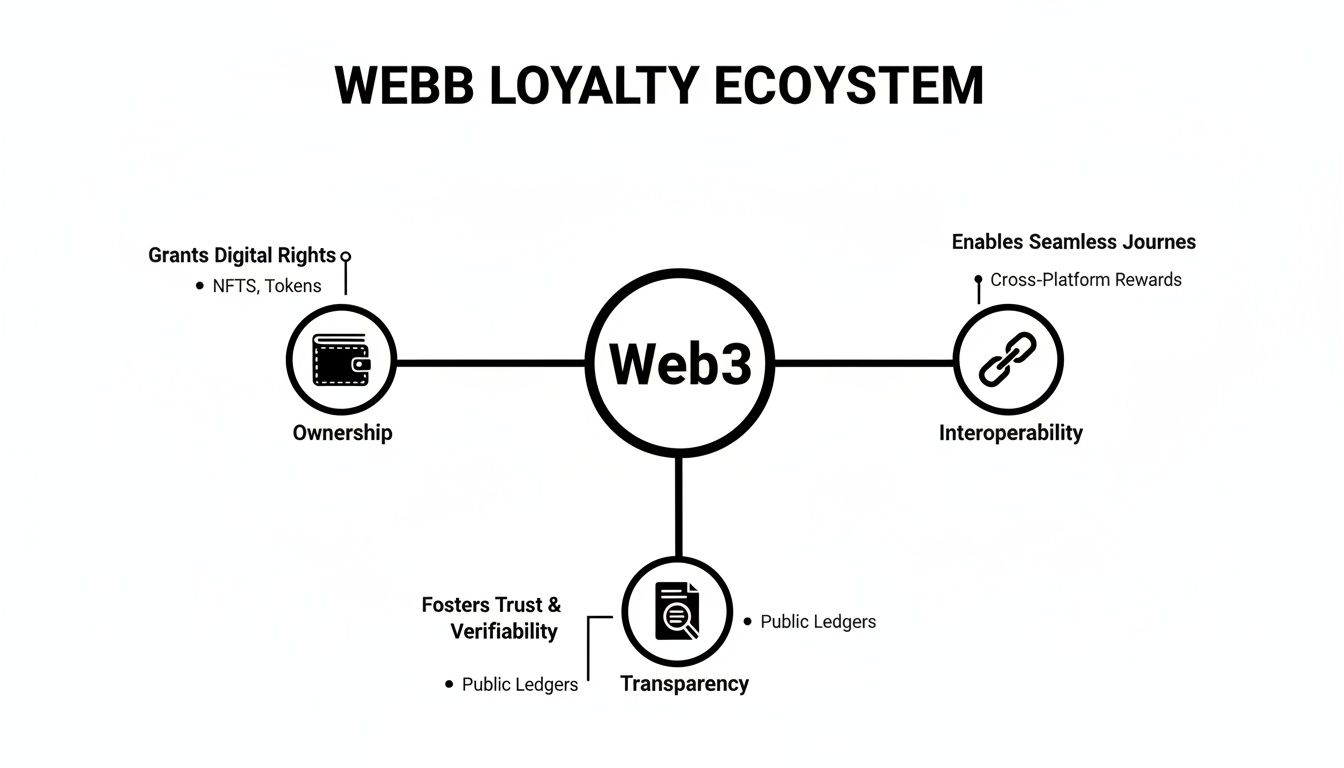
This really drives home how every piece of a Web3 loyalty program is designed to give users more control and a much clearer view of how the system works. Now, let's get our hands dirty and break down the individual pieces that make it all happen.
Fungible Tokens: The Program's Currency
First up, and probably the most common piece of the puzzle, is the fungible token. These are usually ERC-20 tokens on Ethereum or a similar standard on another chain. "Fungible" is just a fancy way of saying each token is identical to the next, just like one dollar bill is the same as any other.
These tokens are basically the native currency of your loyalty program. Customers can earn them for making purchases, completing quests, or even just for referring their friends. Since they're all the same, they’re perfect for a simple, liquid point system that's easy to hand out. A local coffee shop, for example, could create "Bean Tokens" that customers get with every latte.
Non-Fungible Tokens (NFTs): The Unique Digital Assets
Next, we have Non-Fungible Tokens (NFTs). Unlike their fungible cousins, every single NFT is unique and can't be swapped one-for-one. Think of them as digital collectibles, VIP passes, or one-of-a-kind achievement trophies.
Their uniqueness is what makes them so cool for representing things that aren't interchangeable. Brands use them in a few clever ways:
- Membership Passes: An NFT can act like a digital key, unlocking access to exclusive Discord channels, special events, or early product drops.
- Achievement Badges: If a user completes a tough challenge or hits a major milestone, you could reward them with a unique NFT badge they can show off.
- Digital Collectibles: Brands can drop limited-edition digital art or items that die-hard fans can collect, trade, and display in their wallets.
This introduces a sense of rarity and status that a simple point balance just can't match.
The real power of NFTs in loyalty is their ability to represent ownership over something specific and verifiable. It's the difference between a generic coupon and a numbered, first-edition print signed by the artist.
Smart Contracts: The Automated Rulebook
So, how do all these tokens and NFTs actually get distributed? That's where smart contracts come into play. These are basically self-executing contracts where the rules of the agreement are written directly into the code. They're the automated, unbiased rulebooks that run your entire program.
To really get a feel for this stuff, it helps to understand what is blockchain development and how these decentralized apps work. A smart contract automatically enforces the rules you lay out. If a user completes a required action, the contract instantly sends them their reward—no delays, no human error, and no funny business.
This automation is what makes Web3 loyalty so transparent and fair. The rules are locked in and visible to everyone.
Quests and Triggers: The Action Engine
Finally, you need a way to connect what your users do with the rewards they get. This is handled through quests and triggers. A quest is a specific task you want someone to complete, and a trigger is the signal that tells the smart contract, "Hey, this person did the thing! Send them their reward."
These actions can be a mix of things happening on and off the blockchain:
- On-Chain Triggers: These are actions recorded directly on the blockchain, like staking an NFT, voting on a DAO proposal, or buying something with crypto.
- Off-Chain Triggers: These are things that happen elsewhere, like sharing a post on social media, writing a product review, or joining a Telegram group. Tools can use APIs to verify these actions and then trigger the on-chain reward.
When you combine these four building blocks, you can create a really dynamic and interactive loyalty program. It's how you reward a huge range of valuable behaviors and turn passive customers into a truly engaged community.
From Quests to Tokenomics: The Blueprint for Your Program
A killer Web3 loyalty program isn't just about slapping some cool tech onto your brand. It’s about thoughtful design. This is where your big-picture strategy gets real, turning casual observers into die-hard fans. It all boils down to two things: designing quests that actually get people to do stuff, and building a reward economy—your tokenomics—that doesn't crash and burn.
Think of it like you're building a new city. The quests are the roads that guide people to all the best spots. The tokens are the local currency that keeps the economy humming. If the roads lead nowhere or the money is worthless, you’ll end up with a ghost town. No pressure, right?
Crafting Quests That Actually Drive Action
Quests are the heart and soul of your program. These are the specific, rewarded tasks you set for your community, designed to line up their actions with your business goals. They can be as simple as a follow on social media or as complex as a multi-step on-chain transaction. The key is that they always have to be a win-win for both the user and you.
A good quest system does more than just dish out points. It onboards new users, gets people to explore your product, and gives them that satisfying feeling of accomplishment. If you want to go deeper into the mechanics, we've got a whole guide on Web3 quests and how they work.
Here are a few classic quest types you can mix and match:
- Onboarding Quests: The basics. Think "Join our Discord," "Follow us on X," or "Connect your wallet." These are your digital handshakes for new members.
- Engagement Quests: These are all about stoking the community fire. Get people participating in polls, reacting to announcements, or even creating their own content about your project.
- Product-Led Quests: This is where you drive real product usage. Ask users to stake an NFT, make a swap on your decentralized exchange, or try out a new feature in your app.
- Educational Quests: Got a complex project? Use quizzes or short tutorials to teach people about your mission, new features, or just cool stuff happening in Web3.
Here’s a peek at the Domino platform, which shows just how easy it can be to set up different kinds of quests without needing to write a single line of code.
As you can see, you can easily blend on-chain and off-chain tasks to build a well-rounded and engaging campaign for your community.
Building Your Token Economy
Okay, so you've got the quests down. Now, what are you giving people for their effort? This is where tokenomics—the economic model behind your token—is absolutely crucial. Your token is the fuel for this whole engine, and its design will make or break your program's economy.
You basically become the central bank for your brand's little nation-state. You have to be smart about the token supply, what it can be used for, and how it gets into people's hands. Print too much (inflation), and its value goes to zero. If it has no real purpose, nobody will care about earning it.
A token without clear utility is just a digital souvenir. Sustainable web3 loyalty programs are built on tokens that grant access, provide tangible benefits, or unlock exclusive experiences—giving users a real reason to earn and hold them.
The gamification that these programs create is a total game-changer. We're seeing brands that use NFT-based rewards report up to 40% higher customer interaction rates because users are hooked on completing personalized quests. This taps into bigger trends, which you can read about in this report on Web3 loyalty.
Key Tokenomic Decisions
Getting your tokenomics right means answering a few big questions that will shape the token's value and long-term health.
Inflationary vs. Deflationary? Are you going to have a fixed, finite supply of tokens (deflationary), or will you keep minting new ones to hand out as rewards (inflationary)? A fixed supply creates scarcity, which can drive up value, but you might run out of tokens to reward new users. An inflationary model is great for keeping the rewards flowing, but you risk devaluing the token unless you have "sinks"—ways for tokens to be spent or removed from circulation.
What's the Utility? What can someone actually do with this token? This is non-negotiable.
- Governance: Let token holders vote on key community decisions.
- Staking: Allow users to lock up their tokens to earn even more rewards.
- Access: Use tokens as a key to unlock exclusive channels, content, or early access to features.
- Discounts: Let people redeem tokens for discounts on your actual products or services.
How Do You Distribute It? You need a clear and fair plan for how tokens get out into the world. A chunk should obviously be set aside for community rewards. But you'll also have allocations for the team, the project treasury, and investors, which should almost always have vesting schedules. This is super important to prevent early insiders from dumping their bags on the market and tanking the price for everyone else.
When you nail both your quest design and your tokenomics, you create a powerful, self-sustaining loop. Fun quests get people involved, which earns them valuable tokens. The genuine utility of those tokens then pulls them right back in to engage with your product and community all over again.
Real World Examples of Web3 Loyalty in Action
Theory is great, but seeing web3 loyalty programs actually working in the wild is where the lightbulb really goes on. Brands of all shapes and sizes are jumping in, launching programs that are getting real, tangible results. Let’s break down how crypto natives and even household names are using this tech to build communities that are genuinely buzzing with excitement.
These examples really show how the core pieces we've talked about—tokens, NFTs, and quests—can be shaken up and remixed into something that truly clicks with a specific crowd.
Starbucks Odyssey: A Mainstream Giant Dives In
Probably the most talked-about example comes from a brand you might not expect: Starbucks. Their Odyssey program is a fantastic case study in how to weave Web3 tech into a familiar Web2 experience without scaring anyone off.
Members of their tried-and-true Starbucks Rewards app can jump into "Journeys," which are just fun games and quizzes about coffee. Completing them earns you digital "Journey Stamps"—which are, you guessed it, NFTs.
But these aren't just for show. Racking up Stamps unlocks some seriously cool perks, from virtual classes on how to make the perfect espresso martini to invites for special events at actual Starbucks estates. The strategy is pure genius. They use gamification to teach customers more about their brand and forge a deeper connection, all while subtly introducing millions of people to the idea of digital ownership.
Starbucks Odyssey proves that Web3 loyalty isn't just for niche crypto projects. By sliding NFTs into an app that millions already love and use, they made digital collectibles feel fun and rewarding, not technical and intimidating. It's the perfect on-ramp for the everyday consumer.
The numbers don't lie. By 2023, the Odyssey program helped drive a 15% year-over-year jump in app engagement. For Web3 marketers and growth teams, this is a clear signal. You don't have to be a behemoth like Starbucks to get results; you can use no-code tools like Domino to launch tokenized rewards that supercharge your community quests.
Lacoste UNDW3: Building an Exclusive Fashion Community
The iconic French fashion brand Lacoste went a totally different route with their UNDW3 (pronounced "underwater") project. Instead of adding a Web3 layer to an old program, they built a brand new, exclusive community from scratch, with an NFT as the key to the door.
It all kicked off with a limited NFT drop. Owning one of these Lacoste NFTs gets you into a private Discord server and unlocks a world of unique experiences. We're talking about the chance to co-create products with Lacoste's actual designers, get your hands on exclusive merch, and score invites to private events. Here, the NFT is so much more than a collectible—it’s a ticket into a creative ecosystem.
- Their Goal: Build a close-knit community of the brand's biggest fans.
- The Tools: NFTs as membership passes and a token-gated Discord.
- What They Reward: Long-term holding and being an active, helpful member of the community.
This model is a perfect fit for brands that want to give their most loyal followers real influence and a taste of true exclusivity. When you get creative with how you thank your fans, you build a community that's far more resilient and engaged. If you're looking for more inspiration, you should check out our guide on different kinds of crypto community rewards.
As you can see, web3 loyalty programs are incredibly flexible. Whether you're a global coffee chain gently introducing customers to NFTs or a luxury brand building a hyper-exclusive club, the core ideas of ownership and community deliver seriously powerful results.
How to Launch Your Program Without Writing a Line of Code
Not long ago, the biggest roadblock for anyone wanting to start a web3 loyalty program was the intimidating technical side of things. The thought of wrangling smart contracts, blockchain nodes, and wallet integrations was enough to make most marketing teams run for the hills.
Thankfully, that era is over.
You no longer need a squad of expensive developers to get a killer loyalty campaign up and running. The emergence of no-code platforms has been a complete game-changer, placing the power to build and launch sophisticated programs right where it belongs: in the hands of marketers and community managers. It lets you focus on the what and why of your strategy, not the how of the code.
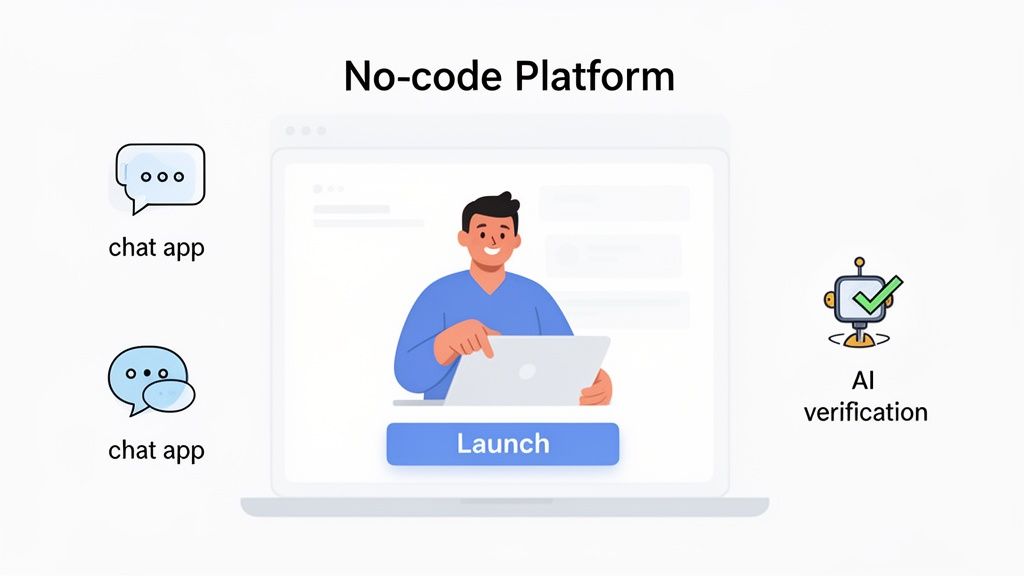
These platforms do all the heavy lifting in the background. Think of one as your Web3 mission control—it takes your campaign ideas and translates them into secure, automated blockchain interactions, all without you ever needing to touch the code.
Your No-Code Launch Playbook
So, what does it actually feel like to launch a campaign with a platform like Domino? It's way more intuitive than you'd think and can be done in minutes, not months. The whole process is designed to let you create engaging experiences without getting bogged down in technical weeds.
Here’s a quick walkthrough of what that might look like:
- Choose Your Quests: You’d start by browsing a library of pre-built quest templates. You can easily mix and match on-chain actions, like staking an NFT, with off-chain tasks, like sharing a post on X. This lets you reward all sorts of valuable user behaviors, not just one type.
- Integrate Your Community Hubs: Next, you connect the platform directly to the places your community hangs out, like Discord and Telegram. This makes the experience feel totally seamless, so users can jump into quests without ever leaving their favorite apps.
- Automate Verification: This is where the magic happens. You set up rules for how tasks get confirmed. Many platforms now use AI to automatically check things like social media shares or content submissions, which saves a ton of manual work and helps shut down cheaters.
- Set Your Rewards and Launch: Finally, you decide what people get for completing quests. It could be XP, fungible tokens, or a special-edition NFT. A few more clicks, and boom—your campaign is live and running on its own.
The Power of Accessible Tooling
This no-code approach isn't some watered-down version of "real" Web3 development. It's just a smarter, faster way to get the same results. For teams using a tool like Domino, that means accessing over 130+ quest templates for AI-verified tasks that drive genuine engagement. This kind of accessibility has already powered 25 million completed quests across 13,000 campaigns, proving just how effective these platforms are for growing a community.
No-code platforms are opening up Web3 to everyone. They tear down the technical gates, letting the people who actually understand the community—the marketers and managers—build and test loyalty ideas as fast as they can dream them up.
By making web3 loyalty programs approachable for non-devs, these tools are kicking off a huge wave of creativity and experimentation. If you want to dive deeper into the strategy, our guide to loyalty programme management breaks down the principles that make these campaigns tick. The best part? You can start building today, no matter what your technical background looks like.
Frequently Asked Questions About Web3 Loyalty
So, you're curious about web3 loyalty programs. That's a smart move. It’s a whole new world, blending marketing goals we all know with tech that can feel a bit out there. Let's break down some of the most common questions marketers and founders are asking right now.
What Actually Makes a Loyalty Program "Web3"?
A loyalty program crosses into "Web3" the moment it uses blockchain to give customers rewards they genuinely own. Think about it: instead of points stuck in your company's database, your members get digital assets like tokens or NFTs sent directly to their personal crypto wallets.
This simple shift is a game-changer. It creates transparency, portability, and provable ownership—the very heart of what Web3 is all about.
The traditional loyalty market is already a giant, valued at $13.31 billion in 2024 and on track to hit $41.21 billion by 2032. But the Web3-powered slice of that pie is growing twice as fast. In the luxury space alone, these programs are expected to be worth $6.5 billion by 2033. The interest is absolutely exploding. You can dig into more of the loyalty market's growth trends to see for yourself.
The real difference isn't just the tech—it's the entire mindset. Web2 loyalty is like renting perks from a brand. Web3 loyalty is about owning a real piece of that brand's community and economy.
How Much Does It Really Cost to Launch One?
This is a classic "how long is a piece of string?" question, but the answer is probably a lot less than you'd guess. While a fully custom-built program with a dedicated dev team can run up a hefty bill, the new wave of no-code platforms has completely changed the game.
Tools like Domino let you sidestep the massive costs of smart contract development and security audits. Your main expenses boil down to the platform subscription and the "gas fees" for creating the rewards on the blockchain. Even those can be kept super low by picking an efficient network like Polygon or Base.
Is This Actually Secure for My Customers?
Security is always top of mind, and it should be. The great news is that blockchain technology, at its core, is incredibly secure. Every transaction is encrypted and permanently recorded on a public ledger, which makes it nearly impossible for anyone to tamper with.
When you're setting up your program, security really comes down to two things:
- Smart Contract Audits: The safest bet is to use a platform that provides pre-audited, battle-tested smart contracts. This saves you a ton of risk and headache.
- User Education: You have to teach your community the basics of wallet security, like the golden rule: never, ever share your private keys.
By choosing a trusted platform and giving your community the knowledge to stay safe, you can build a loyalty experience that’s far more transparent and secure than the old centralized systems we're used to.
Ready to build a loyalty program your community will actually care about, without having to write a single line of code? Domino gives you everything you need to launch fun quests and reward your people with assets they truly own.