Your Guide to Web3 Quests for Driving Real Growth

In a nutshell, Web3 quests are basically a gamified to-do list for your community. Think of them as a supercharged loyalty program where people complete specific tasks—some on the blockchain, some off—to earn real rewards like NFTs, tokens, or exclusive access.
What Are Web3 Quests Anyway?
Imagine you’re trying to get a friend hooked on a new video game. You wouldn’t just throw the instruction manual at them and walk away, right? Of course not. You'd guide them through the first few levels—the "quests"—that teach them the controls, introduce the world, and give them a taste of victory.
That's exactly what Web3 quests do for your project. They're a fun, hands-on way to turn curious onlookers into active, invested community members.
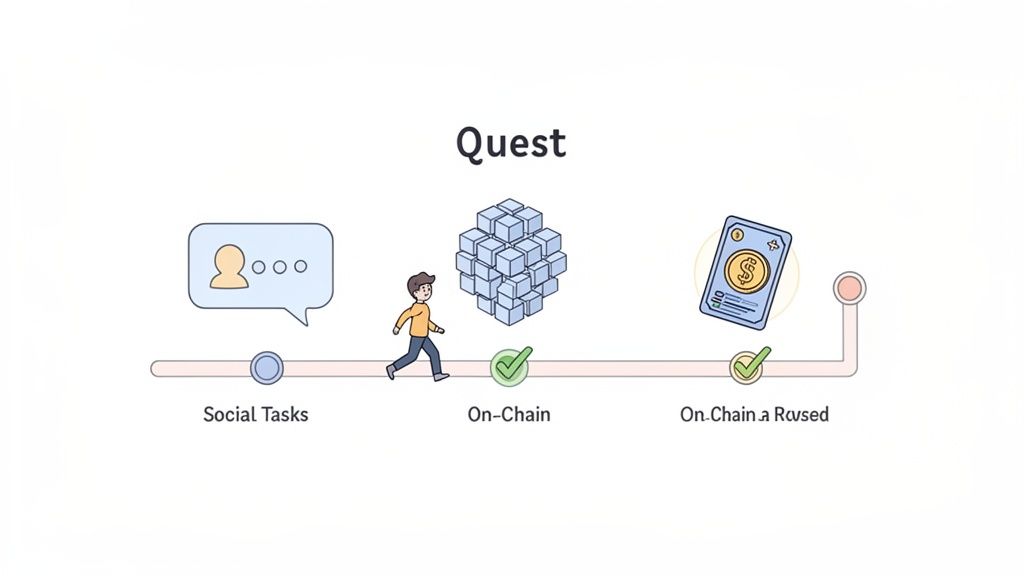
Instead of just hoping people stumble upon your app's cool features, you create a quest that guides them to try it out. When they complete the task, they get an instant reward. It’s a simple, powerful loop.
This isn't your typical marketing fluff. It’s a strategic tool for driving real, measurable actions that help you build a smarter, more committed community from day one.
The Big Shift: From Paying for Ads to Rewarding Actions
Let's face it, the Web3 world is blowing up. Valued somewhere between $2.25–$4.4 billion in 2023, the market is on a rocket ship projected to shoot past $33 billion by 2030. This breakneck growth is forcing a major rethink in how projects attract and keep users. We're moving away from the old model of paying for clicks and impressions and toward incentivizing verifiable, on-chain actions. That’s the heart of questing. You can read more about the Web3 marketing market's growth projections on OpenPR.com.
This performance-based approach is just way more efficient. You’re not just renting attention anymore; you’re rewarding genuine participation and creating a permanent, on-chain record of community loyalty.
Quests are not just about giveaways. They are a powerful mechanism to educate users, drive product adoption, and build a defensible community moat by rewarding people for actions that create real value.
To really see the difference, let’s compare the old way with the new.
Traditional Marketing vs Web3 Quests
| Metric | Traditional Marketing | Web3 Quests |
|---|---|---|
| Focus | Grabbing attention (impressions, clicks) | Driving action (swaps, mints, follows) |
| Verification | Often relies on pixels and analytics | Verifiable on-chain or via APIs |
| User Role | Passive consumer | Active participant |
| Reward | Indirect (e.g., a discount code) | Direct and tangible (tokens, NFTs) |
| Cost Model | Pay-per-impression or click (CPM/CPC) | Pay-per-action (cost-per-acquisition) |
| Community | Builds an "audience" | Builds an "ownership" community |
As you can see, quests flip the script entirely. Instead of shouting into the void, you're building a direct, reciprocal relationship with your users from their very first interaction.
How Quests Guide the User Journey
A well-crafted quest campaign is like an interactive onboarding ramp for your ecosystem. It can take a brand-new user from "What is this?" to "I'm a pro" by breaking down the journey into fun, bite-sized, and rewarding steps.
Here’s how that typically plays out:
- Discovery: A user hears about your project and sees an invitation to join a quest.
- First Steps: The first tasks are super easy wins, like following you on X or joining your Discord.
- Deeper Engagement: Next, you might ask them to try a core feature, like swapping a token in your dApp.
- Loyalty Building: Advanced quests get them more invested, asking them to stake tokens or participate in a governance vote.
Each completed quest gives them a little dopamine hit, encouraging them to stick around and explore more. At the same time, they're effortlessly learning how your project works, which is a massive win for engagement and long-term retention.
How Does a Quest Campaign Actually Work?
So, what's really going on behind the scenes of a Web3 quests campaign? Let's pop the hood and see how the engine runs. It boils down to a simple, elegant, three-step dance: a user does something, a system verifies it, and they get a reward.
Think of it as a digital scavenger hunt. We give players a map with a series of checkpoints (the tasks), a magical way to instantly know when they've reached one (the verification), and a treasure chest waiting at the end (the reward).
Step 1: The Quest Begins With a Task
Every quest starts with a simple "ask." This is the specific action you want someone to take. The real magic of Web3 quests lies in the huge range of tasks you can string together, mixing and matching actions from all corners of the web into one seamless experience.
These tasks typically fall into two buckets:
- Off-Chain Tasks: These are actions happening off the blockchain, usually on social media or in community hubs. They're perfect for casting a wide net, building brand awareness, and getting people into your orbit. Think top-of-funnel.
- On-Chain Tasks: This is where the rubber meets the road. These actions are recorded on a blockchain and get users to actually use your product, whether that's interacting with your dApp or making a transaction with your protocol. This is how you drive deep, meaningful engagement.
You can create a really natural user journey with this. A newcomer might start with easy off-chain tasks, like following you on X and joining your Discord. Once they're part of the community, you can guide them to their first on-chain action, like minting a free NFT or trying out a swap on your platform. You're gently leading them from being a passive follower to an active user.
Step 2: The Magic of Automated Verification
This part is the secret sauce. A user says they completed a task, but how do you know they did? Checking thousands of Twitter follows or wallet transactions by hand is an operational nightmare. That's why automated verification is the powerhouse of any good questing platform.
These platforms use a combination of APIs and direct blockchain data to confirm everything in real-time.
- When a user clicks "complete" on a "Follow on X" task, the platform's API instantly checks if their connected X account is actually following yours.
- For an on-chain task like "Swap a Token," the system scans the blockchain for a transaction from the user's connected wallet that fits the criteria.
This hands-off process is a game-changer. Users get that instant hit of satisfaction knowing their task was approved, and your team can focus on strategy instead of getting buried in administrative busywork. Everybody wins.
This seamless verification is what builds trust and makes Web3 quests so powerful. It creates a transparent system where actions are verifiably tied to rewards. The blockchain doesn't lie, so there's no guesswork involved.
Step 3: The Payoff—The Reward
And now for the fun part: the reward! This is what gets people excited to participate and serves as your "thank you" for their time and effort. Just like tasks, rewards can be anything and everything, depending on what your community gets excited about.
Some of the most popular rewards are:
- NFTs: Awesome digital collectibles that can act as a status symbol, unlock special access, or just be a cool piece of art to show off.
- Tokens: Your project's own tokens (or a partner's), giving users a real stake in the ecosystem from day one.
- Allowlist Spots: A golden ticket that guarantees access to a hot new NFT mint or token sale.
- Discord Roles: Special roles that unlock private channels and grant exclusive perks in your community server.
The reward is so much more than just a prize; it closes the loop. When a user completes a task and their reward lands in their wallet seconds later, it reinforces that positive action and gets them hooked, ready for the next quest. This simple, automated flow—task, verification, reward—is the engine that turns casual observers into a dedicated, loyal community.
Why Quests Are a Game Changer for Growth
It's easy to dismiss Web3 quests as just a bit of fun for the community, but that's really only scratching the surface. When you get them right, quests become a powerful, ROI-focused growth engine that hits your most important business goals head-on. They’re the bridge between casual chats in a Discord server and real, measurable results.
The secret sauce is their ability to deliver tangible outcomes. This is a lot like performance marketing's focus on measurable ROI, which makes quests a true game changer for any project trying to grow. You’re no longer just paying for eyeballs; you're rewarding people for taking specific, valuable actions that build lasting momentum.
And let’s be honest, standing out is getting harder. In the first quarter of 2023 alone, over 108 Web3 startups pulled in about $814 million. That kind of competition is driving user acquisition costs through the roof. It's why smart projects are turning to incentivized engagement loops, like quests, to cut through the noise.
From Funnels to Flywheels
Old-school marketing is all about the funnel. You pay to pour users in at the top, and you watch as most of them leak out before reaching the bottom. Quests flip that model on its head by creating a self-sustaining growth flywheel.
Here’s how it works: Engaged users complete quests, get rewarded, and then turn into advocates who naturally bring new people into the fold. That kicks off the cycle all over again, turning your community from a cost center into your best acquisition channel.
Quests let you perfectly align your community's incentives with your project's KPIs. Need more daily active users? Design a quest for it. Want to boost on-chain transactions? There's a quest for that, too.
The whole thing boils down to a simple, repeatable loop: users do stuff, the system checks their work, and the rewards go out. It’s that straightforward.
This flow shows exactly how a quest moves from a simple task to a verified reward.
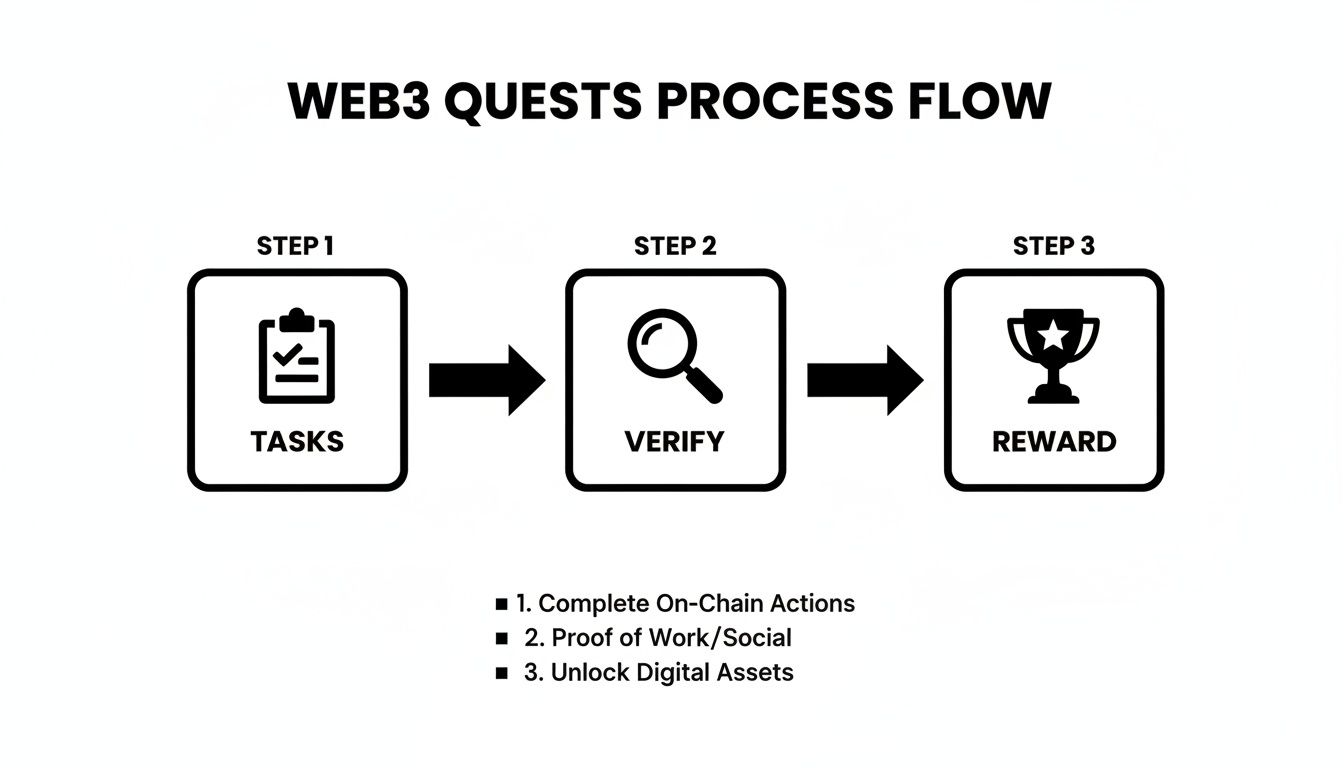
This automated loop keeps the experience smooth for your users and makes the entire process scalable for your team.
Connecting Quests to Core Business KPIs
The real magic of Web3 quests is how cleanly they connect to your Key Performance Indicators (KPIs). Instead of just hoping a marketing campaign makes a difference, you can draw a straight line from a quest to a specific metric you care about. For teams who have seen this in action, the results speak for themselves, as you can see in these success stories of projects using Domino.
Here’s a look at how quests can really move the needle on the numbers that matter:
- User Acquisition: Airdrop or allowlist campaigns built as quests can slash your Cost Per Acquisition (CPA). You’re rewarding people not just for joining, but for bringing their friends along, too.
- Active User Growth: Need to get your numbers up? Quests that require daily or weekly check-ins with your dApp are a direct line to boosting metrics like Daily Active Users (DAU) and Monthly Active Users (MAU).
- Product Education and Adoption: Have a killer feature that nobody’s using? Create a quest that walks users through it step-by-step. They learn how it works, you get higher adoption rates. It’s a win-win.
- On-Chain Activity: Want more action on your protocol? By rewarding things like staking, swapping, or adding liquidity, you can directly increase your Total Value Locked (TVL) and overall transaction volume.
- Community Engagement: Quests that encourage people to vote on governance proposals or join community calls make your ecosystem feel alive and give people a real stake in its future.
When you build your growth strategy around quests, you create a system that doesn't just bring people in. It educates them, keeps them coming back, and ultimately turns them into the kind of long-term participants every project dreams of.
Proven Quest Campaigns You Can Use Today
Theory is great, but let's talk about what actually works. The best way to really get the power of web3 quests is to see them in action. Instead of staring at a blank page, you can get moving fast with proven, battle-tested templates that are already getting results.
Think of these as your go-to playbooks for turning an idea into a campaign that makes a real impact.
Each template is built to hit a specific goal, whether you're welcoming new people into the fold or blowing the doors off your next product launch. Let's walk through three of the most effective quest campaigns projects are using to drive serious growth right now.
The New User Onboarding Quest
You only get one chance to make a first impression. The New User Onboarding quest is how you turn a curious newcomer into an educated, active community member from their very first visit. The goal isn't to hit them with a firehose of information; it's to create a guided, "yellow brick road" experience that introduces them to your world one small, rewarding step at a time.
This campaign is perfect for smoothing out the notoriously steep learning curve in Web3. By breaking down complex actions into simple, incentivized tasks, your project immediately feels more welcoming and less intimidating. It’s the difference between handing someone a dense instruction manual and personally showing them the ropes.
The core idea is simple: Reward the learning process. Guide users through their "firsts"—their first social follow, their first dApp interaction, their first on-chain transaction—to build their confidence and get them invested early.
Sample Onboarding Tasks:
- Goal: Create a smooth and educational entry point for new users.
- Tasks:
- Join the official Discord server and claim a "Newbie" role.
- Follow the project's account on X (formerly Twitter).
- Read the project's "Getting Started" guide and answer a simple quiz question.
- Connect their wallet to your dApp for the first time.
- Mint a free "Welcome" NFT to commemorate joining the community.
- Reward Structure: A mix of a unique Discord role and a commemorative NFT.
The Product Launch Hype Campaign
Got something big dropping soon? A Product Launch Hype campaign is all about building a groundswell of excitement to drive a huge wave of users on day one. This isn't just about posting an announcement; it's about making your community feel like they're a core part of the launch itself.
This approach effectively turns your community into a grassroots marketing team. By rewarding them for spreading the word and being the first to try your new feature, you create authentic buzz that paid ads just can't buy. These campaigns usually run for a limited time leading up to and just after the launch to create a real sense of urgency.
Sample Launch Tasks:
- Goal: Generate maximum awareness and immediate user adoption for a new product or feature.
- Tasks:
- Quote-tweet the official launch announcement with a specific hashtag.
- Watch a short video tutorial about the new feature.
- Be one of the first 1,000 users to try the new feature on-chain (e.g., perform a swap using the new V3 pool).
- Create a short video or thread on X explaining why they're excited about the launch.
- Reward Structure: A tiered system works best here. For example, you could offer a larger token reward or an exclusive NFT for the first 1,000 users who complete the on-chain task, with smaller rewards for social actions. You can find inspiration by checking out other successful web3 quest campaigns and seeing how they structure their rewards.
The Social Proof Amplifier Campaign
Nothing sells your project better than real people saying great things about it. The Social Proof Amplifier campaign encourages your users to share their positive experiences, creating a powerful library of user-generated content (UGC) that builds trust and brings in new folks.
This quest is all about mobilizing your happiest users and giving them a megaphone. It’s an incredibly effective way to generate authentic marketing material while rewarding your most loyal supporters at the same time. Think of it as a systematic way to capture that lightning-in-a-bottle moment when a user has a great experience.
Sample Social Proof Tasks:
- Goal: Encourage the creation and sharing of authentic, user-generated content.
- Tasks:
- Share a screenshot of their favorite feature in your dApp on X.
- Write a review of your project on a third-party review site.
- Create and share a meme about the community or project.
- Submit a short video testimonial explaining what they love about the project.
- Reward Structure: Focus on quality over quantity. Offer a token prize for the top 10 most creative or impactful submissions, as judged by the team or even the community itself.
Popular Web3 Quest Campaign Templates
To make things even clearer, here are some of the most common campaign templates you'll see in the wild. Use this as a cheat sheet to match your business goal with a proven quest structure.
| Campaign Template | Primary Goal | Example Tasks |
|---|---|---|
| New User Onboarding | Guide and educate new community members | Join Discord, follow on X, connect wallet, mint a welcome NFT |
| Product Launch Hype | Drive adoption and awareness for a new feature | Quote-tweet announcement, watch a tutorial, be the first to use a feature |
| Social Proof Amplifier | Generate authentic user-generated content (UGC) | Post a review, share a screenshot, create a meme, submit a testimonial |
| Community Engagement | Increase daily/weekly active participation | Participate in a poll, attend an AMA, join a community game night |
| Liquidity Drive | Boost on-chain liquidity for a token or pool | Provide liquidity to a specific pool, stake LP tokens |
| Growth Loop/Referral | Acquire new users through existing ones | Invite friends who complete an onboarding quest, share a unique referral link |
These templates aren't rigid rules—they're starting points. The best campaigns often mix and match elements from different templates to create a unique experience that fits their community perfectly.
Designing Quests People Actually Want to Complete
A great quest campaign isn't just a list of chores; it's an adventure. It’s the difference between a boring to-do list and a scavenger hunt that pulls you in. Nailing this is the secret to building campaigns that create real fans, not just attracting a flash mob of reward hunters who disappear overnight.
The magic happens when you find that perfect sweet spot between the effort you ask for and the reward you give back. If a quest feels like climbing a mountain for a handful of peanuts, people will just walk away. On the other hand, if you offer a treasure chest for a simple click, you’ll be swarmed by bots and farmers who will drain your budget without adding an ounce of real value.
Balancing the Scales of Effort and Reward
Think of it like a conversation. You're asking for a user's time and attention, and in return, you need to offer something they actually care about. This is all about creating a sense of a fair value exchange. And spoiler alert: it doesn't always have to be a massive token drop.
A great way to approach this is to map out your quests along a difficulty curve.
- Easy Peasy (Low Effort): These are your front-door tasks. Think: follow us on X, join the Discord. The rewards should be small but satisfying, like a special Discord role, a neat POAP to mark the occasion, or a small bundle of points to get them started.
- The Next Level (Medium Effort): Here, you ask for a bit more. Maybe they try out a key feature in your dApp or watch a quick tutorial. The reward should reflect that extra step—perhaps a small NFT or a ticket into a raffle for a bigger prize.
- For the Hardcore (High Effort): These are for your power users and true believers. We’re talking about tasks like providing liquidity, creating awesome user-generated content, or casting a vote in governance. The rewards here need to be worth it, like a guaranteed allowlist spot or a significant token prize.
This tiered approach means there's something for everyone, from the casually curious to your most die-hard community members, while making sure you properly incentivize the actions that matter most.
Building a Bot-Resistant Fortress
Nothing sours a community campaign faster than an army of bots swooping in to steal all the rewards. If you want to build something that lasts, keeping your web3 quests fair and human-centric is non-negotiable. Luckily, you’ve got some solid tools in your arsenal to fight back.
Start with the basics of Sybil resistance. Simple checks like requiring a wallet to be a certain age, have a minimum number of transactions, or hold a specific token can knock out a surprising number of low-effort bots right away.
A well-designed quest is its own best defense. When you make people engage deeply with your product in ways that are tough to automate, you naturally filter for real humans who are genuinely curious about what you're building.
To really beef up security, get creative with tasks that are a nightmare for bots to fake. For instance, you can use AI-powered tools to verify the quality of user-generated content like video reviews or thoughtful tweets. This ensures a real person put actual brainpower into their submission.
Creating a Frictionless User Experience
You could design the most brilliant quest in the world, but if the user experience is a clunky, confusing mess, it’s dead on arrival. Your campaign needs to feel clean, intuitive, and work flawlessly on mobile. Every single step, from connecting a wallet to claiming a reward, should feel completely effortless.
Keep these simple UX rules in mind:
- Crystal-Clear Instructions: Never assume people know what you mean. Write simple, direct instructions for every task. No jargon, no ambiguity.
- Show, Don't Just Tell: A visual progress bar or a simple checklist is incredibly motivating. It shows people how far they’ve come and keeps them hooked.
- Give Instant Feedback: When someone completes a task, let them know it worked. A little green checkmark or a "Success!" message goes a long way.
- Be Transparent About Rewards: Clearly state what the reward is for each quest and how and when they'll get it. Managing expectations builds trust, and trust is everything.
This focus on a smooth user journey is critical, especially when you look at the global picture. In 2023, North America made up about 37.3% of Web3 revenue, but the Asia-Pacific region is the fastest-growing market on the planet. That growth is fueled by vibrant gaming and fintech scenes where a seamless, engaging UX is the absolute minimum standard. This global demand is pouring investment into the tools that power these experiences. You can learn more about the growth of Web3 infrastructure on SkyQuestt.com. By making a great UX your top priority, you’re setting your campaign up to win not just locally, but on a global stage.
Launch Your First Campaign in Minutes
All this talk about strategy and best practices is great, but let’s get down to brass tacks. How do you actually get a quest campaign out the door? Not too long ago, this meant roping in developers for weeks of custom coding. Today, you can build and launch sophisticated web3 quests in less time than it takes to brew a pot of coffee.
The secret? Modern no-code platforms that handle all the technical heavy lifting behind the scenes. This is a game-changer. It puts the power to drive real growth directly into the hands of marketers and community managers—no engineering degree required. The whole point is to move fast, keep it simple, and get results.
Let’s walk through just how ridiculously easy it is to get your first campaign live.
Step 1: Choose a Goal with a Pre-Built Template
You never have to start from a blank page. The first step is simply deciding what you want to achieve. Are you trying to onboard a flood of new users? Hype up a big product launch? Or maybe drive more liquidity to your protocol?
Platforms like Domino are packed with pre-built templates designed for pretty much any goal you can think of. This isn't just about saving time; it's about starting with a proven recipe for success instead of guessing which tasks will actually work. Just pick the template that matches your KPI, and the core of your campaign is instantly built for you.
Step 2: Design Your Quest with Drag-and-Drop
With your template loaded, it’s time to make it your own. This is where the magic of a drag-and-drop editor comes in. You can add, remove, or reorder tasks to create the exact journey you want for your users.
Want them to join your Telegram channel? Drag that task in. Need them to swap a specific token on your dApp? Add the on-chain task module and plug in the details. It feels less like configuring a complex marketing campaign and more like snapping LEGO bricks together.
This screenshot shows just how simple it is to build a workflow for a web3 quest.
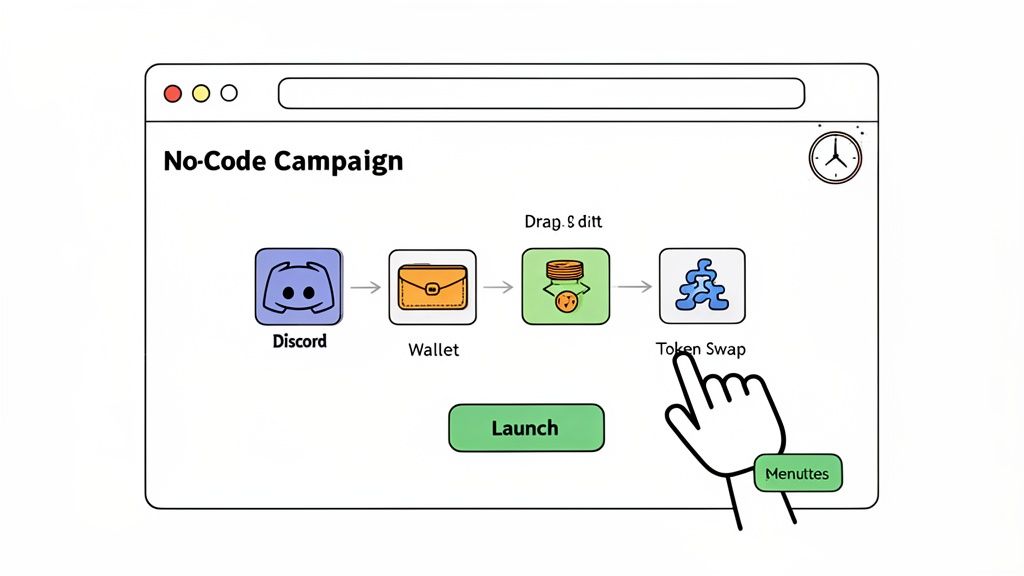
You can see how different actions, both on-chain and off-chain, are chained together in a logical sequence to guide the user from one step to the next.
Step 3: Set Up Your Rewards
Now for the fun part: the rewards. This is just as straightforward as setting up the tasks. You pick from a menu of reward types and decide exactly how they’ll be distributed.
- NFTs: Upload your artwork, set the total supply, and define the minting conditions.
- Tokens: Earmark a specific amount of your project's token from a dedicated rewards pool.
- Discord Roles: Connect your server and choose which role to automatically assign when a quest is completed.
- Allowlist Spots: Instantly generate a list of verified wallet addresses for special access.
You can get creative and mix and match these, creating tiered prizes or unique incentives for different quests. The platform handles all the secure, automated distribution, so you don’t have to spend your weekend manually sending hundreds of NFTs or tokens. You can see the full range of options by checking out the different plans offered by Domino.
The entire process is designed to be self-serve. You have full control, from the first task to the final reward, without writing a single line of code or waiting on a developer to free up their schedule.
Step 4: Hit Launch and Watch the Results Roll In
Once you’re happy with the quest flow and the rewards are locked in, there’s only one thing left to do: hit the launch button. Seriously, that's it. Your campaign is live and ready to share with your community.
From there, you can sit back and track everything in real-time from a central dashboard. You’ll see exactly how many people are participating, which tasks they’re completing, and the direct impact on your growth metrics. This instant feedback loop is incredibly powerful—it shows you what’s working so you can double down on your best strategies for the next campaign.
Got Questions About Web3 Quests? We've Got Answers.
Alright, so you've got the strategy down, but now the real-world questions are popping up. It's totally normal. Let's walk through some of the most common things people ask before they launch their first campaign, so you can jump in with confidence.
What’s a Realistic Budget for Rewards?
There's no single right answer here—it all comes down to what you're trying to achieve. A good starting point is to think about your normal Customer Acquisition Cost (CAC). If you typically spend $5 to get a new active user, then your onboarding quest rewards should probably be in that same ballpark.
For campaigns aimed at your existing crew, you could tie the budget to a small slice of their potential Lifetime Value (LTV). My advice? Start small. See what works, measure your return, and then you can confidently pour more fuel on the fire.
A great rewards strategy isn't just about throwing tokens at people. Think bigger. Mixing in exclusive NFTs, unique Discord roles, or early access to content can create a ton of excitement without costing you a fortune.
How Do I Attract Real Users and Not Just Airdrop Hunters?
This is the big one, right? It's a legitimate worry, but it’s one you can solve with smart quest design. The trick is to create tasks that require people to actually use your product, not just click "follow" on Twitter.
For instance, design a quest that makes someone try out a key feature in your dApp or stake one of your NFTs. When you link rewards to genuine product interaction, you naturally filter out the noise and attract people who are curious about what you’re building.
You can also put up some simple guardrails to keep bots and farmers out:
- Wallet Age: Only allow wallets that are at least 30 days old.
- Transaction History: Require users to have a minimum number of past on-chain transactions.
- Token Gating: Make quests exclusive to people who already hold your token or NFT.
These small steps go a long way in making sure you're rewarding future fans, not just fly-by-night reward hunters.
Do I Really Need a Developer to Launch a Quest Campaign?
Not anymore, thankfully. In the early days, you'd need a whole dev team to build a custom questing system. But today, no-code platforms have made it incredibly simple for anyone to get started. These tools give you a drag-and-drop interface to build out intricate Web3 quests in a matter of minutes.
They handle all the tricky stuff in the background—connecting wallets, verifying on-chain data, and sending out rewards securely. This means your team can stop worrying about the technical weeds and focus on what they do best: coming up with creative growth ideas and engaging with the community.
Ready to stop wondering and start building? With a tool like Domino, you can get your first Web3 quest campaign live in minutes, not months. It's all about designing, launching, and scaling your community growth without writing a single line of code. Start your journey with Domino today!