Crypto community rewards: Mastering crypto community rewards campaigns
Crypto community reward programs are all about giving people a real reason to get involved and stick around in your Web3 ecosystem. We're talking about more than just a one-off airdrop. A smart program uses a mix of token rewards, exclusive NFTs, and special access to get people to do things that actually matter—like engaging on socials, making on-chain transactions, or creating cool content. It’s how you turn lurkers into loyalists.
Why You Can't Afford to Skip a Crypto Rewards Program
Let's be real: launching a Web3 project today without a rewards strategy is like throwing a party and forgetting the music. A few years ago, a slick whitepaper and some good old-fashioned hype might have been enough. But now? The space is packed, and user attention is the most valuable commodity out there.
A rewards program is the engine that drives sustainable growth. It pushes past the initial speculative buzz to build a genuine, vibrant community that actually uses your product. This isn't just about handing out freebies. A well-thought-out program is a serious tool for hitting your most important goals: finding real users, sparking meaningful activity on your protocol, and building a base of fans who will go to bat for you.
Turning Followers into Participants
A rewards program makes the relationship a two-way street. Instead of just begging people to "join our Discord," you give them clear, valuable actions to take. This completely changes the game, turning a passive experience into an interactive one.
- Get Real Users: When you reward actions like connecting a wallet or trying out your testnet, you attract people who are actually curious about your tech, not just your token price.
- Spark On-Chain Activity: You can directly incentivize the specific behaviors that your project needs to thrive, whether that’s adding liquidity, minting an NFT, or casting a vote in governance.
- Build a Loyal Crew: By rewarding consistent participation—like being active in discussions or creating helpful tutorials—you cultivate a core group of advocates who feel like they have real skin in the game.
A smart rewards program is fundamentally about shaping behavior. It provides the right nudges to guide users toward actions that create compounding value for the entire network. Individual contributions build collective momentum.
So what does this all mean for your project? Let’s break down the core goals into a simple table.
Core Goals of a Crypto Rewards Program
Here’s a quick summary of what a well-structured rewards program should help you achieve, along with the metrics you should be tracking.
| Objective | Key Metric | Example Task |
|---|---|---|
| User Acquisition | New Wallet Connections | Connect a wallet and follow on X |
| Protocol Adoption | On-Chain Transactions | Complete one swap on our DEX |
| Community Engagement | Social Mentions & UGC | Create a video tutorial about our dApp |
| Brand Evangelism | Referral-Driven Sign-ups | Invite 3 friends to join our Discord |
| Long-Term Loyalty | User Retention Rate | Participate in 5 governance votes |
As you can see, each goal is tied to a tangible action and a trackable metric, making it easy to measure your program's success.
The Real-World Impact on Your Growth
The benefits here aren't just fuzzy feelings; they show up directly in your analytics. A strategic rewards campaign gives a measurable boost to the KPIs that signal a healthy, growing project. You’ll see a clear lift in user retention because people have ongoing reasons to stick around. Your social engagement will skyrocket when there’s an incentive for spreading the word.
To get a feel for what works, take a look at the playbooks used by top Web3 crypto projects and blockchain startups. You'll notice many of them built their entire go-to-market strategy around community incentives. It’s an approach that borrows heavily from proven B2B tactics, where engagement is everything. If you want to explore that connection further, our guide on building a powerful B2B loyalty platform has some fantastic insights that translate surprisingly well to Web3.
The best part? With no-code tools like Domino, you can spin up and test these campaigns in a matter of hours, not weeks. That kind of speed gives you the freedom to experiment, learn, and build a sophisticated program that grows with your community, ensuring your project doesn't just launch—it thrives.
Designing a Rewards Program That Actually Works
Alright, let's get from the whiteboard to the real world. This is where the fun starts. Building a killer crypto community rewards program isn't about just copy-pasting what another project did. It's about crafting an experience that feels native to your ecosystem. The aim here is to create something that doesn't just hand out freebies but builds real, tangible value for both your users and your protocol.
It really all boils down to one simple question: what are you actually trying to accomplish? If you don't have a clear goal, you're just throwing tokens into the void. Your rewards program has to be a direct answer to your project's biggest needs right now.
Defining Your Core Objectives
Before you even think about designing a quest or minting an NFT, you need to lock in your North Star. Are you trying to get new eyeballs on the project? Are you trying to get people to actually use your product? Or is the focus on building a loyal, ride-or-die community?
Sure, you can do all three, but picking a primary focus will give your program the punch it needs to really deliver.
Let's break down the three main goals you can target. You can think of it as a flow, where each objective builds on the last to create a growth loop that keeps feeding itself.
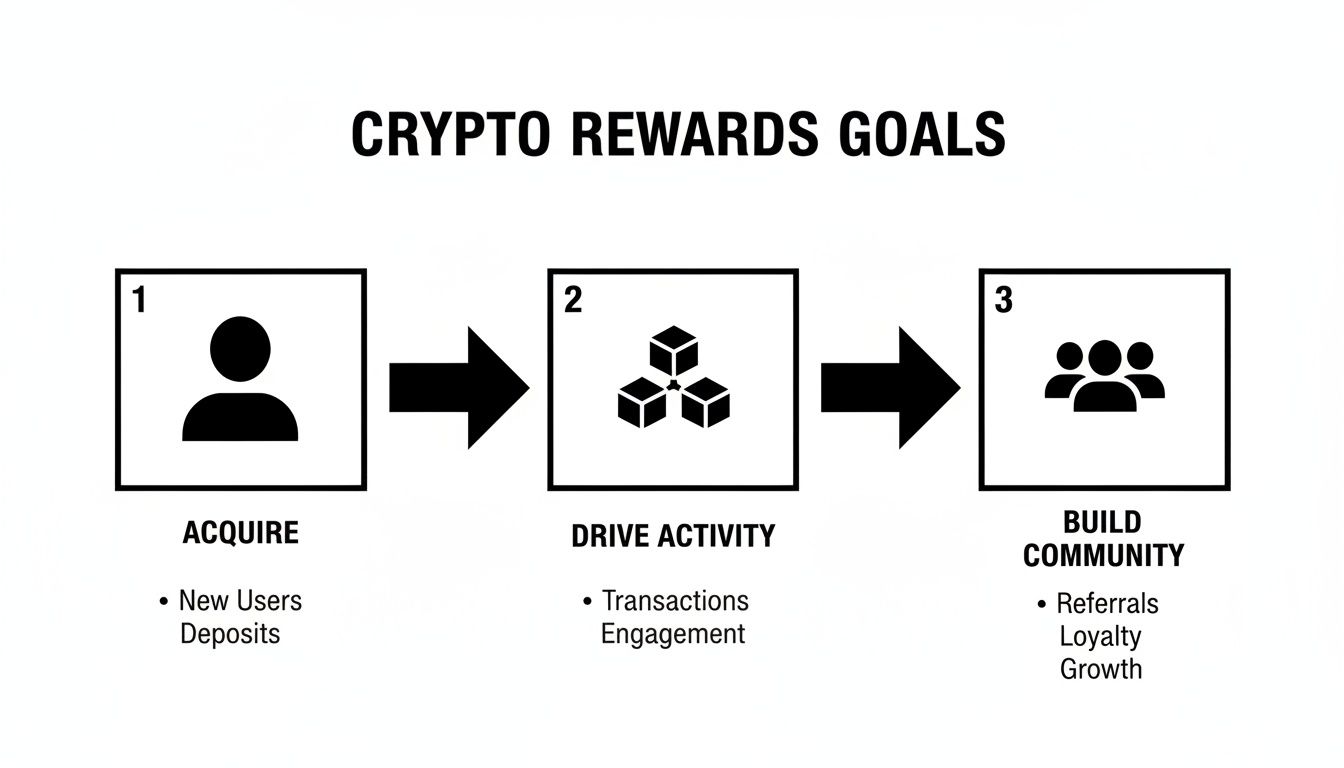
This visual shows the natural user journey. First, you get them in the door (acquisition). Then, you get them doing meaningful things on-chain and off-chain (activity). Finally, you turn those active users into a core, self-sustaining community (loyalty).
This isn't some new-fangled idea; it's a modern take on the oldest incentive model in the game. Bitcoin's mining rewards have been the OG crypto incentive since 2009, proving that rewarding participation is the key to network security and growth. With Bitcoin's market cap now pushing past $2 trillion, those early mining rewards look like the foundation of a global gamified economy. Modern reward strategies just echo this, using platforms like Domino to automate rewards for everything from a Discord emoji reaction to staking an NFT, turning simple incentives into viral growth engines.
Choosing Rewards That Resonate
Once you know why you're building the program, it's time to figure out the "what." Tokens are the default answer, but they’re just one tool in the shed. I've found that the most memorable and effective programs mix it up to hit different user motivations.
- Fungible Tokens (Your Native Token or Stablecoins): The heavy hitters. These are perfect for incentivizing high-value, on-chain actions like providing liquidity or voting in governance. They offer straightforward financial upside.
- Exclusive NFTs: These are fantastic for rewarding your OGs, contest winners, or top contributors. An NFT can be a status symbol, a collectible, or even a key that unlocks special access down the road.
- Special Discord Roles: Don't sleep on this one. It's a simple but incredibly powerful way to recognize your most active members. A unique color and role name makes people feel seen and valued right where the community lives.
- Early Access Passes: Want to make your loyalists feel special? Give them a first look at new features or a spot on an allowlist for an upcoming mint. This creates a powerful sense of being an insider.
- Reputation Points (XP): A brilliant way to gamify everything. Points can fuel a leaderboard, create friendly competition, and unlock tiered rewards as users "level up" in your community.
The best reward isn't always the one with the biggest price tag. More often than not, it's the one that grants status, access, or a sense of belonging. That's what creates a real connection.
Structuring Quests for Maximum Impact
You've got your goals and your rewards. The final piece is designing the actual tasks, or "quests." A classic rookie mistake is making everything either ridiculously easy or impossibly hard. You need a balanced journey with a mix of quick wins and more involved challenges.
We go much deeper into this concept in our guide to loyalty programme management, which is all about how to structure incentives for the long haul.
Here’s a quick, practical example of what a quest funnel could look like for a new DeFi protocol:
- Top of Funnel (Awareness): Start with super simple social tasks. These are the low-hanging fruit designed to get people into your orbit with zero friction.
- Follow on X and jump in the Discord.
- Like and retweet our launch post.
- Join the Telegram announcements channel.
- Middle of Funnel (Onboarding): Now, gently guide them toward your actual product for the first time.
- Connect your wallet to our dApp.
- Watch a 2-minute tutorial and answer a simple quiz.
- Make a single swap on our testnet.
- Bottom of Funnel (Activation): This is where you encourage the sticky, value-adding on-chain actions.
- Stake $50 worth of tokens into a liquidity pool.
- Mint a specific NFT from one of our partner collections.
- Cast a vote on our latest governance proposal.
This tiered structure creates a natural path forward. It makes newcomers feel welcome with easy first steps while properly rewarding your dedicated power users for their high-value contributions. That's how you build a crypto community rewards program that actually moves the needle.
Let's Talk Automation: Scaling Your Rewards Without Burning Out
If you've ever tried manually checking thousands of tweets, Discord messages, and wallet transactions, you know the pain. It’s a community manager’s nightmare and the fastest way to kill a promising rewards program before it even gets off the ground.
Scaling isn't just about handling more people; it's about building a system that can grow without your team collapsing under the weight of it all. The secret? Ditching the manual grunt work and embracing smart automation. You need a tech stack that does the heavy lifting, freeing you up to focus on strategy and actual human interaction.
Unifying On-Chain and Off-Chain Worlds
A truly effective rewards program has to live in two places at once. You need to track the social buzz happening off-chain while also verifying real product usage on-chain. Trust me, trying to juggle this with a bunch of spreadsheets and disconnected bots is a recipe for absolute chaos.
This is where integrated platforms become your best friend. Think of them as the central nervous system for your campaign, pulling all the disparate pieces together into one clean workflow.
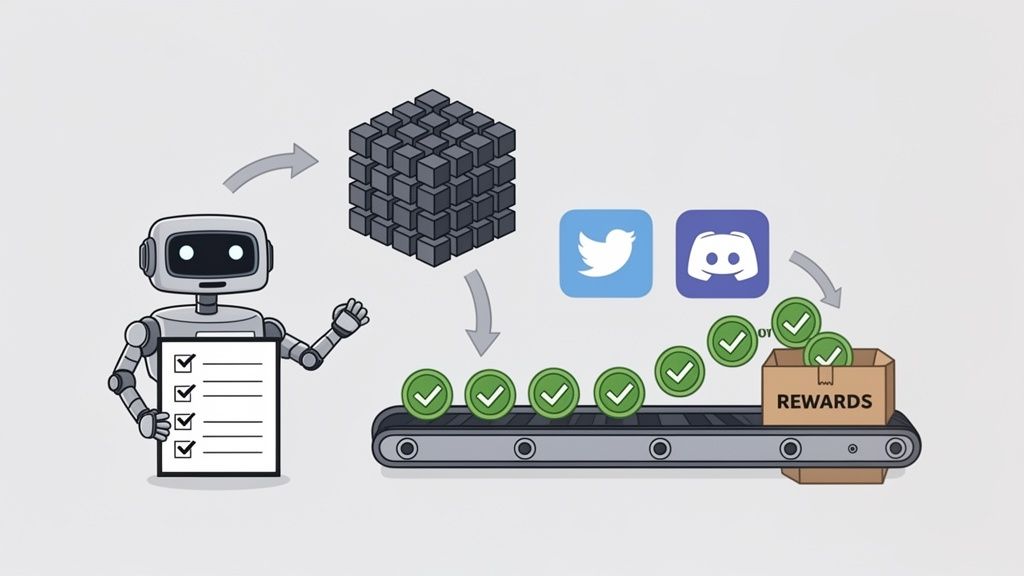
- Off-Chain Automation: Instantly verify social media tasks. We're talking follows, likes, retweets, and even assigning Discord roles. The best tools can even use AI to scan content, making sure a user’s post actually makes sense and isn't just spam.
- On-Chain Automation: This is huge. The platform connects directly to the blockchain to confirm actions. You can automatically validate if someone has swapped tokens, minted an NFT, or staked assets in a liquidity pool without lifting a finger.
Getting both on-chain and off-chain verification right is a total game-changer. It frees up an insane amount of time, slashes human error, and makes sure your rewards are distributed fairly and accurately.
Picking the Right Tools for the Job
When you’re looking at automation platforms, the goal is to find something that removes friction, not adds more of it. You want a solution that simplifies the complex web of verifications and payouts that modern reward campaigns demand.
For example, a platform like Domino lets you design quests that mix and match on-chain and off-chain tasks. Imagine building a campaign where someone has to first retweet your announcement (off-chain) and then stake 0.1 ETH in your protocol (on-chain) to unlock a special NFT. The platform handles both verification steps automatically. No manual checks, no headaches.
We actually dive deep into this strategy in our guide on designing effective Web3 quests, which shows you how to structure these multi-step journeys to keep people hooked.
The point of automation isn't to replace the community manager; it's to empower them. When you automate the tedious stuff, you get to focus on the creative work—dreaming up better campaigns, having real conversations, and building genuine relationships.
Meet Your Community Where They Already Are
Your rewards program shouldn't feel like a chore. Forcing users to navigate a clunky, unfamiliar website is a surefire way to lose their interest. The best campaigns feel like a natural extension of your community's daily experience. To nail this, you need to deploy your quests wherever your community hangs out.
Think about the different touchpoints your community has with your project:
- A Dedicated Quest Portal: A branded, white-label site that acts as the home base for all your campaigns. This is perfect for creating a polished, official-feeling experience.
- Native Discord Integration: Let people discover and complete tasks right from inside your Discord server with a bot. This is gold for engaging the die-hards who practically live in your server.
- Telegram Bots: If your community is all about Telegram, a bot can push quests and updates directly into their favorite chat app.
By offering multiple ways to participate, you make it incredibly easy for people to get involved. A user might see a quest on X, complete it using a Discord bot, and then track their progress on your dedicated portal. This flexible, multi-channel approach is how you maximize participation and scale your program to a global audience. It ensures that no matter where your users are, the rewards are just a click away.
Measuring Success and Optimizing for Growth
Okay, you’ve launched your rewards program. High-fives all around! But popping the champagne is just the first step. Now comes the real work: figuring out if all that effort is actually moving the needle.
If you aren't tracking the right numbers, you're flying blind. It's time to stop obsessing over vanity metrics like your Discord member count and start digging into the data that shows whether you’re building a real, engaged community or just attracting a flash mob of airdrop hunters.
This is all about understanding the real ROI of your community spend. Every token you give away should be a strategic investment. Let's make sure it is.
Identifying Your Most Important KPIs
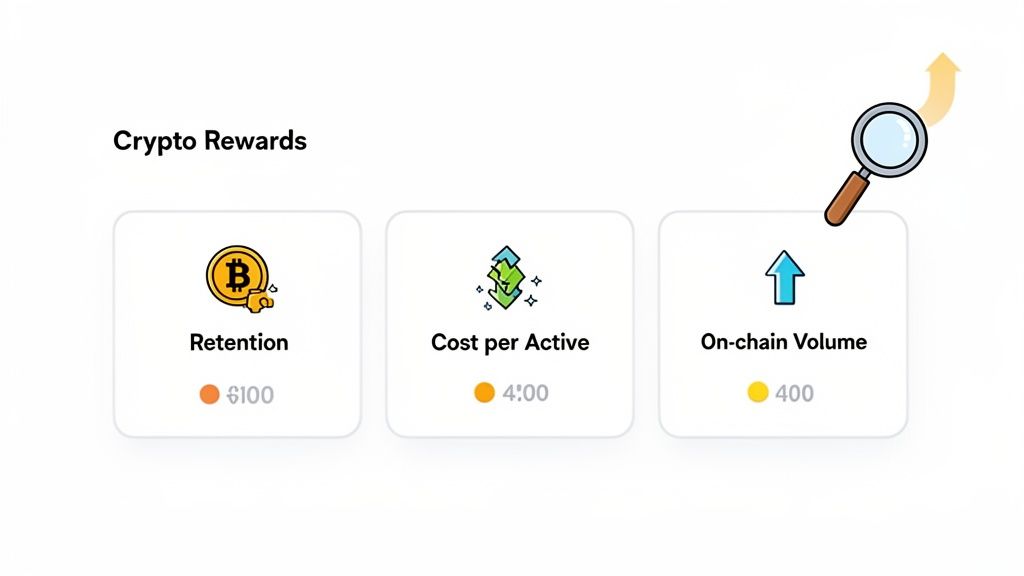
You don't need to track a million different things. In fact, that's a recipe for analysis paralysis. To get a true sense of your program's health, you just need to focus on a handful of key performance indicators (KPIs) that cut through the noise.
Here’s what I keep my eye on:
- User Retention Rate: This is your north star. Of the people who complete a quest today, how many are still around doing another one next week? Or next month? Strong retention is the ultimate sign that you're providing genuine value, not just a quick payday.
- Cost Per Active Participant (CPA): This one's simple but incredibly telling. Just divide the total value of rewards for a campaign by the number of truly active participants it brought in. This tells you exactly what you're paying to acquire a community member who actually sticks around.
- Impact on On-Chain Volume: Let's tie this back to what really matters. Are your reward campaigns driving a noticeable spike in transactions, total value locked (TVL), or whatever on-chain metric is crucial for your protocol? You need to see that connection.
- Quest Completion Funnel: For any quest with multiple steps, you need to watch the drop-off rate. If tons of people start but very few finish, you've got a problem. The task might be too confusing, the reward might not be worth the hassle, or something else is broken along the way.
Building Your Analytics Dashboard
You don't need a PhD in data science to get this done. Most modern questing platforms—including Domino—have analytics dashboards built right in. They do the heavy lifting for you, tracking these core metrics in real-time.
The trick is to actually use it. I recommend checking in at least once a week. Get familiar with the rhythm of your community's activity so you can quickly spot what's working and, just as importantly, what’s falling flat.
Set up a simple dashboard that puts your main KPIs front and center. This becomes your command center, giving you a quick, honest look at your program's health.
Think of your analytics dashboard as a direct conversation with your community. It’s not just charts and graphs; it’s a feedback loop telling you what they love, what confuses them, and where your biggest growth opportunities are hiding.
Creating a Data-Driven Feedback Loop
Here's where the real growth happens. You take the data you're seeing and use it to tweak, experiment, and optimize. It’s all about creating a continuous cycle of improvement.
Start running small experiments to see what your community responds to. For example, you could A/B test:
- Different Reward Types: For a similar task, does a rare NFT outperform a token drop of the same perceived value?
- Quest Difficulty: Do you get better overall engagement from a series of quick, easy tasks versus one big, complex challenge?
- Campaign Messaging: Try framing a quest around a mission, like "Help secure the network," instead of just "Complete this task to earn X." You might be surprised by the results.
The entire crypto space is shifting away from pure speculation. We're seeing a massive trend towards skill-based rewards and sustainable engagement, with $1.4 billion in institutional capital pouring into crypto prediction markets and gaming in Q2 of 2025 alone. You can read more about these trends in crypto markets in 2025 to see where things are headed.
With platforms like Domino now powering over 13,000 campaigns with AI-verified quests, the tools are here to build smarter programs. The goal is to create rewards that have lasting value, much like the yields in a well-designed play-to-earn game.
By constantly testing, measuring, and refining, you turn your rewards program from a simple expense line into a powerful, dynamic growth engine for your entire ecosystem.
Dodging the Bullets: Common Pitfalls in Community Rewards
Kicking off a community rewards program is a rush, but it’s just as easy to stumble right out of the gate. Think of this as your pre-mortem—a way to sidestep the common traps so you can build something that actually lasts.
The biggest challenge? Honestly, it's making sure you attract real believers, not just a swarm of mercenaries hunting for the next airdrop. If your rewards are too easy to grab, you'll get a flood of users who bring zero long-term value and dump your token at the first chance.
Keep the Airdrop Hunters at Bay
This is the classic mistake. You create a campaign that’s just a series of "Follow us on X" and "Join our Discord" tasks. What you get is a red carpet for bots and hit-and-run users who will ghost your community the moment they get paid. Sure, your follower count looks great, but it's a vanity metric that doesn't build a real, engaged community.
You need to filter for quality by designing a journey, not just a simple to-do list.
- Create Multi-Step Quests: Don't make it a one-click affair. Combine a simple off-chain task (like a retweet) with something more involved on-chain. Maybe they need to watch a tutorial video and then execute a specific swap on your testnet to qualify.
- Reward Real Commitment: Time is a great filter. A user who stakes their tokens for 30 days should earn a whole lot more than someone who stakes for a day and bails. This simple trick weeds out the impatient and rewards those who are sticking around.
- Build a Reputation System: This is a game-changer. Using experience points (XP) or leaderboards shifts the focus from a one-time cash grab to building a lasting reputation. It rewards the people who show up day after day.
It's not just about rewarding an action; it's about rewarding intent. Your quests should force people to actually learn about and use your protocol. That's your best defense against the quick-flippers.
Your Tokenomics Can Make or Break You
Here’s another landmine: unsustainable tokenomics. It's tempting to throw a huge chunk of your token supply at rewards to generate that initial hype. But this can backfire, big time. Giving away too much, too fast, creates a mountain of sell pressure that can absolutely crush your token price after launch.
Treat your rewards pool like a strategic war chest, not an open bar. Map out a clear emissions schedule that ties into your project’s roadmap. For example, you could release bigger reward batches to coincide with a mainnet upgrade or a major new feature launch—driving adoption when it matters most.
Transparency is also non-negotiable. Be upfront about the total token allocation for community rewards and any vesting schedules. This manages expectations and stops your community from feeling blindsided by sudden token unlocks. A well-planned model keeps your project healthy and ensures your community’s efforts aren’t instantly devalued.
Don't Skimp on Communication and Compliance
Finally, don't overlook the "people" problems. Bad communication can turn an excited community into an angry one overnight. Be painfully clear about the rules, the exact rewards, and when people can expect to receive them. If something gets delayed, get out in front of it and explain why. Radio silence is a community killer.
On top of that, you can't just ignore the regulatory side of things. Crypto rules are a moving target, and what flies in one country might get you in hot water in another. A huge—and often forgotten—pitfall is the tax man. Both you and your community members could have tax obligations. For instance, knowing the rules around the Australian tax on crypto is essential if you have a user base there.
Staying informed and being transparent about these responsibilities protects everyone. By steering clear of these common mistakes—filtering for genuine users, managing your tokenomics like a pro, and communicating clearly—you’ll build a rewards program that creates real loyalty and drives lasting growth.
Your Top Questions About Crypto Rewards, Answered
As you start piecing together your rewards strategy, a few big questions always come up. I've heard them from countless teams, so let's cut through the noise and get you some straight answers based on what actually works in the wild.
How Much of Our Token Supply Should We Give Away?
This is the big one, right? While there's no single magic number, most projects land somewhere between 5% and 15% of their total supply for community rewards. If your entire growth model is built around the community, you might even see that number creep up toward 20%.
But here’s the real secret: the total percentage matters less than how you release it. Don't just dump it all at once in a massive airdrop. That's a recipe for a price crash. Instead, think in terms of a multi-year emissions schedule. Tie your reward releases to major roadmap milestones. This keeps incentives flowing and ensures you have fuel in the tank for long-term growth.
Should We Use Points (XP) or Just Give Out Tokens?
Honestly, the best play is to use both. They solve different problems and work together beautifully.
- Experience Points (XP): Think of XP as your long-term loyalty and gamification engine. It creates a sense of progress and status. People rack up points for daily check-ins, participating in governance, or just being helpful in Discord. This is your best filter for identifying true fans and weeding out the short-term mercenaries.
- Direct Token Rewards: This is your high-octane fuel for driving specific, high-value actions. Need more liquidity for a new trading pair? Want users to bridge assets to a new chain? A direct token reward provides that immediate financial nudge to get it done now.
A killer combo is to let users earn XP for consistent, everyday engagement, which then unlocks eligibility for bigger, more exclusive token rewards later on.
How Do We Stop Bots from Draining Our Rewards?
Ah, the eternal struggle against Sybil attacks. The key is to stop thinking about a single line of defense and start thinking in layers. Relying on just one verification method is asking for trouble.
- Prove They're Human: Start with a "proof of humanity" layer. Tools like Gitcoin Passport, BrightID, or Worldcoin are great for this.
- Check Their History: Require wallets to have a certain amount of transaction history or hold a base amount of a major asset like ETH. This easily weeds out freshly created bot wallets.
- Look at Socials: Make sure their connected X or Discord accounts aren't brand new. An account created yesterday is a huge red flag.
- Make Them Work for It: Design quests that require actions across multiple platforms (like engaging on Discord, liking a post on X, and then performing an on-chain action). This complexity makes it way too expensive and annoying for bot farms to keep up.
Your best defense against bots isn't a single wall; it's a series of hurdles. Each layer you add makes it less profitable for attackers to target your campaign, naturally filtering for real, dedicated users.
What's the Smartest Way to Distribute NFT Rewards?
NFTs make for awesome rewards, but you don't want to get bogged down in gas fees and admin headaches. You’ve got a few clever options.
- Lazy Minting: This is a neat trick where you only create the NFT's metadata upfront. The NFT isn't actually minted on-chain until the user decides to claim it, and they cover the gas fee. It's a standard, user-friendly approach.
- Go Gasless on an L2: Just use a Layer-2 like Polygon, Arbitrum, or Optimism. The gas fees are practically nothing compared to Ethereum mainnet, so you can airdrop thousands of NFTs without breaking the bank.
- Merkle Tree Airdrops: For really massive distributions, this is the pro move. You create a cryptographic proof (a Merkle root) from your list of eligible wallets. Users then pull their NFT from a single smart contract, which is way more gas-efficient than your team pushing out thousands of individual transactions.
Can We Run a Campaign with Zero Budget?
You absolutely can. If you're a pre-launch project and don't even have a token yet, you can still offer things people desperately want.
- Allowlist Spots: A guaranteed spot in an upcoming mint can be more valuable than gold.
- Exclusive Discord Roles: Never underestimate the power of status. A unique role is a simple yet powerful badge of honor.
- Future Airdrop Points: This is the "points meta" we've seen work so well. Reward early contributions with points that will convert to a token allocation after your TGE (Token Generation Event).
This approach is perfect for attracting genuine, early believers who are betting on your future success.
What Are Some of the Unexpected Benefits?
A great rewards program does more than just juice your engagement metrics. It can fundamentally shape your community's culture. One of the coolest things we're seeing is how these programs are becoming a launchpad for philanthropy.
In 2024, the crypto community donated over $1 billion to charity, a mind-blowing 386.33% jump from the year before. The average donation size also shot up to $10,978.28. People are channeling their crypto gains into making a real-world impact. You can dive deeper into this trend in The Giving Block's annual report. It’s proof that a well-designed rewards program isn't just about taking; it can be about creating a cycle of giving back.
Ready to stop wrestling with spreadsheets and manual verification? Domino gives you the no-code toolkit to design, automate, and scale your crypto community rewards program in minutes. Join thousands of Web3 teams building vibrant communities and launch your first campaign today.