Your Guide to Building a Web3 Loyalty Program That Works
Let’s be honest, most traditional loyalty programs feel a little… broken. You collect points that you can only use with one brand, they often expire, and you never really own them. They live in a company's database, not in your pocket.
It’s a one-way street where your loyalty feels rented, not truly earned. This old model just isn't cutting it anymore. People expect more today—they want real value, transparency, and to feel like part of a community, not just another number in a spreadsheet.
A web3 loyalty program completely flips this script. It's a rewards system built on blockchain, using digital assets like tokens and NFTs to give people genuine ownership over their rewards. Instead of points stuck in a database, these assets live in a user's personal crypto wallet. That makes them permanent, transferable, and often usable across different platforms.
Why Old-School Loyalty Programs Are Fading
The old way of doing things is losing its punch. The core problem? Everything is centralized. The brand controls your points, the rules, and the value, which leads to some serious limitations.
The Problem with Centralized Rewards
Think about the loyalty cards in your wallet right now. They all share the same fundamental flaws that Web3 programs are built to fix:
- You Don't Really Own Anything: Those points are just IOUs on a company's server. They can be devalued, changed, or even wiped out overnight without your consent.
- They're Trapped in a Walled Garden: Your hard-earned rewards are completely useless outside of that one brand's ecosystem. Their utility is incredibly limited.
- Engagement is Skin-Deep: Most programs are purely transactional, only rewarding you for spending money. They completely miss the mark on recognizing deeper forms of engagement, like giving valuable feedback, creating content, or helping other community members.
The result is what I call "loyalty fatigue." We're all drowning in dozens of nearly identical programs, and it’s led to widespread disinterest. The emotional connection that creates real, lasting loyalty is almost always missing.
The Shift Toward Community and Ownership
Web3 loyalty turns this entire model on its head. By using the blockchain, it transforms rewards from flimsy database entries into valuable digital assets that the user actually owns. This isn't just about slapping an NFT onto an old system for hype; it's a fundamental change in how we think about value and community.
This approach creates an incredible growth loop. We've seen brands that adopt Web3 loyalty tokens boost customer engagement by a whopping 28% while simultaneously cutting their acquisition costs by 12%. That's something traditional programs just can't compete with. It works because tokenized rewards give people real ownership, making their points permanent and interoperable.
Instead of just rewarding purchases, you can start incentivizing actions that genuinely build a stronger, more vibrant community. When people feel like they have a real stake in the game, they evolve from passive customers into passionate advocates. This is the secret to building a resilient brand, and effective community building strategies are the bedrock of this new approach. The focus shifts from just trying to keep customers around to building a thriving ecosystem where everyone is invested in its success.
Designing Your Program's Core Mechanics
Alright, you've nailed down the "why." Now for the fun part: building the "how." This is where we get into the nuts and bolts of your web3 loyalty program—designing the engine that makes it all run and keeps your community coming back for more. A program without a clear mission is just a random checklist of tasks; it needs a real purpose to connect with people.
So, let's start with a simple question: What are you actually trying to achieve?
Are you trying to blast through user acquisition goals and get a flood of new people into your ecosystem? Or is the focus more on deepening on-chain engagement, like cranking up transaction volume or boosting the TVL in your protocol? Maybe it’s not about the numbers at all, but about cultivating a genuinely vibrant and tight-knit community.
Your answer here will dictate everything else. Each goal has a different set of key performance indicators (KPIs) you can actually track. If you're chasing new users, you'll be obsessing over new wallet connections and referral rates. If it's all about on-chain action, you’ll be watching daily active users (DAU) and specific smart contract interactions like a hawk. And for community health? You're probably looking at things like social sentiment and how lively your Discord is.
Defining Your Reward System and Tokenomics
Once you know your destination, you need to figure out the incentives that will get people there. This brings us to the heart of your program's tokenomics—the economic model that defines how rewards are earned, distributed, and what people can actually do with them. Get this wrong, and you'll end up with a system plagued by inflation, user apathy, or hit-and-run farmers who cash out and vanish. But get it right, and you create a powerful, self-sustaining growth loop.
The great thing about Web3 is that you’re not just stuck with one type of reward. You've got a whole toolkit to play with.
- Fungible Tokens: Think of these as your classic loyalty points, but on the blockchain. They're interchangeable, divisible, and perfect for rewarding a high volume of smaller, everyday actions.
- Non-Fungible Tokens (NFTs): These are your digital trophies. NFTs are ideal for marking major milestones, granting exclusive access, or serving as a membership pass. It could be a unique collectible or a ticket to an exclusive AMA.
- Exclusive Roles & Access: Sometimes, the most powerful rewards aren't on-chain at all. A "Verified Contributor" role in Discord or access to a token-gated channel can mean more to your core community than a few tokens.
This decision tree gives a good visual breakdown of the fundamental choice between a traditional Web2 system and a Web3 approach.
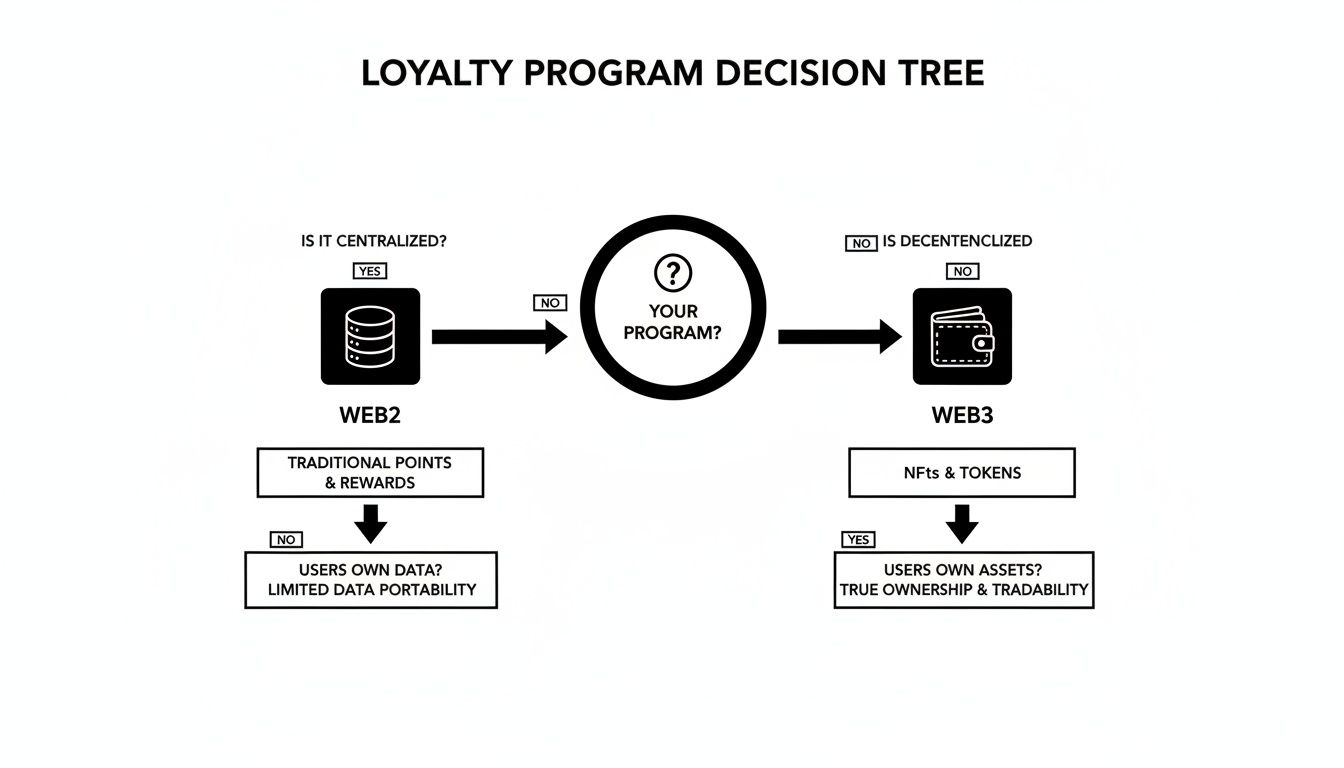
As you can see, the game changes completely. Web2 programs are built on private, centralized databases you control. Web3 programs revolve around user-owned wallets, which fundamentally shifts ownership and control into the hands of your community.
Choosing Your Reward Mechanics
Deciding on the right mix of rewards is crucial. It directly impacts user motivation and the long-term health of your program. This table breaks down the most common options to help you map them to your goals.
| Reward Type | Best For | Pros | Cons |
|---|---|---|---|
| Fungible Tokens (Points) | High-frequency, low-value tasks like daily check-ins, social engagement, and consistent app usage. | Highly liquid, easy to distribute for micro-actions, and simple for users to understand ("earn X points for doing Y"). | Prone to inflation if not managed carefully. Can attract "farmers" if there's no real utility. |
| NFTs (Collectibles, Badges) | Rewarding major achievements, completing campaigns, event attendance, or signifying membership tiers. | Creates scarcity and collectibility. Acts as a status symbol and can unlock exclusive access (token-gating). | Less liquid than fungible tokens. Can be complex to design and mint if you have many unique variations. |
| Exclusive Access & Roles | Recognizing top contributors, beta testers, and community moderators. Building a core group of advocates. | Extremely low cost to implement. Fosters a deep sense of belonging and status within the community. | Not scalable for a very large user base. Value is subjective and tied to the community's prestige. |
| Airdrops & Whitelists | Driving initial adoption, rewarding early supporters, or bootstrapping a new community feature. | Generates significant hype and rapid user acquisition. A powerful way to thank loyal users. | Can attract airdrop hunters who dump immediately. Requires careful snapshotting and anti-sybil measures. |
Ultimately, most successful programs use a hybrid approach. You might use fungible tokens for daily engagement, award NFTs for completing a major questline, and grant special Discord roles to your top 1% of contributors. Mix and match to keep things interesting.
Building a Sustainable Economic Model
Let's be blunt: you have to avoid the dreaded "farm-and-dump." That’s the classic scenario where users grind through tasks just to sell their rewards on the first available exchange. To prevent this, your rewards need real utility inside your ecosystem.
I’ve seen this happen time and again: projects over-reward simple, low-value actions. If you're handing out a ton of tokens for a single retweet, you’re not building a community—you’re attracting mercenaries. The reward should always feel proportional to the value of the action.
Here are a few battle-tested strategies to build a more robust and sustainable model:
- Capped Supply: Put a hard limit on the total number of tokens that will ever exist. This is Economics 101—scarcity creates demand and helps prevent runaway inflation.
- Vesting Schedules: Don't dump all the tokens at once, especially for big rewards or team allocations. Release them over a set period to prevent a sudden shock to the market.
- Burning Mechanisms: Introduce ways for tokens to be permanently removed from circulation. Maybe users have to burn tokens to mint a special-edition NFT or to upgrade their in-app status.
- Staking and Utility: This is key. Give people a compelling reason to hold their tokens instead of selling them. Let them stake tokens to earn more rewards, get a share of protocol fees, or gain voting rights in your DAO.
Implementing Tiers to Encourage Long-Term Loyalty
A tiered system is one of the best ways to gamify the experience and keep people hooked for the long haul. It creates a clear ladder for users to climb, where they unlock better rewards and higher status along the way.
Think about it: a new user might join at a "Bronze" tier with basic perks. By completing quests, participating in governance, and being a helpful community member, they can grind their way to "Silver" to unlock exclusive content. The most dedicated members might reach a "Gold" or "Diamond" tier, granting them early access to new features or even a direct line to the core team.
This isn't just about handing out goodies. It's about building a sense of achievement and social capital. Your top-tier members become your biggest champions, and their status becomes a public badge of honor that shows off their dedication. By blending a clear mission with smart tokenomics and a compelling tier structure, you create a loyalty engine that truly drives growth.
Crafting Quests People Actually Enjoy
Alright, you've got the engine for your web3 loyalty program built. Now you need the fuel—the actual quests and tasks that will get people hooked and keep them coming back every day.
Let's be honest. The world doesn't need another loyalty program built on boring "like and retweet" tasks. Those are low-effort, low-value interactions that just attract mercenaries, not a real community.
A killer program is built on creative quests that feel less like a chore and more like a game. The real magic happens when you start mixing on-chain actions with off-chain community fun. This creates a story around your brand and pulls users into your world, making their participation actually feel meaningful.
Blending On-Chain Actions with Off-Chain Fun
Think bigger than the basics. Instead of just asking for a follow, why not design multi-step quests that tell a story? For example, a user could kick things off with an on-chain action, like swapping a specific token pair on your DEX. Once that transaction is verified, boom—the next step unlocks.
This second step could be something totally different, like an off-chain creative task. Maybe you ask them to generate AI art inspired by your project's lore or write a short story about their experience. This mix is so powerful because it validates their financial commitment (the swap) while tapping into their personality. You just turned a simple transaction into a memorable brand moment.
This flow from a Domino-powered campaign is a perfect example of how a simple process can guide users from an on-chain action right into deeper community engagement.
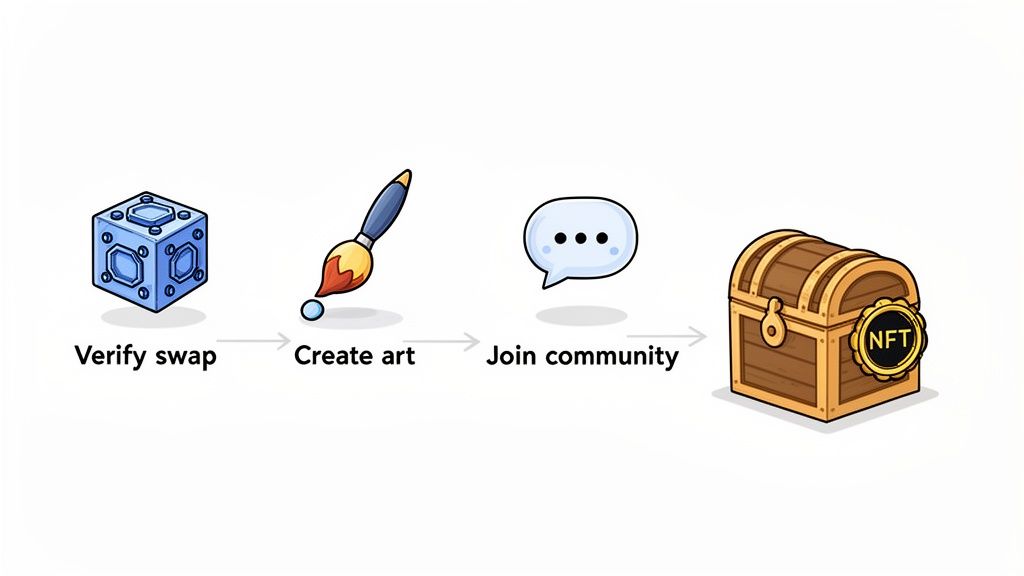
The key here is the seamless journey. The user isn't just checking off random boxes; they're following a path that gets them more invested at every turn.
The Power of Quest Templates
Designing these kinds of quests from scratch might sound like a ton of work, but it doesn't have to be. Most modern loyalty platforms come loaded with hundreds of pre-built quest templates that you can customize in minutes. This is a huge time-saver, letting you focus on the creative strategy instead of getting bogged down in the technical setup.
You can easily set up quests for things like:
- Social Engagement: Verifying follows, likes, retweets, or even specific comments on posts.
- On-Chain Activity: Confirming swaps, providing liquidity, minting NFTs, or casting a governance vote.
- Content Creation: Letting users submit memes, articles, or videos for the community to check out.
- App Integration: Rewarding people for hitting a certain level in a game or trying out a new dApp feature.
The global Web3 Loyalty Platform market has already exploded to USD 1.12 billion, all thanks to the insane adoption of these blockchain-based reward systems. This growth proves just how much demand there is for tools that make creating campaigns easier. As a case in point, platforms like Domino have already powered over 25 million completed quests. You can dig into more stats about the booming Web3 loyalty market on Dataintelo.
Balancing Challenge with Reward
One of the biggest mistakes I see projects make is getting the effort-to-reward ratio completely wrong. If you ask someone to write a 1,000-word blog post for 10 community points, you'll hear crickets. On the flip side, offering a rare NFT for a simple retweet devalues your rewards and brings in the wrong crowd.
A great quest feels like a fair trade. The user gives you their time, attention, or creativity, and you give them a reward that feels proportional and valuable to them.
Always ask yourself, "What is this action really worth to my project?" A referral that brings in a new, active user is way more valuable than a passive social follow. Your rewards need to reflect that. This is where truly understanding Web3 gamification mechanics can give you a massive advantage in building a system that actually motivates people.
Creating Narrative-Driven Quest Chains
Instead of just throwing a bunch of one-off tasks at your community, try building quest chains that tell a story over time. It’s an incredible way to keep people engaged long-term and build a ton of anticipation.
Imagine a week-long campaign for a new product launch.
- Days 1-2 (The Teaser): Start small with simple social quests. Ask users to solve a riddle about the new feature or find a clue hidden on your website.
- Days 3-4 (The Reveal): Step it up. Have them watch an announcement video and take a quick quiz on it, or tweet about their favorite part of the reveal.
- Days 5-7 (The Launch): Now, drive on-chain action. Reward the first 100 users who try the new feature, or ask them to provide liquidity to the new pool.
Each step builds on the last, creating a story that pulls users from just being aware to taking real action. Finishing the whole chain could unlock a special "Early Adopter" NFT, giving them a permanent badge of honor in your community.
Using AI for Automated Verification
This all sounds great, but who has the time to manually sift through thousands of memes or AI art submissions? This is where automation becomes your secret weapon. The best loyalty platforms are now using AI to verify all those subjective, off-chain tasks.
Instead of your community manager burning hours scrolling through Discord, an AI model can be trained to automatically check for things like:
- Content Relevance: Does this image or text actually have anything to do with our brand?
- Originality: Is this a blatant copy-paste job?
- Brand Safety: Does this content violate our community guidelines?
This frees up your team to focus on the big picture—strategy, community building, and dreaming up the next awesome quest chain. When you combine creative quests with smart automation, you can build a web3 loyalty program that's not just effective, but genuinely fun.
Alright, you've designed a killer program with quests that are genuinely fun. Now for the make-or-break moment: the launch.
A brilliant web3 loyalty program is totally useless if it’s buried behind a clunky user experience or hard to find. Accessibility is everything. Your goal is to weave the program so seamlessly into your community’s world that participating feels like a natural part of just hanging out.
Meet Your Community Where They Are
This means you’ve got to show up where your users already are. Don't force them to jump through hoops or leave their favorite platforms. Instead, bring the quests right to them.
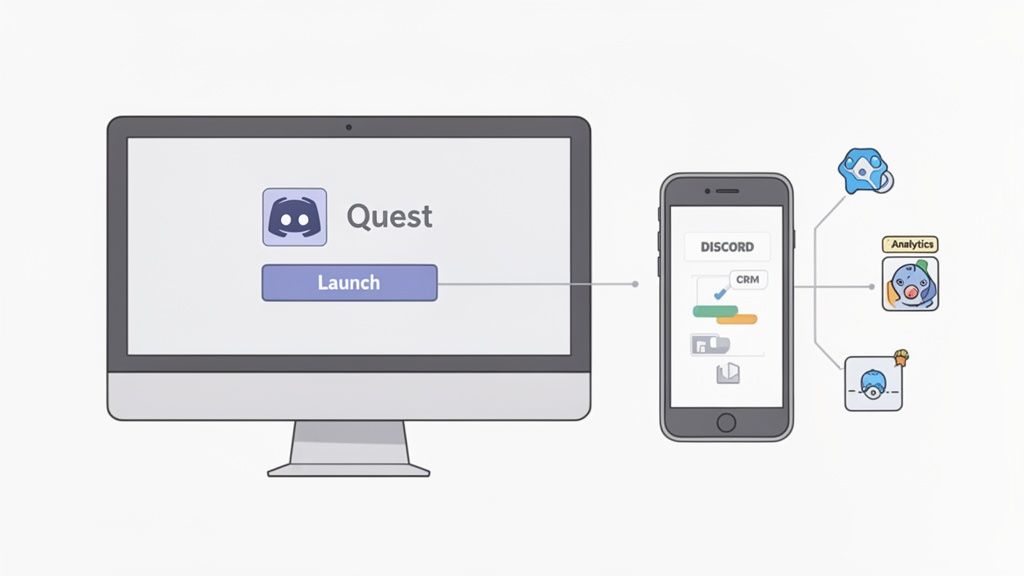
Modern loyalty platforms make it incredibly easy to integrate directly into community hubs like Discord and Telegram. You can run an entire campaign right from within a server or chat, which slashes the friction and keeps people hooked.
For projects that want that completely polished, on-brand feel, a custom white-label site is the way to go. This gives you total control over the look and feel, letting you build a questing portal that’s a core part of your dApp or website. If that sounds like your speed, you can learn more about building a white-label Web3 loyalty platform in our detailed guide.
Plug Your Program into Your Growth Stack
Running your loyalty program in a silo is a massive missed opportunity. To really see it fly, you need to connect it to the other tools you already rely on. Think of it as plugging a new high-performance engine into a car you’ve already built.
The right integrations transform your program from a simple engagement toy into the central hub of your entire growth machine.
Here’s what I mean:
- Your dApp: Link quests directly to in-app actions. This lets you reward people for trying new features, hitting milestones, or completing specific on-chain transactions. It's a fantastic way to drive product adoption.
- Your CRM: Syncing this data shows you which of your most valuable customers are also your most engaged community members. You can segment users based on quest activity and craft laser-focused marketing campaigns.
- Analytics Dashboards: Funnel your quest data into tools like Google Analytics or Mixpanel. This gives you a clear line of sight into the full user journey and helps you measure the program's direct impact on your core business metrics.
These connections create a powerful feedback loop. You can see exactly how your loyalty initiatives are shaping user behavior, product usage, and even revenue, giving you the hard data you need to justify and scale your efforts.
The Secret to a Flawless Launch? A Phased Rollout.
It’s tempting to go for a huge, splashy launch announcement. I get it. But from my experience, a more strategic, phased approach almost always works out better. A "big bang" launch leaves zero room for error. A small bug, a confusing quest, or wonky rewards can sour your program's reputation before it even gets going.
My advice is simple: start small and focused. A successful launch isn't about making the biggest splash on day one. It's about building a solid foundation, gathering real-world feedback, and making sure everything works perfectly before you open the floodgates.
A smart launch strategy minimizes risk and sets you up for success. Here’s a playbook that works.
- Internal Alpha Test: Before anyone outside your company sees a thing, run the program internally. Let your own team try to break it, find loopholes, and point out anything that's confusing. This first pass will catch 80% of the obvious problems.
- Ambassador Beta Program: Next, open it up to a small, hand-picked group of your most trusted community members and brand ambassadors. These are your super-users. They want you to succeed and will give you honest, high-quality feedback. Their insights on quest difficulty and reward value are pure gold.
- Go-Live: Once you’ve tweaked things based on beta feedback and you're confident in the system, it's time to go live. Even here, be strategic. Announce the launch to your core community first—your dedicated Discord and Telegram members—before you start shouting about it on Twitter.
This measured approach ensures that by the time your program is fully public, it's already been battle-tested. You’ll launch a polished experience with a built-in group of advocates who are already hyped up and engaged. That kind of momentum is how you make a real, lasting impact from day one.
Measuring, Optimizing, and Scaling Your Program
So, you've launched. Pop the champagne, but don't kick your feet up just yet. The launch is the easy part. The real grind—and the real magic—happens next, turning that initial spike of excitement into long-term, sustainable growth.
A great web3 loyalty program isn't a machine you build and walk away from. It's more like a garden. You have to constantly tend to it, measure what's growing, and prune what isn't. Success isn't found in the launch, but in the relentless optimization that follows.
Forget the fluff. Total quest completions and your Discord member count look nice on a slide, but they're vanity metrics. They don't tell you if your program is actually working. To get the real story, you need to tie community actions directly to on-chain value.
What to Measure: The Metrics That Actually Move the Needle
You need to get smart about your data. The right metrics will tell you what’s working and what’s just creating noise. If you focus on these key areas, you'll get a crystal-clear picture of your program's health and its true ROI.
- On-Chain Impact: This is your source of truth. Are the people doing your quests actually driving more transaction volume on your protocol? Is your Total Value Locked (TVL) ticking up? Are you seeing more interactions with your most important smart contracts? These are the hard numbers that prove your loyalty program is creating real economic activity, not just social chatter.
- Retention and Stickiness: Getting people in the door is one thing; getting them to stick around is another entirely. Look at your 30, 60, and 90-day retention rates for members who participate in your quests. A program that’s firing on all cylinders will show that engaged members stay way longer than your average user.
- Customer Lifetime Value (LTV): This is the ultimate boss-level metric. Put an active loyalty program member side-by-side with a non-participant. Is their LTV higher? If you see a meaningful lift here, you’ve found the holy grail. It’s the clearest signal you’re building genuine, lasting value with your community.
And this isn't just theory. We've seen early adopters of NFT-based loyalty programs pull in a 40% increase in retention and a 31% bump in LTV. You can dig into more of the data on how Web3 is transforming customer bonds on NFTBaz. It’s powerful stuff.
Figure Out What Your Community Really Wants
Every quest you run is a direct conversation with your community. They're telling you what they like and what they don't with their actions. Are they all over the creative, off-chain stuff like generating AI art, or do they prefer getting their hands dirty with on-chain actions like providing liquidity? The data holds the answer.
Don't just glance at completion rates. You have to go deeper. Look at multi-step quests and find where people are dropping off. If 90% of users finish step one but only 10% even start step two, you've found a problem. It could be a friction point, or maybe the reward just isn't worth the effort for that second step.
This creates a killer feedback loop. You can double down on the quests they love and either fix or kill the ones that are flopping. This constant iteration is what separates a decent program from a legendary one.
The A/B Testing Secret Weapon
Stop guessing. The only way to know what truly works is to test it. A/B testing is your secret weapon for constant improvement, and it's simpler than it sounds. Just run two slightly different versions of a quest or a reward and see which one gets better results.
You can test practically anything:
- Reward Types: For the same task, what works better? A cool NFT badge or a handful of fungible tokens?
- Quest Framing: Does calling something a "Community Challenge" get more clicks than calling it a "Task"? Language matters.
- Effort vs. Reward: Will more people grind through a hard quest for a big prize, or do they prefer an easy win with a smaller reward?
When you’re constantly testing and making changes based on real data, you’re no longer just running on assumptions. You're letting your community's behavior guide the evolution of your program. This is how you build a loyal user base that isn’t just an audience—they become your most powerful growth engine.
Got Questions About Web3 Loyalty? We've Got Answers
Diving into Web3 loyalty can feel a bit like stepping into a new world. New terms, new tech, new rules. It's totally normal to have a ton of questions swirling around as you start planning things out.
Let's cut through the noise. Here are some quick, no-fluff answers to the most common questions we hear from teams just like yours.
What's the Real Difference Between a Web2 and a Web3 Loyalty Program?
Honestly, it all comes down to one massive concept: ownership.
Think about your airline miles or Starbucks points. They live in a company's database, and you're just borrowing them. The company can change the rules, devalue your points, or wipe them out overnight. You have zero real control.
A Web3 loyalty program completely flips that script. Rewards are actual assets on a blockchain—things like NFTs or tokens—that live in your crypto wallet. You own them, period. They can't be snatched back, and you can often trade them or use them in other apps. That sense of true ownership makes them feel way more valuable and gets people a lot more invested.
How Do I Build a Token Economy That Doesn't Just Collapse?
Ah, the million-dollar question. Building a sustainable token economy is everything. If you get this wrong, you'll just attract a swarm of reward "farmers" who will earn your tokens and dump them on the market, tanking the value for everyone.
A classic mistake is throwing tons of rewards at super simple, bot-friendly tasks. You'll get a temporary spike in activity, but it's all mercenaries, not a real community. The key is to make sure rewards are tied to actions that genuinely help your project grow.
To keep your economy healthy, focus on these fundamentals:
- Give Your Token a Job: A token can't just be a reward. It needs a real purpose. Can people use it to vote on proposals? Stake it to earn a cut of protocol fees? Unlock special access? The more jobs it has, the more reasons people have to hold onto it.
- Keep a Lid on Supply: A fixed, finite supply creates scarcity. It’s economics 101, and it's a powerful driver of long-term value.
- Burn, Baby, Burn: Create mechanisms that take tokens out of circulation forever. For instance, require users to "burn" a certain number of tokens to mint a super-exclusive NFT or access a premium feature.
Do I Actually Need to Be a Developer to Launch One of These?
Not anymore. A few years ago, the answer would have been a resounding "yes." You would've needed a team of expensive blockchain engineers to write custom smart contracts from scratch.
Thankfully, that's all changed. The rise of no-code platforms means marketers and community managers can now build and launch a full-blown Web3 loyalty program without writing a single line of code. These tools do all the heavy lifting for you.
Platforms like Domino are built for this. They give you pre-built templates for quests, automatically verify when users complete both on-chain and off-chain tasks, and plug right into your community hubs like Discord and Telegram. This lets you and your team focus on the fun stuff—strategy, creativity, and building an awesome community—instead of getting bogged down in technical details.
How Can I Actually Prove This Thing Is Working and Measure ROI?
This is where you need to look beyond the vanity metrics. Sure, a jump in your Twitter follower count looks nice on a slide, but it doesn't mean your business is growing. To really measure the ROI of your program, you have to connect engagement directly to your core business goals.
Here are the metrics that actually matter:
- On-Chain Impact: Is your program pushing up your transaction volume? Increasing the Total Value Locked (TVL) in your protocol? Bringing in more active wallets? This is hard, cold proof of economic activity.
- User Retention: Look at the 30, 60, and 90-day retention rates. Are the people who join your loyalty program sticking around longer than those who don't? A great program makes your users "stickier."
- Lifetime Value (LTV): This is the big one. Calculate the LTV of a user who's active in your loyalty program and compare it to someone who isn't. If you see a major lift here, you've got a clear winner.
- Community Growth: Don't just track total members; track the growth in your core channels that came directly from program incentives or referral quests.
Focusing on these numbers will give you the hard data you need to prove your program's value and make smart decisions about where to invest your energy next.
Ready to build a Web3 loyalty program that drives real growth without the technical headaches? With Domino, you can launch engaging, automated quest campaigns in minutes, not months. Start building for free on Domino.