A Guide to Web3 Gamification That Turns Users Into Fans
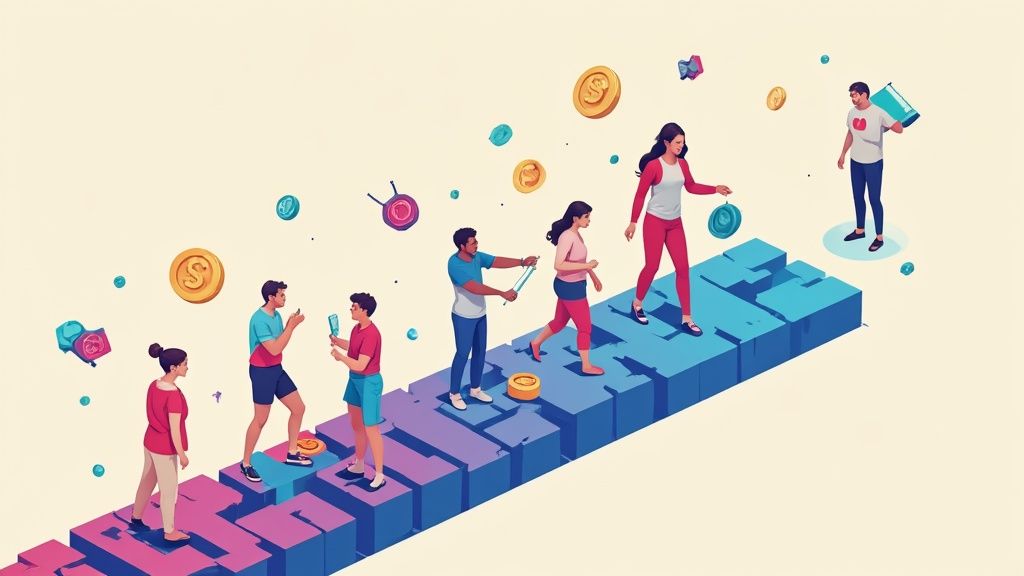
Web3 gamification is all about borrowing the fun parts of games—things like quests, leaderboards, and cool digital collectibles—and plugging them into regular apps using blockchain.
Imagine a loyalty program, but instead of points that are stuck in one app, you get actual digital assets. Things you truly own, can trade, or even use on other platforms. This simple shift changes everything. It turns users from passive observers into genuine stakeholders in your community.
A Whole New Way to Engage Users
At its heart, Web3 gamification creates a real partnership between a project and its users. Forget about rewards like airline miles or coffee shop stamps that are locked away. This model uses the blockchain to hand out rewards that have actual value and function.
This is all made possible by true digital ownership. When someone earns a reward—maybe an NFT badge for finishing a tutorial or some tokens for joining a community event—that asset is theirs, not the company's. They can hang onto it, sell it on a marketplace, or use it to unlock special perks elsewhere.
How Is This Different From Regular Gamification?
The gap between Web2 and Web3 gamification is huge. Old-school gamification is a closed loop where the platform calls all the shots. Your points, badges, and virtual items are just entries in a database that the company can change or delete whenever it wants.
Web3 flips that completely. To really get it, you have to understand the core principles of blockchain technology, including transparency and accountability. This tech gives us a public, unchangeable record, proving that rewards are real and ownership is final. It's a foundation that builds a much deeper level of trust and loyalty.
Just look at the Web3 gaming market, which is a close cousin to this idea. It exploded from USD 31.49 billion in 2024 and is on track to hit USD 37.55 billion in 2025. With a crazy compound annual growth rate (CAGR) of 19.24%, it’s projected to become a USD 182.98 billion industry by 2034. That’s not just a trend; it’s a massive signal that how we interact with digital stuff is changing for good.
The Takeaway: Web3 gamification isn't just about slapping a leaderboard on your app. It’s about building a mini-economy where users are rewarded with real, ownable assets for helping out, creating a powerful cycle that keeps them coming back.
Web2 vs Web3 Gamification at a Glance
Let's break down the key differences. This table puts the old and new models side-by-side, showing the fundamental shifts in how we think about engaging people and creating value.
| Feature | Web2 Gamification (Traditional) | Web3 Gamification (Blockchain) |
|---|---|---|
| Ownership | Platform owns all assets and data. | Users truly own their digital assets (NFTs, tokens). |
| Value | Points and badges are locked within one ecosystem. | Assets have real-world value and can be traded. |
| Transparency | Rules and rewards are controlled by the company. | Rules are coded in smart contracts, making them transparent. |
| Interoperability | Rewards are not usable outside the platform. | Assets can potentially be used across different apps. |
| Incentive | Motivates short-term actions for platform-owned rewards. | Fosters long-term contribution for user-owned value. |
Seeing it laid out like this makes the contrast obvious. The move to Web3 is about empowering users, not just entertaining them. If you're keen to explore this further, our guide on community gamification dives even deeper into building these kinds of engaged communities.
The Core Mechanics That Drive Engagement
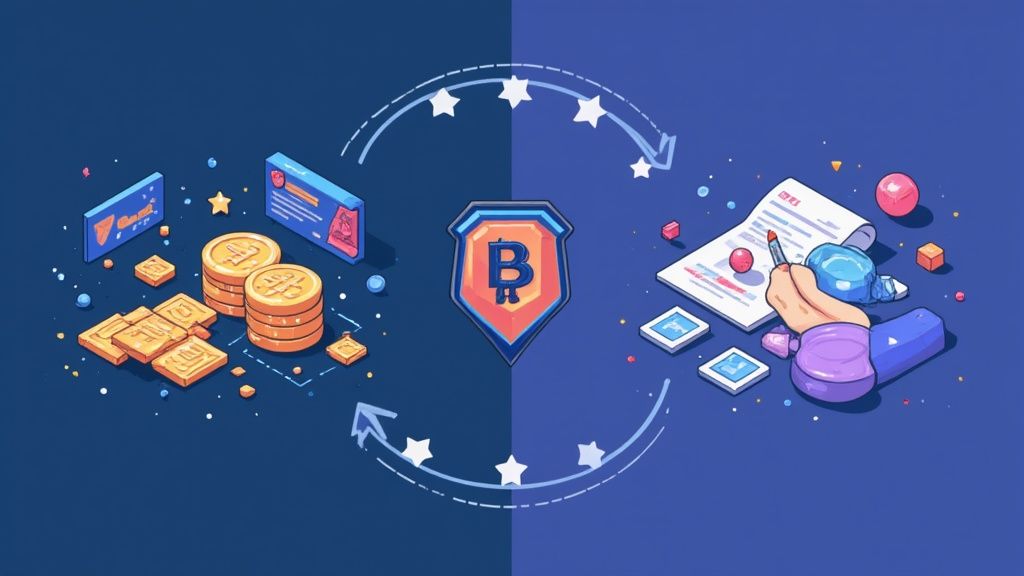
So, what actually makes Web3 gamification tick? To really get it, you have to look under the hood. The whole system runs on a smart mix of on-chain and off-chain tasks, and each one plays a very different role in a user's journey.
Think of it like getting someone into a new hobby. You start with the easy, fun stuff first.
Off-chain tasks are the casual, low-barrier activities that welcome people in. These are things that happen outside the blockchain, like sharing a post on X (formerly Twitter), joining the community Discord, or watching a quick tutorial. They don't ask users to connect a wallet or spend any crypto, which makes them the perfect on-ramp for newcomers.
Then you have the on-chain tasks. These are the big commitments, the actions that show someone is truly invested. We're talking about things like minting an NFT, staking tokens, or voting in a governance poll. Because these actions are permanently recorded on the blockchain and often involve a user's own assets, they're a clear signal of serious engagement.
A solid strategy uses both. You cast a wide net with off-chain tasks to bring people in, then use on-chain tasks to find and reward your true believers. It’s a natural funnel from casual observer to loyal contributor.
Building the Progression Loop
Once you've figured out what you want users to do, the real fun begins: rewarding them for it. This is where you create that addictive loop that keeps people coming back. It’s not about just handing out meaningless points; it's about crafting a sense of real achievement with assets that users actually own.
Here are the key building blocks you'll be working with:
- Points Systems: The classic. Users do stuff, they get points. It’s simple, effective, and perfect for leaderboards to spark a little friendly competition.
- Digital Badges: This is where things get more Web3. Badges are often issued as NFTs or, even better, Soulbound Tokens (SBTs). Unlike a normal NFT you can sell, an SBT is non-transferable. It’s stuck to a user's wallet forever, acting as a permanent, undeniable record of their accomplishments. It becomes part of their digital identity.
- Dynamic NFTs: Now we're getting to the really cool stuff. These are NFTs that can literally change or "level up" based on what a user does. Imagine a digital avatar that gets new armor after you complete a tough quest, or a membership pass that visually upgrades to unlock new perks. It turns a static collectible into a living chronicle of a user's journey.
A well-designed loop weaves these elements together. A user completes a task, earns a reward that boosts their status or unlocks something cool, and immediately wants to know what's next. That's the cycle you're trying to build.
It’s Not Just for Games
While models like play-to-earn have brought millions into Web3 by rewarding in-game actions with tokens, the applications go way beyond traditional gaming. Move-to-earn projects are even blending fitness with crypto rewards. This whole movement is fixing some of Web2 gaming's biggest problems—like centralized control—by giving players actual ownership of their digital stuff. For a closer look at this trend, you can find great insights on the Web3 gaming market.
But think bigger.
A fintech app could use a series of quests to teach new users about its advanced features, awarding them a cool NFT certificate at the end. An online school could issue SBTs to verify a student's skills, creating a portable, permanent digital resume they can take anywhere.
Even community platforms can use this to encourage good behavior. By rewarding helpful members with tokens, a project can build a thriving, self-governing ecosystem. The goal is always the same: use game-like incentives to drive the actions that matter, building a stronger and more dedicated user base along the way.
How to Design a Sustainable Token Economy
Your Web3 gamification system isn't just a collection of quests and leaderboards; it's a living, breathing digital economy. And if that economy isn't built to last, the entire experience will eventually fall apart. This is where tokenomics—the art and science of designing a sustainable token economy—becomes the single most important part of your strategy.
Think of yourself as the central bank for your own small nation. Your job is to manage the money supply, keep inflation in check, and make sure the currency actually holds its value. Get it right, and you create a thriving ecosystem. Get it wrong, and you end up with hyperinflation that makes your hard-earned rewards feel worthless.
A healthy economy starts with figuring out what jobs your tokens will do. Most successful projects use a dual-token model to separate different functions and incentives, which is a great place to start.
Utility vs Governance Tokens
The first step is deciding what kind of "money" your users will earn and spend. The two main flavors are utility tokens and governance tokens, and they serve very different purposes.
- Utility Tokens: These are the workhorses of your ecosystem. Think of them as arcade tokens or in-game currency. Users earn them for completing tasks and spend them on in-app perks like unlocking features, buying digital items, or paying for services. Their value is tied directly to how useful they are inside your world.
- Governance Tokens: These tokens represent power and ownership. Holding them gives users a say in the project's future, like the right to vote on proposals or changes to the rules. Their value is tied to the overall success and influence of the project itself.
Many projects end up needing both. A utility token keeps the day-to-day economy churning, while a governance token gives your most dedicated community members a real stake in its long-term direction. This separation also cleverly prevents speculators who only care about voting power from messing with your in-app economy. For those looking to build a system that fosters genuine user buy-in, exploring models of Web3 loyalty programs can provide valuable blueprints for balancing these token types effectively.
Balancing Supply and Demand
Once you’ve defined your tokens, you have to manage their flow. Just like a real-world economy, you need ways to introduce money and ways to take it out. In tokenomics, we call these faucets and sinks.
Faucets are how you distribute tokens into the economy. This includes things like quest rewards, airdrops, staking rewards, and community grants.
Sinks are mechanisms that permanently remove tokens from circulation. This includes spending tokens on consumable in-game items, paying fees for certain actions, or running a "buy-and-burn" program where you use revenue to buy back and destroy your own tokens.
A healthy token economy needs a careful balance between these two forces. Too many faucets without enough sinks leads straight to inflation, flooding the market with tokens and tanking their value. This was the critical failure of many early play-to-earn games—they were all faucet and no sink.
Learning from Past Mistakes
The cautionary tale of first-generation play-to-earn games is a masterclass in what not to do. These games often drowned players in tokens just for showing up, creating a system where everyone was earning (faucet) but almost no one was spending (sink).
This meant new players had to buy tokens from existing players who were cashing out as fast as they could. The model relied entirely on a constant stream of new money to stay afloat. The moment new user growth slowed, the whole thing imploded.
A sustainable model focuses on creating real, intrinsic utility. The goal isn't just to reward users for participating; it's to build an economy where tokens are genuinely useful for something other than just selling them. By designing powerful sinks and carefully managing your token issuance, you can build a system that truly rewards users while ensuring the long-term health of your entire gamified world.
Web3 Gamification Examples in the Wild
Theory is one thing, but seeing these ideas in action is where it all clicks. Some really smart companies are already using Web3 gamification to get incredible results—and not just in gaming. They’re boosting engagement, teaching users new skills, and building die-hard communities by making everyday actions feel more like a game.
Let's look at a few real-world examples to see how Web3 gamification is solving actual business problems. These aren't just hypotheticals; they show how quests, on-chain rewards, and digital ownership are working today across different industries.
For any of this to work, you need a balanced token economy. Think of it like a real economy with a flow of currency. You have "faucets" that introduce rewards into the system and "sinks" that take them out. This simple loop is the engine that keeps everything running smoothly.
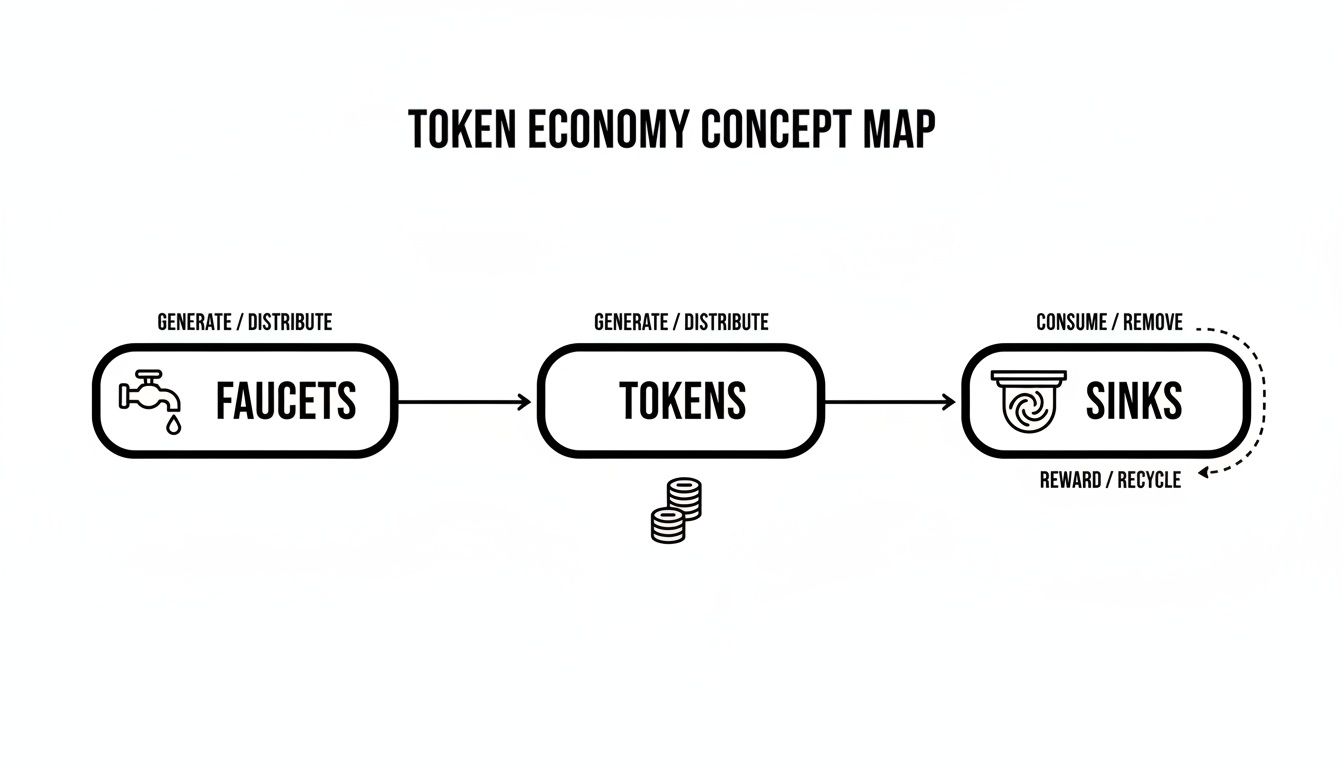
The image above nails the concept: faucets drip out new tokens as rewards, while sinks give users a reason to spend or burn them. This balance prevents the token’s value from crashing and keeps the whole ecosystem healthy.
Learn-to-Earn Platforms That Actually Work
Education is a perfect match for Web3 gamification. Why just read a lesson when you can "learn-to-earn" and get a tangible reward for your effort? This model completely changes the dynamic, turning passive learning into an active, motivating journey.
- Upskillist: This platform is all about building practical skills. Students get tokenized rewards and NFT certificates for finishing courses. The best part? The blockchain stuff happens quietly in the background. The results speak for themselves: they've seen a 30% boost in engagement in their gamified courses.
- Galxe: Think of Galxe as a credentialing network. Projects can launch quest-based campaigns to teach people about their platform. For example, a DeFi protocol could set up a quest where you learn about staking, try a real transaction on a testnet, and walk away with an exclusive NFT badge for your on-chain resume.
These platforms prove that rewarding people for learning doesn't just get them to finish the course; it properly onboards them into complex ecosystems. It's a win-win. You create educated, invested power users right from the start.
The Takeaway: When you tie verifiable achievements to on-chain rewards, you create an incredibly powerful incentive. It turns education from a chore into a rewarding adventure where users are building both their knowledge and their digital wallet.
Decentralized Social and Community Hubs
Web3 gamification is also flipping the script on how online communities are built. Platforms like Zealy have become the go-to tool for projects that want to get their user base fired up and involved.
Zealy is basically a quest board for communities. Projects create "sprints" full of tasks—anything from a simple social media follow to creating cool user-generated content—and reward everyone who participates from a prize pool. It effectively turns community engagement into a massive, collaborative game.
The mechanics are simple but shockingly effective. By using leaderboards, points, and quests that expire, projects can drive huge, coordinated action that puts a simple "like and retweet" campaign to shame. It gives members a clear way to contribute and a real stake in the community's success. If you're curious about this model, we break it down in our guide to Web3 quest platforms.
At the end of the day, things like leaderboards and token rewards tied to on-chain achievements make participation feel valuable and, frankly, a little addictive. It can even turn casual involvement into a side hustle. When you add NFT-based assets that users can trade, you get vibrant secondary markets that add a whole new layer of economic activity, as explored in this detailed industry report. These examples show that if you get the mechanics right, you can build a self-sustaining ecosystem where everyone is genuinely excited to pitch in.
A Practical Roadmap to Your Gamification Strategy
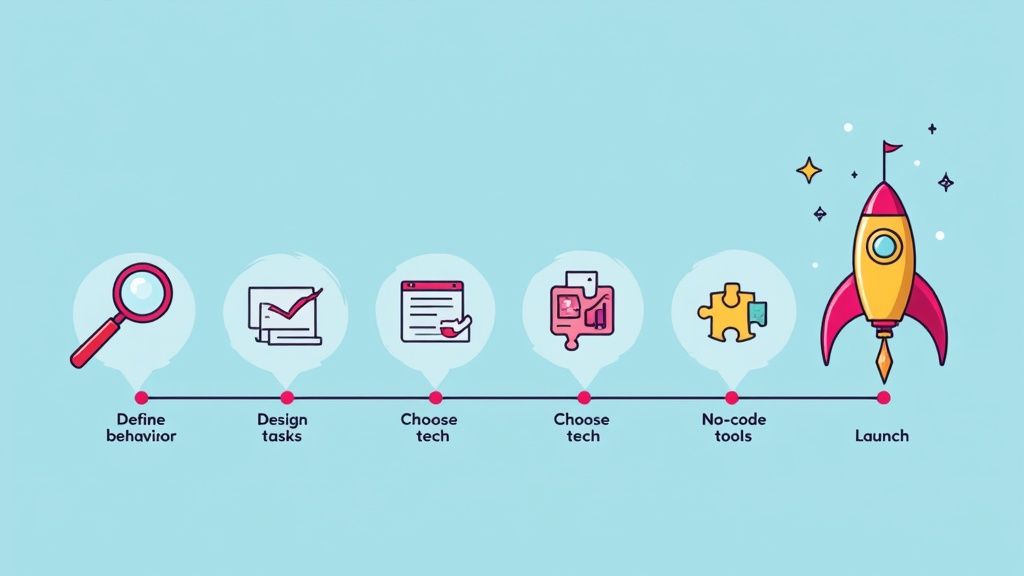
Okay, so you’re sold on bringing Web3 gamification into your project. Awesome. But how do you go from a cool idea to a live campaign that people actually enjoy?
It's not about just throwing a bunch of quests at your community and hoping for the best. A solid strategy starts with one simple but crucial question: What specific user behaviors do you want to encourage?
Seriously, everything else flows from this. Are you trying to get more people through your onboarding flow? Boost transaction volume on your protocol? Or maybe just get your community buzzing on social media? You have to be crystal clear on your goals, because they'll shape every task, reward, and progression loop you create.
Once you know what you want users to do, you can start mapping out their journey. Think of it like designing a level in a video game. Where do they begin? What are the easy first steps (off-chain tasks) versus the more involved challenges (on-chain tasks)? The aim is to build a path that feels both fun and meaningful, guiding someone from a curious newcomer to a loyal super-fan.
Defining Your Core Loop and Rewards
With your goals and user journey sorted, it’s time to get into the fun stuff: the core mechanics. This is where you connect the actions you want with rewards that will actually motivate people. When you get this right, the whole system feels intuitive and rewarding, creating a cycle that keeps users coming back for more.
Start by brainstorming the specific tasks that lead to your goals:
- Onboarding Quests: Simple stuff like "Join our Discord," "Follow us on X," or "Read our whitepaper."
- Engagement Tasks: Things that get users interacting with your product, like "Mint your first NFT," "Stake tokens for a week," or "Vote on a governance proposal."
- Community Building: Actions that grow the tribe, such as "Invite three friends," "Create a tutorial video," or "Host a community call."
For every task, you need a reward that feels right. Easy off-chain actions might earn you some points or a basic digital badge. But the more complex on-chain tasks should offer something juicier—exclusive NFTs, token airdrops, or even special roles in your community. The key is creating a clear sense of progression where more effort equals a better reward.
This is the very heart of your gamification engine. The loop is simple: a user sees a task, completes it, gets a reward, and feels that little hit of achievement that makes them want to tackle the next one.
Choosing Your Tech Stack
Now, let's talk tech. To bring this all to life, you need the right tools, and your first big decision is which blockchain to build on. Each one has its own quirks and trade-offs, so you need to think about what really matters for your project.
Here are the big three factors to consider when picking a chain:
- Transaction Costs (Gas Fees): If your users are going to be doing a lot of on-chain tasks, high gas fees will kill the vibe—fast. This is why Layer-2 solutions like Polygon or Arbitrum are so popular; they keep costs way down compared to the Ethereum mainnet.
- Transaction Speed: Nobody likes waiting around. A slow, clunky experience is a surefire way to lose people. You need a network that can confirm transactions quickly to keep the momentum going.
- Security and Decentralization: Speed and cost are great, but not if they come at the expense of security. Stick with a network that has a proven track record and a strong, decentralized set of validators to protect both your users and your project.
The Rise of No-Code Solutions
Just a few years ago, launching a Web3 gamification campaign was a massive undertaking. You'd need a team of developers to write and audit smart contracts, which was both slow and expensive.
Thankfully, the game has completely changed. No-code platforms have emerged, making it possible for anyone to build and run sophisticated quest campaigns without touching a single line of code.
These tools handle all the heavy lifting for you—from verifying that tasks were completed and distributing rewards to providing analytics and even preventing fraud. This frees up marketing and community teams to do what they do best: design creative and engaging experiences.
By dropping the technical barrier to entry, no-code solutions like Domino are making Web3 gamification accessible to everyone, empowering projects of all sizes to build the vibrant, interactive communities they've always envisioned.
How to Know if You're Winning (and How to Avoid Messing It Up)
So you've launched your Web3 gamification strategy. High five! But don't pop the champagne just yet. The real work is just beginning. How do you actually know if any of this is working? Success isn't about getting a shout-out on Twitter; it's about building a real, engaged community—not just a leaky bucket that loses users as fast as it gets them.
To get the real story, you have to look past vanity metrics like total sign-ups. The truth is in the user behavior and the health of your little token economy. These are the numbers that actually matter.
The Metrics That Really Matter
If you want a clear, no-BS view of how your campaign is doing, you need to focus on these specific metrics. They tell you if people are sticking around, if they find what you’re offering valuable, and if you’re building something that can last.
Daily Active Users (DAU): Think of this as your project's heartbeat. It shows you how many unique people are actually showing up and doing things on your platform each day. It’s the clearest signal of consistent, real-world engagement.
User Retention Rate: This is arguably the most important number on your dashboard. What percentage of users who complete their first quest come back to do another? And another? A high retention rate is proof that your gamification is genuinely compelling, not just a one-off gimmick.
Task Completion Rate: Are people starting quests but bailing halfway through? This metric is your friction detector. A low completion rate could mean a task is too hard, the reward isn't worth the hassle, or your UX is just plain clunky.
Economic Health (Sink/Faucet Ratio): You have to watch the flow of your tokens. How many are you giving out (the faucets) versus how many are being spent or burned (the sinks)? A healthy ratio is crucial for making sure your token holds its value and your economy doesn't inflate into oblivion.
The Bottom Line: Real success in Web3 gamification comes from sustained activity and a stable economy, not just launch-day hype. If your retention is tanking and your token is inflating like a balloon, it’s time for a serious rethink.
Common Pitfalls and How to Dodge Them
So many projects fall into the same predictable traps. Know what they are from the get-go, and you can save yourself a world of pain and avoid letting your community down.
Focusing on Speculation, Not Fun
This is the cardinal sin of Web3 gamification. If the main reason people are participating is to earn tokens and dump them on an exchange, you haven't built a community. You've just built a revolving door for mercenaries.
- How to fix it: Design quests that are actually fun or genuinely useful. The reward should feel like a cherry on top for doing something cool, not the only reason to show up. Focus on intrinsic motivation—making the activity itself the prize.
Creating a Broken Economy
Like we just talked about, a system with all faucets and no sinks is built to fail. If you just keep handing out rewards without giving people cool ways to spend them, your token's value will inevitably crash. Suddenly, all those hard-earned rewards feel completely worthless.
- How to fix it: Plan your token sinks from day one. Create things people actually want—exclusive items, special access, or unique features—that can only be unlocked by spending tokens. This creates real demand that helps balance out the supply you're creating.
Designing a Clunky User Experience (UX)
Nothing—and I mean nothing—kills engagement faster than a confusing, frustrating experience. If your users feel like they need a computer science degree to complete a simple on-chain task, they’re just going to leave. The friction of connecting wallets, paying for gas, and waiting for transactions is a massive buzzkill.
- How to fix it: Hide the messy parts. Use tools that let you integrate social logins, embedded wallets, and gasless transactions. Make the Web3 part feel totally invisible. The smoother the ride, the more likely people are to stick around for the long haul.
For a wider lens on tracking your wins, it's also smart to understand how to measure marketing ROI effectively. By nailing these core areas, you can build a Web3 experience that's engaging, sustainable, and actually valuable to your users.
Got Questions About Web3 Gamification? Let's Clear Things Up.
It’s totally normal to have a few questions when you're diving into something new. Let's walk through some of the most common ones I hear about Web3 gamification so you can feel confident about moving forward.
How Is This Different from a Normal Loyalty Program?
Great question. The biggest difference boils down to one simple concept: true digital ownership.
Think about your typical loyalty program—the company owns your points, and they live inside that company's private database. Web3 gamification flips that script. The rewards you earn, like NFTs or tokens, are actual assets on a blockchain. You own them, period.
This might sound like a small detail, but it opens up a world of possibilities:
- Interoperability: Your rewards aren't stuck in one place. You could potentially use an NFT you earned from a coffee shop in a completely different app or game.
- Verifiable Scarcity: When a brand says a reward is "limited edition," the blockchain proves it. Everyone can see exactly how many exist, which makes them feel genuinely special.
Do My Users Need to Be Crypto Experts?
Nope, and this is a huge relief for everyone. The early days of Web3 were clunky, filled with confusing crypto wallets and complex steps. Thankfully, those days are pretty much over.
Modern Web3 gamification is all about a smooth user experience, keeping the blockchain stuff working quietly in the background.
We're now seeing social logins and embedded wallets become the norm. This means your users can sign up with a simple email or their Google account, just like they would for any other app. The goal is to make it easy for everyone, not just the crypto die-hards.
Is This Only for Gaming and Crypto Companies?
Not at all. While the gaming world definitely paved the way, these mechanics are incredibly versatile. If you have a business that wants to encourage specific user actions, Web3 gamification can work for you.
We're seeing it pop up in e-commerce, education, and online communities. Imagine a "learn-to-earn" platform that gives students tokens for finishing a course—suddenly, learning feels a lot more like a rewarding adventure.
Ready to build a powerful Web3 gamification strategy without the technical headaches? With Domino, you can launch engaging quests and reward your community in minutes, no code required. Get started for free on domino.run.