Your Guide to Building a Web3 Incentive Program That Lasts
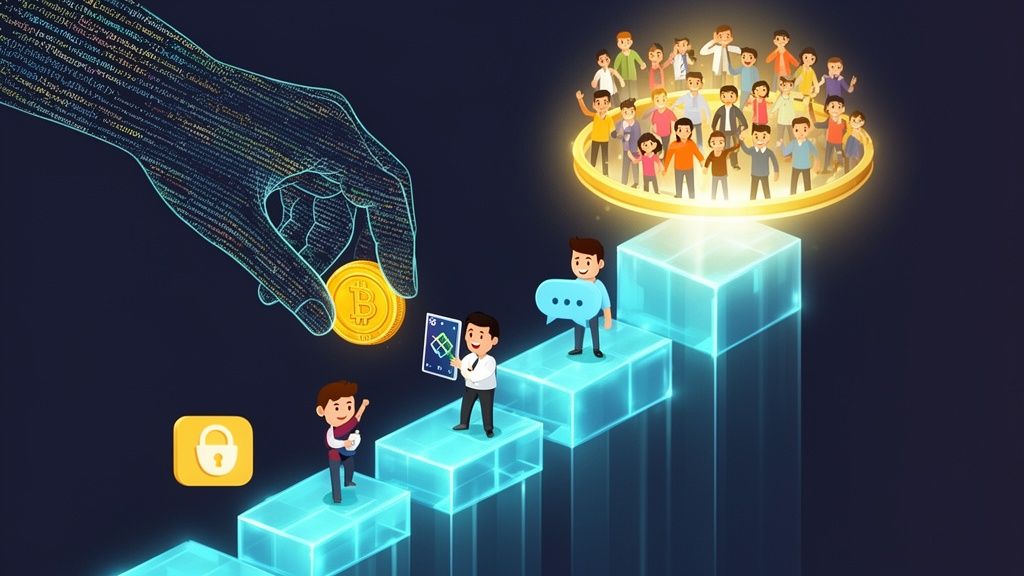
At its core, a Web3 incentive program is a way to reward your community for taking actions that help your project grow. But instead of giving them points or discounts, you give them a slice of the pie—real digital ownership in the form of tokens or NFTs.
This simple shift changes everything. Your users go from being passive customers to active stakeholders who are genuinely invested in seeing the project succeed.
The New Playbook for Community Growth
Think about traditional marketing for a second. It's mostly a one-way conversation. A brand shouts a message, and customers hopefully listen. Even loyalty programs, like the classic coffee shop punch card, are pretty transactional. Once you get that free latte, the interaction is over.
Web3 incentive programs flip that model on its head.
It’s no longer just a transaction; it's a genuine value exchange. By giving users assets with real-world value and utility—like governance tokens that let them vote on key decisions—you’re inviting them to co-build the future with you. This turns the old company-customer dynamic into a powerful partnership. This entire model is powered by blockchain technology, which provides the transparent and automated foundation for proving ownership and distributing rewards.
To put it in perspective, let's look at a quick comparison.
Traditional Marketing vs Web3 Incentives At a Glance
This table breaks down the fundamental differences between the old way of doing things and the new Web3 approach.
| Feature | Traditional Marketing | Web3 Incentive Program |
|---|---|---|
| User Role | Passive Consumer | Active Participant & Owner |
| Relationship | Transactional (buy/get) | Collaborative (contribute/earn) |
| Reward Type | Discounts, Points, Freebies | Digital Assets (Tokens, NFTs) |
| Motivation | Extrinsic (get a deal) | Intrinsic & Extrinsic (ownership, value) |
| Community Goal | Build an Audience | Cultivate a Network of Stakeholders |
See the difference? One is about getting people to buy, while the other is about getting people to believe.
From Passive Users to Active Owners
The real goal here isn't just to grab attention; it's to build a loyal, die-hard community. When your users hold your project's tokens or NFTs, their success is directly tied to your project's success. That creates a powerful, built-in motivation for them to contribute in ways that matter.
This new mindset introduces a few key shifts:
- Ownership over Discounts: Forget a 10% off coupon. Users earn a small piece of the very network they're helping to build.
- Participation over Consumption: People are rewarded for meaningful actions like providing liquidity, voting on proposals, or beta-testing new features—not just for clicking "buy."
- Community over Audience: You're building a network of true advocates who are financially and socially invested, not just a passive audience waiting for the next sale.
This pivot to ownership is a massive growth engine. The Web3 space has exploded largely because of these programs, which are expected to rocket the global market from $4.62 billion to a staggering $99.75 billion by 2034. This boom is being driven by over 17,000 companies finding new ways to engage their communities. You can dig into all the numbers in the full Web3 industry report from Startus Insights.
By mixing these rewards with fun, game-like elements, you can create experiences that people genuinely want to be a part of. We cover this in more detail in our guide to https://domino.run/blog/web-3-gamification, where we show you how to make participation feel less like work and more like play.
The Building Blocks of a Great Rewards Campaign
Think of a successful Web3 incentive program like a well-designed video game. It needs clear objectives (the tasks) and awesome rewards that actually make people want to play. The real magic happens when you line up the right actions with the right incentives to hit your project's goals.
Broadly speaking, the tasks you reward fall into two buckets: on-chain and off-chain. They're two different toolkits for growth. One strengthens your actual product and ecosystem, while the other gets the word out and expands your reach.
This diagram really nails the fundamental shift from old-school marketing to the ownership-driven world of Web3.
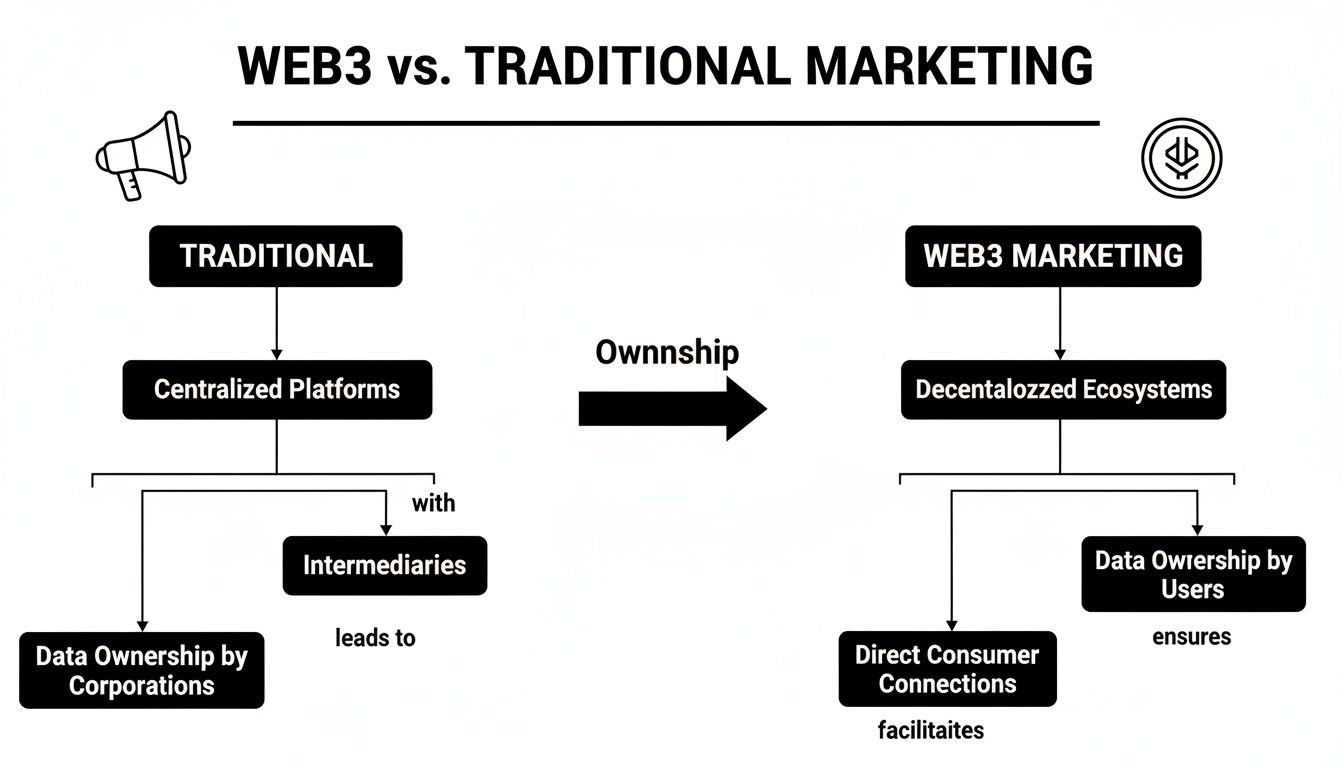
You can see how Web3 flips the script, turning marketing from a one-way street into a two-way value exchange where the community has real skin in the game.
On-Chain Actions That Build Your Ecosystem
On-chain actions are the things people do directly on the blockchain. These are incredibly valuable because they have a direct impact on your protocol's health, liquidity, and overall strength. When you reward these actions, you’re encouraging users to be active participants, not just lurkers.
Here are the heavy hitters:
- Staking: Users lock up tokens to help secure the network. This is a must for Proof-of-Stake chains and signals serious, long-term belief in the project.
- Providing Liquidity: People deposit token pairs into pools on decentralized exchanges (DEXs). This is the lifeblood of smooth and efficient trading.
- Trading and Swapping: Getting people to actually use your platform creates volume, which makes your ecosystem look a lot more vibrant and appealing to newcomers.
- Governance Voting: By rewarding users for voting on proposals, you give them a real voice and make your project more genuinely decentralized.
These tasks are the foundation of a healthy on-chain economy. Incentivizing them isn't just "buying engagement"—it's a direct investment in your project's core infrastructure.
Off-Chain Actions That Grow Your Reach
Off-chain actions happen on familiar turf like social media, Discord, or Telegram. This is how you build brand awareness, educate your community, and fill the top of your funnel with new faces.
Common off-chain tasks include:
- Social Engagement: Following accounts, liking and reposting content, or creating original posts on platforms like X (formerly Twitter).
- Community Participation: Hopping into your Discord server, earning special roles, or showing up for community calls.
- Content Creation: Writing blog posts, making video tutorials, or even just designing killer memes about your project.
- Referrals: Getting new, active members to join the community through their unique links.
These actions effectively turn your community into a massive, decentralized marketing team, spreading your message further than any traditional ad budget ever could.
Choosing the Right Rewards
Okay, you've figured out what you want people to do. Now you need to give them a good reason to do it. The reward you offer should match both the user's motivation and the value of their contribution.
The best Web3 incentive programs don't just give away value; they distribute ownership. The goal is to turn users into stakeholders who are financially and emotionally invested in the project's success.
Here's a look at what's on the rewards menu:
- Tokens: This is the classic choice. It could be governance tokens, utility tokens, or even stablecoins. They offer immediate financial value and a direct stake in your project's future.
- NFTs: These are perfect for rewarding loyalty or celebrating major milestones. An NFT can be a cool piece of collectible art, or it can provide real utility, like access to exclusive features or events.
- Points or XP Systems: A fantastic way to track contributions over time, especially if your project doesn't have a token yet. These points can eventually be converted into an airdrop, rewarding your earliest and most dedicated supporters. Our complete guide on how to build a Web3 points program is a great resource if you want to go deep on this strategy.
- Exclusive Benefits: Sometimes, the best rewards aren't on-chain at all. Think whitelist spots for a hot new mint, lower platform fees, or access to a private, high-signal Discord channel.
By mixing and matching these tasks and rewards, you can create a powerful Web3 incentive program that drives key on-chain metrics while building a thriving community. And with no-code platforms like Domino, you can launch these campaigns without getting bogged down in development, letting you focus on the strategy that matters most.
Designing a Program for Sustainable Community Growth
Getting a flood of new users with a Web3 incentive program is actually the easy part. The real trick? Making them stick around. This is exactly where a ton of projects stumble. They get caught up in attracting "mercenary users"—people who show up for the rewards and disappear the second the freebies stop.

If you want to build a community that actually lasts, your program has to be more strategic. You need to focus on sustainable growth, not just flashy, short-lived spikes in activity. It's all about moving past vanity metrics and building real, long-term loyalty.
Moving Beyond Vanity Metrics
It's so tempting to pop the champagne when your Total Value Locked (TVL) skyrockets or your social media followers explode overnight. But while those numbers look amazing on a chart, they often paint a misleading picture. A huge TVL driven purely by rewards can vanish in a flash, leaving your protocol just as quiet as it was before.
The key is to zero in on metrics that actually measure the health and stickiness of your community. These are the numbers that tell you if you're building something that people genuinely care about.
- Cohort Retention: Of the users who joined in a specific week, what percentage are still active a month later? Three months? Six months? This is the ultimate loyalty test.
- User Lifetime Value (LTV): On average, how much value does a user bring to your ecosystem throughout their entire time with you? This helps you figure out the real return on your efforts.
- Post-Campaign Activity: Do people keep using your protocol even after they've claimed their rewards? This is a huge signal that you have a solid product-market fit.
By shifting your focus to these deeper metrics, you can build a Web3 incentive program that cultivates a loyal following, not just a temporary crowd.
Building a Balanced and Tiered Reward Economy
A sustainable program isn't a free-for-all giveaway. It needs a carefully designed reward economy that encourages people to participate consistently and get more involved over time. One of the best ways to do this is with a tiered reward structure.
Think of your program like a game with multiple levels. Newcomers can knock out simple, low-effort tasks to get a feel for things. Meanwhile, your dedicated power users can unlock much bigger rewards by making more meaningful contributions.
A tiered system transforms a one-off airdrop into a long-term engagement loop. It rewards users not just for showing up, but for sticking around and growing with the project.
This approach brings some major wins:
- Filters for Quality: It naturally weeds out the low-effort folks and bots, since getting the best rewards requires real commitment.
- Creates a Path to Power User: It gives new members a clear roadmap for how to become a core part of the community.
- Encourages Long-Term Thinking: Users are motivated to stay involved for weeks or months to climb the ranks and earn more exclusive perks.
Of course, for your Web3 incentive program to work, the core idea behind your project has to be solid. Brushing up on startup idea validation can give you some great frameworks for testing and refining your program's foundation.
Lessons from the Field: The Compound Case Study
The DeFi world offers a masterclass in the dynamics of incentive-driven growth. Take Compound's aggressive campaign, which was backed by a massive 1.8 million ARB token grant. It showed the raw power of rewards to pump up protocol metrics. Starting from $90 million in TVL, the protocol’s assets shot up by 180% to $260 million during the campaign.
But if you dig into the data, you’ll find a crucial lesson about sustainability. While the campaign was a huge success for short-term acquisition, the users it attracted had a six-month retention rate of just 7%. Compare that to the pre-incentive users, who stuck around at a much healthier 12.8%. That stark difference highlights how explosive growth can easily mask a leaky bucket.
The takeaway is crystal clear: a successful Web3 incentive program has to be designed with the long game in mind. You have to align rewards with your core product goals, reward genuine engagement, and give users a compelling reason to stay long after the initial hype is over.
How to Launch Your Campaign Without Writing Any Code
Alright, let's get out of the theory and into the real world. Designing a killer Web3 incentive program might sound like a huge technical lift, but the right tools make it surprisingly simple. You really don't need a team of devs on standby anymore; modern no-code platforms let marketers and community managers spin up sophisticated campaigns in minutes.
The whole process boils down to a pretty logical workflow. You start with a clear goal, pick the right tasks to hit that goal, set up automatic verification to keep things fair, and then send out rewards to your awesome community members. It's a growth formula you can run on repeat.
This visual breaks down that four-step process, showing how no-code tools turn a complex strategy into something anyone can manage.

This loop—define, assign, check, and reward—is the engine of any great campaign. And now, it’s accessible to your whole team.
Step 1: Define Your Campaign Goal
First things first. Before you even think about tasks or rewards, you have to know what winning looks like. What are you actually trying to accomplish here? Your goal is the foundation for every other decision you'll make.
Are you trying to:
- Boost On-Chain Activity? Maybe your goal is to increase token swaps on your DEX by 20% this month.
- Grow Your Social Footprint? You could aim to get 10,000 new, real followers on X (formerly Twitter).
- Drive Product Adoption? Perhaps you want 500 people to try out a new staking feature.
A clear, measurable goal is your North Star. Without one, you're just throwing assets into the void and hoping for the best.
Step 2: Choose Tasks From a Template Library
Once your goal is locked in, it’s time to figure out what actions will get you there. This is where no-code platforms like Domino are a game-changer. Instead of coding task verification from the ground up, you can just grab what you need from a huge library of pre-built templates for both on-chain and off-chain stuff.
Let's say you're launching a campaign to get people using a new NFT staking feature. You could mix and match tasks like this:
- On-Chain Task: Stake at least one NFT from your main collection.
- Off-Chain Task: Post a screenshot of your staked NFT on X with a specific hashtag.
- Community Task: Join the exclusive "stakers-only" channel in your Discord.
This kind of multi-pronged approach gets users deep into your product and has them shouting about it from the rooftops. You just pick the templates, adjust the specifics, and move on.
Step 3: Automate Verification and Prevent Fraud
This is where the magic really happens—and historically, it's been the biggest headache. Manually checking thousands of submissions is a total nightmare. It's slow, full of errors, and an open invitation for bots and scammers. Automation is the only way to do this at scale.
No-code tools handle this for you, almost effortlessly.
- On-Chain Verification: The platform talks directly to the blockchain to see if someone actually did the thing, like a swap or a stake. It’s instant and impossible to fake.
- Off-Chain Verification: Smart AI tools can check social tasks automatically, confirming if a user liked a tweet, joined a Telegram, or posted with the right hashtag.
Automation completely removes the single biggest bottleneck in running campaigns. It frees your team to focus on community building and strategy instead of losing hundreds of hours to mind-numbing manual checks.
This automated guard not only saves a ton of time but also protects your campaign's integrity by kicking out bots and low-effort participants. If you're looking for platforms that nail this, checking out a powerful Galxe alternative can give you a good sense of the latest tech in verification.
Step 4: Distribute Rewards Automatically
The grand finale: getting those rewards into your users' wallets. When this part is smooth, it feels like magic to your community. They finish a task, and boom—the reward lands in their wallet. That instant feedback loop is what keeps them coming back for more.
Modern platforms make this whole process automatic. As soon as the system confirms a user has completed their tasks, it can trigger the distribution of tokens, NFTs, or points. That instant gratification is absolutely crucial for keeping momentum and making sure your community is hyped for whatever you launch next in your Web3 incentive program.
Measuring Success and Avoiding Common Pitfalls
So, you’ve launched your incentive program. Great! But launching is the easy part. The real question is: is it actually working?
Throwing a campaign out into the wild without a way to measure its success is like trying to navigate the open sea without a compass. You’ll see plenty of activity, sure, but you'll have no idea if you're actually moving toward your goal. A campaign is only as good as the results it brings, which means you need to track the right things and know how to dodge the traps that trip up so many projects.
It’s tempting to get swept up in the excitement of a massive spike in new users or a flurry of social media mentions. These are often called "vanity metrics" for a reason—they look good on the surface but can be totally misleading. The real story, the one that tells you about your ROI and the long-term health of your community, is hidden a layer deeper in the data.
Key Metrics for Your Incentive Program Dashboard
To really get a feel for your campaign's impact, you have to look past the initial hype. The metrics below will tell you if you're attracting genuine, long-term contributors or just a swarm of temporary reward hunters.
This table breaks down the essential numbers you should have on your dashboard. Think of it as your campaign's health check.
| Metric | What It Tells You | Why It Matters |
|---|---|---|
| User Retention Rate | The percentage of users who stick around and stay active after the rewards stop. | High retention is a huge signal. It means your project has real value beyond the freebies, which is a great indicator of product-market fit. |
| Cost Per Active Member | Your total campaign spend divided by the number of genuinely active new users. | This is all about efficiency. It tells you if your budget is attracting quality people who will contribute, or just empty wallets looking for a quick flip. |
| Post-Campaign On-Chain Activity | How many transactions or protocol interactions new users are making after the incentives end. | This is the acid test for stickiness. It shows if you've successfully integrated your project into their regular Web3 routine. |
Focusing on these numbers gives you an honest, no-fluff assessment of your Web3 incentive program. It’s how you make smarter, data-backed decisions for the next one.
Common Pitfalls and How to Sidestep Them
Even the most well-intentioned campaigns can go sideways. Knowing what can go wrong is half the battle. Here are the most common mistakes projects make and, more importantly, how you can steer clear of them.
1. Creating Confusing Instructions
If people can’t figure out what you want them to do, they’ll just leave. It's that simple. Overly complex quests packed with jargon are the fastest way to lose someone's interest before they even get started.
- How to Fix It: Keep it simple. Use plain English and break down every task into small, easy-to-follow steps. This is where no-code platforms like Domino really shine, by providing clean dashboards that walk users through each step, making the whole experience feel intuitive, not frustrating.
2. Falling Victim to Bots and Sybil Attacks
Nothing will drain your reward pool faster than an army of bots and Sybil attackers spinning up fake accounts to gobble up all the rewards. This doesn't just waste your money; it also cheapens the experience for your real community members.
- How to Fix It: Layer your defenses. Combine on-chain requirements (like small gas fees that make botting expensive) with off-chain checks, such as connecting social accounts that have some history. Modern tools also use AI to review content and automatically verify tasks, which helps filter out the fakes and make sure rewards go to actual humans.
3. Failing to Plan for What Comes Next
This is the big one. The single greatest pitfall is having no plan for what happens after the incentives run out. Token rewards have become the lifeblood for many Web3 apps, but they can create a "sugar rush" effect. A campaign might drive a massive spike in users, but as soon as the rewards slow down, those users vanish to chase the next big thing. You can read more about these retention challenges at onchain.org.
- How to Fix It: Think of your campaign as the start of a relationship, not the end. Use it as an opportunity to onboard people into your Discord or Telegram, show them the coolest features of your product, and give them a clear pathway to becoming a core contributor. That’s how you turn a one-off event into a growth engine that keeps on running.
Got Questions About Incentive Programs? We've Got Answers.
Jumping into the world of Web3 incentive programs can feel like heading into uncharted territory. You get the big picture, but the nitty-gritty details are where the real questions pop up. We get it. That's why we've put together this Q&A section to tackle the most common questions we hear from founders and marketers.
Think of this as your go-to guide for the practical stuff. We’ll cover everything from figuring out a budget and understanding the legal side of things to fending off bots and launching a program before you even have a token.
How Much Should I Actually Budget for This?
There’s no magic number here. Your budget is going to depend entirely on your project's stage, your goals, and how your tokenomics are structured. A better way to think about it isn't in dollars, but in token allocation.
For projects just starting out, a good rule of thumb is to set aside 5-15% of your total token supply for community incentives. The key is to spread this out over several years. This gives you a long runway for growth without creating a massive wave of sell pressure every time you reward someone.
When you're planning a specific campaign, try working backward from what you want to achieve.
- Cost Per Acquisition (CPA): How much are you willing to spend to get a real, active user? A simple Twitter follower campaign will have a tiny CPA, but attracting high-value liquidity providers? That’s going to require a much bigger reward pool.
- Pilot Campaigns: Don't go all-in at once. Start with a small pilot campaign to test the waters and see what your return on investment looks like. Use what you learn to scale up smartly.
Here's the biggest budget-saver people miss: efficiency. Using a no-code platform means you don't have to sink a ton of cash into development, freeing up more of your budget for what really matters—the community rewards.
Ultimately, your budget should be a living thing that grows as you see real results.
What's the Difference Between an Airdrop and an Incentive Program?
This is a big one, and getting it right is crucial. People often use these terms interchangeably, but they serve completely different strategic purposes. Mixing them up can lead to missed opportunities and a messy growth strategy.
An airdrop is usually a one-time, look-back event. It’s a surprise "thank you" to early supporters for things they've already done, like using your testnet or holding a specific NFT. Think of it as a reward for past loyalty.
A Web3 incentive program, on the other hand, is a forward-looking, ongoing strategy. It's a structured campaign with clear tasks designed to encourage specific actions in the future. It's a growth engine you build and run over time, not a single snapshot in time.
Here's the key takeaway: you can use an incentive program to decide who gets a future airdrop. This is a super powerful model because it rewards the people who are consistently active and loyal, not just those who showed up on one specific day.
How Do I Stop Bots from Ruining My Program?
Ah, the bot problem. Fighting bots and Sybil attacks (where one person spins up a bunch of fake accounts) is one of the biggest headaches. A single line of defense won't cut it. You need to layer your security to make sure your rewards go to actual humans.
First, mix up your tasks. Require a combination of on-chain and off-chain activities. Bots can spam a social media post all day long, but making them execute an on-chain transaction costs gas. That small financial hurdle is surprisingly effective at deterring bot farms.
Next, bring in smart verification tools.
- Account Linking: Have users connect accounts like Discord or X (formerly Twitter) and set minimum requirements, like account age or activity level.
- AI-Powered Review: Modern platforms use AI to automatically scan user-generated content, flagging and filtering out the low-effort, bot-like submissions with impressive accuracy.
- Reputation Systems: Look into integrating identity tools like Gitcoin Passport, which gives users a "humanity" score based on their linked accounts and online history.
The more layers you have, the harder you make it for fraudsters to game your Web3 incentive program.
Can I Run an Incentive Program if I Don't Have a Token Yet?
Absolutely! In fact, running a program before your token generation event (TGE) is one of the smartest things you can do. It helps you build and measure a dedicated community from day one. You've got a few great options for non-token rewards.
You can offer NFTs that unlock special perks like access to a private Discord, whitelist spots for a future mint, or unique in-game gear. Another solid option is rewarding users with stablecoins (like USDC), which offer immediate, real-world value that everyone understands.
But one of the most powerful pre-token strategies is a points (XP) system. Users complete tasks, rack up points, and climb a leaderboard. These points serve as a clear, verifiable record of their contributions. Later on, you can convert those points into a token airdrop, ensuring your earliest and most active supporters get the biggest slice of the pie. No-code platforms are perfect for this, as they handle the entire XP system and eventual reward distribution for you.
Ready to build a loyal community without the technical headaches? With Domino, you can launch powerful, automated incentive campaigns in minutes, not months. Join the top Web3 projects and see how easy it is to drive real growth at https://domino.run.