Launch a Killer Web3 Points Program Your Community Will Love
So, what exactly is a Web3 points program? Think of it as a loyalty system supercharged by the blockchain. Instead of just getting points stuck in an app, users earn actual on-chain digital assets, like tokens or NFTs.
This simple shift gives them true ownership over their rewards. They can trade them, sell them, or use them across different platforms. Suddenly, passive engagement becomes an active, community-driven growth machine.
Why Your Project Needs a Web3 Points Program
Let’s be real for a second. Most traditional loyalty programs are stale. People are tired of points that vanish, rewards they can’t really own, and systems that feel completely one-sided. It's time to rethink how we build communities and keep users around. A Web3 points program isn't just a flashy gimmick; it's a strategic move for real, sustainable growth.
The magic is all in the ownership. When users earn points recorded on a blockchain, they aren’t just numbers in your private database. They become tangible, tradable assets. This one change flips the script, turning passive followers into active advocates who have a real stake in your project's success.
Here’s a quick breakdown of the key differences that make Web3 rewards a game-changer for community building.
Traditional Loyalty Vs Web3 Points Program
| Feature | Traditional Loyalty Program | Web3 Points Program |
|---|---|---|
| Ownership | Project owns the data; points are liabilities | User owns the points as on-chain assets |
| Value | Locked within a single ecosystem, often expires | Liquid, tradable, and has real-world value |
| Transparency | Opaque rules and point distribution | Verifiable and transparent on the blockchain |
| Engagement | Transactional; "buy more, get more" | Fosters genuine community contribution and advocacy |
| Growth Model | Relies on paid marketing and discounts | Drives organic, viral growth through shared incentives |
As you can see, we're talking about a fundamental upgrade in how value is created and shared with your community.
From Passive Users to Active Promoters
Instead of just collecting user data, you’re actually empowering your community. This fuels some seriously powerful viral loops. When rewards have real-world value and can be moved around freely, people are naturally going to share, trade, and talk about your project. It’s the kind of authentic word-of-mouth marketing you just can't buy.
A well-designed Web3 points program becomes a self-sustaining growth engine. It aligns the incentives of your project with your community, creating a powerful feedback loop where user engagement directly fuels project growth.
This approach can dramatically cut down your user acquisition costs. The data speaks for itself: Web3 points programs are totally reshaping customer loyalty, with 43% of participants jumping in just for the exclusive perks. This translates into real wins, like 28% higher engagement and 12% lower acquisition costs compared to old-school systems.
Unlike points that expire in some siloed database, Web3 tokens give users permanent, transferable ownership on the blockchain. That’s what enables the kind of viral sharing that traditional programs can only dream of.
Building a Stronger Foundation
A points program also does something incredibly important: it acts as a filter. Over time, it helps you pinpoint your most dedicated and valuable community members. By tracking consistent participation, you can reward genuine supporters—not just the hit-and-run traders who show up for a one-time airdrop and disappear.
To really get the most out of this, it helps to understand the broader Web3 ecosystem where these programs thrive.
Ultimately, launching a Web3 points program is about way more than just handing out rewards. It's about building a defensible, engaged, and truly loyal user base. If you want to go even deeper, our guide on building a Web3 community offers more strategies that pair perfectly with a points program. This is how you lay the foundation for long-term success and resilience in a crowded market.
Designing Your Points Economy That Actually Works
Jumping into a Web3 points program without a clear plan is like setting sail without a map. Sure, it’s exciting, but you’ll likely end up adrift. This is where you lay the groundwork, turning random point handouts into a balanced, sustainable economy that actually drives measurable results for your project.
Building a solid foundation is non-negotiable. If you're new to this kind of strategic planning, I've found that resources on creating a logic model for program design are incredibly helpful for connecting your actions directly to your desired outcomes. It forces you to think through the why before the what.
This flowchart gives you a high-level look at the ideal user journey—how you can guide someone from being a passive observer to a true advocate for your project.
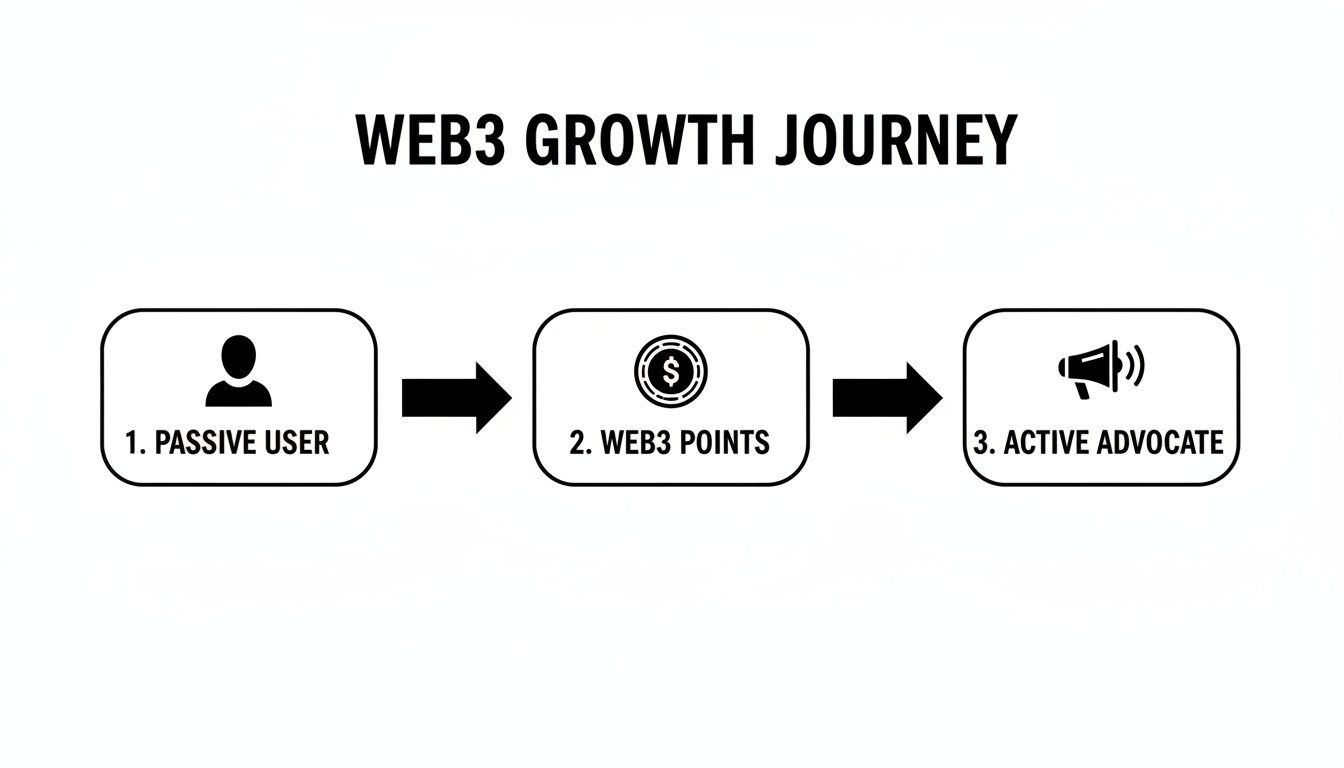
Think of your points program as the engine powering this entire flow, pushing users from one stage to the next.
Define Your Primary Objective
Okay, first things first. Before you even think about assigning a single point, you have to answer one critical question: What are we trying to achieve here? A vague goal like "increase engagement" is a recipe for a weak, unfocused program. You need a sharp, specific objective to guide every decision.
Your main goal will dictate which actions get the most love (and points). Are you focused on:
- Acquisition? If so, your program should heavily reward social shares, referrals, and user-generated content that brings fresh faces into your ecosystem.
- Protocol Usage? Here, you'll want to incentivize core on-chain actions like staking, swapping, minting, or providing liquidity to boost your product's key metrics.
- Community Building? Maybe your goal is a vibrant community. In that case, you could award points for active and helpful Discord messages, joining community calls, or mentoring newcomers.
Picking one primary goal doesn't mean you totally ignore the others. It just gives you a north star. It ensures you're rewarding the behaviors that matter most for your project's current growth stage.
Mapping Actions to Rewards
With a clear objective in your pocket, you can start mapping specific user actions to point values. This is where the art and science of building a points program really come together. You need a system that feels both motivating and fair.
For example, a simple Twitter follow might be worth 10 points, but a successful referral who completes an on-chain transaction could be worth 500 points. The trick is to assign higher values to actions that are tougher, more valuable to your project, or require a bigger commitment.
I like to think about actions in tiers:
- Low-Effort (The Welcome Mat): Following social accounts, joining the Discord/Telegram, reading the whitepaper.
- Medium-Effort (Getting Involved): Joining a discussion, creating a meme, retweeting a major announcement.
- High-Effort (True Commitment): Staking tokens, holding a specific NFT, writing a detailed product review, or submitting a governance proposal.
This tiered approach creates a natural ladder for users to climb. It hooks them with easy wins and then keeps them engaged with more challenging, high-reward tasks. If you're looking for more inspiration on how to structure this, digging into different https://domino.run/blog/web-3-gamification strategies can be a goldmine of ideas.
Establish Your Points Tokenomics
Finally, let's talk about the bigger economic picture. This is your "points tokenomics," and it's absolutely crucial for making your program last. Skip this step, and you risk creating an inflationary mess where points become worthless.
You need to sit down with your team and hash out the answers to these questions:
- Total Supply: Is there a fixed cap on the total number of points, or will it be inflationary? A fixed supply creates scarcity, which can make each point feel more valuable.
- Distribution Schedule: How will you release points over time? You could front-load the rewards to kickstart growth and then taper off as the community matures.
- Conversion & Redemption: What's the end game for these points? Be clear about whether points will eventually convert to a token, unlock NFTs, or grant exclusive access. The potential for future value is what gets people to grind.
Thinking through these elements is what separates a flash-in-the-pan campaign from a sustainable ecosystem. It builds trust and ensures that the points your community earns today will still mean something tomorrow.
Crafting Quests That Drive Real Engagement
Let’s be honest: a brilliant points economy is useless if the quests are a snooze-fest. Your quests are the engine of your web3 points program. They're the actions that actually get your community moving and spark real, measurable growth. This isn't about making a fancy to-do list; it’s about architecting a journey that feels fun, rewarding, and genuinely valuable to your users.
So, how do you build quests people actually want to do? The key is to create a healthy mix of tasks that serve different goals—from rolling out the welcome mat for newbies to activating your most hardcore power users.
This flow gives you a great visual for how to guide people from simple social tasks to more meaningful on-chain actions.
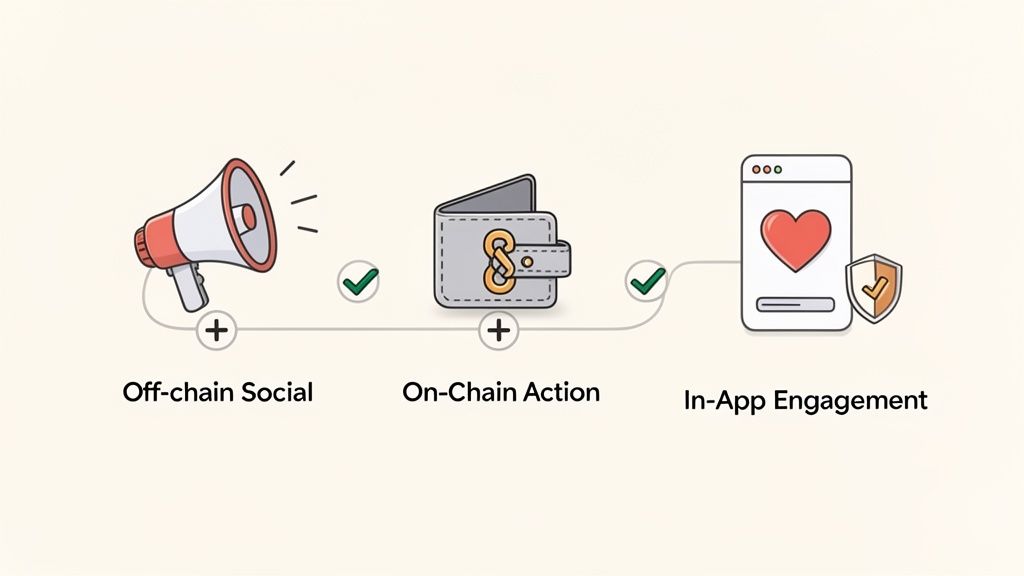
Think of it as building momentum. Each stage should flow logically into the next, so the user’s journey feels like a natural progression, not a random list of chores.
The Three Pillars of Quest Design
A solid program stands on three types of quests. I like to think of them as different doorways into your ecosystem, each one built for people with different levels of commitment.
Off-Chain Social Tasks: These are your bread and butter for grabbing attention. They're super low-friction and perfect for newcomers who aren't quite ready to connect a wallet or spend gas. Use these to get your name out there and build top-of-funnel buzz.
On-Chain Protocol Actions: This is where the magic happens for your core metrics. These quests directly incentivize people to interact with your smart contracts, which can pump up everything from transaction volume to TVL.
In-App Behavioral Quests: These are your secret weapon for finding and rewarding your true fans. By hooking into your app’s backend with an API, you can reward specific, high-value actions like daily logins or using an advanced feature.
When you blend these three, you create a powerful user journey. Someone might start by earning 20 points for a simple retweet, get drawn in to earn 200 points for staking some tokens, and then get hooked trying to earn 1,000 points for hitting a major milestone inside your app.
Building a Progressive Quest Journey
Don't just dump a list of tasks on your community and hope for the best. You need to craft a progressive experience that gently guides them from simple to complex actions. I call this the "quest funnel," and it's absolutely critical for keeping people engaged without overwhelming them.
Always start with some easy wins. Your first few quests should be dead-simple social tasks that take less than a minute. This gives users an instant dopamine hit of accomplishment and gets them bought into the program from the get-go.
From there, you slowly turn up the heat.
- Beginner: Follow us on X, join the Discord, read our latest blog post.
- Intermediate: Retweet an announcement with a thoughtful comment, create a cool meme, vote in a community poll.
- Advanced: Stake 0.1 ETH, mint a specific NFT, provide liquidity to a pool.
- Expert: Write a detailed guide about our protocol, create a video tutorial, submit a real governance proposal.
The secret is to make it feel like a game. Each quest they complete should unlock the next set of challenges. This builds momentum and keeps people curious to see what’s next, turning participation from a chore into something they genuinely want to do.
Verification and Fighting Fraud
Okay, so you've designed some killer quests. That's only half the battle. If you can't verify completions and filter out the bots, your program will get drained dry. Sybil attacks—where one person spins up hundreds of fake accounts to farm rewards—can kill your budget and make the points worthless for your real community.
This is where modern platforms really come in handy. The best ones use a mix of automated systems to keep things fair.
- AI-Powered Verification: For off-chain stuff like social posts, AI can be a lifesaver. It can analyze submissions to see if they're legit, spotting generic comments, spammy retweets, or lazy content and kicking them out automatically.
- On-Chain Proofs: On-chain actions are the gold standard for verification. The system just checks the blockchain data to confirm a user's wallet did what it was supposed to, like a swap or a stake. It’s trustless and virtually impossible to fake.
This two-pronged approach is your best defense. It makes it easy for real users to claim their points while making it incredibly difficult and expensive for bots to cheat. In fact, brands using secure Web3 loyalty systems have seen a 28% higher rate of repeat customer interactions compared to old-school points programs.
Plus, as you'll discover in this analysis, these tokenized systems can even slash acquisition costs by 12% because your most engaged users become your best marketers. Protecting the integrity of your points program is how you protect its value and build a community based on real participation.
Choosing the Right Tech for Your Program
You’ve done the hard work. Your points economy is dialed in, and you've dreamed up quests that people will actually want to do. Now for the make-or-break decision: Where will this all live?
Choosing your tech stack is less about finding the one "best" platform and more about finding the right fit for your brand, your community’s vibe, and frankly, your technical resources. This isn't just about a slick interface; it’s the entire experience. It’s where your community discovers quests, gets that dopamine hit from watching their points rack up, and battles for a spot on the leaderboard.
Platform Showdown: Your Frontend Options
When it comes to the user-facing part of your program, you’re looking at three main roads. Each has its own pros and cons, balancing speed, control, and the overall feel of the experience.
H3> The All-in-One Platforms
Think of platforms like Zealy or Galxe. These are the turn-key solutions. The biggest plus? Speed. You can spin up a campaign in a matter of hours, tapping into a user base that’s already familiar with the questing format.
The trade-off is control. You’re building on rented land. Your program will live on their domain, with their branding, right next to hundreds of other projects. It's a bit like setting up a booth at a giant convention—great for foot traffic, but harder to create a unique, branded experience.
H3> The White-Label Route
This is where you get the best of both worlds. A white-label solution gives you a pre-built, battle-tested quest portal that you can host on your own domain. You can customize the look and feel to be a perfect extension of your brand.
It offers deep customization without the massive headache and cost of building from the ground up. You get full brand ownership and a much more premium, integrated user experience that feels like it’s truly yours.
H3> The Native Community Hubs
Why make users go somewhere else? Running quests directly inside Discord or Telegram with bots meets your community exactly where they are. This is an awesome strategy for removing friction, especially for simple social tasks like retweets or joining a discussion.
The downside is that it can get clunky. Managing complex on-chain tasks, displaying slick leaderboards, or handling a high volume of quests can push the limits of what a bot can do gracefully. It’s perfect for tactical engagement, but maybe not for a sprawling, long-term program.
Your choice here sends a message. A dedicated platform says, "We're tapping into the Web3 questing trend." A white-label solution says, "This is a core part of our ecosystem." Neither is wrong, but they communicate very different things.
Comparing Key Factors
Let's lay it all out.
| Factor | Dedicated Platform | White-Label Solution | Direct Integration |
|---|---|---|---|
| Branding Control | Low | High | Medium |
| Speed to Launch | Very Fast | Fast | Medium |
| User Experience | Standardized | Fully Customized | Native but Limited |
| Technical Lift | Minimal | Low | Medium to High |
| Best For | Quick user acquisition campaigns | Building a premium, branded community hub | Driving engagement inside an existing community |
Be honest about your primary goal. If you need to kick off a viral campaign tomorrow to get a ton of new eyes on your project, something like Zealy is a brilliant move. But if you're in it for the long haul, building a loyalty program that becomes a cornerstone of your community, investing in a white-label solution will almost always pay off.
Beyond the Frontend: Integrating with Your Ecosystem
Here's a pro-tip: a truly powerful points program doesn't live on an island. The real magic happens when you plug it into your wider marketing and data stack. This is what turns a simple quest board into a genuine growth engine.
Think about what happens when your systems can talk to each other. When a user completes a high-value quest, you could automatically:
- Update your CRM: Tag them as a "Superfan" in HubSpot so your team knows who your champions are.
- Trigger an email flow: Send a personalized "You're crushing it!" email via Mailchimp that hints at the next reward tier.
- Enrich your product analytics: Push quest data into tools like Mixpanel to see how on-chain engagement impacts product retention.
This is how you create a seamless, responsive journey. It’s how you go from blasting generic announcements to delivering personalized experiences that build real loyalty. Without these backend connections, you're flying blind, missing out on a goldmine of data that could help you scale your program and prove its impact.
Managing Rewards and Scaling for Growth
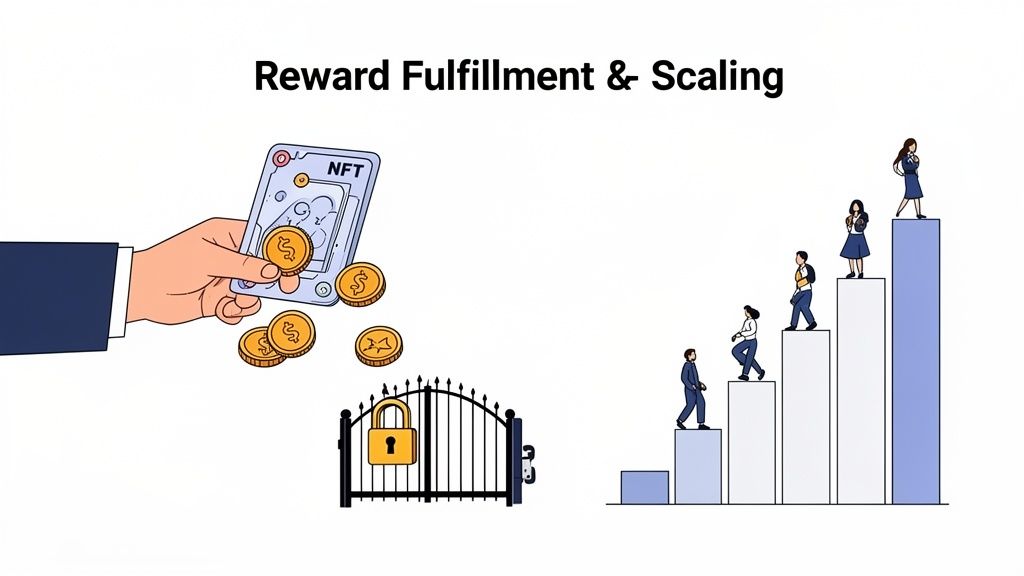
Getting users to earn points is just the first step. The real moment of truth—the payoff—is when they actually claim their rewards. This is where your Web3 points program has to deliver on its promise. A clunky or confusing fulfillment process can ruin the whole experience, no matter how cool your quests were.
The trick is to offer rewards your community actually cares about. And no, it doesn't always have to be a future token airdrop, even though that's a massive motivator. The best projects I've seen use a smart mix of incentives to keep everyone from the casual user to the hardcore degen engaged and excited for what's coming next.
Crafting a Reward Structure People Actually Want
Think bigger than a simple points-to-token swap. When you diversify your rewards, you create more chances to surprise and delight your community while steering them toward specific actions you want them to take.
Here are a few models that just plain work:
- Exclusive NFTs: These are perfect for creating a little FOMO. Offer limited-edition digital collectibles that act as status symbols, unlock special perks, or grant access to future events. You could even have a top-tier NFT give holders a permanent boost on all future point earnings.
- Future Airdrop Allocation: Let's be real, this is the big one. Make it crystal clear that the points people earn will directly impact their slice of a future token airdrop. It’s the ultimate incentive for long-term commitment and high-value contributions.
- Gated Content or Access: Use points to unlock the velvet rope. Think private Discord channels, early access to new features, or exclusive AMAs with the founding team. This makes your most dedicated community members feel like true insiders.
- Discounts and Whitelists: Sometimes, the best rewards are the most practical. Giving active participants guaranteed whitelist spots for an upcoming mint or discounts on protocol fees is a tangible, immediate benefit that delivers instant gratification.
A pro tip from the trenches: Be transparent about what the points are for, even if you haven't nailed down the exact airdrop conversion rate. Managing expectations early builds trust and keeps the community from getting salty later on.
Scaling Your Program Without the Headaches
Getting your points program live is one thing. Keeping it from going stale is a whole different beast. The real challenge—and where the massive growth comes from—is scaling it effectively. A program with the same three quests on repeat will lose momentum fast.
This is where you need to embrace automation. Manually tracking quest completions and dishing out rewards is a logistical nightmare once you have thousands of users. If you're tying points to a token airdrop, automating workflows isn't just a nice-to-have; it's essential. For example, using a template to distribute rewards by converting leaderboard points into tokens can save you hundreds of hours and prevent costly mistakes.
The timing for this couldn't be better. The global Web3 market was valued at $4.62 billion in 2025 and is on a trajectory to hit an eye-watering $99.75 billion by 2034, with a compound annual growth rate (CAGR) of 41.18%. That growth is being driven by over 3,200 startups and 17,000 companies all experimenting with tokenized incentives.
The Metrics That Truly Matter
If you want to scale intelligently, you have to track the right data. Forget vanity metrics like the total number of points you've handed out. Focus on the numbers that tell you whether your program is actually moving the needle on your core goals.
Keep these metrics front and center on your dashboard:
- Quest Completion Rate: What percentage of people who start a quest actually see it through? If it’s low, the quest might be too hard, the instructions might be confusing, or the reward might not be worth the effort.
- On-Chain Impact: Is the program boosting your key protocol metrics? Look at things like daily active wallets, transaction volume, or total value locked (TVL) for users in the program versus those who aren't. That’s your ROI.
- User Retention: Are participants coming back week after week? High retention is a clear signal that your program is genuinely engaging and the rewards feel achievable.
- Referral Conversion Rate: For your referral quests, don't just count the sign-ups. Track how many new users join and complete their first quest. This tells you about the quality of the users you're attracting.
By constantly watching this data, you can fine-tune your strategy on the fly. You can A/B test different point values for quests, roll out new task types, and kill the ones that aren't performing. This iterative loop is what turns a points program from a short-term campaign into a sustainable growth engine that evolves right alongside your community.
Common Questions About Web3 Points Programs
As you get into the weeds of designing your own campaign, some tough questions are bound to pop up. Let's be real—building and running a solid Web3 points program means tackling some unique challenges, from outsmarting bots to managing your community's expectations.
Here are the answers to the most common questions we hear from founders and marketers, straight from the trenches.
How Do I Stop Bots from Farming My Points Program?
This is the big one, and for good reason. A program overrun by bots is a massive waste of time and money, rewarding fake accounts instead of your actual community. The only way to win is with a multi-layered defense that makes it too difficult and expensive for bots to succeed.
First off, your choice of platform is your frontline. You need a tool with modern, built-in anti-fraud measures. For instance, AI-powered verification can check social media submissions in real-time, instantly flagging those generic, copy-pasted comments or spammy retweets that scream "bot activity."
Next, get smart about how you mix your quests. A bot can easily follow a thousand Twitter accounts, no problem. But it's a whole different ballgame for them to perform meaningful on-chain actions. Start requiring tasks like staking a certain amount of tokens or holding a specific NFT to earn the big points. This on-chain proof is nearly impossible for basic bots to fake.
Finally, you can add another gate with proof-of-humanity solutions like Gitcoin Passport or BrightID. Think about designing your quests with progressive difficulty. Keep the entry-level quests simple to get genuine users in the door, but save the high-value point rewards for tasks that demand real investment and commitment. This effectively prices out the casual bot farmers.
What's the Real Difference Between a Points Program and a Direct Airdrop?
Think of it like this: a direct airdrop is like throwing a handful of seeds in the wind and hoping for the best. A points program is like carefully nurturing a garden.
A direct airdrop is a one-and-done event. You take a snapshot, reward a list of wallets, and hope it makes a splash. It’s great for a quick burst of attention, but the problem is that airdrops often attract what we call "mercenary capital." These are users who show up, claim the tokens, and immediately dump them on an exchange without ever engaging with your project again. They were never really part of your community; they were just passing through for a quick buck.
A Web3 points program, on the other hand, is a long-term engagement strategy. It's a marathon, not a sprint. It rewards sustained participation over time, filtering for users who are genuinely invested in your project's future.
By having people complete quests week after week, you get them to demonstrate their commitment and actually learn about your ecosystem. The points they rack up become a transparent, ongoing record of their loyalty. This record can then be used to decide their share of a future airdrop, ensuring your most dedicated community members get the biggest rewards. It completely changes the dynamic, turning the reward from a handout into a hard-earned prize.
Can I Run a Points Program Without Promising a Token?
Absolutely! While the promise of a future token is an undeniably powerful motivator, it’s not the only play in the book. You can run a killer web3 points program by offering value that your community genuinely cares about, turning points into a currency for exclusivity and status within your ecosystem.
You could offer all kinds of non-token incentives:
- Exclusive NFTs: Digital collectibles that serve as status symbols, unlock special perks, or grant access to future events.
- Private Channel Access: Use points as the key to unlock private Discord or Telegram channels where users can chat directly with the core team.
- Allowlist Spots: A guaranteed spot for a hot new mint is a hugely valuable reward that dedicated community members will gladly grind for.
- Product Discounts: Offer immediate, tangible value by letting users cash in points for discounts on protocol fees, products, or services.
The goal is to make the points themselves feel valuable. This approach can actually build a more authentic community, attracting people who are there for the project itself, not just to speculate on a token price.
Just one word of advice: if you go this route, be crystal clear about it from day one. Tell everyone exactly what the points can be redeemed for to manage expectations and build a foundation of trust.
Ready to build a Web3 points program that drives real growth without the technical headaches? Domino provides a no-code toolkit to design, launch, and scale reward-based quests in minutes. Automate verification, integrate with your favorite tools, and turn your community into a growth engine. Launch your first quest with Domino today.