Your Playbook for a Killer Web3 Treasure Hunt Event
A treasure hunt is more than just a campaign—it's an interactive adventure. It uses a series of quests and challenges to guide people toward a final, exciting reward. In the Web3 world, this format is pure gold for turning a passive audience into a community of active, fired-up members by mixing fun, game-like tasks with real on-chain and off-chain actions.
Why Your Next Campaign Should Be a Treasure Hunt
Let's be real—most marketing campaigns are completely forgettable. People see an ad, maybe they click, and then they're gone. A Web3 treasure hunt completely flips that script by creating an experience that actually sticks with them.
Instead of just telling people about your project, you're inviting them to be part of its story. This isn't some cheap gimmick; it's a seriously powerful way to turn sideline observers into deeply engaged fans. A well-designed hunt builds a community that's genuinely invested because they've experienced your value for themselves.
Setting Clear Goals for Maximum Impact
Before you even think about designing a single quest, you need to know what winning looks like. A treasure hunt isn't just a fun activity; it's a strategic weapon. Your main goal will dictate every other choice you make, from the tasks you set to the rewards you offer.
So, what are you trying to achieve? Common goals usually fall into one of these buckets:
- Driving User Acquisition: You want to bring new people into your ecosystem and walk them through onboarding in a way that doesn’t feel like a chore.
- Boosting Product Education: The goal is to teach people how to use specific features of your protocol or dApp through hands-on tasks.
- Increasing Community Engagement: You're looking to spark conversations and teamwork within your Discord, Telegram, or other community hubs.
- Generating Buzz for a Launch: The plan is to build massive hype and have a fired-up user base ready to go for a new product, feature, or token drop.
The whole point is to get people to do something. A successful treasure hunt prompts action, turning your campaign into a journey people want to join. It’s a concept that works anywhere, even in the real world—just look at how something like a London Pub Crawl Treasure Hunt uses the same principles to get people moving and engaged.
A great treasure hunt event is a story, not just a to-do list. Each quest should feel like a chapter that pulls participants deeper into your world, making them feel like valued contributors rather than just users.
And the data doesn't lie. Gamifying an event gets real results by making participation feel like a game. For example, the Techsauce Global Summit 2025 ran an NFT-based hunt that saw over 60,628 blockchain interactions in only three days. That’s tens of thousands of measurable actions driven by mission-style tasks. This kind of active involvement is the bedrock of strong Web3 community building.
Designing Quests People Actually Want to Complete
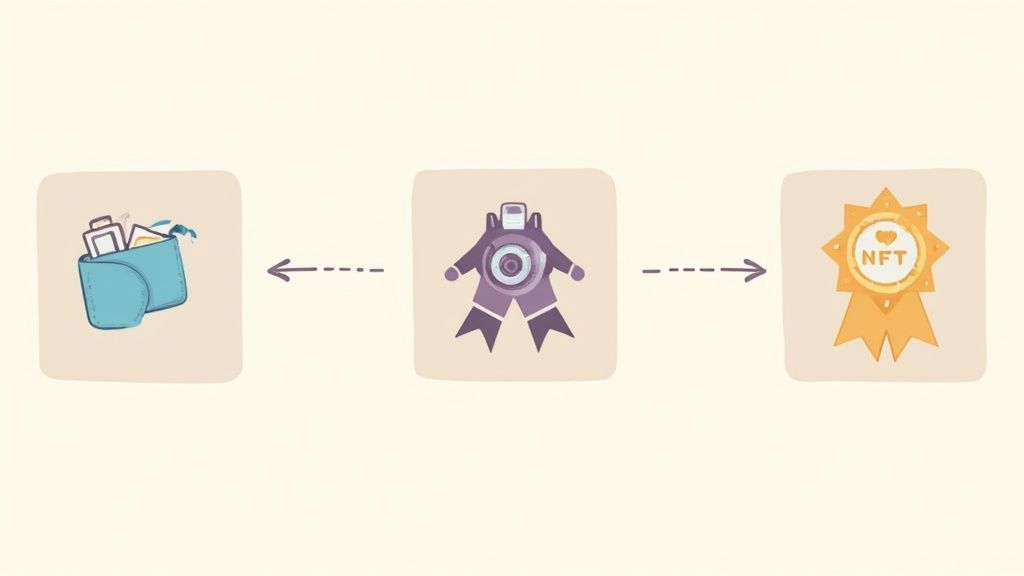
Let's get to the fun part. A killer treasure hunt feels less like a chore list and more like an actual adventure. This is where you swap your strategist hat for your creative one. You're not just listing tasks; you're building a journey that people genuinely want to be a part of.
If all you have are generic, boring quests, people will tune out fast. The secret is mixing things up. Weaving together simple on-chain actions with more creative off-chain activities creates a dynamic that appeals to everyone, from your die-hard DeFi degen to the curious newcomer who just joined your Discord.
Crafting a Compelling Quest Narrative
Every good adventure needs a story. Your quests shouldn't feel like a random to-do list, but more like chapters in a book, each one pulling the user deeper into your world.
Think about it this way: an NFT gaming project could frame its treasure hunt around a hero’s journey. The first few quests could be off-chain, maybe focused on learning the game's lore. Then, the next step might be an on-chain task to "forge your first weapon," which is really just minting a specific NFT. This narrative framing is what turns a simple action into a meaningful moment.
It all comes down to giving context to the "why." Someone is way more likely to do a swap on your DEX if you frame it as "brewing a magic potion" instead of "execute a token swap." This is the core of smart community gamification—it makes the mundane feel epic.
Balancing On-Chain and Off-Chain Tasks
A great Web3 treasure hunt connects what happens on social media with real, tangible on-chain activity. A balanced questline is absolutely essential to get everyone involved, no matter their crypto comfort level.
On-chain quests are your heavy hitters for driving real product usage. They're undeniable proof that someone is engaging with your protocol.
- Token Swaps: Get people actually using your DEX.
- NFT Minting or Staking: Push interaction with your most important smart contracts.
- Liquidity Provision: A great way to encourage users to add to your pools.
- Governance Votes: Turn lurkers into active participants in your DAO.
Off-chain quests, on the other hand, are perfect for building social hype and a sense of community. They're the low-hanging fruit that gets new people in the door.
- Social Media Buzz: "Share a screenshot of your favorite feature on X with our hashtag."
- User-Generated Content: "Make a quick TikTok explaining how our protocol works."
- Discord Engagement: "Earn the 'Community Helper' role by being active and helpful."
The best questlines have a smooth difficulty curve. Start people off with easy wins to build their confidence. Then, you can gradually introduce the bigger, more complex challenges that come with even better rewards.
Nailing this mix is non-negotiable. If you lean too heavily on complex on-chain tasks, you’ll scare off the newbies. But if you only stick to social tasks, you won't see the product adoption you’re looking for.
Designing for a Smooth User Journey
Finally, put yourself in your user's shoes. Every single quest needs to have crystal-clear instructions. Ambiguity is the enemy here. If someone has to stop and wonder what you mean, you've probably already lost them.
A fantastic way to structure everything is by creating quest "chains" or "chapters." For example, maybe completing three simple social tasks unlocks the first set of on-chain challenges. This tiered approach gives users a real sense of progression. It gently guides them from being a social butterfly to a confident on-chain pro, all inside one cohesive event.
Building a Fraud-Proof Verification System
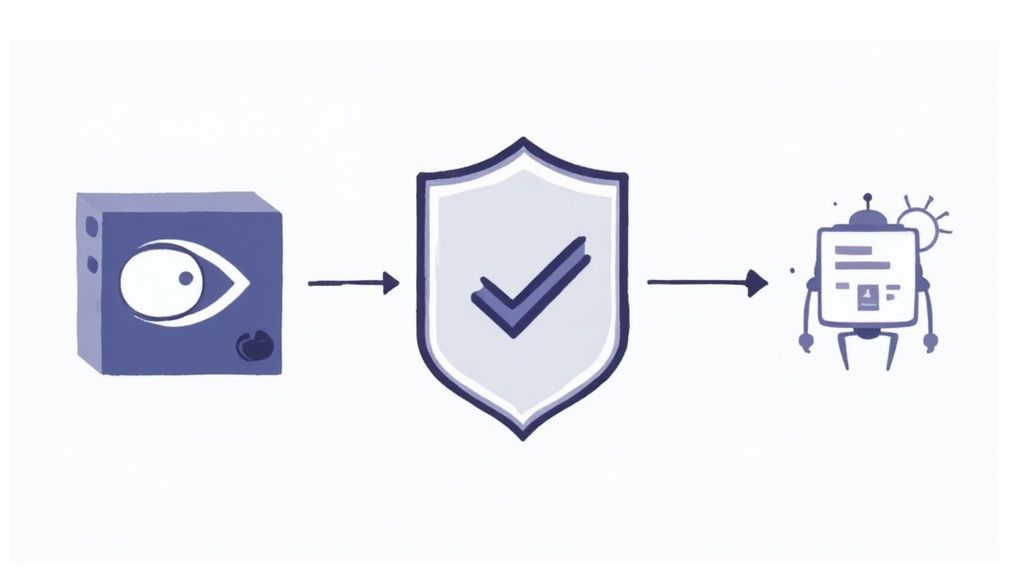
Let's be real: a great quest design is only half the battle. If you can't actually confirm people did what you asked, the whole treasure hunt falls apart. A solid verification system is what makes your event fair, keeps cheaters out, and gives real participants a legitimate experience.
You need a system smart enough to handle everything from on-chain transactions to social media creativity. The goal is to create a process where blockchain actions are checked instantly and user-generated content is reviewed accurately, all without letting the bots win.
Automating On-Chain Quest Verification
On-chain tasks are the bedrock of any Web3 treasure hunt. Why? Because they’re verifiable truth. When someone mints an NFT or swaps a token, they leave a permanent, undeniable record on the blockchain. Your verification system has to tap directly into that.
With a platform like Domino, this is completely automated. You just set the rule—say, "stake at least 100 of our governance tokens"—and the system does the heavy lifting. It scans the chain to confirm the transaction and gives the user credit right away. No manual review needed.
This kind of instant feedback is a game-changer for the user experience. People know their effort was seen and counted, which gets them excited to jump into the next quest.
Using AI for Off-Chain Task Review
Off-chain tasks—like posting on X (formerly Twitter) or making a meme—are fantastic for generating buzz, but they can be a nightmare to verify. Manually sifting through hundreds or thousands of submissions just isn't scalable. This is where AI becomes your MVP.
Think about a quest asking users to tweet about your project with a specific hashtag and link. An AI-powered system can check all the boxes in a split second:
- Content Analysis: Is the tweet's sentiment positive, matching the quest goal?
- Keyword & Hashtag Checks: Did they actually include the mandatory
#YourProjecthashtag? - Link & Mention Verification: Is your official account tagged correctly?
By automating the review of social posts, memes, and even screenshots, you free up your team to actually engage with the community instead of getting buried in busywork. It’s the key to making sure your event can scale smoothly.
Implementing Strong Fraud Mitigation
The moment you put real rewards on the table, you can bet the bots and bad actors will show up. A successful treasure hunt has to be built on proactive fraud mitigation. The aim is to make it way too difficult and expensive for cheaters to game the system.
A multi-layered defense works best. A simple starting point is requiring participants to connect multiple accounts, like a wallet, Discord, and X profile. This bit of friction is surprisingly effective at deterring low-effort bots. You can also make it easier for real people by enabling social logins for quests, which helps build a more credible user identity right from the start.
Beyond that, you have to look for patterns. A sophisticated platform can spot suspicious behavior, like dozens of entries coming from the same IP address or wallets all funded from a single source. This isn't a new concept; major companies have used structured "treasure hunt" methods for years to find operational savings. Just look at General Electric—their program has reportedly saved millions by identifying and fixing system inefficiencies. You can read more about GE's successful treasure hunt initiatives on the EPA website.
By combining automated on-chain checks, AI-powered off-chain review, and smart fraud detection, you build a system that protects the integrity of your campaign. It’s how you make sure your rewards go to the real, engaged community members who actually earned them.
Choosing Your Event Platform and Rewards
Alright, you've got your quests mapped out and know how you'll verify them. Now comes a crucial decision: where will this whole treasure hunt actually live? This choice is a big deal. The right platform can make your campaign feel effortless and fun, while the wrong one can trip people up before they even start. It’s all about creating a smooth user experience that fits your campaign's vibe.
Just as important is the loot. A lot of people think you need to throw a giant prize pool at a campaign to get attention. Honestly? That's not the whole story. A smarter, more layered incentive structure often works way better for keeping people hooked long-term than just one massive giveaway.
Selecting the Right Frontend for Your Audience
Think about where your community already hangs out. The platform you choose for your treasure hunt will define their entire experience. Are you aiming for a quick launch, a native feel within your existing community, or a completely custom-branded adventure? Each path serves a different purpose.
If speed is your top priority, you can't go wrong launching on an established platform like Zealy. These sites are literally built for this stuff. They offer a clean interface that tons of Web3 folks are already familiar with, which means less of a learning curve for your participants. People can just jump right in. It’s the undisputed champ for getting a campaign off the ground fast.
But what if you want to bring the event to where your community already lives? Integrating your treasure hunt directly into Discord or Telegram is a fantastic move. It creates a seamless experience where participants don't have to bounce to another website. This is a brilliant way to deepen community bonds and keep all the action in one place.
For those who want total creative control, a white-label site is the ultimate answer. This lets you build a completely unique, branded world for your treasure hunt. You control every pixel, every button, and every step of the user's journey. It takes more effort to set up, but the result is a truly immersive experience that’s 100% yours.
The best platform is the one that meets your community where they already are. If your people live and breathe on Discord, don't force them to a separate website. It just adds friction. Match the platform to their habits.
You can see the power of a centralized hub even outside of Web3. Just look at geocaching, the OG global treasure hunt. By mid-2025, it had exploded to over 3 million active caches in almost 190 countries, all powered by a single platform. The most popular cache in Prague has been found tens of thousands of times! It’s a perfect example of how a shared community platform can create incredible scale. You can read more about the global geocaching phenomenon on the EUSPA website.
To help you decide, here’s a quick breakdown of the frontend options you have with Domino.
Frontend Platform Comparison for Your Treasure Hunt Event
Choosing where to host your event is a strategic decision that impacts user adoption and overall experience. This table compares the main options to help you find the perfect fit for your community and campaign goals.
| Frontend Option | Best For | Key Advantage | Consideration |
|---|---|---|---|
| Zealy | Quick launches, reaching new audiences, and leveraging a familiar Web3 UI. | Speed to market and low friction for experienced questers. | Less brand control; you're on a third-party platform. |
| Discord/Telegram | Engaging your existing community in their native environment. | High engagement and strengthens community bonds. | Experience is limited by the bot interface within the app. |
| White-Label Site | Maximum brand immersion and creating a fully custom user journey. | Total control over design, features, and user experience. | Requires more development time and resources to set up. |
Ultimately, the goal is to make participation as easy and enjoyable as possible. Whether you prioritize speed, community integration, or brand control, there’s a frontend solution that fits your needs.
Designing a Reward Structure That Motivates
Now for the fun part: the prizes! The real goal here isn't just to give away free stuff. It's to build an incentive system that keeps people excited and motivated from the very first task to the final boss battle. A great reward structure is about the journey, not just the destination.
You want to create a feeling of constant progress. Tiered rewards are perfect for this. Offer small, instant wins for completing individual quests. These little dopamine hits are surprisingly powerful and encourage people to stick around and do "just one more."
Here are a few ideas to get you started on a multi-layered reward system:
- NFT Badges or POAPs: These are like digital trophies. Award unique, non-transferable NFTs for finishing a chapter or a tough milestone. They’re a great way for users to show off their loyalty and participation.
- Tiered Leaderboard Prizes: This is where you put the big guns. Save your most valuable prizes, like stablecoins or token allocations, for the top players on the leaderboard. A little friendly competition can really fire up your most dedicated community members.
- Exclusive Access: Some of the best rewards aren't monetary. Think about offering things money can't buy—a special role in Discord, access to a private chat with the founders, or an early look at a new product feature.
- Experience Points (XP) Systems: Use XP to track progress visually. As users rack up points, they can unlock new quests, cool rewards, or even raffle tickets for a grand prize drawing.
This kind of layered approach makes sure there’s something in it for everyone. The casual participant gets rewarded for their time, while your super-users have a big, juicy prize to chase. It turns your treasure hunt from a simple giveaway into a full-blown community game.
How to Launch, Track, and Optimize Your Campaign
Alright, you've put in the hard work. Your quests are designed, your platform is chosen, and the foundation is solid. But a killer treasure hunt doesn't just happen on its own. Now it’s time to shift gears from building the event to actually running it—from creating that initial wave of hype to making smart, data-driven tweaks on the fly.
The real magic begins the moment your campaign goes live. A launch isn't just about flipping a switch; it's a coordinated blast to grab your community's attention. But what really separates a good event from a legendary one is what you do next. It’s all about staying agile, spotting where people get stuck, and fine-tuning the experience to keep that momentum roaring.
Kicking Off a High-Impact Launch
Launch day sets the entire mood for your event. Your main goal here is to create a tidal wave of excitement that pulls everyone in right from the get-go.
It all starts with a synchronized announcement across every channel you own. Think X, Discord, Telegram—the whole nine yards. Your message needs to be crystal clear: what the event is, how to join, what the first quest involves, and most importantly, what’s up for grabs.
But don't just post and ghost. Your team needs to be all hands on deck in your community channels. Be there to answer questions, cheer on the first wave of participants, and build a genuinely vibrant and supportive vibe. Think of it like hosting a party. You wouldn't just unlock the doors and hide in the back, right? You’d be at the front, greeting people and getting the energy up.
The first 24 hours are absolutely critical. A strong start creates a powerful flywheel effect, where your early birds get excited, share their progress, and naturally pull in their own networks, doing a lot of your marketing for you.
To help visualize how your choice of platform impacts your launch, here’s a simple flowchart.
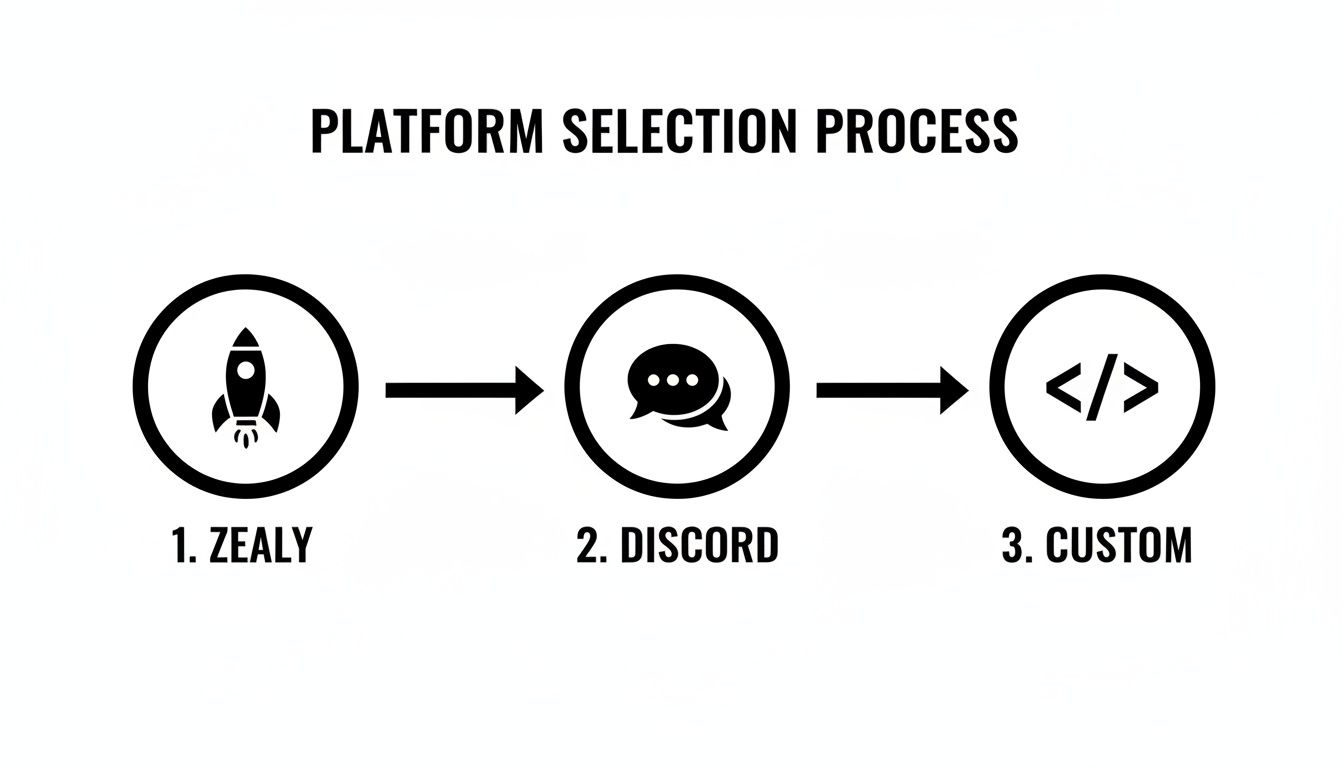
This shows the natural progression many projects take—starting with a quick-and-easy platform like Zealy, moving to a more integrated community hub on Discord, or eventually building a completely custom experience as they scale.
Tracking Performance with a Live Dashboard
Once the treasure hunt is underway, your analytics dashboard is your new best friend. This isn't about staring at vanity metrics; it's about keeping your finger on the pulse of the event to see exactly what’s happening in real time. For a deeper dive into this, it’s worth mastering marketing campaign tracking to really squeeze the most value from your data.
A good dashboard gives you an instant read on your event's vital signs. Sure, it's fun to watch the numbers go up, but the real value is in spotting problems before they completely derail your campaign.
Here's what you should be watching like a hawk:
- Completion Rate Per Quest: This is your number one metric. If a specific quest has a massive drop-off, that’s a huge red flag. It could be too hard, the instructions might be confusing, or the reward just isn't worth the hassle.
- User Drop-Off Points: Where are you losing people? Pinpointing these friction points lets you jump in and fix the issue before more users get stuck and give up.
- Top Performing Quests: On the flip side, which tasks are people absolutely crushing? This tells you what your community genuinely enjoys and gives you amazing intel for planning your next event.
- Participant Engagement: Is the average user completing just one or two quests, or are they diving deep? This tells you how invested they really are in the whole experience.
This data isn't just for a fancy report after the fact. It’s your toolkit for making live adjustments that directly improve your treasure hunt's success.
Optimizing Your Campaign on the Fly
Being able to react and adapt is your secret weapon. All that data you're tracking is useless unless you actually do something with it. If you see a quest that’s acting like a brick wall for your participants, don't just leave it there. Step in and make a change.
This is what real-time optimization is all about.
- Clarify Instructions: Seeing a 50% drop-off rate on a quest? The first thing to do is check the instructions. Often, just rephrasing a sentence or adding a helpful screenshot can solve the problem instantly.
- Adjust Difficulty: Maybe that on-chain task was a little too complex for your newer community members. You could add a simpler alternative or post a quick tutorial video to guide them through it.
- Boost a Reward: Is a high-effort quest getting ignored? Sometimes, a small bump in the reward—a few extra XP or another raffle ticket—is all it takes to get people motivated again.
- Engage Directly: Use what you’re learning to start a conversation. Hop into Discord and post something like, "Hey everyone, we noticed Quest 5 is a bit tricky! Here's a quick tip to help you out." This shows you're actually listening and actively working to make the experience better for them.
This constant feedback loop of launching, tracking, and optimizing is what elevates a simple set of tasks into a dynamic, living event. It keeps your community engaged, ensures you hit your goals, and makes sure your treasure hunt delivers the biggest impact possible.
Got Questions About Your Treasure Hunt? We've Got Answers
So you've got the big idea for your treasure hunt, but the little details are starting to pile up. It happens every time. Even the most seasoned pros run into questions about timing, quest design, budget, and how to actually prove the whole thing worked.
Let's walk through some of the most common questions we hear. Nailing these details is what separates a decent event from a legendary one that people talk about for months.
How Long Should This Thing Actually Run?
The "perfect" length for a treasure hunt really depends on what you're trying to accomplish. There’s no magic number, but I like to think of it as choosing between a sprint and a marathon.
A short, intense sprint—think 1 to 2 weeks—is your best bet for generating massive hype around a product launch or a major announcement. The ticking clock creates a real sense of urgency, getting a ton of people to take action all at once. It’s perfect for creating a big, explosive moment.
On the other hand, if your goal is more about long-term community building or really teaching people the ins and outs of your product, a marathon approach of 4 to 8 weeks is often better. This gives everyone a chance to jump in without feeling rushed, which is key for building lasting habits. You can even roll out quests in weekly "chapters" to keep the energy up and prevent people from getting bored.
What's the Single Biggest Mistake I Can Make with Quest Design?
Oh, this one's easy: a brutal difficulty curve. It's the most common pitfall we see.
If you throw complex on-chain tasks at people right out of the gate, you're going to alienate your new and curious users immediately. They'll see a wall of confusing steps and just bounce. It's a surefire way to kill your momentum before it even starts.
But if all your quests are just "Like and Retweet," your power users and long-time supporters will get bored and check out. You have to cater to both crowds.
Pro Tip: Always start with dead-simple "welcome" quests. Get people in the door and feeling successful. Then, you can slowly ramp up the difficulty, introducing tasks that require them to actually dig into your protocol or product.
This layered approach creates a smooth on-ramp for newcomers while still offering a meaty challenge for your die-hard fans. Everyone feels included, and everyone has something to strive for.
How Do I Actually Prove This Treasure Hunt Was Worth It?
Measuring your ROI isn't something you do at the end; it's something you plan for from the very beginning. If you don't define what success looks like upfront, you’ll have no idea if you actually achieved it.
Get specific with your goals. For example:
- Growing your user base? Your key metric is the number of new wallet addresses that completed at least one quest.
- Driving product adoption? You'll want to measure how many people used a specific feature for the first time.
- Building community? Track the growth in active Discord members or the spike in social media mentions during the campaign.
Your analytics dashboard is your best friend here. It will show you everything from quest completion rates and user engagement patterns to all the on-chain activity. By tying that hard data directly back to the goals you set in the planning stage, you can build a rock-solid case for your campaign's ROI.
Ready to build a treasure hunt that genuinely captivates your community? With Domino, you can design, launch, and manage powerful Web3 quests without touching a line of code. Automate verification, shut down bots, and see your community thrive. Start building your campaign today at domino.run.