Unlock Growth with telegram quests: A Guide to Engaging Web3 Campaigns

Telegram quests are basically interactive, gamified campaigns you run right inside your Telegram group. The goal? To get your community to take specific actions—both on-chain and off—that actually help your Web3 project grow. Think of it as turning passive lurkers into active players by rewarding them for things like joining a Discord, swapping a token, or just spreading the word on social media.
Why Telegram Quests Are a Web3 Growth Engine
Let’s be real for a second. Growing a Web3 project is tough. The old playbook of just shouting updates into an announcement channel doesn't cut it anymore. Top-tier growth teams know they need to get people doing things, not just watching. This is where Telegram quests have become a secret weapon for building a community that sticks around.

These quests completely change the vibe of your Telegram group. It stops being a one-way street for information and becomes an interactive playground. Instead of just reading your updates, your members get a clear path to contribute and earn rewards for their effort.
The Power of Gamified Participation
The whole idea is to gamify the user journey. By framing tasks as "quests," you create a really satisfying feedback loop that drives both on-chain activity and social chatter. You're meeting the crypto-native audience right where they are, in a format they understand and enjoy.
And the platform itself is a powerhouse. Telegram's growth has been insane. It hit 700 million monthly active users back in June 2022 and then blew past the 1 billion user milestone in March 2025. That’s a massive, built-in audience for any Web3 project to tap into.
In the traditional business world, people focus on building a sales pipeline for steady revenue growth; for us in Web3, Telegram quests are our version of that—a structured way to nurture engagement and guide users toward valuable actions.
The real magic of Telegram quests is how they guide a user's journey. A well-designed campaign can take a complete newbie, teach them about your protocol, and get them to make their first on-chain transaction—all in one seamless, fun experience.
From Passive Followers to Active Contributors
At the end of the day, quests are all about converting those passive channel members into genuine advocates and power users. They create a real, tangible connection between what the community does and how the protocol performs. That shared sense of purpose builds a much stronger, more loyal community for the long haul.
Here's a quick rundown of why they work so well:
- Direct Engagement: Quests give people a clear reason to interact with your project, pulling them off the sidelines and into the game.
- Measurable Actions: Forget fuzzy marketing metrics. Quests deliver specific, trackable results, whether it's a hundred retweets or fifty new liquidity providers.
- Community Building: Working toward shared goals (and rewards) naturally builds a sense of camaraderie and strengthens the social fabric of your community.
By using a tool like Domino, you can turn your Telegram channel into a high-performance growth machine. Check out how it works here: https://domino.run/blog/growth-engine-x.
Designing a Quest Campaign People Actually Enjoy
Alright, let's get down to business and turn your Telegram quest strategy into a reality. The real art here isn't just tossing a bunch of tasks at your users; it's about crafting an experience that feels more like a game and less like a chore. You want people hooked from the very first tap all the way to that final reward.
Before you even think about a single task, you need to lock in your main goal. What does a "win" look like for this campaign? Are you trying to get a flood of new wallet connections? Maybe you're chasing viral social shares to get your name out there. Or perhaps you want to push deeper engagement with your protocol, like encouraging token swaps or liquidity provision. Having that one clear objective is your compass—it guides every decision you make from here on out.
Crafting a Balanced Quest Flow
The best campaigns I've seen always mix easy off-chain tasks with more involved on-chain actions. This approach is brilliant because it gives newcomers a simple way in, while still offering a real challenge for your die-hard community members. For example, you could kick things off with a simple Twitter follow and then gently nudge them toward something bigger, like staking a small number of tokens.
This flow is everything. It needs to feel natural, almost like the user is being guided by an invisible hand from one step to the next. Thankfully, tools like Domino have pre-built templates that take a lot of the guesswork out of structuring these journeys.
With Domino, you can literally map out your entire quest campaign visually from one dashboard. It makes it incredibly easy to see how all your different tasks, both on-chain and off, fit together to create a smooth and compelling experience for your users.
It's also worth paying attention to where your audience is. Did you know that Asia makes up a whopping 38% of Telegram's user base, with Europe coming in second at 27%? Knowing these kinds of regional breakdowns, which you can find on sites like RichAds, can help you time your campaign launches and tailor your content to hit the right people at the right time.
Setting the Rules of Engagement
Nothing kills a campaign faster than confusing rules. You need to lay out your parameters so they're crystal clear and dead simple to understand.
Make sure you nail down these key points:
- Eligibility: Who gets to play? Is this a free-for-all, or is it just for brand-new wallets?
- Duration: How long is this quest going to run? A little bit of urgency can work wonders for participation rates.
- Rewards: What’s in it for them? Be totally transparent about the prize pool right from the start.
Your quest's narrative is just as important as its mechanics. Frame the campaign with a compelling story. Is it a "treasure hunt" for a new feature? A "training mission" for new users? A strong theme makes the entire experience more memorable and shareable.
At the end of the day, designing killer Telegram quests is a blend of smart marketing psychology and solid technical setup. Get the mix of tasks, rewards, and storytelling right, and you can turn a basic campaign into a serious growth engine. By putting these ideas into practice, you'll build campaigns that not only crush your KPIs but also foster a more loyal and engaged community.
If you want to go even deeper on this, check out our guide on the core principles of Web3 gamification. It’s packed with more ideas to help you make your quests genuinely addictive.
Choosing Your Quests (and Making Sure People Actually Do Them)
The real magic of a great Telegram quest comes down to two things: the tasks you ask people to do and how you check their work. This is where your strategy gets real. Nail this, and you'll see genuine growth. Mess it up, and you'll just be spinning your wheels.
The tasks you choose will directly influence what your community does. Simple things like joining a Discord server or following you on Twitter are perfect for getting new folks in the door. These off-chain tasks are low-effort and a great way to pump up your social numbers and get people familiar with your brand.
But if you want to drive real, meaningful protocol engagement, you need on-chain tasks. Think about asking users to provide liquidity on Uniswap or swap a specific token. These actions are aimed at more seasoned users and directly boost your ecosystem's activity and health.
This flowchart breaks down how to match your goals to the right kind of quest.
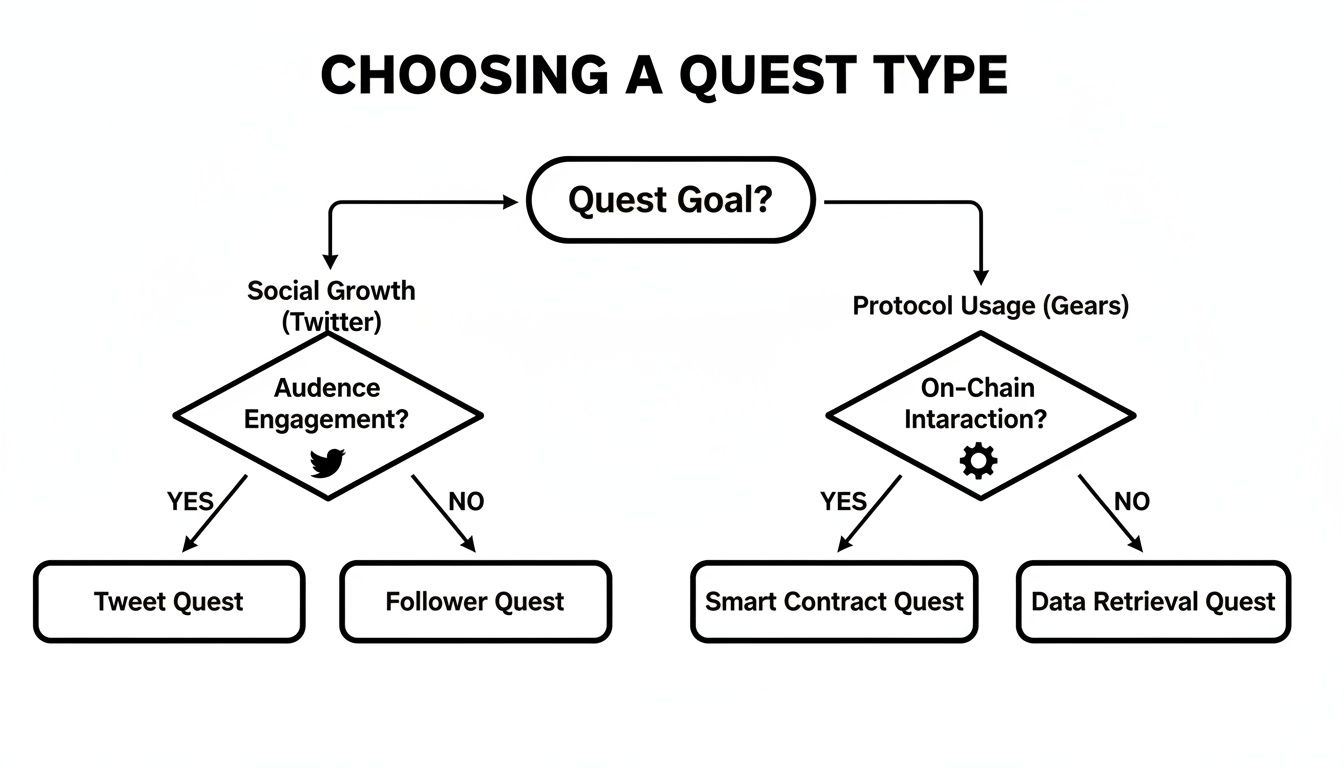
As you can see, it all starts with what you're trying to achieve. Are you gunning for social growth? Or do you need to get more people actually using your protocol? Let that be your guide.
Don't Get Buried in Manual Checks
Imagine having to manually verify thousands of quest submissions. It's a nightmare—slow, full of mistakes, and completely unscalable. That’s why automated verification is an absolute must-have for any serious Telegram quests. Automation is what lets you run massive campaigns without losing your mind.
For on-chain actions, verification is surprisingly straightforward. A platform like Domino can plug right into the blockchain and confirm transactions as they happen.
- Token Swaps: The system peeks into a user's wallet to confirm they made the right swap on the right DEX.
- NFT Mints: It instantly verifies if a user's wallet is holding an NFT from your collection.
- Staking: The platform can check if a user has staked the correct amount of tokens in your protocol.
The whole process is instant and secure, which means no manual work for your team and a super smooth experience for your community.
The best verification systems are tough on bots but easy on real people. You need strong checks to keep the fakers out, but you can't create so many hoops to jump through that you frustrate your actual community.
To help you decide which verification method fits your needs, here's a quick breakdown of the options.
Quest Verification Methods Breakdown
| Verification Type | Best For | Pros | Cons |
|---|---|---|---|
| On-Chain API | Protocol usage, DeFi actions, NFT mints. | Tamper-proof, instant, highly secure. | Requires users to connect a wallet, can be complex for newbies. |
| AI-Powered Social | Twitter retweets, content creation, social follows. | Scales easily, catches low-effort spam. | Can sometimes be fooled by sophisticated bots. |
| Manual Review | High-value, creative tasks (e.g., video creation). | Catches nuance AI might miss, ensures quality. | Extremely time-consuming, doesn't scale. |
| Link Submission | Blog posts, joining external communities. | Simple for users to complete. | Prone to fake links, requires some form of back-end check. |
Ultimately, a mix of these methods will likely give you the best results, balancing security with a good user experience.
Let AI Handle Your Off-Chain Tasks
Off-chain tasks, like getting a retweet or a new follower, come with their own set of problems. How do you prove someone really did it? This is where AI tools are a game-changer.
AI can scan social media and validate actions for you. For instance, if a user submits a link to their tweet, an AI model can instantly check it for the right content, hashtags, or mentions. This ensures everyone is playing by the rules without your team having to click through hundreds or thousands of links.
This frees you up to think about the big picture and actually engage with your community, instead of getting stuck in the weeds of verification. You want to build a system that does the heavy lifting for you, making sure every quest completion is a real win for your project.
Connecting Quests to Your Entire Growth Stack
A great Telegram quest campaign shouldn't be an island. To really make it sing, you need to weave it into the fabric of your entire marketing and community ecosystem. This is how you turn a one-off campaign into a self-sustaining growth loop, making every single user action count across all your platforms.
The magic word here is integration. Picture this: quest participant data automatically syncing directly into your CRM. Just like that, you have a rich profile of your most engaged users, ready for targeted follow-ups or exclusive perks. It’s not just about collecting data; it’s about making that data work for you everywhere.
Automating Across Your Ecosystem
One of the slickest integrations you can set up is between Telegram and Discord. With a tool like Domino, you can create automations that grant special Discord roles to users who finish specific Telegram quests. This is an instant way to reward your top contributors with status and access, which does wonders for strengthening community bonds.
But it's a two-way street. You can also pull in user activity from other quest platforms like Zealy to get a single, unified view of what a user has accomplished. This holistic perspective lets you build much more sophisticated reward structures and truly understand who your biggest champions are.
Platforms like Zealy act as a central hub for community quests. By plugging this data into your system, you create a powerful synergy where your growth efforts on different platforms actually boost each other, building a stronger community overall.
Using APIs and Webhooks for Maximum Impact
So, how does all this connectivity happen? It's powered by APIs and webhooks. By setting up a simple webhook, you can trigger an action in another system the very moment a quest task is completed. For example, a user completing an on-chain task could instantly trigger a welcome email sequence or add them to an allowlist for an upcoming mint.
The goal is to build an interconnected growth engine. An action on Telegram should create ripple effects across your entire stack, reinforcing your brand at every touchpoint and making the user journey feel seamless and rewarding.
To make sure these connections are solid and can handle growth, you have to build them right from the get-go. Adopting modern RESTful API best practices is non-negotiable for reliable data exchange and automation, especially when you're verifying quest tasks or syncing data between systems.
This approach also unlocks some pretty advanced strategies. You could, for instance, combine quest completion data with on-chain activity to implement smarter security measures. If you want to go deeper on this, check out our guide on using Telegram token gating to shield your community from bots and reward your most loyal holders.
By connecting all the dots, your Telegram quests graduate from a simple engagement tool into a core component of your entire growth strategy.
Measuring What Matters and Optimizing Your Quests
So, you've launched your Telegram quest campaign. Great! But that’s just the first step. The real magic happens when you start digging into the data to see what’s actually working and what’s falling flat. This is where we stop counting participants and start tracking the metrics that really move the needle in Web3.

Let’s be honest, vanity metrics like total participants are nice for a quick dopamine hit, but they don't tell you the whole story. You need to focus on what impacts your project’s health: things like wallet retention, the volume of on-chain transactions, and the conversion rate of a quest-doer turning into a genuinely active user. These are the numbers that show you’re building a real community, not just attracting a fleeting crowd.
Pinpointing Your Funnel’s Weak Spots
Think of every quest as a mini-funnel. People enter at the top, but where are they bailing? A solid analytics dashboard becomes your best friend here, showing you exactly where the leaks are.
By looking at the numbers, you can spot the exact tasks that are causing people to throw in the towel. Is there a specific on-chain step where you see a massive drop-off? That’s your signal. Maybe the instructions are confusing, the gas fees are too high, or the task just isn't worth the effort. Finding and fixing these friction points is how you create a smoother journey that more people will actually finish.
Don't just measure completion; measure velocity. How long does it take the average user to get from the first click to the final reward? If you can shorten that time by removing a clunky step, you’ll see your overall conversion rates jump.
The Power of A/B Testing Your Quests
Once you have a hunch about what’s not working, it’s time to experiment. This is where A/B testing your Telegram quests comes into play. Seriously, don't be afraid to test everything. Tweak the reward sizes. Play with the tone of your instructions. See what happens.
Here are a few ideas to get your gears turning:
- Reward Structures: Pit a small, guaranteed reward against a larger, lottery-style prize. You might be surprised which one your community prefers.
- Task Ordering: Try putting a super-easy social task upfront. Does it build momentum and encourage more people to stick around for a tougher on-chain action later? The order matters.
- Messaging and CTAs: Test out different copy. Is a playful, game-like tone getting more engagement, or does your audience respond better to straightforward, benefit-focused language?
By constantly testing, learning, and refining, you make every new quest better than the last. This loop of measuring and optimizing is what separates the okay campaigns from the legendary ones, turning your Telegram channel into a true growth engine for your project.
Got Questions About Telegram Quests? We've Got Answers
Even seasoned Web3 growth teams hit a few snags when they first start building out campaigns. We've seen it all over the years. Here are some straight-up answers to the questions we hear most often about getting Telegram quests right.
How Do We Stop Bots and Fraudsters?
This is the big one. How do you keep bots from farming your rewards and draining your budget? You can't just rely on one thing; you need a layered defense.
The trick is to combine different verification methods. For DeFi-related tasks, on-chain verification is your source of truth. But for social tasks, you need something smarter. This is where AI comes in handy. It can scan a user's Twitter profile, for example, and flag brand-new accounts with zero followers that scream "bot activity." It's not about blocking everyone, but about creating a strong enough filter to deter the most obvious fakers.
What's the Best Way to Structure Rewards?
There's no magic formula here, but a hybrid model usually crushes it. You want to motivate everyone without going broke.
- Something for Everyone: Start with smaller, guaranteed rewards for completing the main quests. Think a simple POAP or a handful of tokens. This makes sure that anyone who puts in the effort walks away with something, which is huge for building goodwill.
- The Big Prize: Then, save the high-value prizes for a lottery. This adds that "what if" factor and lets you offer something really exciting.
This mix of guaranteed wins and a shot at a big prize keeps the energy high and makes participation feel worthwhile for your whole community.
How Much Should We Budget for Rewards?
Figuring out the right budget is more art than science, but here’s a solid way to approach it: work backward from your goals.
What’s a new, truly active user actually worth to your protocol? If your quest gets someone to stake tokens or provide liquidity for the first time, that’s a massive win. Your reward should just be a fraction of that value.
For a project just starting out, a reward pool somewhere between $1,000 and $5,000 is a pretty standard starting point for a first campaign. It's enough to get people's attention and drive some early action. Of course, more established projects with bigger goals will often put up much more to drive serious on-chain engagement.
The point isn't just to hand out free tokens. You're investing in acquiring engaged, long-term community members. Treat your reward budget like a user acquisition cost and measure your ROI by seeing what these users do after the campaign is over.
Can We Run Quests for Off-Chain Stuff, Too?
Of course! And you absolutely should. This is one of the best ways to get your entire community involved, not just the degen traders.
You can build amazing Telegram quests around creative tasks that have nothing to do with transactions but everything to do with building your brand.
Imagine running a meme contest where everyone drops their best creations in a dedicated channel. You could even use an AI tool to help sift through submissions and flag the low-effort ones, leaving your team to pick the winners from the best of the best. Or, ask people to write a quick blog post about your project. These quests are fun, build a real sense of culture, and turn your community into your best storytellers. It’s proof that not all value happens on-chain.
Ready to turn your Telegram group into a high-performance growth engine? With Domino, you can design, launch, and automate powerful quest campaigns in minutes, no code required. Start building your first quest for free.