Build Your Web3 Growth Engine X with Domino
Let's ditch the jargon for a minute. What we're calling a "Growth Engine X" isn't just another complicated marketing funnel. Think of it as a living, breathing system you build to consistently attract, engage, and keep users hooked on your Web3 project. We’re moving past one-off campaigns and building a sustainable community flywheel.
The whole point is to create a cycle where your most engaged members become your best marketers, creating a snowball effect of organic growth. It's a system that feeds itself.
Ditch The Funnel, Build a Flywheel
Traditional marketing is a numbers game, right? You pour a ton of people into the top of a funnel and hope a few trickle out the bottom as customers. It's leaky, expensive, and just doesn't vibe with the community-first ethos of Web3.
The Growth Engine X flips that old model on its head. Instead of a one-way street, we're building a roundabout. New users are pulled in with smart incentives, get hooked by doing meaningful quests, and stick around because they feel a real sense of ownership and belonging.
Once they're invested, they naturally start telling their friends, bringing new people into the ecosystem, and starting the cycle all over again. This creates a powerful compounding effect that isolated campaigns just can't touch.
What Makes It Tick?
At its core, a Web3 growth engine isn't rocket science. It’s a few key pieces working in harmony to build momentum.
- Smart Incentives: We're not just talking airdrops. Real incentives are things like XP, exclusive NFTs, coveted Discord roles, or early access to features. The rewards have to match the contribution.
- Meaningful Quests: Forget asking for a simple "like and retweet." We need quests that provide real value, like asking users to test a new dApp feature, write a technical explainer, or create awesome user-generated content.
- Frictionless Verification: You can't manually check thousands of submissions. That's a non-starter. Using AI-powered verification to instantly confirm tasks is the only way to scale this without hiring an army.
This is where Domino comes in, acting as the central hub that connects user actions to automated rewards, keeping that flywheel spinning smoothly.
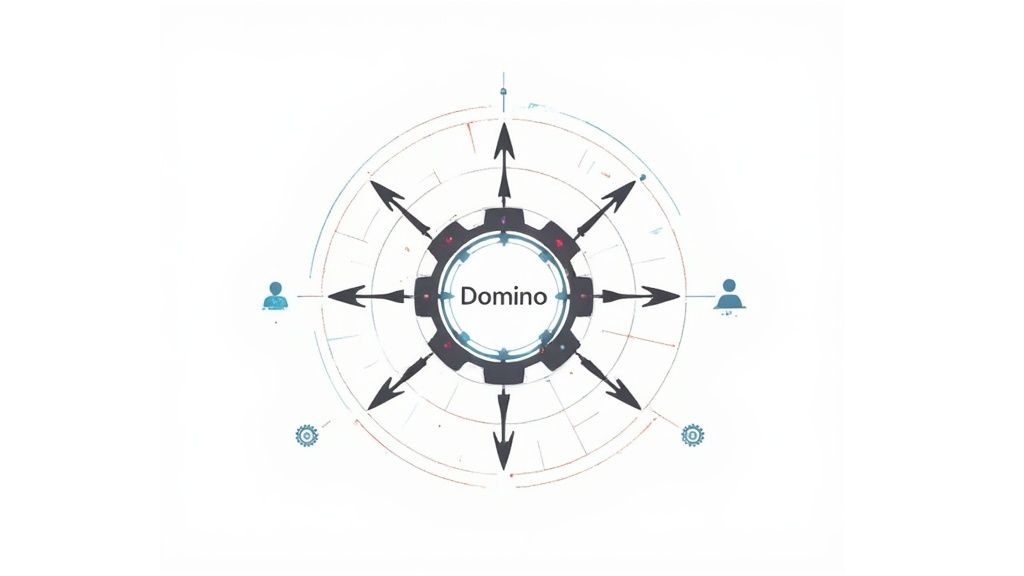
This interconnected setup ensures every single user action adds fuel to the fire, making your growth strategy cohesive and, most importantly, scalable.
Before we dive deeper, let's summarize the foundational components we'll be building on throughout this guide.
Key Pillars of a Web3 Growth Engine
Understand the essential components that drive a successful Web3 growth engine, which we'll explore throughout this guide.
| Pillar | Description | Why It Matters in Web3 |
|---|---|---|
| Community Flywheel | A self-sustaining cycle where engaged users attract new users, creating organic, compounding growth. | It turns passive consumers into active advocates, which is more authentic and cost-effective than ads. |
| Incentive Design | Crafting rewards (XP, NFTs, roles) that motivate valuable contributions beyond simple social tasks. | Aligns user actions with project goals, rewarding real value creation and fostering long-term loyalty. |
| Quest & Task System | A structured set of on-chain and off-chain activities that guide users to engage deeply with the project. | Provides a clear path for community members to contribute, learn, and feel invested in the project's success. |
| Automation & Scale | Using tools for automated verification and reward distribution to manage growth without friction. | Allows you to engage thousands of users simultaneously, making community management efficient and scalable. |
These pillars are the blueprint. Get them right, and you're well on your way to building a growth machine that lasts.
Why This is Non-Negotiable Right Now
This idea of a systematic growth engine isn't new, and it's been battle-tested outside of Web3. Just look at the B2B world. Eric Nowoslawski's team scaled their "Growth Engine X" to send an insane 1.5 million cold emails a month. One of their clients booked 200 meetings in a single quarter, which translated into over $2 million in pipeline. They treated growth like an engineering problem, not a series of marketing whims.
In Web3, your community isn't just your audience; they are your co-builders, your marketers, and your biggest asset. A Growth Engine X recognizes this by turning passive users into active participants.
This mindset shift is critical. User attention is scattered, and trust is everything. When you build a system that rewards genuine contribution, you create a loyal, deeply invested community that has skin in the game.
Making this fun is crucial. Using community gamification makes participation feel less like work and more like play, which is where a platform like Domino really shines. It's the difference between renting an audience for a season and building a dedicated ecosystem that will stick with you for the long haul.
Charting Your Course: Mapping the Growth Funnel and Setting KPIs
Alright, let's get real. A powerful growth engine isn't built on wishful thinking. It starts with a clear map. Too many projects get obsessed with vanity metrics—how many Discord members or Twitter followers they have. Those numbers might look good in a pitch deck, but they don't tell you if your ecosystem is actually healthy.
True, sustainable growth comes from deeply understanding and fine-tuning the entire user journey, from the moment someone first hears about you to when they become a die-hard advocate. This is where your funnel comes in. It's the absolute bedrock of your entire growth strategy.
Forget the old-school, top-down marketing funnel. In Web3, the user journey is way more dynamic—it’s less of a straight line and more of a flywheel. A user might discover you on Twitter, jump into a quest, become a vocal supporter, and then pull their friends into the same cycle. Your funnel is the blueprint for that entire experience.
From Lurker to Legend: The Web3 Journey
First things first, you need to visualize the path someone takes to become a core part of your community. We're not just moving leads through a pipeline; we're guiding people from being passive observers to active participants who genuinely feel like they have skin in the game.
Here’s a practical way to break it down for a Web3 project:
- Discovery: How are people stumbling upon your project in the first place? Maybe it's a partner's announcement, a killer tweet that goes viral, a deep-dive blog post, or just an existing community member spreading the word. Pinpoint these channels.
- Activation: This is the magic moment—the first meaningful action a user takes. It’s not just about them clicking "Join" on your Discord. It's about them connecting their wallet, completing that very first easy quest in Domino, or minting a free "welcome" NFT. It’s their first real step in.
- Contribution: Now we're talking. This is where users start creating real value. They might be creating awesome user-generated content, stress-testing a new feature and giving you detailed feedback, or even participating in a governance vote. They've gone from taking to giving.
- Retention: The challenge now is keeping these awesome contributors around. This is all about ongoing quests, rewards that get better over time, and fostering a real sense of purpose that makes them want to stick with you for the long haul.
- Advocacy: This is the holy grail. Your most dedicated contributors become your most powerful marketers. They're the ones voluntarily hyping your project, creating tutorials for newcomers, and onboarding their own circles into your world.
You're not just building a product; you're engineering an experience. Your funnel is a map designed to guide people toward becoming true believers in what you're building, one small, rewarding step at a time.
Mapping this journey out immediately shows you where the leaks are. Seeing a ton of people join your Discord but almost none of them complete that first quest? Boom. You've just identified a massive friction point in your Activation stage that you need to fix, fast.
Choosing KPIs That Actually Move the Needle
Once you’ve got your funnel stages sketched out, it’s time to attach real, measurable Key Performance Indicators (KPIs) to each one. This is how you stop guessing and start making data-backed decisions. Forget the generic stuff; you need KPIs that reflect genuine engagement and value creation.
Let's look at some sharp, actionable KPIs you can track for each stage.
Activation KPIs
These numbers tell you how good you are at turning curious onlookers into actual participants.
- Wallet Connection Rate: Out of all the people who land on your quest page, what percentage actually connect their wallet? This is your front door.
- Time to First Quest Completion: How many minutes or hours does it take a new member to finish their first task? A short time here means your onboarding is slick and intuitive.
- First Quest Completion Rate: What percentage of new members complete at least one quest within their first 7 days? This is a huge indicator of future engagement.
Contribution & Retention KPIs
These metrics give you a pulse on the health and vibrancy of your core community.
- Weekly Active Contributors: Forget "total members." How many unique users are completing at least one meaningful quest per week? This is your true user count.
- Average Quests Completed Per User: Are people doing one thing and bouncing, or are they digging in and completing multiple quests? This shows you the depth of their engagement.
- Contributor Churn Rate: What percentage of your active contributors from last month didn't complete any quests this month? Keeping this number low is critical for long-term success.
By zeroing in on these kinds of specific data points, you can use a platform like Domino for more than just running quests. You can build a sophisticated measurement machine from day one. This disciplined, data-driven approach is what separates a flash-in-the-pan hype cycle from a growth engine that stands the test of time.
Crafting Engaging Quests And Workflows In Domino
Alright, you've got your funnel mapped out and your KPIs dialed in. Now for the fun part: actually building the engine inside Domino. This is where we stop talking strategy and start creating the quests and workflows that will bring your whole growth machine to life.
A great quest is more than just a task. It’s a tiny, rewarding experience that pulls a user deeper into your world.
Let's be real: the old "like and retweet" quests are dead. They create a quick sugar rush of vanity metrics but offer zero lasting value. A truly effective quest is a win-win. It delivers something genuinely useful for your project while making your community member feel like they’ve actually accomplished something meaningful.
Moving Beyond Basic Tasks
The best quests I've seen ask for a little more effort, a bit of creativity, or some real skill. In return, they generate way more value for everyone involved. Think about quests that create lasting content, provide you with crucial feedback, or help you grow in a way that feels organic.
Here are a few ideas for higher-impact quests you can spin up in Domino right now:
- The High-Value Meme: Challenge your community to create a meme that nails your project's vibe or a key feature. This generates authentic, user-generated content that almost always outperforms sterile, corporate-looking assets.
- The Technical Explainer: Got some brainiacs in your community? Ask them to write a blog post or a detailed X thread breaking down a complex part of your protocol. It's a fantastic way to educate new users and spot potential tech ambassadors.
- The dApp Test Pilot: Get real-world feedback by creating a quest that walks users through a new feature. Have them hunt for bugs or suggest improvements. This is infinitely more valuable than any internal QA session you could run.
- The "Follow on X" Quest: A simple, foundational quest. Getting users to connect their X account and follow you is the first step for so many other community actions. We've got a simple walkthrough on how to create a "Follow on X" quest that shows you the exact setup.
To get a feel for how you might structure these, here’s a quick look at some sample templates.
Sample Quest Templates for Your Growth Engine
This table breaks down a few different quest types you can build, their main goal, and the kind of user they're perfect for.
| Quest Type | Primary Goal | Target Platform | Example Action |
|---|---|---|---|
| Social Engagement | Increase Reach & Awareness | X (Twitter) | Share a personal story about how you discovered the project. |
| Content Creation (Meme) | Generate UGC & Virality | Discord / X | Create and post a meme about our latest partnership. |
| Educational (Quiz) | User Onboarding & Knowledge | Your dApp / Blog | Read our litepaper and answer five key questions. |
| On-Chain Action | Drive Protocol Usage | Testnet / Mainnet | Mint your first "Community Member" NFT for free. |
| Product Feedback | Improve UX & Find Bugs | Staging App | Test the new swap feature and report any issues. |
Think of these as starting points. The real magic happens when you tailor them specifically to your project's needs and your community's unique culture.
Designing Smart Workflows
Individual quests are great, but their true power is unlocked when you chain them together into smart workflows. A workflow is just a sequence of quests designed to guide someone smoothly through your funnel, building their investment and knowledge along the way.
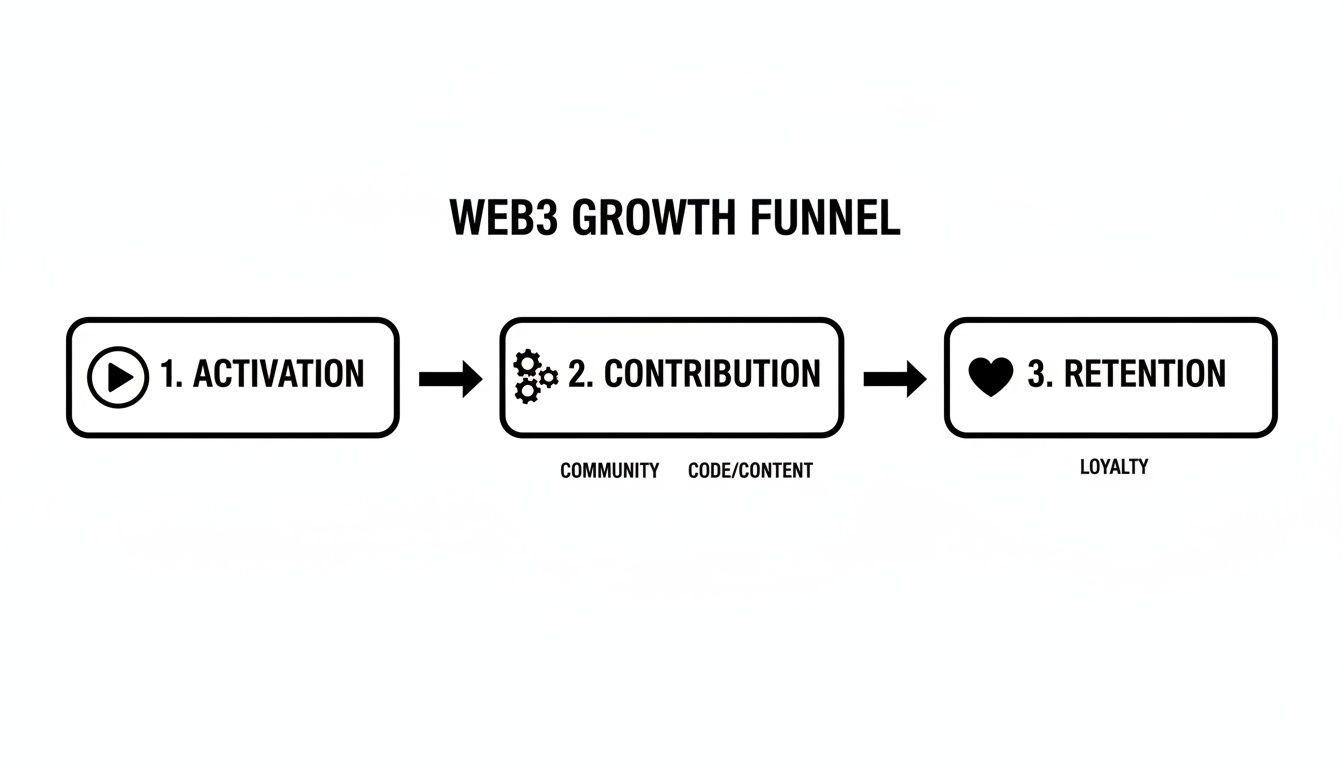
Think of it like the tutorial level of a video game. You don't throw the final boss at a player right away. Your growth engine should work the same.
A well-designed workflow doesn't just ask users to do things; it educates them, builds their confidence, and gradually increases their commitment to your project. It’s an onboarding experience disguised as a series of fun challenges.
For example, a solid "Activation" workflow could look like this:
- Quest 1 (Low Effort): Join our Discord and get a special "Newcomer" role.
- Quest 2 (Slightly More Effort): Read our litepaper and answer a simple quiz to earn 100 XP.
- Quest 3 (First On-Chain Action): Mint your free "Community Starter" NFT on our testnet.
See how each step flows logically to the next? You're reducing friction and building momentum. That user now feels a sense of progression, making them way more likely to stick around for the more advanced quests you have planned.
To get these workflows mapped out and keep everything from turning into a chaotic mess, leaning on dedicated platforms is a huge help. For a deeper dive into how these tools work, it's worth checking out the world of creative workflow management software.
The Role Of AI in Quest Design and Verification
In the old days, crafting and verifying these kinds of quests at scale was a soul-crushing operational nightmare. This is where tools like Domino completely change the game. AI isn't just a gimmick here; it’s what makes a modern growth engine actually scalable.
You can now use AI to automatically verify subjective submissions—things like memes, blog posts, or X threads. This alone frees up thousands of hours your team would have spent on manual reviews.
It means you can run more creative, ambitious quests without drowning your community managers in admin work. Your growth engine can finally run on autopilot.
Weaving Your Tech Stack Together & Supercharging Verification with AI
A growth engine with disconnected parts is like a race car with mismatched tires—it’s clunky, inefficient, and will never reach its top speed. Siloed platforms create a choppy experience for your community and make it impossible to see what's actually driving growth. For Growth Engine X to really fly, you need to build a single, seamless system where your tools are all talking to each other.
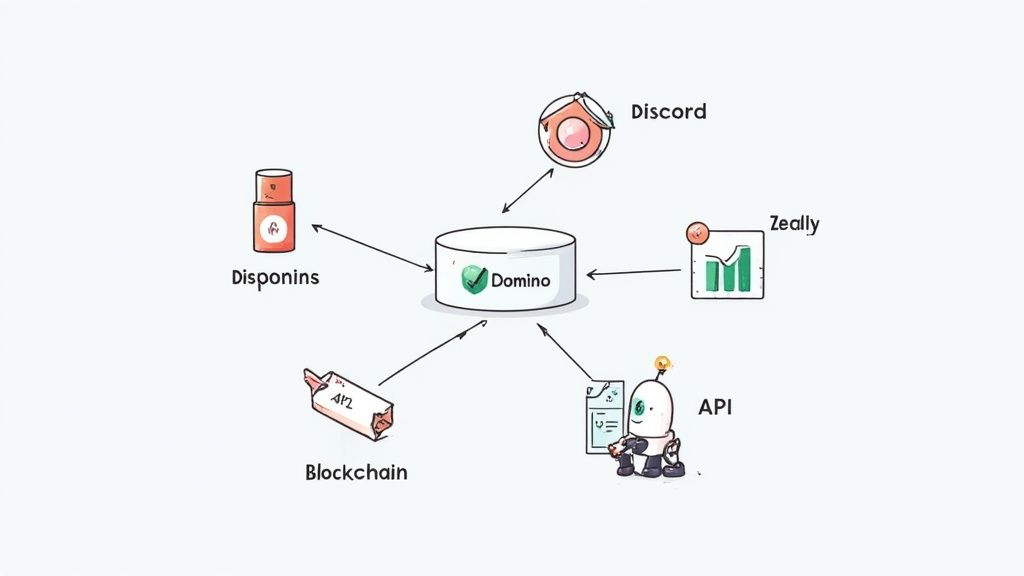
Think of your Domino workspace as the central nervous system. It shouldn't be off on its own island. Instead, it plugs directly into the places where your community already hangs out, creating an experience so smooth that users don't even realize they're interacting with different tech.
Connecting Your Community's Core Hangouts
Let's get practical. For most Web3 projects, there are a few absolute must-haves. Your growth engine needs to feel like a natural part of these platforms.
- Discord Integration: This is home base. When you connect Domino to your Discord server, the magic starts. You can automatically grant roles when someone finishes a quest. A user completes your "Activation" flow? Bam. They instantly get the "Contributor" role, unlocking new channels and making them feel like a true insider.
- Zealy Integration: A ton of communities use Zealy for their gamified quests and leaderboards. By plugging Domino in, you can add some serious horsepower. Suddenly, you can build complex, on-chain verification logic that Zealy on its own just can't handle.
- Custom API Connections: Here’s where you can get really creative. Domino's API capabilities mean you can connect to basically anything—your project’s dApp, a CRM, you name it. You could trigger a quest the moment a user makes their first swap on your protocol.
These connections turn your growth engine from a static to-do list into a living system that reacts and adapts to what your users are doing across your entire ecosystem.
The AI Verification Game Changer
Okay, let's talk about the single biggest bottleneck that kills growth programs: manual verification.
If you're asking users to do anything creative—write a thread, make a video, design a meme—someone on your team is stuck personally reviewing every single submission. It's a soul-crushing nightmare. It's slow, boring, and completely breaks down the second you get any real traction.
This is where AI verification in Domino becomes your secret weapon. You can build workflows that use models like GPT-4 to automatically review user-generated content against your specific rules. We're not just talking about checking for a keyword; this is about judging quality, relevance, and even tone.
You're essentially hiring an AI assistant for your community manager that can review thousands of submissions in minutes, not weeks. This is how you unlock true scale.
Imagine a quest asking users to write a thoughtful X (formerly Twitter) thread about your new feature. Instead of your team spending days clicking links, a Domino workflow can do this automatically:
- Confirm the user actually posted a thread.
- Check that the thread mentions your project and the new feature.
- Analyze the content to make sure it's positive and well-written.
- Instantly approve the submission and award the XP.
This frees up your team to do what they do best—building relationships and planning the next big move. To see this in action, check out this Domino template that shows you exactly how to review a Zealy quest and check a user's tweet with GPT-4.
How to Craft the Perfect AI Prompts
The whole system hinges on how well you write your instructions, or "prompts," for the AI. If you're vague, you'll get garbage results. You have to be incredibly clear.
Think of it like giving instructions to an intern who takes everything you say literally.
- Be Hyper-Specific: Don't just ask, "Is the article good?" Instead, write, "Verify the article is over 500 words, mentions the phrase 'zero-knowledge proof' at least twice, and has a positive or neutral tone."
- Give It Context: Tell the AI what role it's playing. For a meme quest, you could start with, "You are a Web3 community manager judging a meme contest. The meme must be funny and directly reference our recent mainnet launch."
- Define the Output: Be explicit about what you want back. A simple and effective method is to tell it to return "PASS" if the submission is good and "FAIL" if it's not. This creates a clean, binary signal for your Domino workflow to act on.
By nailing these integrations and leaning on AI for the heavy lifting, you eliminate the friction that causes most growth programs to stall. Your Growth Engine X can finally run on autopilot, scaling to the moon without burning out your team.
How To Measure Performance And Optimize Your Engine
So, you’ve launched your growth engine. Pop the champagne? Not just yet. Getting it live is the starting line, not the finish. The real magic—the stuff that turns a trickle of users into a flood—happens in the trenches of continuous analysis and improvement.
Think of it less like launching a product and more like planting a garden. You can't just throw seeds on the ground and walk away. You have to water it, pull weeds, and see what's actually growing. The good news? You don't need a crystal ball to figure it out; you just need to know where to look.
Your Dashboard Is Your Command Center
Your Domino analytics dashboard is your new best friend. It’s where all the chaotic user activity gets crunched into clear, actionable insights. Make it a habit to check in regularly—daily, if you can—to keep a pulse on the Key Performance Indicators (KPIs) you set up earlier. But don't just stare at the big numbers. The real stories are hidden in the trends.
Start playing detective and ask some pointed questions:
- Which quests are people actually finishing? This tells you what your community finds genuinely fun and easy to do. It’s your low-hanging fruit.
- Where are people getting stuck? If a quest has a ton of starters but almost no one finishes, you've found a bottleneck. Is it too hard? Are the instructions confusing? Is there a technical bug?
- Which channels are bringing in the A-players? Are the folks from your X (formerly Twitter) promos sticking around longer than the ones who clicked a link in a partner's Discord? Find out, then pour more fuel on that fire.
Spotting these patterns is where you get your first "aha!" moments. For example, you might notice that 80% of the users who complete your "dApp Test Pilot" quest go on to finish five more. Boom. You've just found a golden onboarding path. Your next move is obvious: find every way possible to steer new users toward that specific quest.
The Art of Data-Driven Optimization
Once you've spotted a trend or a problem, it's time to start tinkering. Optimization isn't about blowing everything up and starting over. It's about making small, educated guesses and seeing what happens. This is where A/B testing comes into play.
And no, you don't need a fancy, expensive tool to do it. You can run simple tests yourself.
- Form a Hypothesis: Start with a smart guess. For instance: "I bet if we change the 'Meme Creation' quest reward from 100 XP to a unique NFT, we'll see submissions jump by 50%."
- Run a Time-Based Test: For one week, run the quest with the original XP reward and track the submission rate. The next week, change only the reward to the NFT and run it again.
- Analyze the Results: Compare the numbers from both weeks. Did your change work? Was it a huge win, a tiny nudge in the right direction, or did it totally flop?
Optimization is a game of inches. A 5% boost here and a 10% improvement there might not feel world-changing on their own. But when you stack them up over time, they create unstoppable momentum.
You can apply this same "tweak and measure" approach to almost anything: the way you write your quest descriptions, the images you use in your promos, the difficulty of your tasks, even the time of day you post announcements. Every single test, pass or fail, gives you a valuable piece of data that makes your entire system smarter.
The payoff for this kind of disciplined approach can be massive. Look at what happened when one mid-sized company partnered with Growth Engine global to rebuild their digital presence using a similar data-driven framework. They saw 48.96% year-over-year sales growth, their monthly leads doubled to 1,200, and they slashed their customer acquisition costs by 35%. The end result? $5.2 million in new revenue. You can even read the full story on their website. It's a perfect example of what happens when you stop guessing and start measuring.
Got Questions About Your Growth Engine? We've Got Answers.
Building a full-on growth engine is exciting, but let's be real—it can bring up a ton of questions. Getting the strategy right often comes down to nailing the small details. We’ve been in the trenches with countless teams, and we see the same challenges pop up time and again.
So, we put together this quick-hit guide to address the most common roadblocks. This isn't just about the tech; it's about the strategic hurdles that can really slow you down.
How Much Should We Actually Reward Our Community?
This is the million-dollar question, and the honest answer is: it really depends. There's no magic number for XP or a universal token drop that works for every project. The trick is to think in tiers, basing rewards on how much effort a quest takes and how much value it brings back to your ecosystem.
- The Easy Stuff: Simple actions like an X follow or joining a Telegram group? Keep the reward small. Think of it as a friendly handshake to get people started. 10-25 XP is usually plenty.
- A Little More Effort: This is for quests that require some real engagement, like creating a fun meme, participating in a poll, or giving thoughtful feedback. The reward should feel worth the few minutes they put in, maybe somewhere in the 50-150 XP range.
- The Heavy Lifts: When you're asking for something that requires serious skill or time—like writing a deep-dive blog post, creating a video tutorial, or finding a critical bug—the reward needs to match. This is where you can break out bigger XP drops, exclusive NFTs, or even token rewards.
A Quick Word of Advice: The reward must align with the value of the contribution. If you ask for a masterpiece, don't offer pocket change. An unbalanced reward system is the fastest way to kill community motivation and grind your growth engine to a halt.
My Quests Are Live, But Nobody's Biting. What's Wrong?
It’s a gut punch to see a new questline fall flat. But don’t tear up your whole strategy just yet. More often than not, the fix is simpler than you think. Run through this quick diagnostic before you do anything drastic.
First off, did you actually tell anyone? A single, lonely post in a chaotic Discord channel just won't cut it. You need to announce it properly—post it on X, pin the announcement in your main channels, and give it a shout-out during your next community call.
Next, take a hard look at the quest itself. Is it too difficult right out of the gate? If your very first "welcome" quest demands users bridge assets and perform some complex on-chain transaction, you’ve already lost most of them. The first few quests should be incredibly easy to complete. It's all about building that initial momentum.
Finally, are your instructions crystal clear? Vague language is a quest-killer. The best test is to grab a new team member or someone totally unfamiliar with the project and watch them try to complete it. If they get stuck, you know your instructions need a rewrite.
How Do We Stop the Spam and Low-Quality Junk?
This is a massive concern, especially once you start to get some traction. Manually sifting through thousands of spammy submissions is a soul-crushing task that will burn out your team fast. This is exactly why automation isn't a "nice-to-have"—it's a must.
Your first line of defense is just designing smarter quests. Ditch the overly simple "post anything with our hashtag" tasks. Instead, ask for specific actions that are much harder to fake, like having them answer a question based on your latest blog post.
Your second, and far more powerful, line of defense is AI-powered verification. By setting up automated workflows in Domino, you can let AI be your tireless gatekeeper. For example, you can configure it to automatically check if a submitted X post contains the right link, has a positive tone, and comes from an account with a reasonable number of followers. For more involved content, AI can even analyze submissions for quality, relevance, and originality. For teams looking to build a deeper playbook, consulting with experts on AI Strategy services can provide a comprehensive framework.
This automated approach doesn't just block spam. It ensures your rewards are going to people who are genuinely adding value, which protects the integrity of your entire program. It’s really the only way to keep quality high without killing your ability to scale.
Ready to build a scalable, automated growth machine without all the guesswork? Domino gives you the no-code tools and AI-powered verification to launch and manage your Web3 quests in minutes. Start building your Growth Engine X today.