A Guide to Telegram Token Gating

Have you ever scrolled through a Web3 project’s Telegram and wondered how they keep the conversation so focused and valuable? It’s not magic, and it’s definitely not a team of mods working around the clock. The secret weapon is Telegram token gating.
Think of it as a smart, automated bouncer for your digital community. It only lets people in who can prove they hold your project's token or NFT.
Why Token Gating Your Telegram Is a Game Changer
At its heart, token gating takes a potentially chaotic, open-to-everyone group and turns it into a secure, exclusive space for your actual stakeholders. By tying membership directly to on-chain ownership, you’re creating an incredibly effective filter. This immediately cuts out the noise from scammers and spammers, which instantly raises the quality of the discussion.
It's not just a security upgrade; it's a completely different approach to community building. It aligns everyone’s incentives and helps foster real connections among people who are literally invested in your project.
For new members, the experience is smooth. A bot asks them to connect their crypto wallet and sign a simple, gas-free message—this just proves they own the wallet, nothing more. The bot then peeks at the blockchain to see if they hold the required token or NFT. If they pass the check, they're granted access. If they later sell, the bot politely shows them the door.
Cultivating a High-Signal Environment
This whole process is automated, which is a massive relief for community managers. Instead of spending their days manually verifying members or kicking out bots, they can focus on what they do best: engaging with and growing the community.
What you get is a room full of people who have skin in the game. This creates a powerful dynamic with some clear wins:
- Tighter Security: The constant threat of scams, phishing links, and coordinated FUD that poisons so many open crypto groups? It pretty much disappears.
- Better Engagement: When members are actual holders, they're far more likely to contribute to meaningful conversations, ask smart questions, and offer constructive feedback.
- Real Exclusivity: You create a powerful reason to hold your token. Access to alpha, private AMAs with the team, or early announcements become perks for the truly committed.
Token gating is about making sure your most important conversations happen with your most important people—your holders. It transforms a public free-for-all into a focused, private roundtable.
To really see the impact, let's break down the core advantages.
Key Benefits of Token Gating Your Telegram Group
Here’s a quick look at how implementing token gating can directly benefit your community and project.
| Benefit | Impact on Community |
|---|---|
| Spam & Scam Reduction | Dramatically cleans up the channel by preventing bots and bad actors from joining. |
| Higher Quality Discourse | Conversations are more relevant and constructive since all members are invested. |
| Increased Token Utility | Adds a tangible, non-financial benefit to holding your project's token or NFT. |
| Reduced Moderator Burden | Frees up community managers from manual vetting to focus on engagement. |
| Fosters Exclusivity | Creates a premium, members-only feel that enhances the value of your community. |
Ultimately, these benefits work together to create a stronger, more resilient community that adds real value back to the project.
The Impact on Community Dynamics
Token gating isn't just a neat feature anymore; it's become a core piece of infrastructure for successful Web3 projects. Just look at platforms like Collab.Land—they’ve become the standard, helping over 40,000 communities connect with more than 3.5 million wallets.
Huge names like NBA TopShot and World of Women rely on this exact technology to manage their exclusive communities, proving it works at a massive scale. To really get why this matters, it helps in understanding social media engagement and what makes a community thrive. By making sure every single member is a verified stakeholder, you’re building a foundation for authentic interaction that can drive your project forward for the long haul.
Understanding Your Token Gating Architecture
Before you start messing with settings, it’s really helpful to get a picture of what’s happening under the hood. A good Telegram token gating setup isn't a single app—it’s a few different parts working together to keep your community exclusive. I like to think of it as a digital nightclub with a bouncer who has a very, very specific guest list.
First up, you have the gatekeeper: a purpose-built Telegram bot. This bot is your bouncer, the first point of contact for anyone trying to get in. It’s programmed to greet new people and kick off the whole verification process.
When someone tries to join, the bot asks them to connect their crypto wallet. This is their digital ID card. It's important to know this step doesn't cost them anything—no gas fees, no transactions. They just sign a message, which is basically a secure, cryptographic way of proving, "Yep, this wallet is mine," without ever giving the bot control over their funds.
That signature gets passed to the third piece of the puzzle: the verification service. This is the real brain of the operation. It checks the signed message to confirm the user's wallet address, then peeks at the public blockchain to see if they're holding the right token or NFT. If everything checks out, the service gives the bot the green light, and the user is welcomed into the group.
This simple diagram shows the flow perfectly—it’s all about filtering out the noise and letting only true holders into the private space you've created.

The goal is a smooth, hands-off process that turns a potentially chaotic public channel into a focused, high-value community.
Ready-Made vs. Custom Solutions
Okay, so you get the concept. Now you have a choice to make: use a tool that's already built or go rogue and build your own. Let's be real—for 99% of projects, a ready-made solution is the smartest move.
Ready-Made Services: Think tools like Collab.Land or Guild.xyz. These guys bundle the bot, the verification service, and the user flow into a clean package. They’ve been around the block, support tons of different blockchains, and you can get one running in minutes. The only downside is you have less control over the branding, and there might be a small fee.
Custom-Built Solutions: Going the custom route gives you ultimate control over the experience and security. But—and it's a big but—it takes serious developer time, constant maintenance, and you'd better be ready for security audits to make sure you haven't left a back door open. Honestly, this is overkill unless you're a massive project with a dedicated dev team and very unique needs.
For the vast majority of community managers, the peace of mind you get from a trusted, battle-tested tool is worth its weight in gold. It lets you focus on building your community, not debugging code.
This kind of architecture can get even more interesting when you start plugging it into other tools you’re already using. For example, you could create a workflow that checks if a user has finished a quest on Zealy and holds a certain ERC-20 token before they get a special role. It's a great way to build more complex and engaging reward systems.
If that sounds interesting, you can see exactly how to review Zealy quests and token holdings using automated workflows.
Choosing the Right Token Gating Tools
The good news is you don’t need to be a developer to get a solid Telegram token gating system running. The market is full of powerful, easy-to-use tools that bring this to life for any Web3 project, no matter the size. Let's walk through the best options out there so you can pick the right one for your community.
We'll look at the big players, see what they do best, and explore how modern no-code platforms are changing the game completely.
Comparing Popular Platforms
You’re going to run into two names over and over again: Collab.Land and Guild.xyz. Both are great, but they serve slightly different purposes.
Think of Collab.Land as the reliable, straightforward workhorse. It’s popular for a reason—it’s been battle-tested by over 40,000 communities and supports a ton of blockchains. The setup is simple: it verifies if someone owns a token or NFT and grants them a single role. Done.
Guild.xyz, on the other hand, is built for more complex, multi-layered role management. It's your go-to if you want to create a tiered community. For instance, you could set up a basic "Holder" role for anyone with one NFT, a "Diamond Hands" role for those holding five or more, and maybe a "Whale" role with access to secret channels for wallets holding both a specific token and a POAP from a past event. Guild is a beast at handling these "if-this-and-that" types of rules.
For simple, one-time verification, Collab.Land is fantastic. But if you're building intricate, evolving role structures, Guild.xyz gives you that granular control.
The Rise of No-Code Integration
While standalone tools are great, a new wave of no-code platforms is making Telegram token gating even more powerful. Instead of just guarding the door, they integrate gating into your bigger marketing and community workflows. This is where a tool like Domino shines.
This screenshot from Domino shows just how easy it is to build powerful automations, turning what sounds like complex logic into simple, visual steps.
What you're looking at is a way to build automated systems that do so much more than just access control. You can connect on-chain data directly to your community engagement strategy.
Let's imagine a real-world scenario. You want to run a special campaign for your OG holders. With an integrated tool, you can build a workflow that:
- Verifies a user holds an NFT from your V1 collection.
- Grants them access to a private Telegram channel.
- Automatically DMs them a link to a special quest inside that channel.
- Tracks when they complete the quest.
- Airdrops a reward directly to their wallet once they're done.
You can set this entire sequence up in minutes without touching a single line of code. This flips Telegram token gating from a simple security fence into a dynamic engine for community engagement. It’s the same thinking behind the best Web3 quest platforms, which are all about driving action and rewarding loyalty.
This integrated approach saves a ton of time, gets rid of manual busywork, and lets you create much richer experiences for your community.
Getting Your Telegram Bot Up and Running
Alright, this is where the rubber meets the road. We've talked about the "why," so now let's get into the "how." Setting up your Telegram bot is the most hands-on part of this whole process, but honestly, it’s a lot easier than you might think. We'll start by creating the bot inside Telegram and then hook it up to a service that can actually check for tokens.
Meet the BotFather
First things first, you need to create your bot. Telegram has a slick system for this using a master bot they call BotFather. You literally just have to have a conversation with it.
Find BotFather using the search bar in Telegram, start a chat, and send the command /newbot. It’ll then ask you two questions:
- What’s its name? This is the display name people will see, like "Super Cool Project Access."
- What’s its username? This needs to be unique and must end with "bot," for example, "SuperCoolProjectBot."
After you answer, BotFather will give you the keys to the kingdom: an HTTP API token. This string of characters is super important and totally secret. It's how your token-gating tool will talk to and control your bot. Copy it somewhere safe.

Connecting the Bot and Setting the Rules
Got your token? Great. Now it's time to give your bot its brain. This involves connecting it to a token-gating service. We'll use a no-code platform like Domino for this walkthrough since it turns a complex task into a few simple clicks, but the general idea is the same no matter what tool you use.
You’ll head to the platform’s dashboard, look for an option to add a Telegram gate, and paste in that API token you just got from BotFather. That’s the handshake that links your bot to the verification service.
Next, you need to tell the bot which channel or group to protect. You’ll add your bot to your private group and give it admin rights. Specifically, it needs permission to ban users and invite users via link. This is critical for it to automatically manage who's in and who's out.
Don't sweat giving it these permissions. The bot only uses them to kick people who no longer hold the required token and to generate the unique verification link for new members. It’s a standard, secure part of the process.
Now for the fun part: defining who gets past the velvet rope. This is where you set the rules for entry. You'll need to specify a few things:
- The Blockchain: Pick the network where your token or NFT lives (e.g., Ethereum, Solana, Polygon).
- The Contract Address: Drop in the unique address for your token or NFT collection.
- The Requirement: Set the condition for access. Are you looking for people holding at least 1 NFT? Or maybe they need to have a minimum of 500 project tokens? You decide.
Finalizing and Going Live
Once you save those rules, your telegram token gating system is officially live. From this moment on, anyone who tries to join your group will be greeted by your bot. It will send them a welcome message with a button that kicks off the wallet verification process.
This kind of setup is becoming incredibly relevant as the Telegram ecosystem just keeps on growing. Take its native blockchain, TON, for example. The Toncoin network is seeing a massive surge, hitting 3.8 million weekly active transactions with over 162 million total accounts. The on-chain audience is exploding, and token-gating is the perfect way to engage them directly within the app they already use every day.
And this is just the beginning. If you want to get more advanced, you can build entire automated workflows. For some ideas on what’s possible, check out our guide on how to use Domino for Telegram integrations to create things like automated airdrops or on-chain quests.
Common Mistakes to Avoid
Alright, let's talk about the things that can go wrong. Setting up a Telegram token gate is pretty straightforward, but a few common slip-ups can turn your exciting launch into a support nightmare for you and a frustrating mess for your community.
The good news? You can learn from the mistakes others (and let's be honest, probably me at some point) have made. Think of this as your pre-flight checklist.
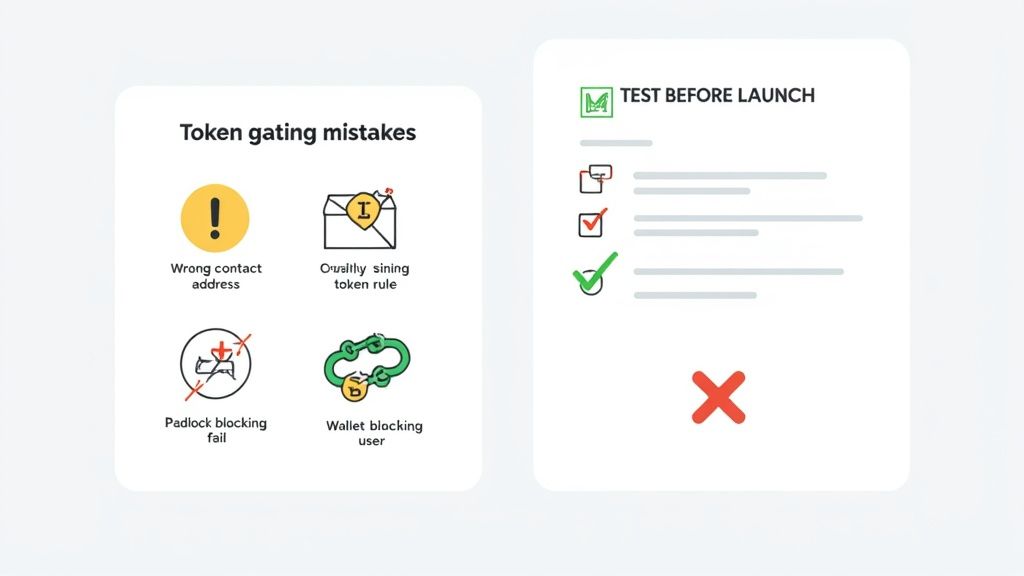
One of the most painful—and surprisingly common—errors is simply pasting in the wrong contract address. It happens more than you'd think, especially if you're grabbing it from a third-party site in a hurry. Always copy the address directly from the source of truth, like Etherscan or your project’s official docs. Double-check it. Then check it again.
Another classic blunder is getting the token requirements wrong. If you set the threshold for an ERC-20 token too high, you might lock out loyal community members who just aren't whales. On the flip side, setting it too low can water down the exclusivity you were trying to create in the first place.
Neglecting the User Experience
Look, the technical setup is just one piece of the puzzle. The user’s journey from "I want to join" to "I'm in!" is just as critical. A clunky or confusing verification process will turn people off before they even see a single message. Your goal is to make joining feel smooth, fast, and secure.
Here’s where people usually drop the ball:
- Unclear Instructions: That first message your bot sends is everything. It needs to tell the user exactly what to do (e.g., connect wallet, sign message) and why they're doing it. No jargon, just simple steps.
- No Fallback Support: What if the wallet connection times out or fails? Don't leave them hanging. Give them a clear way to get help, whether it's a link to a support channel or a simple troubleshooting guide.
- Slow Verification Times: On-chain data can sometimes be slow to fetch, especially during peak times. A simple message like, "Just a moment, we're checking your on-chain status!" can prevent a lot of frustration and duplicate attempts.
A critical aspect of token gating is maintaining strong security; therefore, reviewing best practices for creating a secure website is essential to avoid common vulnerabilities that could compromise your community’s trust and safety.
The Peril of Skipping Tests
This is the big one. The single biggest mistake you can make is launching without testing everything from top to bottom. This part is absolutely non-negotiable.
Before you even think about tweeting that announcement link, you need to create a private staging group. Invite a few teammates and have them run through the entire process as if they were a new user. Have them try different wallets and different scenarios.
Seriously, try to break it. See what happens when someone connects a wallet with zero tokens. Or a wallet that's on the wrong network. Does the bot give them a clear error message? Can they easily try again? These little details are what separate a professional, confidence-inspiring launch from a chaotic one. A well-tested Telegram token gating system shows your community you respect their time and effort.
Got Questions? We’ve Got Answers.
When you're setting up Telegram token gating for the first time, a few questions always pop up. Let's break down the most common ones we hear from founders and community managers just like you.
What Happens If Someone Sells Their Token After They're Already In?
This is probably the most common question, and a good gating system has it covered. Think of the bot not just as a bouncer at the front door, but as security that patrols the club.
Modern token gating bots don't just check a wallet once. They’re constantly running automated, periodic checks on everyone inside the group. If the bot scans a member’s wallet and sees they no longer hold the required token or NFT, it will automatically and gracefully kick them out. You can usually configure how often these checks happen, which keeps the community exclusive and protects its value.
Can I Set Up Different Tiers or Roles for Different Holders?
You bet. This is where token gating goes from just being a barrier to entry to a seriously powerful community-building tool. A simple in-or-out system is fine, but creating a tiered structure is where the magic happens.
Imagine setting it up like this:
- Holder Role: Anyone holding at least 1 NFT gets basic access.
- Whale Role: Holding 10 or more NFTs? You unlock access to private, high-signal channels.
- OG Role: Got a token from a legacy collection? The bot can assign a special flair or permissions, recognizing your long-term support.
This is a brilliant way to segment your community and reward your biggest supporters based on their on-chain activity. It makes people feel seen and valued.
The real power of token gating isn't just about keeping people out; it's about creating meaningful, tiered experiences for the people who are in. It's how you recognize and reward your community members on-chain.
Is It Safe for My Members to Connect Their Wallets?
Security is everything, and thankfully, the process is built to be safe. When a user connects their wallet to a trusted gating bot, they are only asked to sign a message. They are not asked to approve a transaction.
This is a huge difference. A signature is a "gasless" action. It’s like showing your ID to prove you are who you say you are—it doesn't hand over your keys or give anyone permission to touch your funds. It’s a read-only check to verify ownership, plain and simple.
Of course, this all hinges on using well-vetted, reputable Telegram token gating tools. Always do your homework to keep your community safe.
Ready to build a stronger, more engaged Web3 community? With Domino, you can launch powerful, automated token gates and reward campaigns in minutes, not months. Stop managing members manually and start building loyalty with our no-code toolkit. Start building for free on Domino.