Telegram Community Rewards: Grow Your Web3 Community Fast
So, you're thinking about running a rewards program for your community. Smart move. These programs are all about turning those lurkers in your group into active, die-hard fans by giving them cool stuff for completing simple tasks. And when it comes to Web3, there's really only one place to do it right: Telegram.
Why Telegram Is the Perfect Playground for Community Rewards
Let's be real—Telegram isn't just a messaging app anymore. For any project in the Web3 space, it's the de facto town square. It’s where your most dedicated users hang out, and that makes it the ideal launchpad for any reward-based campaign. The entire platform is basically built for this.
You get this perfect mix of public channels for big announcements and private groups where the real magic happens—the discussions, the memes, the community vibe. This setup lets you blast out important updates while also nurturing that tight-knit feeling. People aren't just logging into Telegram once a week; they're on it all day. Your community is already there, ready and waiting for the next quest to drop.
A Native Environment for Engagement
Telegram's true power lies in its ecosystem. It's not just about the chat. It's the whole suite of tools that turns a simple group into a powerhouse for growth.
I'm talking about the core features that make the "quest" model feel so natural here:
- Channels: These are your broadcast towers. Perfect for announcing new tasks, dropping leaderboard updates, and celebrating top contributors without getting lost in chat noise.
- Groups: This is the heart and soul. It’s where your members team up, ask questions, and hype each other up, creating a feedback loop that keeps the energy high.
- Bots: This is the automation engine that makes it all run smoothly. A good bot can serve up quests, check if they're done, and even dish out the rewards. It all happens right inside the app, making the whole experience feel seamless.
This combo is what makes Telegram the undisputed champ for community quests. You can deliver a task, watch your community discuss it, and verify completion without ever forcing them to click away to another app. It’s worth looking into the pros and cons of different https://domino.run/blog/community-platforms to see just how much of an edge Telegram has in the Web3 world.
Telegram isn’t just where your community lives; it’s where they’re most active. A rewards program here taps into existing daily habits, rather than trying to create new ones. This dramatically lowers the barrier to participation and boosts campaign effectiveness from day one.
To give you a clearer picture, here’s a quick breakdown of how Telegram’s features directly fuel your reward campaigns.
Key Telegram Features for Reward Campaigns
A quick look at Telegram's core features and how they directly empower your community reward programs.
| Feature | Benefit for Reward Programs |
|---|---|
| Channels | One-way broadcasts for quest announcements, leaderboards, and winner spotlights. Clean and direct. |
| Groups | The community hub for task discussion, user support, and organic hype-building. Fosters collaboration. |
| Bots | Automates quest delivery, task verification (e.g., social follows), and reward distribution. Crucial for scale. |
| Deep Linking | Creates unique links that can start a bot conversation or direct users to a specific channel, streamlining onboarding. |
| Inline Keyboards | Provides interactive buttons within chats, making it easy for users to select tasks and submit proof. |
| Web Apps (Mini Apps) | Allows for rich, web-based experiences inside Telegram, perfect for complex quests or dashboards. |
Ultimately, these tools work together to create an environment where running a rewards program feels like a native part of the user experience, not a clunky add-on.
Built for Scale and Automation
The numbers don't lie. Telegram has over 1 billion monthly active users, and its community is famously engaged. That's a massive, fertile ground for launching any kind of reward mechanic. Supporting this user base is an incredibly mature bot ecosystem with more than 10 million active bots managing everything from simple moderation to incredibly complex user flows.
This bot infrastructure is the secret sauce. It lets you automate verification and reward distribution, which is absolutely essential for running quests without creating a ton of friction. Think about it: when someone completes a task and gets instant confirmation from a bot, the whole program feels more legitimate and satisfying. That immediate feedback is what keeps people coming back for more.
If you want to go deeper on this concept, it’s worth exploring the ideas behind messaging-first automated funnels for community growth. Grasping that foundation is key before we jump into the nuts and bolts of designing your own killer program.
Laying the Groundwork: Your Reward Program Strategy
Before you dream up a single quest or airdrop, we need to talk strategy. A powerful rewards program isn't just a list of random tasks; it’s a carefully crafted engine designed to hit your project's most critical goals. Without a solid plan, you’re just throwing rewards into the void and hoping for the best.
Think of it like this: your strategy is the blueprint. It ensures every single action a community member takes—and every reward you give out—is pushing your project in the right direction. It's the difference between busywork and real, measurable growth.
First Things First: What Are You Actually Trying to Achieve?
Let's get brutally honest. What's the end game here? "Growing the community" is a nice sentiment, but it's far too vague to be useful. You need to dig deeper and define specific, measurable outcomes.
The goals you set will shape the entire campaign. Are you a brand-new DeFi protocol that desperately needs to bootstrap liquidity? Or are you an established NFT project trying to bring dormant holders back into the fold? The approach for each is completely different.
Here are a few concrete objectives to get you thinking:
- Pump Up On-Chain Activity: Maybe you want to increase daily active wallets, drive swaps on a specific DEX, or get people staking in a new liquidity pool.
- Amplify Your Social Voice: You could aim for a flood of authentic user-generated content, a spike in high-quality Twitter engagement, or more traffic from social media to your website.
- Get People Using Your Product: This could mean guiding users to test a new feature, boosting sign-ups for a beta, or getting more mobile app downloads.
- Educate Your Community: Think about rewarding members for reading your whitepaper, watching a tutorial, or acing a quiz on your roadmap.
Take the Flow Community Rewards program, for example. They built a "flywheel for growth" to help apps on their blockchain get discovered. They didn't just want vague "engagement"; they incentivized specific on-chain actions that grew their entire ecosystem. The results speak for themselves—one app in the program, KittyPunch, saw its user base explode by 427%.
Your goal isn't just to get people to do things; it's to get them to do the right things. A sharp, well-defined objective makes sure every quest moves the needle.
Map Out the Member Journey
Once you know where you're going, you need to draw the map. A great rewards program doesn't just dump a laundry list of tasks on people. It guides them on a journey, turning curious newcomers into die-hard advocates, one step at a time.
I like to break this journey down into a few distinct phases, with the tasks and rewards escalating as members get more involved.
Phase 1: The Welcome Mat
This is all about getting those easy first wins. The goal is simple: get new members to take a couple of small actions and feel an immediate sense of accomplishment and belonging.
- Example Quests: Join the Telegram group, follow on X (formerly Twitter), react to the welcome message.
- Rewards: A little bit of XP, an entry-level Discord role like "New Recruit," or a raffle ticket for a future giveaway.
These initial tasks need to be dead simple. You're looking for that quick dopamine hit from an instant reward to build momentum and get them excited for what's next.
Phase 2: Going a Little Deeper
Okay, you've got their attention. Now you can start asking for a bit more. The tasks in this phase should nudge them to explore your project's ecosystem and contribute in more meaningful ways.
- Example Quests: Read a blog post and answer a quick quiz, create a meme about the project, or join a "Telegram raid" on a partner's announcement.
- Rewards: A bigger chunk of XP, access to a token-gated channel, or a small airdrop.
Phase 3: The High-Value Players
This is the final stage, reserved for your most dedicated champions. The quests here require real effort, but they should be directly tied to your most important KPIs.
- Example Quests: Swap tokens on your native DEX, provide liquidity to a specific pool, or create a genuinely helpful video tutorial about your product.
- Rewards: Exclusive NFTs, a significant token reward, or a coveted role like "Community Ambassador."
This tiered approach does so much more than just keep your quests organized. It creates a natural progression that builds loyalty over time. By matching the effort required with a fitting reward, the whole system feels fair, motivating, and sustainable. This is how you build a real community growth engine, not just a one-off campaign.
Crafting Quests People Actually Want to Do
Let's be honest: boring tasks create ghost towns. This is where we get our hands dirty and design quests that are actually fun, engaging, and tied directly to your growth goals. A great quest never feels like a chore. It should feel like a game, pulling your community members deeper into your ecosystem with every action they take.
The real secret is balancing effort with reward. If a task is too difficult for the prize on offer, people will just scroll past it. On the other hand, if you’re too generous for simple tasks, you'll attract a swarm of reward farmers who will drain your treasury and disappear. Finding that sweet spot creates a compelling sense of progress that keeps your community buzzing.
Blending On-Chain and Off-Chain Actions
The most successful Telegram community rewards programs don't just stick to one type of task. Relying only on endless "follow and retweet" quests is a fast track to community burnout. A well-rounded campaign needs a healthy mix of on-chain, off-chain, and Telegram-specific actions.
- On-Chain Quests: These are the actions that happen directly on the blockchain and are easily verifiable. They're incredibly valuable for driving your core protocol metrics.
- Off-Chain Quests: These tasks take place on other platforms, like social media or your blog. They're perfect for cranking up your brand's volume and reach.
- Telegram-Native Quests: These actions are all about keeping engagement high right inside the app, making your community hub stronger and more active.
This multi-pronged approach ensures you're hitting different goals at the same time, from juicing your social stats to boosting on-chain liquidity.
Designing High-Impact On-Chain Quests
On-chain quests are the gold standard for driving real, measurable product usage. Instead of just begging for likes, you're guiding users to interact with your protocol in ways that matter. These are the quests that directly pump up your project's health and KPIs.
Imagine you're launching a new DEX. Your on-chain quests could look something like this:
- Token Swaps: Reward users for making their first swap over a certain value.
- Liquidity Provision: Incentivize adding liquidity to a specific, high-priority pool.
- Staking: Offer bonus rewards for staking tokens for a minimum amount of time.
- NFT Minting: Drive participation in a new NFT collection by rewarding the first people to mint.
These tasks aren't just busywork; they’re essentially user onboarding with a paycheck. You're teaching people how to use your product while simultaneously boosting your on-chain metrics.
The best on-chain quests feel like a guided tour of your ecosystem's best features. You're not just telling users what your protocol can do; you're rewarding them for experiencing it firsthand.
Amplifying Your Reach with Off-Chain Quests
While on-chain actions are vital, off-chain quests are your megaphone to the world. These tasks can turn your community into a decentralized marketing army, creating a groundswell of social proof and user-generated content (UGC).
Here’s how that might look for a Web3 gaming project:
- Targeted X (Twitter) Campaigns: Ask users to quote-tweet your latest game trailer with a specific hashtag and tag their favorite streamer.
- Content Creation: Reward the best gameplay clips, character fan art, or strategy guides posted on platforms like YouTube or TikTok.
- Blog Engagement: Have users read a new developer diary and ace a quick quiz about upcoming features to earn a reward.
- Product Feedback: Incentivize thoughtful feedback on a new beta test through a dedicated form.
Campaigns like these generate an authentic buzz that paid ads just can't buy. When a potential user sees hundreds of real people sharing positive stuff, it builds instant trust and curiosity. For a deeper dive into structuring these, you can learn more about crafting effective Web3 quests in our comprehensive guide at https://domino.run/blog/web-3-quests.
Using Templates to Keep Campaigns Fresh
Constantly coming up with new and exciting tasks every week is a serious grind. This is where a solid platform like Domino becomes a game-changer. By using a library of over 130 quest templates, you can launch diverse and engaging campaigns in minutes, not hours.
Instead of staring at a blank screen, you can quickly deploy proven quest types designed to drive specific outcomes.
| Quest Template Type | Primary Goal | Example Task |
|---|---|---|
| Social Amplification | Increase brand visibility | Quote-tweet an announcement with a personal comment |
| On-Chain Activation | Boost protocol usage | Stake a minimum of 100 project tokens in the main pool |
| Content Generation | Drive user-created content | Create and share a meme about the project's mascot |
| Community Building | Strengthen in-group ties | Welcome five new members in the main Telegram chat |
Using templates saves both you and your community from campaign fatigue. It helps you maintain a consistent rhythm of fresh activities, which is critical for long-term engagement and avoiding the dreaded burnout that plagues so many projects. By mixing up the quest types, you appeal to different segments of your audience and keep them guessing what's coming next.
Keeping It Real: Automating Verification and Fighting Fraud
Let's be honest, manually checking thousands of completed tasks is a surefire way to lose your mind. As your Telegram community reward program takes off, you simply can't keep up with verifying every single tweet, Discord join, and on-chain swap by hand. This is where you need to stop grinding and start getting smart with automation.
Modern questing platforms are built for exactly this. They tap into AI and direct API integrations to instantly verify a huge range of actions. When someone says they followed you on X or swapped a token on Uniswap, the system confirms it automatically, right on the spot.
This immediate feedback loop is everything. It frees up your team from the soul-crushing admin work and lets them focus on what actually moves the needle—talking to your community, answering questions, and building real relationships.
You want to create a healthy mix of tasks to keep things interesting. Think of it like a balanced diet for your campaign.

By blending on-chain, off-chain, and content-based quests, you create a much more engaging program that automation can handle without breaking a sweat.
The Bot Problem Is Real
The second you dangle a valuable reward, you’re going to attract bots. It’s not a question of if, but when. These sybil attacks—where one person spins up tons of fake accounts to farm rewards—can bleed your budget dry and make your real members feel like their contributions don't matter.
Fighting back requires a defense-in-depth strategy. One simple checkpoint just won't cut it. You need to stack different verification methods to make it too expensive and annoying for farmers to game your system. This is how you ensure your Telegram community rewards end up in the hands of people who are actually here for the project.
Building Your Anti-Fraud Fortress
A solid defense starts before a user even lays eyes on their first quest. By setting up checks right at the point of connection, you can weed out a huge chunk of low-effort bots from the get-go.
Here are a few layers of protection I always recommend:
- Wallet Analysis: This is your first and best line of defense. The system can automatically see if a connecting wallet has a minimum amount of a token (like ETH for gas) or has any transaction history. A brand-new, empty wallet is a massive red flag.
- Social Account Vetting: Link social accounts like X (formerly Twitter) and Discord. You can set rules that require an account to be a certain age, have a minimum number of followers, or even just have a profile picture. This easily filters out freshly made bot accounts.
- CAPTCHA & Human Checks: It might seem basic, but a simple CAPTCHA or a similar "prove you're human" step is surprisingly effective at stopping basic scripts dead in their tracks.
The goal isn’t to build an impenetrable fortress. It's about adding just enough friction to make reward farming a pain. Your best community members will breeze through these checks, while most bots will get stuck at the gate.
Supercharge Your Verification with AI
For more subjective tasks, like creating content, AI is a total game-changer. Nobody has time to manually review hundreds of memes or tweets to see if they’re actually good.
AI-powered systems can now handle this for you. Say you run a quest asking people to tweet about a new feature. The AI can check for a few things instantly:
- Keyword Check: Did they actually use the right hashtag and mention the feature?
- Sentiment Analysis: Is the tweet positive, or are they just going through the motions?
- Image Recognition: If you asked for an image, did they post something relevant, or just a picture of their cat?
This kind of smart automation makes sure you’re only rewarding high-quality work that helps your campaign. It also keeps things fair, since every submission is judged by the same rules. This protects your budget and preserves the integrity of your leaderboards.
Speaking of which, if you want to dive deeper into how rankings drive engagement, check out our guide on building a Web3 whitelabel leaderboard. When you combine strong fraud prevention with transparent rankings, you create a rewards program that your community will actually trust and enjoy.
Measuring Success and Optimizing Your Campaigns
Alright, so you’ve launched your Telegram rewards program. Pop the champagne? Not quite. The real work is just beginning. If you're not measuring, you're just guessing, and hope isn't a strategy. This is where we separate the flash-in-the-pan campaigns from the ones that build lasting value. It's time to get a little obsessed with the data.
A great rewards program isn't a machine you build and walk away from. Think of it more like a garden. It needs constant tending, pruning, and feedback to thrive. By digging into the right metrics and creating a tight feedback loop with your community, you can turn this program into a powerful growth engine for your entire project.
Identifying KPIs That Actually Matter
It’s so easy to get hooked on vanity metrics. Seeing a huge number of "total participants" feels great, but it often doesn't tell you much. We need to look deeper to see what's actually working.
Here are the key performance indicators (KPIs) you should be watching like a hawk:
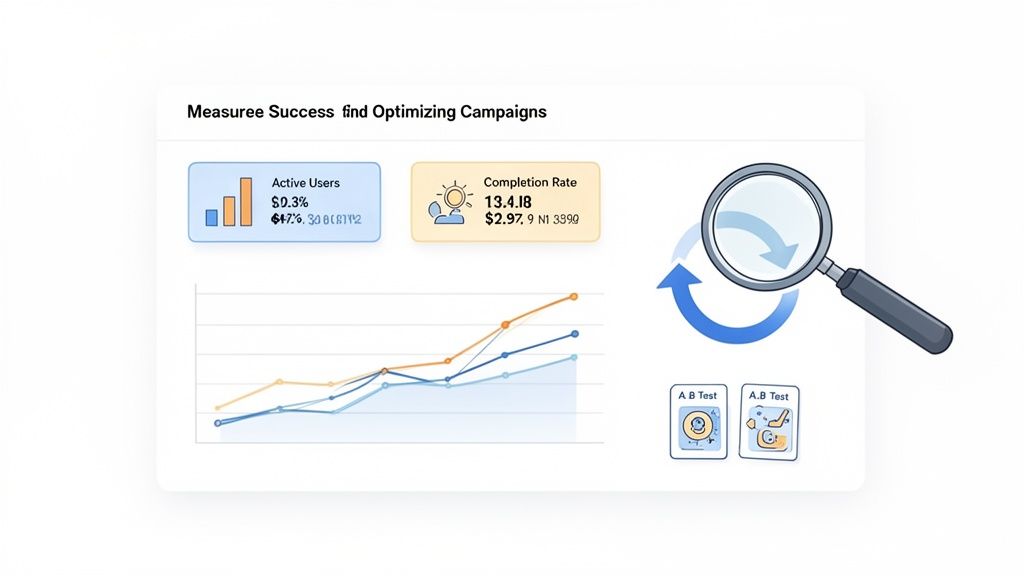
- Active Participant Rate: Forget total members for a second. What percentage of your community is actually doing something—completing at least one task per week or month? This is your true pulse-check.
- Quest Completion Rate: When people start a task, do they finish it? If you have a 90% drop-off on a specific quest, that’s a huge red flag. It could mean the instructions are confusing, the task is broken, or the reward just isn't worth the hassle.
- On-Chain Impact: This is where the rubber meets the road. Are your quests driving real, measurable activity like an increase in daily active wallets, a bump in transaction volume, or more liquidity? You have to tie your program's activity directly back to your protocol's health.
- Retention Rate: Of the people who joined for your first campaign, how many are still around for the second? And the third? High retention means you’re building a loyal base, not just attracting a swarm of airdrop hunters who disappear overnight.
If you want to get really granular with your in-app stats, diving into resources on mastering Telegram analytics can give you a much clearer picture of what's happening inside your channels.
Tracking these numbers is non-negotiable. Below is a quick-glance table of the metrics we've found to be the most critical for understanding the real ROI of a rewards program.
Essential KPIs for Your Telegram Reward Program
| Metric | What It Tells You | How to Improve It |
|---|---|---|
| Active Participant Rate | The true level of engagement and community health. | Offer daily/weekly "streaks," introduce time-sensitive tasks, or create tiered rewards for consistent participation. |
| Quest Completion Rate | How effective, clear, and well-incentivized your individual tasks are. | A/B test quest descriptions, simplify complex steps, or increase the reward for high-effort tasks. |
| On-Chain Impact | The program's direct contribution to your core business goals (e.g., protocol usage). | Design more quests that require specific on-chain actions; reward users for providing liquidity or trying new features. |
| Retention Rate | Your ability to build a long-term, loyal community vs. attracting transient users. | Introduce a loyalty/XP system, create multi-part quest sagas, and offer exclusive perks for long-time members. |
Ultimately, these metrics are your guide. They tell you where to double down and where to pull back, ensuring your efforts are always moving the needle.
Building a Community Feedback Loop
Data tells you what is happening. Your community tells you why. Never, ever forget that.
Your members are on the front lines, using your quests every day. They know instantly if something feels clunky, broken, or just plain boring. You need to make it ridiculously easy for them to tell you about it.
Set up a dedicated #feedback channel in your Telegram group or Discord server. Actively ask for ideas for new quests. And when you actually implement a suggestion from the community, make a huge deal out of it! Announce it publicly and give that person a shout-out. This simple act transforms them from passive users into active co-creators of your program.
Data tells you what is happening, but your community tells you why. Combining quantitative analytics with qualitative feedback is the key to continuous improvement and building a program people genuinely love.
A/B Testing Your Way to Maximum Engagement
Never assume you know what will work best. The most effective way to optimize your program is to constantly be testing. A/B testing isn't just for marketers trying to sell you something; it’s a killer tool for refining your quests and rewards.
Here’s how you can put it into practice:
- Test Your Framing: Take the same basic task—say, swapping a token—and write two completely different descriptions for it. Is a funny, meme-heavy tone more effective than a direct, no-nonsense one? Test it and find out.
- Experiment with Rewards: For an identical task, offer one group a small, guaranteed token reward and offer another group a raffle ticket for a much larger prize. You might be surprised which one drives more completions.
- Vary the Difficulty: Pit a simple, one-click social follow against a more complex, multi-step on-chain quest. This helps you figure out the perfect balance of effort and reward for different segments of your audience.
Systematically testing and learning is how you go from good to great. By making small, data-backed tweaks over time, you can methodically increase your campaign’s effectiveness and ensure your Telegram community rewards are delivering the best possible ROI.
Got Questions About Telegram Rewards? We've Got Answers
Stepping into the world of Telegram rewards programs always brings up a few questions. It’s smart to get these sorted out before you dive in, so let's tackle some of the most common ones I hear.
What’s a Realistic Budget for a Telegram Rewards Campaign?
This is the big one, right? Your costs really fall into two categories: the actual rewards and the platform you use to run the show.
The rewards part is entirely up to you. You could go big with high-value tokens and NFTs, or you can keep it lean with non-monetary perks like special Discord roles or early access to a new feature. Honestly, it all comes down to what gets your community excited.
Then there's the tool you use. Sure, you could try to run this all manually with a spreadsheet, but a no-code platform saves you from a world of technical pain. These tools usually charge based on how big your community is or how many people are actively participating. In my experience, they easily pay for themselves by stamping out fraud and automating all the soul-crushing verification work.
What Are the Biggest Mistakes People Make?
I've seen a few common missteps that can sink a campaign before it even gets going. Knowing what they are is half the battle.
The absolute biggest mistake is designing a snoozefest of repetitive tasks. If all you're asking people to do is "like and retweet" 50 times, you're going to burn out your community fast. Your true fans will check out, and you'll be left with low-quality engagement.
Another killer is weak (or non-existent) fraud protection. Without it, you're just ringing the dinner bell for bots and sybil attackers. They’ll show up and drain your reward pool before your real community members get a chance.
Finally, I often see programs with no real strategy. Every quest needs to tie back to a meaningful goal for your project. If you're just chasing vanity metrics, you're wasting everyone's time.
A great rewards program isn't about giving away free stuff. It's about building a system that encourages actions that create real, tangible value for your project. If you can't connect a task back to a core KPI, you should probably scrap it.
How Do I Make Sure Rewards Are Distributed Fairly and Safely?
When it's time to pay out, automation is your best friend. In fact, I'd say it's non-negotiable. Trying to manually check thousands of task submissions and airdrop rewards one by one is a recipe for pure chaos. It’s slow, full of mistakes, and completely falls apart once you start to grow.
A dedicated questing platform handles all the heavy lifting. Here’s a quick look at how it typically works:
- Auto-Verification: The system taps into APIs and AI to confirm tasks are completed correctly, almost instantly.
- Wallet List Generation: It pulls together a clean, verified list of all the wallet addresses that earned rewards.
- Secure Airdrops: The platform then helps you execute a secure, batch airdrop of tokens or NFTs right to the winners' wallets.
This whole process ensures everyone gets what they earned, and it creates a transparent, on-chain record of every transaction. This is absolutely critical for building trust and proving your Telegram community rewards program is legit.
Ready to launch a rewards program that drives real growth without the technical overhead? With Domino, you can build, automate, and scale your Telegram quests in minutes. Check out our no-code toolkit and see why top Web3 teams trust us to power their community engagement at https://domino.run.