Choosing Web3 Community Platforms That Actually Work
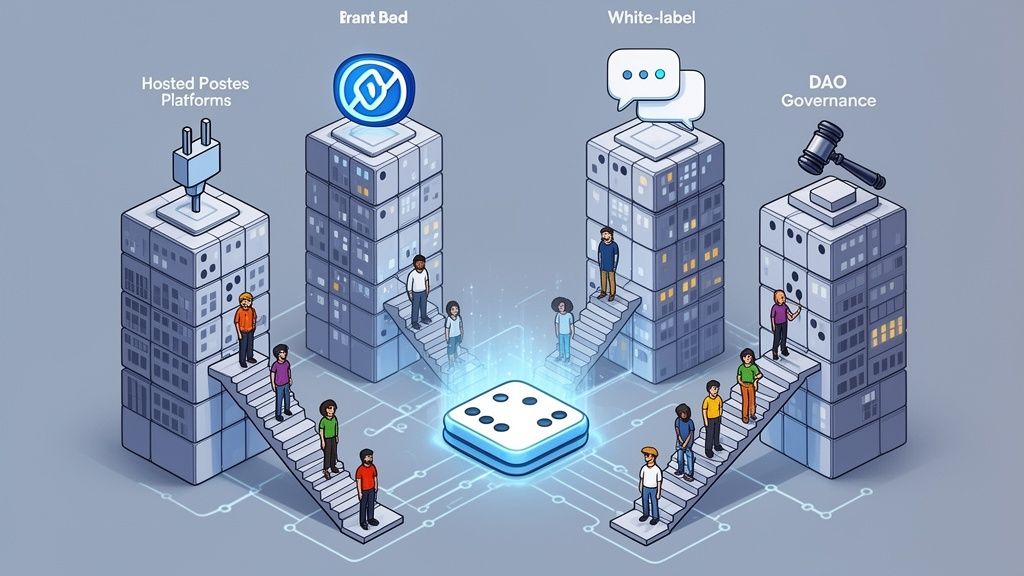
At its core, a community platform is a dedicated digital space where your project’s supporters can hang out, work together, and connect directly with your team and each other. Think of it less like a social media page and more like a private clubhouse for your members. It’s where you turn passive followers into active, invested participants who feel a real sense of ownership.
What Are Community Platforms in Web3?
Imagine trying to build a nation just by shouting announcements in a crowded public park. That’s what it feels like when you rely only on big social platforms like Twitter or Telegram. You can broadcast messages, sure, but you can't really build a society. A true community platform is the infrastructure—the town square, the city hall, and the marketplace—where your culture can actually take root and grow.
In Web3, this idea gets a massive upgrade. Your community isn't just an audience; they're a core part of your project's value. These platforms are where that value gets created and shared. They're more than just chat rooms; they become hubs for organized quests, deep learning, and even governance. This move from just watching to actively doing is exactly why building a strong Web3 community is a must for any project that wants to succeed.
The Digital City Analogy
Let's stick with the city analogy for a minute, because it really helps clarify why these platforms are so important.
- Infrastructure for Connection: A city needs roads and parks for people to meet. Your community needs discussion channels, DMs, and event spaces. This is the basic scaffolding that lets people connect without friction.
- A Place for Commerce and Exchange: Every great city has a bustling market. In the same way, the best community platforms have built-in features for rewards, quests, and member-to-member trades, sparking a lively internal economy.
- Governance and Identity: Cities have town halls where decisions are made. Web3 platforms offer tools for voting, proposals, and token-gated roles that give members a real voice in the project’s future and a powerful sense of belonging.
This strategic move toward building your own digital nation is why the market is exploding. The global community platform space has ballooned from hundreds of millions to billions in just a few short years. One analysis predicted the market would jump from USD 454.11 million in 2021 to USD 819.40 million by 2025—a compound annual growth rate of almost 16%. That's some serious momentum.
A community platform isn't just software. It’s the soil where your project's culture grows. It's the difference between having followers and having citizens.
At the end of the day, these platforms give you a controlled, branded home where you can build real relationships, away from the constant noise and unpredictable algorithms of public social media. If you want to dive deeper into the basics, you can learn more about what a community platform for creators really involves. It’s about building a sustainable ecosystem with a loyal base, not just yelling into the void. This is precisely why picking the right platform is one of the most critical decisions any Web3 project will face.
Comparing the Four Types of Community Platforms
Not all community platforms are created equal. Picking the right one is a bit like choosing a venue for a huge event. Are you looking for a plug-and-play conference hall that’s ready to go, or are you building a custom stadium from the ground up? Let’s break down the four main categories to help you make a smart decision that fits your project's vision, budget, and long-term goals.
Your choice here really sets the stage for every single interaction your community will have, so it's a big deal.
Hosted Platforms: The Rented Conference Hall
Hosted platforms are your all-in-one, ready-to-go solution. Think of them like renting a fully equipped conference hall for an event—the lights, sound system, and chairs are already set up. You just need to show up with your people and your content.
Platforms like Circle or Mighty Networks handle all the technical headaches for you. Security, updates, maintenance—it's all on them, so you can focus on what actually matters: engaging with your community. You don't get a ton of deep customization options, but their speed and simplicity make them a fantastic choice if you need to get a community space up and running fast without hiring a dev team.
White-Label Platforms: Your Custom-Branded Venue
If a hosted platform is a rental, a white-label solution is like leasing an empty venue and bringing in your own designers to build it out. These community platforms give you the core infrastructure, but you get a ton of control over the branding, layout, and user experience.
This approach lets you create a space that feels completely your own, with your domain, logo, and color scheme front and center. It’s a great middle ground, offering the convenience of a managed service but with the brand consistency of a custom build. It’s perfect for established projects that want a unique, ownable home for their community without the insane cost of building a platform from scratch.
Choosing a platform isn't just a technical decision; it's a strategic one. It defines the boundaries, culture, and potential of your digital nation. Your platform is the container for your community's entire experience.
The flowchart below shows that initial journey—from someone just following you on social media to becoming a real member of your community. This is the fundamental goal, and the right platform makes this transition smooth.
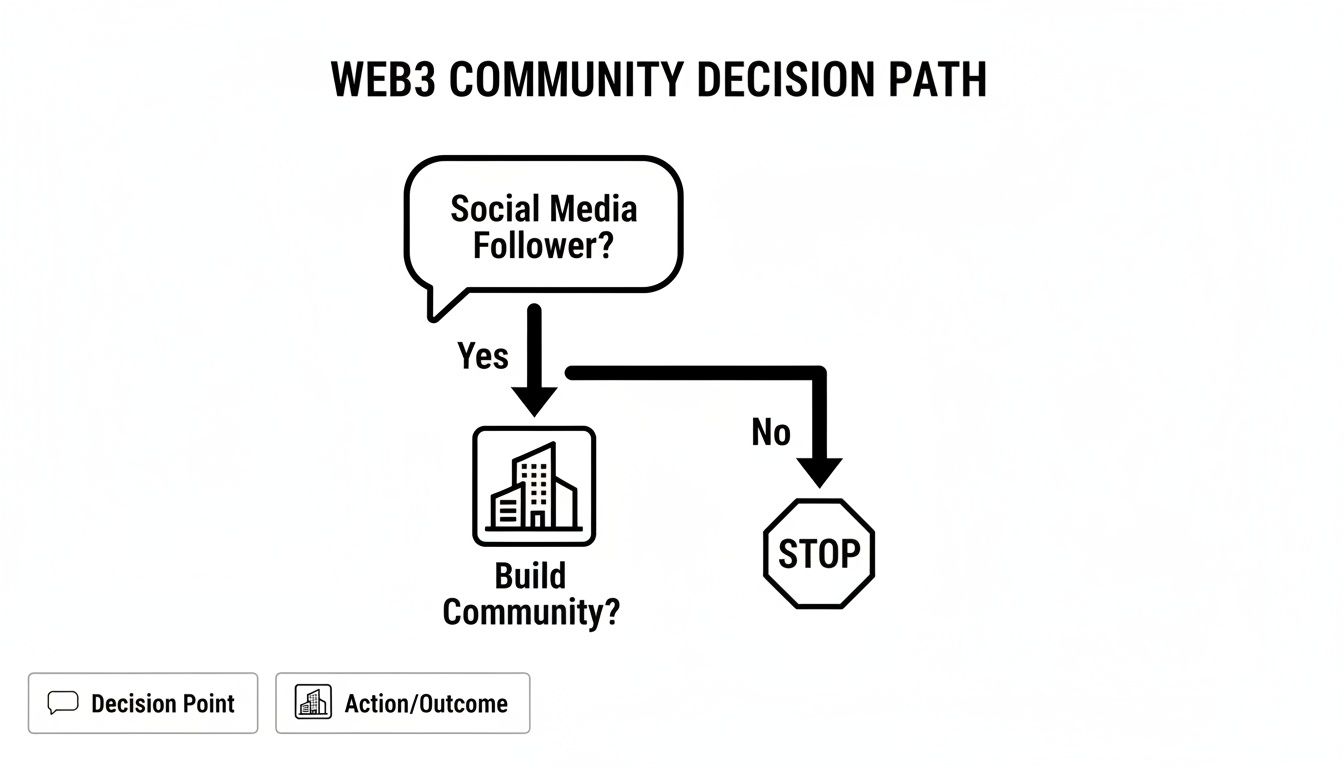
This visual shows just how critical it is to guide a follower toward active participation. Your platform is the bridge that makes that happen.
A Quick Glance at Your Options
Before we dive into the next types, let's put these categories side-by-side. This table gives you a quick snapshot of what each platform type is all about, so you can see where your project might fit best.
Community Platform Types at a Glance
| Platform Type | Best For | Customization Level | Example |
|---|---|---|---|
| Hosted | Projects needing a quick, easy-to-manage launch | Low (basic branding) | Circle |
| White-Label | Established brands wanting a unique, owned feel | Medium (full branding, UI/UX tweaks) | Tribe |
| Social/Chat | Web3 natives and projects prioritizing low-friction onboarding | Very Low (server settings only) | Discord |
| DAO Tooling | Projects focused on on-chain governance and voting | Varies (often integrated) | Snapshot |
Think of this as your cheat sheet. Each option has its own trade-offs, and seeing them laid out like this can make the decision-making process a whole lot clearer.
Social and Chat Platforms: Meeting on Familiar Ground
Sometimes, the best place to build your community is where everyone already hangs out. Social and chat platforms like Discord and Telegram are the digital version of setting up a weekly meetup in a popular city park. You don’t own the park, but everyone knows how to get there.
The biggest win here is the incredibly low friction for new members to join. For Web3, Discord has become the undisputed king, with a staggering 91% of projects using it as their main hub. But that convenience has a downside: you’re playing by the platform’s rules, you’re limited by their features, and you’re constantly fighting for your members’ attention against the noise from a thousand other servers.
DAO Tooling: The On-Chain Governance Hall
Finally, we have DAO tooling. This is the most specialized category, built specifically for one thing: decentralized governance. These platforms are less like a social club and more like a digital city hall built directly on the blockchain.
Tools like Snapshot focus on the core functions of a DAO: submitting proposals, casting on-chain votes, and managing the treasury. While they’re brilliant for facilitating transparent and secure governance, they usually lack the rich social features you’d find elsewhere. Because of this, many projects pair their DAO tools with a platform like Discord to get the best of both worlds—one place for governance, another for the day-to-day conversation.
Measuring Community Health and Engagement
A packed house is a good start, but it doesn't mean your community is actually healthy. It's like judging a city by its population sign. A million people can live there, but are they happy? Engaged? Productive? To really get a feel for how your community platforms are doing, you have to look past the vanity metrics like member count and dig into what truly matters: engagement.
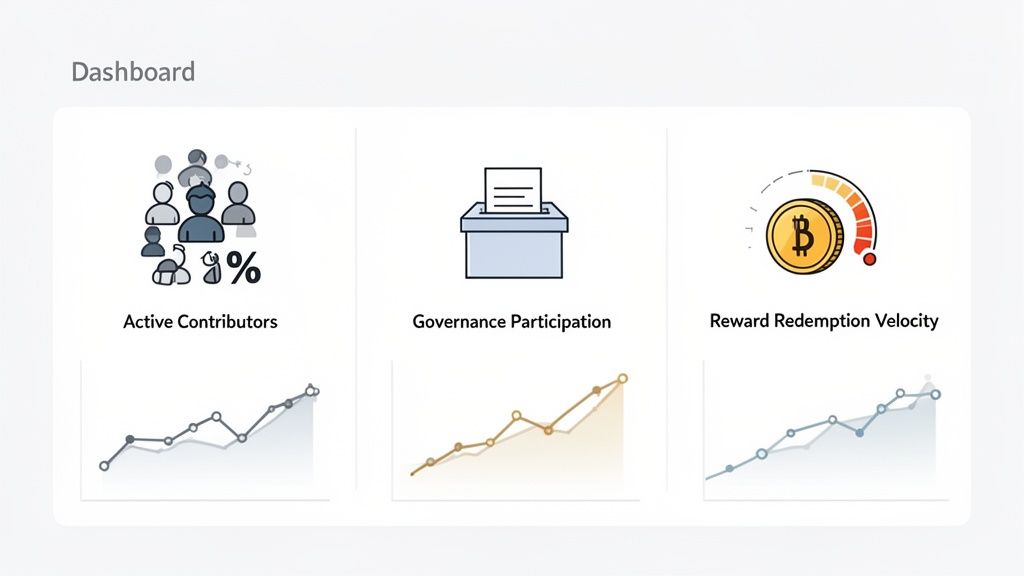
The real health of your community shows up in what your members do. Are they jumping into discussions, voting on proposals, or knocking out quests? Those are the vital signs of a living, breathing digital nation. To track them, you need a platform with the right guts and a smart way to watch your key performance indicators (KPIs).
Core Features That Let You Measure Anything
Before you can track engagement, your platform has to have the tools to actually create it and see it happen. A simple chat room won't cut it. For any Web3 project, a few features are absolutely essential for gathering data that means something.
- Token-Gating and Role Management: This is your velvet rope. It lets you create special areas and assign roles based on what tokens or NFTs someone holds. It’s the first step to understanding how your most committed members behave.
- On-Chain Integrations: Your platform needs to speak blockchain. It has to see on-chain actions like staking, swapping, or minting so you can verify that people are actually doing what your quests and bounties ask of them.
- API Access and Webhooks: Think of these as universal adapters. They let you plug your platform into other tools (like Domino, for instance), creating a smooth data pipeline to track everything—both on-chain and off—all in one spot.
Without this technical backbone, you're flying blind. You’ll see the chatter, but you'll never connect it to the actions that actually create value.
KPIs That Actually Matter
Once you've got the right tools in place, you can stop obsessing over member count and start measuring the real pulse of your community with metrics that tell you a story.
A healthy community isn't just large; it's alive. The right metrics help you distinguish between a crowded, silent library and a bustling, collaborative workshop. Your goal is to build the workshop.
Here are a few powerful KPIs you should start watching:
- Active Contributor Ratio: This is the percentage of your members who are actually doing something—posting, reacting, or participating—over a set period. A healthy community usually sees a 5-10% ratio. Anything less, and you might just have a lot of lurkers.
- Governance Participation Rate: For DAOs and other decentralized projects, this one is huge. It's the percentage of token holders who are actually voting on proposals. If this number is low, it could be a sign that people are losing interest or don't feel connected to the mission.
- Reward Redemption Velocity: This one is simple: how fast are people completing quests and claiming their rewards? If the velocity is high, it’s a great sign that your incentives are hitting the mark and your members are motivated. For a deeper dive, you can learn more about designing effective community rewards programs that really get people moving.
Let's be real—the pressure is on. Teams are working with tighter budgets and have to prove that what they're doing actually has a return on investment. The latest market reports show that buyers are laser-focused on ROI, and product messaging has to reflect that. You can learn how the market is shifting to see just how critical this is. Tracking solid KPIs like these isn't just a nice-to-have anymore; it's about survival.
How to Choose the Right Platform for Your Project
Picking a community platform is a huge decision. It's less about choosing a piece of software and more like laying the foundation for a house. A shaky foundation can cause endless problems down the road, but a solid one lets you build something amazing and lasting.
The good news is, you don't have to get overwhelmed by all the options out there. If you break it down and think strategically, you can confidently pick a platform that will feel like an asset, not another chore on your to-do list. The trick is to look past the flashy features and focus on what actually matters for your community's long-term goals.
First Things First: What’s Your Community For?
Before you even think about looking at demos, you have to nail down one simple question: What is the main reason our community exists? Your answer to this will guide every other decision. Are you trying to create a hub for:
- Product Support and Feedback? If so, you'll need great Q&A tools, a searchable knowledge base, and maybe even a connection to your helpdesk software.
- Building and Bounties? You'll want a platform that can handle project management, track tasks, and make it easy to reward contributors.
- Socializing and Networking? Look for platforms with rich member profiles, direct messaging, event features, and ways for people to form smaller groups around shared interests.
- Decentralized Governance? Here, things like on-chain voting tools and secure token-gating aren't just nice-to-haves; they're absolute musts.
Once you’re crystal clear on your "why," you can immediately cut through the noise and zero in on the platforms that are actually built to do what you need.
Think of it this way: your platform isn't just a place for your community to hang out. It's a tool designed to help you achieve a specific goal. If you don't know what that goal is, any tool will seem just as good—or just as bad.
Your Platform Shopping Checklist
With your core purpose locked in, it's time to start comparing options. This is your inspection checklist. Don’t get distracted by shiny objects; stick to these five critical areas.
1. Scalability and Performance
Will this platform grow with you? A tool that feels zippy with 100 members might completely fall apart when you hit 10,000. You need to ask potential vendors how their infrastructure is built and if it can handle a ton of people online at the same time. The last thing you want is for your platform's limitations to throttle your community's growth.
2. Integration Capabilities
In Web3 especially, no platform can do it all. It has to play nicely with the other tools in your stack. Check for a solid API and pre-built integrations with essentials like Discord, Telegram, your project’s dApp, and reward engines like Domino. A well-connected ecosystem creates a seamless experience for your members and makes your life way easier.
3. User Experience (UX)
This one’s simple: if your platform is a pain to use, people won't use it. The ideal experience is intuitive and gets out of the way, especially for members who aren't super tech-savvy. A clean design and a great mobile app are non-negotiable for keeping people engaged and coming back.
4. Total Cost of Ownership (TCO)
Don't just look at the monthly subscription fee. The real cost includes everything—setup fees, transaction fees if you monetize, and, most importantly, the time and people you'll need to run it. A "cheap" platform can get very expensive, very fast, if it requires a dedicated developer just to keep the lights on.
5. Customization and Branding
Your community space needs to feel like your space. How much can you really make it your own? Look for true white-labeling options where you can use your own domain, logo, and brand colors. This isn't just about looking good; it's about building trust and making your members feel like they're in the right place.
Powering Engagement with Reward-Based Quests
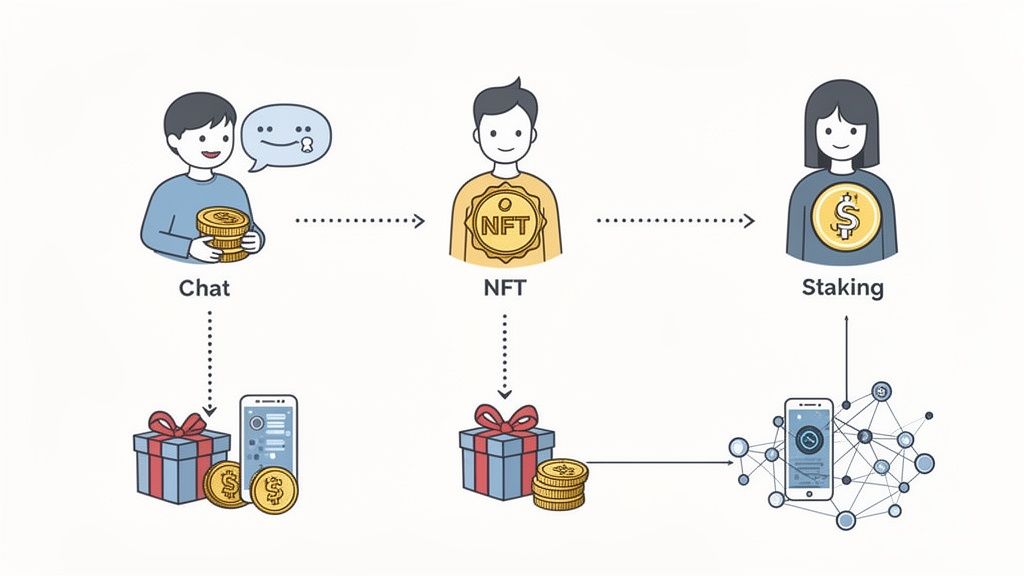
This diagram nails the perfect engagement loop. Simple off-chain actions, like chatting with other members, lead directly to valuable on-chain rewards like staking. It's a simple, powerful way to get people involved.
Once you’ve launched your new community platform, the real work begins. An empty digital space is just a collection of code—the people and their conversations are what bring it to life. The biggest hurdle isn't getting the platform live; it’s keeping it buzzing with energy long after the initial hype wears off.
This is where you need an engagement engine. Think of your platform as the car. It might look great, but you still need an engine to actually make it go. Just having the features isn't enough; you need a system that actively encourages people to use them.
Turning Passive Members Into Active Contributors
So, how do you kickstart that activity? The best way I've seen is through reward-based quests.
Quests completely reframe the user experience. They transform passive lurkers into active players by giving them clear, fun, and valuable tasks to complete. This gamified approach turns your community from a static place for announcements into a dynamic, interactive world.
A powerful no-code tool like Domino is built to be this very engagement engine. It layers right on top of any platform you use—Discord, a white-label solution, you name it—and lets you spin up automated quests in minutes.
The real magic happens when you start connecting the dots between the on-chain and off-chain worlds. With an integrated questing system, you can reward members for a massive range of actions, creating a single, unified strategy that touches every part of your ecosystem.
Examples of Integrated Quests in Action
Let’s get practical. Say you want to boost both social chatter and on-chain activity. Instead of just asking people to be more active, you can create a multi-step quest that guides them through exactly what you need.
- Discord Engagement: The first step could be a simple quest rewarding points for adding a specific emoji reaction to an announcement or hitting a certain message count in a key channel.
- On-Chain Action: Next, you might require them to stake a specific NFT or cast a vote on a governance proposal through Snapshot.
- Social Amplification: The final task could be to quote a project tweet with a specific hashtag.
By stringing these actions together, you're not just creating busywork. You’re building habits and driving behaviors that directly strengthen your project. This approach can turn a silent audience into a thriving ecosystem of contributors. To see how this works in the most popular Web3 hub, check out our deep dive on creating effective Discord quests.
An engagement strategy without rewards is just a list of suggestions. A reward-based quest system turns those suggestions into a compelling game that everyone wants to play and win.
This isn’t just a theory; it’s a proven tactic. Studies show that gamification can boost user engagement by up to 48%. It taps into our natural drive for achievement and reward, making participation feel less like a chore and more like a game.
Measuring Growth That Matters
At the end of the day, it’s all about measurable growth. An engagement engine helps you move past fuzzy metrics and track real-world impact. When you run quests, you can directly measure the spike in key activities.
You can see exactly how many people completed an on-chain action because of a campaign. You can quantify the jump in social media mentions or the surge in Discord activity during a quest period. This gives you clear, undeniable proof of your community's ROI.
This kind of targeted engagement is what separates vibrant communities from digital ghost towns. And while reward-based quests are a huge piece of the puzzle, exploring broader strategies to boost community engagement can round out your approach. By layering a smart, automated rewards system over your platform, you create a powerful flywheel: quests drive engagement, engagement creates value, and that value attracts and keeps more members, fueling a cycle of sustainable growth.
Common Questions About Web3 Community Platforms
Jumping into the world of Web3 community platforms is a big move, and it’s totally normal to have questions. Getting things right from the get-go can save you a world of headaches, time, and money later on.
To help you get started with confidence, we’ve tackled some of the most common questions Web3 teams have when picking and running their community home base.
What Is the Biggest Mistake Projects Make When Choosing a Platform?
Hands down, the biggest mistake is obsessing over features while completely forgetting about engagement strategy. You can have the slickest platform on the market, but if you don't have a real plan to create content, run interactive campaigns, and reward your members, it’ll feel like an empty ghost town in no time.
Before you even look at a single vendor, your first job is to define your community's purpose. You need to map out your engagement plan from day one.
Think about what you actually want people to do. What actions matter? And how will you make them feel genuinely valued for taking those actions? The platform is just the venue; your engagement strategy is the main event.
This is precisely where a tool like Domino slots in perfectly. It acts as the engine for your engagement strategy. By letting you build quests and rewards that give people a reason to show up every day, it breathes life into whatever platform you choose.
Should I Build My Own Platform or Use an Existing One?
For over 99% of projects, just use an existing platform. It's the smarter, safer, and more strategic call. Building a community platform from scratch is a massive drain on time and money, not to mention the constant need for maintenance and security updates.
The market for community platforms is already well-established, with fantastic hosted and white-label options that cover pretty much any use case you can dream up. Your resources are much better spent on what you do best—building your product and growing your community—not on reinventing the wheel.
The modern way to do it is to grab a best-in-class platform for the "venue" and then use specialized tools like Domino to power the "events" inside. This modular approach gives you a few killer advantages:
- Flexibility: You can easily swap out tools as your needs evolve without having to tear down your entire setup.
- Scalability: Let the platform experts handle growth so you don't have to worry about your servers crashing.
- Cost-Effectiveness: Pay for proven, ready-to-go solutions instead of bankrolling a long, unpredictable development project.
How Do I Migrate My Community to a New Platform?
Moving your community is a delicate operation. It demands careful planning and, above all, clear communication. The first thing you need to do is tell your community—way in advance. Don't just drop the news; explain the "why" behind the move and get them hyped about the cool new features.
Next, you'll want to create a step-by-step migration plan. It should cover:
- Data Handling: Figure out what user data, roles, and old content you can export and import.
- New Space Setup: Recreate the channels and roles they’re used to so the new place feels familiar right away.
- Educational Resources: Make simple tutorials, quick videos, or guides to show everyone around the new interface.
Keep both platforms running for a short transition period so everyone has time to get comfortable. And here's the key: make the launch a real event. Use a tool like Domino to create a special "welcome" quest with exclusive rewards for the first people to make the jump. It’s a great way to incentivize the move and make your community feel celebrated for coming along.
How Can I Measure the ROI of My Community Platform?
Measuring community ROI isn’t about vanity metrics like your total member count. It's about tracking numbers that connect directly to your core business goals.
Instead of just looking at how big your community is, start tracking KPIs that actually tell the story of its impact:
- User Acquisition: How many new users are coming from community referrals or campaigns?
- Product Adoption: What percentage of your community is actively using your product or completing key on-chain actions?
- Retention Rate: Are community members sticking around longer than non-members?
- Support Cost Reduction: Is your community answering each other's questions, taking some of the load off your support team?
By running quests that link what happens off-chain (like a Discord chat) to on-chain actions (like staking an NFT), you can draw a straight, measurable line from community activity to your bottom line. This makes it incredibly easy to prove the value of your community-building efforts to anyone who asks.
Ready to power up your community with an engagement engine that delivers real, measurable results? Domino lets you design and automate reward-based quests in minutes, turning passive members into your most active contributors. See how you can accelerate growth by visiting https://domino.run.