Your Guide to a No-Code Rewards Program Platform
Think of a rewards program platform as the mission control for your project's community. It’s a dedicated system for creating interactive "quests" that get your users to take specific actions that help your ecosystem grow. The best part? It automates everything from checking social media follows to verifying complex on-chain transactions.
What Is a Web3 Rewards Program Platform
We're not talking about your grandpa's loyalty points program. A Web3 rewards platform is more like a real-life video game built around your community. Every task a user completes, whether it's hopping into your Discord or staking an NFT, pulls them deeper into your world and drives real, measurable growth. This is way more than just handing out prizes; it's a strategic engine built to find new users, keep them engaged, and turn them into die-hard fans.
Instead of getting buried in spreadsheets and manually checking thousands of screenshots, these platforms do all the heavy lifting for you. That frees up your team to do what they do best: dream up cool campaigns and actually connect with your community.
Moving Beyond Simple Giveaways
Sure, simple giveaway bots are fine for one-off events, but they're a temporary fix. A full-blown rewards platform is built for the long haul. It lets you create complex, multi-step campaigns that string together all sorts of different actions from your users.
This connected approach lets you take people on a proper journey. A newcomer might start with easy social tasks, then move on to more involved on-chain activities, leveling up and earning better rewards as they go. This creates a powerful feedback loop where engagement is constantly being encouraged and rewarded.
A true rewards platform is the difference between a one-time firework and a sustainable power plant. One creates a momentary spark of excitement, while the other generates continuous, reliable energy for your ecosystem's growth.
The Core Components of a Rewards Engine
Under the hood, a rewards platform is a machine with several key parts all working together. These pieces create a smooth experience for both your team running the show and the community members participating.
Here's what you'll typically find:
- Quest Creation: An easy-to-use builder for designing and launching campaigns, no coding required.
- Task Integration: The ability to reward both off-chain stuff (like social media follows) and on-chain actions (like token swaps).
- Automated Verification: Smart systems that instantly confirm when a task is done, which stops fraud and saves a ton of admin time.
- Analytics and Reporting: Dashboards that show you exactly how your campaigns are doing, what your users are up to, and how your community is growing.
When you put all these pieces together, a rewards program platform becomes a non-negotiable part of your marketing and community stack. It’s how you turn passive followers into active, long-term evangelists for your project.
The Core Features That Drive Real Growth
A great rewards program platform is way more than just a slick dashboard. Think of it as the engine powering your community growth, with specific, interconnected parts all working together to turn simple user actions into tangible results. When you understand how these features click, you see how a basic quest can become your secret weapon for user acquisition and retention.
The real power starts with the ability to reward a massive range of activities. Your community isn't just hanging out on Twitter or only interacting with your smart contracts; they're everywhere. A flexible platform meets them right where they are, creating one smooth experience that connects all their digital hangouts.
On-Chain and Off-Chain Task Integration
Picture your community's journey as a treasure map. Some clues are found by exploring the social media landscape (that's off-chain), while others require them to dive deep into your protocol or dApp (that's on-chain). A top-tier rewards program platform lets you place rewards at every single stop along that map.
This dual capability is non-negotiable. You can bring new people into the fold with easy, low-friction tasks like joining a Telegram channel. From there, you can gently guide them toward higher-value on-chain actions, like staking tokens or minting an NFT. This creates a natural funnel that not only educates users but also gets them more invested in your ecosystem over time.
A rewards platform that only tracks one or the other—on-chain or off-chain—is like trying to build a bridge from only one side of a river. You need both to create a strong, seamless connection between your community's social life and their on-chain behavior.
To get a better sense of what this looks like in practice, here’s a breakdown of the kinds of actions you can incentivize. This table illustrates the variety of tasks you can reward, bridging the gap between social engagement and blockchain interaction.
On-Chain vs Off-Chain Tasks: What You Can Reward
| Task Category | Example Action | Primary Goal |
|---|---|---|
| Social Engagement | Follow on X, Retweet a post, Join Discord | Build brand awareness & top-of-funnel growth |
| Content Creation | Write a blog post, create a meme, submit a video | Generate organic marketing & user-generated content |
| Product Usage | Swap tokens on your DEX, mint an NFT, stake assets | Drive protocol adoption & on-chain activity |
| Community Participation | Vote on a governance proposal, attend a community call | Foster a sense of ownership & active participation |
| Referrals | Invite a friend who completes a specific quest | Fuel viral growth & user acquisition |
As you can see, the possibilities are endless. A good platform doesn't make you choose; it lets you mix and match these tasks to create campaigns that hit your specific goals.
AI-Powered Verification and Automation
Let's be real: manually checking thousands of task submissions is a nightmare. This is where automation becomes your best friend. Modern platforms use smart systems to instantly confirm that a task was actually completed, whether it's checking if a user really retweeted that post or verifying a transaction hash on Etherscan.
This automated process does two critical things:
- It shuts down fraud. AI-powered verification weeds out the bots and bad actors trying to game the system. This ensures your rewards go to genuine community members who are adding real value.
- It delivers instant gratification. Users get immediate feedback that their task was approved and their reward is on its way. This creates a satisfying dopamine hit that keeps them coming back for more.
This completely frees up your team from mind-numbing admin work, letting you focus on the fun stuff: strategy and creative campaign ideas. For more inspiration on structuring your campaigns, check out our complete guide to building a successful Web3 incentive program.
No-Code Quest Builders and Templates
You shouldn't need a dev team on standby just to launch a community campaign. The best platforms are built for marketers and community managers, featuring intuitive, no-code tools like drag-and-drop quest builders. This means you can design and deploy a sophisticated campaign in minutes, not weeks.
Pre-built templates are another game-changer. They give you proven recipes for hitting common growth goals. Want to blow up your Discord engagement, drive traffic to a new feature, or get the word out about an upcoming mint? There’s probably a template for that. You just tweak it to fit your brand and hit "launch."
This accessibility completely changes the game, making powerful growth tools available to projects of any size. When you put all these core features together, a platform stops being just a tool and becomes a scalable, efficient engine for building a community that lasts.
So, Why Bother With a Rewards Platform?
Let's get past the flashy features and talk about what really matters: results. What can a rewards program actually do for your project? The short answer is, a lot. It’s not just another line item in your marketing budget; it's a living, breathing engine for growth.
By automating rewards and turning simple tasks into a game, you empower your community to become your most powerful marketing channel. This approach tackles some of the toughest nuts to crack in Web3, turning quiet lurkers into your project's biggest fans.
Turn Your Community Into a Growth Engine
A rewards platform gives you a framework to guide what your community does. You can create quests that point users toward actions that directly support your goals—things like bumping up protocol usage, getting more mentions on social media, or pushing traffic to a new feature launch.
This isn’t just about tossing tokens into the void. It’s a smart value exchange. Your members take meaningful actions that help the whole ecosystem thrive, and in return, they get rewards that make them feel valued and want to stick around. It creates a powerful, self-reinforcing loop.
This is basically how the core features all tie together to make that growth happen.
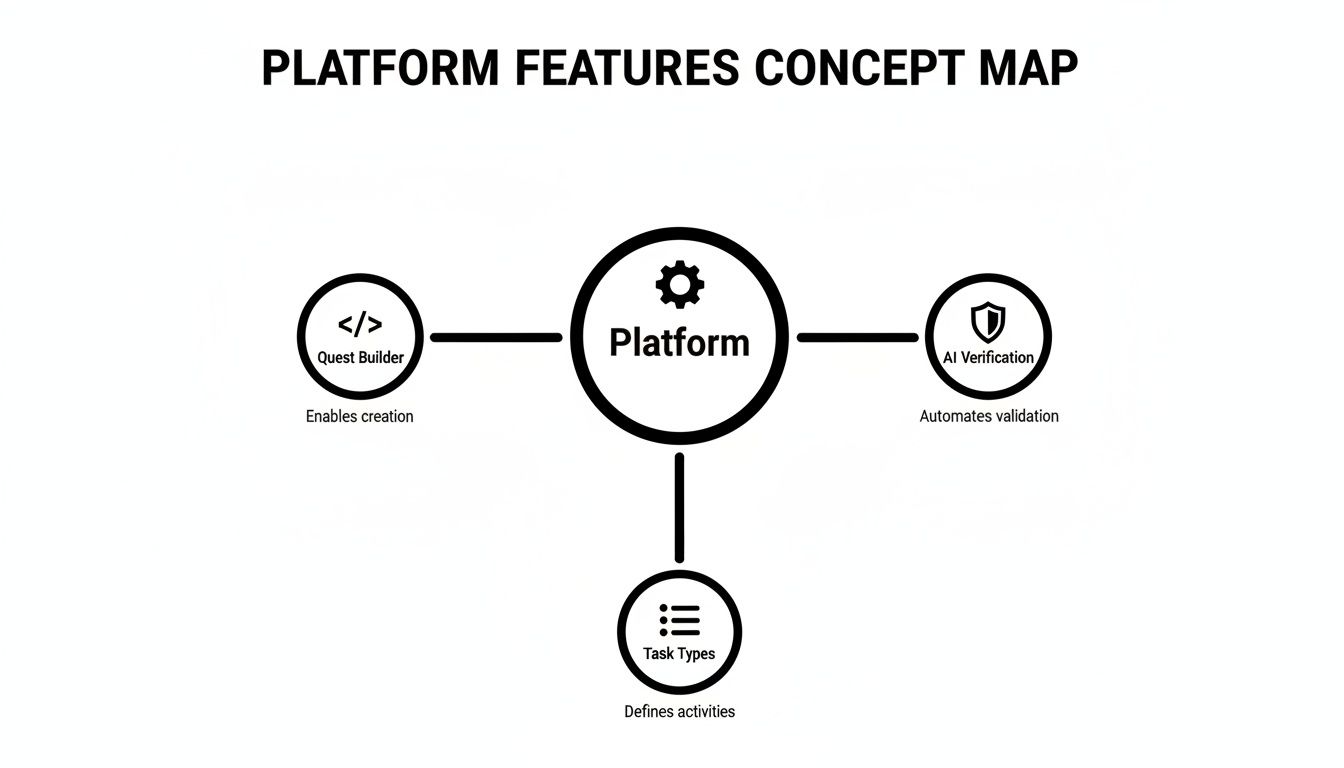
You can see how a simple quest builder, automatic verification, and a bunch of different task types all work in concert to create a smooth, scalable system that keeps people engaged without you having to manage every little detail.
Driving the Web3 Metrics That Actually Matter
At the end of the day, you need to move the needle on key metrics. A well-designed rewards program can directly boost your project's health in a few critical ways.
Here's what you can realistically expect:
- Lower User Acquisition Costs (UAC): When your own community becomes your evangelist, you can ease off the expensive paid ads. Growth becomes more organic and word-of-mouth driven.
- Higher User Lifetime Value (LTV): Happy, engaged users don't just disappear. They stick around longer, explore your product more deeply, and become valuable, long-term contributors.
- A Stronger Community Moat: A lively, active community isn't just a "nice-to-have." It’s a massive competitive advantage that’s incredibly hard for anyone else to copy.
And the numbers don't lie. This isn't just a Web3 trend; it's a proven strategy. Over 90% of companies across all industries have some kind of loyalty program. In our space, platforms that make this easy are putting that trend into overdrive.
Take Domino, for instance. They've powered over 25 million completed quests across 13,000 campaigns, which has a huge and measurable impact on active user counts. The data shows that members who cash in on rewards end up spending 3.1 times more per year. Even better, top-notch programs can boost annual revenue from these engaged users by 15-25%. If you're curious, you can dig into more of these powerful loyalty statistics and see the impact for yourself.
By putting a dedicated rewards program platform in place, you’re not just running a few campaigns. You’re building a lasting asset—a loyal base of users who are both financially and emotionally invested in seeing you win.
Using Gamification to Boost Community Engagement
Rewards are great, but let's be honest, they can also be a bit... transactional. The real magic happens when you make the process of earning those rewards genuinely fun. That’s where gamification comes in. It’s not about turning your project into a video game, but about borrowing the best parts of gaming to make participation feel less like a chore and more like a challenge.
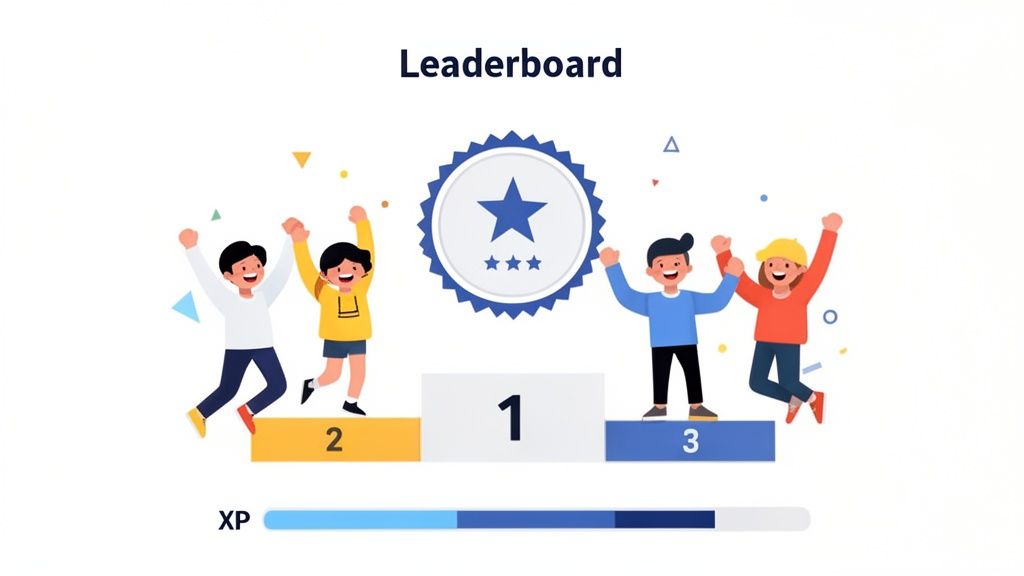
Think about why people sink hundreds of hours into games. It's that feeling of progress, the thrill of seeing your name on a leaderboard, and the satisfaction of unlocking a rare achievement. A smart rewards program platform injects these same psychological hooks into your community. Suddenly, simple tasks feel way more compelling.
For example, retweeting an announcement isn't just a click anymore; it's a chance to climb the weekly leaderboard. Holding a specific NFT isn't just an investment; it’s how you earn that coveted "Diamond Hands" badge and unlock a special role in Discord. You’re turning passive community members into active players.
Turning Mundane Tasks into Exciting Quests
The goal here is to build an emotional connection that runs deeper than just "do this, get that." When your community members feel like they're on a bigger quest, their mindset shifts from "What's in it for me?" to "What can I achieve next?" This is where having a library of easy-to-use quest templates becomes a massive advantage for any Web3 project.
Gamification makes loyalty fun and sticky. The numbers don't lie: a massive 77% of consumers are more likely to join a program with game-like elements, and 87% of those programs are better at keeping customers around. For Web3 growth teams, this is huge.
Platforms like Domino are built for this, offering over 130+ quest templates that let you spin up a tweet verification or NFT staking quest in just a few minutes. We're talking about the kind of engagement that drives real business results—just look at Starbucks, where rewards members account for 53% of U.S. store spend. If you want to dig into the stats, Capital One Shopping has some great insights on how gamification is changing the loyalty game.
Gamification reframes your community's journey. It’s no longer a checklist of tasks but an adventure with levels, bosses, and epic loot. This narrative is what turns casual users into dedicated brand champions.
By baking game mechanics into your strategy, you create a powerful feedback loop where the community's success is directly tied to the project's success. You're not just buying engagement; you're building a vibrant culture of contribution and friendly competition.
If you want to go deeper on this, check out our guide on leveraging crypto gamification for your project.
How to Choose and Launch Your Rewards Platform
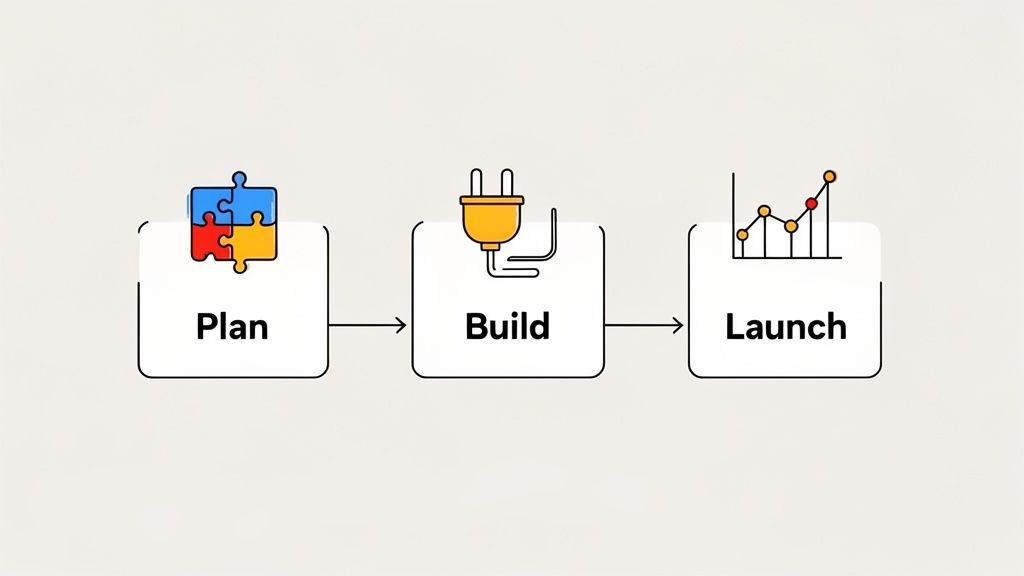
Okay, so you're sold on the idea. Now comes the fun part: making it real. How do you actually pick the right platform and get it off the ground?
Choosing your platform is the first domino to fall, and a good launch is the second. Nail these two things, and you'll save yourself a ton of headaches and build a foundation for genuine community growth. Think of it like this: first, you pick the right tools, then you follow a simple blueprint to build something amazing.
Let’s get into what to look for and how to get started.
The Platform Selection Checklist
Here’s the thing: not all rewards platforms are the same. When you're shopping around, you need to zero in on the features that will actually make your job easier and your campaigns hit harder. It’s easy to get distracted by flashy features, but you have to prioritize what truly matters.
Here are the absolute must-haves:
- Truly No-Code: I mean really no-code. Can your community manager, with zero dev experience, spin up a new campaign on a Tuesday afternoon? Look for simple drag-and-drop builders and ready-to-go templates.
- Smooth Integrations: A rewards platform can't live on an island. It has to play nice with the tools you already rely on, like Discord and Telegram, and connect to your dApp through a straightforward API.
- Scalability and Reliability: Your platform needs to grow with you. Make sure it can handle thousands of people rushing to complete a quest without buckling under the pressure. Nothing kills hype faster than a server crash.
A key piece of this tech stack is solid referral management software. As your community grows, you need something that can track and automate all that user-driven growth without creating a manual mess for your team.
Your Four-Step Launch Plan
Got your platform? Awesome. Now it's time to launch your first campaign. The biggest mistake people make is trying to do too much, too soon. A focused, step-by-step approach always wins.
Follow this simple playbook for a smooth rollout:
Set One Clear Goal: Don't just throw quests out there and hope for the best. What is the one thing you want to achieve with this first campaign? Maybe it's boosting Discord members by 20%, gaining 500 new X followers, or getting 1,000 wallets to test a new feature. Be specific.
Design a Simple Questline: Start small and focused. Create a short series of 3-5 tasks that walk a new user through a specific journey. A "Welcome Quest" is a classic for a reason: join Discord, follow on X, retweet the launch announcement. That's it. Keep the instructions dead simple.
Shout About It Everywhere: Your community can't get excited about something they don't know exists. Announce the new rewards program in your Discord, on X, in your email newsletter—everywhere you have an audience. Build some hype and make it ridiculously easy to find the sign-up link.
Analyze and Adjust: Let the campaign run for a week or two, then dig into the numbers. What worked well? Which task had the biggest drop-off? Use what you learn to make the next quest even more effective. This is all about learning and improving as you go.
By following this roadmap, you’re not just deploying a rewards program platform; you’re building a repeatable engine for community growth. If you want to dive deeper, see how a dedicated loyalty program platform can completely change your user engagement game.
Frequently Asked Questions
Jumping into the world of Web3 growth tools can bring up a lot of questions. Let's clear up some of the most common ones about using a rewards program platform to build and energize your community.
What’s the Difference Between a Rewards Platform and a Giveaway Bot?
Great question. Think of a simple giveaway bot as a firecracker. It’s perfect for a quick, loud bang of excitement—like picking a random winner from a list of retweets. It's a single tool for a single event.
A true rewards program platform, on the other hand, is the entire fireworks show. It’s a full-blown growth engine designed to run ongoing campaigns that link together dozens of different actions from your community. It connects what people do on-chain with their off-chain social activity, verifies everything automatically, and gives you a clear picture of what's working.
You're not just creating a momentary flash of hype; you're building a sustainable, strategic journey for your community members.
How Much Time Does It Take to Manage a Rewards Program?
This is where no-code automation really shines. If you tried to do this manually, you’d be drowning in a sea of screenshots and wallet addresses, spending hours upon hours just checking if people completed the tasks. It’s a nightmare.
With a modern platform, you can lean on pre-built quest templates to get a sophisticated campaign live in just a few minutes. From there, ongoing management is pretty minimal because smart automation and AI handle the heavy lifting of verification and reward distribution. Your time shifts from soul-crushing admin work to what actually matters: strategy and designing cool campaigns.
The right platform doesn't add more work to your plate; it takes it away. You get to focus on creating awesome experiences for your community, not managing a spreadsheet.
Can a Rewards Platform Integrate with Our dApp?
Absolutely. The best platforms are built to be connected. Using an API, you can plug the platform directly into your dApp to create some seriously powerful and seamless growth loops.
For instance, you could set up a quest that automatically grants a user a special NFT or a new Discord role the second they complete a key action in your app—like making their tenth trade or staking a specific amount of tokens. This creates a frictionless experience that encourages people to explore your product more deeply and stick around for the long haul.
What Kind of ROI Can We Expect?
The return on your investment here isn't just about vanity metrics. It's about making the core of your project stronger and more resilient.
You can expect to see real, measurable results in a few key areas:
- Lower Customer Acquisition Cost (CAC): When you empower your community to become your marketing team, you don't have to rely as much on pricey paid ads. You get more organic, word-of-mouth growth, which is far more effective (and cheaper).
- Higher User Lifetime Value (LTV): People who feel engaged and rewarded stick around longer. They dig deeper into your ecosystem and are way more likely to become true fans and advocates for what you're building.
- Measurable Community Growth: You’ll see a direct impact on the numbers that matter, like your active Discord user count, social media engagement, and on-chain activity.
In the end, the ROI is measured in a stronger community, more protocol usage, and genuine brand loyalty. A well-run rewards program amplifies all of it.
Ready to turn your community into your most powerful growth engine? With Domino, you can design and launch engaging, no-code quests in minutes. Start building your rewards program today.