Choosing a Web3 Loyalty Program Platform for Growth

So, what exactly is a Web3 loyalty program platform? Think of it as a powerful digital toolkit designed to build and supercharge your community. It goes way beyond basic point systems, letting you create immersive experiences that blend on-chain and off-chain activities—all without needing to write a single line of code.
What Is a Web3 Loyalty Program Platform?

Forget those dusty punch cards and generic coupons. A modern loyalty platform is more like a versatile Lego set for community engagement. It provides the building blocks for marketers, NFT projects, and DAOs to snap together gamified quests, automated rewards, and specific tasks into one seamless campaign.
This whole approach turns passive followers into active participants by rewarding them for genuine contributions. It closes the gap between different worlds, letting you incentivize a user for staking an NFT (an on-chain action) and for sharing a tweet about it (an off-chain task) all within the same quest.
The Big Idea Behind Modern Loyalty
At its heart, the goal is to build real, lasting connections, not just transactional relationships. Instead of only tracking purchases, these platforms track and reward a whole spectrum of valuable behaviors that help a project grow and feel alive.
The global loyalty management market is expected to hit $18.2 billion USD by 2026. This is fueled by the simple fact that keeping a customer is up to five times cheaper than finding a new one. We're seeing the same trend in Web3 with reward-based systems. For instance, platforms like Domino have already powered over 25 million completed quests across 13,000 campaigns, which just shows the massive demand for these kinds of engagement tools.
To give this some context, let's quickly compare the old way of doing things with the new possibilities that Web3 opens up.
Traditional Loyalty Versus Web3 Loyalty Platforms
| Feature | Traditional Loyalty Programs | Web3 Loyalty Platforms |
|---|---|---|
| Ownership | Company owns the data & points. | User owns their assets (NFTs, tokens). |
| Activities | Primarily tracks purchases. | Rewards a wide range of on/off-chain actions. |
| Transparency | Rules are centralized and can change. | Rules are often transparent via smart contracts. |
| Interoperability | Points are locked to one brand. | Assets can be used across different ecosystems. |
| Automation | Often requires manual oversight. | Heavily automated verification and payouts. |
This shift from a closed, brand-controlled system to an open, user-owned model is what makes Web3 loyalty so powerful. It's about giving back control and creating a true sense of shared ownership.
How These Platforms Actually Work
A loyalty program platform acts as the central command center for your entire engagement strategy. It takes what would otherwise be a huge technical headache and simplifies it, offering tools to design, launch, and track campaigns from an easy-to-use dashboard.
Here’s what they typically offer:
- No-Code Quest Builders: Lets non-technical team members create surprisingly complex campaigns in minutes.
- Automated Verification: Uses AI and direct API connections to confirm that tasks are completed without anyone having to check manually.
- Flexible Reward Distribution: Can handle everything from simple points and badges to token airdrops and exclusive NFTs.
- Omnichannel Integration: Connects with the platforms where your community actually hangs out, like Discord, Telegram, and X (formerly Twitter).
By automating all these moving parts, a Web3 loyalty platform frees up your team's time. You get to focus on the creative strategy and building real relationships instead of getting buried in spreadsheets and manual reward payouts. For a deeper dive, check out our guide on how to design effective Web3 loyalty programs for more ideas.
Must-Have Features in a Loyalty Platform
When you start shopping around for a loyalty platform, it’s easy to get lost in a sea of features. But not all bells and whistles are created equal. A truly great platform is built around a core set of tools that actually save you time and drive real results.
Let’s break down the absolute non-negotiables.
At the very top of the list is a no-code campaign builder. Think of this as the engine of your entire loyalty strategy. It’s what lets your marketing team—the people who actually get your community—design and launch engaging quests in minutes, not weeks. Without it, every new idea gets stuck in a developer backlog, killing your momentum.
This builder needs to be intuitive and flexible, letting you mix and match different tasks and rewards without needing to ping a dev for help. The goal here is speed and autonomy.
Connecting Your Entire Ecosystem
The best platforms don't operate in a silo; they plug into every part of your community's journey. This is where omnichannel task integration becomes so important. It’s all about creating a single, unified campaign that pulls in activities from completely different worlds.
Imagine a quest where a user earns rewards for:
- On-chain actions: Staking an NFT, swapping a token on a DEX, or voting on a governance proposal.
- Off-chain actions: Joining a Telegram group, reacting to a Discord announcement, or sharing a specific tweet.
A powerful loyalty platform brings these together seamlessly. This lets you reward the full spectrum of valuable behaviors, creating a much richer experience for your members and making your community feel cohesive, no matter where they hang out.
Automation and Smart Verification
Manually checking thousands of submissions is a total nightmare. It’s slow, full of errors, and a massive drain on your team's time. That’s why automated verification is a must-have, and modern platforms are increasingly using AI to make it even smarter.
Instead of someone scrolling through Twitter to confirm retweets, the platform just does it instantly through an API. AI can even analyze submitted content, like memes or articles, to make sure it meets your campaign's quality standards.
Automated verification doesn’t just save time; it builds trust. When users get their rewards instantly after completing a task, it creates a positive feedback loop that encourages them to participate again and again.
That instant gratification is key to keeping engagement high and making your campaigns feel fair and responsive.
Rewards, Frontends, and Actionable Data
A one-size-fits-all reward system just doesn't cut it. Your platform has to offer customizable rewards to keep things exciting. This means everything from simple experience points (XP) and digital badges to more tangible incentives like NFT drops, token airdrops, and exclusive event access.
Just as important is a flexible frontend. Your community lives on different channels, so your loyalty program should meet them there. The best platforms support various interfaces:
- A dedicated portal like Zealy or a white-label quest board.
- Integrated bots for Discord and Telegram.
- APIs to build a custom experience directly into your own app.
Finally, none of this matters if you can't see what's working. You need a clear analytics dashboard. A good dashboard will show you which quests have the highest completion rates, which rewards are the most popular, and who your most active community members are. To see how different functionalities are presented, you can check out platforms like the ones on the Copycat247's features page.
This data is gold for refining your strategy over time. When you start looking at bigger solutions, understanding how analytics and integrations work is crucial, something we dive into in our overview of enterprise loyalty software. With the right features, a loyalty platform stops being just a tool and becomes a strategic partner in your growth.
On-Chain Versus Off-Chain Loyalty Models
When you’re picking a loyalty platform, one of the first big forks in the road is a technical one: do you go on-chain, off-chain, or with a hybrid model? This isn't just tech for tech's sake; your choice here dictates how the program feels, how much it costs to run, and how much your community can trust it.
Think of an on-chain loyalty model as a public, unchangeable record book. Every single thing—every quest someone finishes, every point they earn, every reward they claim—gets permanently stamped onto the blockchain. This gives you bulletproof transparency and security. Anyone can look it up and verify it, which is a massive trust-builder.
But, that level of transparency has its own price. Sticking every little interaction on the blockchain can be slow and expensive, especially when the network is busy. It's kind of like sending a registered package just to deliver a postcard. It’s secure, sure, but it's overkill for small, frequent actions.
The Case for Off-Chain Speed
On the other side, an off-chain loyalty model works more like a private company database. The platform keeps track of all the user activity—points, quests, and rewards—on its own servers. This approach is lightning-fast and way cheaper because you're not paying gas fees for every little thing.
This is basically how every Web2 loyalty program you've ever used works. It’s perfect for handling thousands of simple tasks like social media follows or daily logins. The catch? You lose that built-in transparency. Your community has to take your word for it that the database is correct and that you'll actually deliver the rewards you promised.
This diagram shows the basic loop of a loyalty platform, which can be run either way.
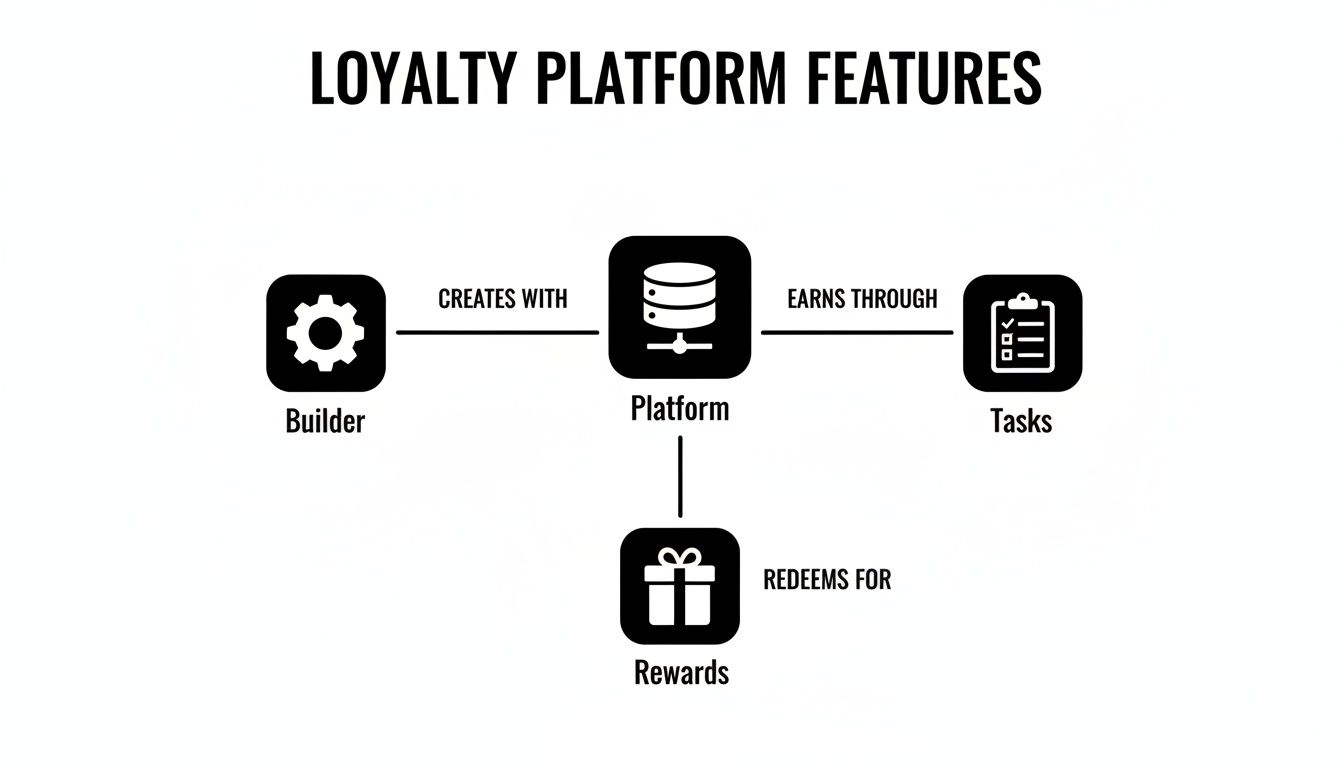
As you can see, it breaks down into three key parts: the builder for setting up quests, the tasks users do to earn, and the rewards they get, all managed by the platform in the middle.
Getting the Best of Both Worlds with a Hybrid Model
So, how do you get the zippy performance of an off-chain system without sacrificing the trust of an on-chain one? That's where the hybrid model comes in, and it's what most smart Web3 platforms are leaning into now.
A hybrid platform handles all the day-to-day, low-stakes stuff off-chain. It tracks quest progress, social shares, and points in a normal, fast database. This keeps the user experience slick and avoids nickel-and-diming everyone with gas fees.
Then, when it’s time for the main event—distributing the actual rewards like an NFT, a token drop, or a special pass—that single, important transaction gets settled on-chain.
This hybrid approach hits the sweet spot. Your marketing team gets the speed and freedom to run all sorts of creative campaigns off-chain, while your community gets the verifiable, trustless proof of on-chain rewards they expect.
By keeping the daily grind off-chain, you keep your costs down and stay nimble. When a user finally hits a big milestone or wants to cash in their points, the platform makes one on-chain move to deliver their prize. That final step is public, permanent, and provably fair—nailing the core ethos of Web3. Ultimately, picking the right model comes down to what your project needs, your budget, and how big you plan to go.
How a Loyalty Platform Actually Drives Growth
Alright, let's get past the technical jargon and talk about what really matters: results. A good loyalty platform isn't just another tool in your community management stack. It's the engine that turns fuzzy goals like "engagement" into hard numbers—more users, better retention, and a much smoother operation.
The first thing you'll notice is the impact on user acquisition. Instead of just throwing money at ads and hoping for the best, you're giving your existing community the tools to become your best evangelists. Think gamified referral quests that turn casual word-of-mouth into a growth channel you can actually measure and scale.
This kicks off a pretty powerful flywheel. New people join, get hooked by the quests, and start inviting their friends. Before you know it, you've got a self-sustaining cycle that slashes your acquisition costs and brings in high-quality folks who are already bought in.
Turning Lurkers into Lifelong Fans
Getting people in the door is just step one. The real challenge is making them stick around. This is where a loyalty platform truly earns its keep by cranking up user engagement and retention.
Suddenly, your community members have clear, fun reasons to show up and participate. They aren't just idling in your Discord anymore; they're actively knocking out tasks, climbing leaderboards, and earning cool rewards. This kind of consistent, positive interaction builds a genuine connection to your project, making them far more likely to stay for the long haul.
A loyalty program shifts your community from a passive audience to an active, collaborative force. You're rewarding actions that bring real value—like creating content, giving solid feedback, or onboarding newcomers—and building a culture of participation that directly fuels your project's success.
This is a game-changer for long-term health. A truly active community is your best defense against the wild swings of the market. To get more ideas on how to keep your members motivated, it's worth exploring different kinds of crypto community rewards that get people excited.
Finally Get Real Community Insights
How do you really know what your community wants? One of the most underrated perks of a loyalty platform is the treasure trove of deep community insights it unlocks. By seeing which quests get the most action and which rewards people are clamoring for, you get a direct window into what makes your users tick.
This data is pure gold for refining your entire growth strategy. You can ditch the campaigns that fall flat and pour your energy into the ones that actually work. Personalization is huge here. For example, loyalty members who cash in on personalized offers tend to spend 4.5 times more each year. In the Web3 world, this means a platform that lets you create custom quests and verify them with AI to build unique experiences for different segments of your audience.
With 79% of companies already planning to overhaul their loyalty programs and 65% looking to switch platforms, the move toward more flexible, plug-and-play solutions is undeniable. You can dig into more of the current loyalty program trends on openloyalty.io to see where things are headed.
Stop Wasting Your Devs' Time
Let's be honest, one of the biggest wins here is the massive reduction in developer resources and operational headaches. Without a no-code platform, every little idea for a quest or a new reward turns into another ticket for your engineering team. That's slow, expensive, and, frankly, a terrible use of their time when they should be building your core product.
A no-code solution hands the keys to your marketing and community managers. They can dream up, launch, and track campaigns all on their own, completely freeing up your developers. It also gets rid of the soul-draining manual labor of checking tasks and dishing out rewards from a messy spreadsheet, which saves a ton of time and prevents silly mistakes. That kind of efficiency lets everyone on the team focus on what they're best at: building something great and nurturing an incredible community.
Driving Community Growth With Domino
Alright, we’ve covered the theory behind modern loyalty platforms. Now, let's get our hands dirty and see how this stuff actually works in the real world. This is where a tool like Domino, a no-code Web3 community toolkit, comes into play, solving the very challenges we've been talking about.
Domino is designed from the ground up to make growing your community feel less like a chore and more like a creative process. It takes all those powerful ideas—hybrid models, omnichannel tasks—and wraps them up in an interface that doesn't require a computer science degree to use.
Making Sophisticated Campaigns Simple
One of the biggest headaches for any project is that gap between a killer marketing idea and the technical grunt work needed to make it happen. Domino is built to bridge that gap. With its no-code approach, you can launch surprisingly complex campaigns in just a few minutes.
Let's say you're running an NFT project and want to give your most loyal holders some love. Instead of spending weeks in a developer's backlog, you can jump into one of Domino's 130+ pre-built templates and set up a multi-step quest.
A campaign might look something like this:
- Stake an NFT: An on-chain action that the platform verifies automatically.
- Share a Post: The user then hops over to X (formerly Twitter) to share their staked NFT.
- Get Verified: Domino's AI scans the post to make sure the right image and hashtags are there.
- Claim Reward: Once everything checks out, the user gets their points or a shiny new badge instantly.
You can set up this entire flow without touching a single line of code. It perfectly marries on-chain proof of ownership with off-chain social buzz, rewarding the exact behaviors that help your project grow.
Practical Use Cases Across Web3
The real magic of a platform like Domino is how adaptable it is. It's not just a one-trick pony for NFT projects; it's about shaping campaigns to hit specific growth goals.
Here’s a look at the Domino interface, which gives you a feel for how different tasks can be strung together in a simple, visual quest builder.
As you can see, the dashboard lets you piece together a campaign with all sorts of on-chain and off-chain tasks, each with its own verification and reward. This modular design means you can build incredibly specific user journeys.
Think about another scenario. A DeFi protocol wants to boost liquidity in a new trading pool. Trying to track contributions and reward everyone manually would be an absolute nightmare.
Instead, they could use Domino to launch a campaign that nudges users to:
- Add a specific amount of liquidity (on-chain).
- Take part in a related governance vote (on-chain).
- Jump into a Telegram discussion about the protocol (off-chain).
By automating the whole thing, the protocol can drive crucial on-chain metrics while getting the community fired up and talking. It’s a holistic approach that nurtures both the technical and social sides of the ecosystem.
This ability to mix and match tasks is what turns a loyalty program into a genuine growth machine. At their core, these platforms are all about community. For more ideas on how to build a dedicated member base, check out these strategies for building a thriving online community.
Key Differentiators That Drive Results
So, what makes this approach so effective? It really boils down to a few core principles that eliminate friction for both your team and your community.
First, the AI-powered verification is a game-changer. It saves a ton of time by getting rid of manual checks and ensures rewards go out fairly and immediately. Second, the flexible frontends mean you can meet your community where they already hang out—whether that's a dedicated quest board, a Telegram bot, or an integration right inside Discord.
Finally, the whole system is built to scale right out of the box. It doesn't matter if you have a hundred users or a hundred thousand; the platform handles all the backend complexity. This lets you stop worrying about logistics and start focusing on creative strategy, turning community management from a reactive chore into a proactive engine for growth.
Choosing the Right Platform for Your Project
Alright, you’ve seen what these platforms can do, you get the tech, and you’re probably buzzing with ideas for growth. Now for the tough part: picking the right loyalty program platform that will actually get the job done. This isn't about finding the one with the longest feature list; it's about finding a partner that gets your project’s unique vibe.
To help you cut through the marketing fluff, let's build a practical checklist. Think of this as your compass for making a smart, future-proof decision that empowers your team instead of giving them another headache.
Evaluate Core Platform Capabilities
Before you even think about booking a demo, let's talk fundamentals. These four pillars will tell you if a platform can handle your vision as you scale from 100 users to 100,000.
Your evaluation needs to hit these key areas:
- Scalability: What happens when your campaign goes viral? Can the platform’s infrastructure handle sudden spikes in activity without breaking a sweat? A successful launch shouldn't crash your system.
- Integrations: How well does it play with the tools you already rely on? Seamless connections to Discord, Telegram, and whatever CRM you're using are totally non-negotiable.
- Ease of Use: Can a non-technical person actually use it? Your marketing team should be able to spin up a new campaign in minutes, not days.
- Security: How does the platform protect user data and handle reward payouts? You need to see robust security protocols and clear, transparent processes.
A platform can have a slick interface, but if it stumbles on any of these core points, it’ll quickly become a bottleneck that chokes your growth.
Analyze the Integration Process
A great loyalty platform should feel like a natural part of your workflow, not some clunky add-on you have to wrestle with. This is why the integration process is so critical. A smooth, painless setup is often the best sign of a well-built product.
Look for platforms that offer crystal-clear documentation, pre-built connectors for popular services, and a solid API. For example, a platform like Domino focuses on a streamlined integration experience, letting you plug its loyalty engine into your own apps or frontends with minimal developer fuss.
Choosing a partner that grows with you means selecting a platform with a flexible, API-first architecture. This ensures that as your needs evolve, your loyalty program can adapt without requiring a complete overhaul.
This kind of flexibility is your get-out-of-jail-free card. It stops you from being locked into a rigid system and gives you the freedom to build custom experiences and add new tools as your community and strategy grow up.
The Ultimate Evaluation Checklist
When you’ve narrowed it down to a few contenders, pull out this checklist. Scoring each platform against these criteria will make it obvious which one truly aligns with where you want to go.
- No-Code Builder Flexibility: Can your marketing lead build complex, multi-step quests that mix on-chain and off-chain actions without needing a developer?
- Automation and AI: Does it use AI to automatically verify things like content submissions or social media posts? This saves a ton of manual work.
- Reward Customization: Are you stuck with just points and badges, or can you offer a wide mix of rewards, like token airdrops and exclusive NFTs?
- Frontend Options: How can users participate? Look for multiple options, like a white-label portal you can brand, a Discord bot for easy access, or an API for a fully custom build.
- Analytics and Reporting: Does the dashboard give you clear, actionable data? You need to see campaign performance, user behavior, and overall engagement at a glance.
- Support and Onboarding: What happens after you sign up? Look for a dedicated success manager and great documentation to help you get started fast.
By carefully thinking through these factors, you can confidently choose a loyalty program platform that doesn’t just solve today's problems but becomes a key part of your long-term community growth.
Frequently Asked Questions
Even with the best game plan, jumping into Web3 loyalty programs can feel like navigating a new world. Let's clear up some of the common questions that pop up so you can move forward with confidence.
What Is the Best Loyalty Program Platform?
Honestly, there's no single "best" platform—it all comes down to what your project actually needs. If you're a massive enterprise, you'll probably want an API-first solution that gives you total control. If you're a small e-commerce shop, a simple plug-and-play tool will get the job done.
But for Web3 projects, the sweet spot is usually something different. The ideal loyalty program platform effortlessly connects on-chain actions with off-chain tasks. It should have a no-code builder so you're not stuck waiting on developers, and maybe even use AI to verify tasks and save you a ton of time. Most importantly, it needs to scale with you and meet your community where they hang out, whether that's Discord or Telegram.
How Much Does Loyalty Software Cost?
The price tag can be all over the map. Simple plugins for platforms like Shopify might have free tiers or cost just a few bucks a month. At the other end of the spectrum, enterprise-level platforms with all the bells, whistles, and dedicated support will give you a custom quote based on your specific setup.
That quote will usually depend on a few things:
- How many active users you have.
- The number of tasks and transactions you're running.
- How much hands-on support you need.
Is Loyalty Program Software Worth It?
For any project serious about long-term growth? Absolutely. A good loyalty program is a direct line to better user retention and a higher lifetime value. Plus, it gives you a treasure trove of first-party data on what truly motivates your community.
The real win here isn't just about rewarding people for buying something. It's about building a community that no one can copy. An engaged, loyal community is your project's most powerful asset, and the right software gives you the tools to build it, turning quiet followers into your biggest champions. That’s an investment that pays for itself over and over again.
Ready to turn your community into your biggest growth engine? With Domino, you can launch powerful, reward-based campaigns in minutes, not months. See how our no-code toolkit can help you accelerate user acquisition and engagement by visiting https://domino.run.