Boosting App Stickiness A Web3 Guide to Retention Rate for Apps

So, what exactly is the retention rate for apps? It's simply the percentage of people who keep using your app over time. Think of it as the ultimate test of your app's "stickiness"—it tells you if you've built something valuable enough to make users come back after that first download.
The Leaky Bucket Problem in the App Economy
Picture this: you spend a ton of time, money, and energy filling a giant bucket with water, but the bucket is riddled with holes. Most of the water leaks out almost as fast as you can pour it in. That, right there, is the app business for most developers.
Getting a download or a sign-up feels great, but these are often just vanity metrics. The real victory isn't getting users; it's keeping them.
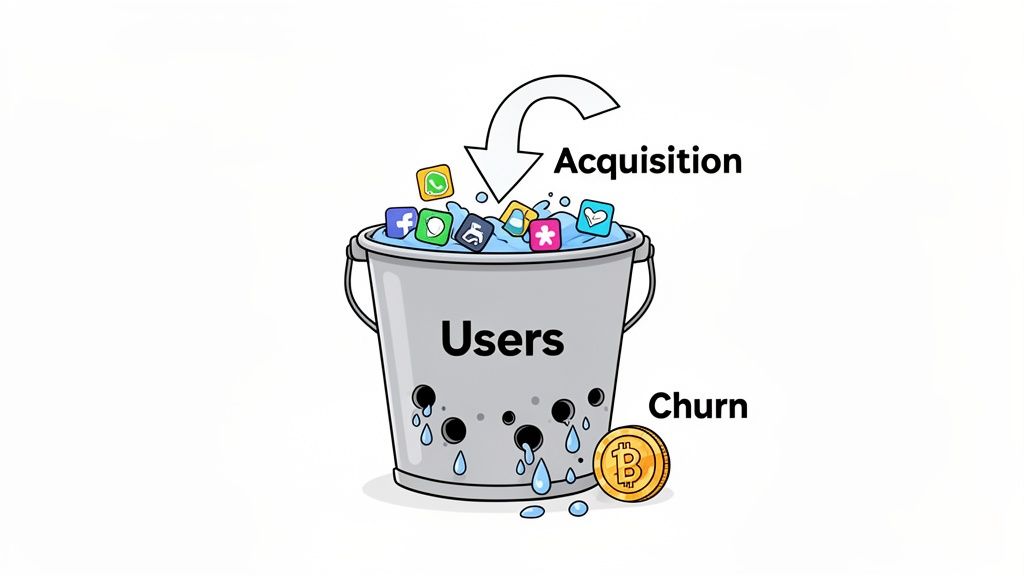
This "leaky bucket" problem is why the retention rate for apps is the single most important metric you're probably not paying enough attention to. It’s the true indicator of long-term engagement and whether you’ve actually achieved product-market fit.
The Staggering Reality of User Churn
The numbers here are genuinely eye-watering. You could launch a fantastic new app, pour your heart and soul into it, and still watch 74.8% of your new users disappear by the very next day. That's not an exaggeration; it's the harsh reality of global app retention.
Industry-wide data shows that the average Day 1 retention rate is just 25.2%. By the end of the first month, that number craters to a tiny 3.5%.
This massive drop-off screams one thing loud and clear: your app's first impression is everything. If users don't "get it" or find value right away, they're gone. Forever.
This is a tough pill to swallow for any app creator, but for Web3 projects, it's an existential crisis. A Web3 app is nothing without an active, engaged community. Low retention doesn't just mean fewer users—it means a weaker community, fading network effects, and a project that's likely failing to deliver on its core promise.
Why Retention Matters More Than Acquisition
Constantly chasing new users while ignoring your retention problem is like trying to build a skyscraper on a foundation of quicksand. It's just not going to work.
Here’s why making users stick around is where the real magic happens:
- Sustainable Growth: Your loyal, retained users are the bedrock of real growth. They become your biggest fans, bring their friends into the fold, and actively contribute to making your ecosystem better.
- Higher Lifetime Value (LTV): It's simple math. A user who sticks around longer is far more likely to spend money, stake tokens, participate in governance, or take other actions that bring value to the project.
- Priceless Feedback: Who better to tell you how to improve your app than the people who use it every day? These loyal users are invested in your success and will give you the honest, practical feedback you need to level up.
Fixing that leaky bucket is a huge job, but it's the most important one you have. To get started, check out these Practical Tips to Engage and Retain Users. It’s a great resource for turning those one-time downloads into a thriving community of true believers.
Decoding App Retention: How to Measure What Matters
So, we know retention is a big deal. But talking about it is one thing—actually measuring it is where the rubber meets the road. If you want to improve your app's retention rate, you first need to get a handle on the right way to calculate it, without getting tangled up in confusing jargon.
There are really two main ways to look at this: classic day-based retention and the far more powerful cohort analysis.
Think of it like checking on a plant. You could glance at it today and say, "Yep, it's alive." That's useful, but it's a pretty limited snapshot. Or, you could track its growth week-by-week since you first planted it. That gives you the real story of its health over time. Classic retention is that quick daily check-in; cohort analysis is the complete growth story.
Let's dive into both.
Classic Retention: D1, D7, and D30
This is the old-school, tried-and-true way to get a quick pulse check on user stickiness at a few critical moments. These metrics give you a simple snapshot of how your app is doing right after a user signs up.
- D1 (Day 1) Retention: What percentage of users came back the day after they installed? This is your clearest, most immediate feedback on your onboarding. Did they get it? Did they like what they saw?
- D7 (Day 7) Retention: Who is still around after a full week? This tells you if users found some kind of real, repeatable value. They didn't just try it; they're starting to form a habit.
- D30 (Day 30) Retention: This tracks the folks who are still active a month later. A healthy D30 rate is a fantastic sign that you've achieved some level of product-market fit.
The math is pretty simple. Let's imagine you launched a new Web3 dApp.
Formula: (Number of Users Who Returned on Day X) / (Number of New Users Who Installed on Day 0) * 100
If 1,000 people installed your dApp on Monday (Day 0) and 250 of them came back on Tuesday (Day 1), your D1 retention is a solid 25%. If only 80 of that original group of 1,000 came back the following Monday (Day 7), your D7 retention is 8%.
The Power of Cohort Analysis
While D1/D7/D30 metrics are great for a quick look, cohort analysis is where the deep insights live. A cohort is just a group of users who share a common starting point—usually the day or week they signed up.
Instead of just checking who came back on one specific day (like Day 7), cohort analysis follows that entire group over their lifetime. This is a game-changer because it helps you connect your actions to user outcomes. You can finally see the complete retention curve for each group of users.
For instance, you can compare the "January Sign-ups" cohort to the "February Sign-ups." If the February crew has a much better D30 retention rate, you can pinpoint what you changed that month. Was it the new feature you shipped? The onboarding flow you tweaked? That's how you build a growth strategy that actually works. To dig deeper into this, check out our guide on how to increase daily active users by understanding these user patterns.
To make this crystal clear, here’s how the two measurement methods stack up.
Key Retention Metrics at a Glance
| Metric Type | What It Measures | Best For Answering |
|---|---|---|
| Classic Retention (D1, D7, D30) | The percentage of new users who return on a specific day post-install. | "How effective is our immediate onboarding?" or "Are we hitting industry benchmarks at key milestones?" |
| Cohort Analysis | The retention of a specific group of users (e.g., "January sign-ups") over their entire lifecycle. | "Did our new feature release in February actually make the app stickier?" or "How is our long-term retention trending over time?" |
As you can see, both are useful, but cohort analysis gives you the context you need to make smarter product decisions.
Tools for Tracking Retention Metrics
Let's be real: you're not going to calculate this stuff in a spreadsheet. To properly measure what matters, you'll want to use some of the best mobile app analytics tools out there.
These platforms do the heavy lifting for you, automating the tracking and giving you clear dashboards that visualize retention curves and cohort performance. For Web3 projects, the ideal setup usually involves a mix of tools:
- Traditional Mobile Analytics: Platforms like Mixpanel, Amplitude, or Firebase are the gold standard for tracking what users do inside your app—think clicks, funnels, and classic retention metrics.
- On-Chain Analysis Tools: For a complete picture, you need to see what's happening on the blockchain. Tools like Dune Analytics or Nansen are essential for tracking wallet interactions, token staking, or NFT mints, giving you true insight into your community's engagement.
What a Good Retention Rate Looks Like (Industry Benchmarks)
Okay, so you've crunched the numbers and have your retention rates. But what do they actually mean? Is your 10% Day 30 retention a reason to pop the champagne or a sign of a leaky bucket?
Honestly, without context, that number is pretty useless. It could be amazing for one app and a total disaster for another. This is exactly why you need to get familiar with industry benchmarks.
Understanding the typical retention rate for apps in your category is crucial for setting goals that make sense. It’s about knowing what’s normal and what’s possible. You wouldn't expect a hypercasual game, which someone might play for five minutes on the bus, to have the same stickiness as the banking app they use every single day.
Comparing your app to the right benchmarks reveals the unique challenges and opportunities in your space. For anyone building in Web3, this context is even more important. Should your new DeFi protocol be aiming for the same retention as a traditional finance app? How does a buzzing NFT marketplace's loyalty compare to a classic e-commerce store?
A Look Across Different App Categories
The differences between app categories are massive. Some apps are built to become daily habits, while others are used only now and then. This behavior is reflected directly in their retention numbers.
A recent analysis of over 1,000 apps paints a really clear picture. The average Day 1 retention across the board is about 25.3%, but the real story is what happens by Day 30. For example, digital banking apps hold on to a solid 11.6% of their users after a month, while new social media apps plummet to just 3.9%. This makes perfect sense—checking your bank account is a need, but scrolling a new social feed is a choice.
Here’s a quick look at how some major categories stack up at the 30-day mark:
- Marketplaces: 8.7%
- Finance (General): 5.8%
- Shopping: 5.6%
- Entertainment: 3.8%
- Gaming: 2.3%
The data shows that shopping apps manage a 5.6% Day 30 retention rate, which is more than double what gaming apps see. That’s a powerful insight, especially for Web3 projects building marketplaces or using token rewards to create a commerce-like feel. You can dig into more of these stats in this breakdown of industry benchmarks.
The takeaway is simple: your app’s purpose defines its retention potential. A utility-driven app will almost always have a stickier user base than one built purely for entertainment.
This chart does a great job of showing the two main ways to look at retention, which helps put these benchmarks into perspective.
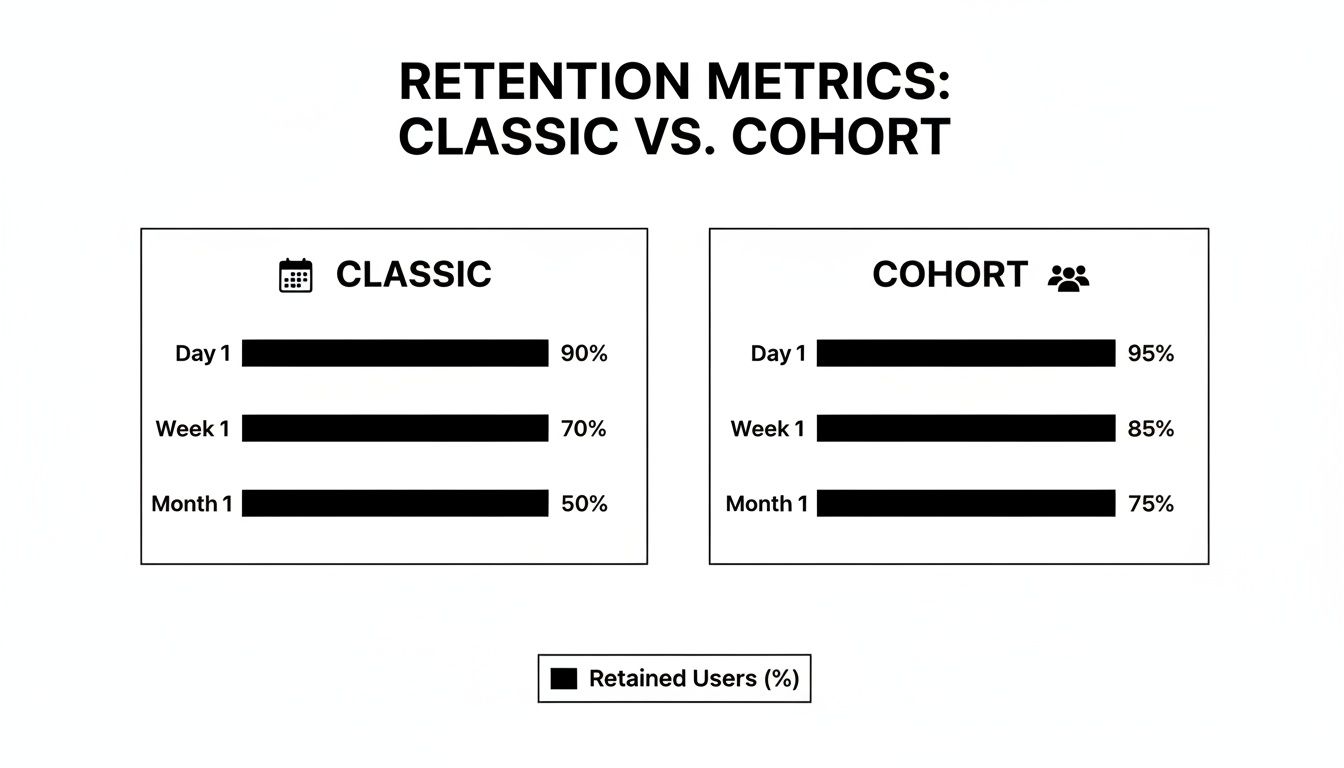
As you can see, classic retention gives you that quick, high-level view, while cohort analysis tells you the much deeper story of what specific groups of users are doing over time.
Setting Realistic Goals for Your App
Now that you have these benchmarks, you can start setting smart, achievable goals. If you're building a new DeFi wallet, aiming for a Day 30 retention of 12-15% is ambitious but realistic—it would put you in the top tier of finance apps. But if you’re launching a Web3 social app, hitting a 5% Day 30 retention would be a massive win.
Your goal isn't just to hit the average. It's to understand the baseline and then figure out how to blow past it. For Web3 projects, this often means leaning into the unique on-chain mechanics that traditional apps just can't copy.
Think about how you can use these tools to outperform your category:
- Tokenized Rewards: Use tokens to create powerful incentives for repeat engagement, pushing you way past typical e-commerce retention numbers.
- On-Chain Quests: Build real habit loops by rewarding users for completing specific actions on-chain. This turns passive users into truly active participants.
- Community Governance: Give users a real voice and stake in the project’s future through a DAO. That creates a level of ownership that goes far beyond just using an app.
By weaving in these Web3-native strategies, you can build an experience that’s just fundamentally stickier than your Web2 counterparts. The game plan is to find your industry’s benchmark, then use your unique advantages to leave it in the dust.
So, Why Are Your Users Really Leaving?
Before you can even think about improving your app's retention, you have to play detective. Why are people walking out the door? It’s almost never just one thing. More often than not, user churn is a quiet storm brewed from a few different problems that, together, make your app feel disposable.
Getting to the "why" is everything. You have to go deeper than vague complaints like a “bad UI.” The real reasons for that massive drop-off after day one are usually hiding just beneath the surface.
Let's face the hard truth: a staggering 71% of users bail on an app within 90 days. That's not just a statistic; it's a giant, flashing sign that most apps aren't building a real connection. The data gets even more brutal when you realize 25% of all downloaded apps are opened only once—a number that keeps ticking up every year. You can dig into more of these revealing app usage statistics on 99firms.com.
So what are the usual suspects?
Your Onboarding is a Cluttered Mess
Your onboarding flow is your one and only chance to make a good first impression. If it’s confusing, drags on forever, or just feels clunky, you’ve lost people before they’ve even had a chance to see what you’re about. This is where they decide if your app is worth another 30 seconds of their life.
A bad onboarding experience is like being tossed the keys to a spaceship with a million blinking lights and no manual. People get overwhelmed, confused, and just want out. They close the app and, poof, they’re gone forever.
For Web3 projects, this is a five-alarm fire. Complicated wallet setups, scary seed phrase warnings, and surprise gas fees are like hitting a brick wall. The user’s journey stops dead in its tracks.
You Don’t Show the "Aha!" Moment Fast Enough
People are impatient. They need to hit that "aha!" moment—the instant they get why your app is awesome—as quickly as humanly possible. If they have to tap through five screens and fill out their life story just to see the core feature, they're already gone.
You have to answer their silent, urgent question: "What's in it for me?" And you need to answer it now.
The best apps give you a win in the very first session. It could be as simple as finding a perfect song for your playlist, making a quick, successful trade, or connecting with a friend. Without that early dopamine hit, your app just feels like work.
There’s No Habit Loop to Hook Them
Amazing retention doesn't just happen; it's designed. The stickiest apps out there are masters of the habit loop, a simple psychological model that gets people coming back on autopilot. It’s all about the cue, the routine, and the reward.
Think about how it works:
- Cue: A notification dings on your phone.
- Routine: You instinctively open the app to see what's new.
- Reward: You get a little hit of satisfaction from a new message, a like, or a sense of progress.
If you don't build these hooks into your app, using it remains a conscious choice instead of an ingrained habit. Eventually, making that choice feels like too much effort, and they just... stop.
The Unique Friction Points of Web3
The decentralized world brings its own special brand of retention killers to the party. While the promise of Web3 is massive, the user experience often feels like it's a decade behind, creating all sorts of new ways for users to get frustrated and leave.
Here are the biggest culprits:
- Wallet and Gas Fee Nightmares: Newcomers to crypto are often completely blindsided by gas fees or intimidated by the whole process of connecting a wallet. That initial friction is more than enough to make them give up entirely.
- The On-Chain vs. Off-Chain Disconnect: A lot of projects build incredible hype on Twitter and Discord (off-chain) but fail to deliver an experience to match once you actually connect your wallet (on-chain). When the reality doesn't live up to the hype, people feel duped and lose trust fast.
Figuring out which of these problems are plaguing your app is the first step. Once you know what's broken, you can finally start to fix your leaky bucket for good.
The Web3 Playbook for Boosting App Retention
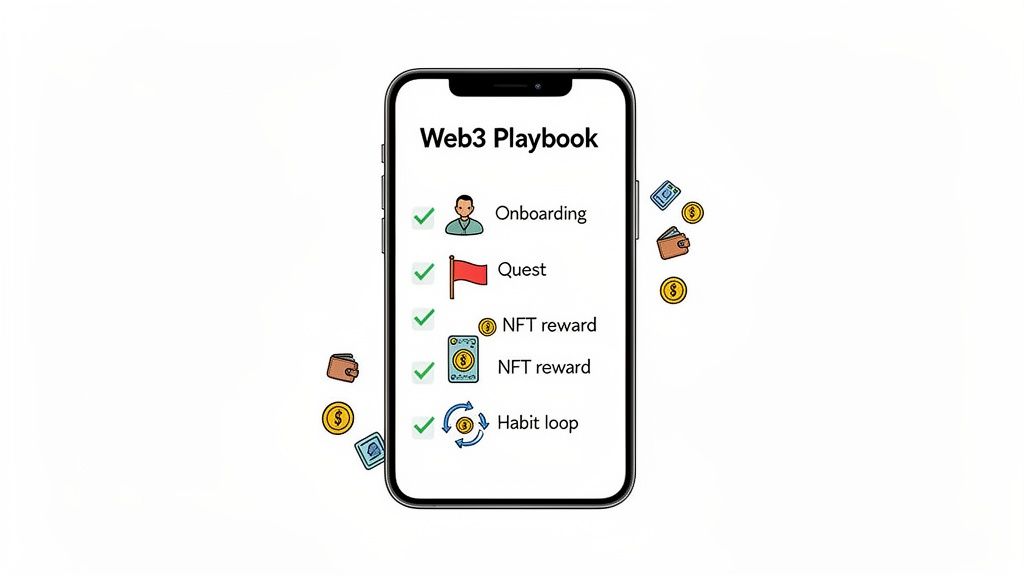
Alright, we’ve talked enough about the problem—it’s time to start building the solution. Let's shift gears from theory to a practical, prioritized playbook designed to make your app incredibly sticky. We’ll kick things off with foundational fixes that deliver the biggest impact, then dive into the strategies that give Web3 projects their unique, powerful edge.
Think of this as your step-by-step guide to plugging the leaks in your user bucket. Improving the retention rate for apps isn’t about some magic bullet; it’s about systematically creating an experience people can’t imagine leaving.
Nail the First Session Experience
The first time a user opens your app is your highest point of leverage. Period. If you win here, your chances of seeing them again on Day 1, Day 7, and beyond skyrocket. It’s all about obliterating friction and delivering value, fast.
Your goal? Make onboarding feel less like a chore and more like an exciting discovery.
Start by streamlining how people get in. In the Web3 world, this means hiding the scary parts of crypto. Forget forcing a complex wallet connection right away. Instead, look at options like social logins or embedded wallets that create a familiar, Web2-style signup flow.
Your north star for onboarding should be "Time to Wow." How many seconds does it take for a new user to actually feel the magic of your app? The shorter that time, the higher your Day 1 retention will be.
Once they’re in, you need to guide them straight to that "aha!" moment. Don't just show them a generic tutorial. Create a simple, interactive first task that proves your app's value. For a DeFi app, that might be a single, low-stakes swap. For a game, it's crushing the first level and earning a reward.
Build Powerful Habit Loops with Gamification
Once you’ve nailed that first impression, your next job is to give people a reason to come back tomorrow, and the day after that. This is where you intentionally design habit loops that make engagement feel rewarding and almost automatic.
And let's be clear: gamification isn't just about slapping on points and badges. It's about tapping into the core psychological drivers that make us tick.
Here are a few simple but brutally effective mechanics you can use:
- Daily Streaks: Reward people for consecutive days of activity, just like Duolingo does. A streak creates a real sense of investment and loss aversion—who wants to break a 50-day streak?
- Progress Bars: Visually show users how close they are to hitting a goal, whether it’s leveling up, unlocking a feature, or completing their profile. It creates a powerful, nagging desire to close that gap.
- Milestone Celebrations: Make a big deal out of user achievements. When someone stakes their first token or mints their first NFT, make it feel like a victory with a pop-up, a special badge, or a fun animation.
These small touches transform using your app from a conscious decision into a satisfying, repeatable behavior. That’s the real secret to strong long-term retention.
Supercharge Engagement with On-Chain Quests
Now we get to the Web3 superpowers. While Web2 apps are stuck with in-app actions, you can create way more meaningful engagement by tying rewards to real, on-chain activities. This is how you turn users from passive observers into active participants in your ecosystem.
On-chain quests are basically structured tasks that guide people to explore the full depth of your protocol. Instead of just hoping they stumble upon key features, you actively incentivize them to try things out.
You can use a no-code toolkit like Domino to spin up these quests in minutes, letting you build campaigns around specific growth goals without bugging a developer. For example, you could create a questline that rewards users for:
- Staking Tokens: Guide new users through staking their first tokens and give them a small bonus for doing it.
- Providing Liquidity: Create a quest that nudges users to add liquidity to a specific pool, which directly boosts your protocol’s health.
- Voting on a Proposal: Encourage governance participation by rewarding users who cast their first vote in your DAO.
This approach not only educates your users but also directly contributes to the core metrics that matter to your protocol. It’s a win-win that turns your app into an interactive, rewarding journey.
Reward Loyalty with NFTs and Verifiable Credentials
In Web3, loyalty isn't just a metric; it's a verifiable asset. You can use NFTs and verifiable credentials (VCs) to give your most dedicated community members tangible, on-chain proof of their status and contributions.
This creates a powerful new layer of stickiness that goes way beyond simple points or discounts.
Think about rewarding your power users with special NFTs that grant exclusive access—like a token-gated channel in your Discord, early access to new features, or even a cut of protocol revenue. Suddenly, being a loyal user isn't just a feeling; it comes with real, ownable perks.
Verifiable credentials take this a step further. You can issue on-chain credentials to users who take on specific community roles, like "DAO Moderator" or "Top Contributor." These credentials become part of their on-chain identity, creating a deep sense of belonging and status that they won't want to lose by leaving. If you're looking to build out a robust system, you can learn more about Web3 loyalty programs and how to implement them effectively.
By combining a frictionless first session with powerful, Web3-native reward systems, you can build an app that doesn't just attract users—it turns them into true, long-term fans.
From Users to True Fans
When it comes down to it, improving your app's retention rate isn't about pulling a rabbit out of a hat. There's no secret growth hack that solves everything. Instead, it's about a complete mindset shift. You have to stop the frantic, expensive chase for new downloads and start focusing on the art of building a genuine community. The real goal is to turn first-time users into loyal fans who feel like they're part of something special.
This isn't just a random walk in the park; it requires a thoughtful, systematic approach. It all starts with a buttery-smooth onboarding experience that shows people the value right away. From there, it's about building powerful habit loops and creating a rewarding experience that gives them a reason to come back. For Web3 projects, this isn't just a nice-to-have—it’s the absolute foundation of sustainable growth.
In the hyper-competitive world of Web3, a strong, engaged, and loyal user base isn't just another metric. It's your most valuable asset. This community becomes your defense, your marketing team, and your co-creators all rolled into one.
What's Your First Move?
Staring at the mountain of "retention" can feel overwhelming, but it doesn’t have to be. The secret is to start small and be deliberate. Don't try to boil the ocean and change everything at once.
Instead, take one concrete step today. Seriously, just one.
- Pick one metric you want to move the needle on. Maybe it's Day 7 retention.
- Zero in on one user cohort, like "new sign-ups from last week."
- Launch one strategy from this guide. It could be something as simple as an on-chain quest or making your wallet connection flow a little less painful.
Measure the impact of that one change. That’s how you start building the muscle for continuous improvement. The journey from a leaky bucket to a thriving ecosystem begins with that first, focused step. If you're looking for more ideas on how to make your app sticky from the get-go, see how Web3 gamification can completely change the game for your user experience.
FAQ
We've gone deep on everything from the nitty-gritty formulas to the Web3-specific tactics that build die-hard communities. Still, a few common questions always pop up, so let's tackle them head-on.
What’s a Good Day 1 Retention Rate for an App?
This is the million-dollar question, and the honest answer is: it depends on your app category. But a great North Star to aim for is anything above 25%. That's around the global average, so if you're there, you're on the right track.
The real rockstars in the app world, though? They can push Day 1 retention up to 35-40% or even higher.
On the flip side, if you're seeing rates below 20%, that's a red flag. It's a pretty clear sign that your onboarding process is clunky or, worse, that new users just aren't "getting" your app's value in that critical first session.
How Do I Calculate the Retention Rate?
Calculating your basic retention rate is actually pretty simple. You just need two pieces of information: the number of new users who signed up on a specific day and how many of those exact users came back on a later day.
The Formula: (Number of Users Who Returned on Day X) / (Number of New Users Who Started on Day 0) * 100
Let's make it real. Say 1,000 people download your app on a Monday (that's Day 0). If 80 of those same people open the app again the following Monday (Day 7), your Day 7 retention rate is 8%. The key is to track that original cohort, not just your overall active user count.
Which Is More Important: DAU or Retention?
Ah, the classic debate. They're both vital signs for your app's health, but if I had to pick one that points to long-term success, it’s retention.
Daily Active Users (DAU) tells you how many people showed up to the party today. It's a snapshot, and a good one at that.
But retention tells you if anyone wants to come back for the next party. You could pump up your DAU with a huge marketing spend, but without good retention, those users will be gone in a week. Strong retention is the foundation that lets your DAU grow steadily over time, instead of just being a series of spikes and crashes.
Ready to turn your app's leaky bucket into a thriving community? With Domino, you can build and launch powerful on-chain quests and reward campaigns in minutes, no code required. Engage your users, drive key on-chain actions, and watch your retention soar.