How to Increase DAU in Web3 A Practical Growth Guide
Let's be real—growing Daily Active Users (DAU) in Web3 isn't just about getting sign-ups. It's about building a habit. The most effective way to do that is to give people a clear, compelling reason to come back every single day.
This means you need a mix of easy, rewarding experiences. Think gamified quest campaigns that reward people for both on-chain and off-chain actions, a dead-simple onboarding process, and a tight feedback loop with your community.
The Playbook for Boosting Daily Active Users
The secret to pumping up your DAU is building a solid growth cycle. You pull people in with fun quests, make it ridiculously easy for them to get started, and keep them around because the experience is genuinely valuable. This guide walks you through that exact playbook, using tools like Domino to put your growth on autopilot.
To really see sustainable DAU growth, you have to adopt some core growth hacking principles. This is less about old-school marketing and more about a mindset of constant, data-backed experimentation.
The Core DAU Growth Loop
The whole process really comes down to a simple, repeatable loop: attract new people, get them onboarded smoothly, and then keep them engaged for the long haul.
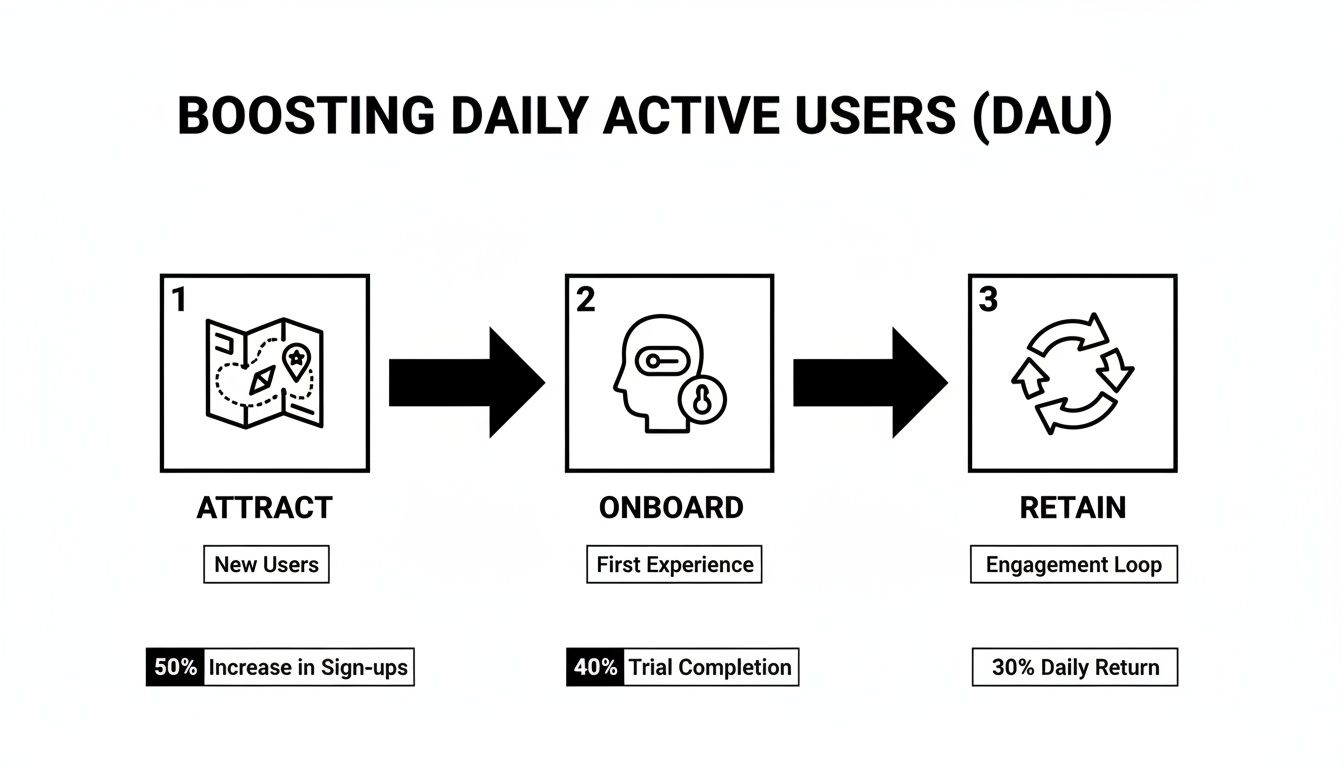
As you can see, each stage—Attract, Onboard, and Retain—naturally flows into the next. This creates a powerful cycle that consistently grows your active user base without you having to start from scratch every time.
Gamified rewards are what make this whole engine run. Just look at the explosive growth in blockchain gaming and DeFi—it’s proof that this model works. One recent survey showed Web3 activity is surging, with blockchain gaming up 3 percentage points and DeFi usage climbing 4 points in just a year.
This is the exact trend we're seeing on platforms like Domino. With over 25 million quests completed across more than 13,000 campaigns, the data is clear: well-designed quests directly drive a lift in active users.
The key takeaway is this: daily engagement doesn't happen by accident. It's the result of a deliberate strategy that combines compelling incentives with an effortless user experience, turning one-time visitors into daily participants.
The Three Pillars of DAU Growth in Web3
To put this into action, it helps to break down the strategy into three core pillars. Each pillar has a distinct focus but works together to create a powerful, self-sustaining growth loop.
| Pillar | Primary Focus | Key Actions | Expected DAU Impact |
|---|---|---|---|
| Attract | Driving Top-of-Funnel Traffic | - Run reward-based quests on social media. - Partner with other communities for co-branded campaigns. - Use referral programs. |
Increase in new user sign-ups and initial interactions. |
| Onboard | Converting New Users to Active Users | - Create a "First Day" quest flow. - Guide users through core product features. - Verify on-chain wallet connections. |
Higher activation rates (W1D1 retention). |
| Retain | Turning Active Users into Daily Habits | - Launch daily check-in quests. - Run weekly "streaks" with bigger rewards. - A/B test different reward types. |
Sustained increase in DAU and higher lifetime value. |
By focusing on these three areas, you're not just chasing vanity metrics; you're building a system that fosters genuine, long-term engagement.
Laying the Groundwork for Real DAU Growth
Look, before you even think about launching that big, splashy marketing campaign, we need to talk about the prep work. This is the unglamorous, behind-the-scenes stuff that most projects skip. Rushing this is like trying to build a skyscraper on a shaky foundation—it’s just not going to hold up.
First things first: what does "active" even mean for your project? Seriously. This one definition will shape your entire strategy. Is it just a wallet connecting? A message sent in Discord? Or is it a meaningful, on-chain action that creates real value, like staking a token or minting an asset?
If you don't nail this down, you're flying blind. A vanity metric like "wallet connects" might pump your numbers for a day, but it tells you nothing about genuine engagement. You need to focus on actions that prove a user is actually using your product.
Define Your Key User Actions
Your absolute most critical first step is to define your North Star metric for "activity." You're looking for an action that clearly signals a user is getting real, tangible value from what you've built.
- DeFi Protocol? Think about actions like making a swap, adding to a liquidity pool, or claiming staking rewards. These are signs of real financial engagement.
- NFT Community? Maybe an active user is someone who votes on a DAO proposal, hops into a token-gated channel, or shows up for a community event.
- Web3 Game? This one’s usually more straightforward. Completing a daily quest, winning a match, or crafting an item are all crystal-clear indicators of an active player.
Once you know exactly what you’re measuring, you can wire up your analytics to track it properly. This isn't about just plugging in a generic tool. It’s about setting up specific event tracking that maps one-to-one with your definition of an active user.
Segment Your Users to See What's Really Going On
Not all users are created equal. Lumping everyone into one giant bucket is a surefire way to miss crucial insights. The next move is to slice up your user base into cohorts based on their behavior. This lets you see different groups clearly and build strategies that actually work for them.
Here's a simple but incredibly powerful way to start segmenting:
- New Users: Anyone who joined in the last 7 days. The goal here is all about activation.
- Power Users: The top 10% of your community who perform your key action the most. Your job is to learn from them and keep them happy.
- Casual Users: People who are active weekly or maybe monthly, but not daily. You want to figure out how to turn their casual interest into a daily habit.
- Churn Risks: Users who were active but haven't done anything meaningful in the last 14-30 days. The mission here is pure re-engagement.
This data-first mindset shifts you from guessing to knowing. You can pinpoint exactly where users are dropping off, see what your most loyal fans are doing every day, and identify the biggest opportunities for growth.
Build Your Go-To DAU Dashboard
Finally, you need a single place to see all this data. You don't need some ridiculously complex business intelligence suite to get started. A simple dashboard that tracks a few core metrics will give you immense clarity and help you make much smarter decisions, way faster.
| Metric | What It Tells You | Why It Matters for DAU |
|---|---|---|
| Daily Active Users (DAU) | The total number of unique users performing your key action each day. | This is your main pulse check for daily engagement. |
| New User Activation Rate | The percentage of new sign-ups who complete the key action within 24 hours. | Shows how well your onboarding creates that crucial "aha!" moment. |
| Stickiness Ratio (DAU/MAU) | The percentage of your monthly users who come back every day. | Measures how intense your engagement is. A ratio over 20% is a great sign. |
| Day 1 & Day 7 Retention | The percentage of new users who return 1 day and 7 days after their first visit. | Tells you if your initial experience is compelling enough to bring people back. |
With these pieces in place—a sharp definition of activity, smart user segments, and a clean dashboard—you're no longer just throwing things at the wall to see what sticks. You have a system. A system for understanding your users and a baseline for measuring the real impact of every single quest, campaign, and product update you ship.
Designing Quest Campaigns That Users Actually Enjoy
Alright, this is where the rubber meets the road. Your strategy goes from a bunch of numbers on a dashboard to a living, breathing growth engine for your community. A great quest campaign is so much more than a boring to-do list; it's a journey that pulls users deeper into your ecosystem and makes them feel like part of the story.
Forget those generic, low-effort "like and retweet" tasks. If you really want to move the needle on DAU, you need to start thinking like a game designer. The real goal here is to craft multi-layered quests that educate people, get them engaged, and reward them for actually participating in a meaningful way.
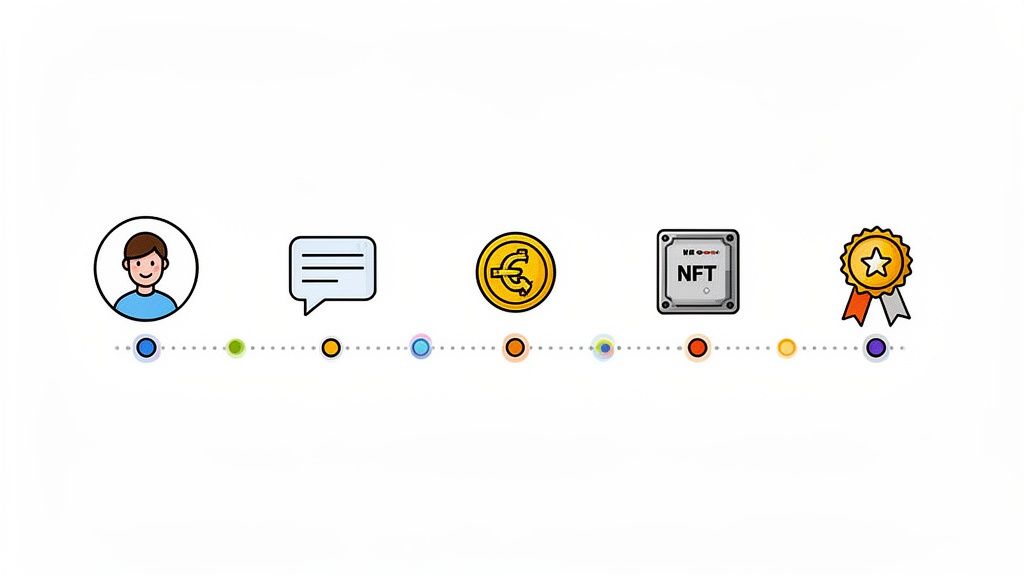
This is the kind of user journey we're aiming for—moving people from simple social stuff to real on-chain activity, all leading to a reward they actually care about.
The secret sauce? A compelling narrative that keeps people hooked. Think about launching a "New User Adventure" quest. It could kick off with something simple like joining your Discord, then level up to making their first on-chain transaction, and finally, culminate in a bigger action like staking an NFT. Each step should offer a small, instant reward, creating a satisfying feedback loop that makes them want to see what's next.
Crafting a Narrative for Your Quests
Instead of just dropping a list of tasks, wrap them in a story. It’s a subtle shift, but it can dramatically boost participation and make the whole experience feel less like a chore and more like an adventure.
The story you tell really depends on what you're trying to achieve.
- Want to educate users? Run a "Master the Protocol" campaign that walks them through your core features, rewarding them as they try each one out.
- Need more liquidity? Design a "Treasury Guardian" quest where people can earn special roles or NFTs for adding and maintaining their liquidity.
- Trying to build community? Launch a "Community Champion" event that rewards users for creating helpful guides, answering questions in Discord, or even hosting their own small meetups.
By giving your tasks a theme, you make participation feel less transactional and more like a genuine part of being in the community. If you need some inspiration, we've got a bunch of Web3 quest examples in our detailed guide to get your ideas flowing.
Blending On-Chain and Off-Chain Actions
The most effective campaigns don't live in a silo; they bridge a user's entire digital life. This means you need a smart mix of on-chain actions (which are easy to verify automatically) and off-chain tasks that build social proof and get people talking.
A successful quest isn't just about driving a single metric. It’s about building a habit. You want users to think, "What's new in the community today?" That curiosity is the foundation of a high DAU.
For example, a campaign might ask a user to first share a specific tweet (off-chain), then use a testnet version of your dApp (on-chain), and finally join a feedback channel on Discord (off-chain). This combo creates a well-rounded journey that delivers value to your product, marketing, and community teams all at once.
Building this kind of active Web3 community is the absolute cornerstone of boosting DAU. The data is clear: engagement is directly tied to retention and growth. That's why tracking things like social media activity and event participation is so important. In fact, a recent survey showed 76% of respondents believe Web3 will transform digital advertising in five years, with engaged communities as a key driver. TokenMinds has a great piece on why motivated communities see such sustained lifts in daily users.
Designing for Retention, Not Just Spikes
Look, a one-off campaign might give you a nice, temporary bump on your DAU chart. But we're playing the long game here. The real goal is sustained growth, and that means you need to think about your quest cadence. It’s not about one big launch; it’s about creating a consistent rhythm of engagement.
This is where a structured quest schedule is a game-changer.
- Daily Quests: These are your quick wins. Think "connect your wallet daily" or "react to today's announcement." The reward is small, but the goal is to build that crucial daily check-in habit.
- Weekly Quests: These can be a bit more involved, maybe requiring users to complete a series of smaller tasks throughout the week. A "weekly streak" bonus can be a huge motivator here.
- Special Event Quests: These are the big ones, tied to major announcements, product launches, or holidays. They're high-effort, high-reward campaigns designed to generate massive buzz and pull dormant users back into the fold.
By layering these different types of quests, you give every single user a reason to stay involved. Your power users will grind the special events, while casual members can still get that hit of accomplishment from knocking out the daily tasks. It’s this multi-tiered approach that turns a one-time visitor into a long-term, daily active user.
Creating a Frictionless Onboarding Experience
You can dream up the most brilliant, rewarding quest on the planet, but if people get stuck just trying to sign up, your DAU will flatline. Honestly, this is where most Web3 projects bleed users—the clunky, confusing, and frankly intimidating onboarding process.
Fixing this isn't just a minor tweak; it's one of the highest-impact things you can do to get more people sticking around.
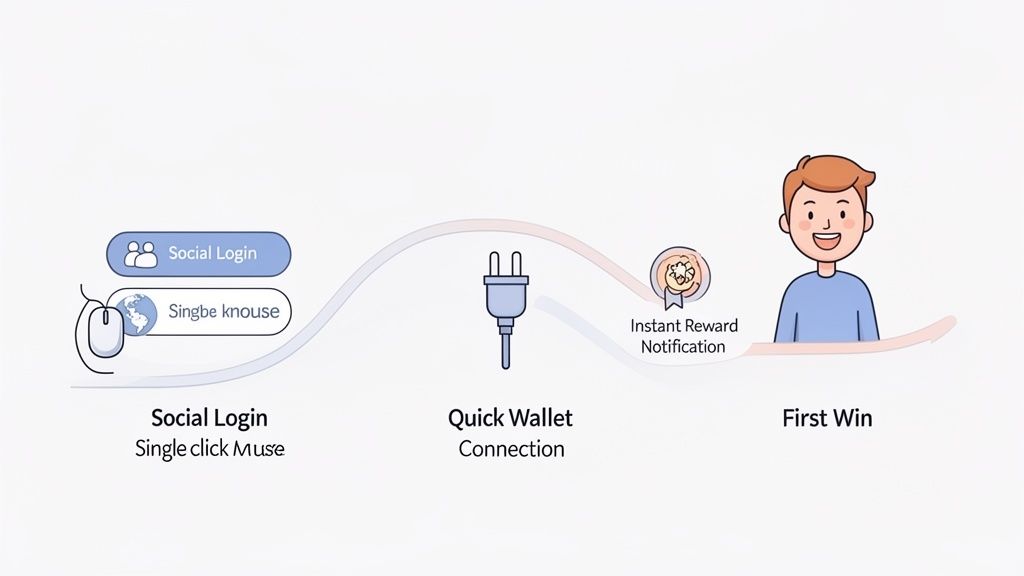
The real goal is to shrink the time-to-value down to just a few seconds. From the moment someone discovers your quest to the second they complete their first simple action, the entire journey has to be smooth and obvious. A single unnecessary click or one confusing instruction is all it takes for them to bounce and never come back.
Ditch the Hurdles with Social and Email Logins
Let's be real: the classic Web3 onboarding flow is a conversion killer for anyone outside our bubble. "Install a wallet, save this terrifyingly long seed phrase, connect..." It’s exactly where curiosity goes to die.
The solution is simple: meet people where they already are.
By integrating familiar options like social logins (think Discord, Twitter, or Google) and simple email sign-ups, you completely change the game. These methods feel safe and normal, which instantly lowers the barrier to entry. Instead of a multi-step, high-anxiety ordeal, a new user can join your community and start their first quest with a single click. Our own guide on using email logins for quests breaks down just how much this one change can make your conversion rates soar.
The most powerful onboarding is the one users don't even notice. The less they have to think, the more likely they are to stick around and become a daily active user.
Engineer an Early Win
Momentum is everything. A new user needs to feel a quick sense of progress and accomplishment within their first minute. This is the power of the "early win"—a dead-simple, rewarding first task that builds immediate confidence and gets them hooked.
This is not the time for a complex on-chain transaction. Your first quest should be ridiculously easy.
- React to an Announcement: Ask them to add an emoji to your latest post in Discord.
- Follow on Twitter: A simple social follow that takes two seconds flat.
- Join a Telegram Channel: A quick click to become part of the conversation.
The moment they complete this tiny task, they need to get an instant reward. It could be a small bit of XP or a "Welcome" badge, but that immediate positive feedback is addictive. It provides the motivation they need to dive into the next, more involved quest.
Eliminate the Verification Bottleneck
One of the most frustrating parts of older quest platforms was the waiting game. You'd complete a task, like sharing a tweet, and then sit around for hours—or even days—waiting for someone to manually verify it. This delay is a momentum killer and a huge reason why users drop off.
Modern platforms fix this by using AI-powered verification for social tasks. This gives users instant feedback and rewards, closing the loop immediately after they take action. Think about it: a user tweets about your project and, within seconds, a bot confirms their action and drops their reward. That instant gratification is a powerful tool for creating a great experience and encouraging people to come back every day.
In fact, simplifying onboarding with no-code tools and social integrations is a key trend driving DAU in Web3. The Web3 market, which hit $4.62 billion, is projected to soar to $99.75 billion by 2034, largely because user-friendly tools are finally removing these exact barriers. Platforms that offer frictionless quests across Telegram and Discord, enabling both on-chain and off-chain tasks without code, are leading this charge. You can discover more insights about Web3 development trends and see how they are shaping user adoption firsthand.
Keep Your Growth Engine Running: How to Automate and Iterate
Look, launching a killer quest campaign is a great start, but it's not the finish line. If you want real, sustainable growth, you can't just "set it and forget it." You've got to get into a rhythm of testing, learning, and optimizing. This is where you level up from just running campaigns to building a smart, automated growth engine that keeps your DAU climbing.
First things first: you have to get your team out of the weeds. Running quests, especially successful ones, involves a ton of repetitive, manual work. We're talking about verifying social tasks, dishing out rewards, and sending follow-up messages. It's a grind, and it's where automation becomes your new best friend.
Modern no-code tools can take all that tedious work off your plate. Think about it: automatically checking a thousand retweets, instantly sending NFTs to the right wallets, and dropping a personalized welcome message—all without anyone on your team lifting a finger. This isn't some far-off dream anymore. It's how you free up your team to stop being task-doers and start being growth strategists. If you want to go deeper on this, we've put together a solid guide on marketing automation best practices.
Get Into an Experimentation Mindset
Once you've got automation handling the grunt work, you can focus on what really moves the needle: iteration. The whole idea is pretty simple. You come up with a hypothesis, run a controlled test, and use the results to figure out your next move. It's how you stop guessing what your community wants and start knowing.
A simple experiment template can keep you honest and focused.
Hypothesis Template: We believe that changing [Variable X] to [Variable Y] will cause [Expected Outcome] because [Reasoning]. We'll track [Key Metric] to see if we're right.
Let's make that real.
- Hypothesis: We believe that changing our daily login reward from 10 XP points to a raffle ticket for a rare NFT will increase 7-day retention by 10% because the chance at a huge prize is way more exciting than a small, guaranteed one. We'll measure this by comparing the retention rates of two different user groups.
This kind of structured thinking turns your growth strategy from a shot in the dark into a methodical process, letting you make smart, data-backed decisions that actually improve your DAU.
Dig Into Your Campaign Data
Your analytics dashboard is a treasure map. It doesn't just show you what happened; it can help you understand why. By really digging into the numbers, you can spot which quests are home runs and which user groups are your biggest fans.
Start asking yourself some key questions as you look at the data:
- Which quests get completed the most? This tells you what your users actually enjoy doing (or find easiest).
- Where are people giving up? If a quest has a massive drop-off rate after step two, you've found a point of friction. It's probably too hard or just plain confusing.
- Which rewards actually bring people back? Are they more motivated by tokens, special Discord roles, or a shot at a big prize?
- How do different users behave? Maybe new folks love simple onboarding quests, while your power users are hungry for high-effort, high-reward challenges.
Answering these helps you do more of what works and ditch what doesn't. For instance, if you see new users bailing on quests that require on-chain transactions, that's your cue to make the onboarding flow all about simple, off-chain tasks. For more practical advice on this, the team at Rebel Growth has a ton of great content; you can find more actionable growth insights on their blog.
Build Automated Re-Engagement Flows
Finally, let's talk about winning back users who start to drift away. Instead of just letting them go dark, you can use automation to build re-engagement flows that trigger based on their inactivity.
This creates a system that's always on, actively working to keep your community engaged and your DAU from dipping.
| If This Happens... | ...Then Automatically Do This | The Goal Is To... |
|---|---|---|
| User is inactive for 3 days | Send a "Come Back & Earn" push notification or email with a quest offering bonus XP for a simple task. | Nudge them back into a daily habit before they forget about you completely. |
| User finishes onboarding but doesn't start another quest | After 24 hours, pop up an in-app message highlighting a popular and easy quest. | Gently guide them from just signing up to becoming a real, engaged participant. |
| User hasn't connected a wallet after 7 days | Trigger an email explaining why connecting a wallet is a good idea, with a direct link to a quest that rewards it. | Help them get over the hurdle and become a fully-fledged on-chain member of your community. |
This proactive, automated approach is the final piece of your growth machine. It works around the clock to turn casual visitors into loyal daily users, building a community that's not just big, but strong and resilient.
Answering Your Top Questions About DAU Growth
Once you get serious about growing your daily active users, the real questions start popping up. It's one thing to talk strategy, but it's another thing entirely to get your hands dirty and make it work.
Here are the most common questions we hear from Web3 marketing and community teams in the trenches, along with some straight-up answers.
What’s a Realistic DAU Growth Rate to Expect?
Honestly, there's no magic number. It really depends on where your project is at. A brand-new dApp is going to see way higher percentage growth than a more established one, and that's totally normal.
That said, a well-planned initial quest campaign can easily deliver a 20-50% lift in your DAU within the first month. The real trick isn't just getting that spike; it's keeping it. For instance, if you run a campaign for a 7-day login streak and see a 30% jump, the real win is holding onto 10-15% of that gain as your new, higher baseline.
Think of it this way: sustainable growth comes from consistent, smaller wins that compound over time, not one-off, massive launches.
How Do I Offer Rewards Without Draining My Treasury?
This is the big one, right? The ultimate balancing act. The key is to get creative and stop thinking every reward has to be a token payout that hits your bottom line.
Focus on rewards that have a high perceived value to your community. These often work even better than small token drops because they're about status and access, not just cash.
- Exclusive Discord Roles: A classic for a reason. They give people bragging rights and recognition.
- Raffle Entries for a Valuable NFT: The thrill of a potential big win can be way more exciting than a guaranteed tiny reward.
- Early Access to New Features: This makes your most dedicated users feel like true insiders.
- Unique POAPs (Proof of Attendance Protocol): People love collecting these digital badges to prove they were there.
For the rewards that do involve tokens, set up a tiered system. Simple tasks get a small taste, but high-value actions—like providing liquidity or making a governance vote—get the bigger prizes. Always tie your most valuable rewards to actions that directly benefit your ecosystem.
When you do this, your rewards system stops being an expense and becomes a smart, sustainable investment in your community.
How Much Technical Skill Is Needed to Run These Campaigns?
Almost none. And that's a massive change from how things used to be. Not too long ago, you needed to pull in a developer for pretty much any on-chain growth campaign, which created a huge bottleneck for marketing and community teams.
Today, no-code platforms have torn that wall down. If you can write a social media post or build a simple form, you've got all the technical chops you need to design and launch a sophisticated quest campaign.
Tools like Domino handle all the messy backend stuff—smart contract pings, API integrations, task verification—through a simple visual interface. This means marketers and community managers can finally own the growth engine from start to finish. You can go from idea to live campaign in minutes, not weeks, and spend your brainpower on creative strategy instead of technical headaches.
What Metrics Should I Track Besides DAU?
DAU is your north star, no doubt. But it doesn't tell you the whole story. To really understand what’s going on and where the leaks are, you need to keep an eye on a few other key numbers.
- Retention Rate (Day 1, 7, and 30): This tells you if users are actually sticking around. High DAU with terrible retention just means you have a very leaky bucket.
- Stickiness Ratio (DAU/MAU): This is your Daily Active Users divided by your Monthly Active Users. It’s a great way to see how often your core users come back. A ratio over 20% is pretty good for most apps, and if you're hitting above 50% in Web3, you're crushing it.
- Activation Rate: What percentage of new users complete that first critical action you want them to take (like finishing their first quest)? This shows you how effective your onboarding really is.
- Campaign Completion Rate: Of all the people who start a quest, how many actually finish? This helps you figure out which campaigns are truly engaging and which ones might be too confusing or boring.
Tracking these KPIs together gives you a complete dashboard for your community's health. It lets you stop guessing and start pinpointing exactly where you need to focus your efforts.
Ready to stop guessing and start growing? With Domino, you can launch powerful, automated quest campaigns in minutes—no code required. Design your growth engine, engage your community, and watch your DAU climb. Start building for free on Domino