Unlocking Growth With Enterprise Loyalty Software
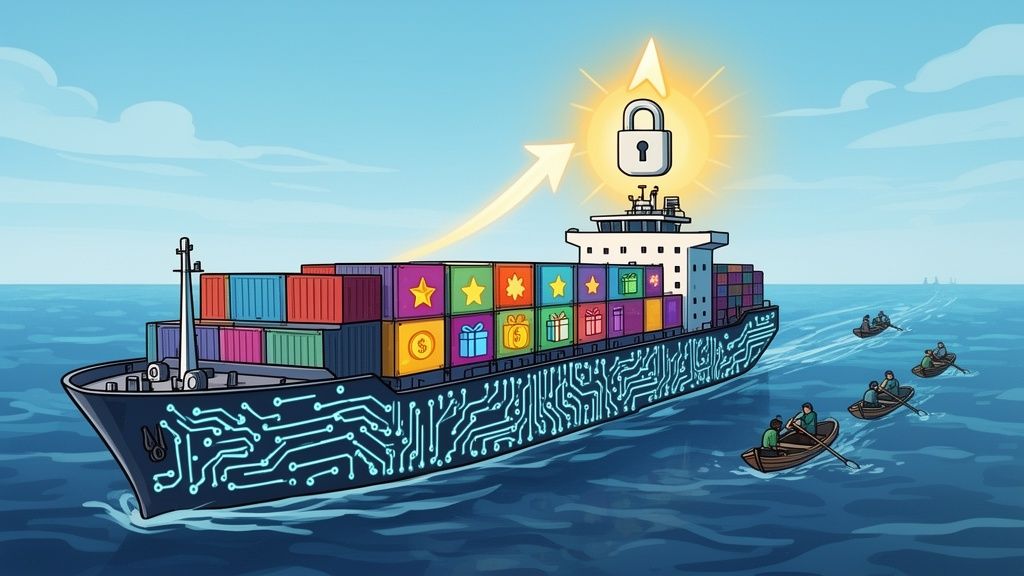
So, what exactly is enterprise loyalty software? Think of it as the central command center for a company’s entire customer relationship and rewards universe. It’s not just a simple tool; it's a fully integrated platform built to manage millions of customers, complex reward systems, and the heavy-duty data analytics that global brands rely on.
Moving Beyond Digital Punch Cards
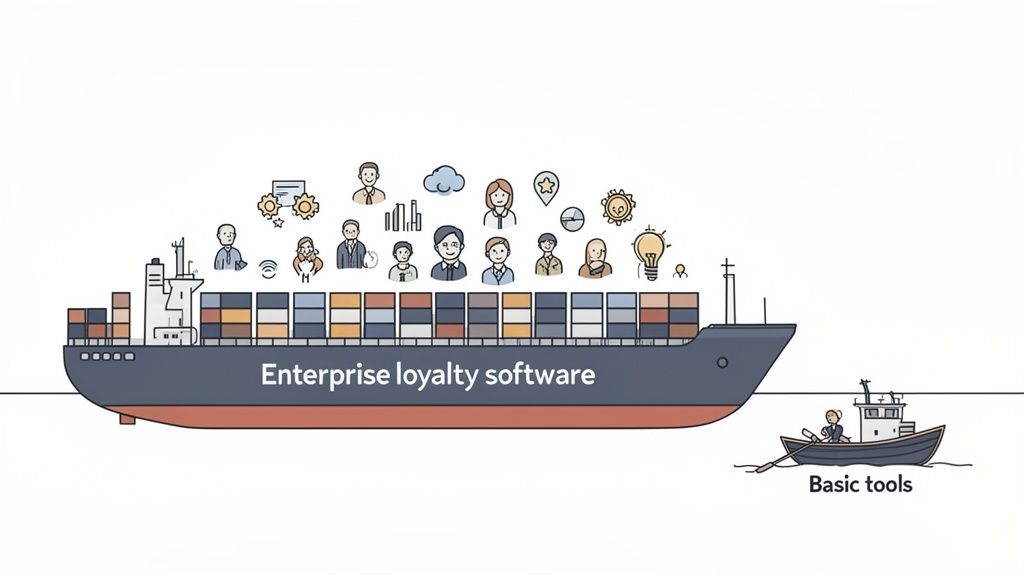
We've all seen basic loyalty tools. They're like a digital punch card—a simple spreadsheet or a small app that works perfectly for the local coffee shop. It's the rowboat of the loyalty world: great for a small pond but totally out of its depth in the open ocean.
When you're dealing with a massive, global customer base, that rowboat sinks fast. Enterprise loyalty software, on the other hand, is the container ship. It’s built from the ground up to handle the immense scale and complexity of global commerce, managing millions of customer interactions across different countries and securely carrying a priceless cargo of customer data.
Why Scale Demands a Different Approach
At the enterprise level, loyalty is so much more than just tossing points at people for buying stuff. It’s about deeply understanding the entire customer journey and forging a real connection that creates lasting value. This isn't something you can fake with a simple tool. You need a system that can:
- Handle massive data volumes: We're talking about tracking and making sense of every single interaction for millions of customers, all without grinding to a halt.
- Integrate seamlessly: It has to plug right into your core business systems—your CRM, ERP, and marketing automation platforms—to create one unified view of the customer.
- Offer deep personalization: Use all that rich customer data to deliver rewards and experiences that feel personal and relevant, not just another generic discount.
- Ensure robust security: Protecting sensitive customer information and staying compliant with global data privacy rules like GDPR isn't optional; it's table stakes.
This is the big shift: moving from one-off, transactional rewards to building data-driven relationships. And that’s exactly where enterprise solutions shine. The market is exploding for a reason. Valued at USD 12.5 billion in 2024, it’s expected to skyrocket to USD 77.4 billion by 2034. That kind of growth shows just how critical these platforms have become for big business.
An enterprise platform transforms your loyalty program from a simple marketing tactic into the central nervous system of your customer relationship strategy. It's about building an ecosystem, not just a points system.
Standard vs Enterprise Loyalty Software At a Glance
The difference really comes down to capability and strategic depth. While basic tools focus on the immediate transaction, enterprise systems are architected for long-term, sustainable growth. Understanding broader client relationship management strategies helps put into perspective how these powerful platforms fit into the bigger picture.
Here’s a quick table to break down the key differences between the two.
| Feature | Standard Loyalty Tools | Enterprise Loyalty Software |
|---|---|---|
| Scalability | Limited to thousands of users; performance degrades with volume. | Built to handle millions of users and transactions globally. |
| Customization | Basic branding and simple "earn-and-burn" rules. | Fully customizable reward logic, tiers, UI, and branding. |
| Integrations | Limited, often relying on simple plugins or basic APIs. | Deep, native integrations with CRM, ERP, CDP, and marketing stacks. |
| Analytics | Surface-level metrics like sign-ups and points redeemed. | Advanced analytics, predictive modeling, and customer segmentation. |
| Security | Basic security protocols, often unsuitable for enterprise needs. | Enterprise-grade security, compliance certifications (SOC 2, ISO 27001). |
In short, while both aim to foster loyalty, one is a bandage and the other is a comprehensive health and wellness plan for your customer relationships.
The Core Features That Make or Break a Modern Loyalty Program
When you’re picking out enterprise loyalty software, you’re not just buying a tool; you’re investing in the engine that’s going to power your customer relationships. There are a few features that are absolutely non-negotiable. Think of them as the pillars holding up a program built for real growth, not just earning points.
The bedrock of any serious system is its ability to create a single, unified view of each customer. This isn’t a nice-to-have, it’s the price of entry. This is only possible through deep, native integrations with your most critical platforms—specifically your Customer Relationship Management (CRM) and Customer Data Platform (CDP).
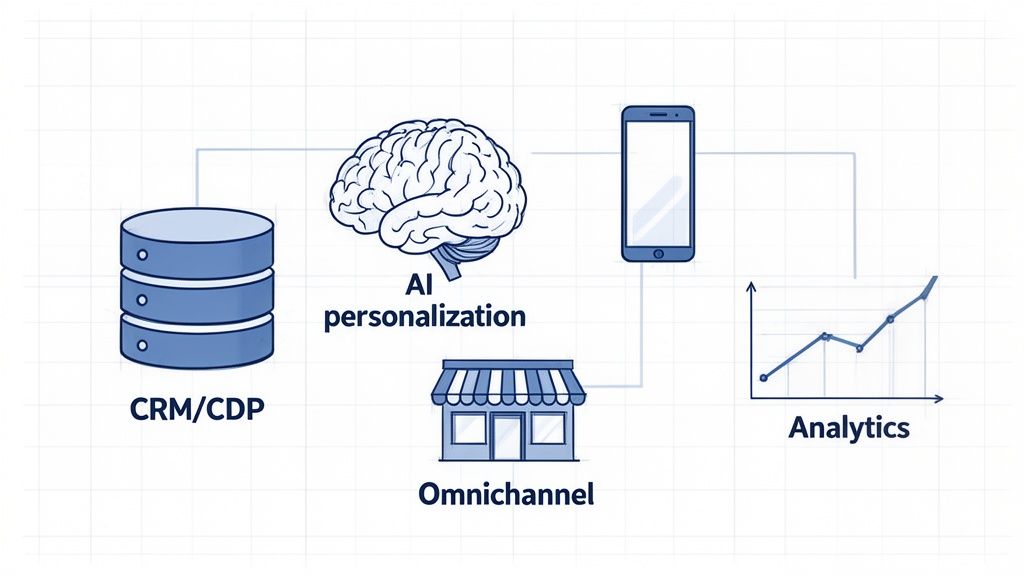
We're not just talking about syncing a contact list here. It's about a constant, two-way conversation where loyalty data makes your customer profiles smarter, and in return, that rich customer data fuels genuinely personal loyalty experiences. This foundation is so critical that companies are racing to get their data infrastructure in order, which is why CDP adoption is skyrocketing.
AI-Powered Personalization
Once you have that unified customer view, the real fun begins. Modern loyalty programs have moved way past just greeting a customer by their first name in an email. They use Artificial Intelligence (AI) and machine learning to craft one-to-one experiences that feel genuinely thoughtful.
It's like the difference between a generic coupon and your favorite barista remembering your usual order, but also suggesting a new single-origin roast they know you'll love. AI does that, but for millions of customers at once. It digs into customer behavior to predict what they’ll do next, recommend things they actually want, and send offers that hit the mark every time.
AI flips the script on loyalty. Instead of just rewarding past purchases, it proactively anticipates what a customer needs next, making them feel truly seen, not just tracked.
This predictive muscle turns your loyalty program into a powerful engine for growing customer lifetime value. It helps you spot your VIPs who deserve extra love and flags customers who might be about to leave, giving you a chance to step in with the perfect offer to win them back.
Omnichannel Experience Orchestration
Customers today don’t live in a single channel. Their journey weaves fluidly between browsing on their phone, adding to a cart on their laptop, and maybe making the final purchase in a physical store. Omnichannel orchestration is all about making sure your loyalty program shows up consistently and works flawlessly at every single one of those touchpoints.
It means a customer can earn points online and redeem them on the spot in-store with their mobile app. It means their VIP status gets them the same great service whether they're dealing with a chatbot or a store manager. This seamlessness is what builds trust and removes friction, creating a brand experience that just works, no matter how someone chooses to engage with you.
Advanced Segmentation and Analytics
Finally, any enterprise-level loyalty software worth its salt has to give you deep, actionable insights. You need to know more than just what is happening; you need to understand why it's happening and what you should do about it. That requires a robust analytics suite that digs deeper than surface-level vanity metrics.
You should be looking for platforms that offer:
- Advanced Segmentation: The power to group customers based on sophisticated criteria—think purchase history, engagement levels, location, and even predicted lifetime value.
- ROI Dashboards: Clear, visual reports that draw a straight line from your loyalty program activities to bottom-line business goals like revenue growth and retention.
- Behavioral Analytics: Tools that let you map out the entire customer journey, so you can see the patterns that lead to bigger spending and long-term loyalty.
For example, a brand could use these tools to launch a hyper-targeted campaign that rewards customers for both engaging on social media and making a purchase in the same week. By exploring how to create reward-based quests on platforms like Domino—where you can build these experiences without code—you can see how this combo of smart segmentation and gamification can send engagement through the roof. It’s this data-driven approach that lets you constantly test, learn, and fine-tune your program for maximum impact.
How To Measure Your Loyalty Program ROI
So, you've got a loyalty program. Is it actually making you money, or is it just another expense on the marketing spreadsheet? The only way to know for sure is to connect your efforts directly to the bottom line. It's time to look past surface-level numbers like how many people signed up and start tracking the Key Performance Indicators (KPIs) that really get the C-suite's attention.
Figuring out the real Return on Investment (ROI) of your enterprise loyalty software is how you build a rock-solid business case. It’s how you prove, with cold, hard data, that loyalty is a major driver of sustainable growth. The good news? This isn't some theoretical fantasy. The results are in, and they're impressive.
In fact, a staggering 90% of loyalty program owners are seeing positive returns, with the average program bringing in 4.8 times its initial investment. This kind of financial performance is exactly why loyalty has become a top priority for big companies. If you're curious about the data behind these numbers, you can find more customer loyalty statistics that paint a very compelling picture.
Ditching the Vanity Metrics
To get a real sense of your ROI, you need to track metrics that show a genuine shift in customer behavior. These are the numbers that prove your program is doing more than just handing out discounts—it's actively shaping how people engage with your brand.
Three core metrics are the bedrock of any serious ROI calculation:
- Customer Lifetime Value (CLV): Think of this as the total profit you can expect from a single customer over the entire time they do business with you. When the CLV of your loyalty members starts climbing, you know you're on the right track.
- Customer Churn Rate: This is the percentage of customers who walk away over a certain period. A great loyalty program acts like glue, giving people compelling reasons to stick around and bringing that churn rate down.
- Average Order Value (AOV): This one's simple—it’s the average amount a customer spends every time they check out. Loyalty programs are brilliant at boosting AOV, often by nudging members to add just one more item to hit a reward threshold.
When you put these KPIs together, they tell a powerful financial story. If your loyalty members are consistently spending more, staying longer, and buying more often than everyone else, you’ve got undeniable proof of a positive ROI.
The Back-of-the-Napkin ROI Formula
While you can build incredibly complex financial models, you don't need to. You can get a clear snapshot of your program's health with one straightforward formula. All you're doing is comparing the money you're making from the program against what it costs to run it.
Loyalty Program ROI = (Financial Gain from Program - Cost of Program) / Cost of Program
Let's unpack that a bit. "Financial Gain" is the extra profit you're seeing from higher CLV, bigger AOV, and the money you're saving by preventing customers from leaving (reduced churn). The "Cost of Program" is everything you spend to keep it running: software fees, the cost of the rewards people redeem, marketing campaigns, and any admin time.
For example, if your program brought in an extra $500,000 in profit and cost you $100,000 to operate, your ROI is a whopping 400%. This simple math completely changes the conversation from "How much are we spending?" to "Look at the incredible value our loyalty investment is creating."
Key Loyalty Program KPIs and How to Track Them
Knowing what to measure is half the battle. This table breaks down the most important KPIs, what they really mean, and why they're so crucial for proving the value of your enterprise loyalty software.
| Metric (KPI) | What It Measures | Why It Matters for ROI |
|---|---|---|
| Customer Lifetime Value (CLV) | The total predicted profit from a customer over their entire relationship with your brand. | A rising CLV for loyalty members directly proves the program is creating more valuable customers over time. |
| Churn Rate | The percentage of customers who stop purchasing from you within a specific time frame. | Lower churn means higher retention. This metric shows how effectively the program is saving customer relationships and their future revenue. |
| Average Order Value (AOV) | The average amount a customer spends per transaction. | A higher AOV among members shows the program successfully incentivizes larger purchases, directly boosting top-line revenue. |
| Purchase Frequency | How often a customer makes a purchase within a defined period. | Increased purchase frequency is a strong indicator of loyalty and directly contributes to a higher CLV. |
| Redemption Rate | The percentage of issued points or rewards that are actually used by customers. | This measures program engagement. A healthy redemption rate suggests customers find the rewards valuable and are actively participating. |
By keeping a close eye on these metrics, you're not just running a loyalty program—you're managing a profit center. You'll have the data you need to make smarter decisions, optimize your strategy, and prove its worth to anyone who asks.
Your Implementation and Integration Roadmap
Rolling out a new enterprise loyalty platform can feel like a monster project. But if you break it down with a clear, step-by-step roadmap, it becomes a much more manageable process. A successful launch really comes down to three things: careful planning, clean data, and making sure it plays nicely with all your other tech. The whole point isn’t just to switch on a new piece of software; it's to create a seamless flow of information that makes your entire business sharper.
Think of it like adding a new wing to your corporate headquarters. You wouldn't just show up and start laying bricks without a detailed blueprint. The same logic applies here. The journey unfolds in a few logical phases, each one setting the stage for the next.
Phase 1: Discovery and Stakeholder Alignment
Before anyone touches a single line of code, the most important work has to happen: getting everyone on the same page. This first phase is all about agreeing on what a "win" looks like and getting buy-in from every key department—marketing, sales, IT, finance, you name it.
At this stage, you'll sit down with your software partner and hammer out the details:
- Define clear business goals: What specific numbers are you trying to move? Are you focused on boosting Average Order Value (AOV) or cutting down churn? Get specific.
- Map out technical requirements: What systems absolutely have to talk to each other? What data needs to flow where?
- Establish a realistic timeline: Break the entire project into smaller milestones, assign clear owners, and set deadlines that people can actually meet.
Skipping this foundational work is a classic mistake. When expectations are misaligned from the start, you're just asking for scope creep and painful delays.
Phase 2: Data Migration and System Integration
Once you have a solid plan, the real technical work begins. This is where your new loyalty platform gets plugged into the rest of your business. The core of this phase is integrating with your essential systems, like your CRM, ERP, and any marketing automation tools you're using.
A massive part of this is data hygiene. You're about to move a ton of customer data from old systems into the new one. This is your golden opportunity to clean house—get rid of duplicates, fix errors, and standardize formats. Trust me, clean data is the fuel for personalization, so spending time on this now will pay off big time later.
You can see below how a well-integrated system is what allows you to measure the metrics that actually matter, like CLV, churn, and AOV. It’s how you’ll ultimately prove your ROI.
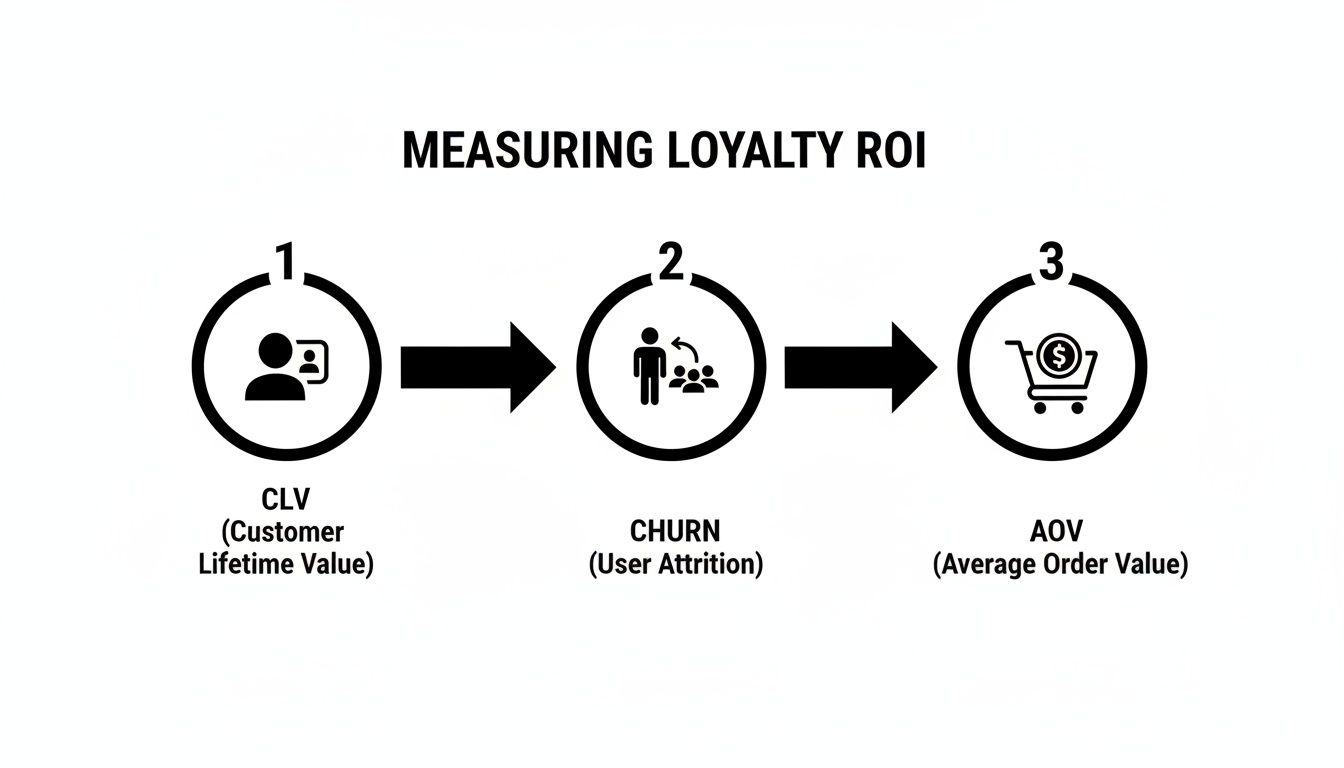
This simple flow shows how a proper implementation directly feeds into tracking the financial outcomes that justify the whole program.
Phase 3: Testing and Launch
With the integrations built and your data in place, it’s time to put the system through its paces. A formal User Acceptance Testing (UAT) phase lets your team run through real-world scenarios to catch any bugs or clunky workflows before a single customer ever sees it.
After a successful UAT, you can move toward a phased rollout or go for a full launch. This part also includes training your internal teams—customer service, marketing, etc.—on how to actually use the new platform. A lot of companies find it helpful to start with pre-built campaign templates to get some quick wins. If you want some ideas, you can always browse a library of reward-based apps and quests to see what’s possible.
And remember, implementation isn't a "one and done" deal. The best loyalty programs are living things, constantly being tweaked and improved based on real performance data and what your customers are telling you.
How Web3 Is Reshaping Customer Loyalty
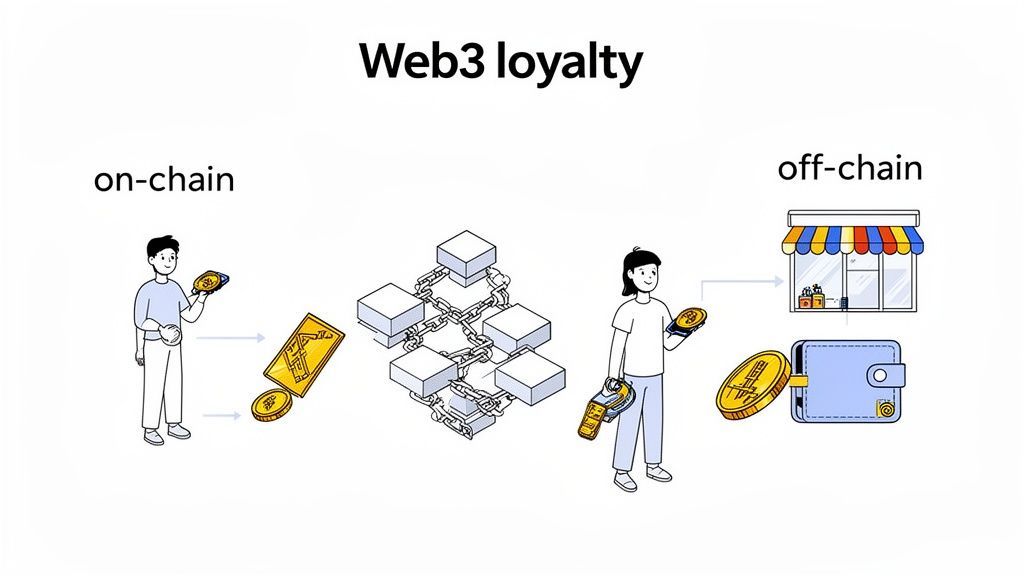
The next big thing in customer loyalty is already here, and it's built on a totally different playing field. Forget the old, closed-off systems where brands call all the shots. Web3 technologies—things like blockchain, NFTs, and digital tokens—are flipping the entire script. Loyalty is no longer just something a brand gives you; it’s becoming an asset that you, the customer, actually own.
Think about it. What if your loyalty points weren't stuck in one company's app? What if they had real value you could trade, sell, or even use with other brands? That's the big idea behind Web3 loyalty. We're moving from a simple transactional relationship to one built on shared ownership and a genuine stake in a community.
This new model brings concepts to the table that just weren't possible before, creating a much more engaging and sticky customer experience. The rewards aren't just temporary perks anymore; they're durable digital assets that live on a blockchain, completely separate from the company that first issued them.
From Points to Portable Assets
In any traditional loyalty program, the brand holds all the cards. They dictate the rules, control what points are worth, and can change the game whenever they feel like it. And if that company goes under? Your hard-earned rewards vanish with it.
Web3 completely changes this dynamic by introducing verifiable digital ownership. When you earn a reward—maybe it's a unique NFT for being a top customer or tokens for completing a task—that asset gets recorded on a public blockchain and sent straight to your personal digital wallet. You're in full control.
Suddenly, a whole new world of possibilities opens up:
- True Portability: Customers can actually take their rewards with them. Since they own the asset, they could potentially use it in another brand's ecosystem or trade it on an open market.
- Provable Scarcity: A brand can drop a limited-edition NFT for its top 100 customers, and the blockchain proves that only 100 will ever exist. This creates real, verifiable exclusivity and drives up value.
- Community Governance: Some programs are even using tokens to give customers a say in future products or brand decisions. This turns people from passive consumers into active, invested community members.
This shift has a powerful psychological effect. When customers feel like they own a small piece of the brand, their loyalty deepens, and they naturally become its biggest advocates.
Bridging the Gap for Enterprises
Now, this all might sound incredibly technical and out of reach, but modern enterprise loyalty software is specifically built to make this transition painless. You don't need a team of blockchain developers on standby to launch a sophisticated Web3 campaign anymore.
Web3 isn't just some far-off concept; it's a practical toolkit you can use today to build deeper, more resilient customer communities. Modern platforms handle all the technical heavy lifting, letting marketers get back to what they do best: creating amazing experiences.
These platforms are the essential bridge, connecting the marketing actions you're already familiar with to the new world of on-chain tech. Marketers can design entire campaigns using intuitive, no-code interfaces that feel just like the tools they use every day.
For example, a company could easily create a reward-based quest that mixes different types of engagement. A customer might earn a special digital collectible by completing a few simple tasks, all verified automatically by the software:
- On-chain task: Prove they hold a specific NFT in their digital wallet.
- Off-chain social task: Like and retweet a specific company post on X (formerly Twitter).
- In-app action: Make a purchase or use a key feature within the brand’s own mobile app.
As Web3 loyalty evolves, it's clear that community and social interaction are at its core. Bringing in specialized social engagement applications can seriously boost how many people participate in these kinds of multi-step quests.
Once all the tasks are done, the platform's smart contracts automatically kick in and send the reward directly to the customer's wallet. This kind of automation removes all the friction and creates a seamless experience that feels more like a game than a marketing campaign. All the while, you’re building a powerful, verifiable record of customer loyalty. It’s simply a smarter way to engage, reward, and keep your most valuable customers coming back.
Choosing The Right Enterprise Loyalty Software
Picking your tech partner is easily one of the most critical decisions you'll make when building a new loyalty program. This isn't just about buying a piece of software. It's about finding a platform—and a team—that can grow and adapt right alongside your business. The right choice can supercharge your strategy, but the wrong one will hamstring you from day one.
To help you cut through all the marketing fluff, you need a solid checklist. Think of this as a decision framework to guide your conversations during demos and sales calls. It’ll help you ask the tough questions and make sure you land on a solution that actually fits your long-term goals, whether you're focused on traditional loyalty or dipping your toes into Web3.
Evaluating Technical Capabilities
First things first, you have to look under the hood. A platform's technical guts determine its real power and flexibility. You need total confidence that the software can handle your current customer base and scale up for the future without skipping a beat.
Here are the absolute must-haves to dig into:
- Platform Scalability: Can this thing handle millions of customers and transactions without crashing? What happens during a Black Friday-level traffic spike?
- Deep Customization: Are you getting a true "white-label" experience where you can tailor every reward, tier, and pixel to match your brand? Or are you just stuck with some glorified templates?
- Robust API and Integrations: Look for a solution built with an API-first mindset. It absolutely must play nice with your existing systems—your CRM, CDP, marketing automation tools, the whole shebang.
The real magic of enterprise loyalty software is its ability to plug into your entire tech stack. A platform that operates in a silo is a strategic dead end.
Assessing Security and Support
Beyond the flashy features, you need to be sure the vendor is serious about security and is ready to be a real partner. This is where trust comes in. A platform could have every bell and whistle imaginable, but if it’s not secure or the support team is MIA, it's a massive risk.
Don't be shy about asking for proof of their security and compliance credentials. Certifications like SOC 2 and ISO 27001 are the gold standard here; they show a vendor is truly committed to protecting your data. This isn't just a technical checkbox—it's fundamental to keeping your customers' trust.
Then, you need to evaluate the people behind the platform:
- Vendor Support and Training: What does their support actually look like? Are you getting a dedicated customer success manager? Do they provide real training to get your team up to speed?
- Future Product Roadmap: Ask them about their vision for the future. A vendor worth partnering with will be thinking ahead, especially about new frontiers like AI-driven personalization and Web3 integrations.
At the end of the day, you're not just buying software; you're choosing a partner to help you build better, stronger customer relationships. A transparent vendor will be upfront about their capabilities and how they price their solution. To get a feel for how different features impact the bottom line, it's a good idea to explore various enterprise software pricing models to find a fit for your budget. A little due diligence now ensures you find a solution that's built for the long haul.
Got Questions? We've Got Answers
Diving into enterprise loyalty software can feel like a lot. Let's clear things up by tackling the most common questions we hear from business leaders just like you.
How Long Does It Take To Implement Enterprise Loyalty Software?
There’s no magic number, but you can generally expect a full enterprise rollout to take somewhere between 3 to 9 months. What really sets the pace is the complexity of your business and how many different systems you need to plug into.
We're talking about a multi-stage process here: discovery and planning, getting the system configured just right, integrating with your existing tech stack (like your CRM and ERP), moving customer data over, testing everything, and then the big launch. The integration part is usually the trickiest and most time-consuming. Pro-tip: look for a platform with a solid API and pre-built connectors—it can save you a world of headaches and speed things up considerably.
Can This Software Integrate With Web3 Technologies?
You bet. The best enterprise loyalty platforms are now built to play nicely with Web3 technologies. This is usually done through APIs that connect the loyalty software to various blockchains, smart contracts, and digital wallets.
For marketers, this is where things get really interesting. You can start rewarding customers for things they do on-chain, like holding a specific NFT or casting a vote in a DAO. It’s all about blurring the lines between traditional loyalty and the new world of digital ownership, making for a much deeper and more engaging customer experience.
What Is The Biggest Mistake To Avoid With A Loyalty Program?
Easy. The absolute biggest mistake is getting stuck on transactional discounts and forgetting to build a real, emotional connection with your customers. If your program is just a race to the bottom on price, you're going to lose.
A great loyalty program is about so much more than saving a few bucks. It should offer exclusive experiences, early access to products, or create a genuine sense of community. Programs that only compete on price are incredibly fragile; they give customers no reason to stay loyal when a competitor dangles a slightly bigger discount.
How Does AI Improve A Loyalty Program?
Think of Artificial Intelligence as a supercharger for your loyalty program. It makes hyper-personalization possible at a scale you could never manage manually. AI crunches all your customer data to figure out what they might do next, then automatically suggests the perfect offer, piece of content, or reward for each person.
AI is also a rockstar at segmentation. It can instantly spot different customer groups, like identifying your VIPs who deserve some extra love or flagging customers who are about to churn so you can swoop in with a smart re-engagement campaign. On top of that, AI helps automate things like fraud detection and customer support, making the whole operation run smoother.
Ready to build a loyalty program that people actually love, without all the technical heavy lifting? With Domino, you can design and launch reward-based quests in minutes. Check out our no-code Web3 community toolkit and see how it works at https://domino.run.