How to Create a Rewards Program for Web3 That Drives Growth
So, you want to build a Web3 rewards program. The whole process really boils down to three big pieces: figuring out your goals, designing the right quests, and picking the best platform to run it all. Think of it as a value exchange—you’re giving something to your community, and in return, you're turning them from passive followers into genuine, active contributors.
Building a High-Impact Web3 Rewards Program: Your Foundation
Launching a rewards program in Web3 can feel a bit like herding cats, but a solid plan is your best friend. It’s not just about throwing out some basic social media tasks. To build something that actually adds value, you have to anchor the entire program to clear, measurable goals. This way, every single quest has a purpose.
What are you actually trying to achieve? Are you hunting for new users? Pushing for specific on-chain actions? Or maybe you just want to build a die-hard community. The best projects I've seen link their goals directly to the rewards. For instance, if you need more on-chain liquidity, you could reward users who provide it on a particular DEX. If brand awareness is the name of the game, reward awesome user-generated content instead.
Nailing Down Your Core Components
A great program is all about balance. Don't just ask for retweets. The most successful strategies blend on-chain and off-chain quests to guide users through a complete journey. An off-chain task might be as simple as hopping into your Discord. An on-chain one could be staking an NFT or swapping tokens on your dApp. This mix makes the program easy for newcomers to get into while still offering deeper challenges for your power users.
This diagram lays out the basic flow I follow, moving from high-level strategy to the nuts and bolts of execution.
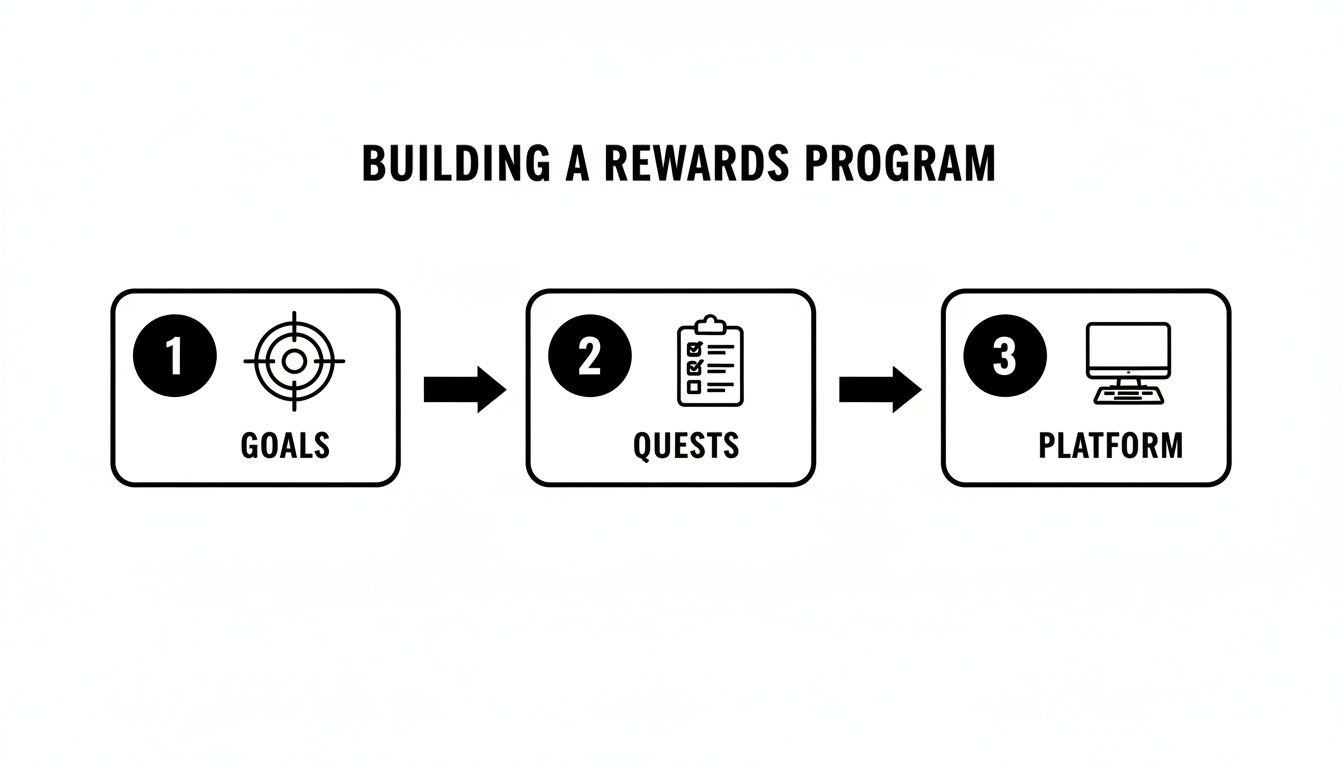
As you can see, it’s a pretty linear process. Your goals dictate what kind of quests you create, and those quests help you decide which platform makes the most sense.
Why This Matters Right Now
It helps to understand just how big this space is getting. The global loyalty market is on a tear, projected to grow by 15.9% annually and hit a staggering US$93.79 billion by 2025. For those of us in Web3, that’s a massive wave to ride. It means we should be designing quests that tap into that growth—think on-chain staking challenges or social share campaigns with automated verification to spark viral loops.
My two cents: Your rewards program isn't just another marketing gimmick. It's a fundamental part of your growth engine. It’s designed to transform passive lurkers into active, on-chain participants who are genuinely invested in your ecosystem.
Choosing where to host your program is a huge decision, too. Do you need a dedicated web portal, or would a bot inside Discord and Telegram get the job done? The answer usually comes down to where your community already lives. For a much deeper look at this, check out our complete guide on Web3 loyalty programs.
This is where tools like Domino become invaluable. They let you automate all the tedious quest verification and help you scale up your community engagement without losing your mind. This is how you start turning followers into true contributors. Consider this your strategic starting point.
Figure Out Your Goals Before You Promise Any Rewards
Let's be real. A rewards program without a clear objective is just a money pit. You'll be burning through resources without knowing if you're actually moving the needle. Before you even think about what shiny rewards to dangle in front of your community, you have to nail down what success actually looks like for your project. This is your "why."
And I don't mean vague, feel-good goals like "boost engagement." That's useless. You need to get specific and set targets you can actually track.
Is your main focus on growing your community? A solid goal would be: "Increase active Discord members by 30% in the next 60 days." What if you're all about getting people to use your protocol? A much better target is: "Drive 10,000 new wallet connections to our dApp this quarter." Each of these points you in a completely different strategic direction.
Designing Rewards People Actually Want
Once you know exactly what you're trying to achieve, you can start designing the "what"—the actual rewards that will get your community excited enough to help you hit those goals. This isn't just about handing out prizes; it's a bit of a psychology game. Every reward you offer sends a powerful signal about what your project values and what kind of behavior you want to see.
It's tempting to just airdrop some tokens and call it a day, but that’s a rookie mistake. The best programs offer a diverse menu of incentives that appeal to everyone, from the crypto-curious newbie to your most hardcore, ride-or-die loyalists. A smart structure blends real, tangible value with the kind of exclusive access and status that money can't always buy.
Think about mixing and matching from these categories:
- Financial Incentives: This is the most straightforward stuff. We're talking stablecoins (USDC/USDT), your project's native token, or even a valuable NFT. They provide clear, immediate financial value.
- Access-Based Perks: These rewards are all about exclusivity. This could be a highly sought-after whitelist spot for a new mint, a sneak peek at new features, or a chance to get into a beta test before anyone else.
- Status and Recognition: Seriously, don't sleep on the power of social capital in Web3. Things like unique Discord roles, flashy on-chain badges, or a spot on the community leaderboard can be huge motivators for your most dedicated members.
The magic really happens when you connect these rewards directly to your goals, creating an obvious path for users to follow.
A well-designed rewards program creates this awesome feedback loop. The more someone participates to earn rewards, the more invested they become in your project's success. It totally changes the dynamic from a simple transaction to a real partnership.
This kind of thoughtful approach pays off, big time. In fact, crafting a solid rewards program can deliver a killer ROI. Data shows 83% of program owners report positive returns that average a whopping 5.2x on their investment. And get this—members of top programs who redeem rewards end up spending 3.1x more annually than non-members. You can dig into more loyalty program trends and see how the best programs manage to boost user revenue by 15-25% every single year.
Mapping Rewards to Your Web3 Goals
To make this super practical, you need to draw a straight line from your objectives to the rewards you're offering. This table should help you visualize how different goals can be tackled with specific reward types and quests.
| Project Goal | Primary Reward Type | Example Quest (using Domino) | Why It Works |
|---|---|---|---|
| Increase Community Size | Financial & Access | "Join our Discord & invite 3 friends for a 10 USDC reward." | Offers a simple, low-friction financial incentive that directly drives member growth. |
| Boost Protocol Adoption | Native Tokens & NFTs | "Bridge at least 0.1 ETH to our L2 to earn 100 $TOKEN." | Encourages on-chain activity by rewarding users with a stake in the protocol's success. |
| Improve User Retention | Status & Recognition | "Complete 10 weekly quests to earn the 'DAO Veteran' role." | Gamifies long-term participation and rewards consistency with a visible sign of status. |
| Drive Social Engagement | Whitelist Spots | "Like & RT our announcement tweet for a chance to win a WL spot." | Taps into the high demand for exclusive access to amplify your message on social media. |
Thinking through these connections ensures every reward has a purpose. You’re not just giving things away; you’re strategically guiding your community to take the actions that matter most.
Structuring Reward Tiers to Keep Everyone Hooked
Look, not every community member is on the same level of commitment, and your rewards shouldn't treat them that way. A tiered system is a brilliant way to keep everyone in the game. It basically creates a ladder of achievement that encourages people to stick around and climb higher.
For instance, you could break it down like this:
- Bronze Tier: For the newcomers and casual lurkers. Think a unique Discord role, a small token reward, or an entry into a basic raffle.
- Silver Tier: For your active participants. Maybe a whitelist spot for a partner project, a slightly bigger token drop, or access to an exclusive chat channel.
- Gold Tier: For the power users and true advocates. This is where you offer a guaranteed mint spot, a significant token bonus, or early access to a new protocol feature.
- Diamond Tier: For your absolute top contributors. Reward them with something truly special, like an exclusive 1-of-1 NFT, direct feedback sessions with the core team, or even a small share of protocol fees.
A tiered structure like this makes the program feel welcoming for beginners while also providing juicy, long-term goals for your most valuable supporters. It makes sure every reward feels earned and every action contributes to a greater sense of progress and belonging in your ecosystem.
Designing Quests That Actually Get People Hooked
Let's be real: the quests you design are the heart and soul of your rewards program. Just asking for a follow or a like is lazy. Sure, it's low-hanging fruit, but it won't build a loyal, die-hard community. If you want to build a program with real staying power, you have to get creative and design tasks that are purposeful and get progressively more interesting.
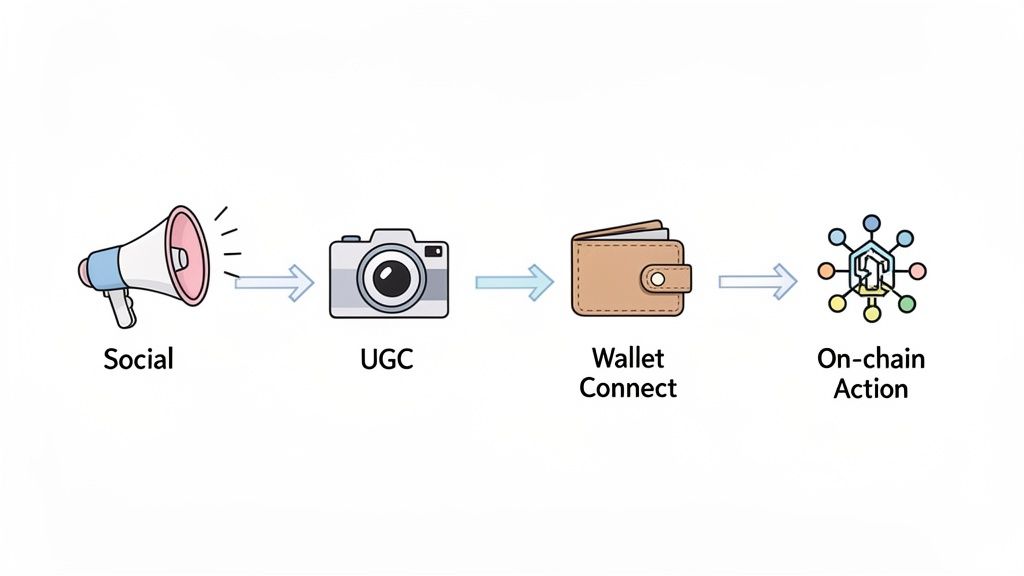
This is about moving beyond the generic and thinking about the user's journey. The best programs don't just throw a random to-do list at people; they guide them from simple, easy wins to meaningful contributions that actually help the project grow.
Balancing Off-Chain Buzz with On-Chain Action
Your questboard needs a healthy mix of two main ingredients: off-chain and on-chain tasks. Getting this balance right is critical because it gives everyone a way to get involved, regardless of their crypto comfort level.
Off-chain quests are your handshake. They’re perfect for building awareness and getting the community vibe going. Think of them as the top of your funnel, introducing new people to what you're building without making them connect a wallet right out of the gate.
Instead of the tired "Like and Retweet," try something with more substance:
- UGC Contests: Ask your community to fire up their creativity. Get them making memes, educational threads, or short videos about your project. Reward the best ones.
- Community-Led Events: Empower your most passionate members to host their own Twitter Spaces or AMAs, and reward them for taking the lead.
- Real Feedback: Create quests that ask for genuine thoughts on your whitepaper or a new feature mock-up. You get valuable insights, they get rewarded.
To make sure these social tasks actually create a stir, it’s a good idea to incorporate proven social media engagement strategies into your quest design.
Now, on-chain quests are where things get serious. These are the actions that directly drive protocol usage, boost your key metrics, and transform lurkers into active, invested participants.
Here are a few examples of powerful on-chain quests:
- Protocol Interaction: Verify a user has swapped at least $20 worth of tokens on your DEX.
- Staking and Liquidity: Reward users for staking an NFT from your collection or adding liquidity to a key pool.
- Governance Action: Give users a reward for voting on a recent governance proposal.
These tasks are gold because they show real product adoption. Someone who completes them is truly invested in your ecosystem's success.
To help you build a balanced and engaging questboard for your community, here’s a quick comparison of different task types you can use.
On-Chain vs Off-Chain Quest Ideas
| Quest Category | Task Example | Complexity | Best For |
|---|---|---|---|
| Social Engagement | Like and retweet a specific project announcement. | Low | Boosting visibility and reach quickly. |
| Content Creation (UGC) | Create a meme or short video about the project. | Medium | Generating authentic community content. |
| Community Building | Invite 5 friends to the Discord server. | Low | Organic, word-of-mouth growth. |
| Product Feedback | Provide detailed feedback on a new UI mockup. | Medium | Gathering valuable user insights. |
| Simple On-Chain | Swap any amount of tokens on our DEX. | Medium | Encouraging first-time protocol interaction. |
| Liquidity & Staking | Stake at least 1 NFT from our collection. | High | Deepening user investment and TVL. |
| Governance | Vote on an active governance proposal. | High | Fostering a sense of community ownership. |
Ultimately, a good mix makes your program accessible to newcomers while still offering a challenge for your dedicated power users.
Building a Path from Newbie to Power User
The most successful rewards programs don't just dump a list of tasks on their users. They design a journey. They guide people from being curious observers to becoming protocol champions.
Think of it like a video game. The first level is a breeze, just teaching you the controls. The later levels? They test your skills and demand real commitment.
My Two Cents: Structure your quests in tiers. Start with dead-simple social tasks to build confidence. Then, introduce a "Connect Wallet" quest as the bridge to the next level. Finally, roll out the more complex on-chain quests that drive your core metrics.
This tiered approach keeps you from scaring off beginners while still offering a real challenge for your crypto-native supporters. The goal is to make it feel like an ongoing adventure, not a one-and-done checklist.
Why You Absolutely Cannot Skip Automation
Here’s a hard truth I’ve learned: manually verifying thousands of quest submissions is a complete nightmare. It’s slow, full of errors, and it just doesn't scale. If you're serious about this, automation isn't a "nice-to-have"—it's a must from day one.
Just try to imagine confirming that 10,000 people actually retweeted your announcement or swapped a token on your DEX. You’d need an army of interns and a whole lot of coffee.
This is exactly why a no-code platform like Domino is a lifesaver. It automates the entire verification process, both on-chain and off-chain.
- For Off-Chain Tasks: Domino uses AI to automatically check things like tweets, Discord messages, and user-generated content, freeing up countless hours for your team.
- For On-Chain Tasks: It plugs directly into the blockchain to instantly confirm actions like token swaps, staking, or smart contract interactions with 100% accuracy.
Automating verification means you can build a rewards program that’s fun, fair, and can handle massive growth without burning out your team. It lets you focus on what really matters: designing killer Web3 quests that build a community that lasts.
Choosing the Right Platform for Your Community
Where your community actually interacts with your rewards program is a huge decision. User experience is everything. If you get this wrong, even the most brilliantly designed quests will fall flat.
Your choice boils down to a classic dilemma: Do you prioritize speed and convenience, or deep branding and control? There’s no single "best" answer here, just the right fit for your project’s current stage, budget, and community vibe. The key is to meet your users where they already hang out, making it as easy as possible for them to jump in and start earning.
Established Platforms Like Zealy
Platforms like Zealy have become the go-to starting point for tons of Web3 projects, and for good reason. Their main draw is a massive, built-in audience. You’re tapping into a pre-existing pool of quest-hunters who already know the interface and are actively looking for new projects.
This approach has some pretty clear upsides:
- Speed to Market: You can spin up a questboard and launch your program in a matter of hours, not weeks. The entire infrastructure is ready to go.
- Built-in Discovery: Your project gets immediate visibility with a crypto-native crowd. It’s a surprisingly effective user acquisition channel.
- Simplicity: The backend is simple enough for non-technical folks to manage campaigns, review submissions, and track everything without bugging an engineer.
Here’s a peek at the Zealy interface, which is basically a big marketplace of project communities and their questboards.
The whole layout is built for discoverability, letting users hop between different project "communities" to see what’s on offer. The trade-off, of course, is that your brand is just one among many. It can be tough to build a unique, memorable experience when you’re sharing the stage.
White-Label Portals for Maximum Brand Control
For projects that want a completely seamless user journey, a white-label portal is the way to go. This gives you a dedicated, custom-branded website just for your rewards program. Think of it as your own private Zealy, where your project is always the star of the show.
The real power here is owning the entire user experience. Every font, color, and quest card is perfectly aligned with your brand identity. This feels far more professional and makes the rewards program seem like a core part of your ecosystem, not some third-party add-on. For a deeper look, you can explore the different things to consider when picking a https://domino.run/blog/loyalty-program-platform that can handle this kind of customization.
A white-label solution signals a higher level of maturity and investment in your community. It tells your users that you're serious about building a long-term relationship with them.
Of course, this path used to require a ton of dev work. But with a no-code solution like Domino, you can launch a fully branded portal without writing a single line of code. You get the best of both worlds: total brand control without the engineering headache.
Integrated Bots in Discord and Telegram
Why force your community to leave their favorite app? Instead of sending users to an external website, you can bring the quests directly to them inside Discord or Telegram. This is the most native, frictionless approach you can take. You’re literally meeting them where they spend all their time.
Using a bot, members can see quests, submit their proof, and check the leaderboard with simple slash commands. It’s an incredibly powerful way to drive quick, in-the-moment engagement. Someone sees a new quest announcement in your Discord, and two seconds later they're done—without ever switching windows.
Connecting Your Program to Your Marketing Stack
Your rewards program shouldn’t be an island. It’s a data-generating machine that needs to be plugged into your entire growth toolkit. Any modern rewards platform worth its salt has to integrate with the tools you’re already using.
This means hooking your program up to:
- Your CRM: To see which of your most valuable users are also your biggest fans in the rewards program.
- Analytics Tools: To measure how completing quests actually impacts on-chain activity or product usage.
- Social Platforms: To automate all the "follow us on X" and "retweet this" tasks.
When you're thinking about the tech behind your rewards program, it helps to look at broader guides on Marketing Tech Stacks. You’ll see how a platform like Domino acts as a central hub, using no-code integrations to connect all the pieces and turn your rewards program into a true growth engine.
Launching, Measuring, and Scaling Your Program
Alright, you've put in the work. The quests are designed, the platform is chosen, and you're ready to go. Now for the fun part: the launch. But hold on—a successful launch isn't just a single tweet fired off into the void. It’s a full-blown campaign, carefully orchestrated to build hype, show your community what's in it for them, and drive a huge wave of people to your questboard on day one.
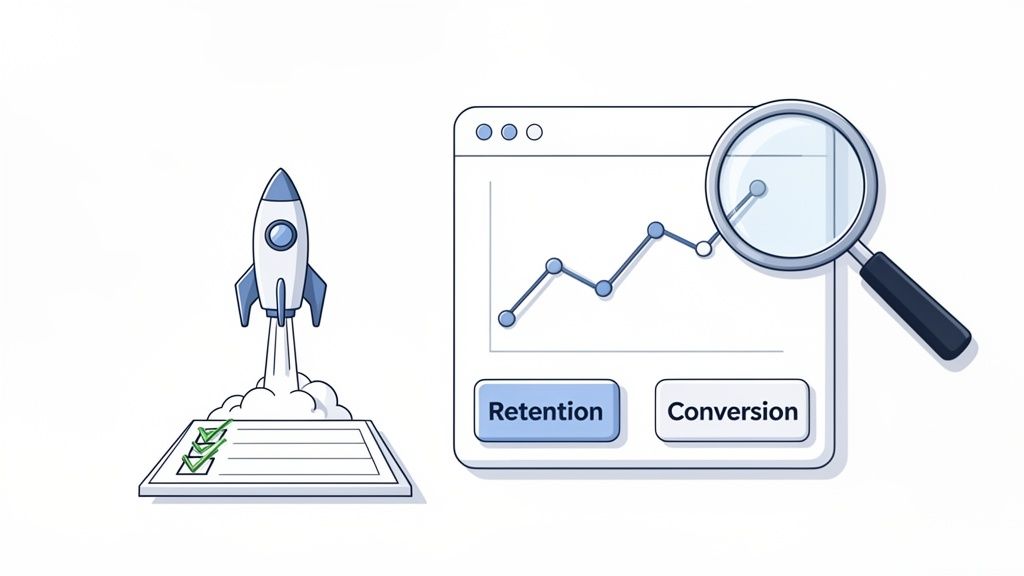
I like to think of it as a three-act play: the build-up (pre-launch), the main event (launch day), and the encore (post-launch). Nail all three, and you won't just get a spike in activity; you'll kickstart a self-sustaining growth engine.
Crafting a High-Impact Launch Campaign
Your launch needs to feel like an event. Start dropping breadcrumbs a week or two out. Tease some of the juicy rewards on X, share sneak peeks of the questboard in Discord, and get your community speculating about what's coming. Build that anticipation.
When the big day arrives, it’s time to make some noise. This is your moment for a coordinated, multi-channel push.
- Official Blog Post: Kick things off with a detailed article. This is your chance to explain the "why" behind the program, break down how it works, and showcase what people can actually earn.
- X Announcement: Get a clear, punchy tweet pinned to your profile. Include a link directly to the questboard and a killer graphic that grabs attention.
- Discord & Telegram: Drop a formal announcement. I’d even recommend locking the channel for a few minutes so the message doesn't get buried. Follow it up with a quick AMA to clear up any immediate questions.
- Collaborations: This is key. Have your partners, KOLs, and influencers ready to share the news with their audiences at the exact same time.
The whole point is to create a concentrated blast of energy that makes your program impossible to miss. But the work doesn't stop there. Once the initial splash is over, you have to keep that momentum going with weekly quest drops, leaderboard shoutouts, and maybe even a few surprise rewards to keep things fresh.
Focusing on Metrics That Truly Matter
Once your program is live, data is your new best friend. It’s incredibly easy to get distracted by vanity metrics like the total number of participants or a spike in Twitter impressions. To figure out if your rewards program is actually working, you need to zero in on the KPIs that signal real, sustainable growth.
Your dashboard should tell a story about user behavior, not just user count. Are people just farming the easy social tasks, or are they actually bridging, swapping, and becoming true participants in your ecosystem?
Here are the core metrics I’m constantly watching for any rewards program:
- Quest Completion Rate: Of all the users who start a quest, what percentage actually finish it? If you see a big drop-off, it’s a red flag that the task might be too hard or the reward isn’t compelling enough.
- On-Chain Conversion: This is the big one. What percentage of your participants complete at least one on-chain action? This is the ultimate test—it shows you’re successfully turning curious followers into active protocol users.
- User Acquisition Cost (UAC): This is just simple math: divide the total value of the rewards you've given out by the number of new active users you've acquired. It tells you exactly how efficient your program is at its primary job.
- Long-Term Retention: Are people sticking around? I always track how many participants from week one are still knocking out quests in week four. High retention is the hallmark of a healthy, engaging community, not just a one-off airdrop farm.
These numbers give you a brutally honest look at what’s resonating and what’s falling flat, which is exactly what you need to start making smart, data-driven improvements.
Optimizing and Scaling Your Growth Engine
A rewards program is not a "set it and forget it" machine. It’s a living, breathing system that needs constant attention and fine-tuning. Relentless optimization is what separates a decent program from an unstoppable one.
The feedback loop is pretty straightforward: launch, measure, analyze, and iterate.
See a quest with a terrible completion rate? Dig in and find out why. Is the UI confusing? Is the reward too low for the effort involved? Don't be afraid to kill quests that aren’t pulling their weight and pour more resources into the ones that are driving real on-chain activity.
A/B testing is your secret weapon here. Try offering different types of rewards for the exact same task to see what moves the needle. For instance, pit a 10 USDC reward against a coveted whitelist spot and see which one gets more people to complete a tricky on-chain task.
And don’t forget to actually talk to your users. Create a dedicated channel in your Discord just for program feedback and suggestions. You'll be amazed at the brilliant ideas your community comes up with—they'll tell you exactly what motivates them if you just give them a place to do it.
As you start to identify these winning formulas, you can confidently begin to scale. Introduce more complex, multi-step questlines. Launch bigger, seasonal campaigns with higher-stakes rewards. Bit by bit, you’ll turn that initial pilot program into a massive, ongoing growth machine that consistently brings high-quality, engaged users into your ecosystem.
Answering Your Questions About Web3 Rewards Programs
Even with the best-laid plans, you're going to have questions. When you're figuring out how to set up a rewards program, especially in the Web3 space, a few common concerns always seem to bubble to the surface. Let's dig into what project founders and marketers ask most, so you can move forward with a clear head.
So, How Much Does This Actually Cost?
Honestly, the cost can swing wildly. If you go the route of a fully custom, built-from-scratch solution, you could be looking at tens of thousands of dollars just for the development. On the flip side, using a no-code platform like Domino makes it way more affordable and faster to get a really effective program off the ground.
Your budget is really going to boil down to two things:
- Platform Subscription: This is what you pay for the software that powers everything—the engine that runs, tracks, and automates your quests.
- Reward Pool: This is the pot of gold. It’s the total value of whatever you're giving away, whether that's tokens, stablecoins, NFTs, or other cool perks.
The best way to approach budgeting? Work backward. Start with your user acquisition goals. Figure out what you're willing to pay per user, and then map out the potential return on that investment.
A quick pro-tip: Don't overlook the operational savings. Using tools that automatically verify quests will save you an unbelievable amount of time and money that would otherwise be spent on tedious manual work. This is a huge factor in the true cost of running your program and seriously boosts your potential ROI.
What are the Biggest Mistakes People Make?
I've seen a lot of projects stumble over the same hurdles. The number one mistake, without a doubt, is launching a program without any clear, measurable goals. If you're just throwing rewards at people for random social tasks that don't lead to meaningful on-chain actions, you're basically just burning cash. It creates a lot of noise but no real, lasting value.
Another classic pitfall is lazy reward design. If your rewards feel cheap, boring, or are nearly impossible to earn, you’ll demotivate your community right out of the gate. In this game, the perception of value is absolutely everything.
Finally, so many teams underestimate the sheer operational lift of doing it all manually. Trying to verify thousands of submissions for a single popular quest isn't just a headache; it's a nightmare. If you want to scale and keep your sanity, an automated system is non-negotiable.
How Quickly Can I Expect to See Results?
You can actually see some results almost immediately. For simple off-chain quests, like a big push for retweets, you'll often see a nice spike in engagement within the first 24 to 48 hours. This initial buzz is fantastic for getting your name out there and capturing new attention.
But the results that really move the needle take a little more time to bake in.
Metrics that truly signal a healthy, growing ecosystem—like a real increase in on-chain transactions, better user retention, or a bump in protocol revenue—usually take a few weeks to a month to become clear in your analytics. A great program creates a kind of flywheel effect: the first wave of activity pulls in new users, who then participate and draw in even more people, creating a cycle of sustained, long-term growth.
Ready to build a rewards program that drives real growth without the technical headaches? With Domino, you can design, launch, and automate powerful Web3 quests in minutes. Start building your community today.