How to Create a Loyalty Program for Your Web3 Community
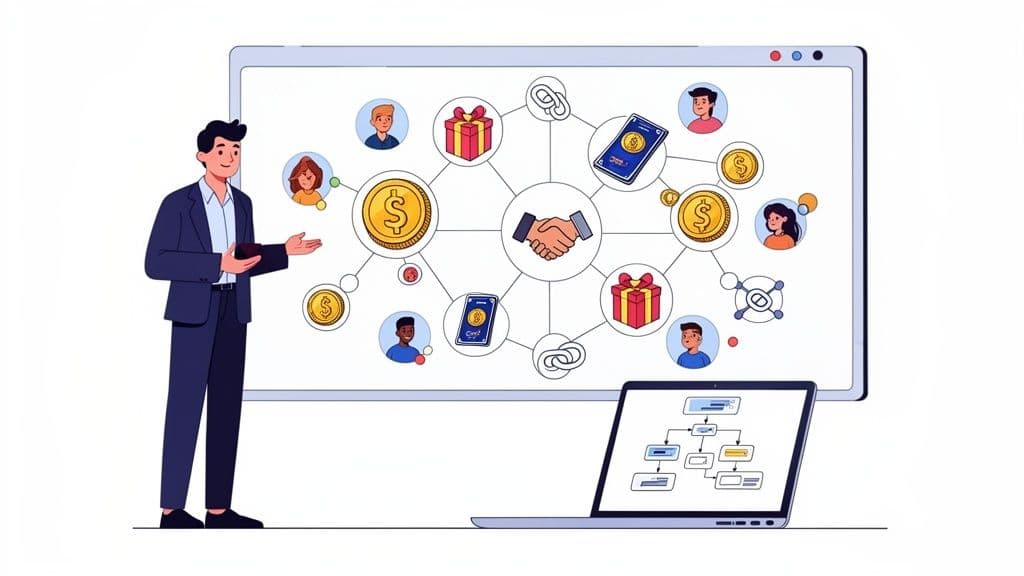
So, you're thinking about launching a Web3 loyalty program? Good. It might seem like a huge undertaking, but it’s more straightforward than you might imagine. The whole game is about setting clear goals, figuring out rewards people actually want, and then putting the entire system on autopilot.
This guide is your blueprint for doing just that—turning a simple idea into a loyalty engine that practically runs itself and drives real growth for your project.
Your Blueprint for a Thriving Web3 Loyalty Program
Let’s be honest, loyalty programs aren't new. Over 90% of companies already have one. It’s a massive market, on track to blow past $41.21 billion by 2032, all because people crave more personal and engaging brand experiences.
But this is where Web3 projects have a serious edge. You can move way beyond the boring "buy 10, get one free" model. Instead, you can offer rewards that are woven directly into the fabric of your ecosystem, creating a gamified journey that people genuinely enjoy.
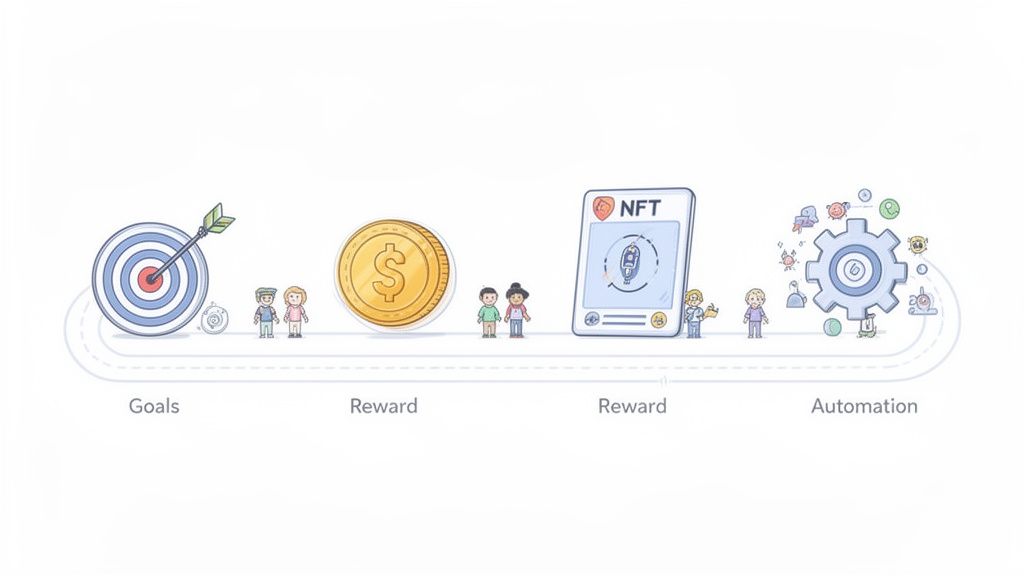
To get there, you need a solid plan. I've broken down the core components you need to think about into a simple table. It’s a quick-glance guide to what truly matters when you're building from the ground up.
Key Pillars of a Web3 Loyalty Program
| Pillar | What It Means | Example Action |
|---|---|---|
| Clear Goals | Defining what you actually want to achieve. | "We need to increase our token staking by 25% in Q3." |
| Target Audience | Knowing exactly who you're building this for. | "Focus on our active Discord members who hold our Gen 1 NFT." |
| Reward Mechanics | Deciding how people earn and what they get. | "Complete 5 social quests to earn a limited-edition POAP." |
| Smart Tokenomics | Ensuring your rewards are sustainable and don't wreck your economy. | "Cap the monthly reward pool at 1% of the total supply." |
| Task Mapping | Connecting on-chain and off-chain actions to your goals. | "Tweet about our new feature (off-chain) and vote on a proposal (on-chain)." |
| Automation | Using tools to verify tasks and distribute rewards automatically. | "Use a platform like Domino to verify retweets and airdrop rewards." |
| KPIs & Iteration | Tracking what works and what doesn't so you can improve. | "Monitor the quest completion rate and adjust difficult tasks." |
Think of these pillars as your foundation. Get them right, and the rest of the structure will be solid.
Defining Your Core Objectives
Before you dream up a single quest, stop and ask yourself: What is the number one thing we need to accomplish? Seriously, this is the most important question. Your answer will guide every single decision you make from here on out.
Maybe you want to...
- Boost On-Chain Activity: Get more people staking, providing liquidity, or minting your latest NFT drop.
- Drive Social Engagement: You need more eyeballs, so you design quests around retweets, content creation, or just getting people active in Discord.
- Turn Holders into Advocates: It's time to transform those passive wallets into true believers who vote on proposals and spread the word.
Knowing your "why" is the difference between a program that feels like a bunch of random chores and one that feels like a core part of your community's identity.
The best loyalty programs I've ever seen aren't just about transactions; they're about relationships. They make people feel seen and valued, turning them from users into true fans who will go to bat for you.
Connecting Actions to Rewards
Once you've got your goals locked in, you can start mapping out the specific actions you want your community to take. The real power comes from blending on-chain and off-chain activities. For instance, a user could earn XP for participating in a Telegram raid (off-chain) and then get a bonus multiplier for staking the tokens they already hold (on-chain).
The magic is making the verification and payout process seamless. This is where tools like Domino come in, using AI to confirm social tasks while also connecting to wallets to check for on-chain actions. No manual spreadsheets, no headaches.
As you build out your plan, remember that a strong community is the bedrock of any successful loyalty program. It's worth looking into essential community building strategies to make sure you're fostering the right environment. This section is just the starting point—your roadmap to the key pillars we're about to explore in detail.
Designing Rewards and Tokenomics That Actually Work
Alright, this is where the fun begins. The reward system is the engine of any loyalty program, but with Web3, you get to build a high-performance machine. We're moving past the days of collecting digital stamps for a free coffee. Your audience is smarter than that. They want real value, true ownership, and a tangible piece of the upside.
The trick is to stop thinking in terms of simple discounts and start thinking like a community builder. What really gets a crypto-native audience excited? We're talking exclusive NFT mints for the most dedicated members, airdrops tied to meaningful contributions, or even giving them a say in your project's future through governance. These aren't just perks; they're invitations to go from a user to a co-owner.
Moving Beyond Points to Web3-Native Incentives
Your rewards need to feel authentic to your brand and the culture you're building. If you just slap some generic offerings on top, they'll fall flat because they don't connect with what makes your project special.
Let's brainstorm a few ideas that actually work:
- Exclusive NFT Access: This is a classic for a reason. Offer whitelist spots or even free mints to your most active community members. It’s a powerful way to reward loyalty with a scarce digital asset that could become incredibly valuable.
- Token Airdrops: Airdropping your native token to people who complete high-value quests is a direct way to get them financially invested. Suddenly, your project's success is their success.
- Governance Power: This is the ultimate reward in a decentralized world. Granting voting rights or proposal power to top contributors gives them a real voice. You're not just giving them a reward; you're giving them influence.
- Role-Based Perks: Never underestimate the power of social capital. Using Discord roles to unlock private channels, alpha chats, or direct access to the team can be just as motivating as financial incentives.
Think about it this way: a traditional coffee shop program gives you a free latte after ten purchases. A great Web3 program might give you a vote on the next single-origin bean they source. One is a transaction; the other is a partnership.
Building a Sustainable Economic Model
Killer rewards are great, but they're useless without a sustainable economic model to back them up. This is where your tokenomics comes in—it’s the art and science of designing a healthy economy for your program. So many projects rush this part and end up with a hyperinflated token that alienates their earliest and most loyal supporters. Don't be one of them.
The biggest challenge you'll face is managing the emission schedule—that's just the fancy term for how quickly you release new rewards into the wild. Flood the market with too many tokens, and the price will tank. Be too stingy, and nobody will bother participating.
Your tokenomics model isn't just an add-on; it's the economic backbone of your entire community. Get it right, and you'll create a flywheel where engagement drives value, and that value inspires even more engagement.
I like to think of the reward pool as a reservoir. You have to carefully control the outflow (rewards) to make sure it never runs dry and that the water (your token) stays clean and valuable. If you're still getting your head around the fundamentals, it's worth taking a deeper look into how tokens and cryptocurrency work at their core.
Structuring Tiers and Balancing Rewards
One of the smartest things you can do is set up a tiered system. Let's be honest, not all members contribute equally, and your rewards shouldn't treat them that way. A well-designed tier system gives people a clear ladder to climb, motivating them to deepen their engagement to unlock better and better perks.
Here’s a simple framework you could totally steal and adapt:
| Tier Level | Contribution Example | Potential Reward |
|---|---|---|
| Bronze | Joins Discord, follows on X, completes 5 basic social quests. | A unique Discord role and a small airdrop of 25 tokens. |
| Silver | Holds at least one project NFT, active in chat for 30 days. | Access to an alpha channel and a 5% boost on future quest rewards. |
| Gold | Staked 1,000+ tokens for 3 months, voted on a governance proposal. | Whitelist spot for the next mint and a 10% reward boost. |
| Diamond | Top 10 on the monthly leaderboard, actively helps new members. | A 1-of-1 honorary NFT and direct line to the founding team. |
This kind of structure provides a clear progression path. A brand-new member can immediately see what it takes to get to the next level, which gamifies the whole experience and turns passive observers into active participants. The key is to find that sweet spot where each tier feels achievable but still aspirational. That’s how you build lasting value for everyone involved.
4. Weaving On-Chain and Off-Chain Actions into Your Program
A killer Web3 loyalty program doesn’t just live on the blockchain. It has to connect the dots between all the places your community hangs out—from the chaotic energy of social media to the verifiable proof of on-chain activity. This is where we get tactical and start mapping out the actual tasks people will complete to earn rewards.
The trick is to think about it like a complete journey. Someone new to your project might dip their toes in with a few simple social tasks, but as they get more bought-in, they'll be ready for higher-impact, on-chain actions.
Mixing Social Buzz with Real On-Chain Value
The most magnetic loyalty programs are a cocktail of on-chain and off-chain tasks. This creates multiple ways for people to get involved, so you’re not just catering to the crypto-native whales. Everyone, from your hardcore stakers to your newest followers, should feel like they can contribute and get rewarded.
Think about creating a "questline" that starts with easy, off-chain stuff:
- Amplify Your Message: Reward people for simple actions like liking, retweeting, or commenting on a huge announcement on X.
- Fuel the Content Machine: Give incentives for creating and sharing hilarious memes, slick GIFs, or quick videos about your project.
- Rally the Troops: Organize and reward coordinated engagement (think "raids") on platforms like Telegram or Discord.
These off-chain activities are your bread and butter for building awareness and making your social channels feel alive. Getting this right means understanding the platform dynamics—digging into how brands leverage X for community building can give you a ton of ideas to plug directly into your loyalty program.
Once you have their attention, you can guide them toward on-chain tasks that show a deeper commitment:
- Become a Holder: A classic for a reason. Reward users just for holding a project NFT or a certain amount of your token.
- Support the Protocol: Incentivize actions that genuinely help your ecosystem, like staking tokens or providing liquidity.
- Have a Voice: The ultimate goal is active participation. Reward users for voting on a DAO proposal and give them a real stake in the project’s future.
This balanced approach ensures you're not just paying for social noise—you're driving real, tangible value that shows up on the blockchain.
Nail Your Verification (Without Losing Your Mind)
So, how do you actually confirm all this happened? This is the question that trips up so many projects. Without the right tools, your team can quickly find themselves drowning in a sea of manual checks, spreadsheets, and headaches.
The secret sauce of a modern Web3 loyalty program isn't just the quests themselves. It's the invisible, automated verification that makes it all feel seamless. When someone retweets and gets rewarded seconds later, it feels like magic.
This is where a platform like Domino really shines. By using AI and direct wallet integrations, these systems take the entire verification nightmare off your plate.
An AI model can instantly see if someone retweeted your post or reacted in Discord. At the same time, the system can ping a user's wallet to confirm they're holding the right NFT or staking the required tokens. It completely removes the manual work, slashes the risk of fraud, and lets your team focus on building a great program, not checking off boxes.
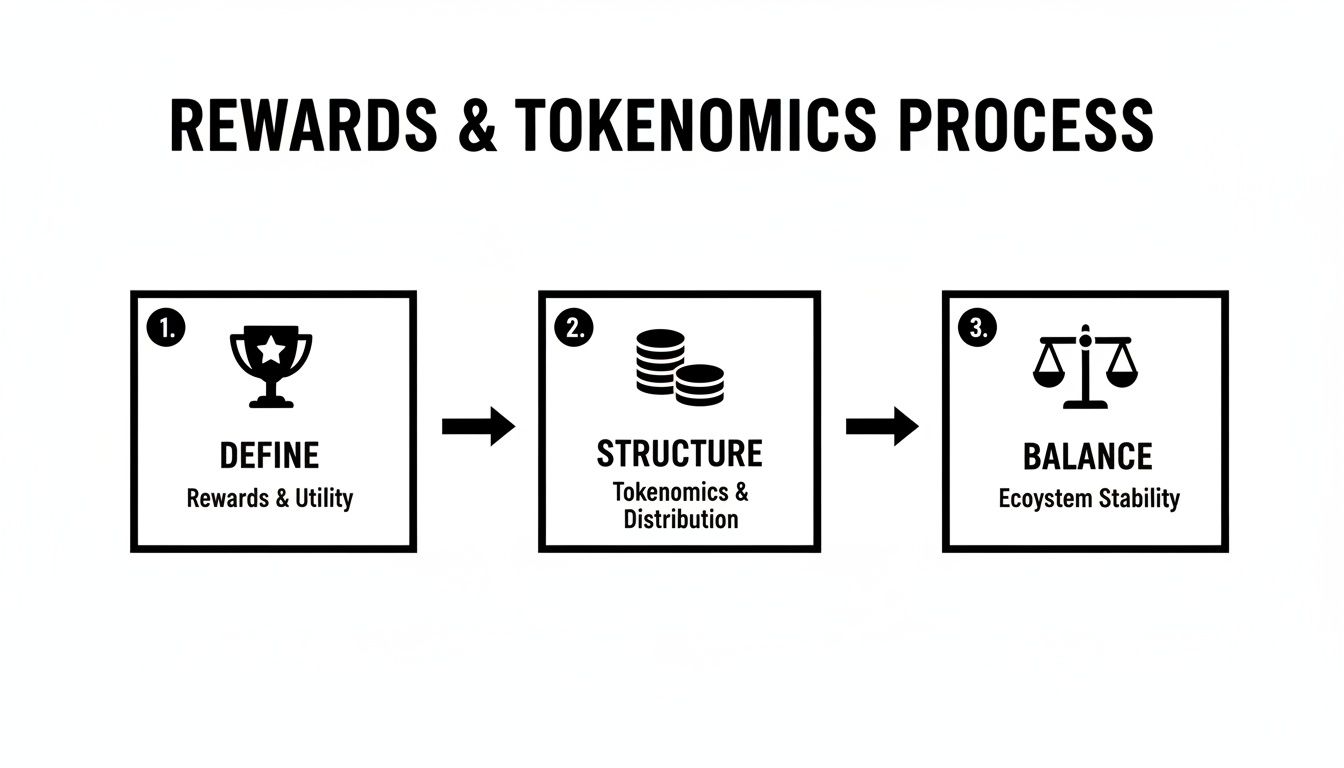
This process is critical. You start by defining what your rewards actually are, give them a logical structure, and then continuously balance the tokenomics to make sure the whole system is sustainable long-term.
On-Chain vs Off-Chain Task Ideas
Need some inspiration? Here’s a quick-glance table comparing different types of on-chain and off-chain tasks you can build into your loyalty program. Think of it as a menu of ideas to get you started.
| Task Type | Examples | Best For | Verification Method |
|---|---|---|---|
| Off-Chain | Liking/retweeting on X, joining a Telegram group, reacting in Discord, creating user-generated content (memes, videos). | Building top-of-funnel awareness, boosting social engagement, community building. | AI-powered social media scanning, bot integrations. |
| On-Chain | Holding a specific NFT or token, staking tokens, providing liquidity, voting on a governance proposal, swapping tokens on a DEX. | Driving protocol-level value (TVL), increasing user investment, encouraging active governance. | Direct wallet connection, smart contract data, on-chain analytics. |
Mixing and matching from both columns is how you create a program that’s both fun to participate in and drives meaningful results for your project. If you want to go deeper, our guide on Web3 quests is packed with more advanced strategies for designing compelling challenges.
Using Gamification to Keep Your Community Hooked
Let's be real—most loyalty programs are a total snooze. You sign up, you get points, you forget they exist. It’s transactional, predictable, and frankly, forgettable. But in Web3, we have this incredible opportunity to ditch the old playbook and build something that actually feels like a game. Something people want to come back to.
This is where gamification comes in. It’s not just some trendy buzzword; it’s about strategically designing an experience that’s rewarding and genuinely interactive. Instead of just passively handing out points, you’re inviting your community to play, compete, and win.
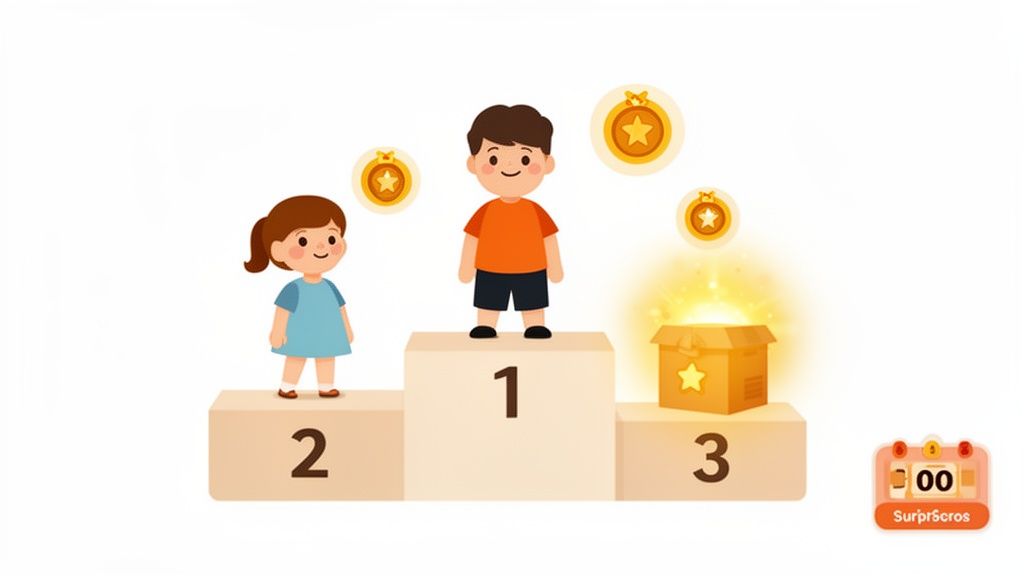
The whole idea is to create a dopamine loop. A user completes a task, gets that little hit of accomplishment, and is immediately motivated to take the next action. It's a powerful psychological hook that can transform your loyalty program from a simple marketing tactic into the vibrant, beating heart of your community.
Core Gamification Mechanics That Actually Work
To get that addictive, game-like feel, you need to bake in some proven mechanics. These aren't super complicated to set up, especially with the right tools, but they make a world of difference in keeping people engaged.
Here are a few of my go-to's:
- Competitive Leaderboards: Nothing gets people going like a bit of friendly competition. Leaderboards showcase your top contributors, giving them bragging rights and a little bit of status, while inspiring everyone else to climb the ranks. You can run daily, weekly, or all-time leaderboards to keep the energy high.
- Achievement Badges & POAPs: People are natural collectors. Awarding unique, non-transferable NFTs (POAPs) or digital badges for hitting certain milestones—like joining 10 governance votes or being a member for a full year—creates a visual history of their journey. It's something they can actually show off.
- Surprise Reward Drops: Predictability is the enemy of fun. Randomly airdropping special rewards to your active members creates moments of pure surprise and delight. It keeps everyone on their toes, knowing that their consistent participation could pay off at any moment.
- Limited-Time Campaigns: A little bit of urgency goes a long way. Running special campaigns or "sprints" with exclusive, time-sensitive rewards is a fantastic way to drive a huge burst of activity. It encourages people to act now instead of putting it off.
When you start weaving these elements together, you're catering to different motivations. Some people are driven by competition, others by the thrill of collecting, and some just love the chance of an unexpected win.
Structuring Quests into a Compelling Journey
A great gamified program shouldn't feel like a random to-do list; it should feel like a journey. You want to guide your members from simple, easy first steps to more meaningful, high-value contributions. Think of it like leveling up in a video game.
For a brand new member, the initial quests should be dead simple:
- Welcome Aboard: Jump in the Discord and claim a "Newbie" role.
- Get Connected: Follow the project on X and like the pinned post.
- First Contribution: Drop a reaction on an announcement.
These quick wins give them an immediate taste of success and get them familiar with how the program works. Once they're warmed up, you can introduce more involved quests that require a deeper commitment, like staking tokens or creating awesome user-generated content.
Platforms like Domino are great for this, offering templates for questlines that let you build out a structured path without starting from scratch. There's a reason this approach is taking off. In fact, it's projected that 43% of loyalty programs in 2025 will blend rewards with interactive fun. Web3 is perfectly suited for this, turning simple things like social shares or on-chain actions into automated wins that close the engagement gap you see in so many traditional programs. Discover more insights from loyalty predictions for 2025.
The most successful gamified programs I've seen make users feel like they are progressing and mastering the ecosystem. Each completed quest isn't just a transaction; it's another step forward in their journey with your community.
By thoughtfully combining different mechanics and structuring your quests, you build an experience that's truly sticky. You're no longer just asking for loyalty; you're earning it by making participation an absolute blast. For a deeper look, check out our guide on the power of Web3 gamification and how to apply it effectively.
Measuring Success and Scaling Your Program
Getting your program out the door isn't the finish line—it's the starting gun. The best loyalty programs are living, breathing things. They adapt and evolve based on hard data and what your community is telling you. To keep your program from going stale, you need to track what actually matters and have a smart plan for growth.
Forget vanity metrics like your total member count. Let's get real. You need to zero in on the Key Performance Indicators (KPIs) that tell you if people are truly engaged. Are they actually finishing the quests you're setting up? How many people are sticking around month after month? These are the numbers that give you a real pulse on how things are going.
Key Metrics to Track for Real Growth
To figure out if your loyalty program is actually working, you need to look at two things: how engaged people are and whether that engagement is helping your main project goals. Don't get lost in a sea of data; just focus on a few metrics that pack a punch.
- Quest Completion Rate: This is your most direct feedback loop. If the completion rate is low, something's off. Maybe the quests are too hard, the rewards aren't juicy enough, or your instructions are just plain confusing.
- Active Member Retention: Of the people who were active last month, how many came back this month? A high retention rate is a fantastic sign that your program has real staying power and is keeping your community hooked.
- On-Chain Impact: This is where the rubber meets the road. Is your program actually leading to more token holders? Are you seeing a bump in on-chain transaction volume or more assets being staked? This is the stuff that directly impacts your ecosystem's health.
Knowing When and How to Scale
As your community gets bigger, your program needs to keep up. But when is the right time to roll out new rewards, add another membership tier, or launch a big new campaign? The answer is always in your data and, just as importantly, in what your community is telling you.
You have to listen. Set up a dedicated feedback channel on Discord or run regular community polls. Find out what rewards people are genuinely excited about and which quests feel like a total grind. This qualitative feedback is pure gold.
The biggest mistake I see teams make is designing a program in a vacuum. Your community will tell you exactly what they want if you just give them a chance to speak. Their feedback is your single most valuable resource for iteration.
This constant feedback loop is the key to personalization, which is really the secret sauce for modern loyalty. It's no surprise that around 57-60% of brands are planning to double down on personalization to fine-tune their rewards and messaging. This isn't just a fluffy trend; it’s a proven way to drive better retention and higher spending.
And with platforms like Domino, you can use AI-powered review for quests to create truly unique on-chain and off-chain journeys for your members. This level of customization is a huge reason why 90% of brands that overhaul their programs report a positive ROI. You can learn more about the latest loyalty program trends here.
A simple health-check framework can help guide your scaling decisions:
- Monthly KPI Review: Sit down with your core metrics. Are they trending in the right direction?
- Quarterly Feedback Sprint: Make a dedicated push to gather and dig through community feedback.
- Bi-Annual Strategy Check-in: Look at all the data and feedback you've gathered. Now, is it time to introduce that new reward tier, tweak your points system, or get rid of quests nobody is doing?
By sticking to this simple cycle of measuring, listening, and adapting, you can make sure your loyalty program remains a powerful growth engine for your entire ecosystem for the long haul.
Got Questions About Web3 Loyalty Programs?
When you first start exploring Web3 loyalty, a ton of questions pop up. It's totally normal. Let's walk through some of the big ones we see teams grappling with all the time.
Do We Really Need Our Own Token?
Honestly, probably not—at least not right away.
Launching a native token is a massive undertaking. You're suddenly dealing with complex tokenomics, legal hurdles, and market volatility. Many incredible loyalty programs get off the ground without ever touching a custom token.
You can get really creative here. Offer rewards in stablecoins, give out cool NFTs as achievement badges, or grant access to a token-gated Discord channel. The point is to deliver real value, and that can take many forms.
What’s This Going to Cost Us?
This is the classic "it depends" answer, but for good reason. The budget can range from a few hundred bucks to $10,000+.
A simple setup using a punch card-style bot on Discord or Telegram can be incredibly cheap. But if you're picturing a fully custom dApp with deep on-chain integrations, you're looking at a serious investment in development.
My advice? Start lean. Prove your concept with low-cost tools first. Once you see real engagement and know what your community actually wants, then you can justify spending more on a polished, feature-rich platform.
How Do We Stop People from Gaming the System?
Fraud is a huge deal in this space, especially when you're rewarding social tasks like follows or retweets. If you rely on basic bots to verify actions, you're basically inviting a sybil attack where one person uses hundreds of fake accounts to farm your rewards.
This is where more advanced, AI-powered verification comes into play. You need a system that can tell the difference between a real fan and a bot that's just checking boxes. For on-chain stuff, wallet verification is your best friend—it’s a straightforward way to confirm someone actually holds your NFT or has staked tokens.
Should We Use Points or Give Out Direct Rewards?
Ah, the great debate. Points systems are what everyone is used to, but they often create a disconnect. People collect points without having any clue what they're actually worth, which can kill their motivation to participate.
In Web3, direct rewards usually hit harder. Think about it: getting an exclusive NFT, a surprise airdrop of $USDC, or a guaranteed whitelist spot feels immediate and valuable. There's no ambiguity.
A hybrid approach can also work wonders. Let users rack up points for smaller, everyday actions, and then allow them to cash those points in for a bigger, more exciting direct reward.
Ready to launch a loyalty program that handles verification for you and gets your community hyped? Domino has over 130 quest templates and AI-powered tools to get you live in minutes, no coding needed. Get started with Domino.