A Web3 Marketer's Guide to Gamification of Loyalty Programs
Let's be real for a second: the old-school "earn points, get a discount" loyalty model is on life support, especially in the Web3 space. Gamification of loyalty programs is the antidote, transforming a passive, transactional system into an active, rewarding journey. It’s what turns fly-by users into die-hard community members. Think of it as the difference between a flimsy punch card and an epic quest.
Why Traditional Loyalty Programs Don't Work for Web3
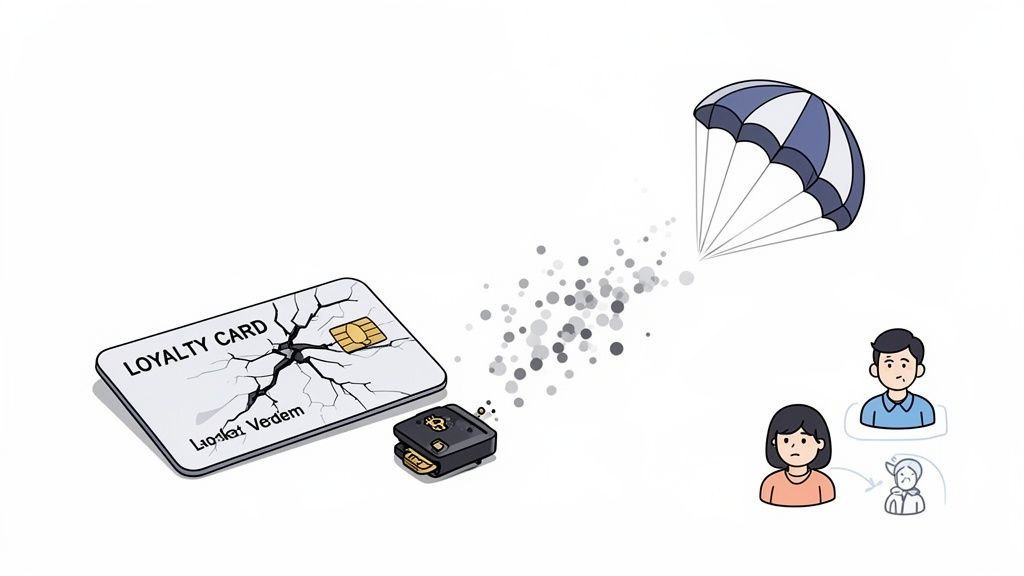
If your Web3 project is still clinging to a simple "buy more, get more" system, you're leaving a massive amount of engagement on the table. The crypto-native audience just operates on a different wavelength. They're driven by a unique set of motivations that static, transaction-based programs completely miss.
These legacy models were built for a world of passive consumption, not active participation. In Web3, your community is the product, and their engagement is your most valuable asset. Just rewarding purchases is missing the entire point.
The Airdrop Cliff and Engagement Decay
We've all seen it happen. A project builds insane hype, users swarm in to complete a few basic tasks for a potential token drop, and then… crickets. The moment the airdrop is over, the community evaporates because there was no real connection—just a fleeting transaction.
This is the classic "airdrop cliff," and it happens when a program is designed as a one-off event instead of a continuous journey. Without ongoing challenges, achievements, and fresh reasons to come back, users have zero incentive to stick around. Their attention simply moves on to the next shiny airdrop.
Failing to Reward What Truly Matters
Old-school programs are painfully one-dimensional. They can track a purchase or a login, but they're completely blind to the actions that actually build a thriving Web3 ecosystem.
- Social Amplification: Who’s out there creating killer user-generated content, defending your project on X, or welcoming new members in Discord?
- Community Governance: Who is showing up to DAO votes and adding real value to governance discussions?
- On-Chain Actions: Who is staking your token, providing liquidity, or actually using your protocol the way it was intended?
Static point systems just ignore these critical behaviors. They fail to recognize and reward the true evangelists who are driving your project's sustainable growth.
The real problem is a fundamental misalignment of values. Web3 users crave ownership, status, and a sense of belonging—not just a 10% discount. They want to be recognized for their contributions and feel like they’re part of building something important.
This shift in what users expect is fueling explosive growth in more dynamic systems. The global loyalty management market, supercharged by gamification, hit $13.31 billion in 2026 and is projected to skyrocket to $41.21 billion by 2032. This isn't just a trend; it's a massive market response to the demand for better, more interactive reward systems. You can discover more insights on how tiered loyalty programs are evolving to meet this need.
To really see the difference, let's break down how these two approaches stack up.
Traditional vs. Gamified Loyalty in Web3
Here's a quick comparison of old-school loyalty models versus modern gamified systems, highlighting key differences in approach, user motivation, and outcomes for Web3 projects.
| Feature | Traditional Loyalty | Gamified Loyalty |
|---|---|---|
| Core Loop | Spend Money -> Get Points -> Get Discount | Complete Tasks -> Earn XP/Badges -> Unlock Rewards/Status |
| Motivation | Extrinsic (discounts, financial gain) | Intrinsic (status, competition, achievement) |
| User Role | Passive Consumer | Active Participant & Co-Creator |
| Behaviors Rewarded | Primarily transactional (e.g., purchases) | Transactional, social, and on-chain actions |
| Engagement | Spiky, fades quickly | Consistent, long-term, and habitual |
| Community | A mailing list of customers | An interactive, self-sustaining ecosystem |
As you can see, the gamified model is built from the ground up to foster the kind of community that Web3 projects need to survive and thrive.
The Gamification Solution
This is exactly where the gamification of loyalty programs shines. It reframes participation from a boring chore into a compelling experience. Instead of just passively racking up points, users are embarking on quests, earning unique badges for their achievements, and climbing leaderboards for status and bragging rights.
By applying proven game mechanics, you create a system that intrinsically motivates users to engage deeply and consistently. You’re no longer just trying to buy their loyalty; you’re earning it by giving them a fun, rewarding, and status-driven experience that clicks perfectly with the Web3 ethos. This is how you lay the foundation for a vibrant community that sticks around long after the initial hype fades.
The Secret Sauce of Gamified Engagement
If you want to move past a basic points program, you have to get inside your users' heads and understand what makes games so darn compelling. The real power behind the gamification of loyalty programs isn't just handing out points; it's the mechanics—the little hooks and loops that turn a passive observer into an active player. These are the systems that speak to our very human desires for achievement, status, and just plain old competition.
Get this part wrong, and your program will feel like a chore list. But when you weave these elements together, you create a powerful engine that keeps your community buzzing. It’s all about making every single interaction feel like a meaningful step on an exciting journey.
Light a Fire with Leaderboards
Leaderboards are probably the fastest way to inject some friendly competition into your community. When you start ranking people based on experience points (XP) or quests they’ve knocked out, you're putting contribution and status on public display. It's a simple move, but it gives your top dogs the recognition they crave and lights a fire under everyone else to start climbing.
A good leaderboard is never static. You should think in terms of "sprints," resetting them weekly or monthly. This gives newcomers a real shot at the top and stops the OGs from camping out in the #1 spot forever, which can be a huge turn-off for new members.
Imagine a DeFi protocol running a weekly trading sprint. The top 10 traders on the leaderboard get a unique NFT badge. Suddenly, you're not just driving trading volume; you're creating a recurring event that the community can get excited about week after week.
Mark Milestones with Badges and Achievements
Think of badges as digital trophies. They’re a permanent, visual shout-out to a user's accomplishments and dedication. Unlike points that you spend, badges are collected and displayed, becoming a key part of someone’s identity within your project.
You can get really creative here, rewarding all sorts of valuable behaviors:
- Getting Started: A "Genesis Member" badge for your first 1,000 users.
- Being a Good Human: A "Community Pillar" badge for that person who’s always helping newbies in Discord.
- On-Chain Action: An "Alpha Staker" badge for anyone who has locked up a certain amount of tokens for over 90 days.
- Showing Up: A limited-edition badge for anyone who joins a major product launch event.
This approach builds a rich story of recognition that goes way deeper than just rewarding transactions. For this to work well, you need a solid foundation, and understanding the nuts and bolts of a loyalty points system is a great place to start.
Guide the Journey with Quests and Progress Bars
Quests are the very heart of the game. They give your users clear, bite-sized tasks to complete, guiding them toward the exact behaviors you want to see. The trick is to offer a good mix that keeps everyone interested.
You could have simple daily "check-in" quests, more involved weekly challenges, and big, one-off quests tied to special events. This variety keeps things from getting stale and makes sure there's always something new to do. We cover a bunch of practical examples in our deep-dive on Web3 gamification strategies.
And don't sleep on progress bars. They are such a simple but powerful psychological tool. Watching that bar fill up as you complete tasks gives you a real sense of momentum. It taps into that "completionist" drive in all of us, making users want to push through to 100% completion and see what's next.
Look, the real magic happens when these mechanics all work together. A user finishes a quest, earns XP, watches their name jump up the leaderboard, and unlocks a shiny new badge. Every action delivers instant, layered feedback that makes them feel good and keeps them coming back.
Platforms like Zealy absolutely nail this, blending quests, leaderboards, and rewards into one cohesive experience.
As you can see, the questboard lays out a clear menu of tasks—from social media shares to creating content—each with its own XP reward.
This structure gives users a clear path to follow, letting them decide how they want to contribute while always seeing the progress they're making. The results speak for themselves. Brands that get this right see a 47% jump in engagement, a 22% boost in brand loyalty, and a 15% lift in brand awareness. These are serious, bottom-line results, not just vanity metrics.
Launching Your Gamified Quests Without Code
Theory is great, but execution is everything. Now we get to the fun part—bringing your gamified loyalty program to life without needing a developer or writing a single line of code. I’ve seen projects get stuck in development hell for months, but with a no-code toolkit like Domino, you can go from a brilliant idea to a live quest board in minutes.
The whole point is to tear down the technical walls so you can focus on what you do best: creating experiences that your community will actually love.
This visual really nails the core loop from a user's perspective—it’s all about moving from action to recognition.
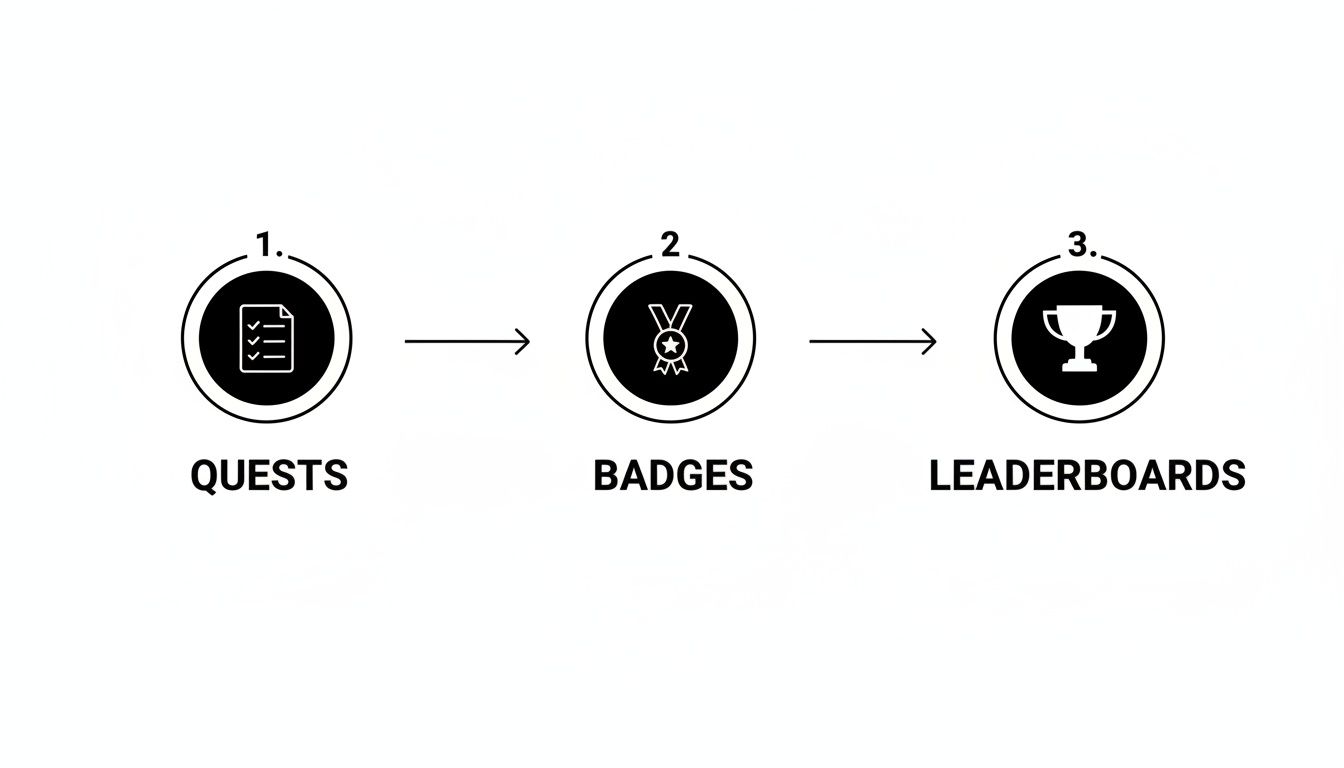
This simple flow—Quests to Badges to Leaderboards—is incredibly powerful. It creates a feedback loop that keeps people coming back for more.
Designing Your First Quests
Getting your first quests live is way easier than you might think, especially if you have a library of proven ideas to pull from. The trick is to create a healthy mix of tasks that hit your project’s growth goals while appealing to different types of users.
You really don't have to reinvent the wheel. Platforms like Domino come packed with over 130 pre-built quest templates you can tweak in seconds. This means you can quickly launch a balanced campaign that includes both on-chain and off-chain activities.
So, what does that mix actually look like in practice?
- On-Chain Actions: These are the tasks tied directly to your protocol. Think things like verifying a wallet balance, confirming NFT ownership, or checking if someone has staked your token. These are your bread and butter for driving real product adoption.
- Off-Chain Engagement: These quests are all about building social buzz and community vibes. You could ask people to follow your X (Twitter) account, join a Telegram raid, or share a specific announcement. These are absolutely crucial for top-of-funnel growth.
When you blend these two, you build a program that rewards people for every valuable contribution, whether they’re clicking around in your dApp or just hyping you up on social media.
Structuring Rewards That Actually Motivate
Once your quests are set, you have to figure out the rewards. This is where a lot of programs fall flat. If you get it wrong, you’ll either bleed your treasury dry or, worse, nobody will even bother to participate.
The secret is finding the right balance between two very different kinds of rewards.
A well-balanced reward system is the engine of any successful gamified program. Extrinsic rewards get new users in the door, but intrinsic rewards are what convince them to stay for the long haul.
Intrinsic rewards are all about status and belonging. They don’t have a direct dollar value, but they are often way more powerful for building lasting loyalty. Think about offering:
- Exclusive Discord Roles: A shiny "DAO Contributor" or "Alpha Tester" role gives people a visible badge of honor.
- Access to Private Channels: Create a gated channel where your top members get early news or can chat directly with the core team.
- Unique Badges: Digital collectibles that show off specific achievements. People love to collect these.
Extrinsic rewards, on the other hand, are tangible. These are your tokens, NFTs, or stablecoins. They're essential for getting people to complete high-effort tasks and for attracting new members in the first place. Just make sure you tie these bigger rewards to actions that deliver real, measurable value back to your project.
Automating Verification to Ensure Fairness
Let’s be honest: manually verifying thousands of quest submissions is a complete nightmare. It’s slow, full of errors, and just doesn't scale. This is where automated verification becomes your new best friend.
Seriously, imagine trying to check thousands of tweets or Discord messages every day. That’s a full-time job right there, pulling you away from the stuff that actually matters. Modern no-code platforms solve this by plugging directly into social and on-chain APIs.
For social tasks, AI-powered verification can instantly confirm if someone has liked, retweeted, or commented on the right post. No more messy screenshot submissions. This keeps the system fair for everyone and automatically filters out the low-effort spam.
For on-chain tasks, it's even cleaner. The system just queries the blockchain to confirm a user's wallet holds a specific NFT or has interacted with your staking contract. It’s a completely trustless setup where rewards are handed out based on cold, hard proof.
Integrating Seamlessly into Your Community Hub
Finally, for your program to really take off, it has to live where your community already hangs out. Forcing people to a separate website just adds friction and kills participation. You need to embed the whole experience right into the platforms they use every single day.
- Discord Integration: Set up a dedicated
#questschannel in your server. Members can see new tasks, check their progress, and claim rewards without ever leaving the app. - Telegram Integration: Use a bot to ping users about new quests and let them participate right from their favorite messaging app.
When you embed your program like this, it feels less like a chore and more like a natural part of being in the community. It boosts visibility and makes it dead simple for people to engage, turning your loyalty program into a powerful, "always-on" engine for growth.
Measuring Success and Optimizing Your Campaign
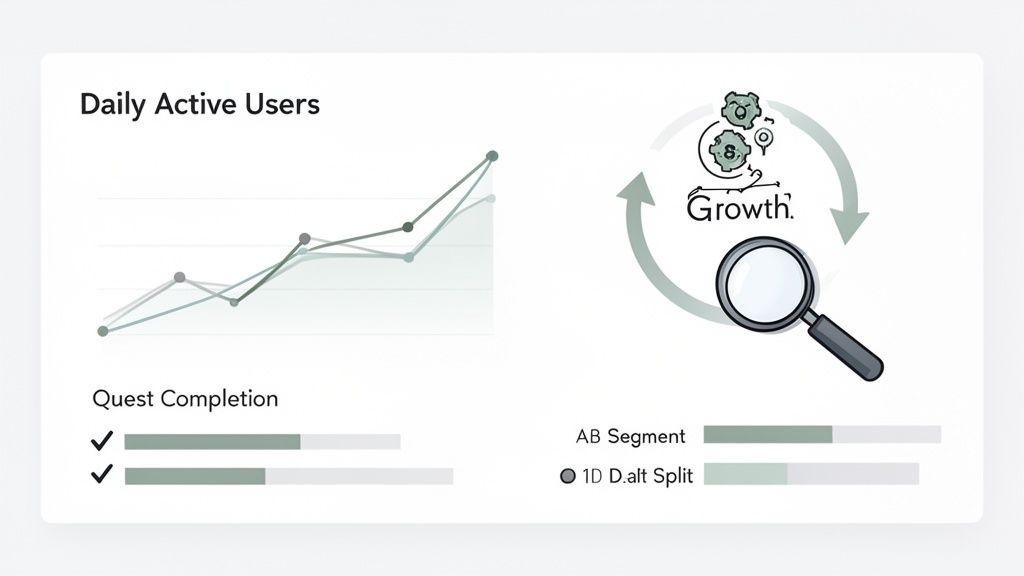
Alright, so you've launched your quests. High five! But this is just the starting line. Now comes the part where you figure out if all this work is actually, well, working.
It's tempting to get caught up in flashy numbers that look good but don't mean much. Real success comes from digging into the data and building a feedback loop that makes your program smarter and stickier over time. Let's talk about what you should actually be looking at.
Moving Beyond Vanity Metrics
First things first: we have to separate the signal from the noise. A huge total user count might feel great, but it doesn't tell you if your community is healthy or just a ghost town. You need to track the active pulse of your program.
These are the KPIs that give you a true picture of what’s going on:
- Daily Active Users (DAU): This is your north star. How many unique people are jumping in and doing stuff every single day? A steady or growing DAU means you're successfully building a habit.
- Quest Completion Rate: This one’s a goldmine. It tells you which quests are actually hitting the mark. A high completion rate means you've found that perfect blend of effort and reward.
- Community Growth Velocity: Don't just count new members; track how fast you're acquiring them. A good gamified program should feel like a growth engine, pulling new people into your orbit.
- On-Chain Conversions: This is where the rubber meets the road. Are your quests driving real-deal on-chain actions like staking, providing liquidity, or minting? This is how you tie your loyalty program directly to your protocol's health.
Keeping an eye on these metrics gives you a powerful dashboard for understanding user behavior. You’ll see pretty quickly which activities are driving value and which are just collecting dust. For a deeper dive, our guide on how to measure community engagement has a ton of extra insights.
Analyzing and Acting on the Data
Once you have a steady stream of good data, you can start asking the right questions. What are your most active users doing? Are they all over the simple social tasks, or are they digging into the more complex on-chain challenges? The answers are your roadmap.
Imagine you see a quest to "Join our Telegram" has a 90% completion rate, but a "Stake 100 tokens" quest is limping along at 5%. That's a huge tell. Maybe the staking reward isn't juicy enough, the instructions are confusing, or the process is just too clunky. This is your cue to jump in and fix it.
The goal is to build a data-driven feedback loop. You analyze performance, cook up a hypothesis for why something isn't working, and then run a new test to see if you can make it better.
This cycle of testing and learning is everything. It's a proven model—in some markets, adding game mechanics has led to 30% higher repeat purchases. Brands that constantly track task completion and introduce new levels simply create better experiences. This is super easy to do with a tool like Domino, which gives you over 130 quest templates ready to go for any NFT or DeFi project.
Optimizing with A/B Testing
Got a handle on your baseline performance? Awesome. Now it's time to start actively optimizing with some A/B testing. This just means running two slightly different versions of a quest or reward to see which one your community likes more.
You don't need to overthink it. Start with simple tests that give you clear answers.
- Reward Testing: For the same quest, offer Group A 100 XP and Group B a unique Discord badge. Which one gets more completions? Now you know what that segment of your community really wants.
- Copy and Framing: Try two different descriptions for the same task. Does calling it an "exclusive challenge" work better than a "simple task"? The words you use can make a massive difference.
- Quest Difficulty: If a quest has a really low completion rate, try breaking it into smaller, bite-sized steps. See if making it less intimidating encourages more people to give it a shot.
By constantly testing and refining, you transform your loyalty program from a static to-do list into a living system that grows and adapts with your community. This continuous improvement is what separates a program that fizzles out in a month from one that becomes the foundation of your long-term growth.
Common Gamification Pitfalls and How to Avoid Them
Building a killer gamified loyalty program can be a massive growth lever, but it's also riddled with traps. I’ve seen countless projects pour tons of energy into launching a system, only to watch it fizzle out because they stumbled into a few common, and totally avoidable, mistakes.
Let’s be real: a poorly designed game is worse than no game at all. It can frustrate your users, burn out your most dedicated members, and even tarnish your project’s reputation. To get it right, you need to build something sustainable, fair, and genuinely fun. So, let's walk through the biggest pitfalls I see time and time again, and how you can sidestep them.
The Unbalanced Reward Economy
This is, without a doubt, the number one killer of gamified programs. It's a delicate balancing act that can go wrong in two ways.
First, you have rewards that are way too generous. Sure, you might see a huge initial spike in activity, but you're basically just lighting your treasury on fire. This model is completely unsustainable and attracts mercenaries who will dump and run, not the loyal community members you're after.
On the other end of the spectrum, the rewards are too stingy. If people have to grind for hours just to earn next to nothing, they’ll lose interest fast. The effort has to feel proportional to the payoff, otherwise your quest board will quickly turn into a ghost town. The goal is to find that sweet spot where rewards feel meaningful without bankrupting the project.
A healthy reward economy isn’t just about the size of the reward; it's about the perceived value. A rare, non-transferable badge earned through a tough challenge can often be more motivating than a small token reward that feels transactional.
Overly Complex and Grindy Quests
It’s tempting to get carried away designing these intricate, multi-step quests that sound amazing on paper. In practice, complexity is the enemy of participation. If a user needs to read a novel-length description and juggle ten different steps to complete one task, they’re just going to leave. This is especially true for newcomers who are still trying to figure things out.
This leads directly to burnout. When your program feels more like a second job than a fun game, you’ve already lost. The best gamification of loyalty programs I've seen always mixes simple, daily check-ins with a few more involved weekly or special-event quests.
To keep things from getting out of hand, focus on clarity and simplicity:
- Keep instructions short and sweet. Use clear, action-oriented language. Tell people exactly what to do in as few words as possible.
- Break down bigger tasks. If a quest is naturally complex, turn it into a series of smaller, sequential quests. This creates a real sense of progress and makes the end goal feel much more achievable.
- Always ask: is this actually fun? Or is it just a chore? If it’s the latter, go back to the drawing board and find a way to make it more engaging.
The Never-Ending Bot Invasion
In Web3, if there's value to be farmed, the bots will come. It's a fact of life. Sybil attacks—where one person spins up tons of fake accounts to game the system—can completely destroy the integrity of your program.
When bots start snatching up all the rewards, your real community members get discouraged and lose trust. They rightfully feel like the game is rigged against them.
Trying to manually weed out these bad actors is a losing battle. It’s an endless game of whack-a-mole that will drain your team’s time and sanity. You absolutely need an automated defense system to maintain a level playing field.
This is where automated verification becomes non-negotiable. Modern platforms like Domino use a combination of AI-powered review for social tasks and direct on-chain verification to ensure things stay fair. The system can instantly check if a wallet holds the right NFT or if a social media action was completed by a real account, stopping bots in their tracks. This kind of automation is the only way to create a fair, scalable, and trustworthy environment where genuine contributions are the only ones that get rewarded.
Your Questions on Gamified Loyalty, Answered
Jumping into gamified loyalty programs for the first time? You've probably got questions. I get it. Especially in the wild west of Web3, it's smart to wonder about the real costs, the right rewards, and how long it actually takes to see a payoff. Let's tackle some of the most common questions I hear from marketers and community managers.
How Much Is This Going to Cost Me?
The budget for a gamified loyalty program can swing wildly. If you decide to build a custom solution from scratch, you're signing up for a massive investment. We're talking tens of thousands of dollars upfront, plus the ongoing headache and cost of a dev team to keep it running.
Honestly, there's a much smarter way. Using a no-code platform completely changes the game. Instead of a huge capital outlay, you're looking at a simple, predictable monthly subscription. Better yet, you don't need a single developer. This means you can go from idea to launch in minutes, not months, which makes for a much healthier ROI.
What’s the Difference Between Intrinsic and Extrinsic Rewards?
Getting the rewards right is everything. You need to understand the two main types, because they do very different jobs but work together to keep people hooked for the long haul.
- Extrinsic Rewards: These are the straightforward financial perks. Think tokens, NFTs, stablecoins—anything with a clear monetary value. They’re amazing for grabbing attention and driving those big, important actions that bring new people into your world.
- Intrinsic Rewards: These are all about status, achievement, and belonging. We're talking special Discord roles, access to alpha channels, or soulbound badges that show off a user's OG status. They're non-financial but incredibly powerful.
You absolutely need both. Extrinsic rewards get people in the door. They provide that initial spark. But it's the intrinsic rewards that make them stick around, creating a community that’s motivated by more than just a quick profit.
The secret to a great loyalty program is using extrinsic rewards to hook them and intrinsic rewards to build the habit. One is the bait, the other is the reason they stay.
How Do I Stop People from Cheating or Using Bots?
Ah, the million-dollar question for any Web3 incentive program. Manually checking every submission is a nightmare. It’s slow, full of mistakes, and completely falls apart once your community starts to grow. You need a system that can police itself.
Modern platforms solve this with a two-part strategy. For anything happening off-chain, like a retweet or a follow, AI-powered review can instantly verify completion and spot sketchy behavior. For on-chain stuff, the system just pings the blockchain directly to confirm things like staking or holding a specific NFT. It's foolproof.
This kind of automation ensures a level playing field, frees up hundreds of hours for your team, and makes sure your actual community members are the ones reaping the rewards for their genuine support.
How Long Until I Actually See Results?
Building true loyalty is a marathon, not a sprint. But you can start seeing a real impact almost right away. With a no-code tool, you can spin up a campaign in a few minutes and often see a jump in social chatter and Discord activity within the first 24-48 hours.
The deeper metrics—like a steady climb in daily active users or a real bump in on-chain transactions—will likely take a few weeks to build momentum as people get into the groove. The trick is to keep it going. An "always-on" program with a constant flow of new quests will stack up wins over time, turning those small initial boosts into massive, sustainable growth.
Ready to stop wondering and start building? With Domino, you can launch a full-blown gamified loyalty program in minutes, not months. Automate all the boring verification, plug it right into Discord, and use over 130 templates to get a head start on growing your community. Get started with Domino and see for yourself.