Gamification Loyalty Programs: gamification loyalty programs boost engagement
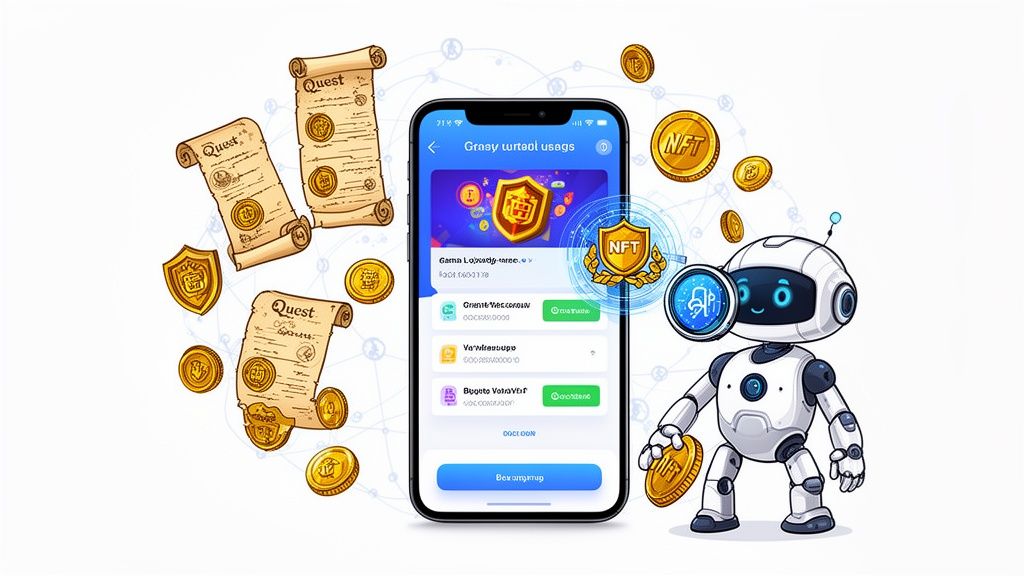
Let’s be real—most loyalty programs are boring. You get some points, maybe a coupon, and that’s about it. The whole experience feels transactional, not personal. This is where gamification loyalty programs come in and flip the script, especially in Web3 where the community is the lifeblood of any project.
Instead of just rewarding people for buying something, gamification turns loyalty into an actual experience. It taps into our basic human wiring: our love for a good challenge, the satisfaction of making progress, and the desire for a little recognition. By weaving in quests, leaderboards, and achievement badges, you get people emotionally invested in a way a simple "buy ten, get one free" punch card never could. They stop being just customers and start becoming players in your world.
The Psychology of Play and Progress
Ever wonder why people sink hours into a video game just to level up a character? It’s all about that satisfying loop of effort, achievement, and reward. Gamification brings that same powerful dynamic to your community.
- Sense of Accomplishment: Checking off a quest, no matter how small, feels good. It’s a tiny dopamine hit. Points and badges are the tangible proof that you’re moving forward.
- Social Status: Leaderboards create a bit of friendly competition and shine a spotlight on your most active members. People love being recognized for their contributions.
- Ownership and Belonging: The more quests someone completes and the higher they climb, the more connected they feel to your project. They start to feel like they’re building something right alongside you.
This is how you turn passive users into true believers. They aren't just holding a token anymore; they're genuinely invested in your success because they've put in the work to earn their place. To really make this work, it's essential that your community gets the basics, starting with understanding what a Web3 wallet is and how it unlocks all these new ways to interact.
When you turn engagement into a game, you’re not just demanding your community's attention—you’re earning it. You’re building a relationship where everyone feels like they’re getting value, not just being marketed to.
A quick look at some core gamification elements shows just how they tap into human psychology to drive specific actions.
Core Gamification Elements and Their Impact
| Gamification Element | Psychological Driver | Expected User Behavior |
|---|---|---|
| Points & Levels | Progress & Accomplishment | Increased frequency of desired actions to level up. |
| Badges & Achievements | Recognition & Status | Completion of diverse tasks to collect all available badges. |
| Leaderboards | Competition & Social Proof | Higher engagement from top users competing for ranks. |
| Quests & Challenges | Goal-Setting & Mastery | Focused effort on specific, high-value tasks. |
| Virtual Goods & NFTs | Scarcity & Ownership | Sustained participation to earn exclusive rewards. |
Each of these mechanics serves a purpose, encouraging users to not just participate, but to become deeply involved in the ecosystem.
A Market That Speaks for Itself
This move toward gamification isn't just a small trend—it's a massive market shift with hard numbers to back it up. The gamification loyalty market hit $14.5 billion in 2023 and is on track to grow at an incredible 21.8% each year through 2029.
Why the explosion? People are craving it. A whopping 71% of consumers want more personalized experiences from the brands they follow.
And the results for companies that get on board are just as impressive. We're talking about a 22% lift in customer retention and a 100%-150% jump in engagement compared to old-school methods. For a Web3 project trying to stand out, those aren't just vanity metrics; they're a serious competitive edge.
Building Your Gamified Loyalty Program Blueprint
Let's be real: jumping into a gamification program without a solid plan is like trying to build a DeFi protocol on a napkin sketch. You might get something up and running, but it'll be messy, unstable, and probably won't get you the results you want. Before you even think about designing a single quest, you need a blueprint.
This is the strategic heavy lifting—the thinking you do upfront that pays off big time down the road. It ensures your program is a cohesive system built to hit specific goals, not just a random assortment of tasks. The whole point is to create a self-sustaining cycle of engagement.
Think of it as a simple but powerful gamification loop that keeps users coming back for more, deepening their connection to your project with every action.
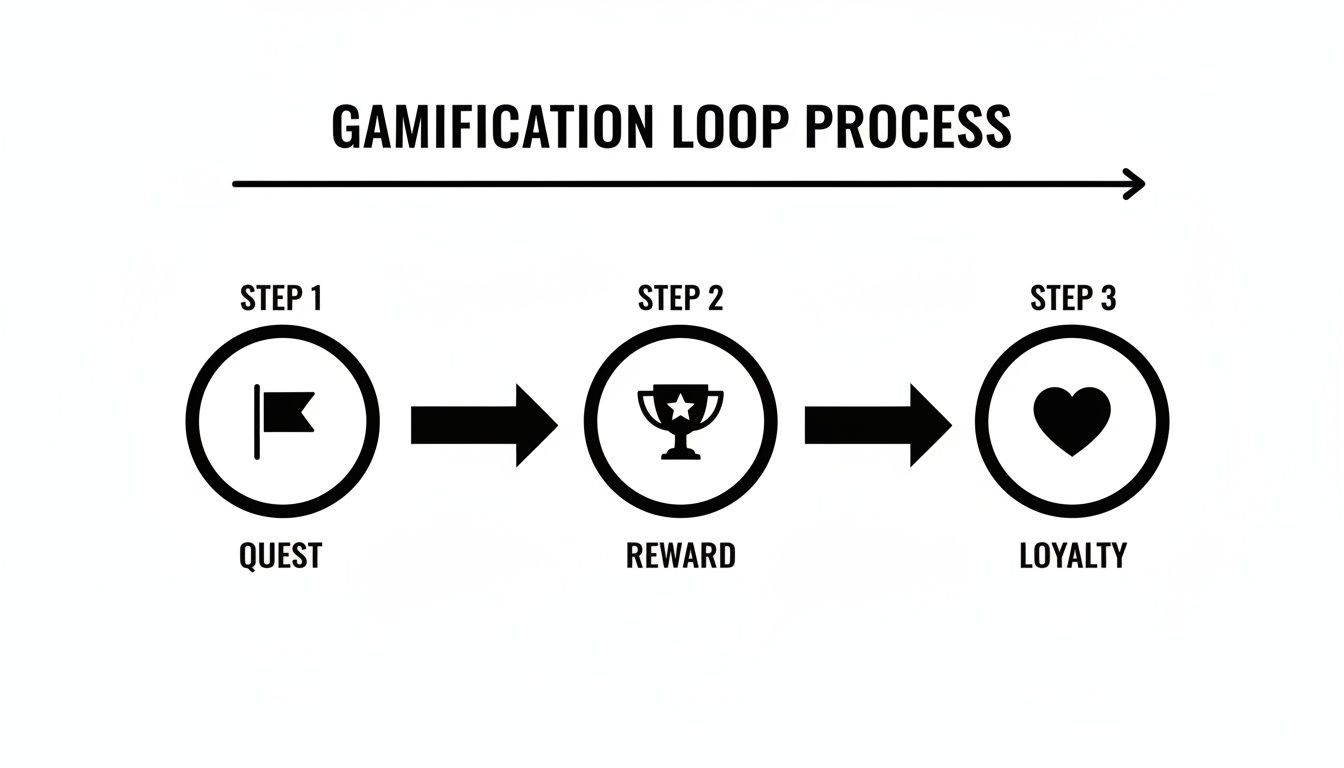
This loop is the engine. Quests lead to rewards, and those rewards foster genuine loyalty, which then gets users excited for the next quest. It’s a flywheel that, once it gets spinning, builds incredible momentum for your community.
Defining Your Primary Objective
First things first: what are you actually trying to do? "Boost engagement" is way too broad. You need to get specific and connect your program to real, measurable business outcomes. A crystal-clear objective is your North Star, guiding every decision you make about quests, rewards, and the tools you use.
Take a hard look at the biggest challenge your project is facing right now. Is it getting new people in the door? Pushing existing users to actually interact with your protocol? Or maybe it's about turning a quiet Discord into a buzzing hub of activity.
Your main goal will likely fall into one of these buckets:
- User Acquisition: Your number one priority is bringing fresh faces into your ecosystem. Quests will be all about social sharing, referrals, and creating content that spreads the word.
- On-Chain Activity: You've got users, but they need to start interacting with your dApp. Here, quests will guide them through key actions like staking, swapping tokens, or minting an NFT.
- Community Deepening: You're looking to transform lurkers into genuine contributors. Quests will focus on things like Discord participation, submitting content, and showing up to community calls.
My advice? Pick one primary goal to start. Trying to boil the ocean will just dilute your efforts and confuse everyone. Nail that first objective, and you can always expand the program to tackle other goals later on.
Setting Meaningful KPIs
Once your objective is locked in, you can define the Key Performance Indicators (KPIs) that prove your program is actually working. These metrics go beyond vanity stats like total sign-ups and zero in on the actions that truly move the needle.
A classic mistake is getting fixated on the number of people who join the program. A great gamified loyalty program isn't measured by participants; it's measured by the tangible actions it drives and the lasting habits it builds.
For instance, if your goal is to ramp up on-chain activity, your KPIs need to reflect that directly.
| Primary Objective | Key Performance Indicators (KPIs) |
|---|---|
| User Acquisition | Referral conversion rate, New wallet connections, Social media reach from quests |
| On-Chain Activity | Daily active users (DAU) on dApp, Quest-driven transaction volume, NFT mints completed |
| Community Deepening | Quest completion rate, Active users in Discord/Telegram, User-generated content submissions |
Tracking these specifics lets you see exactly what's resonating with your community and where you need to tweak your approach.
Mapping the User Journey
Okay, now let's walk in your user's shoes. The best gamification loyalty programs feel less like a checklist and more like a natural, rewarding journey. The key is to guide people from simple, low-effort tasks to more involved, high-value actions. This builds momentum and makes them feel like they're leveling up.
Using a no-code toolkit like Domino makes mapping this out and putting it into action incredibly straightforward. You can structure entire campaigns designed to onboard new folks smoothly.
Here’s a practical flow I've seen work wonders for a new user:
- The Easy Win (Off-Chain): Start with a layup. The first quest should be dead simple, like "Follow us on Twitter" or "Join our Discord." It takes seconds, requires zero commitment, and gives them an immediate dopamine hit of accomplishment.
- Deeper Social Proof (Off-Chain): Now, ask for a bit more. A good follow-up quest is "Retweet our latest announcement" or "Create a meme about our project and post it with #YourProjectMeme."
- The On-Chain Bridge: Time to connect their wallet. This can be a point of friction, so framing it as a necessary quest with a clear reward—like a special "Verified Member" role in Discord—makes it feel like a valuable step.
- Their First On-Chain Action: Gently guide them to perform a core action on your platform. Think "Mint our free commemorative NFT" or "Make your first swap on our DEX." This isn't just a task; it's a hands-on tutorial for your product.
- Building the Habit: From this point, you can introduce recurring quests or more complex challenges. This encourages them to make interacting with your platform a regular habit, cementing their place as a true community member.
Crafting Quests People Actually Want to Complete
If your quests feel like a boring checklist of chores, you’ve already lost. The soul of a great gamification loyalty program isn't just giving people things to do; it’s about creating challenges that feel meaningful, fun, and worth their time. This is where art truly meets science—balancing simplicity with a real sense of accomplishment.
Think like a game designer. Every single quest should have a purpose, guiding your community on a journey that benefits both them and your project. When you get this right, quests become the engine of your ecosystem, driving specific behaviors and building habits that stick.
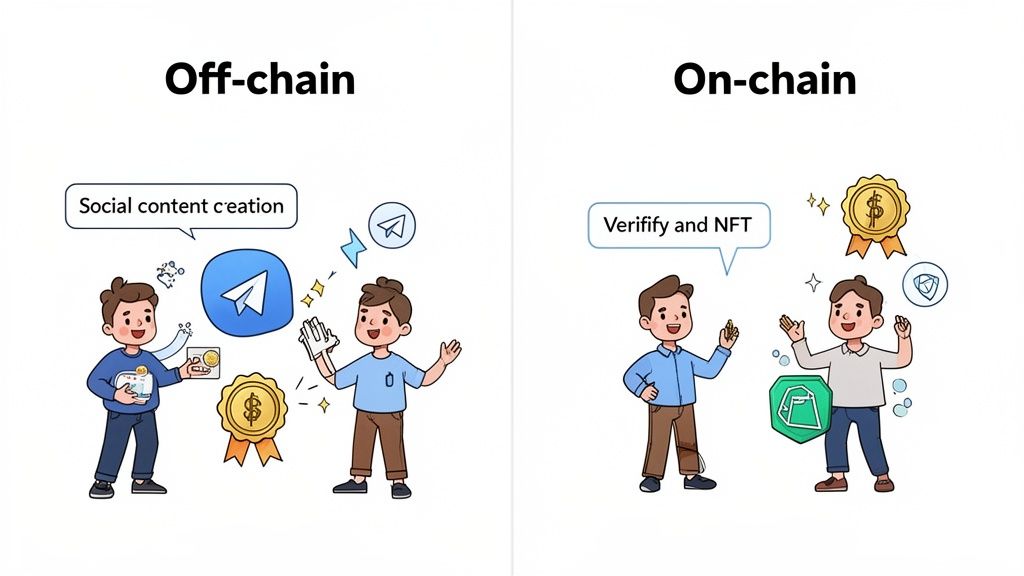
This image perfectly captures the two worlds your quests need to bridge: the buzzing, social world of off-chain engagement and the tangible, value-driven world of on-chain actions. Your program is the bridge.
Blending Off-Chain and On-Chain Quests
The most successful programs don't make people choose. Instead, they weave on-chain and off-chain tasks into a single, cohesive experience. This creates a natural funnel, using easy social quests to draw people in and then gently guiding them toward more impactful on-chain activities.
Off-Chain Quests Your Community Will Love
Think of these as your top-of-funnel activities. They’re perfect for grabbing attention and building that initial burst of momentum. The goal here is pure accessibility. Anyone should be able to knock these out in a few minutes and get that first satisfying hit of progress.
But let's move beyond a basic "like and retweet." Modern quests should get more creative:
- Social Raids: Get your community to swarm a specific tweet or post from a partner project. This creates a powerful feeling of collective action and makes a huge splash for everyone involved.
- Content Creation Challenges: Ask your community to create a meme, a quick video, or a thread explaining a key feature. Throw some bigger rewards at the best submissions and watch the creativity flow.
- Discord Engagement: Reward people for hitting a certain role in your Discord or for being an active, helpful voice in a specific channel for a week.
On-Chain Quests That Drive Real Value
Now we’re getting to the good stuff. These are the quests that directly move the needle on your project's core metrics. It’s all about getting users to experience your ecosystem firsthand, turning passive observers into active participants.
Here are a few on-chain quests that pack a punch:
- Verify an NFT Hold: So simple, yet so effective. This is a great way to reward your most loyal collectors. You can then gate exclusive quests or private Discord channels just for verified holders.
- Try a New dApp Feature: Just launched a new staking pool or a v2 of your swap? Create a quest that rewards the first 1,000 people who try it. This is way more powerful than just writing a blog post.
- Vote on a Governance Proposal: Want more active participation in your DAO? Reward users who connect their wallet and cast a vote. It’s a direct incentive for them to have a say in the project’s future.
The Art of Balancing Difficulty and Reward
Not all quests are created equal, and they shouldn't be. A well-designed program needs a mix of easy wins to keep people hooked and more challenging tasks tied to bigger, better rewards. This creates a clear sense of progression, making users feel like they're leveling up.
A classic mistake is asking for a huge effort for a tiny reward. That effort-to-reward ratio is absolutely critical. If it feels off, people will tune out fast. For a deeper dive, check out our guide on creating effective Web3 quests.
The perfect quest isn't just about what the user has to do. It's about how it makes them feel. An easy win provides satisfaction, a difficult challenge delivers a true sense of accomplishment, and a creative task fosters a feeling of contribution.
The data backs this up completely. Studies show that 77% of consumers are more likely to stick with brands that have gamified loyalty programs. And what gets them going? 53% are motivated by rewards and leaderboards. This isn't just fluff; one brand saw a mind-blowing 6X increase in purchase frequency from game participants compared to everyone else.
Structuring Rewards Without Breaking the Bank
Your reward structure is the fuel for your gamification engine. It has to be tempting enough to get people moving but sustainable enough that you don't drain your treasury on low-value tasks. As you build out your program, it's vital to incorporate proven strategies to improve customer engagement to ensure your quests hit the mark.
Here’s a smart way to think about structuring your rewards:
- Points for Everything: Make points the base currency of your program. They’re flexible, cheap to give out, and provide a constant feeling of progress. Users can rack them up from dozens of small actions.
- NFTs for Milestones: Save NFTs for big achievements. Think completing a major campaign, hitting the top of the leaderboard, or being one of the first to crack a difficult on-chain quest. NFTs feel more special and permanent than points.
- Exclusive Access for Top Contributors: Sometimes, the best reward isn't a token or an NFT. It's access. Offer your most dedicated members things money can't buy, like a private Discord channel with the founders, early beta access, or a guaranteed whitelist spot for your next mint.
Automating Your Program for Effortless Scaling
Let's be real. Even the most brilliant gamification loyalty programs will eventually crash and burn under the weight of manual verification. It’s all fun and games when you have a few hundred community members, but once you hit the thousands, trying to personally check every single tweet, meme, or Discord comment becomes an absolute nightmare. This is the make-or-break moment where you either automate or stagnate.
Smart automation isn't just some nice-to-have feature; it’s the only way to build a loyalty program that can actually keep up with your community's growth. Without it, your team gets sucked into a vortex of mind-numbing, repetitive tasks. Quest approvals crawl to a standstill, and the user experience takes a nosedive. The whole point of a good program is that instant hit of dopamine—which completely vanishes if someone has to wait three days for their points to show up.
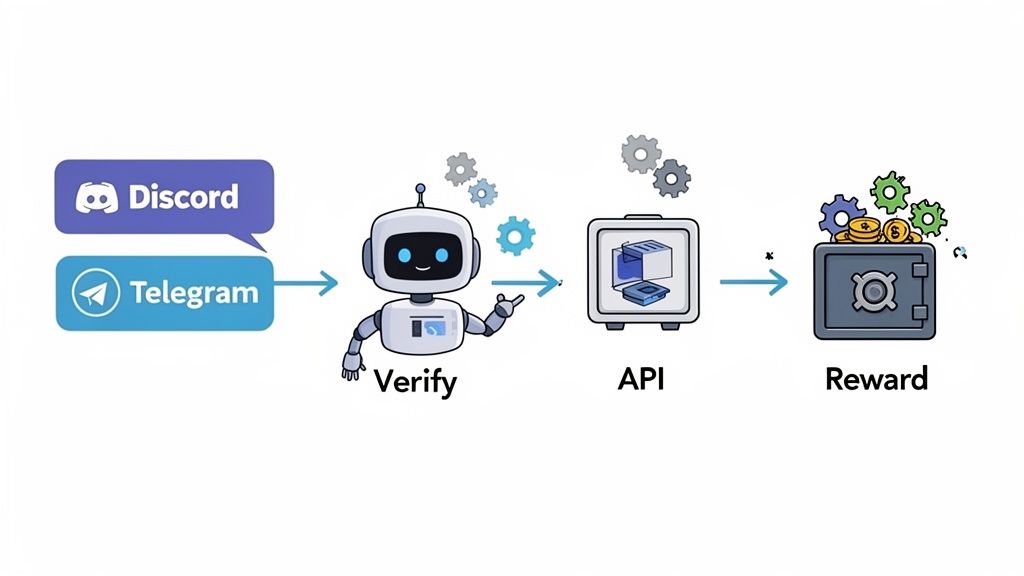
The right toolkit turns this headache into a smooth, automated workflow that just runs in the background, 24/7.
Leveraging AI for Subjective Task Verification
Okay, let's talk about the hard part: user-generated content. How can you be sure someone actually made a relevant meme and didn't just upload a picture of their cat? How do you know their tweet is genuinely supportive? This is where AI-powered verification changes everything.
Modern platforms like Domino have AI baked right in, ready to analyze content based on the rules you set. You can design quests that automatically handle things like:
- Scanning for keywords: Did the user’s tweet include your project hashtag or ticker? Done.
- Analyzing images: Vision AI can tell if a submission is a meme and if it’s on-brand.
- Confirming social actions: Verifying follows, retweets, or Discord reactions happens instantly, no human needed.
This gets your community managers out of the business of being quest police and lets them focus on what actually matters—building real relationships.
The whole point of automation is to make your program feel like magic, both for your team and your users. When verification is instant and trustworthy, it keeps the engagement loop spinning without any friction.
Meet Your Community Where They Are
Your loyalty program shouldn't feel like a separate app or a chore. It has to be woven into the very fabric of your community's daily life. The best programs win because they slide right into the platforms people already use and love.
This means plugging your quest system directly into places like Discord and Telegram. Imagine a user getting points just for dropping an emoji reaction on an announcement, or for joining a coordinated raid. A bot sees it, verifies it, and awards the points. Simple. It makes participation feel like a natural part of just hanging out.
The Power of API Integration
While getting likes and retweets is great for buzz, the real endgame is driving people to actually use your product. This is where API integration becomes your secret weapon. When you connect your loyalty program to your core product through an API, you create an incredibly powerful feedback loop.
This connection lets you reward people for taking high-value actions right inside your dApp or platform, turning your loyalty system into a true growth driver.
- Reward In-App Milestones: Automatically grant points to a user after they complete their 10th swap on your DEX.
- Incentivize Feature Discovery: Create a quest that gives a bonus to the first 500 users who try out a new staking feature.
- Drive Product-Led Growth: Offer an exclusive NFT to anyone who hits a specific trading volume on your platform.
This API-first approach elevates your program from a simple marketing tactic to a core part of your growth engine. You're directly tying community fun to product usage, making sure the things you reward are the things that build lasting value. For anyone serious about building a system like this, effective loyalty programme management is the foundation for making sure your automation is not just efficient, but strategically aligned with your biggest goals.
Measuring Success and Optimizing for Growth
So, you’ve launched your gamified loyalty program. Pop the champagne, right? Well, not so fast. Getting it live is just the starting line. The real magic happens next, turning that initial launch buzz into a growth engine that actually runs on data, not just hope.
Without a solid way to measure what’s working, you’re basically just chucking quests and rewards into the ether. A smart approach to analytics is what separates the programs that fizzle out from the ones that become the heartbeat of a community. The key is to stop staring at vanity metrics like total sign-ups and start focusing on what truly matters. Are you actually changing user behavior? A simple dashboard, like the one built right into the Domino toolkit, is your new mission control.
Identifying Your Core KPIs
Your KPIs need to be a direct reflection of the goals you set way back in the planning phase. Don't fall into the trap of tracking everything—just track what counts. This laser focus makes it way easier to spot what’s working and make quick decisions.
Here’s what I mean:
- Growing Your User Base? Then your north star is the referral conversion rate. Are those "invite a friend" quests actually pulling in new people? Also, keep a close eye on the number of new wallet connections that come directly from program activities.
- Driving On-Chain Activity? This is where the rubber meets the road for most Web3 projects. You should be watching your daily active users (DAU) and seeing if it spikes when you launch new quest campaigns. An even better metric is quest-driven transaction volume—how much on-chain action is a direct result of your program?
- Building a Stronger Community? Look at the quest completion rate. If a specific quest has a terrible completion rate, that’s a massive red flag. It’s probably too hard, the reward sucks, or it's just plain boring. Also, track active user growth in Discord or Telegram and the number of user-generated content submissions tied to quests.
From Data to Actionable Insights
Once you’ve got the data flowing in, you need to turn those numbers into smart moves. A dashboard isn't just there to look pretty; it's a tool for spotting opportunities and nipping problems in the bud.
Let's say you see a huge drop-off rate on a quest that has three steps. That data is screaming at you that there's friction somewhere. Is step two too confusing? Is the final reward not juicy enough to justify the effort? This insight lets you dive in and tweak that specific quest instead of just guessing what went wrong.
The secret to a killer program isn't one big, revolutionary change. It's a constant cycle of small, informed tweaks. Your community's behavior is the ultimate feedback loop—your job is to actually listen to what the data is telling you.
Big players are taking this seriously. The average budget for launching or overhauling loyalty programs has climbed to $375,000. And the investment seems to be worth it. A whopping 71.4% of program owners who recently updated their systems say they're happy with the results, which just goes to show how critical data-driven improvements are.
Optimization Tactics That Actually Move the Needle
With a steady stream of data, you can start running experiments to dial in your program's performance.
A/B Test Your Rewards: Are your users more hyped about 1,000 points or a unique NFT badge? Simple. Run the same quest but with two different rewards and see which one gets more traction. This is a dead-simple way to figure out what your community truly values. If you're stuck for ideas, our guide on loyalty rewards management is packed with creative options.
Tweak Quest Difficulty: If a high-value, on-chain quest has a pitiful completion rate, don’t just scrap it. Try breaking it down into smaller, more bite-sized steps. Or, you could add a bigger point bonus to give people that extra nudge they need to finish a tougher task.
Run Reactivation Campaigns: Use your data to find users who haven't completed a quest in 30 days. You can target this specific group with a special, limited-time "welcome back" quest that offers an easy win and a tempting reward. It’s a super effective tactic for fighting churn and keeping your whole community active.
Frequently Asked Questions
Even with the best playbook, you're going to have questions when you start building out a gamified loyalty program. It's just part of the process. Here are some of the most common ones we hear from Web3 teams who are just getting started.
How Much Is This Going to Cost Me?
Honestly, the cost can be all over the map. If you go the full custom-build route, you could easily be looking at tens of thousands of dollars and months of your devs' time. That's a massive bet to make before you've even validated the idea.
On the flip side, no-code platforms like Domino have completely flipped the script. They drop the barrier to entry so low that you can get a really polished program live in minutes.
When you go this route, your budget shifts. Instead of a huge upfront development bill, you're looking at a manageable platform subscription and the cost of the rewards themselves. This lets you put your money where it matters most: creating awesome experiences for your community, not just building infrastructure. The smartest move is to start small, prove it works, and then scale up as you grow.
What Are the Biggest Mistakes People Make?
The number one killer of these programs? Making them too damn complicated. If your quests are confusing or the rewards feel a million miles away, people will just check out. Always, always lean into simplicity.
Another classic mistake is getting the reward-to-effort ratio wrong. Don't ask someone to write a 10-part Twitter thread and offer them 50 points. It's a slap in the face. The reward needs to feel like it respects their time.
And finally, trying to verify everything by hand is a recipe for disaster. It guarantees your team will burn out and your users will get frustrated with delays. You absolutely have to build with automation in mind from day one. Using tools with AI-powered verification isn't a luxury; it's the only way to scale without creating a bottleneck.
How Do I Keep People Engaged for the Long Haul?
A great program is never "set it and forget it." If you want people to stick around, you have to keep things fresh. If your quest board looks the same in six months as it does today, you're going to lose people to boredom.
Here are a few things that work wonders:
- Keep It New: Regularly drop in new quests that tie into what's happening with your project right now.
- Run Special Events: Nothing creates a little buzz like a limited-time campaign for a holiday or a big product update.
- Spark Some Competition: Leaderboards are a simple but powerful way to get people fired up. Give a shout-out and a small prize to your top contributors each week.
But the most important thing? Just listen. Ask your community what they think. When people feel like they have a say in how the program works, their sense of ownership goes through the roof.
Can I Mix On-Chain and Off-Chain Quests?
Not only can you, but you absolutely should. The best Web3 loyalty programs create a single, smooth experience that connects a user's social activity with their on-chain actions. It’s the perfect way to guide someone from being a curious follower to a true participant in your ecosystem.
A great user journey might flow like this:
- First Touch (Off-Chain): It starts easy. A user follows you on Twitter.
- Join the Hub (Off-Chain): The next quest invites them into your Discord.
- The Bridge (On-Chain Connection): Then, you prompt them to connect their wallet for a special "Verified" role.
- First Transaction (On-Chain): Finally, they get a quest to mint a free, commemorative NFT. Boom. They just made their first on-chain move with you.
Modern tools are built for exactly this kind of flow, able to verify a tweet and a transaction from the same user within the same campaign.
Ready to build a gamified loyalty program that actually gets results? With Domino, you can design, launch, and automate powerful on-chain and off-chain quests in minutes, not months. See how top Web3 teams are driving real growth by checking out https://domino.run.