A Guide to Loyalty Rewards Management in Web3
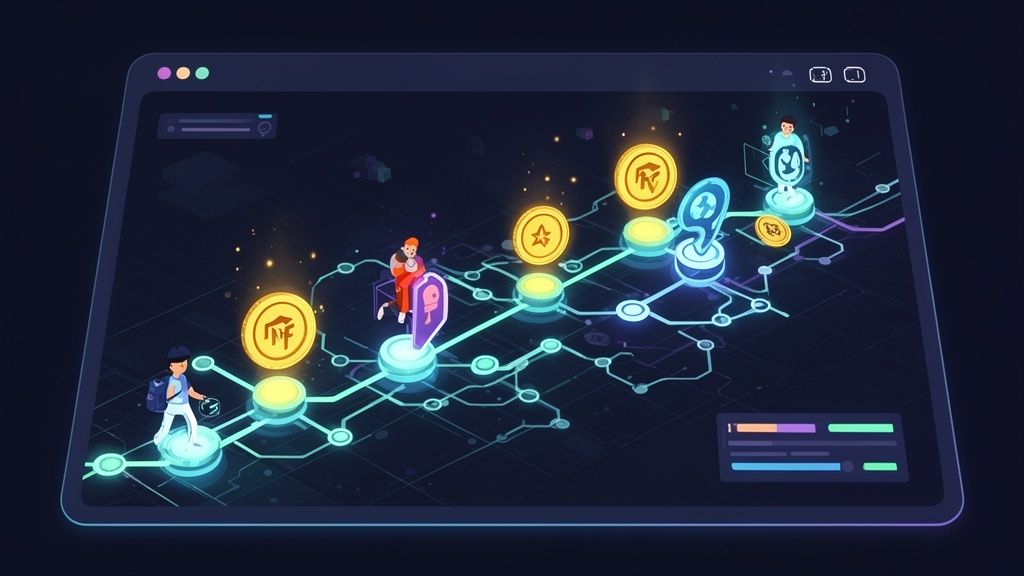
Let's get straight to it: loyalty rewards management is how you design, launch, and fine-tune a system that keeps people coming back and gets them genuinely involved in your community. It’s not about just chucking free stuff at people. It's a thoughtful plan to reward specific actions that help your project grow, turning casual users into true believers.
What Is Loyalty Rewards Management, Really?
Let’s cut through the corporate-speak. At its heart, loyalty rewards management is the art of building a die-hard community out of casual followers.
Think of it like the quest system in a video game. You complete a challenge—beat a tough boss, find a rare artifact—and you get rewarded with awesome loot. It’s what makes the game sticky and keeps you logging in day after day. A smart rewards program does the same thing, creating "quests" that nudge your community to take actions you want to see. This whole management system is the engine that runs the show, from dreaming up the quests to delivering the rewards.
It’s So Much More Than a Digital Punch Card
A good loyalty program isn't just a transactional back-and-forth. It’s about building a genuine connection. When you get it right, your community feels seen, appreciated, and like they’re part of a movement.
This is a massive deal in Web3, where your community isn’t just some audience you market to—they are the project. They’re your investors, your beta testers, your loudest cheerleaders, and sometimes even your co-creators. If you ignore them, you’re ignoring the very thing your project is built on.
A well-run loyalty system can directly boost your growth by rewarding behaviors like:
- Social Amplification: Getting rewarded for firing off a tweet, joining a Telegram raid, or making cool content about the project.
- On-Chain Activity: Incentivizing things like staking an NFT, swapping tokens on a certain exchange, or simply holding a specific amount of your token.
- Product Engagement: Encouraging people to try out new features, give you honest feedback, or hit specific milestones inside your app.
A great loyalty program gives your community skin in the game. When people feel like their contributions matter and get rewarded for them, their investment becomes personal, not just financial.
How to Pull This Off Without a Team of Coders
Not too long ago, building a system that could track all these different actions and automatically dish out rewards was a huge technical headache. You needed a bunch of developers, custom code, and constant upkeep, which put it out of reach for most teams running lean.
Thankfully, those days are over. Modern no-code toolkits like Domino put all this power right into the hands of community managers and marketers. You can build out complex, multi-step quests, automatically check if someone completed on-chain and off-chain tasks, and send out rewards without a hitch—all from one simple dashboard. This completely changes the game, meaning any team can now create the kind of engaging, gamified experiences that build truly loyal and passionate communities.
From Punch Cards to On-Chain Quests
Remember that humble paper punch card from your local coffee shop? Buy ten lattes, get one free. For decades, that simple piece of cardstock was the pinnacle of loyalty programs. It was tangible, easy to understand, and worked just fine for a world that moved a lot slower. The whole model was built on a straightforward, centralized promise: stick with us, and we'll eventually give you something back.
But let's be honest, those old-school systems are full of holes. Your points are basically trapped inside a single company’s ecosystem, like airline miles you can never seem to use on the flight you actually want. You don't really own them; the company holds all the cards and can change the rules, devalue your hard-earned points, or even shut the program down without warning. It’s a classic walled garden where your loyalty belongs to the brand, not you.
A New Era of Digital Ownership
Web3 completely flips this script. Instead of a private company database tracking your points, loyalty gets recorded on a transparent, public ledger—the blockchain. This isn't just a tech upgrade; it's a fundamental power shift. Rewards are no longer just numbers in a spreadsheet. They become real digital assets, like NFTs or tokens, that you genuinely own in your digital wallet.
This is where the idea of on-chain quests comes in. Think of them as dynamic, verifiable tasks that your community members can complete to earn rewards. The real magic is in the verification. Because actions happen on the blockchain, there's no need for manual checks or trusting a third party. Did a user stake an NFT? Did they provide liquidity to a certain pool? The blockchain gives you undeniable proof, making the whole loyalty management process smooth and transparent.
This is what a modern loyalty framework actually looks like—it’s all about connecting your community with the right actions, tools, and rewards.
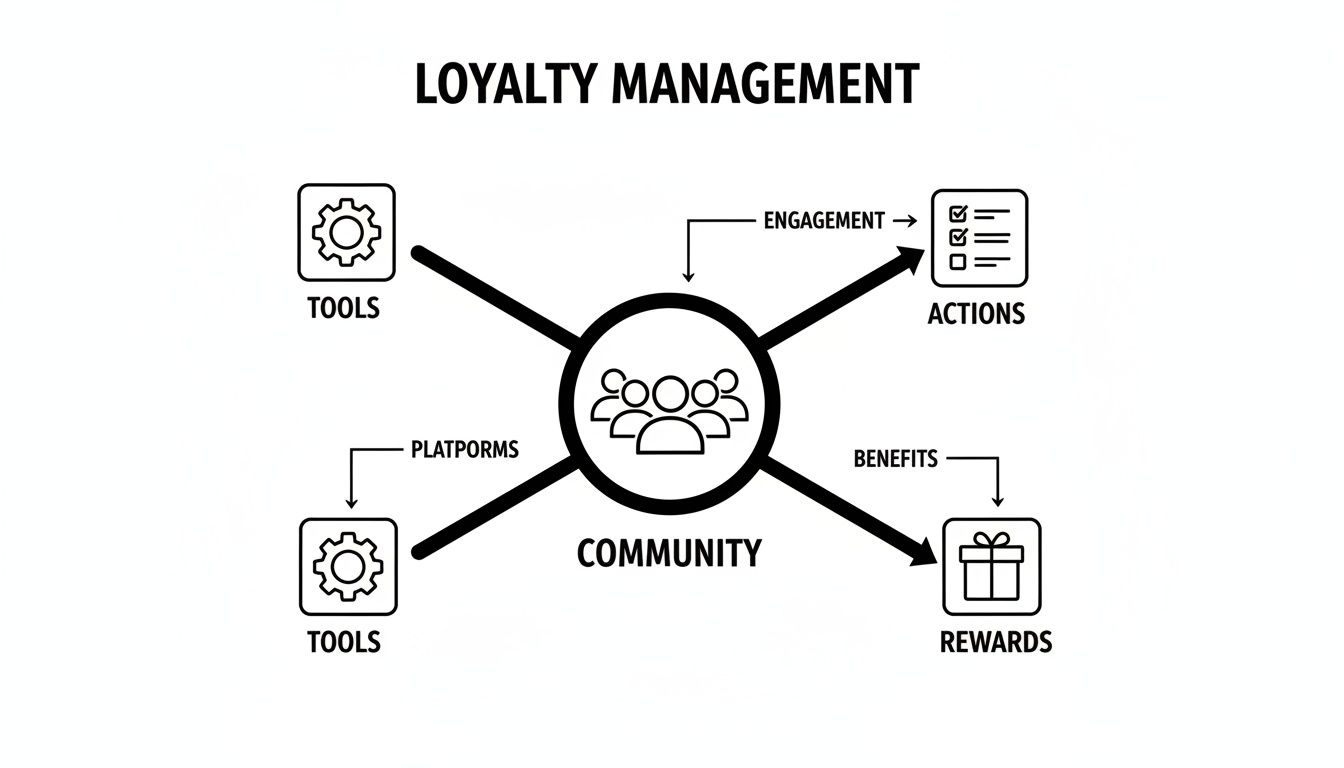
When you get this right, you create a powerful growth loop where community engagement fuels itself.
Traditional Loyalty Programs vs Web3 Rewards Systems
The difference between the old way and the new way is stark. Old programs feel restrictive, while Web3 opens up a world of possibilities based on true ownership and verifiable actions.
| Feature | Traditional Loyalty (e.g., Airline Miles) | Web3 Rewards (e.g., On-Chain Quests) |
|---|---|---|
| Ownership | Brand owns the points; can be revoked or devalued. | User truly owns the rewards (NFTs, tokens) in their wallet. |
| Verification | Manual or relies on centralized company systems. | Automated and trustless via on-chain data. |
| Transparency | Program rules are opaque and can change without notice. | Rules are transparent, often encoded in smart contracts. |
| Portability | Points are locked into a single brand's ecosystem. | Assets are interoperable and can be used across different platforms. |
| Engagement | Typically passive, rewarding only transactions (e.g., "buy X"). | Active and gamified, rewarding specific community actions. |
This table really highlights the core evolution: we're moving from a rental model of loyalty to an ownership model.
Why This New Model Is a Game-Changer
The numbers tell a story of their own. By 2025, over 90% of companies are expected to have some kind of loyalty program, making it less of a bonus and more of a survival tool. With the global loyalty market projected to hit a staggering $41.21 billion by 2032, the stakes couldn't be higher.
Yet, traditional programs are struggling to keep people engaged. A shocking 50% of earned rewards are never even redeemed. That’s a massive sign that something is broken and that there's huge room for improvement with more engaging, gamified designs.
Web3 rewards tackle these old problems directly:
- Effortless Verification: No more manually checking if someone completed a task. Tools like Domino use on-chain data to automatically verify actions like tweets, Discord roles, or NFT stakes.
- True Ownership: Rewards are assets. Your community can hold them, trade them, or use them across different platforms, which creates a much more open and valuable ecosystem for everyone.
- Radical Transparency: Everyone can see the rules of the game. The quests and their rewards are crystal clear, which builds a ton of trust between a project and its community.
- Interoperability: A reward earned in one ecosystem could one day unlock perks in a completely different one, creating a more connected Web3 experience.
The jump from punch cards to on-chain quests is really about moving from a system of permissioned rewards to one of verifiable ownership. It’s the difference between renting your loyalty from a brand and actually owning it.
This new approach lets marketers and community builders create far more interesting and intricate campaigns. Instead of just rewarding a purchase, you can incentivize complex behaviors that build a stronger, more invested community. You can check out hundreds of pre-built Web3 quest templates on Domino to see how projects are already using this to their advantage. This isn't just a slightly better version of the old system; it's an entirely new way to think about building and rewarding loyalty.
Designing Your Web3 Loyalty Playbook
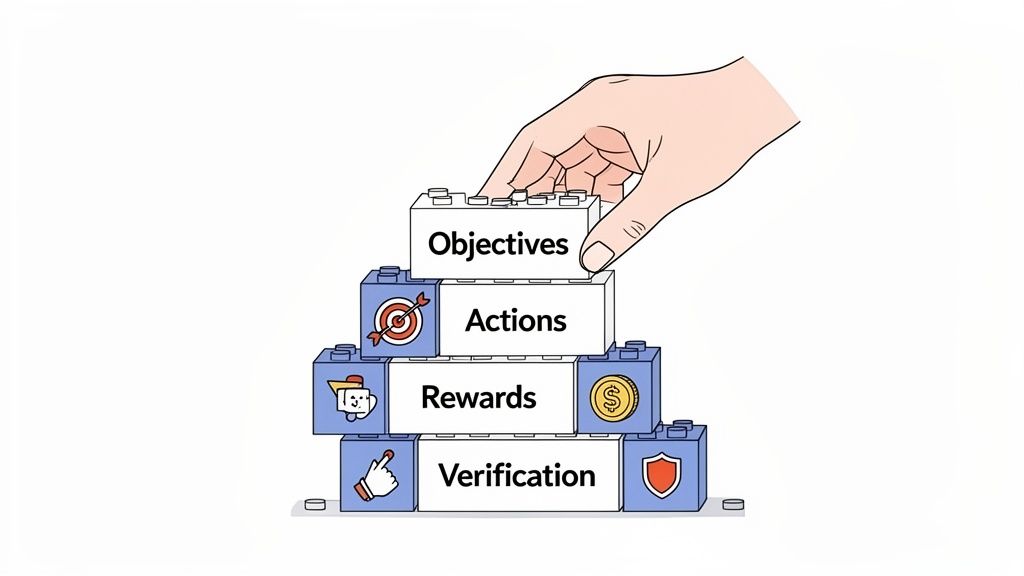
Alright, let's get our hands dirty and turn all that theory into a real-world game plan. Building a Web3 rewards program might seem daunting, but it’s really just about snapping together the right pieces in the right order. Think of this as your workshop for designing a loyalty system that feels less like a technical chore and more like a creative strategy session.
The best part? You don't need to be a developer to pull this off. With the right mindset and tools, any marketer or community manager can spin up an engaging program from scratch. Let's break down the essential building blocks of your loyalty rewards management strategy.
Start With Your Core Objectives
Before you even dream up rewards, you have to answer one critical question: What are we actually trying to do here? A loyalty program without a clear goal is like a ship without a rudder—it might look busy, but it’s just drifting.
Your objectives will steer every other decision you make. Are you a brand new project trying to get your first hundred users, or are you an established protocol trying to deepen the bonds within your community?
Common goals for a Web3 loyalty program usually fall into a few buckets:
- Driving User Acquisition: Getting new people to join your community, connect their wallets, or smash that follow button on your socials.
- Boosting Community Engagement: Lighting a fire in your Discord or Telegram and getting people talking, sharing, and reacting.
- Increasing On-Chain Activity: Motivating users to actually use your protocol—staking a token, providing liquidity, or trying out a new dApp feature.
- Generating User-Generated Content (UGC): Turning your community into a content engine by rewarding them for creating memes, tutorials, or videos about your project.
Your objective is your North Star. Every quest, every reward, and every verification step should point directly to it. If an idea doesn't serve that primary goal, put it on the back burner for now.
Pinpoint Your Target Actions
Once you've figured out your "why," it’s time to nail down the "what." What specific things do you want your community to do? This is where you connect your big-picture goals to tangible, trackable tasks. These actions, or "quests," are the very heart of your program.
A truly great loyalty rewards management system doesn't just live on-chain; it blends on-chain and off-chain activities to create a complete experience.
Off-Chain Actions (Generating Buzz):
- Following your project on X
- Joining your Discord or Telegram and reacting to a key announcement
- Retweeting a specific post
- Creating and sharing a hilarious meme about your project
On-Chain Actions (Driving Real Value):
- Holding a specific NFT from your collection
- Staking a minimum amount of your project's native token
- Completing a transaction on your platform
- Casting a vote on a governance proposal
The trick is to start simple. Pick one or two high-impact actions that directly feed into your main objective. You can always add more layers and complexity down the road.
Select the Right Rewards
Now for the fun part: the loot! Rewards are what get people to participate, but they don't always need to break the bank. In fact, some of the most powerful rewards have little to no monetary value. Instead, they offer exclusivity, status, or real utility within your ecosystem.
Think about offering a mix of rewards to appeal to different types of people in your community:
- Digital Assets: NFTs, fungible tokens, or POAPs (Proof of Attendance Protocol) to commemorate participation.
- Access & Exclusivity: Whitelist spots for an upcoming mint, early access to new features, or a key to a private, holders-only Discord channel.
- Status & Recognition: Unique Discord roles like "OG Contributor" or "Quest Master" that let members flex their dedication.
- Tangible Goods: Who doesn't love swag? Branded hoodies, hats, or stickers for your most committed superfans can go a long way.
My advice? Start with low-cost, high-value rewards like special Discord roles and whitelist spots. This lets you test the waters and see what resonates without a massive upfront investment. Once you prove the program is working, you can scale up to bigger and better rewards. And with a platform like Domino, you can automate the distribution of most of these rewards, making the whole process a breeze for both you and your community.
Measuring What Actually Matters
A successful loyalty program isn’t about how many people sign up. It’s about what they do. If you aren't measuring the impact, you're just flying blind. It's time to cut through the noise of vanity metrics and get down to the Key Performance Indicators (KPIs) that show you what’s really going on.
Counting total members might feel good, but it doesn't tell you if your program is actually driving growth. We need to move past surface-level numbers and dig into the data that counts. Actionable metrics are the difference between guessing and knowing, and they’re what you’ll use to prove your community’s value to any stakeholder.
Key Metrics for Web3 Loyalty Programs
To get a real sense of your program’s performance, you need a dashboard of specific, meaningful KPIs. These numbers tell a story about how engaged your community is, how efficient your rewards are, and what kind of impact you’re having on the project's bottom line.
Here are the essential metrics you should be tracking:
- Quest Completion Rate: This is simply the percentage of people who start a quest and actually finish it. A high rate tells you the quest is clear, engaging, and worth the effort. A low rate? That could mean you have a problem—maybe the instructions are confusing, the task is too hard, or the reward just isn't compelling enough.
- Active Participant Rate: Forget total sign-ups. This is the real deal. It measures the percentage of your community members who jump into at least one quest over a certain period, like a week or a month. This is a much better barometer of community health.
- Cost Per Action (CPA): How much are you spending in rewards for each action you want someone to take? Whether it's a tweet, a token swap, or just reacting to a Discord post, your CPA tells you if you're getting a good return on your rewards budget.
The real magic happens when you connect these loyalty-specific metrics to your project’s ultimate goals. For instance, a high Quest Completion Rate for a "stake our token" quest should directly translate to a higher Total Value Locked (TVL) for your project.
Tying Loyalty Metrics to Project Health
Your loyalty program isn't just a side quest; it's a powerful engine designed to push your core business metrics forward.
Let's say your main goal is to grow your user base. Your quests should then be all about social sharing and referrals. In that case, you’d be watching your viral coefficient—how many new users each existing member brings in—like a hawk. See a spike in your Daily Active Users (DAU) right after launching a new in-app quest? That’s a clear win.
Ultimately, the goal of any loyalty program is to build stronger, long-term relationships and increase Customer Lifetime Value (CLTV). By tracking how much more a program member engages, spends, or participates compared to a non-member, you build an undeniable case for your program's ROI.
Proving the ROI of Your Efforts
Loyalty programs are not just a "nice-to-have" engagement tactic; they're direct revenue drivers. The data backs this up. Research shows that loyalty members can spend up to 164% more when cashing in their rewards and have a 73% higher purchase frequency than people who don't. For Web3 projects, this means more on-chain activity, deeper liquidity, and a stronger token economy. You can read the full research about loyalty statistics to see these powerful benchmarks for yourself.
This is where you make smarter, data-driven decisions. If you notice quests rewarding Telegram raids are bringing in a flood of new members at a low CPA, you know exactly where to double down. On the other hand, if an on-chain quest has a terrible completion rate, it's a signal to investigate. Maybe gas fees are too high, or the instructions just aren't clear.
This constant loop of measuring, interpreting, and adjusting is what effective loyalty rewards management is all about.
Launch and Scale Your Program Without Code
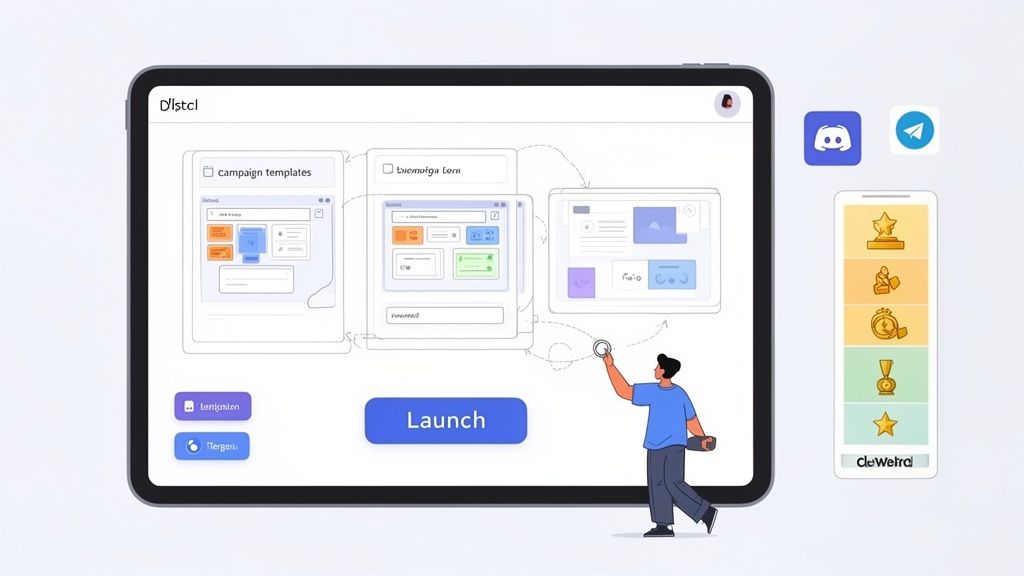
This is where the rubber meets the road. Building and managing a powerful loyalty program used to be a huge undertaking, something only projects with big development teams could even attempt. Not anymore.
With no-code platforms, you can get a surprisingly sophisticated system off the ground in minutes. The focus shifts from wrestling with code to what actually matters: your creative strategy. Imagine getting your first campaign live in the time it takes to grab a coffee. That's what we're talking about.
Your Five-Minute Launchpad
Getting started with a toolkit like Domino is refreshingly straightforward. The whole point is to remove the friction. You can connect your essential community hubs—think Discord and Telegram—with just a couple of clicks. No messing with complex configurations or APIs.
From there, you jump right into designing your first campaign using pre-built templates. These aren't just generic placeholders; they're based on what actually works for driving specific goals, from boosting your social media presence to rewarding on-chain activity.
- Social Amplification Quests: Want to reward people for following you on X, retweeting big news, or joining a Telegram raid? There are ready-made templates for that.
- Community Engagement Quests: You can instantly set up rewards for simple things, like reacting to a Discord announcement or earning a specific role in your community.
- On-Chain Action Quests: Need to verify a wallet connection, check for NFT ownership, or confirm token staking? You can do all of that without writing a single line of code.
This plug-and-play setup means you can go from a cool idea to a live quest in minutes, not weeks. You can browse a huge library of no-code Web3 apps and templates to see just how easy it is to hit the ground running.
The real magic of a no-code platform isn't just about making things easier—it's about making entirely new strategies possible. When you remove the technical hurdles, you free up your team to get truly creative and build a loyalty experience that stands out.
Smart Strategies for Scaling Your Program
Getting launched is just step one. The real win comes when you can scale your program's depth and impact as your community grows. A great no-code platform grows right alongside you, giving you the tools to build a more layered and interesting rewards system over time. To make sure your program doesn't buckle under its own success, understanding effective application scaling strategies is key to keeping everything running smoothly.
Here are a few smart ways to scale up without calling in a developer:
- Introduce Tiered Rewards: Start creating exclusive reward levels for your most active members. For instance, maybe anyone who completes 10 quests unlocks a "Super Contributor" role in Discord, which grants access to a private channel or sneak peeks at new features. This adds a fun, game-like element and gives people a clear path to level up.
- Run Seasonal or Event-Based Campaigns: Keep things fresh by tying quests to specific moments. Got a product launch coming up? A holiday? A big industry conference? Build a campaign around it. This creates a natural sense of urgency and gives people new reasons to check in and participate.
- Integrate with Your Marketing Stack: Connect your loyalty program to the other tools you already rely on. A simple example is automatically adding anyone who completes a quest to a specific email list. This creates a seamless bridge between your community engagement and your broader marketing efforts.
By taking a modular approach, you can keep evolving your loyalty program piece by piece. As your community matures, you can add new layers of engagement, ensuring your program remains a powerful engine for growth for years to come.
Common Questions About Loyalty Rewards Management
Alright, let's get into the nitty-gritty. Diving into loyalty rewards can bring up a ton of questions. You’ve seen how it all works and why it matters, but now it’s time to tackle the practical concerns that every Web3 marketer and community manager bumps up against.
Think of this as your quick-fire guide to clearing up those last few doubts. Let's jump straight into the most common questions we hear from teams building out their first loyalty programs.
What Is the Biggest Mistake Projects Make When Starting a Loyalty Program?
Easy. The single most common pitfall is focusing way too much on the rewards and not nearly enough on the behaviors you want to inspire. So many teams jump straight to, "Let's give away a bunch of NFTs!" without first asking the most important question: "What do we need our community to do right now?"
A successful program always starts with a clear goal. Are you trying to boost Discord engagement by 20%? Or maybe you want to drive 1,000 new wallet connections to your dApp. Once you know what you’re aiming for, then you can design quests and rewards that actually push people toward that specific action.
Another huge mistake is creating too much friction. If a user has to jump through ten different hoops just to claim a small reward, they’ll just give up. It's that simple. Participation has to feel effortless. The key is to make quests easy to understand, verification seamless, and the rewards genuinely meaningful.
The best loyalty rewards management isn't about having the flashiest prizes. It’s about building the smoothest, most direct path between the action you want and the reward your community values.
This is where tools like Domino come in. They solve this problem by completely automating the verification for common tasks like checking for likes, retweets, or on-chain transactions. This cuts out the user friction and frees up your team from an endless death spiral of manual checks.
How Much Should We Budget for a Web3 Loyalty Program?
Ah, the million-dollar question. The honest answer is... it depends. There’s no single number here. Your budget is going to depend entirely on your project’s stage, your goals, and your resources. But thinking about a "budget" goes way beyond just the dollar value of your rewards.
Your total investment really has three key parts:
- The Value of Rewards: This is the obvious one. It could be a small percentage of your token supply, a dedicated collection of NFTs, or even the cash value of some physical swag.
- The Cost of Tools: This is what you pay for the platform you use to run the program. A no-code platform cuts this expense down dramatically compared to hiring developers to build a custom solution from scratch.
- The Cost of Your Team's Time: How many hours will your community manager spend setting up quests, answering questions, and tracking results? This is a real cost that often gets overlooked.
The great thing about modern loyalty platforms is that they slash the "time and tech" slice of the budget pie.
For the rewards themselves, a great strategy is to start with low-cost, high-value perks. Think exclusive Discord roles, whitelist access for an upcoming mint, or early access to new features. Once you start to see the program's ROI, you can scale up to more significant rewards like token airdrops or high-value NFTs. The goal is to build a sustainable rewards economy that grows right alongside your community.
Can a Loyalty Program Work for a Pre-Launch Project?
Absolutely! In fact, running a loyalty program before you even launch is one of the most powerful growth hacks out there for an early-stage project. Before you even have a live product, you can use a reward system to build your foundational community from scratch.
This is your chance to bootstrap your entire initial presence. You can create simple quests that reward people for taking those essential first steps in community building.
Here are a few classic pre-launch quests:
- Joining your Discord server and getting a specific role.
- Following your project's account on X (formerly Twitter).
- Sharing your main announcement post with their network.
- Signing up for your email newsletter to get launch updates.
The rewards for these early actions should build a sense of belonging and exclusivity. Offer a "Founding Member" NFT, a special "OG" Discord role, or guaranteed whitelist access for your token or NFT launch. This strategy creates a core group of dedicated advocates before you even open the doors. With a no-code tool, you can get these foundational growth campaigns up and running in a single afternoon. To explore your options, you can see what fits your project's budget on the Domino pricing page.
How Do You Prevent Bots and Sybil Attacks?
This is, without a doubt, one of the most critical challenges in the Web3 space. A rewards program that can be easily farmed by bots is worse than having no program at all. Your best defense is always a multi-layered approach that makes it too expensive and difficult for bad actors to game the system.
First, use platform-native protections. Simple integrations with Discord and Telegram can leverage their built-in user verification and anti-spam systems as a first line of defense.
Second, design quests that are naturally harder for bots to fake. A "follow" on social media is trivially easy for a bot to complete. But tasks that require genuine content creation, nuanced on-chain interactions, or thoughtful feedback? Those are much more difficult to automate.
Third, use AI-powered verification. This is a game-changer. Modern loyalty tools can use AI to automatically review user-generated content, like tweets or memes, to ensure they meet the quest's criteria and filter out low-effort, spammy junk.
Finally, incorporate on-chain requirements. This acts as a powerful "proof of humanity." Requiring users to hold a specific NFT, maintain a minimum token balance, or have a certain transaction history on their wallet significantly raises the cost and complexity for anyone trying to launch a Sybil attack. By combining all these layers, you can build a robust system that rewards your real community members.
Ready to turn casual followers into a die-hard community? With Domino, you can design, launch, and scale powerful Web3 loyalty programs in minutes, not months. Start building your first quest today.