Build a Web3 Gamification Loyalty Program That Actually Works
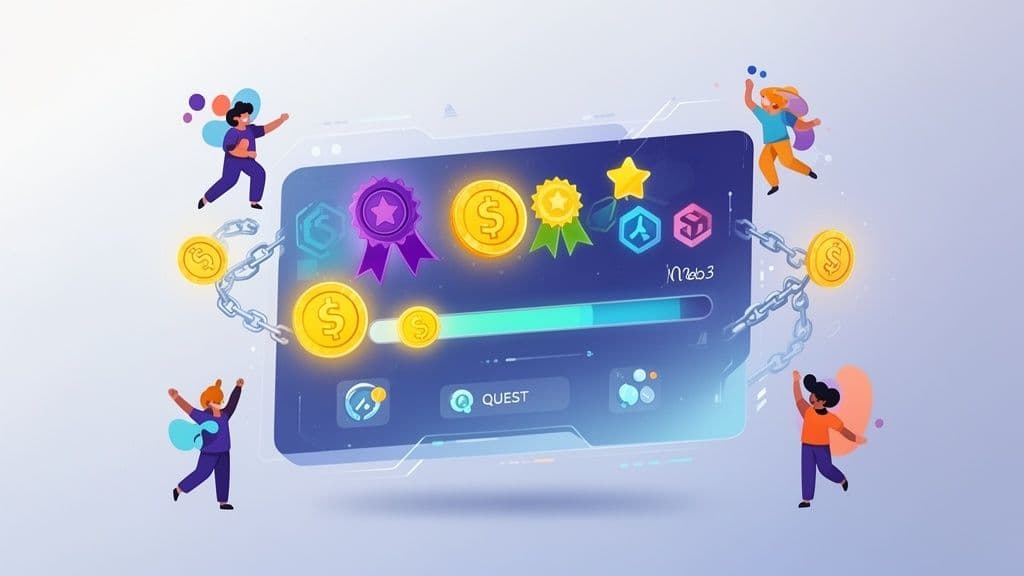
Forget everything you know about old-school loyalty programs. A gamified loyalty program isn't about collecting boring points for purchases; it's about using game mechanics—think quests, leaderboards, and badges—to get your community fired up and actively involved.
In the Web3 world, this is a game-changer. We're moving way beyond simple "earn-and-burn" models to create genuinely fun, interactive experiences that build a die-hard community and, just as importantly, drive real on-chain activity.
Why Your Web3 Project Needs Gamified Loyalty
Let's be real—the traditional loyalty playbook is totally broken for Web3. If your community is the heart and soul of your project, a basic points system that only tracks transactions is a massive missed opportunity. You aren't just selling something; you're building a living, breathing ecosystem. You need a loyalty system that actually recognizes and rewards that.
A gamified loyalty program is essential for survival and growth because it speaks the native language of the internet: engagement, competition, and achievement. It’s how you turn passive lurkers into active, passionate advocates—by making participation feel less like a chore and more like a game.
The Psychology Behind Game Mechanics
So, why does this actually work? It’s all about tapping into some pretty basic human psychology. Things like leaderboards, quests, and collectible badges play directly into our built-in desires for:
- Achievement: Knocking out a quest or earning a new badge delivers a real, tangible sense of accomplishment.
- Competition: There's nothing like seeing your name climb a leaderboard to spark a little friendly rivalry and keep people coming back for more.
- Social Status: Exclusive Discord roles or rare digital collectibles earned through the program become status symbols that people want to show off.
This creates an incredibly powerful feedback loop. People complete tasks, get rewarded, feel that hit of progress, and are immediately motivated to jump back in and do more.
The real magic here is that a gamified program rewards the entire user journey, not just the final transaction. It puts value on social shares, governance votes, and specific on-chain actions, making every single member feel like a vital part of the project.
Moving Beyond Transactional Relationships
Let's break it down with a quick comparison.
Traditional vs Gamified Loyalty Programs
Here’s a quick breakdown of how a gamified approach stacks up against old-school loyalty for your Web3 community.
| Feature | Traditional Loyalty | Gamified Loyalty (Web3) |
|---|---|---|
| User Motivation | Extrinsic (discounts, points) | Intrinsic & Extrinsic (fun, status, rewards) |
| Engagement Style | Passive (earn-and-burn) | Active (quests, challenges, competition) |
| Relationship | Transactional | Community-focused & Relational |
| Rewarded Actions | Primarily purchases | On-chain & off-chain activities |
| Community Impact | Minimal | High (builds culture & advocacy) |
| Flexibility | Rigid & one-size-fits-all | Dynamic & adaptable to project goals |
As you can see, a static "earn-and-burn" model is purely transactional. A gamified loyalty program, on the other hand, builds a dynamic, interactive ecosystem. It gives you the levers to guide user behavior in ways that directly help your project—whether you need to boost liquidity on a DEX, blow up your social media presence, or get users to stress-test a new feature.
The market is already screaming this from the rooftops. The global gamification market is projected to explode from $19.42 billion in 2025 to a staggering $92.5 billion by 2030. If you want to dive deeper, you can explore more gamification statistics to see just how big this shift is. This isn't just a passing trend; it's a fundamental change in how modern projects build and keep their communities alive and kicking.
Designing Quests That Actually Drive Engagement
Alright, this is where the rubber meets the road. Your entire gamified loyalty program lives or dies by the quality of its quests. The goal is to design tasks that genuinely connect to your project's core objectives, turning those passive lurkers in your Discord into active, valuable contributors.
We're moving past just asking for retweets here. It's about building a system that rewards meaningful participation.
The trick is to find that sweet spot between on-chain and off-chain activities to keep people coming back. I always think of it like a good video game: you need some quick, easy wins to get people hooked, but also some bigger, more challenging "boss fights" that offer way better loot and a real sense of accomplishment.
This flow shows exactly how that works—turning a passive observer into a vocal supporter through a cycle of gamified actions.
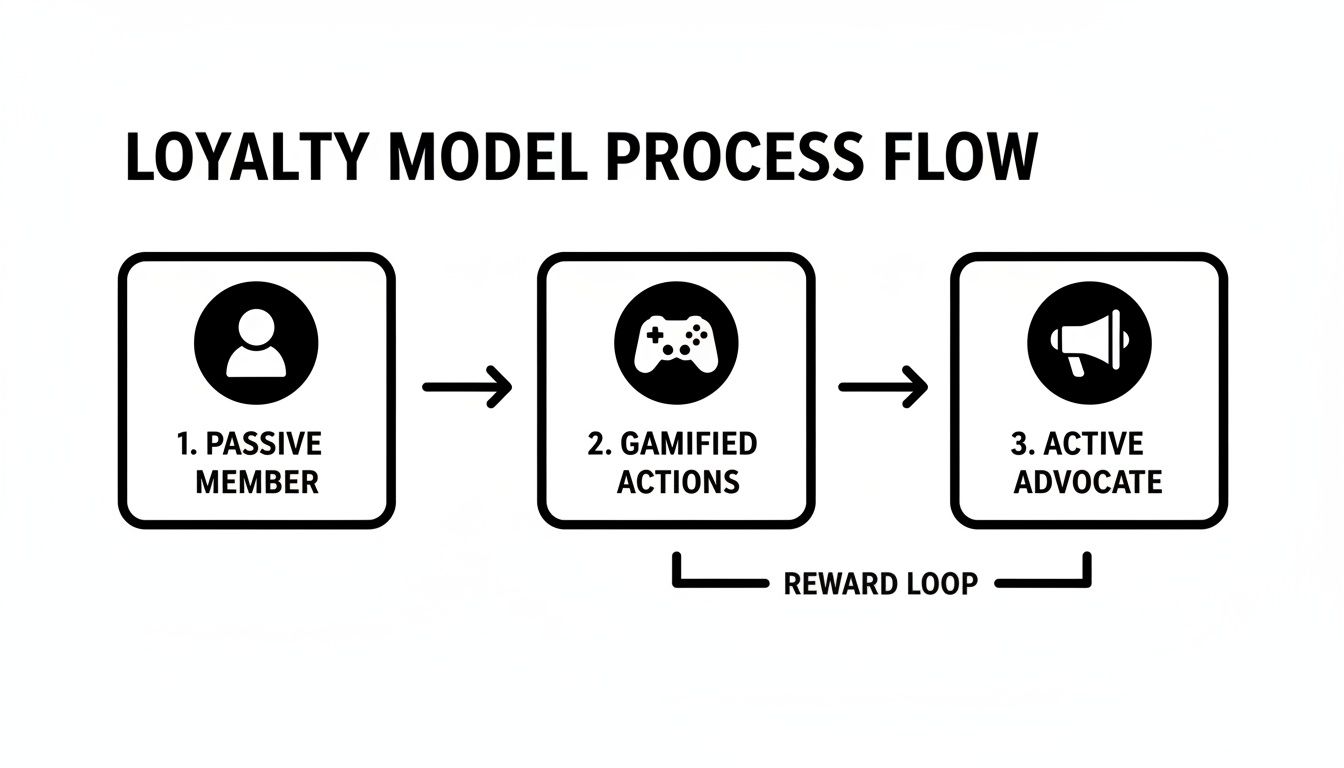
The big takeaway? Gamification isn't just for fun; it's the engine that motivates idle users and transforms them into your project's biggest advocates.
The Right Mix: Blending On-Chain and Off-Chain Quests
A great loyalty program can't be siloed. It needs to weave itself into your entire ecosystem, rewarding users for actions that create real value—whether that's on Twitter or directly on the blockchain. Nailing this balance is everything for keeping people engaged long-term.
Off-Chain Quests: Your Top-of-Funnel Powerhouse
Think of these as your low-hanging fruit. They’re typically low-friction tasks designed to blow up your brand awareness and grow the community.
- Social Amplification: Let's get more creative than "like and retweet." Challenge your community to create and share original content, like killer memes or short videos hyping your project.
- Discord Engagement: Don't just reward people for being present. Reward them for being helpful. Give points for guiding new members, sparking great conversations, or showing up to AMAs.
- Content Creation: Encourage the community to become your content arm. Task them with writing blog posts, creating tutorials, or recording honest reviews. You can even use AI-powered tools to help automate the review process for these submissions, which is a massive time-saver.
On-Chain Quests: Driving Real Protocol Value
This is where you get people to actually use your product. These quests are all about boosting core protocol metrics and encouraging direct interaction with your smart contracts. They’re absolutely critical for building a healthy, active on-chain footprint.
- Protocol Interaction: Get them in the weeds. Reward users for things like staking NFTs, adding liquidity to a key pool, or hitting a certain token swap volume.
- Governance Participation: Turn users into citizens. Reward them for voting on governance proposals or, even better, for creating their own.
- Product Testing: Incentivize your power users to test new features on a testnet. Their feedback is gold, and it helps you build a much stronger product.
Create a Feeling of Progression
A random list of tasks gets old, fast. The programs that truly stick are the ones that make users feel like they're leveling up and accomplishing something real. This is where a well-thought-out progression system becomes your secret weapon.
A strong progression system turns one-off task completion into a long-term journey. It gives users a reason to stick around, continually engage, and deepen their relationship with your project.
You’ll want to build this system with a few different layers to keep things fresh. And remember, rewards aren't just about tokens.
Crafting Your Reward Structure
- Experience Points (XP): XP is the lifeblood of your progression. Every quest gives XP, which stacks up over time to unlock higher levels and new tiers of rewards.
- Exclusive Roles: Connect Discord or Telegram roles to XP levels. A "Level 10 Sentinel" role just feels cooler and more valuable than a generic one, acting as a public badge of honor.
- Valuable NFTs: Offer up limited-edition NFTs for completing tough questlines or hitting major milestones. These can unlock access to exclusive channels, future airdrops, or other awesome perks.
- Leaderboards: Fire up that competitive spirit. Run weekly or seasonal leaderboards with special prizes for the top dogs. The data doesn't lie: people in loyalty challenges purchase seven times more frequently than those who don't.
When you combine these elements, you’re not just giving out points; you’re helping users build a real identity within your ecosystem. If you need a jumpstart, Domino has a whole library of battle-tested Web3 quest templates you can steal and adapt. Taking the guesswork out of the design is half the battle.
Choosing the Right Tech for Your Program
A brilliant quest design is only half the battle. To actually bring your gamification loyalty program to life without completely torching your dev team's roadmap, you need the right technology. The whole point of the modern Web3 stack is efficiency, which means leaning hard into tools that automate the grunt work.
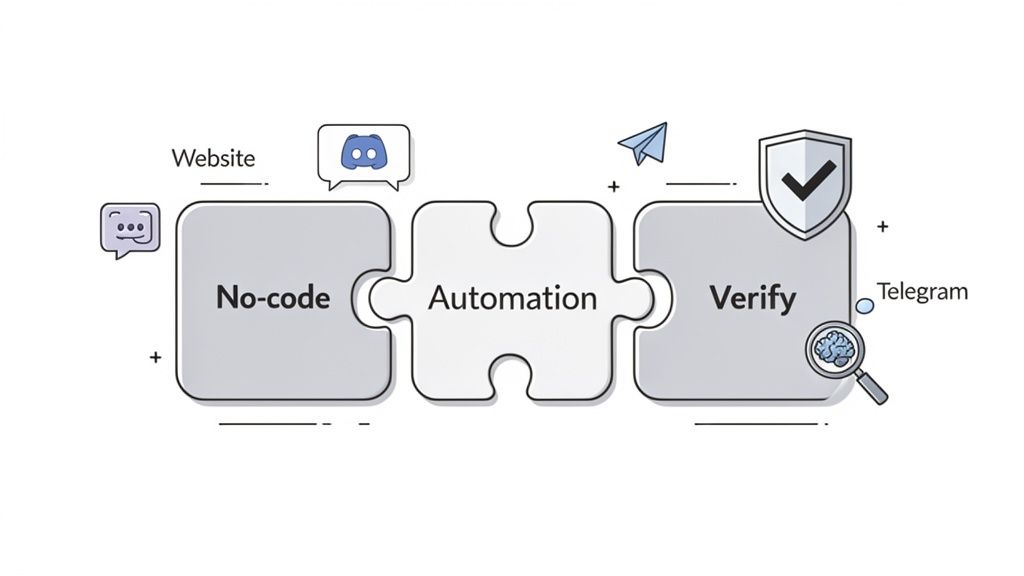
Honestly, forget about building everything from scratch. The name of the game is using powerful, no-code platforms to handle the heavy lifting. This approach lets you focus on what really matters—crafting an awesome community experience—instead of getting lost in backend development and endless bug-squashing sessions. You want to launch, learn, and iterate fast.
Picking Your Frontend Where Your Community Lives
The frontend is the face of your program. It's where your community will actually interact with quests, check their progress, and snag rewards. The golden rule here is to meet your users where they already are. You want to create a frictionless experience that feels like a natural part of your world.
You’ve got a few solid routes you can go down, each with its own perks.
- White-Label Embedded Portals: This is a fantastic option if you want a seamless, branded experience right on your own website. Users don't have to bounce to another site; the quest board is just embedded where it feels like it belongs. It keeps your brand front and center and all the traffic on your domain.
- Discord & Telegram Bots: Is your community’s heart and soul in Discord or Telegram? Then bring the action to them. A bot lets users see quests, submit proof, and get updates in real-time without ever leaving the chat. It's a killer way to drive engagement in your most active channels.
- Standalone Quest Platforms: Services like Zealy offer a dedicated, ready-to-go interface. While this means sending users off-site, it can be the absolute fastest way to get a polished program off the ground with very little setup.
The best choice really comes down to your community's habits. For a truly powerful gamification loyalty program, I've found a hybrid approach often crushes it, letting people engage from wherever they feel most comfortable.
The Critical Role of Automated Verification
Okay, this is the secret sauce. This is what makes a modern loyalty program work without driving you insane. Manually checking every single tweet, Discord reaction, or on-chain transaction is a one-way ticket to community manager burnout. It’s tedious, full of human error, and just won't scale.
Automation is non-negotiable. Your tech stack has to be able to automatically verify that tasks were completed across a huge range of actions. This is where a dedicated platform like Domino becomes a lifesaver.
Automation isn't just a time-saver; it's a trust-builder. When users see their actions verified instantly and accurately, it reinforces the legitimacy of the program and encourages them to keep participating.
Look for a tool that can handle verification for:
- Social Actions: Instantly confirming retweets, likes, follows, and even specific hashtag usage on platforms like X (formerly Twitter).
- On-Chain Activity: Verifying wallet connections, token swaps, NFT ownership, staking, and liquidity provision without anyone lifting a finger.
- Community Platform Engagement: Checking for Discord roles, reactions on announcements, or participation in Telegram raids.
This level of automation frees up your team to do what they do best: build relationships and cultivate a vibe, not act like administrative bots. If you're weighing your options, our guide on choosing the right loyalty program platform can give you a much deeper breakdown of different features.
Leveraging AI for Creative Submissions
So what about those quests that aren't so black and white? I'm talking about asking users to create memes, write threads, or record video reviews. This is where AI-powered content review is an absolute game-changer.
Instead of your team spending hours digging through submissions, an AI can do the first pass. It can check that content was actually made, look for key themes, and flag the best (or worst) submissions for a final human look. This slashes the admin time for creative quests, meaning you can run them more often and at a much bigger scale. It’s the perfect mix of machine efficiency and human touch.
How to Launch Your Loyalty Program for Maximum Impact
You’ve nailed down the quests and picked your tech stack—now it’s time for the main event. A brilliant concept for a gamified loyalty program can easily fizzle out if the launch doesn’t build real, lasting momentum. The goal here isn't just to make an announcement; it’s to create a can't-miss event that pulls your community in from the very first minute.
Think about it: a weak launch feels like dropping a new feature into a dead-silent room. A strong one, on the other hand, feels like a party everyone’s been waiting for. It’s all about building hype, making it ridiculously easy to get started, and giving those first movers an immediate jolt of reward and excitement.
Crafting a Launch That Builds Hype
Your launch is not a single tweet. It’s a mini-campaign. Start teasing the program about a week before it goes live. Use the channels you already own, like X (formerly Twitter) and Discord, to drop hints, share sneak peeks of the rewards, and get people buzzing about the "big reveal."
When you talk about it, focus on the "why." Don't just spit out a list of features. Explain how this program is your way of giving back and finally recognizing the people who truly contribute. Frame it as an adventure you’re all starting together, not just some new marketing gimmick.
For the official announcement, put together a clear, compelling blog post or X thread that breaks it all down:
- The Vision: What’s the whole point of this program?
- How It Works: Give them a simple, visual guide to quests, XP, and rewards.
- What's In It For Them: Show off the awesome roles, exclusive NFTs, and other perks they can actually earn.
This initial communication sets the tone for everything that comes next.
Making Onboarding Effortless
Friction is the absolute killer of adoption. From the second your program goes live, it has to be stupidly simple for people to jump in. You have to assume they know nothing and hold their hand through every step.
Set up a dedicated #loyalty-faq or #quests-help channel in your Discord. Pin a message right at the top with a super-short tutorial—maybe a quick video or a simple graphic showing them how to connect their wallet and knock out their first quest.
Your number one goal for launch day should be to get every single participant to complete at least one task within their first five minutes. That first dopamine hit of XP and the feeling of accomplishment is what hooks them and keeps them coming back.
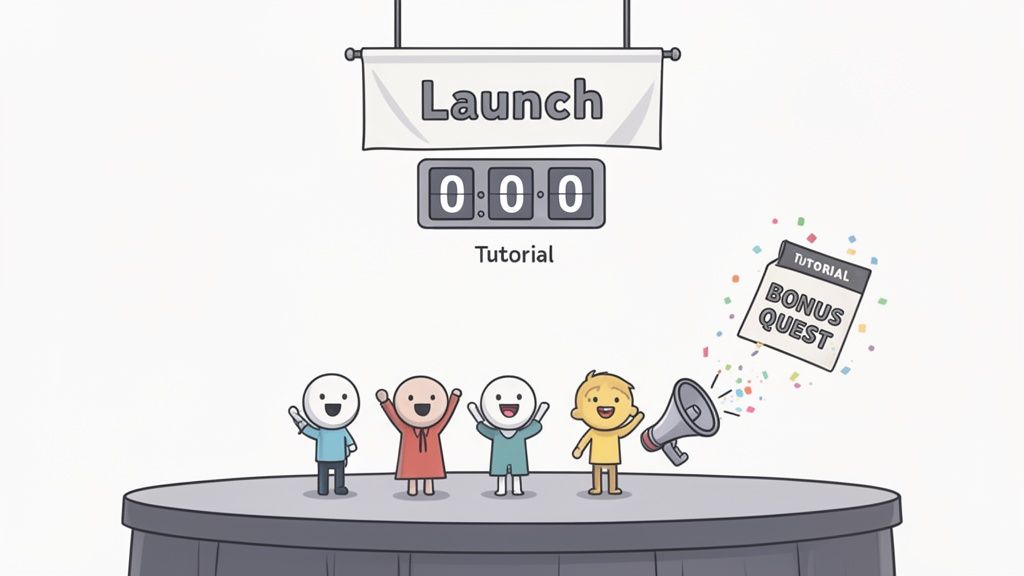
A launch-day "Tutorial Bonus Quest" is a killer tactic here. Offer a little chunk of bonus XP just for doing something easy, like connecting their X account. It’s a simple move that kickstarts their journey and teaches them how the system works right from the get-go.
Sparking Immediate Excitement with a Launch Day Event
Turn your launch into a live event. Host a special AMA or a community call on Discord Stages or X Spaces to personally walk everyone through the program. This adds a human touch and lets you answer questions in real-time, clearing up any confusion and building that shared energy.
To really dial it up, create a set of exclusive, time-sensitive launch-day quests. These could be anything from asking a question in the AMA to completing a specific on-chain action within the first 24 hours. Limited-time rewards create a powerful sense of urgency that will drive a flood of initial sign-ups.
This whole strategy is about more than just getting clicks; it's about building real behavioral loyalty that actually drives profit, not just sign-ups. This is becoming table stakes as loyalty programs mature—by 2026, a staggering 90% of US online adults are expected to be in one, making gamification a critical way to stand out. If you want to dig deeper into where things are headed, you can read the full analysis of top loyalty trends for 2026.
Measuring Success and Optimizing for Growth
Getting your gamified loyalty program live is just the first step. The real work—and the real fun—begins now. Think of your launch as the starting line, not the finish. The most successful programs are living, breathing ecosystems that evolve based on what your community is actually doing.
This is where you stop guessing and start listening to the data. Forget vanity metrics that look good on paper but mean nothing. We need to dig into the key performance indicators (KPIs) that tell you the real story of your program's health. This is what separates a program that builds lasting value from one that's just a flash in the pan.
Identifying Your Core KPIs
Before you can tweak anything, you have to know what success even looks like. Your dashboard should be your mission control, giving you a clear, immediate view of your program's performance. My advice? Don't get lost in the weeds. Focus on a handful of core metrics that directly tie back to real engagement and value.
Here are the KPIs I watch like a hawk on any program:
- Daily Active Questers (DAQ): This is your daily pulse check. How many unique users are knocking out at least one quest per day? If this number is steady or climbing, you're on the right track.
- Quest Completion Rate: This tells you which quests are a hit and which are a miss. I like to break this down by type—on-chain vs. social media tasks, for example—to see what really resonates with different user segments.
- User Retention Rate: This is the big one. Of the people who completed a quest in their first week, how many are still around in week four? High retention is the ultimate proof that you've built something with staying power.
- Average Quests Completed Per User: Are people just doing one easy task and dipping? Or are they diving deep and completing multiple challenges? This shows you the depth of their engagement, not just the breadth.
Tracking these turns vague feelings about your program's performance into hard data you can actually use.
Your goal isn't just to see numbers go up; it's to understand the story those numbers are telling. A low completion rate on a specific quest isn't a failure—it's a valuable piece of feedback telling you to either make the task clearer, the reward better, or the action easier.
Making Data-Driven Tweaks
Once you've got a handle on the data, it's time to start experimenting. Optimization isn't a one-and-done task; it's a constant cycle of looking at the data, forming a hypothesis, and testing your assumptions. Are certain rewards collecting dust? Are some on-chain quests too intimidating for newer members? Your numbers will point you right to the problem.
This is exactly where gamification crushes traditional loyalty programs. It directly tackles the "motivation gap" you see everywhere else—people might sign up for a dozen programs, but they only really engage with a few. By making it interactive and fun, you keep them coming back. In fact, insights from loyalty experts show that after years of adoption, gamification can lead to massive lifts in repeat purchase rates. You can get more details on how gamification boosts customer loyalty over at brame.io.
Having this data-first mindset means you can make smart, surgical improvements instead of just throwing things at the wall and hoping something sticks.
Actionable Optimization Strategies
Ready to get your hands dirty? Here are a few proven strategies you can put into play right now to keep your program fresh and your community hooked.
- A/B Test Your Rewards: Are people more motivated by XP, an exclusive Discord role, or raffle tickets for an NFT? Don't guess—test it. Create two almost identical quests but offer different rewards. The completion rates will give you a clear winner.
- Introduce New Quest Types: If your program has been heavy on social tasks, try rolling out a wave of on-chain challenges to fire up your power users. Variety is the spice of life, and it’s the key to preventing boredom.
- Run Seasonal Campaigns: Use holidays, project milestones, or even crypto-native events to launch themed, limited-time campaigns. A "DeFi Summer" questline or a "Spooky NFT Hunt" for October creates urgency and can bring lapsed users back into the fold.
By constantly keeping an eye on your KPIs and running smart little experiments, your gamification loyalty program becomes a powerful, self-improving engine for growth. And if you're ready to go even deeper, check out our full guide on how to measure community engagement for more advanced strategies.
Got Questions About Gamified Loyalty? Let's Clear Them Up.
Even with the best playbook, launching your first gamification loyalty program can feel like stepping into the unknown. That's totally normal. We see teams wrestle with the same few questions time and again, so let's tackle the big ones head-on.
Getting these right will give you the confidence to build something your community genuinely loves.
How Much Should We Actually Give Away in Rewards?
This is the million-dollar question, isn't it? The honest answer is: it depends, but you should always start smaller than you think.
The goal here isn't just to make it rain tokens. Your rewards budget has to be tied directly to the value of the actions you're asking for. A simple follow on X just isn’t worth the same as someone providing liquidity to a crucial DEX pool, and your rewards should reflect that.
Think of your reward economy like a mini-budget.
- Create Value Tiers: Group your quests by how much they help your project. A "low-impact" social task might get someone 10 XP, while a "high-impact" on-chain move could be worth 500 XP plus a special NFT.
- Cap the Payout: Decide on a total reward pool for a set period—say, a month or a quarter. This is crucial for preventing your program from becoming an unsustainable drain on your treasury.
- Lean on Non-Monetary Rewards: Remember, not everything needs a price tag. Exclusive Discord roles, early access to new features, and slick NFT badges are incredibly powerful motivators that don't cost you a dime.
Start conservatively. You can always sweeten the pot later if engagement is slow. It’s a lot harder to take rewards away once people get used to them.
The best loyalty programs don't just feel rewarding; they feel fair. When the effort lines up with the reward, you create a balanced system that people will stick with for the long haul.
Won't People Just Cheat the System?
Yep, some will definitely try. Cheating, or "sybil attacking"—where one person uses a bunch of accounts to farm rewards—is a real issue. But it's a manageable one.
The trick isn't to make your gamification loyalty program impossible to cheat, but to make it too annoying and expensive for the average person to bother. Your best defense is a layered one.
- Connect Multiple Platforms: Make users link their X, Discord, and wallet to join. This immediately raises the bar for creating a ton of fake identities.
- Check On-Chain History: Use tools to peek at wallet history. A brand-new wallet with zero transactions is a massive red flag compared to one that's been active for months.
- Do Manual Spot-Checks: For your biggest, most valuable rewards, have a real person take a quick look at the user's activity. You can't do it for everything, but it's a great deterrent for your top-tier prizes.
- Use AI Detection: Platforms like Domino can automatically flag suspicious patterns, like a flood of submissions from the same source or accounts acting like bots. This saves you from playing detective all day.
At the end of the day, a small amount of low-level farming is often just the cost of doing business for the huge engagement boost you get in return.
How Do We Keep It From Getting Boring and Repetitive?
Program fatigue is a real killer. If your community is just grinding the same "like and retweet" quests every week, they're going to tune out. Fast. To keep people engaged for the long run, you have to keep things dynamic and a little unpredictable.
You need to think like a game designer, not just a marketer.
Introduce new challenges and mechanics regularly. This keeps your most dedicated fans on their toes and gives lapsed users a good reason to come back and see what's new.
Try mixing in a few of these ideas:
- Run Time-Limited Campaigns: Launch special "sprints" or themed events around project milestones, partnerships, or holidays. This creates a sense of urgency and lets you offer unique rewards that won't be around forever.
- Drop in "Secret" Quests: Surprise your community by dropping a secret quest in Discord with almost no warning. This is a fantastic way to reward the people who are paying the closest attention and makes the whole experience feel more alive.
- Team Up with Other Projects: Partner with another project in your ecosystem for a cross-community campaign. This gets your program in front of a whole new audience and gives your existing members something fresh to do.
Treat your loyalty program like a living, evolving product, not a static feature you set and forget. That’s how you make it an exciting part of your community for months and years to come.
Ready to build a gamification loyalty program that actually works without tying up your dev team? With Domino, you can design, launch, and automate powerful quests in just a few minutes. See how it works and get started for free.