A Guide to Customer Rewards Program Software for Web3

Welcome to the new era of community building. We're moving way beyond simple punch cards and diving headfirst into dynamic experiences powered by customer rewards program software built for Web3. This guide is your map, taking you from the basic ideas to the advanced strategies that actually fuel growth.
From Punch Cards to Web3 Quests
At its heart, customer rewards program software is a system that helps you automate, manage, and track the incentives you offer your community. Think of it as the engine that powers your entire loyalty strategy, turning casual lurkers into die-hard advocates.
But what we consider a "reward" has completely transformed. It all started with the classic "buy nine, get the tenth free" punch card. Then came digital points systems. Now, we're in a whole new ballgame driven by Web3, where rewards are all about genuine engagement and participation, not just how much someone spends.
This modern software is less about transactional loyalty and more about building a real, interactive community around your project.
The Evolution of Customer Loyalty
The journey from simple transactional rewards to complex, engagement-focused Web3 quests is a pretty big leap.
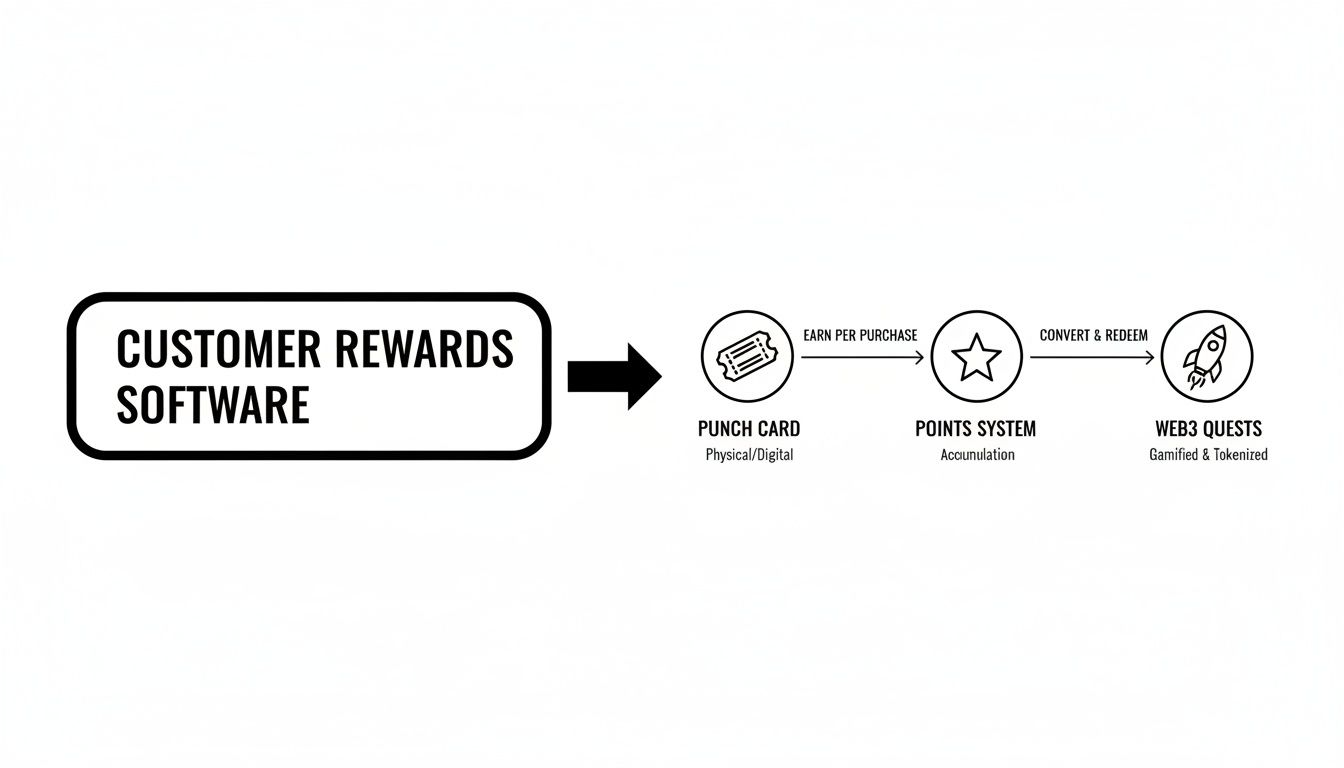
As you can see, the whole model has shifted. We've moved from rewarding a simple purchase to incentivizing a whole range of community actions, which is really the foundation of modern Web3 marketing.
This isn't just a fleeting trend; it’s a massive market shift. The global market for this kind of software was recently valued at around USD 4.5 billion and is expected to explode to USD 10.3 billion by 2033. This surge is all thanks to businesses finally realizing that keeping users is key, more people are online than ever, and everyone wants experiences that feel personal. You can read the full research about these market projections to grasp just how big this is.
Why This Matters for Web3 Projects
For Web3 projects, this evolution is everything. Unlike a typical business, Web3 success hinges on the strength of your community, how much your protocol is used, and what’s happening on-chain. A modern customer rewards program gives you a direct lever to pull to influence these critical metrics.
Here’s what it lets you do:
- Guide Users: Create simple onboarding quests that walk new members through how to use your dApp. No more confusion.
- Incentivize Key Actions: Reward people for doing exactly what you need them to do, like staking NFTs, voting in governance, or adding liquidity.
- Boost Social Engagement: Automatically reward users for social tasks, like retweeting an announcement or joining a Telegram raid.
In short, this software is your command center for community activation. It turns fuzzy goals like "increase engagement" into a concrete set of measurable, rewarding tasks for your users.
By using a quest-based system, you essentially gamify the experience and encourage people to go deeper. Instead of just hoping your community gets involved, you give them a clear path with real rewards at the end. It's this proactive approach that separates the projects that thrive from the ones that fizzle out.
Must-Have Features for a Web3 Rewards Platform
Not all rewards software is built the same, especially when you’re dealing with the wild world of Web3. To really get your community buzzing, you need a specific toolkit that can handle everything from on-chain actions to off-chain chatter. The right features are the difference between a campaign that falls flat and one that rockets your growth.
Think of it like building a custom race car. You wouldn't just throw any old engine in there. You'd want one built for the specific demands of the track—speed, precision, and endurance. Your rewards platform is that specialized engine for your community.
A No-Code Quest Builder
The absolute most important feature is a no-code quest builder. This is what lets your marketing and community teams actually run the show without having to file a ticket with the dev team for every little thing. Speed is everything, and waiting weeks for an engineer to code a simple campaign is a total momentum killer.
A good, clean drag-and-drop interface means you can spin up a new quest in minutes, not weeks. This puts the power to engage your community directly in the hands of the people who know them best.
Seamless On-Chain and Off-Chain Integration
Web3 communities straddle two different worlds. There's the social scene on Discord and X (Twitter), which is all off-chain, and then there's the transactional world of your protocol, which is on-chain. Your rewards software has to bridge that gap without breaking a sweat.
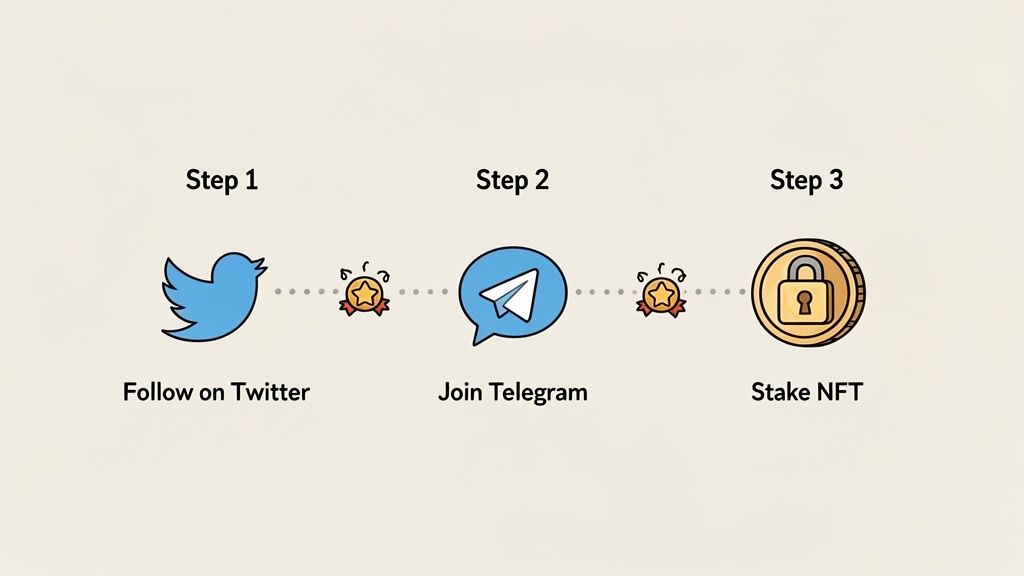
A solid platform lets you string together multi-step quests that pull from both sides. For instance, a single quest could ask a user to:
- Follow your project on X (off-chain).
- Join your Discord and drop a reaction on an announcement (off-chain).
- Stake one of your project's NFTs (on-chain).
This "best of both worlds" approach means you can reward the full range of activities that actually help your project grow.
AI-Powered Automated Verification
Okay, picture this: you run a quest asking 5,000 people to create and share a unique meme about your project. Can you imagine trying to manually check every single one? It would be a soul-crushing nightmare of spreadsheets and endless scrolling, not to mention a huge source of errors.
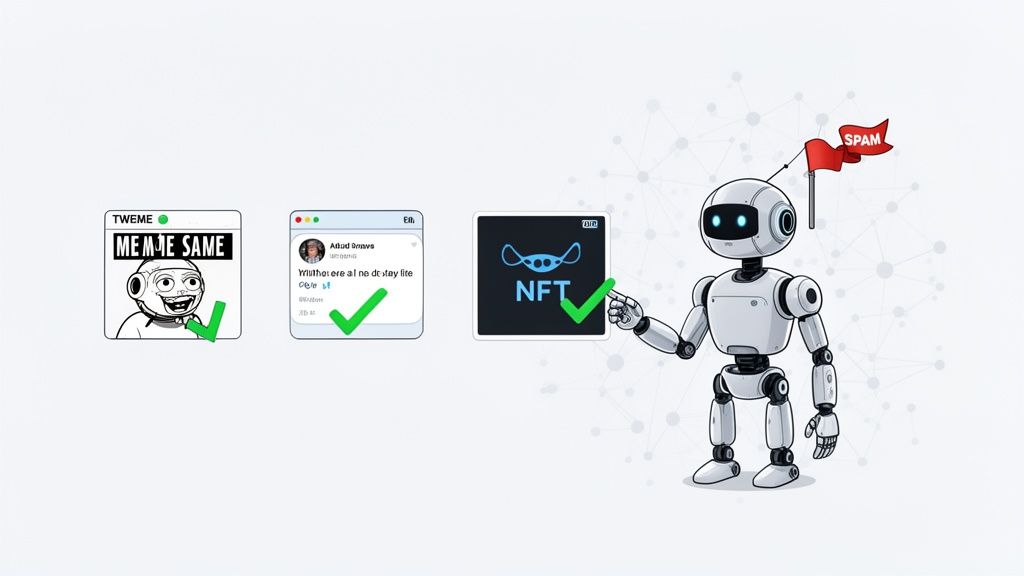
This is where AI-powered automated verification becomes a complete game-changer. AI can scan content instantly, checking for relevance, originality, and whether it follows the rules. It green-lights the good stuff and kicks out the spam, keeping things fair and scalable. This frees up your team to think about the big picture instead of getting bogged down in grunt work.
This kind of tech is a major reason the loyalty management market is booming. The software piece alone makes up a massive 58.2% revenue share of this market, which was valued at USD 13.59 billion. You can dig deeper into the growth of the loyalty management market to see just how big this is.
Multi-Platform Support and Customization
Your community doesn’t live in just one app, so your rewards program shouldn't either. Look for a platform that offers multi-platform support. You want to be able to embed quests right where your users hang out, whether that's in Discord, on Telegram, or through a slick white-label portal on your own website.
Meeting people where they are makes it so much easier for them to join in, which naturally boosts your participation rates. And finally, a deep library of customizable quest templates is a lifesaver. It gives you battle-tested frameworks to start with for common goals like onboarding new users, boosting social media engagement, or pushing on-chain activity.
How Quests Transform Community Engagement
Alright, let's get past the theory and talk about what really happens on the ground. A quest-based customer rewards program software can completely alter the path of your project by giving people real reasons to take specific, meaningful actions. This is what separates a passive audience from an active, buzzing community.
This isn't just about throwing rewards at people. It's about crafting a guided journey. For someone new, quests act like an interactive tutorial, walking them through your ecosystem step-by-step. For your seasoned members, quests give them new and interesting ways to stay involved, turning quiet followers into your most active users.
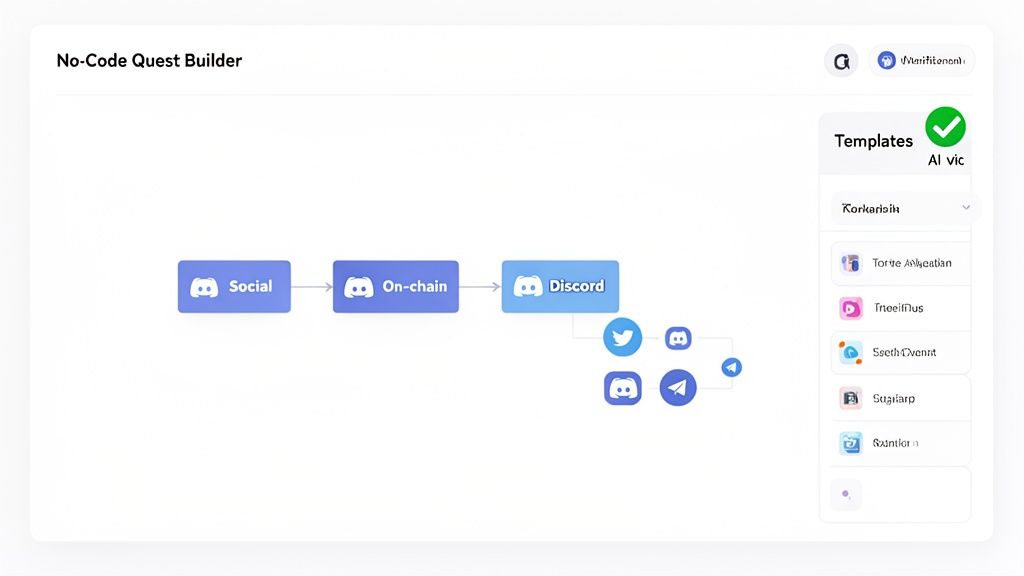
From Manual Chaos to Automated Growth
Just think about how community campaigns used to be run. You'd have a team member hunched over a spreadsheet, manually checking usernames to see who actually joined that Telegram raid or Twitter campaign. It was slow, full of mistakes, and impossible to scale.
Modern rewards software completely automates that whole mess. The platform takes care of verifying tasks and sending out rewards instantly and accurately. This frees your team from soul-crushing admin work so they can actually focus on big-picture strategy and coming up with creative campaigns. You stop being a task manager and start being a growth architect.
This automation is a massive reason why companies with loyalty programs can grow revenue 2.5x faster than their competitors. When you remove the manual roadblocks, you can run more campaigns, engage more people, and collect data way more effectively.
Driving Real On-Chain Activity
For projects in Web3, the impact is even more powerful. The name of the game is usually driving on-chain activity—the stuff that really moves the needle for protocols, dApps, and NFT collections. Quests give users a direct and compelling reason to actually interact with your smart contracts.
Instead of just crossing your fingers and hoping people use your platform, you can create specific, rewarding tasks that guide them there.
- For DeFi Protocols: Build quests that reward users for adding liquidity or making their first swap.
- For dApps: Nudge people to try a new feature or complete a critical in-app action.
- For NFT Collections: Reward your community for staking their NFTs or casting a vote in governance.
These aren't just vanity metrics. They represent real utility and adoption, which is everything for the long-term health of a project and its token. If you want to go deeper on this, check out our guide on how to design effective Web3 quests for your community.
A well-structured quest system acts as a bridge, guiding users from simple social engagement to valuable on-chain participation. It creates a seamless experience that feels less like a marketing campaign and more like an engaging game.
Creating Evangelists, Not Just Users
At the end of the day, the goal is to create an experience that’s fun, interactive, and rewarding—something that connects with your community on a human level. The data backs this up: loyal customers spend 67% more on average than new ones. A huge part of building that loyalty is making them feel seen and involved.
When a rewards program is done right, it does more than just bump up your KPIs. It builds a genuine sense of belonging and accomplishment. People who complete quests and earn rewards feel more invested in the project. They get its value because they’ve been an active part of it.
This is the connection that turns a casual user into a true evangelist—someone who doesn’t just use your product but tells everyone they know about it. They become your best marketing channel, driving organic growth from a place of authenticity. That transformation is the real ROI of a great rewards program.
The Role of AI in Modern Rewards Programs
Let's be honest, AI is the secret sauce that makes modern customer rewards program software actually work at scale. In the Web3 world, its biggest job by far is handling automated task verification. Think of it as the silent workhorse that makes massive community campaigns not just possible, but genuinely easy to manage.
Imagine launching a quest asking thousands of your community members to create and share a unique meme about your project. It's a fantastic idea for getting people engaged, but manually sifting through every single submission? That's an operational nightmare. No community team has the bandwidth for that.
From Manual Bottlenecks to Automated Scaling
This is exactly where AI comes in to save the day. AI-powered content review can instantly scan and analyze thousands of memes, tweets, or whatever else you ask for. It checks for relevance, flags spam, and gives the green light to valid entries, all while ensuring the process is fair and efficient. Suddenly, you can run these huge creative campaigns that would have been completely out of the question before.
This completely changes the game for your community manager. Instead of being buried in tedious, mind-numbing verification tasks, they can actually focus on what matters: designing the next big engagement push. The role of AI in rewards programs is growing fast, offering new ways to personalize experiences, much like how businesses are finding new potential with tools like AI software for small business.
AI completely removes the bottleneck of manual work. It lets you run ambitious, large-scale campaigns that drive real community growth without burning out your team.
But AI does more than just check boxes. It's also a powerhouse for personalization. By looking at a user's behavior, the software can intelligently suggest quests that a specific person is most likely to enjoy and complete. This makes the whole experience feel more relevant and fun, which naturally leads to higher completion rates and a more active community. We get into the nitty-gritty of this in our article on designing AI-powered Web3 quests.
The Financial Impact of AI Personalization
The impact here isn't just about saving time; it's about a serious return on your investment.
The data is pretty clear: AI and data-driven personalization are the biggest game-changers in loyalty software. Organizations using AI engines to offer tailored incentives in real-time are seeing a staggering 5.2× return on loyalty spend compared to those stuck with old-school methods. That massive ROI proves how machine learning can fine-tune rewards and timing for every single user, at scale.
At the end of the day, folding AI into your rewards program does two critical things:
- It lets your campaigns scale by taking verification off your plate.
- It makes them more effective by personalizing the journey for each user.
That one-two punch is what turns a basic rewards system into a sophisticated growth engine, capable of building a stronger, more engaged community around your project.
Putting Your Community Strategy into Action
Theory is one thing, but seeing customer rewards program software work in the real world is where things get exciting. Let's move past the concepts and dive into some practical, high-impact quests you can build with a no-code tool like Domino. These aren't just busywork; they are carefully designed plays that turn passive followers into active, measurable contributors.
Think of each quest as a mini-mission for your community members. It gives them a clear, fun, and rewarding way to engage, making participation feel less like a marketing task and more like a game. This is how you translate a big-picture strategy into a series of small, meaningful interactions.
Driving Social Engagement
One of the quickest ways to generate buzz is to get your community fired up on social media. Instead of vaguely asking people to "spread the word," you can give them a specific, rewarding mission that gets real results.
A classic move is the "Twitter Raid" quest. You set up a quest asking users to like, retweet, and drop a comment on a major project announcement. The software automatically checks that they’ve done all three before handing out the reward. Suddenly, your message is amplified and blasted across hundreds or thousands of timelines, reaching far beyond your own follower count.
Boosting Platform Adoption
Getting people to actually use your platform or dApp can be a major challenge. Quests are the perfect tool to build a bridge, guiding users from social media chatter directly into your on-chain world.
Take an "NFT Staking" quest, for example. It’s a super effective play for NFT projects. The task is straightforward: stake one of the project’s NFTs. The rewards software connects directly to the blockchain to confirm the user's wallet completed the action. No manual checking or clunky screenshot submissions—just a smooth, automated process that drives genuine platform usage.
Strengthening Community Bonds
A thriving community isn’t just about having a ton of members; it’s about getting them to participate where it matters most. You can use quests to focus attention and spark interaction in your main hubs, like Discord or Telegram.
A "Discord Reaction" quest is a simple but brilliant example. You can ask users to react with a specific emoji to a critical announcement in your server. This tiny action helps push that message to the top of everyone’s feed, making sure important news doesn’t get lost in the noise. It’s a low-effort way to boost internal visibility and keep the whole community in the loop.
While these quests are effective on their own, their real power is unleashed when you link them together in a campaign. This creates a guided path that walks users through your entire ecosystem.
Creating Multi-Step Campaigns
By chaining different tasks together, you can design sophisticated user journeys that hit several goals at once. Think about creating an "Onboarding Journey" campaign for new community members. It might look something like this:
- Step 1: Social Follow: The journey kicks off with a simple task—follow your project on X (formerly Twitter).
- Step 2: Join the Conversation: Next, they’re prompted to join your official Telegram group to connect with the community.
- Step 3: First On-Chain Action: The campaign culminates with them making their first swap on your decentralized exchange.
This kind of multi-step flow does so much more than just check off boxes. It teaches new users how to navigate your ecosystem, plugs them into your community channels, and drives the kind of on-chain activity that signals a healthy project. After all, the data doesn’t lie—loyal customers, nurtured through programs like these, spend 67% more on average than new ones.
By breaking down the onboarding process into clear, rewarding steps, you turn what could be a confusing experience into an engaging adventure that builds true loyalty right from the start.
Sample Web3 Quest Templates and Their Goals
To give you a better idea of what's possible, here are a few practical examples of quests you can build and the specific marketing goals each one helps you achieve.
| Quest Type | Example Task | Primary Goal | Platform |
|---|---|---|---|
| Community Building | React to an announcement with a specific emoji in Discord. | Boost visibility of key info; increase engagement. | Discord |
| Social Amplification | Like, retweet, and comment on a specific announcement tweet. | Drive viral reach and brand awareness. | X (Twitter) |
| Platform Adoption | Stake one of the project's NFTs for at least 7 days. | Encourage on-chain activity and user investment. | Your dApp |
| Content Creation (UGC) | Create and share a meme about the project on X with a hashtag. | Generate user-made content; foster a fun culture. | X (Twitter) |
| Educational Onboarding | Complete a short quiz about the project's whitepaper. | Ensure community understands the project's value. | Your Website |
| Real-World Engagement | Check in at a sponsored booth during a crypto conference. | Bridge online community with offline events. | Geolocation (IRL) |
As you can see, each quest is designed with a clear purpose, helping you move the needle on the metrics that matter most to your project's growth.
Choosing the Right Rewards Software for Your Project
Picking the right customer rewards program software is a make-or-break decision for your community strategy. Get it wrong, and you're stuck with a clunky tool that creates headaches and burns through resources. Get it right, and you’ve got a growth engine on your hands.
Think of it this way: you wouldn't use a scooter for a cross-country road trip. You need a vehicle that’s reliable, efficient, and actually built for the long haul. The same goes for your rewards platform.
It's not about finding the software with a million features; it's about finding the one with the right features for what you're trying to achieve. Let's break down what really matters.
Is It Actually Easy to Use?
This is the first and most important gut check. Ask yourself: Can our non-technical team use this without pulling their hair out? If your community managers have to file a developer ticket just to launch a simple Twitter quest, you’ve already failed.
A truly no-code, intuitive interface isn't a "nice-to-have"—it's a must. Your team needs to be able to jump in, design a campaign, and hit "launch" all on their own. Look for a clean, drag-and-drop builder that empowers them to act on creative ideas instantly, not wait in a dev queue for weeks.
Does It Connect to the Right Places?
A rewards platform is pretty useless if it can’t talk to the tools where your community actually hangs out. It absolutely must have seamless, native integrations with the platforms that matter in Web3.
Here's your quick integration checklist:
- Socials: Does it plug directly into X (Twitter), Discord, and Telegram? You need automatic verification for follows, retweets, and server joins. No manual checking.
- Blockchain: Can it see and verify on-chain actions on your specific blockchain? Whether you're building on Ethereum, Solana, or Polygon, this is critical for driving real protocol engagement.
- API Access: Can you connect it to your own dApp or other marketing tools? An open API gives you the flexibility to build custom workflows.
Without these deep connections, you’re just creating more manual work for your team, which defeats the entire purpose of the software.
Choosing the right software is about finding a partner that understands the unique DNA of a Web3 project. The tool should feel like an extension of your team, not another complex system to manage.
Can It Handle Real Growth?
As your community explodes, your rewards program will feel the pressure. Can the software handle thousands—or even tens of thousands—of people rushing to complete quests at the same time?
This is where a platform's track record is everything. How many campaigns have been run on it? How many quests have users completed in total? A platform that has already powered over 25 million completed quests has been battle-tested and proven it won’t buckle under pressure. If you want to dive deeper, we break down what makes a solid rewards program platform.
How Good Is the Automation and Customization?
Finally, look at the smart features that save you time. Does the software use AI to handle tedious but essential tasks, like checking user-generated content for a meme contest? AI-powered review is the only way to scale creative quests without drowning your team in manual approvals.
And just as important, can you make it look and feel like your brand? You need the ability to white-label the user-facing portal with your logo, colors, and fonts. Can you tweak every bit of a quest, from the copy to the reward, so it aligns perfectly with your project's vibe? This kind of flexibility is what creates a cohesive and professional experience that strengthens your community's connection to your brand.
Got Questions? We've Got Answers
Diving into Web3 community building can feel like learning a new language. It's natural to have questions, so we've put together some simple, no-nonsense answers about using a customer rewards program to make your project stand out.
How Is a Web3 Quest Platform Different from a Regular Loyalty Program?
The biggest difference comes down to what you're rewarding. Think about a coffee shop's punch card—it's all about rewarding purchases. That's traditional loyalty in a nutshell: a closed loop designed to get you to buy more stuff.
Web3 quest platforms flip that model on its head. Instead of just rewarding transactions, they reward engagement. We're talking about everything from sharing a post on X and voting on a proposal to minting an NFT or trying out a new dApp feature. They bridge the gap between social chatter and on-chain action, which is perfect for building a real community in a token-based world.
Do I Need to Be a Developer to Set This Up?
Not at all. In fact, that's one of the best parts. Modern customer rewards program software is built for marketers and community managers, not engineers. Forget about needing to write code.
You can now design, launch, and manage entire campaigns using simple drag-and-drop tools. Connecting your social accounts, creating rules to verify on-chain activity, and building out a multi-step quest can all be done from an intuitive dashboard.
The whole point of no-code tools is to move fast and give power to the people on the front lines. Your marketing team can dream up a campaign in the morning and have it live by the afternoon, without waiting in a long developer queue.
How Do I Know If My Rewards Program Is Actually Working?
Success isn't just one magic number; it’s about watching the right metrics move in the right direction. Good software will give you a dashboard that shows the health of your community in real-time.
Here’s what you should be keeping an eye on:
- Community Growth: Are your Discord and Telegram channels growing? When 75% of customers say they’d switch brands for a better loyalty program, you know it's a huge magnet for new people.
- Social Buzz: Are you seeing more likes, retweets, and comments on your posts?
- Real Participation: How many people are actually completing quests? Are they coming back to do more?
- On-Chain Action: Can you see a direct link between your campaigns and an increase in transactions or specific smart contract calls?
Tracking these numbers gives you a clear picture of your program's ROI. It lets you prove what's working and tweak your strategy to get even better results down the line.
Ready to stop just talking to your community and start building with them? With Domino, you can launch quests that get people excited and reward them for taking actions that truly matter. No code needed. Start building your community with Domino today!