Launch Your Next Web3 AI Quest Like a Pro

So, what exactly is a Web3 AI quest? Think of it as a marketing campaign supercharged with blockchain tech and artificial intelligence, built to automate how you find new users and keep your community buzzing. These quests mix on-chain activities with off-chain social tasks to create fun, rewarding experiences that actually move the needle for your project.
Why Web3 AI Quests Are Your New Growth Engine
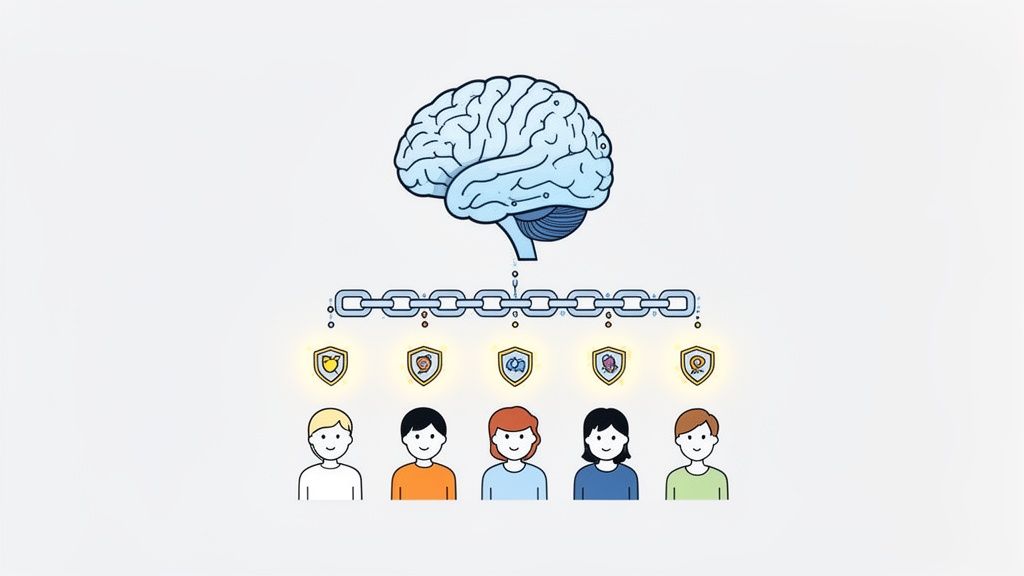
Let's be real: the old marketing playbook just doesn't cut it in Web3. Banner ads and generic email blasts fall flat with an audience that values decentralization and community. This is precisely where Web3 AI quests come in, offering a growth model designed from the ground up for the crypto world.
Instead of just broadcasting a message, quests pull people in and invite them to participate. They turn passive lurkers into active community members by rewarding them for doing things that matter. It's a fundamental shift, and it’s how you build a loyal, truly engaged community that's in it for the long haul.
Automating Engagement at Scale
One of the biggest headaches for any growing Web3 project is keeping up with community interactions. Can you imagine manually checking thousands of tweets, Discord posts, or wallet transactions? It's a logistical nightmare that eats up valuable time and resources.
This is where AI-powered verification changes everything.
Picture launching a campaign with an AI assistant working 24/7 to instantly confirm every task someone completes. Suddenly, your team is free to focus on big-picture strategy, product development, and genuine community building instead of drowning in repetitive admin work. This is how you scale your growth without having to scale your payroll.
And honestly, this level of automation is quickly becoming a must-have. The global Web3 market is expected to explode to around $171–176 billion by 2034. To compete, projects need to handle millions of tiny interactions across dozens of platforms—a feat that's practically impossible without AI doing the heavy lifting.
By automating verification for both on-chain and off-chain activities, you create a seamless experience for your users and a hyper-efficient workflow for your team. This win-win is the secret sauce that makes Web3 AI quests so powerful.
Fusing On-Chain and Off-Chain Worlds
A truly great Web3 AI quest connects the dots between your social media hype and your actual product. It's not just about fluffing up follower counts; it’s about driving real, meaningful actions that strengthen your entire ecosystem.
You can design quests that cleverly mix and match different tasks:
- Create Social Buzz: Reward people for sharing your posts, jumping into Twitter threads, or making awesome user-generated content like memes and explainer videos.
- Drive On-Chain Activity: Give incentives for things like staking tokens, minting an NFT, or adding liquidity to your DeFi protocol.
- Boost Product Usage: Turn your onboarding process into a game by guiding new users through your dApp with a series of simple in-app tasks.
This integrated strategy makes sure your marketing spend directly fuels your most important KPIs. To get the most out of Web3 for growth, you really have to nail the fundamentals. For example, the strategy behind a major Nyce Crypto Advisory launch underscores just how vital these integrated campaigns are for getting new initiatives off the ground.
When you reward people for engaging holistically, you build a community that isn't just big—it's deeply invested in your success. If you want to go deeper on this, check out our guide on the power of https://domino.run/blog/crypto-gamification.
Let's break down the difference with a quick comparison.
Traditional Marketing vs Web3 AI Quests
Here’s a snapshot of how the old way of doing things stacks up against this new, automated approach.
| Metric | Traditional Marketing | Web3 AI Quests |
|---|---|---|
| Engagement | Passive (views, clicks) | Active (on-chain actions, content creation) |
| Verification | Manual, slow, and error-prone | AI-automated, instant, and scalable |
| ROI Measurement | Often indirect and hard to track | Directly tied to on-chain growth and KPIs |
| Community | Audience-based (followers) | Participation-based (contributors, holders) |
| Cost | High CAC, often reliant on paid ads | Lower CAC, driven by organic incentives |
The difference is pretty stark. Web3 AI quests aren't just an iteration; they represent a fundamentally smarter way to build and grow in the decentralized economy.
Blueprint Your Quest for Maximum Engagement
Before you even touch a line of code or think about rewards, you need a plan. A simple plan. The biggest mistake I see projects make is jumping straight into designing tasks without first answering one critical question: What are we actually trying to achieve?
Without a clear goal, your quest is just a bunch of random chores. It won't move the needle on what really matters for your project. Your objective is your North Star—it guides every single decision, from the tasks you pick to how you measure success.
Define Your Core Objectives and KPIs
First things first: don't try to boil the ocean. A quest that aims to boost X followers, pump on-chain volume, and drive Discord activity all at once is doomed to fail at all three.
Pick one primary objective and build your entire campaign around it. Everything else is secondary.
Here are a few common goals I've seen work well, along with the KPIs that prove they're working:
- Objective: Explode Community Growth
- KPIs: Net new followers on X, new members joining your Discord or Telegram, a real jump in daily active users on your social channels.
- Objective: Drive Real On-Chain Activity
- KPIs: The number of new wallets interacting with your smart contract, total volume transacted, or the number of NFTs minted or staked.
- Objective: Get People Using Your Product
- KPIs: New user sign-ups, how many people actually complete your onboarding tutorial, or a spike in daily/monthly active users inside your dApp.
Choosing the right KPI is everything. If you run a DeFi protocol, tracking Twitter likes is pure vanity. A much smarter KPI would be the number of unique wallets providing liquidity for the very first time. Be specific and ruthless with your focus.
A well-defined objective acts as a filter. For every task idea, ask yourself: "Does this directly help us hit our main goal?" If the answer isn't a loud "yes," ditch it.
Curate Tasks Your Community Will Actually Enjoy
Okay, now for the fun part: designing the actual tasks. The best quests don't feel like a to-do list; they feel like a game. The secret is to create a balanced mix of activities that appeal to different people and gently guide them deeper into your world.
Think of it as a journey with multiple touchpoints, blending different types of tasks to create one cohesive experience.
Weaving Together On-Chain and Off-Chain Actions
Your quest should act as a bridge, connecting your social media hype to your actual on-chain product. This is where the magic happens.
On-Chain Tasks: These are the actions that happen directly on the blockchain and are vital to your project’s health. We’re talking about things like staking a certain amount of tokens, minting a special NFT, or voting on a governance proposal. These are powerful because they create real, verifiable value and commitment.
Off-Chain Tasks: These are all about building your community and social buzz. Ask users to retweet a major announcement, join an AMA on Discord, or create a killer meme about your project. These are perfect for building top-of-funnel awareness and getting your name out there.
In-App Tasks: These actions guide people through your actual product. For a Web3 game, this might be completing the tutorial or beating the first boss. For a wallet, it could be as simple as making their first swap.
Let's put it into practice. Imagine a DeFi protocol launching a new liquidity pool. Their quest could kick off with an off-chain task, like sharing the announcement on X. The very next step could be an on-chain task: add a minimum of $50 to the new pool. See how that flow smoothly guides a user from just being aware to actually taking a meaningful action?
If you want a polished front-end for this kind of campaign, looking into Web3 whitelabel quests lets you host a fully branded experience right on your own website, which is a massive plus for user trust.
By mixing these task types, you’re not just chasing social metrics. You're driving real, measurable on-chain growth and building a Web3 AI quest that’s designed for maximum impact from day one.
Go From Blueprint to Launch—No Code Required
Got your quest blueprint ready? Awesome. Now for the fun part: bringing it to life. The best part is, you don't need to be a coding wizard or hire an expensive agency to build a powerful, automated web3 ai quest. Thanks to some incredible no-code platforms out there, you can get a campaign off the ground in a few hours, not weeks.
Tools like Domino were built for exactly this. They take what used to be a massive technical headache and turn it into a simple, visual, drag-and-drop process. This levels the playing field, letting your team focus on smart strategy and killer creative instead of getting bogged down in development hell.
The entire process we've been mapping out—from high-level goal to specific tasks and KPIs—is really that straightforward.
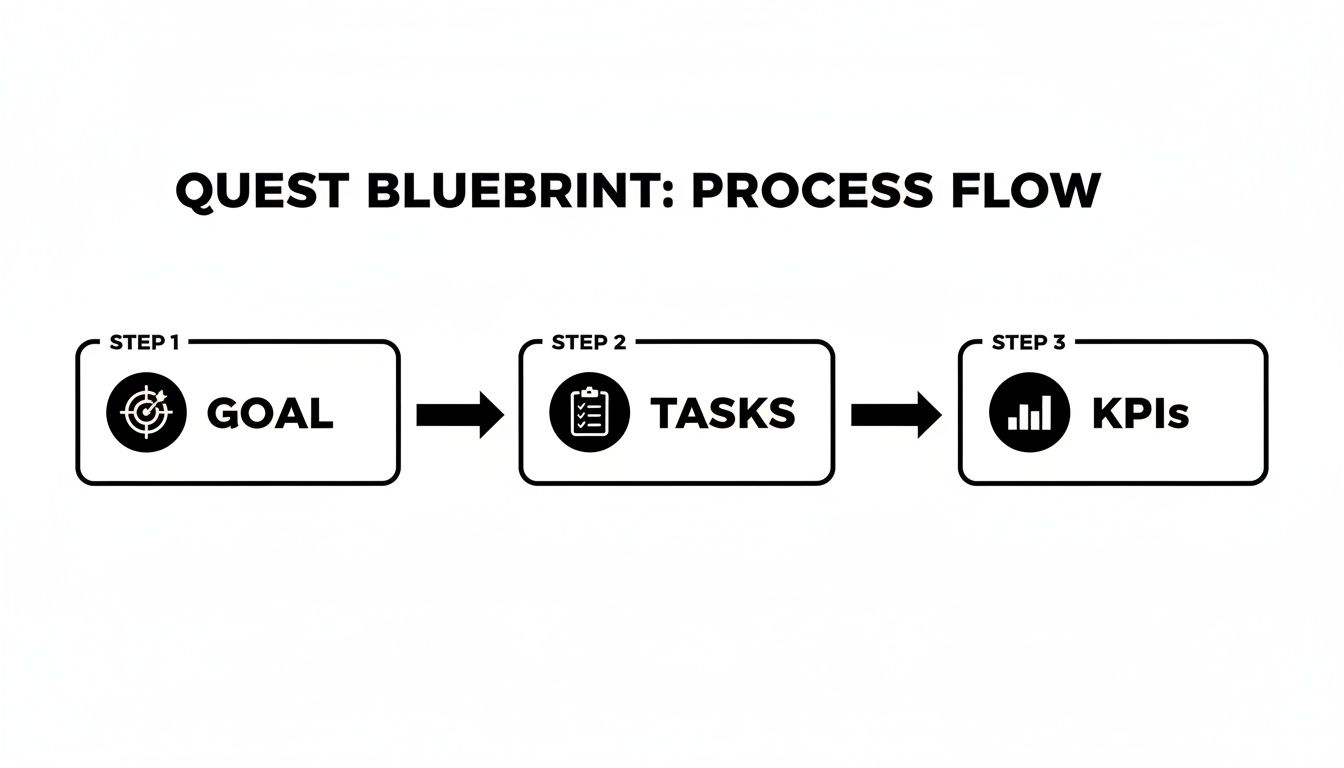
It all comes back to this simple flow: A clear goal dictates the tasks, which are then measured by your KPIs.
Start Fast With Quest Templates
Honestly, the quickest way to get moving is to use a pre-built template. Why reinvent the wheel? You can pick a template that matches your marketing goal, splash your branding on it, tweak the tasks, and hit "launch" in minutes.
Think of them as strategic playbooks you can run instantly. Some of the most popular ones are:
- Twitter Raids: Get your community to swarm a specific post on X to get your project trending. Pure, coordinated hype.
- New User Onboarding: A friendly, gamified walkthrough for new members, guiding them through your Discord, dApp, and other key spots.
- Content Creation Bounties: Incentivize your community to make awesome memes, tutorial videos, or articles about your project.
Let's say you're gearing up for a token launch. You could grab a "Twitter Raid" template, plug in your announcement tweet, set the reward, and have a viral campaign ready to ignite in less than 10 minutes. In the crazy-fast world of Web3, that kind of speed is a serious competitive edge.
Let AI Handle the Task Verification
This is where the magic really happens and the "AI" in web3 ai quest proves its worth. Imagine trying to manually check thousands of tweet submissions. It's not just a nightmare—it's impossible to do well. AI verification automates this whole mess, ensuring everything is fair while saving your team from soul-crushing manual labor.
You can set up AI workflows to check pretty much anything. It can instantly see if someone actually followed you, used the right hashtag, or joined your Telegram group. It goes deeper than just a simple checkmark, too. The AI can even analyze the content of a user's tweet to make sure it's positive and on-topic.
This automated trust layer is what makes quests scalable. It kills the painful back-and-forth of "proof submission" for both you and your users, making the whole thing feel smooth and fun.
If you want to see this in action, check out this template for checking user tweets with GPT-4. It gives you a real-world peek at how the AI verification works under the hood.
Choose Where Your Quest Will Live
Okay, last big decision: where will people actually do the quest? The front-end you choose has a huge impact on the user experience, your branding, and how easy it is for people to participate. You've got options.
Common Deployment Options:
- Third-Party Portals (like Zealy): These are the big questing platforms where users hunt for campaigns from different projects. They’re super fast to set up and plug you into an existing audience, but you sacrifice some control over the look and feel.
- White-Label Solutions: This is where you host the quest experience directly on your own website. You get total brand control, and it feels like a native part of your ecosystem. For teams wanting to get this up quickly, looking into the best no-code website builders can give you a perfect canvas for your white-label portal.
- Direct Bot Integrations (Discord & Telegram): Why make users leave? With bots, you can deliver and verify quests right inside the community hubs they already live in. This is clutch for driving engagement with your most dedicated members.
Each path has its pros and cons. A brand-new project might kick things off on Zealy to get some early eyeballs. A more established project, on the other hand, will probably lean towards a white-label solution for that polished, integrated vibe. Often, the smartest play is to use a mix of these to hit every segment of your audience.
Weaving Your Quests into Your Marketing Stack
Look, a Web3 AI quest campaign shouldn't be an island. It’s a huge mistake to let it run in a silo, completely disconnected from everything else you’re doing. The real magic happens when you plug it into the marketing tools you already live and breathe in every day.
When your quest platform starts talking to your other systems, you transform raw data into a genuinely unified view of your community. You stop seeing just a wallet address that finished a task and start seeing the person behind it. What other emails have they opened? What Discord channels are they active in? How valuable are they really to your project? It's about building that complete picture.
Building a Single Source of Truth for Your Community
Let's be honest, the people grinding through your quests are probably your most die-hard fans. By piping your quest data directly into your CRM, you can finally put a name to the wallet, so to speak. You can tag these power users and get a much clearer understanding of who’s actually driving your community forward.
Think about it this way: someone grinds out ten quests, including a few tricky on-chain ones. This data gets zapped over to your CRM automatically. Suddenly, your marketing team sees this isn't just a random participant; they're a super-fan. This is gold. Now you can get personal—invite them to a closed beta, give them a shout-out in an AMA, or send them some exclusive swag.
This creates a fantastic feedback loop. Quest activity directly fuels your community strategy, making sure you’re pouring your energy into the people who deserve it most.
When you connect quest data to your CRM, you stop treating your community like anonymous wallets. You start building real relationships with the people who champion your project. That’s how you turn simple engagement into unshakeable loyalty.
Automating Workflows and Supercharging the User Journey
Connecting your tools is also about making the user experience ridiculously smooth through smart automation. When someone finishes a major quest, you can set off a chain reaction of cool, automated events across your entire ecosystem—all while you sleep.
This is where a connected web3 ai quest really flexes its muscles. You can set up workflows that feel both personal and instant.
- Instant Bragging Rights in Discord: The second a user polishes off a tough quest line, automatically grant them a "Quest Master" role. It's immediate social proof and makes them feel like a legend in the community.
- Smarter Email Campaigns: Sync your questers to your email platform. From there, you can drop them into specific nurture sequences—maybe a "what's next" guide for newbies or exclusive content drops for your top 10% of players.
- Connecting the Dots in Analytics: Push quest completion events to tools like Google Analytics or Mixpanel. This lets you map the entire journey, from the first time they saw your ad to their first on-chain transaction, finally proving the direct ROI of your quests.
How This Looks in the Real World
Let's ground this in a real example. Imagine a GameFi project trying to get more people to actually play their new mobile game. They launch a quest: download the app and hit level 5.
- The Trigger: A player submits a screenshot proving they hit level 5, and the AI instantly verifies it.
- The Workflow: An integration immediately pings their CRM, tagging that user as a "Verified Player."
- Action #1: This tag automatically gives them a special role in Discord, which unlocks a private channel where they can chat directly with the devs.
- Action #2: At the same time, they're added to an exclusive email list that gets weekly in-game item drops.
This whole thing runs on autopilot. The user feels seen and rewarded in seconds, and the project has successfully pulled someone deeper into their world. That’s how you scale engagement that feels personal and makes every single interaction count.
Measure What Matters and Optimize for Growth

Hitting "launch" on your quest isn't the finish line—it's the starting gun. The real growth happens when you start digging into the data, figuring out what your community actually enjoys, and making smart, informed tweaks. This is where you turn a bunch of numbers into a repeatable growth strategy.
So many projects get hung up on vanity metrics, like the total number of quest completions. Sure, that number feels good, but it doesn't really tell you the story. To genuinely understand what’s working, you have to look at the entire user journey through your campaign.
Look Beyond Simple Completion Rates
The best insights are buried in the details. Instead of just celebrating the final participant count, you need to break down the entire quest funnel. That means pinpointing exactly where people are getting stuck or just bailing.
A fantastic place to start is with task-specific drop-off rates. Let's say you see 80% of users complete the "Follow on X" task, but only 15% make it through the "Stake in our Protocol" task. Boom. You've just found a massive friction point. Is the staking process a nightmare? Is the reward not worth the effort? That data gives you a clear signal on what to fix.
A few other key things to track:
- Conversion Rate by User Source: Are users coming from your Discord more likely to finish on-chain tasks than those who clicked a link in a partner's tweet? This helps you figure out which acquisition channels are gold and which are duds.
- Time-to-Completion: How long is it taking the average person to finish the quest? If it's taking ages, you might be asking for too much and burning people out before they even get to the good stuff.
- Long-Term On-Chain Value: This is the big one. Do your questers actually stick around? You need to track their wallet activity for 30, 60, and 90 days after the quest ends. Are they still using your dApp, or did they just grab the reward and ghost?
Measuring the long-term value of participants is how you prove the real ROI of your web3 ai quest. It changes the conversation from "how many people did the quest?" to "how many high-quality, long-term community members did we acquire?"
Run A/B Tests to Find Your Secret Sauce
The only way to truly know what gets your audience clicking is to test everything. Don't guess what will work—let the data guide you. A/B testing is your best friend here, and it’s a lot easier than you might think.
You can split-test almost every piece of your quest to see what moves the needle. Just set up two versions of a campaign and show each to 50% of your audience.
Here are a few ideas to get you started:
- Rewards: Pit a 100 USDC raffle against a guaranteed small NFT drop for everyone. You might be shocked to find that the certainty of a small win outperforms the slim chance of a big one.
- Task Descriptions: Does a playful, meme-filled description get more completions than a dry, straightforward one? Test your brand's voice and see what resonates.
- Quest Flow: Try flipping the order of your tasks. Maybe asking for an on-chain action before the social follows weeds out the low-intent users and boosts the overall quality of your participants.
These little experiments can lead to some massive wins for your campaign's performance.
Build a Continuous Feedback Loop
This data-driven approach isn't just a good idea; it's quickly becoming essential. The Web3 market is projected to explode to USD 176.32 billion by 2034, which means user acquisition is only going to get more competitive. As more projects chase the same users, having an automated and optimized quest system is no longer a nice-to-have. You can explore more on these market projections and what it means for your GTM strategy.
But remember, your best insights won't always come from a dashboard. They'll come directly from your community.
Set up a simple, continuous feedback loop. After a big quest wraps up, ask people what they thought. What did they love? What was a total pain? Use those insights from one campaign to make the next one even better. This cycle of launching, measuring, and optimizing is how you build a powerful, sustainable growth engine that delivers time and time again.
Got Questions About AI Quests? We've Got Answers
Stepping into the world of AI-powered quests can feel like exploring new territory. It’s natural to wonder how it all works, what it's going to cost, and if it's even the right move for your project.
We hear these questions all the time from Web3 teams. You need to know you're putting your resources in the right place. So, let's cut through the noise and give you some straight-up answers to the most common questions we get.
So, What's This Going to Cost Me?
This is always the first question, and the honest answer is it really depends on what you're trying to achieve. The good news? You don't need a massive budget to get started. The real power of a web3 ai quest lies in its flexibility.
You can get a simple, powerful campaign off the ground with a surprisingly small investment, especially if you're using a no-code platform to handle the setup yourself. Your costs really boil down to just two things:
- Platform Fees: This is what you pay for the software that builds, runs, and automates your quest. Most platforms have different pricing tiers, letting you start small and grow your plan as your community expands.
- Reward Pool: This is the good stuff you give away to participants. It could be anything from a few hundred bucks in a stablecoin raffle to a special collection of NFTs. The size of your reward pool is a huge motivator, so make sure it matches how important the campaign is to you.
For a smaller project, you could easily get started with a reward pool of $500 - $1,000 and a basic platform subscription. It's an incredibly accessible way to kickstart growth. The trick is to have a clear goal and a budget you're comfortable with.
Pro Tip: Treat your first quest like an experiment. Start with a budget that lets you test the waters and see what your audience responds to. Once you find what works, you can confidently invest more. No need to bet the farm on day one.
How Much of a Tech Whiz Do I Need to Be?
This is a big one, especially for marketing and community folks. Let me put your mind at ease: you don't need to be technical at all. Seriously.
Today's quest platforms are built for the rest of us—the non-devs. If you’ve ever used tools like Mailchimp or HubSpot, you have all the skills you need to launch a sophisticated web3 ai quest. Everything is visual, usually with drag-and-drop builders and ready-to-go templates.
You won't be messing with smart contracts or tangling with APIs. The platform does all the heavy lifting behind the scenes, like:
- Securely connecting to user wallets.
- Verifying on-chain actions like a swap or a stake.
- Hooking into social media for off-chain tasks.
- Handling the reward payouts automatically.
Your role is the strategist. You get to focus on the fun part: setting the goals, coming up with creative tasks, and seeing the results roll in. The tech just makes it all happen.
Can AI Verification Actually Stop Cheaters?
Absolutely. In fact, it's one of the most critical reasons to use AI in the first place. Trying to manually check thousands of submissions is a nightmare, and it’s wide open to fraud. It's just too easy for people to fake screenshots or use bots to spam your forms.
AI verification is in a different league. For social tasks, it can actually read the content of a tweet to see if it’s relevant or just mindless spam. For on-chain tasks, the proof is baked right into the blockchain—it's cryptographically secure.
This means your rewards only go to people who genuinely did the work. It protects your budget, keeps your campaign fair, and ensures the engagement you're measuring is real.
Ready to build a growth engine that actually scales? With Domino, you can launch your first AI-powered quest in minutes, not months. Explore over 130 templates and see why top Web3 projects trust us to drive real engagement. Start building for free.