The Ultimate Guide to a B2B Loyalty Platform in Web3
Let's be real—the old-school loyalty playbook doesn't work in Web3. This isn't about giving your partners a flimsy punch card for discounts. It's about building powerful, value-driven alliances that actually move the needle. A modern b2b loyalty platform is your engine for this, helping you forge deep, meaningful relationships with other protocols, key opinion leaders, and strategic partners to spark real ecosystem growth.
Why B2B Loyalty Is Web3's Next Growth Frontier
Loyalty has always been a powerful currency in business, but the game has changed. It's not just about rewarding someone for buying from you again. It’s about creating an experience so valuable that your partners can't imagine going anywhere else. This is especially true in B2B, where long-term value and complex decisions always trump a simple transactional perk.
The Web3 world puts this idea on overdrive. Your project's success isn't just about your code—it’s about the strength and vitality of your entire ecosystem. A B2B loyalty platform is the toolkit you need to build that ecosystem through smart, incentivized collaboration.
Moving Beyond Simple Rewards
Think about it. Instead of just tossing a partner a 10% discount, what if you could spin up a co-branded campaign that pulls thousands of new, engaged users into both of your projects? That’s the magic of a modern B2B loyalty platform. It makes it easy to create activities that generate real, mutual value.
We're talking about things like:
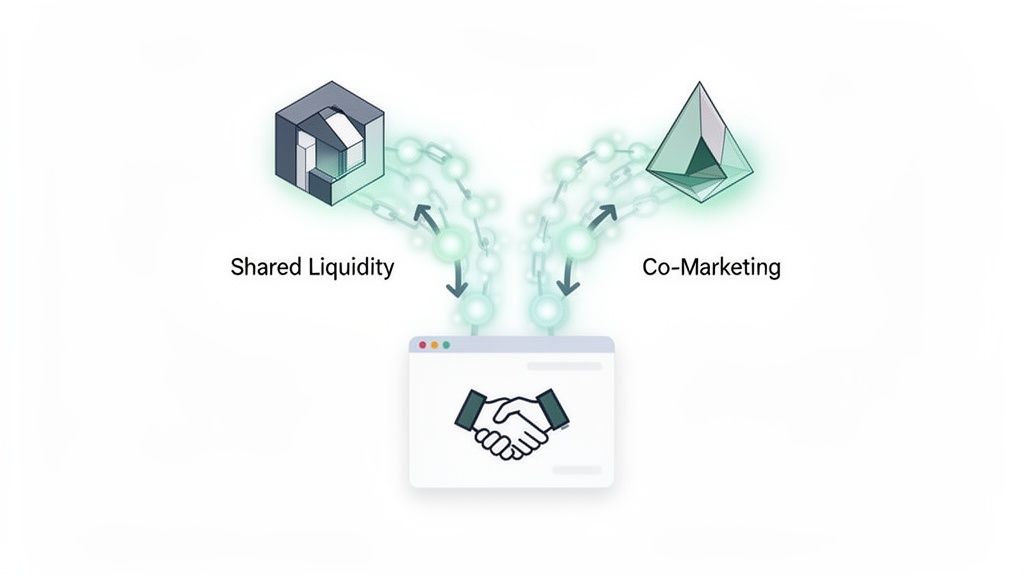
- Co-marketing Quests: Actually rewarding partners for shouting out your project to their communities.
- Shared Liquidity Pools: Creating incentives for collaborations that make the market more stable for everyone.
- Collaborative Community Building: Launching joint AMAs, educational series, or events that both audiences will love.
And this isn't just a hunch; the data backs it up. A whopping 65% of B2B buyers say an exceptional experience is the number one reason they stay loyal. Businesses are now laser-focused on improving customer lifetime value (CLV) as their top loyalty goal. The global loyalty market, which was already worth USD 13.31 billion last year, is expected to explode to USD 41.21 billion by 2032, with B2B programs leading the way.
The Strategic Advantage for Web3
For marketers in the Web3 trenches, this is a massive opportunity. A well-executed B2B loyalty strategy lets you scale your partnerships without burning out your team. It turns what used to be endless manual outreach and messy negotiations into automated, trackable campaigns. You’re not just acquiring users anymore; you're building a loyal army of advocates. And if you want to know if it's working, you have to know how to calculate customer retention rate—it's the ultimate report card for your program.
A B2B loyalty platform transforms your partners from passive allies into active growth drivers. It’s the difference between having a contact list and having a collaborative ecosystem.
Platforms like Domino are built for this. They give you a no-code toolkit to design and launch these kinds of sophisticated alliance-building campaigns in minutes, no developers required. If you're looking for more ideas on fueling Web3 growth, the https://domino.run/blog is packed with great insights.
Traditional Loyalty vs Web3 B2B Loyalty
To see how much things have changed, it helps to put the old and new models side-by-side. The table below shows how Web3, especially with a platform like Domino, supercharges traditional B2B loyalty concepts.
| Aspect | Traditional B2B Loyalty | Web3 B2B Loyalty (with Domino) |
|---|---|---|
| Core Goal | Transactional repeat business | Ecosystem growth & shared value |
| Rewards | Discounts, points, tiered pricing | On-chain assets, co-marketing, shared liquidity |
| Partnerships | Manual, relationship-based | Automated, scalable, performance-driven |
| Measurement | Sales data, manual tracking | On-chain analytics, engagement metrics, ROI |
| Technology | Centralized CRM, spreadsheets | No-code platform, smart contracts |
As you can see, the Web3 approach is all about creating verifiable, transparent, and mutually beneficial partnerships that are baked directly into the ecosystem. It's a fundamental shift from simply rewarding transactions to incentivizing true collaboration.
The Key Features of a Great B2B Loyalty Platform
A top-notch B2B loyalty platform is much more than a simple dashboard. Think of it as an engine built to get your partners to take specific, valuable actions. It’s all about mixing smart incentives with smooth execution to make your strategic goals a reality. The best ones are designed specifically for the unique world of Web3 partnerships, making it easy for anyone—not just developers—to run sophisticated campaigns.
These features aren't your basic "earn points, get a discount" setup. They give you the tools to create exciting, multi-layered campaigns that actually encourage partners to become valuable members of your ecosystem. From tiered rewards that inspire bigger commitments to automated checks that save your team a ton of time, every piece has a purpose.
Tiered Rewards Systems for Smarter Incentives
Let's be real: not all partners bring the same value, and your loyalty program needs to recognize that. A one-size-fits-all approach just doesn’t cut it for motivating your top performers. That's where tiered rewards come in. They let you set up different levels of perks and recognition based on how engaged, influential, or effective a partner is.
Think of it like a video game. A new player starts at Level 1 with some basic loot. But as they knock out more quests and contribute more, they level up to unlock exclusive gear and abilities. This gives partners a clear roadmap for growth and a real reason to invest more into the collaboration.
- Bronze Tier: New partners might get access to some co-marketing materials and a small token reward for simple social media tasks.
- Silver Tier: For driving referral traffic or hosting a joint AMA, they could unlock bigger rewards and get early access to your big announcements.
- Gold Tier: Your A-list partners? They could earn a nice slice of revenue share, join you for exclusive strategy sessions, or get top billing in your marketing.
This layered system makes sure you’re putting your best resources toward the partners who deliver the most, which in turn encourages everyone else to step up their game.
AI-Powered Task and Content Verification
One of the biggest headaches in scaling a loyalty program is the sheer manual labor of checking if partners actually did what they said they would. Sifting through thousands of tweets, Discord messages, or blog posts is a fast track to burnout. A modern b2b loyalty platform takes this off your plate with AI-powered verification.
This tech automatically confirms if tasks were completed correctly. Did a partner use the right hashtag on X? Did they mention your project in their latest article? Did they engage with an announcement in your Telegram? The AI can check it all. For marketers, this is huge.
By automating verification, you get rid of human error, stop fraud in its tracks, and let your team focus on building relationships and strategy instead of getting buried in admin work.
This kind of automation means you can run huge campaigns with hundreds or even thousands of partners without needing a giant team to keep it all straight. It keeps the whole program fair and ensures rewards go where they’re deserved.
Multi-Channel and No-Code Integration
Your partners and their communities are everywhere—Discord, Telegram, X, you name it. A good B2B loyalty platform has to meet them where they already are. Multi-channel capabilities bring everything together, letting partners join in on campaigns right from their favorite apps instead of forcing them onto some clunky, separate website.
On top of that, the best platforms are built for marketers, not coders. No-code integration means you can link on-chain actions (like staking a token) with off-chain tasks (like social media shares) without touching a line of code. This freedom lets you launch complex, creative campaigns in just minutes. You can check out a bunch of pre-built, no-code apps and integrations on platforms like Domino to get a feel for how simple it can be to connect all your tools. It’s this ease of use that really opens the door to powerful and imaginative partnership strategies.
How Top Web3 Projects Are Winning with B2B Loyalty Campaigns
It's one thing to talk theory, but seeing how this works in the wild is where the magic happens. A B2B loyalty platform isn't just a piece of software; it's the engine that powers smart, strategic alliances in the fast-moving world of Web3. The projects that are really pulling ahead aren't just building in a silo—they're creating powerful, interconnected ecosystems through partnerships that actually do something.
Think about it. A hot new DeFi protocol could team up with a popular crypto wallet. Instead of just crossing their fingers and hoping for a shoutout, they could launch a joint campaign that rewards users for staking tokens directly through that specific wallet. This isn't some fuzzy handshake deal. It's a measurable, performance-based strategy that delivers real value to the protocol, the wallet, and their shared communities.
The Challenge-Solution-Result Framework
The most effective B2B loyalty campaigns all follow a pretty straightforward, yet powerful, pattern. Once you get this framework, you can start seeing how to apply it to your own project and turn those "what if" partnership ideas into real, tangible growth.
Here’s the breakdown:
- The Challenge: Pinpoint a specific growth problem you're stuck on. Maybe you need more liquidity for a new token, or you're struggling to get your message in front of a niche group of developers.
- The Solution: Cook up a targeted, co-branded campaign with a partner who can help. You use a B2B loyalty platform to build quests or tasks that directly tackle the challenge you identified.
- The Result: Watch the numbers. This is where you measure the direct impact on your business, seeing a clear ROI through metrics like new user sign-ups, a jump in on-chain activity, or a more vibrant community.
This concept map gives you a quick visual of the core features that bring these solutions to life.
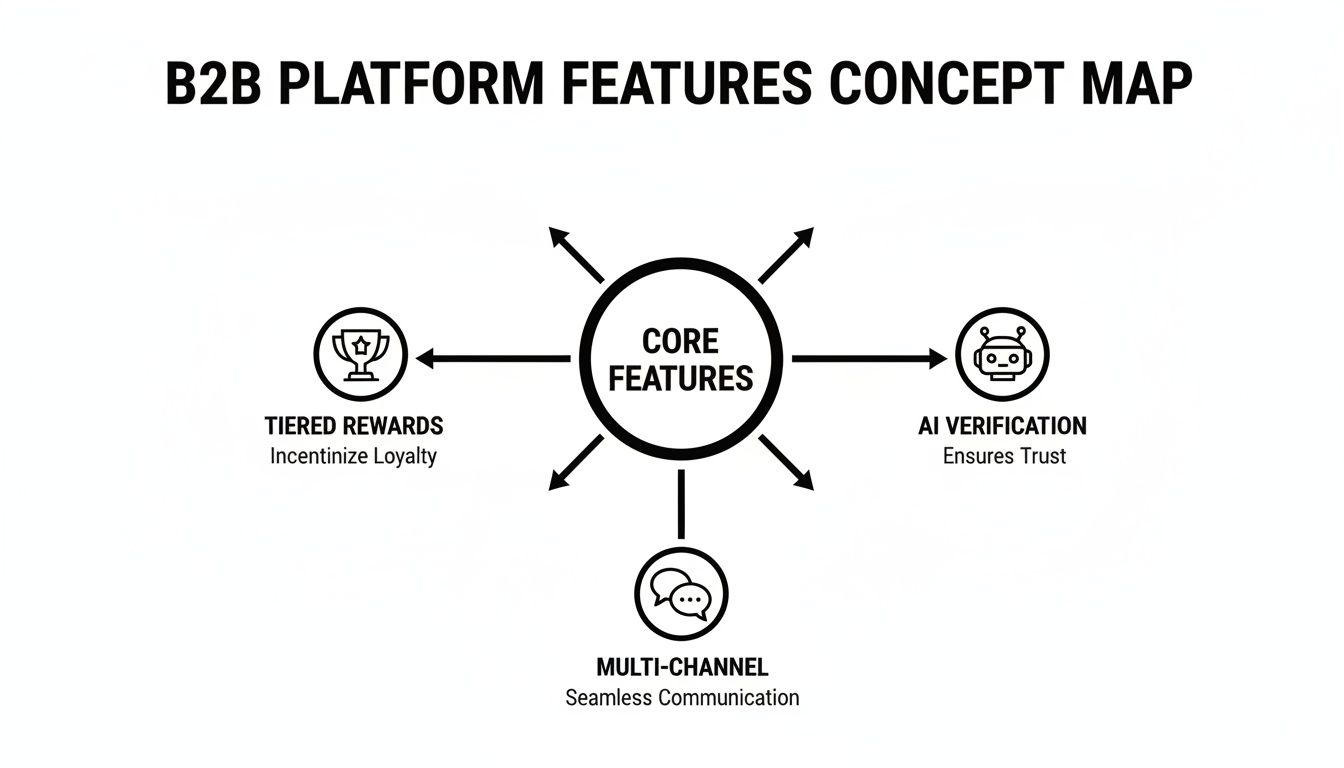
When you combine things like tiered rewards, AI verification, and multi-channel communication, you can build incredibly sophisticated partnership campaigns that scale.
Example 1: The NFT Project and the Influencer
An NFT project is trying to drum up hype for its presale, but they're getting drowned out by all the noise. They know their perfect audience hangs on every word of a major NFT influencer who's known for sharp analysis and a super-engaged community.
- Challenge: They have low visibility and desperately need to build a high-quality whitelist before their mint.
- Solution: They team up with the influencer to run an exclusive quest campaign on a platform like Domino. The influencer's followers get a special link to complete tasks—like joining the project's Discord, retweeting a deep-dive analysis thread, and signing up for the presale.
- Result: The campaign funnels thousands of highly qualified leads straight to the whitelist. The project has a blockbuster mint, and the influencer gets rewarded based on the genuine engagement they drove. It's a perfect win-win.
By turning a simple influencer promo into a structured campaign, the project built a measurable user acquisition funnel. It's the difference between paying for exposure and incentivizing real action.
Example 2: The DeFi Protocol and the Crypto Wallet
A new DeFi lending protocol needs to pump up its Total Value Locked (TVL) to build credibility and attract the big fish. They spot a golden opportunity to partner with a non-custodial wallet that DeFi power users already love and trust.
- Challenge: They need to attract that critical initial liquidity and get people to actually try out their new staking pools.
- Solution: The protocol and the wallet roll out a joint liquidity campaign. Anyone who connects the partner wallet and deposits a certain amount into the protocol’s pools unlocks exclusive perks, like a bonus yield or a limited-edition NFT. The platform verifies actions both on-chain (the deposits) and off-chain (the social shares).
- Result: The campaign pulls in millions in new TVL in the first week alone. The wallet sees a huge spike in active users, and the DeFi protocol gets the strong liquidity base it needs to prove it's a serious player.
These examples make it clear: a B2B loyalty platform is the tool that lets you execute these brilliant ideas. It’s what turns a great partnership concept into an unstoppable growth strategy. And with a no-code solution like Domino, any Web3 marketer can start designing and launching these high-impact campaigns, building the alliances they need to not just survive, but thrive.
Picking the Right Platform for Your Web3 Project
Choosing a B2B loyalty platform for a Web3 project is a different beast altogether. You're not just picking a standard marketing tool; you're dealing with a wild mix of on-chain data, social media chatter, and decentralized communities. Get it right, and the platform becomes the engine for your growth. Get it wrong, and it’s a frustrating roadblock for both you and your dev team.
You need to look past the slick demos and ask some hard-hitting questions. This is about finding a solution that not only works for you today but can grow with you tomorrow. Think of it as hiring a key partner, not just buying a piece of software.
The Make-or-Break Checklist for Web3
Consider this your must-have evaluation list. As you look at different B2B loyalty platforms, run them through these critical checkpoints. If a platform can't tick these boxes, it probably wasn't built for the unique challenges of Web3.
Here's what you absolutely need:
- Real No-Code Power: Can your marketing team actually dream up, launch, and run a complex campaign—mixing on-chain and off-chain tasks—without bugging a developer? Your devs' time is gold; a true no-code platform lets them build your core product, not marketing campaigns.
- Effortless On-Chain & Off-Chain Connections: Does the platform naturally link on-chain actions, like staking a token or holding an NFT, with off-chain tasks, like a simple retweet or a Discord reaction? Seeing the full picture of what your partners are doing is everything.
- AI That Does the Heavy Lifting: How does the platform actually verify tasks when you have thousands of people participating? Manually checking every submission is a non-starter. AI-powered verification isn't a luxury; it's essential for stopping fraud, keeping things fair, and letting your team focus on strategy instead of grunt work.
A platform that gets these three things right is already way ahead of the curve. It shows they understand that Web3 marketing is all about moving fast, connecting data, and working smart.
The whole point is to find a platform that lets your marketing team be marketers, not project managers stuck in the dev queue. It should tear down technical walls, not build new ones.
The Tough Questions to Ask Before You Sign
Once you have a shortlist, it's time to get serious. Treat this like an interview for a crucial role on your team. The answers you get will tell you everything you need to know about a platform's real-world capabilities and if it’s a good fit for the long haul.
How Do You Handle Scale?
What happens when your campaign blows up and you suddenly have 10,000 partners jumping in instead of 100? A platform built for growth should handle huge traffic spikes without breaking a sweat, ensuring everyone has a smooth experience.What's Your Integration Roadmap Look Like?
Web3 moves at lightning speed. You need to know what they're planning next. Ask about their plans for adding new blockchains, social platforms, and other marketing tools. A forward-thinking platform is always building more bridges. If you're looking at the broader tech stack, some general guides on the best website platforms can offer good insight into how top-tier tools approach integrations.Show Me How You Stop the Scammers.
Don't just take their word for it. Ask for concrete examples or a demo showing how their AI catches spam, bots, and low-effort submissions. Solid fraud prevention is vital for protecting your campaign's integrity and making sure rewards go to the people who actually deserve them. You can usually get a feel for a platform’s advanced features by looking at their pricing and features breakdown.
The B2B loyalty market is absolutely exploding, with experts predicting a massive CAGR of 18.3% through 2030. This boom is being driven by platforms that can handle the complex relationships in modern business, especially in a tech-heavy space like Web3. Choosing a platform like Domino, which is built from the ground up to be scalable, no-code, and powered by AI, puts your project in the perfect position to capitalize on this trend.
Your Step-by-Step Guide to Launching a B2B Loyalty Campaign

Ready to put all this theory into action? Getting your first B2B loyalty campaign off the ground can feel like a huge undertaking, but it’s actually a series of simple, powerful steps. This isn't about getting bogged down in code or waiting months for development. It’s all about smart strategy and fast execution.
Think of this as your playbook for turning those partnership ideas into actual growth. By following this process, you can get a sophisticated, high-impact campaign running in minutes, especially when using a no-code B2B loyalty platform like Domino.
Let's walk through the five key stages.
Step 1: Define Your Strategic Goals
First things first. Before you even think about quests or rewards, you need a North Star. What, exactly, are you trying to accomplish? A campaign without a clear goal is like a ship without a rudder—it might look busy, but it’s not going anywhere meaningful.
Your goals need to be concrete and measurable. Forget vague objectives like "increase engagement." That won’t cut it. You have to get specific.
- Increase TVL: "We need to boost our Total Value Locked by $5 million in the next 30 days."
- Drive User Acquisition: "Our goal is to bring in 1,000 new users from our partner’s community this quarter."
- Amplify a Launch: "We need 50 key partners to share our mainnet announcement on X."
Having a crystal-clear objective guides every single decision you make from here on out. It’s the bedrock of a successful campaign.
Step 2: Design a Compelling Quest Flow
Now for the fun part: designing the journey you want your partners to take. Your quest flow is a blend of on-chain and off-chain tasks, all designed to move them closer to the big goal you just defined. A great B2B loyalty platform makes it easy to weave these different actions into a single, seamless experience.
Think about a logical progression. You could start with a few simple, low-effort tasks to get people warmed up before asking for the bigger, higher-value actions.
For instance, a quest flow could look something like this:
- Warm-Up: Join our private partner Discord channel.
- Engagement: Retweet our announcement thread on X.
- Action: Stake at least 0.5 ETH in our new liquidity pool.
- Advocacy: Refer another qualified partner to the program.
The key is making the whole journey feel intuitive and rewarding at every step. This isn’t just a to-do list; it’s a carefully crafted experience built to create momentum.
Step 3: Configure Rewards That Actually Motivate
Rewards are the fuel for your campaign, but they only work if they’re something your partners actually want. Generic rewards get generic results. In B2B, the best incentives often provide real business value, not just a simple cash prize.
The most effective B2B rewards align with your partners' strategic goals. Think about what helps them grow their bottom line, save time, or gain a competitive advantage.
It's a good idea to offer a mix of rewards to appeal to different motivations:
- Financial Incentives: Stablecoins, your project’s native tokens, or even revenue-sharing agreements for your top performers.
- Exclusive Access: Early access to new features, spots in a beta testing program, or a seat on an advisory council.
- Co-Marketing Perks: A featured spot in your newsletter, a joint AMA session, or co-branded content.
- On-Chain Assets: Limited-edition NFTs that grant special access or status within your ecosystem.
By tailoring your rewards, you show partners that you actually understand their needs. That builds a much stronger, more committed relationship than a purely transactional one ever could.
Step 4: Promote Your Campaign for Maximum Reach
You've built a brilliant campaign, but it won't go anywhere if nobody knows about it. Promotion is all about getting your program in front of the right partners and making it incredibly easy for them to jump in.
Start with your own channels. Announce the campaign in your Discord, on Telegram, and through your email list. But don't stop there. Work with your initial partners to cross-promote the campaign to their communities. A personal invitation from a trusted peer is infinitely more powerful than a cold email.
Make sure the value proposition is front and center. Clearly communicate "what's in it for them" and put the most exciting rewards in the spotlight. A strong promotional push ensures your campaign launches with the energy it needs to succeed.
Step 5: Measure What Matters With The Right KPIs
Once your campaign is live, the final—and ongoing—step is to track its performance against the goals you set back in Step 1. A good B2B loyalty platform will give you a dashboard with real-time analytics so you can see what’s working and what isn’t.
When it comes to Web3 loyalty, some metrics matter more than others. Here’s a breakdown of the KPIs you should be watching closely.
Key Performance Indicators for Your B2B Campaign
| KPI | What It Measures | Why It's Important for B2B |
|---|---|---|
| Partner Activation Rate | The percentage of invited partners who complete their first task. | Shows if your initial offer and onboarding are compelling enough to get people started. |
| Task Completion Rate | The average number of tasks completed per active partner. | Indicates how engaging your quest flow is and reveals where partners might be dropping off. |
| Referral Conversion Rate | The percentage of new partners who join via a referral. | Measures the viral potential and true advocacy power of your program. |
| Campaign ROI | The total value generated (e.g., new TVL) versus the cost of rewards. | This is the ultimate bottom-line metric that proves the campaign's business impact. |
By keeping a close eye on these KPIs, you can make data-driven adjustments on the fly to optimize your campaign. More importantly, you'll be able to show your team and stakeholders clear, undeniable proof of its value.
Got Questions About B2B Loyalty Platforms? Let's Talk.
Jumping into a new platform can feel like a big leap, especially in the wild west of Web3. You're probably wondering how a dedicated B2B loyalty platform actually fits into your strategy, what kind of results you can realistically expect, and just how much heavy lifting is involved for your team.
Let's cut through the noise and tackle the most common questions marketers have before they dive in. No fluff, just straight answers to help you see the whole picture.
How Is This Different From a Simple Quest Tool?
This is a big one. You might be using a basic quest tool like Zealy right now, which is perfect for simple community tasks. But a strategic B2B loyalty platform is playing a completely different game. Think of it as the difference between a hammer and a fully-stocked workshop.
A basic quest tool is all about surface-level engagement—get a retweet, join a Discord, earn a few points. A true B2B loyalty platform, on the other hand, is built for creating and managing deep, strategic partnerships.
Here's where they really part ways:
- Deeper Integrations: A B2B platform plugs directly into on-chain data and your other marketing tools. This means you can create complex, multi-step campaigns that reward real business value—not just social media noise.
- Partnership Analytics: It gives you powerful analytics designed specifically to measure the impact of your alliances. You can finally see which partners are driving the most value and calculate a clear ROI for every campaign.
- Strategic Focus: The entire system is built to manage relationships with high-value partners—other protocols, key influencers, and VCs—not just individual community members.
So, while quest tools are great for firing up the general community, a B2B platform gives you the precision tools you need to build and scale powerful, mutually beneficial partnerships that actually move the needle.
What Kind of ROI Can I Realistically Expect?
Alright, let's talk about the bottom line. With a B2B loyalty platform, ROI is surprisingly clear and measurable. We're not talking about fuzzy metrics like "brand awareness." We're talking about hard numbers that directly impact your project's growth and survival.
Your ROI comes from turning expensive, one-off marketing pushes into scalable, performance-based partnerships. You stop paying for exposure and start investing in tangible results.
You can frame the ROI in a few key ways:
- Lower User Acquisition Costs (UAC): Instead of blowing your budget on ads, you’re giving partners a reason to bring their highly-engaged, relevant audiences straight to your door. This pay-for-performance model is almost always more cost-effective than old-school marketing channels.
- Increased Partner Engagement and Retention: A structured program keeps your partners actively invested in your ecosystem. When they’re engaged and see value, they’re far more likely to jump into future campaigns, creating a steady stream of growth.
- Boosted Key Metrics: You can tie campaigns directly to your most important goals, like increasing Total Value Locked (TVL), driving specific on-chain transactions, or growing your daily active users. You see a direct lift in the numbers that matter.
The ROI isn't just a one-time bump. It's about building a sustainable growth engine powered by your entire ecosystem.
What Are the Technical Requirements for My Team?
This is often the biggest roadblock for marketers: "Do I need a dev to run this?" The answer is a resounding no. Modern B2B loyalty platforms like Domino are built for marketers, not engineers. The whole idea is to put the power in your hands without needing to write a single line of code.
You don't need to know how to deploy a smart contract or wrestle with a complex API. These platforms use intuitive, visual interfaces that let you:
- Design and launch sophisticated quest flows in minutes.
- Seamlessly connect on-chain actions with off-chain tasks.
- Automate the entire verification and reward process with AI.
Honestly, the technical requirements are minimal. If you can use any other modern marketing tool, you can run a powerful B2B loyalty campaign. This frees up your developers to focus on what they do best—building your core product—while you focus on building the community and partnerships that will make it a success.
Ready to see how a no-code B2B loyalty platform can completely change your partnership strategy? Domino gives you all the tools you need to design, launch, and scale high-impact campaigns in minutes. Start building your growth engine today.