Launch Your Business Reward Programs Like a Pro
Let’s be honest, business reward programs are more than just fancy ways to give stuff away. They're carefully designed systems built to encourage specific behaviors, supercharge customer loyalty, and get your community buzzing. Don't think of them as simple discounts; see them as a structured handshake—a powerful value swap between your brand and its people.
What Are Business Reward Programs, Really?
At its heart, a business reward program is a formal way of saying "thank you" to the people who matter most to your brand. It’s about moving beyond the one-and-done transaction and building a real relationship. You're creating a two-way street where you offer tangible perks, and in return, your community gives you their engagement, their business, and their word-of-mouth recommendations.
Think about your favorite local coffee shop. That little "buy nine, get the tenth free" punch card? That’s a reward program in its purest form. It does more than just promise a free latte; it builds a habit. It gives you a reason to walk past three other cafes to get to that one. That's the basic psychology in action: you reward the behavior you want to see repeated.
The Core Concept: A Value Exchange
The best programs all nail one thing: a crystal-clear value exchange. Your business offers something people genuinely want, and in return, they do something you want to encourage.
This swap can look a few different ways:
- Financial Value: The obvious stuff—discounts, cashback, or points they can cash in for products.
- Utility Value: Think early access to new features, exclusive content, or a sneak peek at a beta test.
- Social Value: This is about status—getting a special role on Discord, earning a unique digital badge, or getting a public shout-out.
The magic lies in frequent rewards, which link tasks with tangible goals, making community members more motivated to hit targets. When people see a clear connection between their effort and a meaningful reward, they’re driven to repeat that behavior.
This simple idea turns passive customers into active fans. They aren't just buying from you anymore; they're engaging, sharing, and helping your whole ecosystem grow. A great real-world example is the Aeros Couriers Reward Points Program, which clearly shows how customers rack up points and then use them for services.
Quick Guide to Common Reward Program Types
Getting a handle on the basic models is the perfect place to start. This little table breaks down the most common types of programs you'll see out in the wild.
| Program Type | Primary Goal | Real-World Example |
|---|---|---|
| Points-Based | Encourage frequent, small-scale actions and repeat purchases. | Starbucks Rewards (earning "Stars" for every purchase). |
| Tiered Program | Drive long-term loyalty and reward high-value customers. | Airline Frequent Flyer Programs (Silver, Gold, Platinum status). |
| Paid/VIP Club | Create exclusivity and generate a predictable revenue stream. | Amazon Prime (annual fee for premium benefits). |
| Value-Based | Align with customer values and build an emotional connection. | A brand donating to a charity for every purchase made. |
As you can see, each model is built to achieve a different goal, from driving everyday purchases to building a deep, emotional connection with your brand.
Why a Reward Program Is a Growth Engine, Not a Gimmick
It’s easy to look at a business reward program and see a digital punch card—a simple tactic to throw a few discounts at people. But that’s like looking at a rocket ship and only seeing the paint job. A well-built program is a powerful growth engine, designed to hit real business goals that go way beyond a single sale.
Instead of just offering generic perks, these programs are strategic tools. They're built to boost customer lifetime value (LTV), cut down on churn, and transform casual users into your biggest fans. It’s all about creating a system where loyalty directly fuels sustainable growth.
It’s All About Human Psychology
The real magic behind a great reward program is how it taps into human nature. It's not really about the free stuff; it's about the emotional triggers that make people act. Gamification, for example, creates an addictive loop of action and reward. Suddenly, interacting with your brand feels less like a chore and more like a fun challenge.
Exclusivity is another huge motivator. When a program has different tiers or special VIP access, it plays on our natural desire for status and belonging. Being part of your community is no longer just about using a product—it's about being an insider. That emotional hook is something a simple discount can never replicate.
This is precisely what turns a one-time buyer into a true loyalist. They’re not just customers anymore. They become active participants, invested in climbing the ranks within your ecosystem, which in turn helps your entire community grow.
The Financial Impact of Fostering Loyalty
The numbers don't lie: loyal members are a business's best asset. They don't just stick around; they spend more. Once customers feel seen and have a clear path to rewards they actually want, their buying habits change. They’ll pick your brand over a competitor, even if it costs a bit more.
This shift directly pumps up your bottom line.
- They buy more often: Members make more frequent purchases to rack up points or hit the next tier.
- They spend more per purchase: They're more likely to toss an extra item in their cart to meet a reward threshold.
- They aren't as price-sensitive: Loyalty to your program can easily trump a competitor's sale price.
A recent report drives this point home. Companies that actually track the ROI of their loyalty programs see a massive 4.9 times more revenue than they spend, and 80% of them see a positive return. The same report found that nearly 79% of businesses with a program are planning to overhaul it in the next three years—a clear sign that everyone is trying to get this right. You can discover more insights on loyalty program trends and check out the full report.
Think of your reward program as a competitive moat. Every point earned, every tier unlocked, and every exclusive reward redeemed makes it that much harder for a competitor to lure your community away. It builds a powerful barrier based on earned value and emotional connection.
This moat isn't just about playing defense; it’s an aggressive growth strategy. As your program gets more ingrained in your community, it creates a powerful cycle. Engaged members spend more, which lets you offer better rewards, which then attracts and keeps even more members. It's a flywheel that, once it gets going, builds momentum and makes your business stronger and more profitable.
Choosing the Right Reward Program Model
Picking the right structure for your business reward program is a bit like choosing a vehicle for a road trip. A sleek sports car is a blast, but it’s a nightmare for a family of five. An RV is perfect for camping but a pain to park in the city. There’s no single "best" option—the right choice hinges entirely on where you're going, who's coming with you, and the road ahead.
In the same way, the perfect reward model for your business depends entirely on what you want to achieve. Are you aiming for daily check-ins? Do you want to roll out the red carpet for your biggest spenders? Or are you trying to build a real community around a shared mission? Each goal calls for a completely different playbook.
The Classic Models Still Going Strong
Let's kick things off with the foundational models you’ve probably run into countless times. These tried-and-true structures are popular for a reason: they work because they tap into simple, powerful human motivations.
Point-Based Programs: This is the OG of reward systems. A user does something—buys a product, shares a post—and they get points. It's straightforward, easy to grasp, and fantastic for encouraging lots of smaller, frequent actions. Think of it as the digital evolution of that coffee shop punch card in your wallet.
Tiered Programs: Here, loyalty has levels. As people engage more, they climb the ladder from Silver to Gold to Platinum, unlocking better and better perks along the way. This model is brilliant for giving users something to strive for, creating a sense of progress and achievement. It's no wonder it's a favorite for airlines and credit card companies.
Paid VIP Clubs: This model flips the script. Instead of earning their way in, customers pay a fee for instant access to exclusive benefits. Amazon Prime is the king of this category. It creates a powerful feeling of being an insider and generates a steady stream of revenue, but you have to make sure the perks are valuable enough to justify the price tag.
Value-Based Programs: This one is all about connecting on a deeper, more emotional level. Instead of just giving discounts, a company might donate to a charity or plant a tree for every purchase. This approach is a game-changer for brands with a strong mission, turning a simple transaction into a statement of what you and your customers believe in.
These traditional models provide a solid foundation, and many businesses find that the right enterprise loyalty software can make managing them surprisingly straightforward.
Comparing Reward Program Models
To help you figure out which model might be the best fit, let's put them head-to-head. Choosing the right one is all about balancing your business goals with the kind of experience you want to create for your community.
A head-to-head look at different program structures to help you choose the right one for your business.
| Model | Best For | Pros | Cons |
|---|---|---|---|
| Points-Based | Driving frequent, repeatable actions and short-term engagement. | Easy for users to understand; flexible and simple to implement. | Can feel transactional; may not build deep emotional loyalty. |
| Tiered | Fostering long-term loyalty and rewarding high-value customers. | Creates aspirational goals; excellent for retention and increasing LTV. | Can feel exclusive to top tiers; may demotivate new users. |
| Paid/VIP Club | Creating exclusivity and generating a predictable revenue stream. | Builds a highly committed user base; provides stable income. | High barrier to entry; benefits must be extremely valuable. |
| Value-Based | Building a strong brand identity and connecting with users on values. | Creates deep emotional connection; strong brand differentiator. | Rewards are intangible; may not appeal to all user segments. |
The grocery and supermarket sector has absolutely mastered this game, with 47% of global consumers enrolled in their programs. And it pays off—statistics show that loyalty members outspend others by 3.1x annually, helping drive 12-18% more revenue growth. Tiered programs are also having a moment, with 77% of consumers now joining them, a huge leap from just 58% in 2019.
The New Frontier of Web3 Reward Models
Beyond these classic setups, the world of Web3 is opening up a whole new universe of possibilities. Here, rewards are often tied directly to on-chain actions and community governance, creating an ecosystem where users are true participants, not just customers.
Instead of just rewarding purchases, Web3 models can incentivize behaviors like:
- Holding a specific NFT or token to unlock exclusive channels or content.
- Participating in governance votes and having a real say in a project's future.
- Staking tokens to help secure the network and earn a return.
- Interacting with a DeFi protocol or swapping tokens on a decentralized exchange.
The beauty of this is that all these actions are verifiable right on the blockchain, which allows for reward distribution that’s both transparent and automatic. This shift is huge—it transforms users from passive consumers into active stakeholders, fundamentally changing the entire dynamic of what a reward program can be.
How to Build and Launch Your Reward Program
Okay, let's get down to brass tacks. Moving from theory to action can feel like a huge leap, but building a reward program from scratch is totally doable when you break it down. Think of this as your blueprint, with a special focus on what’s working right now, especially in the Web3 world.
The bedrock of any killer program isn't flashy tech or a massive budget—it’s clarity. Before you design a single graphic or think about rewards, you need to know exactly what you’re trying to accomplish. A clear objective is the North Star that will guide every single decision you make.
Start With Your End Goal in Mind
Before you even dream up rewards, you have to answer one critical question: What specific behavior do I want to encourage? A vague goal like "increase engagement" is basically useless. You have to get granular.
Are you trying to:
- Boost User Acquisition? If so, your program needs to reward referrals, social shares, or content that pulls new people into your orbit.
- Improve Retention? Here, the focus is on rewarding repeat actions, daily check-ins, or long-term commitments like staking tokens.
- Drive Product Adoption? The goal is to get users clicking around and exploring new features. You could reward them for trying out a beta or finishing an in-app tutorial.
- Grow Your Community? This is all about rewarding actions that build connections, like joining a Discord server, participating in a Telegram raid, or helping out new members.
Once you have that crystal-clear objective, you can start mapping user actions directly to it. This makes sure your program is a focused engine built for a specific outcome, not just a random list of tasks. You can dig deeper into structuring these kinds of incentives by exploring the core ideas behind gamification in loyalty programs.
Choosing Rewards Your Community Actually Wants
This is where so many programs fall flat on their face. Offering rewards that nobody cares about is the fastest way to kill your momentum before it even starts. The trick is to offer a mix of rewards that speak to different user motivations. It's not always about the money.
Think of it like building a balanced "reward portfolio" that includes:
- Financial Rewards: This is the most direct route. We're talking token airdrops, product discounts, or straight-up stablecoin payouts.
- Utility Rewards: These rewards grant special powers or access. Think beta access to a new feature, exclusive content, or a whitelist spot for an upcoming NFT mint.
- Status-Based Rewards: People love showing off their loyalty. Things like unique Discord roles, special on-chain badges (like POAPs), or a public shout-out from the founders can be incredibly powerful.
- Experiential Rewards: These are the unique, money-can't-buy experiences. A one-on-one strategy call with a founder or a ticket to an exclusive community event fits the bill.
The image below gives you a great visual for how these models can build on each other, guiding users from simple point-gathering to that coveted VIP status.
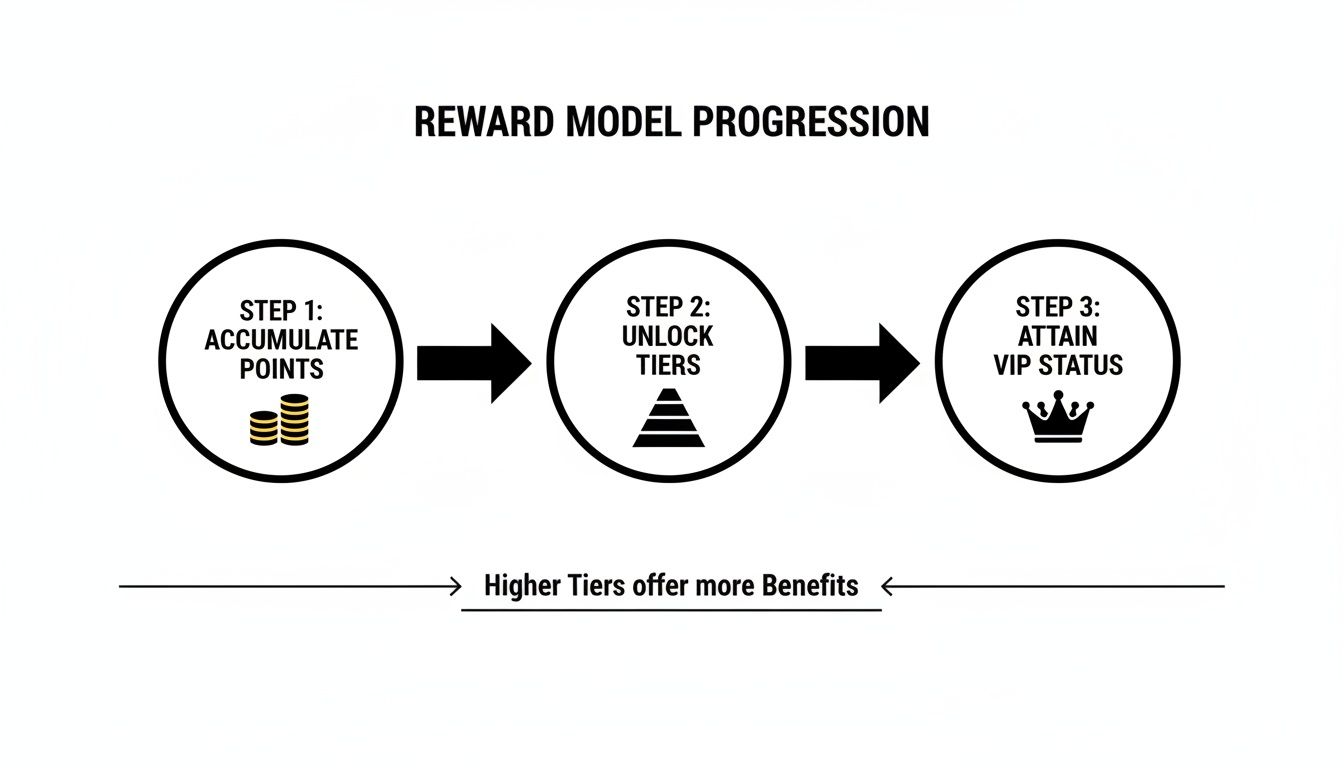
This kind of progression gives users a clear path forward, creating aspirational goals that keep them engaged with your brand for the long haul.
The No-Code Revolution in Reward Programs
Not too long ago, launching a sophisticated reward program meant hiring a team of developers, sinking a ton of time, and having a hefty budget. This put it out of reach for most startups and Web3 projects. Thankfully, that’s just not the case anymore.
Modern no-code platforms like Domino have completely changed the game. They let marketers and community managers design, launch, and manage complex reward-based quests in minutes—no coding required.
This shift is massive. It basically democratizes the ability to build powerful growth engines. The focus moves from wrestling with technical details to crafting a creative strategy. Now, any team can run campaigns that used to be reserved for huge companies.
These platforms become your central command center, pulling together a huge range of on-chain and off-chain tasks into one cohesive campaign. For instance, you could build a single quest that rewards users for:
- Following you on social media.
- Joining your Discord and reacting to a specific announcement.
- Swapping a token on a decentralized exchange.
- Staking an NFT from your collection.
The best part? All of these actions can be verified automatically. This gets rid of the soul-crushing manual work that used to eat up a community manager's entire day, allowing teams to scale up and run multiple campaigns at once.
Launching and Iterating Your Program
The launch isn't the finish line—it's the starting gun. The best reward programs are living, breathing things that evolve with community feedback and performance data. My advice? Start small. Run a pilot program with a specific slice of your community.
This initial test run will give you priceless feedback on what’s hitting the mark and what’s not. Keep a close eye on your key metrics. Which quests are people actually finishing? Which rewards are they clamoring for?
Use that data to fine-tune your approach. Don't be afraid to kill what isn't working and double down on what is. The key is to stay nimble and constantly iterate to keep your program fresh, exciting, and—most importantly—effective.
How to Measure and Optimize Your Program's Success
So, you’ve launched your business reward program. That’s a huge step, but don't pop the champagne just yet. Think of it like a new TV show that just aired its pilot episode. The real work begins now—you need to see what the audience thinks, check the ratings, and decide what to tweak for episode two.
The most successful programs aren't static; they're constantly evolving. You need to get into a rhythm of launching, measuring, and iterating. This constant feedback loop is what turns a good program into a great one, ensuring it stays fresh for your community and keeps delivering a solid return.
Defining Your Key Performance Indicators
To figure out if your program is actually working, you need to look past the surface-level numbers. Sure, a high number of sign-ups looks good on paper, but it doesn't tell you the whole story. You need to dig into the Key Performance Indicators (KPIs) that truly reflect the health and engagement of your community.
These are the metrics that matter:
- Engagement Rate: This is your guiding light. What percentage of your members are actually doing the quests and earning rewards? A high engagement rate is the clearest sign that you've built something people genuinely want to be a part of.
- Reward Redemption Rate: This tells you if the prizes are actually appealing. If people are piling up points but never cashing them in, that's a massive red flag. It means your rewards aren't compelling enough to motivate action.
- Active User Lift: How do your program members behave compared to everyone else? Are they logging in more, using key features more often, or just spending more time on your platform? This is how you prove your program is directly influencing behavior.
- Churn Rate Reduction: Let's be honest, keeping customers is a huge reason for doing this. You need to track if members of your reward program stick around longer than non-members. This is a direct measure of loyalty.
Tracking these numbers isn't just for show-and-tell in a meeting. It's about getting real, actionable insights. Modern platforms often have built-in dashboards that let you see how campaigns are doing at a glance. This is a crucial piece of loyalty rewards management because it helps you spot trends and understand user behavior without needing a data science degree.
Gathering Feedback and Iterating Your Program
Data tells you what is happening, but only your community can tell you why. Your analytics might show that a specific quest is a dud, but it won't tell you if it's because the instructions were a mess or the reward just wasn't worth the effort. You absolutely have to create a way for people to talk to you.
Your community is basically a free, always-on focus group. They have all the answers you need to make your program better. Listen to them, and they'll show you the way.
Here are a few simple ways to get that crucial feedback:
- Run Regular Polls: Jump into your Discord or Telegram and post a quick poll. Ask members to vote on the next reward or which type of quest they'd like to see. It’s fast, easy, and engaging.
- Conduct Short Surveys: When someone cashes in a reward, follow up with a quick, one- or two-question survey. Ask them what they thought of the process. Keep it short, and people will actually do it.
- Create a Feedback Channel: Set up a dedicated channel in your community server just for the rewards program. It's the perfect spot for people to drop suggestions, report bugs, and share ideas.
Understanding how to measure marketing ROI is what ties all of this together and proves your program’s value to the higher-ups. When you combine hard data with real human feedback, you get a complete picture. This allows you to confidently ditch the stuff that isn't working and pour more resources into the things your community truly loves, making sure your program remains a powerful engine for growth.
Got Questions About Reward Programs? We’ve Got Answers.
Jumping into reward programs can feel like a big step. You’re probably wondering about the cost, the tech, and what kind of rewards will actually get people excited. It’s a lot to think about!
Let's break down some of the most common questions we hear from teams just like yours.
How Much Is This Going to Cost Me?
This is usually the first question on everyone's mind, and thankfully, the answer has gotten a lot better over the years. Not too long ago, building a custom rewards program was a massive undertaking. You were looking at a hefty bill, easily in the thousands of dollars, just for the initial development and setup. That kind of price tag put it out of reach for most smaller projects.
But the rise of no-code platforms, especially in the Web3 world, has totally changed the game. Instead of shelling out a huge chunk of cash for developers, you can now use a subscription-based tool.
This is a huge shift. We've moved from a massive one-time capital expense to a predictable monthly operational cost. It opens the door for anyone to run sophisticated reward campaigns, no matter their budget.
What this really means is that startups, DAOs, and NFT projects can now launch the kind of powerful programs that used to be reserved for huge companies. The conversation has shifted from "Can we afford to build this?" to "What's the most creative campaign we can dream up?"
What’s the Real Difference Between Traditional and Web3 Reward Programs?
At their core, both are trying to do the same thing: get people to take certain actions by offering them something valuable in return. But how they do it is what sets them apart. Think of it like a closed-door board meeting versus an open-forum town hall.
Traditional programs are completely centralized. The company holds all the cards—they own the data, make the rules, and control the entire experience. Your rewards, like loyalty points or discount codes, are just entries in their private database.
Web3 reward programs are built differently, from the ground up, on principles of transparency and decentralization.
- Verifiable On-Chain Actions: They can see and reward things that are impossible for traditional systems to track. Think swapping a specific token, voting in a DAO proposal, or staking an NFT.
- Decentralized Rewards: The rewards themselves are often on-chain assets like tokens or NFTs. This gives users true ownership over the value they've earned.
- Bridging Two Worlds: The best platforms today connect both on-chain and off-chain worlds. They can verify wallet activity and social tasks (like a simple retweet or a reaction in Discord), giving you a complete picture of community engagement.
This isn't just a small technical difference. It fundamentally changes the relationship, turning users from passive consumers into active stakeholders who have a real, provable piece of the ecosystem.
How Do I Pick Rewards My Community Will Actually Care About?
This is the million-dollar question, isn't it? If you get this wrong, the whole program falls flat. The secret is realizing that "value" means different things to different people, and it’s not always about money. A one-size-fits-all approach is a surefire way to get a lukewarm response.
The smartest play is to offer a mix of rewards that appeals to different motivations.
- Financial Value: The most straightforward stuff. This includes token airdrops, stablecoin payouts, or discounts on your products.
- Utility Value: This is all about granting special access or abilities. Think early access to a beta, a whitelist spot for an upcoming mint, or exclusive content only members can see.
- Status Value: Never underestimate the power of social standing. Unique NFTs, special Discord roles, or even a public shout-out can be incredibly powerful motivators.
- Experiential Value: These are the cool, money-can't-buy opportunities. How about a one-on-one call with the founders? Or a ticket to an exclusive community event?
So, how do you figure out what your community wants? It's simpler than you think: just ask them. Run polls in Discord, send out a quick survey, and test a few different reward types on a small scale. See what gets the most traction before you go all-in on one idea.
Can I Hook This Up to My Existing Tools?
Yes, and you absolutely should. A reward program that lives on its own island just adds friction for your users. You want to weave it directly into the places where your community already hangs out, making it feel less like a chore and more like a natural part of the experience.
Modern no-code platforms are designed for exactly this. They can plug right into community hubs like Discord and Telegram, letting you reward people for the conversations and actions they’re already taking. Plus, with API access, you can connect the program directly to your own app or website.
This seamless integration means you can create a powerful feedback loop where you reward users for actions inside your product, which in turn drives more product usage and community buzz. For your team, it just makes life easier with automated verification and one central place to track everything.
Ready to build a reward program that actually drives growth, without the technical headaches? With Domino, you can design and launch powerful, reward-based quests in minutes. Explore our no-code toolkit and see how easy it is to supercharge your community engagement.