Your Guide to a B2B Loyalty Program in Web3
When someone says "loyalty program," you probably picture a coffee shop punch card. Buy ten lattes, get one free. That's the classic B2C model we all know. But a Web3 B2B loyalty program is a completely different beast. It's not about rewarding simple purchases; it’s about building strategic alliances with your business partners. Think of node operators, integration partners, or DAOs who are all contributing to your ecosystem's growth.
This isn't just about giving out points. It's about recognizing and rewarding the actions that genuinely drive shared success.
Redefining Loyalty for Web3 Partnerships
Let's ditch the coffee shop analogy. A better way to think about a Web3 B2B loyalty program is like forming a collaborative guild in a multiplayer game. Your partners aren't just customers passing through; they are active players on a shared quest, working alongside you to strengthen the entire network.
Instead of rewarding a single person for a small transaction, these programs are designed to incentivize high-value, strategic actions that forge real, long-term relationships. This approach is absolutely critical in Web3, where the health of any project depends on a strong, interconnected web of builders, validators, and community champions.
From Transactions to Contributions
The fundamental shift here is moving away from a purely transactional mindset. A partner's true value isn't just measured by the money they spend—it's about their active contribution to your project's mission. A smart program figures out what those crucial contributions are and rewards them properly.
So, what kind of actions are we talking about?
- Technical Integrations: A partner protocol taking the time to integrate your smart contracts or APIs.
- Community Building: Co-hosting a developer workshop or jumping on an AMA session together.
- Content Creation: Publishing a deep-dive guide or a video tutorial that explains your platform.
- Network Support: A partner running a reliable validator node that helps secure your entire network.
This turns your partners from passive users into active stakeholders who are genuinely invested in seeing you grow. And it's not just a feel-good strategy; it delivers real results. Research shows that members of B2B loyalty programs can generate 12-18% more revenue growth per year than non-members. You can dig into more B2B loyalty statistics to see the financial upside for yourself.
Think of it this way: You're not just selling a product; you're building an alliance. Your B2B loyalty program is the treaty that defines the terms of this powerful partnership, outlining how mutual success will be recognized and rewarded.
To really nail this down, let’s look at a side-by-side comparison. It’s one thing to talk about it, but seeing the differences laid out makes it click.
Comparing B2C and Web3 B2B Loyalty Programs
This table breaks down the fundamental differences between traditional B2C loyalty programs and the more complex, relationship-driven B2B loyalty programs within the Web3 context.
| Characteristic | B2C Loyalty (e.g., Coffee Shop) | B2B Loyalty (e.g., Web3 Protocol) |
|---|---|---|
| Primary Goal | Encourage repeat purchases | Foster deep ecosystem partnerships and mutual growth |
| Target Audience | Individual consumers | Businesses, DAOs, developers, node operators |
| Reward Trigger | Simple, frequent transactions (e.g., buying a coffee) | Complex, high-value contributions (e.g., an integration) |
| Value Proposition | Discounts, free products, immediate gratification | Shared revenue, co-marketing, early access, governance rights |
| Relationship Depth | Transactional and short-term | Strategic and long-term alliance |
| Program Complexity | Simple (e.g., point system, punch card) | Highly customized with tiered rewards and multi-step quests |
As you can see, the B2B model is far more nuanced. It’s less about a quick win and more about building a sustainable, collaborative network where everyone benefits.
Why This Matters in Web3
In the decentralized world, you can't just issue top-down commands and expect things to happen. Growth has to be organic and community-driven. A B2B loyalty program gives you the framework to guide and accelerate that growth in the right direction. It creates clear, transparent incentives that encourage other projects and businesses to align with your ecosystem.
This is exactly where no-code tools like Domino prove their worth. They let any Web3 team—no matter how small or technically stretched—design and launch these sophisticated reward systems. You can create "quests" that track everything from social media mentions to complex on-chain actions, all while automating the verification and reward payouts. This kind of accessibility empowers even small startups to create powerful network effects and build the deep partnerships they need to survive and thrive.
Why Your B2B Loyalty Program Feels Like a Bad Joke
Ever tried to give a coffee shop punch card to a multi-million dollar business partner? Of course not. It's ridiculous.
But honestly, that’s how a lot of companies approach their B2B loyalty programs. They take a model designed for selling lattes and try to apply it to a world of complex, high-stakes partnerships. It’s a classic case of trying to fit a square peg in a round hole, and it just doesn't work.
The whole "buy ten, get one free" concept is built for one person making a quick, low-cost decision. Think airline tickets or a morning coffee. B2B is the complete opposite. We're talking about long sales cycles, massive deal values, and decisions made by an entire committee, not just one person with a wallet.
Offering a 5% discount or a free gadget doesn't move the needle for an entire organization. Those are transactional perks, not strategic advantages. They reward a single purchase instead of nurturing a deep-rooted partnership. This is the fundamental reason so many B2B loyalty efforts fizzle out—they're using the wrong tool for the job.
The B2B Relationship Disconnect
Here’s the thing: B2B buyers are playing a completely different game. An individual consumer gets excited about a personal discount. A business partner, on the other hand, is looking for things that will boost their bottom line, make their operations smoother, or give them a strategic edge.
Traditional loyalty programs completely miss the mark here:
- It’s Never Just One Person: A B2B deal usually gets passed through finance, IT, and the C-suite. A loyalty program that only rewards the primary contact is ignoring the people who actually sign the checks and approve the project.
- The Clock Ticks Differently: B2B sales cycles can drag on for months, sometimes years. A program built around rewarding frequent, small purchases is totally out of sync with a buying process measured in quarters.
- Value Isn't Just About Price: Businesses care about much more than a simple discount. They want co-marketing opportunities, dedicated tech support, early access to new features, or a seat at the strategy table. A basic points system can't really deliver that kind of value.
It's pretty telling that in a PwC survey, nearly 60% of B2B customers said they've never had a brand experience that made them feel special. That’s not just a statistic; it’s a massive, gaping opportunity. If you can move beyond cheap, transactional rewards, you can build the kind of loyal relationships that your competitors can only dream of.
Web3 Turns Partners Into Stakeholders
This is where Web3 flips the script. It’s not just another tech buzzword; it’s a powerful toolkit for building a B2B loyalty program that actually makes sense. Instead of a clunky, centralized database of points, you can use blockchain, tokens, and NFTs to create a system that's transparent, automated, and genuinely valuable.
What this really does is change the entire conversation. You're no longer just "rewarding" partners. You're giving them a real, tangible stake in your mutual success.
Think about it. You could reward a partner DAO with governance tokens after a major integration, giving them a vote in your project’s future. Or you could issue a special, non-transferable NFT to a key developer who contributed to your open-source code, creating a permanent, on-chain record of their impact.
This isn't some far-off sci-fi concept. It’s happening right now. Web3 tools let you build a system where value flows between you and your partners seamlessly and automatically.
- No More "He Said, She Said": With everything recorded on-chain, you get a permanent, trustworthy record of the partnership. No more disputes, no more need for a third party to verify anything.
- Rewards on Autopilot: You can set up smart contracts to automatically send out rewards when certain milestones are hit—like an integration going live or a sales target being met. It just works.
- Real Ownership, Not Fake Points: Partners get digital assets (tokens or NFTs) that they actually own. These can represent voting power, exclusive access, or a share of future revenue. It’s a world away from points that can expire or be devalued at any time.
By building on Web3 infrastructure, your B2B program finally starts speaking the language of business. It shifts the focus from one-off deals to long-term collaboration, turning passive partners into genuinely invested stakeholders.
Designing Your Web3 B2B Loyalty Program
Alright, let's get down to brass tacks. Moving from a great idea to a growth engine is where the real work begins. A killer B2B loyalty program isn't about tossing out flashy rewards and hoping for the best; it’s about smart design, crystal-clear goals, and a deep understanding of what actually motivates your business partners. This is where you lay the foundation for a system that builds real, lasting alliances.
Think of yourself as an architect. You wouldn't just start throwing up walls without a blueprint, right? Same thing here. You need to map out your key partners, figure out what "loyalty" even looks like for your project, build a reward structure that drives high-value actions, and set up the metrics that prove it’s all working.
Start With Your Strategic Goals
Before you even dream up a single quest or reward, stop and ask yourself one simple question: What are we actually trying to achieve here? Without a clear destination, your program is just going to wander aimlessly. Your goals need to be specific, measurable, and tied directly to your project's growth.
For a Web3 B2B loyalty program, common objectives usually revolve around things like:
- Boosting Ecosystem Integrations: Getting other protocols or dApps to build on or connect with your tech.
- Increasing Network Participation: Nudging partners to run nodes, provide liquidity, or contribute to network security.
- Driving Co-Marketing Efforts: Firing up partners to collaborate on content, events, and community outreach.
- Improving Partner Retention: Making sure your key developer teams, DAOs, or validators stick around for the long haul.
Once you know your primary goal, you can start mapping out the specific actions that will get you there. This clarity is the bedrock of your entire strategy.
Define What Loyalty Means For Your Project
Next up, you have to translate those big goals into tangible, trackable actions. What does a loyal partner actually do? This is where the quest-based model really shines. Instead of handing out vague points for "engagement," you can reward specific contributions that create undeniable value for your ecosystem.
Here’s a classic mistake: rewarding activity over impact. A partner who sends 100 tweets is active, sure. But a partner who completes a single, complex technical integration delivers far more strategic value. Your B2B loyalty program has to be smart enough to recognize—and reward—the latter.
As you're designing your Web3 B2B program, remember that the whole point is to build long-term relationships. One interesting angle is exploring how to increase customer lifetime value with Bitcoin payments, which offers a fresh way to ensure the value exchange feels meaningful and sustainable for everyone involved.
This flowchart shows exactly why old-school loyalty models just don't cut it for modern B2B needs—and how Web3 offers a much better way forward.
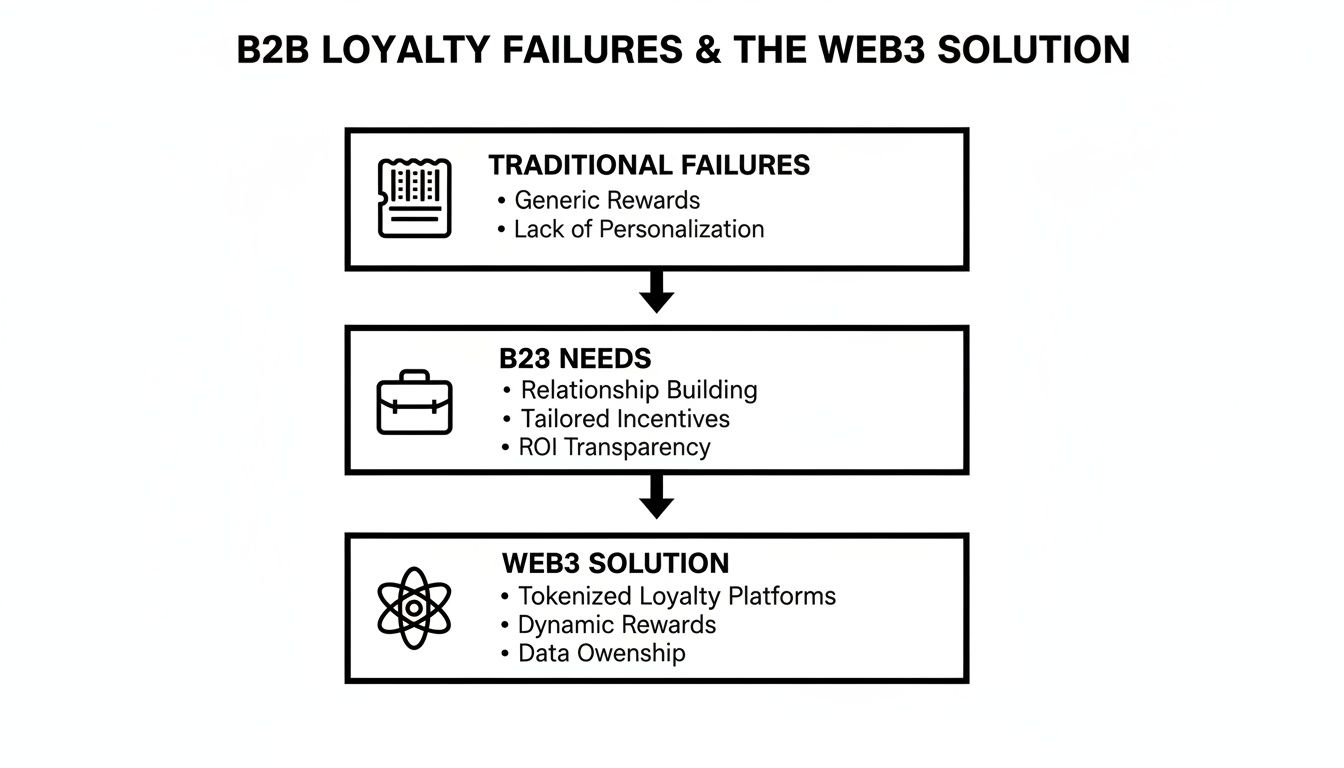
You can see a clear evolution from outdated, transactional rewards to the strategic, stakeholder-driven model that Web3 makes possible.
Create A Reward Structure That Motivates
With your key actions defined, it's time for the fun part: designing the rewards. This is where so many B2B programs fall flat. They offer generic, low-value incentives that nobody really wants. A 5% discount is pretty meaningless to a strategic partner.
Instead, focus on rewards that provide genuine business value. Think about a tiered structure where partners unlock better perks as they complete more valuable quests:
- Tier 1 (New Partners): Give them early access to beta features, a private Discord channel, and official shout-outs on social media.
- Tier 2 (Engaged Partners): Offer up co-marketing opportunities like joint AMAs or blog posts, priority tech support, and warm introductions to your network.
- Tier 3 (Strategic Allies): This is the top tier. Think a seat on a partner advisory council, direct access to your core team for strategy sessions, or even revenue-sharing deals.
The data backs this up. One of the most telling stats is that B2B loyalty participants spend 20% more on average, while 81% of customers say a program encourages them to stick with a brand. Those numbers prove just how sticky a well-designed rewards system can be, especially for Web3 community managers at blockchain startups or DAOs.
Measure The KPIs That Actually Matter
Finally, how do you know if any of this is working? You have to track the right Key Performance Indicators (KPIs). It's time to move beyond vanity metrics like the number of participants and focus on data that shows you're hitting your core objectives.
Key KPIs for a Web3 B2B program should include:
- Partner Retention Rate: Are your most valuable partners sticking around longer?
- Depth of Engagement: Are partners tackling more complex, higher-value quests over time?
- Ecosystem Growth Metrics: Keep an eye on the number of new integrations, the total value locked (TVL) from partners, or the transaction volume driven by your program members.
- Partner Acquisition Cost (PAC) Reduction: Is your program generating new partnerships through referrals, effectively lowering your sales and marketing spend?
By focusing on these practical design pillars, you can build a B2B loyalty program that doesn't just give away freebies but actively builds a stronger, more collaborative, and more valuable ecosystem. To go even deeper, check out our detailed guide on creating a powerful Web3 incentive program.
The Tech Stack for Modern B2B Loyalty
Great ideas need great tools. A forward-thinking B2B loyalty program in the Web3 space is more than just a good strategy—it’s a living, breathing tech ecosystem. To make it work, integration, automation, and user experience have to be front and center. The right tech stack is what turns your big partnership goals into a smooth, automated reality.
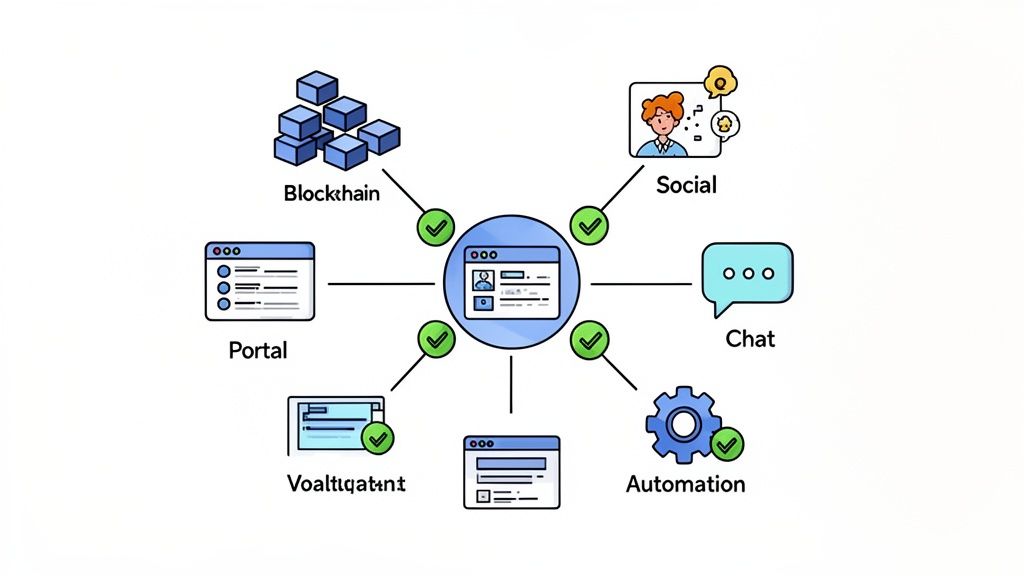
At the core of this whole setup are no-code platforms. You can think of them as the central command center for your entire loyalty campaign, connecting all the different moving parts. They’re the bridge between what happens on-chain and off-chain, letting you build out complex, multi-step quests without needing to write a line of code.
Unifying On-Chain and Off-Chain Actions
Let's be real, a modern B2B partnership isn't confined to one place. It sprawls across social media, community hubs like Discord, and the blockchain itself. Your tech has to be able to follow and verify actions across that entire landscape.
For instance, say you want to roll out the red carpet for a new integration partner. With a no-code toolkit, you could design a "Welcome Quest" that pulls together a few different actions:
- Off-Chain Social Proof: The partner has to fire off a tweet announcing the new collaboration.
- Community Integration: A key developer from their team needs to claim a special role in your Discord server.
- On-Chain Verification: The partner has to interact with a specific smart contract on-chain.
The platform handles the nitty-gritty of checking that each step is done. Once everything is confirmed, the reward—whether it's a token drop, a unique NFT, or access to a private channel—is sent out instantly. That kind of automation is what makes a sophisticated B2B loyalty program something any size team can actually manage.
This unified approach ensures you’re rewarding genuine, holistic engagement. It’s not about a single transaction; it's about recognizing the full spectrum of a partner's contribution to your ecosystem.
Meeting Partners Where They Are
The best user experience is the one your partners barely notice. A flexible tech stack should support multiple frontends, so you can engage with partners on the platforms they already use every single day. This simple idea removes a ton of friction and gets way more people to actually participate.
This multi-frontend support isn't a "nice-to-have"—it's essential for a B2B program to succeed. Your partners will have their own preferences for how they interact, and your tech needs to roll with it.
Key interfaces to think about include:
- A Dedicated Web Portal: For partners who love a good dashboard to track their progress and see their rewards pile up.
- A Discord Bot: For the community-native crowd who wants to complete quests without ever leaving your server.
- A Telegram Interface: For partners who are glued to Telegram, letting them get involved without switching apps.
This flexibility makes your program feel like a natural part of the partnership, not another annoying task on their to-do list. A big piece of the puzzle is having solid payment systems to handle all the transactions and rewards. For a deeper dive, you can often find great insights from resources with extensive payment processing expertise in various systems.
Ultimately, the tech powering your B2B loyalty program should be invisible but powerful. It should automate the tedious work of verifying actions and distributing rewards, freeing you up to focus on what matters: building strong relationships and designing creative campaigns that actually drive growth. To explore your options further, you can learn more about finding the right loyalty program platform to fit your project's specific needs.
Real-World B2B Loyalty Programs in Action
Theory is all well and good, but seeing a B2B loyalty program actually working in the wild is where the lightbulb really goes on. The Web3 space is the perfect proving ground for these ideas because the entire industry is built on collaboration and growing ecosystems together.
Let's walk through a few mini-case studies. Think of these as practical blueprints showing how a project could use a no-code toolkit like Domino to build and run a loyalty campaign that turns partners into true evangelists. We'll look at how different Web3 projects can design quests and rewards that line up perfectly with what they're trying to achieve.
Example 1: The Layer-1 Protocol
Picture a new Layer-1 blockchain trying to get developers in the door. The main goal? Get talented teams to actually build dApps on their network. Just offering a small discount on transaction fees isn't going to move the needle. They need to create incentives for the deep, time-consuming work of building something real.
The Goal: Boost the number of active developer teams and deployed smart contracts on the network by 25% in a single quarter.
The Quests: This isn't a one-and-done deal. The loyalty program would be a journey, guiding developer teams from just being curious to launching a full-blown application.
- Quest 1: "Hello World" — Get a basic "Hello World" smart contract compiled and deployed on the testnet. Easy win.
- Quest 2: "Community Builder" — Host a 30-minute virtual workshop for other devs, showing them a unique feature of the protocol.
- Quest 3: "Mainnet Launch" — Ship a working dApp on the mainnet that gets at least 100 unique wallet interactions.
The Rewards: The rewards have to scale with the effort. Finishing the first quest might get you a special "Builder" role in Discord and some testnet tokens to play with. But for that final quest? We're talking a major grant in the protocol's native token, co-marketing support from the core team, and a featured spot on their official "Awesome dApps" list.
The Payoff: This kind of structure does way more than just attract builders. It walks them through the development process step-by-step, encourages them to become teachers themselves, and rewards the one thing that truly matters: a live, working app that brings real people into the ecosystem.
Example 2: The NFT Project
Okay, now let's think about an established NFT project. They've got a passionate community, but their challenge is keeping long-term holders and community mods from burning out. These are the people running events, answering questions in Discord at all hours, and creating the vibe that brought everyone there in the first place.
The Goal: Empower and reward the top community contributors to keep them engaged and encourage more holder-led content.
The Quests: Here, the quests are all about strengthening the community from within.
- "Lore Master" Quest: Write a high-quality Twitter thread or blog post that takes a deep dive into the project's story and lore.
- "Event Host" Quest: Put together a community event—like a game night or an art contest—that gets at least 50 people to participate.
- "Welcome Wagon" Quest: Get officially recognized by the team for consistently welcoming new members and answering their questions in Discord for 30 days straight.
This approach flips the script, turning a community from a passive audience into an active, self-powering ecosystem. It’s a recognition that in Web3, the community isn't just a marketing channel—it is the product.
The Rewards: This isn't really about money. The ultimate reward could be a unique, soulbound NFT that acts as a badge of honor, showing everyone their status as a core contributor. Other perks could include direct access to the founding team for feedback sessions or even a cut of the revenue from merch sales.
The Payoff: The project ends up with a core group of super-advocates who feel truly seen and valued. This makes the community better for everyone and basically turns your top holders into a decentralized extension of your own team.
Example 3: The DeFi Protocol
Last up, a DeFi protocol that needs other protocols to integrate its liquidity pools. Their dream is to become a fundamental building block in the DeFi world, and that only happens when other projects build on top of them.
The Goal: Land five new protocol integrations that drive a combined $10 million in new Total Value Locked (TVL) within six months. This is a perfect scenario for a highly targeted B2B loyalty program.
The Quests & Rewards: This calls for a tiered program based on how much value a partner brings in.
- Tier 1 (Bronze Partner): Integrate the liquidity pool and drive up to $1M in TVL.
- Reward: A 5% cut of the protocol fees generated from their volume.
- Tier 2 (Silver Partner): Drive between $1M and $5M in TVL.
- Reward: A 7.5% fee share plus a joint marketing campaign.
- Tier 3 (Gold Partner): Drive over $5M in TVL.
- Reward: A 10% fee share, a dedicated tech support channel, and a seat at the table on the protocol's strategic partner council.
The Payoff: The DeFi protocol creates a clear, powerful reason for other projects to plug into its tech. The tiered structure gives partners a reason not just to integrate, but to push hard to drive volume, creating a true win-win where both ecosystems grow together. As you can imagine, the right enterprise loyalty software is absolutely essential for managing these kinds of complex, value-driven partnerships.
Common Questions About Web3 Loyalty Programs
Diving into Web3 partnerships can feel like stepping onto a new planet, so it's only natural to have a few questions. A B2B loyalty program built on Web3 is an incredible tool, but it plays by a different set of rules. Let's break down some of the most common questions we hear from marketers and founders, so you can build with confidence.
Think of this as your no-nonsense field guide. We're going to get into the real-world worries and sticky points that pop up when you're trying to build lasting alliances, not just chase one-off transactions.
What Are the Most Common Mistakes to Avoid?
By far, the biggest mistake is running a B2B program like it's for consumers. You have to fight that instinct to reward small, frequent, low-value clicks. The whole game here is about strategic contributions that actually make the partnership—and your ecosystem—stronger.
Another classic pitfall? Making things too complicated. If your partners need to pull out a manual to figure out how your quests work, they’re just not going to bother. The experience has to feel effortless.
Finally, a surprisingly common error is offering rewards that just don't move the needle for another business.
- Weak Incentives: A 5% discount is a rounding error for a serious partner; it's almost insulting.
- Priceless Alternatives: Things like co-marketing exposure, a dedicated technical support channel, or getting early access to new features can be worth far more than cash.
- Stagnant Programs: Don't just "set it and forget it." Your B2B loyalty program needs to be a living, breathing thing that evolves as your partnerships do.
How Do You Measure the ROI of a B2B Loyalty Program?
This is a big one. Measuring the return on a B2B loyalty program isn't just about tracking sales. The real gold is in the strength and momentum of your network. You need to look at metrics that tell you how healthy your partnerships and the overall ecosystem are.
The goal isn't a temporary spike in revenue. It's about building a resilient, interconnected network where your partners are actively helping each other succeed. Your ROI has to capture that compounding, long-term value.
Here are the key things to track:
- Partner Retention Rate: Are your best partners sticking around for the long haul? This is loyalty in its purest form.
- Increased Engagement Depth: Are partners moving up the ladder from simple tasks to more complex, high-impact quests over time?
- Ecosystem Growth: Can you draw a direct line from your program to new integrations, more developer activity, or a bump in shared liquidity?
- Reduced Partner Acquisition Costs (PAC): A great program should create evangelists who bring in other high-quality partners, lowering your cost to grow.
Using a platform that automatically logs quest completions and partner actions is a must. It gives you the clean, reliable data you need to calculate these deeper ROI metrics and prove the program’s strategic value to your team and investors.
Can a Small Web3 Startup Realistically Implement This?
Absolutely. In fact, for a startup, a quest-based B2B loyalty program is one of the most powerful growth hacks you can find. With the rise of no-code tools, you no longer need a huge budget or a dedicated dev team to pull this off. A small, scrappy team can get a serious program running in days, not months.
The secret is to start small and be laser-focused. You don't need a massive, all-encompassing program on day one. Instead, launch a simple campaign with one clear goal.
- Example 1: Create a program just for your first five integration partners to make them feel like VIPs.
- Example 2: Reward your most active and helpful community ambassadors on Discord.
- Example 3: Incentivize the first ten developers who build something cool with your API.
This focused approach lets even a tiny team create powerful network effects from the get-go. By defining a handful of high-impact actions and using an automated platform to manage it all, you can build the kind of deep, collaborative partnerships that bigger, slower-moving competitors can only dream of.
Ready to turn your partners into your most powerful growth engine? With Domino, you can design and launch a quest-based B2B loyalty program in minutes, no code required. Automate everything from tweet verification to on-chain actions and build the strong, collaborative ecosystem your project needs to thrive. Start building with Domino today.