Launch a Winning Web3 Whitelabel Waitlist
So, what exactly is a web3 whitelabel waitlist? Think of it as a custom-built, branded sign-up system you use before a big token or NFT launch. It's not just some generic email form. It’s your first growth engine, designed from the ground up to pull in crucial on-chain data and build real, authentic FOMO from day one.
Why Your Project Needs a Whitelabel Waitlist
In Web3, a killer launch isn't just about making a lot of noise. It’s about getting the right people in the door—the ones who will stick around and actually support the project long-term. A basic sign-up form completely misses the mark here. It's a passive bucket that collects emails, but it does absolutely nothing to vet or fire up your potential community members.
A custom, whitelabel waitlist flips that whole dynamic on its head.
Instead of just building a list, you're laying a foundation. This becomes the very first touchpoint in your project's ecosystem, a branded experience that’s designed to filter for quality, not just quantity. This is how you make sure the people signing up are genuinely interested and invested, not just bots or flippers looking for a quick payday.
Cultivate an Exclusive and Engaged Audience
Let's be honest: exclusivity works. A waitlist immediately reframes your launch as an invite-only event, which naturally creates a sense of urgency and desire. When you set specific entry requirements—like holding a certain NFT, owning a particular token, or even just completing a social quest—you start attracting a much more dedicated crowd right off the bat. These are the people who are far more likely to become your project’s biggest champions.
This approach gives you a few key advantages:
- Pre-Qualification: You get to set the rules, ensuring everyone who joins meets specific on-chain or social criteria. This weeds out the low-quality noise.
- Reduced Speculation: By curating your initial audience, you massively reduce the risk of your launch getting overrun by speculative traders who couldn't care less about your project's future.
- Stronger Community Bonds: When people have to put in a little effort to join, they feel a stronger sense of belonging. They’re more likely to stick around and actually engage with each other.
"A waitlist isn't just a gate; it's a filter. It's your first and best tool for distinguishing between passive observers and future power users who will champion your project long after the initial hype fades."
Gather Vital Pre-Launch Data
A whitelabel waitlist is also a secret weapon for gathering data. It lets you collect information that goes way beyond a simple email address. You can ask for wallet addresses, Discord handles, and Twitter profiles, giving you incredible insight into who your budding community is really made of.
This data is gold. For example, you can analyze the on-chain history of your waitlist members to see their experience with other DeFi protocols or NFT collections. Understanding these patterns helps you sharpen your marketing and build community programs that actually resonate. This kind of smart data collection is the cornerstone for building a thriving Web3 community, turning fuzzy interest into a real, measurable asset.
When you put all these pieces together, a web3 whitelabel waitlist stops being a simple sign-up form and becomes a strategic launchpad. It’s the difference between crossing your fingers for a good launch and actually engineering one. You build momentum, qualify your audience from the start, and get the intel you need to build a loyal following that will carry your project forward.
Designing Your Waitlist Architecture and User Flow
Building a killer waitlist is a lot like product design. Every single touchpoint, from the moment someone lands on your page to that final "You're in!" confirmation, needs to feel deliberate and smooth. This is your user experience blueprint, and the goal is to make your web3 whitelabel waitlist feel like an extension of your brand—not some clunky, tacked-on form.
The first big question you need to answer is: what data do you actually need? It's a classic tug-of-war between getting the info you need and not scaring people away with a giant form. A wallet address is non-negotiable, obviously. But do you really need their Discord handle, Twitter profile, and email right now? My advice: keep it lean. Only ask for what's absolutely essential for your gating and communication plan.
On-Chain Versus Off-Chain Data Collection
Your next major fork in the road is deciding where this data lives. Are you going to keep it off-chain in a good old-fashioned database, or are you going to use on-chain magic? Each path has some serious trade-offs.
Going off-chain is the fast and cheap route. Sticking wallet addresses and social handles in a private database is straightforward and plays nice with tools like your email marketing platform. The downside? It doesn't have that transparent, trustless vibe that many Web3 natives are looking for.
Putting data on-chain, while a heavier lift to build from scratch, gives you verifiable proof of who signed up. This could mean using a smart contract to register users or even minting a non-transferable "waitlist ticket" NFT. This approach is pure Web3 ethos but can mean gas fees and slower sign-ups for your users.
A great user flow feels invisible. The user shouldn't have to think about whether their data is on-chain or off-chain; they should only feel a smooth, intuitive journey from curiosity to confirmation.
Customizing the User Journey with No-Code Tools
This is where a no-code platform like Domino really flexes its muscles. Instead of burning weeks (and a ton of cash) on custom development, you can map out the entire user flow visually. You can spin up a branded landing page, define the exact data fields you want, and set up all the back-end logic without touching a line of code.
For instance, you could quickly build a flow where a user connects their wallet, gets prompted to join your Discord, and then gets instant confirmation once the platform verifies their new Discord role. You can literally build and tweak that entire sequence in a few minutes, which frees you up to think about strategy instead of getting bogged down in implementation.
This whole process is about turning passive interest into a real, engaged community. It's not just about collecting names. It’s a journey.
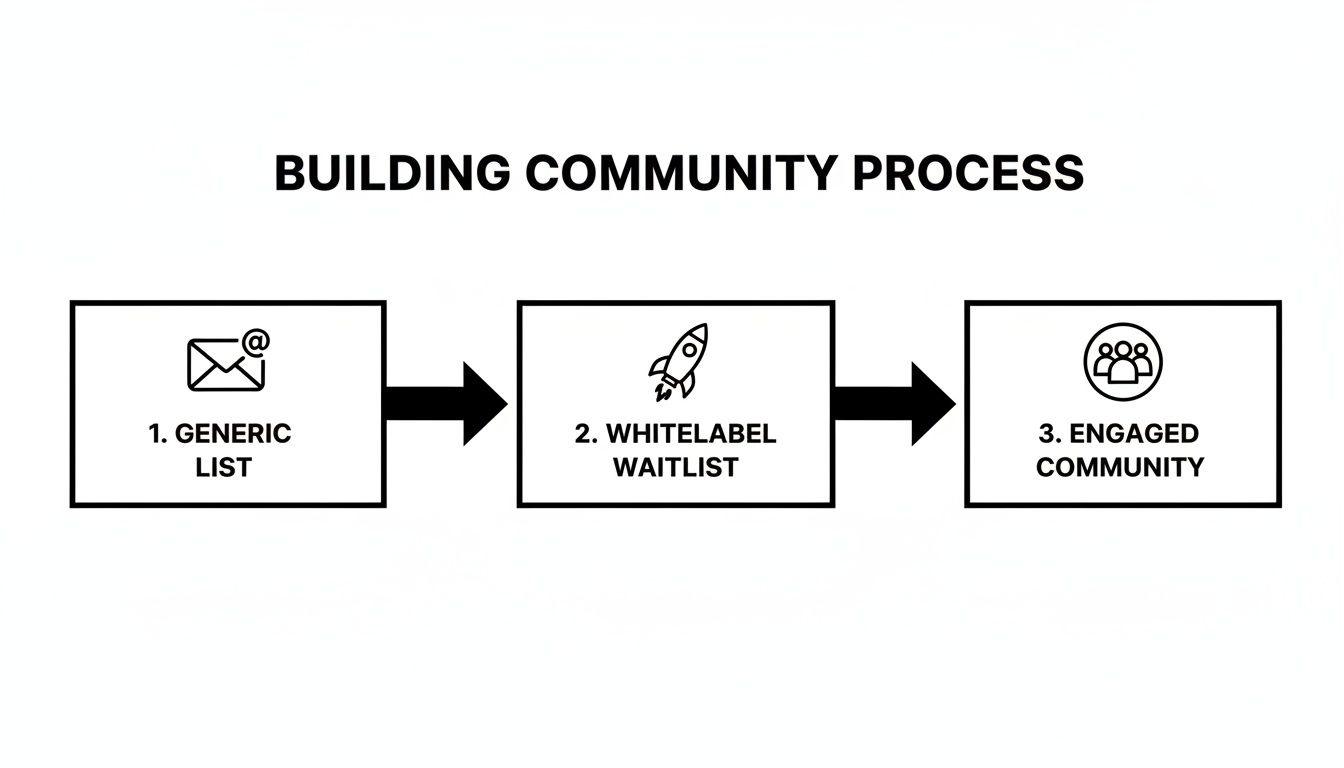
As you can see, the waitlist is that critical bridge. It takes people from "kinda interested" to "I'm in and ready for launch."
And the demand for these tools is just exploding. The Web3 market is expected to rocket to USD 81.5 billion by 2030, a clear sign that decentralized tech is going mainstream. As the space grows up, having smart community-building tools isn't a "nice-to-have" anymore—it's essential for any project that wants a piece of that pie. You can dive deeper into these Web3 industry trends if you're curious.
Build vs. Buy: The Key Considerations
The age-old question: build it yourself or use a ready-made platform? The answer usually boils down to your resources, timeline, and where you want your team to focus. Building a custom solution gives you ultimate control, but it's a huge drain on developer hours and requires constant upkeep.
This is where no-code whitelabel platforms present a seriously compelling argument, especially for teams that need to be nimble and fast.
Waitlist Architecture Options Comparison
Here's a quick breakdown of how the two approaches stack up against each other.
| Feature | Self-Hosted Custom Build | No-Code Whitelabel Platform (e.g., Domino) |
|---|---|---|
| Time to Launch | Weeks or months | Hours or days |
| Upfront Cost | High (developer salaries, infrastructure) | Low (SaaS subscription) |
| Technical Expertise | Requires dedicated Web3 developers | None required |
| Flexibility | Completely customizable but rigid once built | Highly flexible with pre-built modules |
| Maintenance | Ongoing security updates and bug fixes | Handled entirely by the platform provider |
| Integrations | Must be built custom from scratch | Pre-built for Discord, Telegram, Zealy, etc. |
The choice really comes down to your priorities. Building from scratch offers total control if you have the resources, but for most projects, speed and efficiency are paramount.
Ultimately, your architecture should directly serve your launch goals. If you're focused on explosive growth and building a community without the technical headaches, a web3 whitelabel waitlist platform gives you the speed and power to design a user flow that converts from day one. It lets you architect an experience that builds real excitement, collects the right data, and sets the stage for a blockbuster launch.
Using Smart Gating to Get the Right People in the Door
A huge waitlist number looks impressive, but it's often a vanity metric. What good is a list of 50,000 if it's packed with bots, sybils, and flippers who will dump and run the second they can?
The real goal isn’t just building a big list; it’s about building the right list. This is where smart gating completely flips the script for your web3 whitelabel waitlist.
We're ditching the old "enter your email and pray" model. Instead, we're building a dynamic system where a spot on the list isn't just given—it's earned. This whole approach acts as a powerful, built-in filter, making sure the people who get through are the ones genuinely fired up about what you're building.
First, Who Are You Trying to Attract?
Before you can build any gates, you need a crystal-clear picture of who you're trying to let in. What does a top-tier community member look like for your project?
Are they die-hard DeFi users? Are they avid NFT collectors from a specific ecosystem like Solana or Base? Maybe they're just super-passionate advocates who live on Farcaster and X. Get specific.
Once you’ve sketched out this ideal person, you can reverse-engineer the entry criteria to find them. This isn't about being exclusive just for the sake of it. It's about being intentional.
Here are a few of the most powerful gating strategies I've seen work:
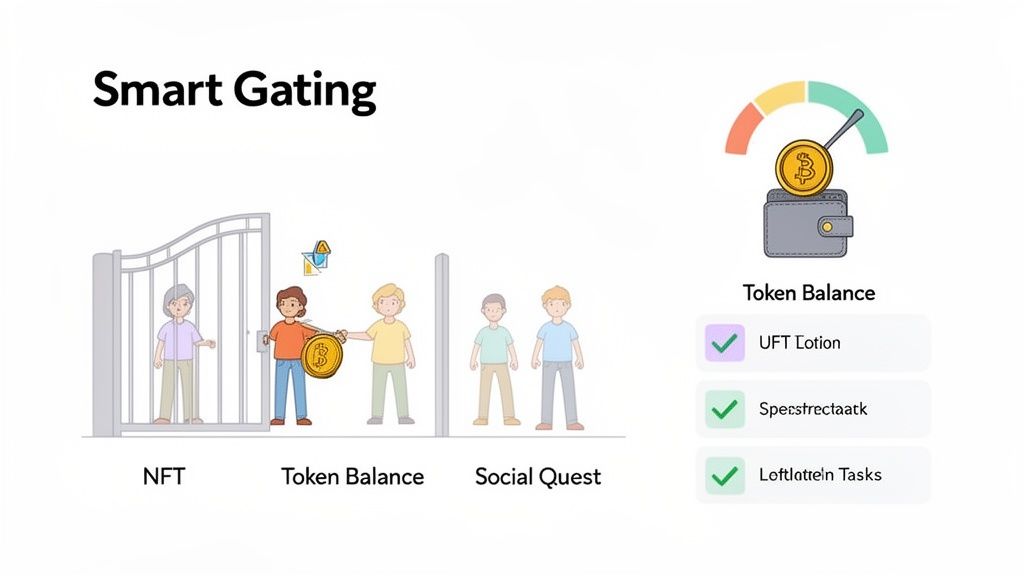
- NFT Ownership: Only grant access to wallets holding a specific NFT, maybe from your own collection or a partner's. This is a brilliant way to tap into an existing community that already gets what you're about.
- Token Balance: Require a minimum balance of a certain token. This could be your own (if you have one) or a major ecosystem token like ETH or SOL. It’s a simple proof-of-skin-in-the-game.
- Social Quests: Make people complete a few small tasks on platforms like X (formerly Twitter), Discord, or Telegram. This immediately weeds out the lazy and filters for people willing to engage.
Pro Tip: The best gating strategies layer multiple criteria. Forcing someone to hold a specific NFT and follow you on X sends a much stronger signal of commitment than just doing one or the other.
On-Chain vs. Off-Chain Verification
Okay, so how do you actually check if someone meets your criteria? This is where verification flows come in, and they basically break down into two camps: on-chain and off-chain.
On-chain verification is your source of truth. It's all about your system pinging the blockchain directly to confirm what's in a user's wallet. It can instantly check for things like, "Does this wallet hold a Degen Ape?" or "Is their balance over 0.5 ETH?" It’s secure, transparent, and exactly what Web3 is all about.
Off-chain verification handles everything else—the actions that happen off the blockchain. We're talking about confirming a Discord role, checking for a follow on X, or verifying a retweet. These checks rely on APIs from other platforms to get the job done.
A really solid web3 whitelabel waitlist platform will blend both seamlessly. Picture this user journey: they connect their wallet (an on-chain check for a token), and then the system prompts them to join your Discord and react to a message in a specific channel (an off-chain check). This multi-layered approach is incredibly effective at finding high-intent people.
Automate Your Gating with a No-Code Platform
Trying to manually verify thousands of wallet addresses and social media accounts is a one-way ticket to burnout. It’s just not scalable.
This is where a no-code tool like Domino becomes a lifesaver. Instead of wrestling with custom scripts to talk to multiple blockchains and social media APIs, you can build these sophisticated gating funnels with a simple, visual interface.
For example, you could easily set up a rule that automatically grants a priority spot to anyone who holds a Pudgy Penguin NFT and also completes a questline on Zealy. The platform does all the verification work in the background, making it a super smooth experience for your users. If you need more ideas, check out our guide on designing effective Web3 quests.
This kind of automation frees you up to do what actually matters: engaging with your community. That’s more important than ever, especially when you consider that there are now over 18,000 Web3 creators out there, with a 50% jump in active developers in the last three years. The fight for attention and genuine community is fierce. Smart, automated gating is what gives you a real edge.
When you implement smart gating, your waitlist stops being a passive email list. It becomes a dynamic, strategic community-building machine that attracts the right people from day one and builds a foundation for a launch with serious momentum.
How to Protect Your Waitlist From Bots and Sybils
Nothing kills a launch faster than a waitlist full of bots. It inflates your numbers, gives you a false sense of hype, and ultimately dilutes the value for your actual community. When the mint day arrives, chaos ensues. So, protecting your web3 whitelabel waitlist from bots and Sybil attacks isn't just a tech problem—it’s about making sure the people signing up are real fans.
The good news? You've got a whole arsenal of tools to fight back. The best defense is a mix of simple tech checks and clever "humanity tests" that are a breeze for real people but a total nightmare for automated scripts. Let's dig into how to build your fortress.
Layering Your Technical Defenses
Think of this as your first line of defense—the basic gatekeepers. No single method is a silver bullet, but when you layer them together, you create a pretty formidable barrier against the low-effort bot armies out there.
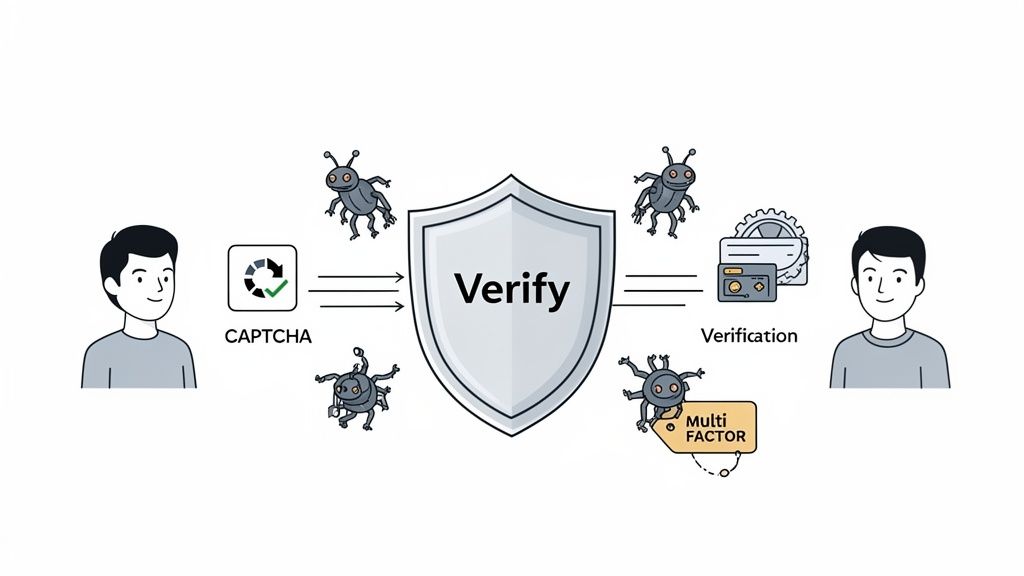
Start with the basics. A simple CAPTCHA still weeds out a surprising number of bots. But we're in Web3, so we can get much smarter than that.
- Wallet Age & History Analysis: A wallet created five minutes ago with zero transactions? That's a huge red flag. You can set up rules to automatically check for things like wallet age, transaction count, or even if it has interacted with other well-known protocols. A wallet with a real history is far more likely to belong to a real person.
- IP Address & Geolocation Flags: I know, I know—VPNs exist. But flagging a dozen signups from the exact same IP address is still a dead giveaway for a coordinated bot farm. It’s an old-school tactic, but it still works.
- Known Bot Address Databases: Why do all the work yourself? There are services that keep running lists of wallets known for shady activities like scams or botting. Hooking into one of these lets you automatically block known bad actors before they even see your sign-up form.
These tech checks are your foundation. They filter out most of the automated noise, which frees you up to focus on the more sophisticated threats.
Designing Human-Centric Behavioral Hurdles
Okay, this is where you can get really creative. The goal here is to come up with tasks that are super easy for a genuine community member but incredibly difficult for a script to fake. You're testing for real engagement, not just the ability to click a button.
Think about what makes your community unique. What actions prove someone is actually interested? Instead of just asking for a simple retweet, make them work for it a little.
A bot can follow an account, but it can't meaningfully contribute to a Discord conversation about your project's roadmap. The more you test for genuine human interaction, the stronger your defenses become.
For instance, you could require users to join your Discord, pop into an #introductions channel, post a real message, and then react to a specific post with an emoji. Or, maybe they have to quote-tweet your announcement with a comment about which feature they're most excited for. That kind of nuance is something most bots just can't handle.
The Power of Multi-Factor Verification
Now for the gold standard: combining on-chain data with off-chain social proof. This is your multi-factor verification, and it’s the best way to secure your waitlist. It’s easy to fake one data point, but faking multiple, unrelated data points is a whole different ballgame.
Picture a user flow like this:
- Connect Wallet: The system checks if they hold at least 0.05 ETH (that's your on-chain check).
- Join Discord: They join your server and a bot automatically gives them a "Newbie" role (that's your off-chain check).
- Complete a Quest: They have to quote-tweet your launch announcement and then submit the link for verification (that's your behavioral check).
Only after a user nails all three steps do they get their spot. This layered approach ensures that only the most dedicated and authentic people make it through. You end up with a waitlist full of high-value members who are genuinely pumped for your launch. This, right here, is the core of building a bot-proof web3 whitelabel waitlist.
Let's Talk Automation: Ditch the Spreadsheets and Scale Your Waitlist
If you're trying to manage a growing Web3 waitlist by hand, you're setting yourself up for a world of pain. Manually sending emails, updating spreadsheets, and checking Discord roles one by one? That’s a surefire path to burnout and it simply doesn’t scale. This is where automation steps in to become your secret weapon, turning a chaotic mess into a well-oiled machine.
Smart automation isn't just about saving time; it's about eliminating human error. Imagine a user finishing a quest and instantly getting their "Verified" role on Discord without you lifting a finger. That's the kind of power we're talking about. The real goal here is to connect all your community and marketing tools into a single, cohesive system so you can focus on what actually matters—engaging with your community, not wrestling with data entry.
Your No-Code Command Center
To make this all work, you need a central hub, a command center for your entire operation. A no-code platform like Domino is designed for this exact scenario. It acts as the glue that binds your sign-up forms, community platforms, and analytics tools together.
Instead of juggling a separate system for your waitlist, another for quests, and yet another for rewards, you can build a single, unified flow. This integration is what creates a professional, seamless experience for your users and keeps the momentum going.
Here’s what that looks like in the real world:
- A user hits your waitlist page and connects their wallet.
- The form prompts them to join your Telegram and follow you on X (what we used to call Twitter).
- Behind the scenes, Domino’s APIs automatically verify they completed those actions.
- Once confirmed, the user is tagged as "Verified" in your database.
- This instantly triggers an automated email confirming their spot and giving them a unique referral link.
This whole process unfolds in real-time. No manual checks, no delays.
Practical Integrations That Actually Save You Time
The real magic happens when you start plugging your waitlist into the platforms where your community actually hangs out. These integrations are what turn a static list of names into a dynamic, community-building engine.
Just think about the most mind-numbing, repetitive tasks your team is doing right now. I guarantee automation can handle them.
- Automated Discord Roles: Instantly grant roles like "Verified" or "OG" when a user meets specific criteria. This gives them immediate social proof and unlocks token-gated channels, making them feel like part of the inner circle.
- Trigger-Based Messages: Set up automated emails or Telegram pings that fire off based on user behavior. For example, you could send a gentle nudge to someone who started the sign-up process but got distracted and didn't finish.
- Synced-Up Analytics: Push all your user data directly into your analytics tools. This gives you a live dashboard of your most important metrics—like conversion rates and referral performance—without ever having to manually export a CSV file again.
Your automation stack should be the silent hero of your campaign. When you get it right, it works so smoothly in the background that your community won't even know it's there. They'll just feel like you're incredibly organized and responsive.
While we're zeroing in on no-code for Web3, the core principles of automation apply everywhere. If you want to dive deeper into general business automation strategies, especially around customer relationships, resources on CRM and automation development can offer some great insights.
Unifying Your Campaign Across Every Platform
Let's be real: a modern Web3 community doesn't live in one place. They’re on Discord, Telegram, X, and maybe even grinding on platforms like Zealy. Automation is the key to creating cohesive campaigns that feel connected across all these different channels. You could, for instance, set up a series of tasks using something like Domino’s Web3 quest solutions that guides a user through your entire ecosystem, from a tweet to a Discord role.
This unified strategy is more important than ever. The market has shifted. In 2023, we saw over 500 financings in Web3 focus on applications, not just backend infrastructure. That means projects are fighting harder than ever for user attention, and having efficient acquisition tools is no longer a "nice-to-have." No-code platforms give smaller, resource-strapped teams the leverage they need to build and engage their communities just as effectively as the big players. You can dig into this trend and read the full Web3 research report to see the data for yourself.
So, Your Waitlist is Live. Now What?
Getting your waitlist launched is a great feeling, but don't pop the champagne just yet. This is where the real work begins. Your waitlist isn't some "set it and forget it" tool; it's a living, breathing campaign that needs attention, measurement, and a whole lot of community love to keep the momentum going until you’re ready for the main event.
It’s so easy to get fixated on that one big number: total sign-ups. And hey, a huge number feels great. But on its own, it tells you almost nothing about the actual health of your community or your odds of a successful launch. We need to dig a lot deeper.
Ditch the Vanity Metrics
Let's get one thing straight: the total number of sign-ups is mostly a vanity metric. It’s time to focus on the KPIs that actually show you what's working and what isn't. These are the numbers that paint a real picture of your community's quality and engagement.
Here’s what I keep on my dashboard for any waitlist campaign:
- Visit-to-Sign-up Conversion Rate: This is your bread and butter. Of all the people who hit your landing page, what percentage actually make it through the sign-up process? If this number is low, something's wrong—maybe your messaging is off, or your gating requirements are a pain.
- Referral Rate: How many new people are being brought in by your existing members? This is a direct signal of virality. If people aren’t referring their friends, you need to ask why.
- Task Completion Rate: If you’re running quests, are people actually finishing them? A big drop-off rate between tasks tells you they’re either too complicated, not worth the effort, or just plain boring.
- Engagement Score: This is a pro move. Assign points to different actions (e.g., 1 point for a Twitter follow, 5 for a referral) to create a weighted score. It instantly shows you who your true evangelists are.
Tracking these numbers helps you spot fires before they become infernos, letting you make smart, data-backed decisions instead of just flying blind.
Always Be Testing
The single best way to pump up those metrics? Constant experimentation. A/B testing isn't just for e-commerce checkouts; it's a seriously powerful tool for optimizing your waitlist. Treat your landing page like a science experiment.
Seriously, test everything.
Run two versions of your page with different headlines. Pit two reward structures against each other—maybe one is a guaranteed NFT mint vs. a larger token airdrop for a select few. I've seen tiny tweaks to gating requirements (like asking for a Discord join after the wallet connect instead of before) make a massive difference in conversion rates.
A/B testing isn't about finding some "perfect" formula that works forever. It's about creating a continuous feedback loop. You're constantly learning what your audience responds to, making you a little bit smarter and your campaign a little bit better every single week.
Keep the Community Warm
The second someone joins your waitlist, a clock starts ticking. If they hear nothing but crickets from you for weeks, they'll forget why they even signed up. You absolutely must have a plan for consistent, valuable communication to keep people excited.
A simple content drip via email or Telegram announcements can work wonders. It doesn’t have to be complicated.
Here’s a simple flow I’ve used:
- Instant Confirmation: The moment they sign up, an automated message hits their inbox. "You're in! Thanks for joining." This is non-negotiable.
- Week 1 Update: Share something from behind the scenes. A sneak peek of the UI, a quick intro to the team, anything that feels exclusive.
- Week 2 Community Spotlight: Find your most engaged members on Discord or Twitter and give them a shout-out. People love being recognized.
- Pre-Launch Hype: A few days before you go live, send the final reminder with the exact date, time, and what they need to do. Build that last-minute urgency.
This steady drumbeat of communication turns a cold list of addresses into a fired-up community that’s ready to show up and make noise on launch day.
Tired of wrestling with spreadsheets to manage your community growth? With Domino, you can design, launch, and scale a custom Web3 waitlist with smart gating, automated rewards, and deep analytics—all without writing a line of code. See how top projects are building real momentum.