A Practical Guide to Web3 Whitelabel Quests
Let’s be real for a minute: most of the old growth hacks just don't cut it in Web3 anymore. This is where web3 whitelabel quests are changing the game. Think of them as a bridge that turns your quiet Discord lurkers into genuinely active, on-chain community members. They’re the engine for real, measurable growth, pushing projects past flimsy vanity metrics.
Why Web3 Whitelabel Quests Are Such a Growth Game Changer
If you're still chasing fleeting trends, you're falling behind. Sustainable growth in Web3 is all about authentic community engagement and provable on-chain activity. Not long ago, the go-to move was a big, expensive airdrop that brought in a flood of people who vanished as quickly as they came. That just doesn't build lasting loyalty.
Today, it's all about creating interactive, rewarding experiences, and that's exactly where quests shine. They flip the user journey on its head, turning it from a passive experience into a hands-on adventure. Instead of just joining a server and disappearing into the background, users get a clear roadmap to contribute, learn, and earn.
This creates an incredible flywheel effect:
- It drives real on-chain actions. You can design quests that encourage the exact behaviors you need, like staking an NFT, swapping a token on your DEX, or casting a vote in a governance proposal.
- It educates and onboards new users. Quests can walk newcomers through your project’s key features, making the learning curve feel less like a chore and more like a game.
- It builds a much stronger community. When you reward participation and social sharing, your most dedicated members become your biggest champions, sparking genuine, organic growth.
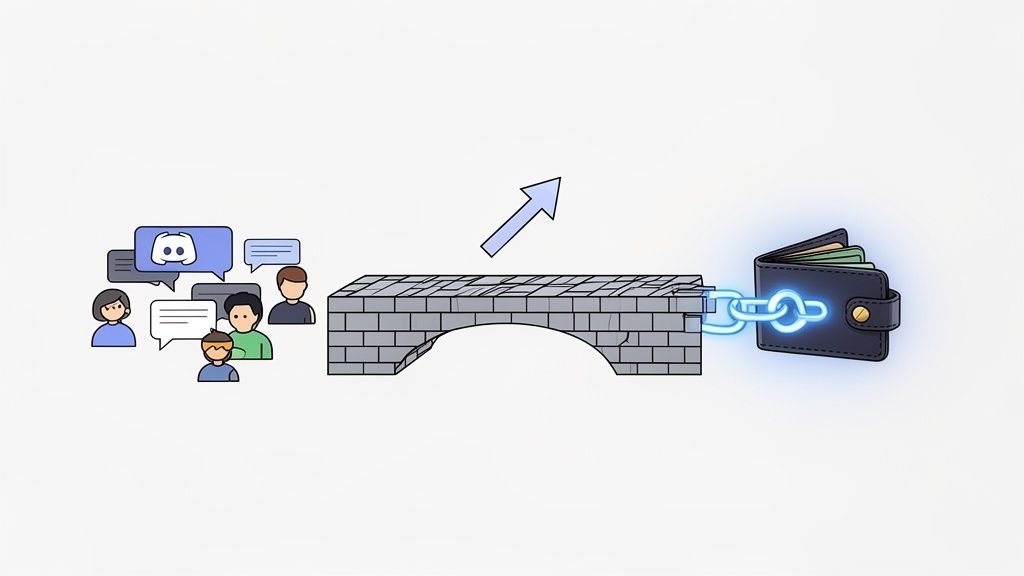
The Power of No-Code Automation
And here’s the best part: this isn't some complex strategy reserved for teams with huge dev budgets. The rise of no-code platforms means almost any project can now build its own automated growth engine. You can design and launch seriously sophisticated quest campaigns that mix off-chain social tasks with complex on-chain verification—all without touching a line of code.
These platforms are quickly becoming essential tools for community-led growth. We've seen them power over 25 million completed quests across more than 13,000 campaigns in the Web3 space. That kind of momentum speaks for itself. The global Web3 blockchain market, which was valued at USD 4.43 billion, is on a trajectory to hit an eye-watering USD 226.4 billion by 2034.
By turning simple community interactions into a powerful growth flywheel, web3 whitelabel quests provide a structured, scalable way to convert community presence into tangible on-chain value. It’s about building with your community, not just for them.
The secret sauce is blending gamification with real, tangible rewards. If you want to dig deeper into how to nail this, it’s worth exploring the core principles of crypto gamification and its impact on user behavior. When you make participation fun and worthwhile, you build a system that doesn't just attract people—it keeps them engaged and coming back for more, turning your audience into an active force behind your project's success.
Designing a Quest Campaign That Actually Works
Let's be real: a great quest campaign is built on a solid game plan, not just a random list of things for users to do. Before you even start daydreaming about rewards or cool tasks, you need a blueprint. The first, and most important, question to ask yourself is: what is the one key thing we absolutely need to achieve with this?
Get your team on the same page around a single, primary goal. Are you trying to pull in new users? Get your existing community more involved? Or are you aiming to drive specific on-chain actions? Trying to hit every target at once is a surefire way to launch a confusing campaign that doesn't really move the needle on anything.
Most campaigns boil down to one of these core objectives:
- User Acquisition: Your main focus is growing your community and bringing fresh eyes to your project.
- Community Engagement: You want to fire up your existing members and turn lurkers into active participants.
- Education and Onboarding: The mission is to walk newcomers through your platform, showing them the ropes and making it easy to get started.
- On-Chain Activity: You need users to do specific things like staking, swapping, or minting to light up your protocol's metrics.
Once you’ve locked in that primary goal, every other decision—from the tasks you set to the rewards you offer—becomes so much clearer.
Mapping Out the Ideal User Journey
With your objective set, it's time to put on your user's hat. The user journey is the entire experience, from the moment someone first hears about your quest to the second they're celebrating their reward. A clunky, confusing journey is the fastest way to get people to give up and bounce.
Think it through step-by-step:
- Discovery: How are people even going to find out about this? Is it a big announcement on X (formerly Twitter), a can't-miss banner in your Discord, or an email blast?
- Onboarding: What’s the very first action they take? Is it a simple wallet connect, or do they have to jump through hoops like joining a specific channel first? Keep this first step as smooth as butter. Any friction here is a dealbreaker.
- Participation: How do they actually do the tasks? Is the interface easy to figure out? Are the instructions crystal clear? A messy UI is a campaign killer, period.
- Completion & Reward: What happens when they’re done? Is the reward instant and automatic, or are they left waiting? Instant gratification is a powerful hook.
A great user journey feels less like a to-do list and more like a guided adventure. You want to make it so easy and fun that people want to see it through to the end.
Mapping this journey helps you spot the potholes before your users fall into them. For instance, if a quest makes someone jump between your dApp, Discord, and a third-party site, you can bet you’ll lose a huge chunk of participants along the way. Simplify the path wherever you can.
Picking the Right Mix of Quest Tasks
Alright, now for the fun part—choosing the actual tasks. The golden rule here is alignment. Every single task you create should directly push your main goal forward. Don't just toss in a "Follow us on X" task because you see everyone else doing it. Ask yourself why that specific action matters for your objective.
A well-rounded campaign usually blends off-chain and on-chain tasks to create a complete experience.
- Off-Chain Tasks (Top of the Funnel): These are fantastic for grabbing attention and getting people in the door. Think social media follows, retweets, joining a Discord or Telegram, or even sharing some user-generated content like memes. They’re low-effort actions, perfect for attracting a wider audience.
- On-Chain Tasks (Bottom of the Funnel): This is where you drive the real, measurable value for your protocol. We're talking about actions like staking a certain number of tokens, minting an NFT, making a swap on your DEX, or casting a vote in a governance proposal. These tasks are for your more dedicated users and should be rewarded accordingly.
Let’s say your goal is to boost liquidity on your brand-new DEX. A smart quest flow could look something like this:
- Start with easy off-chain tasks: Get them to follow you on X and join the Discord. This gets them into your ecosystem.
- Move to an educational step: Have them read a quick "how-to" guide on using your DEX. Now they're informed.
- Finish with the key on-chain action: The final task is to make a swap of at least $10 on your platform. This is the money move.
This structure smoothly guides users from simple awareness to meaningful action. By strategically designing the flow and making sure every task serves your core objective, you're setting the stage for a web3 whitelabel quests campaign that actually delivers.
Alright, you've got your strategy locked in. Now comes the fun part: actually building your campaign and bringing those quests to life.
If you’re picturing a mountain of code and a team of developers, think again. The beauty of modern web3 whitelabel quests is that you don’t need to be a technical wizard to launch something amazing. Thanks to no-code platforms, it’s less about coding and more like using a drag-and-drop builder for your community.
This is where your blueprint becomes a real, interactive experience. These tools are built for people like us—marketers and community managers—giving you a visual interface to piece together your entire campaign.
Start with a Foundation: Pre-Built Task Templates
The heart of any good no-code quest platform is its library of task templates. Honestly, this is a massive shortcut. Instead of figuring out the verification logic for every single action, you just pick what you want users to do from a menu.
These templates cover everything from simple social media follows to complex on-chain transactions, so you can mix and match to hit your specific goals.
- Social Engagement Tasks: Perfect for top-of-funnel growth. You can set up tasks like "Follow us on X," "Retweet this specific post," or "Join our Telegram" in just a few clicks.
- Community Interaction Tasks: Want to get your own spaces buzzing? Use templates for actions like "React to an announcement in Discord" or "Earn a specific role on our server."
- On-Chain Action Tasks: This is where things get really powerful for Web3 projects. You can easily create quests that require users to "Stake at least 1 NFT from our collection," "Swap a token on our partner DEX," or "Hold a certain token balance."
The process is refreshingly simple. You choose a task, connect your project’s account (like your X profile or Discord server), and tweak the settings. This modular approach means you can build out a whole multi-step quest in minutes, not weeks.
If you want to see what this looks like in practice, you can explore a variety of quest templates to get some ideas flowing.
On-Chain vs Off-Chain Quest Task Comparison
When you're designing your quest, you'll constantly be balancing on-chain and off-chain tasks. It's not about one being better than the other; it's about using the right tool for the job. Off-chain tasks are fantastic for building awareness and growing your social channels, while on-chain tasks drive real, measurable protocol engagement.
Here’s a quick breakdown to help you decide what fits where:
| Task Type | Example | Primary Goal | Setup Complexity |
|---|---|---|---|
| Off-Chain | Follow on X, Join Discord | Top-of-funnel growth, community building | Low |
| Off-Chain | Retweet a specific post | Amplifying a message, viral marketing | Low |
| Off-Chain | Create user-generated content (meme) | Fostering creativity, engagement | Medium (requires review) |
| On-Chain | Hold a specific token/NFT | Rewarding loyal holders, user retention | Low-Medium |
| On-Chain | Swap tokens on a DEX | Increasing trading volume, liquidity | Medium |
| On-Chain | Stake an asset | Driving protocol TVL, long-term alignment | Medium |
| On-Chain | Mint a free NFT | Product interaction, user acquisition | Medium-High |
Ultimately, a well-rounded quest will probably include a healthy mix of both. Start with easy off-chain tasks to get people in the door, then guide them toward the more valuable on-chain actions.
Put Verification on Autopilot (and Save Your Sanity)
Remember the old days of running giveaways? Manually checking thousands of screenshots or wallet addresses was a nightmare. It just doesn't scale. This is where no-code tools are an absolute game-changer.
They have automated verification systems baked right in.
When you set up a task—say, "Like and Retweet our launch announcement"—the platform's API hooks directly into the social network. It automatically confirms that the user who connected their wallet actually did the thing. No spreadsheets, no manual spot-checks, no human error.
The same magic applies to on-chain tasks. The platform connects with blockchain explorers to watch for wallet activity in real time. If your quest requires a user to stake an NFT, the system simply pings the blockchain to see if a transaction from their connected wallet went through.
This automated verification is what unlocks your ability to scale. It frees your team from soul-crushing admin work so you can focus on what really matters: engaging with your community and thinking about the next big campaign.
Crafting a Reward System That Actually Motivates
Let’s be real: a flat reward structure, where everyone gets the same thing for minimal effort, is pretty uninspiring. No-code platforms make it easy to build out much more compelling, tiered reward systems that push users to complete the more valuable actions you care about.
Think of it like a video game. You can structure your rewards to create a real sense of progression:
- Bronze Tier: Complete 3 simple social tasks (Follow, Like, Retweet) to earn 50 XP and a basic Discord role. This is the entry point.
- Silver Tier: Do all the Bronze tasks plus join Telegram and post a welcome message. The reward? An extra 150 XP and an entry into a raffle.
- Gold Tier: Finish all the Silver tasks plus perform an on-chain action, like staking a token. For this, they get a final 500 XP, a rare NFT, and a premium "Gold Contributor" role.
This tiered model gives users a clear path forward and motivates them to go deeper than just the low-hanging fruit. You can set this entire flow up visually within the platform, defining exactly what rewards (XP, NFTs, tokens, roles) unlock at each stage. Some platforms even have a dedicated 'Quest Creator' that streamlines this process, letting you quickly create design thinking quests with a quest creator without any code.
This simple flowchart nails the core process you'll follow: define your goal, map the user journey, and then choose the right tasks.
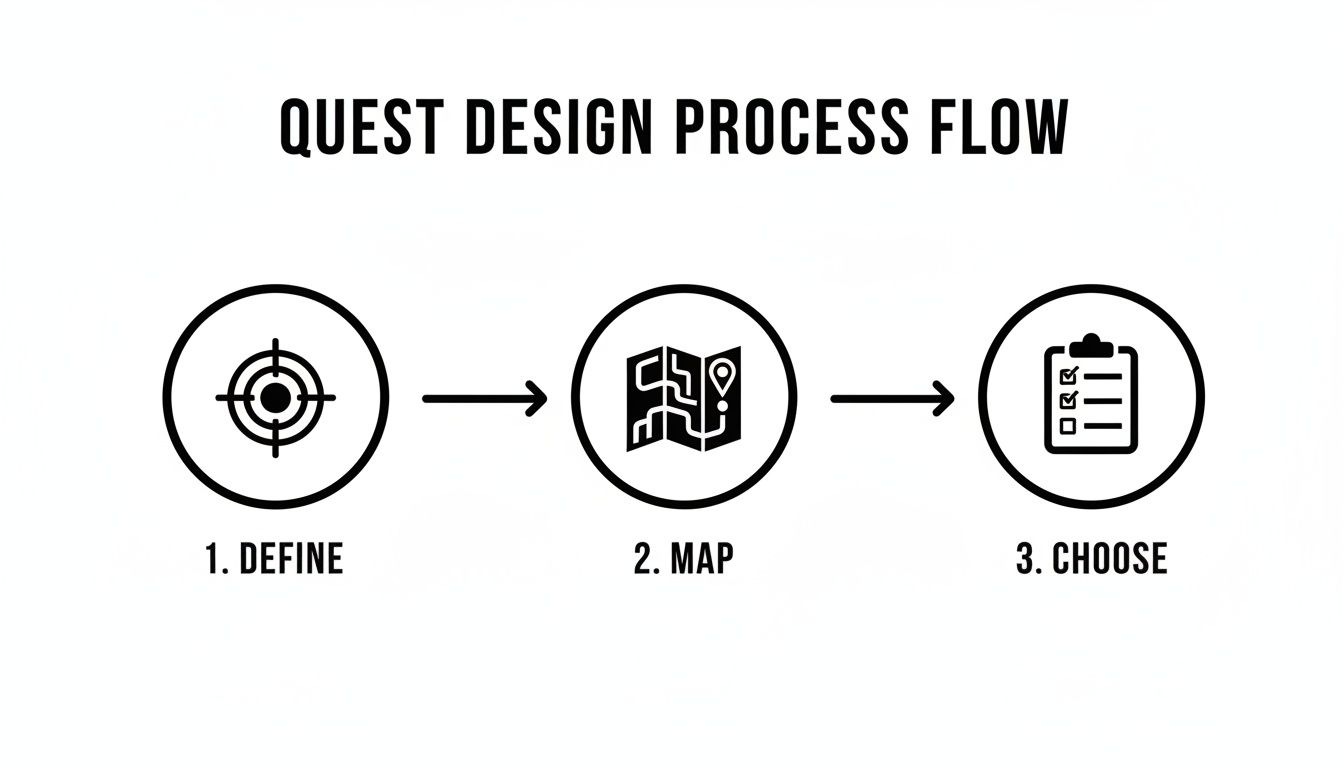
It’s a good reminder that a successful quest starts with clear goals before you even think about the tools. But once you have that plan, a no-code toolkit lets you execute the entire workflow seamlessly, turning your strategy into a live, automated, and engaging campaign.
Launching and Promoting Your Quest Campaign
Alright, you've designed and built out your quests. Now for the fun part: getting them in front of your community. A great launch is all about building momentum, not just flipping a switch. You want to start with a bang, and that begins with deciding where your quests will actually live.
This choice is a big deal because it shapes the entire user experience.
You've got a few solid options here. A fully branded, white-label quest portal is the premium choice. It's your own little corner of the internet, decked out in your project's branding, which feels professional and reinforces who you are.
On the other hand, you can meet your community right where they hang out. Embedding quests directly into Discord or Telegram is a great way to lower the barrier to entry. People can jump in without ever leaving the apps they use all day. Honestly, a hybrid approach often works best—use a central portal as your main hub, but push individual quests out to your community channels.
Crafting Announcements That Create Buzz
Your announcement is your campaign's first impression, and a lazy "Our quests are live!" post just isn't going to cut it. You need to build real excitement and show people why they should care. Think of it less like an update and more like an invitation to an adventure.
Make sure your launch message nails these points:
- Lead with the rewards. What’s in it for them? Exclusive NFTs, a token airdrop, special Discord roles? Make it crystal clear.
- Show off the good stuff. Give a little teaser of the most interesting tasks, especially if you have some unique on-chain actions planned.
- Give them one clear next step. The link to start the quests should be impossible to miss. Use simple, direct language like "Start Your Quest Now."
To really make sure your campaign lands with the right people, building out a solid social media marketing strategy is a non-negotiable part of this launch phase. A good plan ensures your message actually gets heard.
The point of your launch isn't just to inform people; it's to get them to act. Frame it as a limited-time event or a special chance to get closer to the project. Scarcity and exclusivity are your best friends in Web3.
Tapping Into Your Community and Influencers
Your own community is your single best promotional tool. Seriously. Start by creating a dedicated #quests channel in your Discord. This will become the go-to spot for questions, support, and people showing off their progress, which is fantastic social proof for convincing others to join in. We actually wrote a whole guide on running effective Discord quests offers deeper insights into getting the most out of your server.
But don't just stop at creating a channel. Get your key community members and influencers involved early. Find the most active, respected people in your circle and give them a sneak peek or some special recognition. An endorsement from them carries way more weight than any marketing post you could write.
Also, think about collaborating with other Web3 projects or influencers for some cross-promotion. A simple co-hosted quest or even just a shoutout from a partner can open your campaign up to a whole new audience, driving a fresh wave of participants.
The proof is in the numbers. White-label quests are completely changing the game in Web3 marketing, with some platforms enabling over 13,000 campaigns that have sparked massive community growth. This is all happening as the Web3 market itself is exploding—it jumped from USD 4.63 billion to USD 6.94 billion and is on track to hit USD 176.32 billion by 2034. This growth is being fueled by strategies like questing that bring users into the ecosystem effectively.
By mixing a smooth user experience with a smart, multi-channel promotional push, your web3 whitelabel quests campaign will be set up for a seriously successful launch.
How to Measure and Optimize Your Quests
Getting your quest campaign live is just the beginning. The real magic happens when you start digging into the data, figuring out what’s working, and making smart tweaks along the way. A great campaign isn’t a "set it and forget it" deal; it's a living thing you have to nurture.
And forget about just tracking how many people clicked "start." That's a classic vanity metric. We need to look deeper at the numbers that signal real growth and community health for your web3 whitelabel quests.
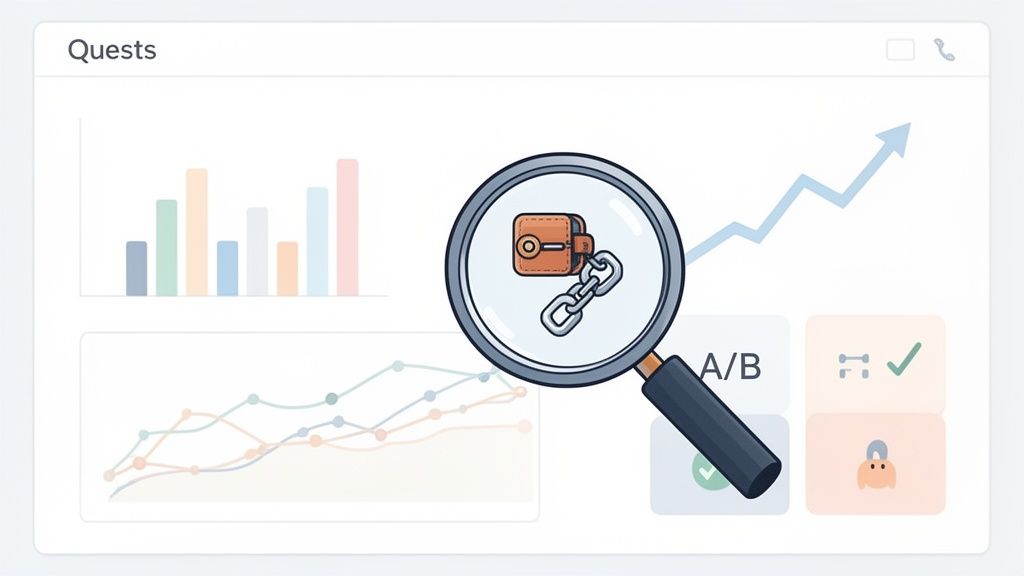
Key Metrics That Actually Matter
To get a real sense of how your campaign is doing, you've got to move past the surface-level stuff. Your analytics dashboard should become your new best friend. I always recommend focusing on a handful of key performance indicators (KPIs) that tie directly back to the goals you set in the first place.
Here are the metrics that will give you the most bang for your buck:
- Completion Rate: What percentage of users who start a quest actually see it through to the end? If this number is low, it could mean your tasks are too hard, the instructions are a mess, or the reward just isn't worth the effort.
- On-Chain Conversion Rate: This is the big one for any Web3 project. Of everyone who participated, how many actually did the critical on-chain action you wanted, like a token swap or an NFT stake? This metric tells you if you're actually driving protocol value.
- User Retention (Post-Campaign): A week or a month after the quest ends, how many of those participants are still hanging around your community? High retention means you've found genuinely engaged users, not just airdrop hunters.
- Cost Per Acquisition (CPA): This is simple but powerful. Just take the total value of the rewards you handed out and divide it by the number of new active users you gained. This helps you understand the real ROI of your campaign.
These data points are more important than ever. The explosion of white-label quests in Web3 is a massive shift toward scalable, reward-driven growth. We've seen platforms help deploy over 13,000 campaigns that resulted in 25 million completed quests. With the Web3 market projected to hit USD 226.4 billion by 2034, quests are one of the best ways to get a piece of that pie. This is especially true in areas like GameFi, which saw 4.66 million daily unique active wallets in a single quarter. It’s a testament to how Web3 revenue models are reshaping business planning.
Finding Your Best and Worst Quests
Your dashboard isn't just for a 30,000-foot view; it’s for getting your hands dirty. You need to dive into the data for each individual quest to see what’s truly clicking with your community and what's a total flop.
Look for the patterns. Do you see a quest with a massive drop-off rate right after the first step? Maybe it’s a signup form with way too many fields, or an on-chain task that surprised everyone with high gas fees.
On the other hand, if one quest has an amazing completion rate, figure out why. Was it the super simple task? The crystal-clear instructions? Or was the reward just too good to pass up?
Your worst-performing quests are often your greatest learning opportunities. They show you exactly where the friction is in your user journey, giving you a clear roadmap for what to fix next.
This kind of deep-dive analysis helps you build your own internal playbook. You’ll start to get a real feel for what kinds of tasks your community actually enjoys and what rewards get them moving, which makes designing your next campaign a whole lot easier.
Simple A/B Tests to Boost Performance
Once you've spotted some areas that could be better, it's time to experiment. A/B testing is a fantastic, straightforward way to fine-tune your quests. You're basically just comparing two versions of one thing to see which one works better. You don't need a complicated lab setup for this.
Start with small, simple tests that can give you clear, actionable answers.
Here are a few ideas to get the ball rolling:
- Test Your Rewards: Run the same quest but offer two different rewards to two different groups. For example, does a guaranteed NFT get more action than a raffle ticket for a big token prize? The results will tell you exactly what your users value.
- Test Task Wording: Try tweaking the instructions for a single task. Does a casual, direct phrase like "Swap any token on our DEX" outperform a more formal "Execute a token swap on our decentralized exchange"? My money is usually on clarity and simplicity.
- Test the Task Order: For a quest with multiple steps, just switch up the sequence. Do you get more completions if you put the easy social tasks first to build momentum, or do you lead with the tougher on-chain action?
The name of the game is continuous improvement. By regularly checking your results, figuring out what works, and testing new ideas, you can turn a decent quest campaign into a powerful growth engine that keeps delivering real results.
Got Questions About Whitelabel Quests?
If you're thinking about launching a whitelabel quest campaign, you probably have a few questions swirling around. It's a smart move, but you want to make sure you’re doing it right—covering your bases on the legal stuff, keeping cheaters out, and figuring out what it’s all going to cost.
Let's dive into the questions I hear most often. Getting these answers sorted out now will save you a ton of headaches later and help you build something your community genuinely loves.
Are My Quest Rewards a Security?
This is the big one, and for good reason. The short, honest answer is: it all comes down to how you design the reward. The regulatory waters are still pretty murky, so playing it safe is the name of the game. Things like NFTs that unlock exclusive content, community badges, or special Discord roles are generally considered low-risk.
But the moment you start offering tokens that people might see as an investment or a piece of your project's future profits, you’re stepping into a legal gray area. I can't stress this enough: talk to a crypto-savvy lawyer before you even think about launching a campaign with token rewards. They’ll help you structure everything to meet your goals without accidentally wandering into trouble.
Here's my rule of thumb: Focus on rewards that provide real utility or status inside your ecosystem. If your reward acts more like a key to your community than a stock certificate, you're on much safer ground.
How Do I Stop Bots and Sybil Attacks?
Ah, the never-ending fight against bots. Nothing kills the vibe of a community campaign faster than a swarm of fake accounts hoovering up all the rewards. Luckily, the tools we have today are pretty sophisticated at sniffing out the fakes.
It’s all about creating layers of defense.
- Smart Verification: Don't just rely on one check. Mix it up. Combine social verification (like linking an X account that's been active for more than six months) with on-chain activity (like holding a certain token or NFT).
- Decentralized ID: Look into integrating systems that use decentralized identifiers (DIDs). These are great for confirming a user is a real, unique person without forcing them to give up their privacy.
- Behavioral Red Flags: Good platforms can spot bot-like activity. Are tasks being completed at lightning speed? Is the user clicking in a way that seems robotic? These patterns are dead giveaways.
- Proof-of-Humanity: Even a simple CAPTCHA can weed out the laziest bots. More advanced tools that actually confirm a user is a living, breathing person are becoming more common and are definitely worth a look.
The goal isn’t to build a completely impenetrable fortress. It's to make it so annoying and expensive for bot farmers that they just give up and move on to an easier target. That way, your rewards land in the hands of the real people you want to engage.
What's a Realistic Budget for a Quest Campaign?
There’s no magic number here, but we can definitely break down where the money goes. Your budget really depends on how big you want to go and what kind of rewards you're putting on the table.
Think about it in these four buckets:
- The Platform: This is your subscription for the no-code toolkit you use to build and run everything. Most platforms have different tiers based on the features you need and how many people you expect to participate.
- The Reward Pool: This is your biggest wildcard. The total value of the tokens, NFTs, or whatever else you're giving away is completely up to you. My advice? Start with a smaller test campaign to see what resonates before you commit a huge budget.
- Getting the Word Out: How will people find your quest? If you're planning on running paid ads, working with influencers, or sponsoring content, you’ll need to budget for that.
- Your Team's Time: Don't forget this one! It's not a direct cash cost, but the hours your team spends planning, building, promoting, and managing the campaign are valuable.
You could run a small, tightly-focused campaign for your existing community on a shoestring budget. On the other hand, a massive campaign designed to acquire thousands of new users with high-value rewards is going to be a serious investment. Figure out your goal first, then build a budget that makes sense for it.
Ready to stop wondering and start building? With Domino, you can launch powerful, secure, and automated Web3 quests in minutes, not months. See how easy it is to turn your community into a growth engine. Get started with Domino today!