Proof of Humanity: A Guide to Stopping Bots and Building Trust
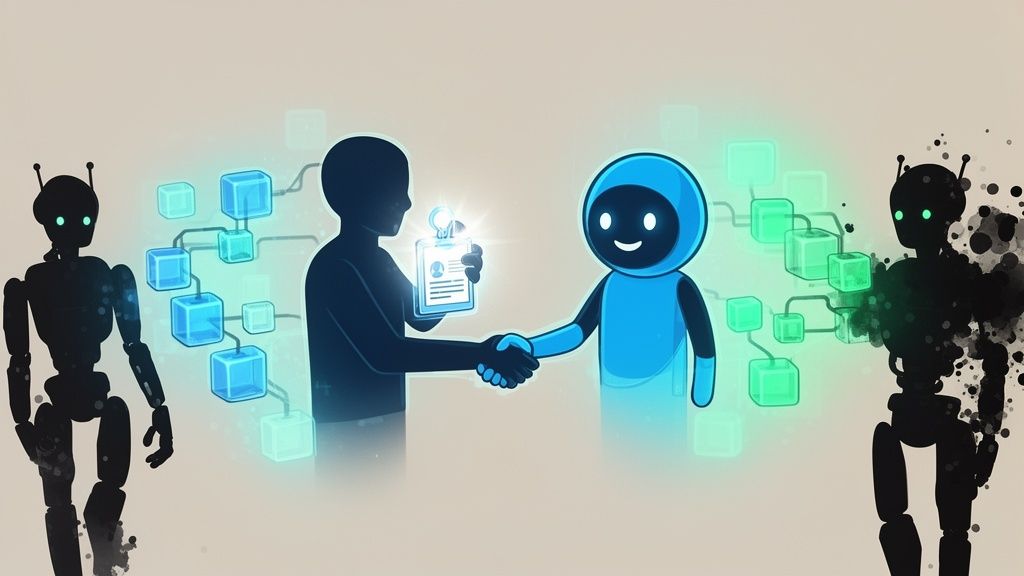
At its core, Proof of Humanity is a way to confirm that a real, live human is behind a digital wallet—and that they only have one. You can think of it like a super-powered CAPTCHA for the Web3 world, designed to stop one person from spinning up thousands of fake accounts to game the system. Getting this right is a huge deal for building fair and secure decentralized communities.
Why We Need Digital Passports for Web3
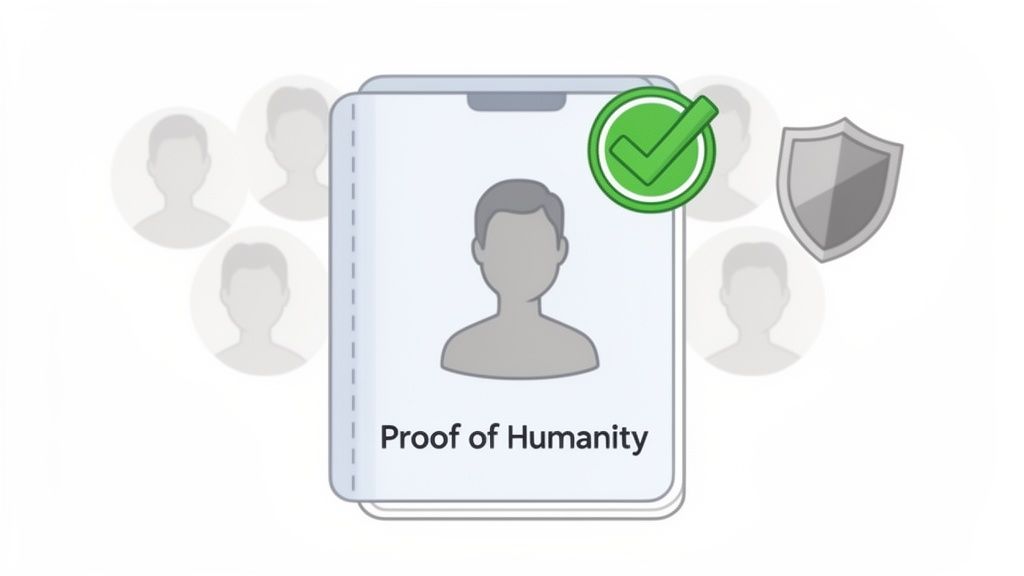
Picture a community vote where a single person could cast a thousand ballots just by creating a thousand fake accounts. Or imagine an airdrop where one clever user swoops in and claims all the rewards meant for hundreds of people. This isn't a hypothetical problem; it's called a Sybil attack, and it's one of the biggest threats to any decentralized network.
This is exactly where Proof of Humanity comes in. It creates a trusted link between a flesh-and-blood person and their on-chain identity, enforcing a simple "one person, one wallet" rule. This isn't about doxxing yourself or flashing your driver's license online. Instead, it uses smart, often privacy-preserving methods to confirm you're a unique human being.
The Core Mission of PoH
When you strip it all down, Proof of Humanity has a simple but powerful goal: to bring real-world accountability to our digital interactions. By weeding out the bots and Sybil attackers, Web3 projects can finally:
- Distribute Rewards Fairly: Make sure airdrops, quest rewards, and giveaways actually reach a wide base of unique individuals.
- Run Democratic DAOs: Implement true "one person, one vote" governance systems where decisions can't be easily manipulated.
- Build Authentic Communities: Cultivate genuine discussions and collaborations by cutting through the noise from spam bots and fake profiles.
By verifying unique humanness, we build a foundation of trust. This allows communities to scale without sacrificing the quality of interaction or the fairness of their incentive systems.
A Growing Need in a Growing Market
As more and more people jump into Web3, the need for solid identity solutions is becoming critical. Crypto ownership in the U.S. has already climbed to 28%, with similar growth happening in places like the UK and Singapore. All this new activity and capital makes Web3 a massive target for fraud, turning Proof of Humanity into an essential line of defense. You can read the latest crypto ownership trends to see just how fast the space is moving.
For marketers and community builders, this isn't just some technical jargon anymore—it's a strategic must-have. If you want to build a community that's sustainable, engaged, and secure, it all starts with making sure you're building it for real people.
How Proof of Humanity Systems Actually Work
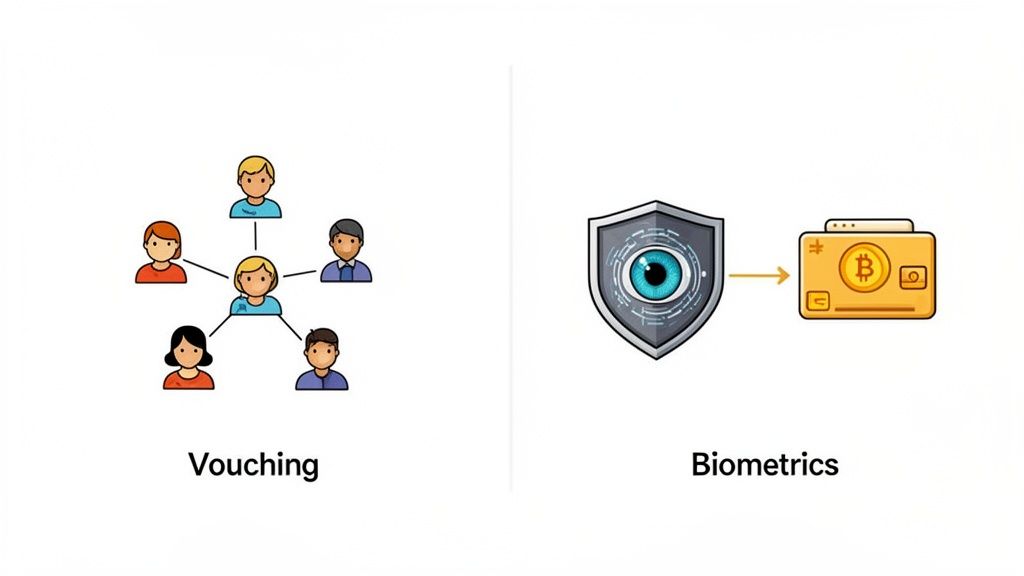
Alright, so how does a system actually figure out you’re a real person without asking for your driver's license or passport? The tech behind it can get complicated, but the core ideas are pretty easy to grasp. Most proof of humanity protocols boil down to one of two main strategies for tying one human to one digital identity.
The first is all about community and is often called social vouching. Think of it like trying to get into an old-school, exclusive club. You can't just walk in; you need a current member to vouch for you, saying, "Yep, I know them. They're legit."
Social vouching in Web3 is the same idea. It creates a "web of trust" where already-verified humans vouch for new applicants. Each new person they bring in strengthens the whole network. It’s a really cool, bottom-up approach that relies on social connections instead of some central company calling the shots.
Biometrics: The Other Side of the Coin
The second major method leans on something nobody else has: your biology. Biometric verification uses physical traits that are incredibly hard to fake or copy, like your face, voice, or even the unique pattern in your eye.
This is the path projects like Worldcoin are taking with their "Orb," a device that scans a person's iris. The scan generates a unique digital code—an "IrisCode"—that serves as proof you're a distinct individual. The clever part is that it’s built for privacy. The system doesn't need to store your iris scan itself, just a code that confirms a new human has signed up.
Given that a recent survey showed a staggering 90% of respondents have either dealt with or know someone who has dealt with digital identity fraud, these kinds of robust checks are more critical than ever. Digging into a platform's authentication mechanisms can often show you exactly how they tackle this problem.
Tying It All Together
Whether it's through social vouching or a biometric scan, the destination is the same. The process creates a secure, on-chain credential that gets permanently linked to a single crypto wallet. This credential becomes your digital passport for proving you're human across different apps, so you don't have to keep verifying yourself over and over.
The core function is to create a verifiable, one-to-one link between a human and a digital wallet. This simple link is what unlocks the ability to build truly Sybil-resistant systems.
At the end of the day, these systems offer a real answer to a tough question: how can we tell who's real in a world swarming with bots? By leveraging either the power of community trust or unique biology, proof of humanity is laying the groundwork for fairer and more authentic online spaces.
What’s In It For Your Web3 Community?
Bringing proof of humanity into your project isn't just about slamming the door on bots. It’s a strategic play that creates serious value across your entire ecosystem. When you can be sure every member is a real, unique person, you're building a foundation for real growth, genuine conversations, and a much healthier community vibe.
It really boils down to fairness. Once you know each wallet is tied to one person, you can hand out rewards without worrying. Airdrops and quest incentives suddenly become powerful growth engines instead of a bot-farming free-for-all. Your tokens end up with thousands of potential fans, not in the wallet of one person with a script.
Creating Real Engagement
Let's be honest, great conversations happen when people know they're talking to other people. By kicking out the spam and automated noise, you make room for real discussions, collaborations, and honest feedback to happen organically. That’s how you build a tight-knit community people actually want to be a part of.
When every participant is a unique human, you build a space on trust and authenticity. It protects your community from looking like a ghost town propped up by fake numbers, like a bunch of bought Threads Likes. When the engagement is real, the feedback you get is gold, and the connections people make are solid. It's the same principle behind stopping bad actors from flooding your server—you can read more on how to stop a Discord server raider in our guide.
Bulletproof Democratic Governance
For any DAO, proof of humanity is a total game-changer. It finally makes a true "one person, one vote" system a reality. This is huge because it protects your governance from being taken over by a single whale who can just buy up a majority of the tokens.
This setup ensures that big decisions reflect what the whole community wants, not just what the deepest pockets can afford. You end up with a governance structure that’s more democratic, resilient, and, frankly, more legitimate because every single member has a voice.
The real power of verifying humanity is that it tokenizes participation itself. Every verified action, from a vote to a transaction, becomes a signal of real human economic activity, building a foundation of trust at scale.
We're already seeing this play out in the wider economy. In 2025, stablecoins became a powerful, non-speculative signal of human activity, with monthly transaction volumes hitting a record $1.25 trillion in September. That massive number isn't just bots—it's real people using crypto for payments and sending money, proving their economic humanity on-chain. Find out more about the surge in stablecoin usage and what it means for Web3.
Comparing Different Sybil Resistance Methods
Proof of Humanity is a fantastic tool for fighting bots, but it's not the only one in the toolbox. When you understand how it stacks up against other methods, you can build a much smarter, more complete strategy for protecting your community and making sure rewards are fair.
Every approach to Sybil resistance comes with its own set of trade-offs. Some are super easy for users but less secure, while others are like Fort Knox but can feel like a bit of a hassle for newcomers. The right choice really depends on what you're trying to do—whether it's a high-stakes DAO vote or a quick and easy airdrop campaign.
This flowchart breaks down how verifying that someone is a real, unique human directly benefits Web3 communities, from fairer rewards to more secure governance.
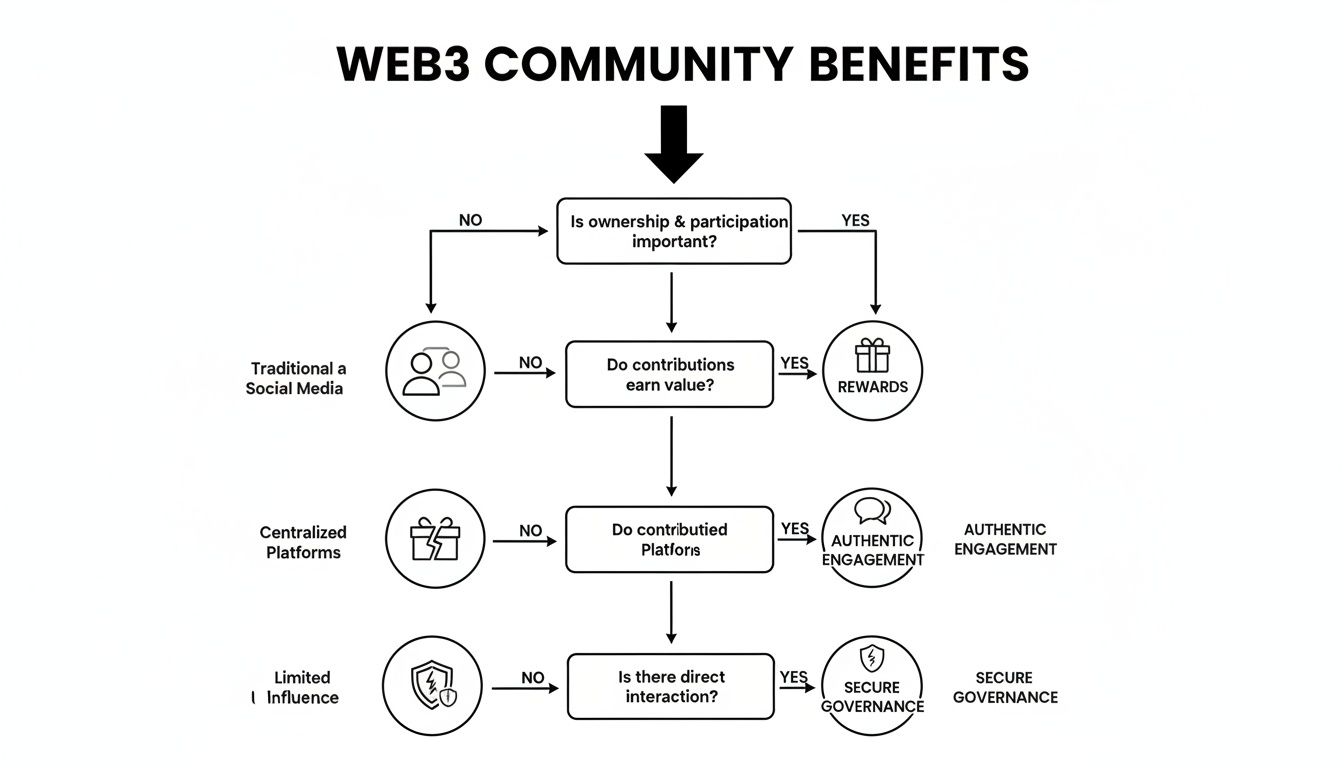
No matter which path you follow, the end goal is the same: a healthier and more sustainable community where you know real people are behind the screen.
Common Sybil Resistance Techniques
To really get the bigger picture, let's break down some of the most common methods you'll bump into. Each one tackles the bot problem from a different angle, offering a unique mix of security, user experience, and privacy.
Here are a few popular alternatives to Proof of Humanity:
- Proof of Stake (PoS): Think of this as "put your money where your mouth is." Users have to lock up a certain amount of capital (tokens) to participate. This makes it super expensive for a bot army to show up, since an attacker would need a massive amount of cash to create enough fake accounts to do any real damage.
- Social Graph Analysis: This is all about reputation. It verifies users based on their existing online connections. Tools like Gitcoin Passport are great examples—they look at a user’s activity on platforms like Twitter, GitHub, and BrightID to build a "trust score." This makes it way harder for brand new, isolated bot accounts to sneak in.
- Wallet Activity Metrics: This is a more lightweight check. It just looks at a wallet's history for clues of genuine human behavior, like its age, how many transactions it has, or if it has interacted with well-known dApps. It’s definitely less secure, but it’s a low-friction way to filter out the most obvious, freshly-minted bot wallets.
The core challenge in Sybil resistance is finding that sweet spot between accessibility and security. Make it too complex, and you risk scaring off real users. Make it too simple, and sophisticated bots will waltz right in.
To help you visualize the trade-offs, here’s a quick comparison of the most common methods.
Sybil Resistance Methods Compared
| Method | How It Works | Pros | Cons | Best For |
|---|---|---|---|---|
| Proof of Humanity | Biometric or social verification to confirm a unique human is behind a wallet. | High certainty of uniqueness, very hard to fake. | Can have privacy concerns, potential friction for users. | High-value airdrops, DAOs, grant funding, critical governance. |
| Proof of Stake (PoS) | Requires users to lock up (stake) a certain amount of tokens. | Makes attacks economically expensive, aligns incentives. | Favors wealthy users ("whales"), high barrier to entry. | Securing blockchains, high-stakes governance where capital is key. |
| Social Graph Analysis | Analyzes a user's connections and reputation across social platforms. | Leverages existing trust networks, hard for new bots to fake. | Can be gamed, privacy concerns, favors socially active users. | Community access, quadratic funding, filtering for engaged users. |
| Wallet Activity Metrics | Checks wallet age, transaction history, and dApp interactions. | Low friction for users, easy to implement. | Low security, easily faked by sophisticated bot farms. | Low-stakes quests, initial airdrop filtering, basic bot detection. |
Ultimately, choosing the right method depends entirely on your campaign's specific needs and the level of security you require.
Choosing The Right Approach
Deciding which method to use means weighing these factors carefully. Biometric-based Proof of Humanity offers one of the highest degrees of certainty that you're dealing with a unique person. In fact, a recent survey found that 73% of people strongly agree that new tech to verify human identity is important, which shows a clear demand for solid solutions.
But you don't have to pick just one. A multi-layered approach often works best.
For example, you could use simple wallet activity filters for a basic quest and then require a full Proof of Humanity check for anyone claiming high-value rewards or participating in a critical governance vote. Combining methods like this lets you build flexible, secure systems that don't push legitimate users away. If your community lives on Telegram, exploring strategies like Telegram token gating can add another powerful layer of verification to your stack.
Putting Proof of Humanity to Work in Your Campaigns
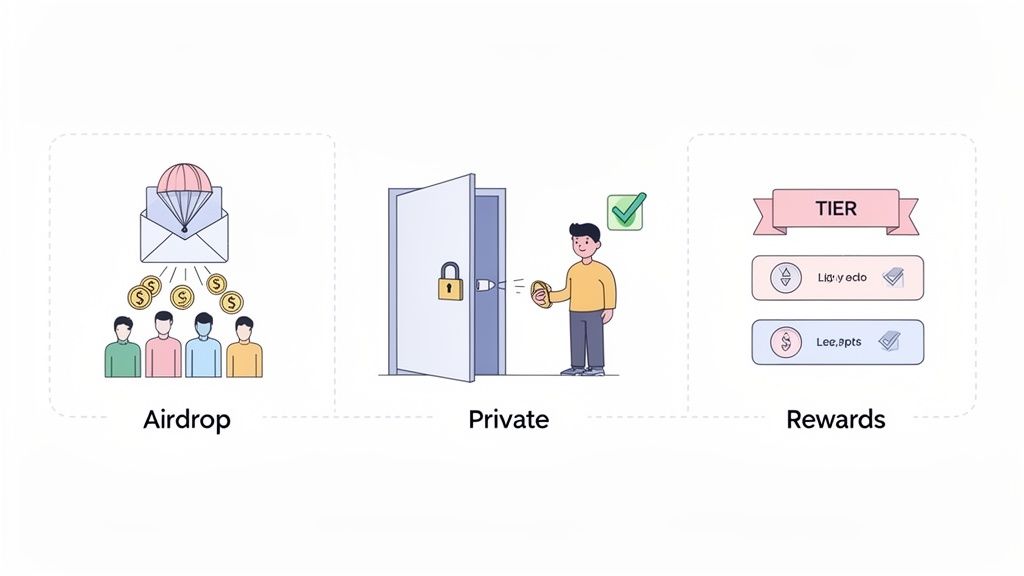
Okay, theory is one thing, but actually using proof of humanity is where the magic happens. Let's get into the playbook for turning identity verification into a real growth engine for your project. The goal here is to move beyond just blocking bots and start designing campaigns that actively reward unique, real people. That’s how you build a legitimately strong and engaged community.
At its core, the idea is simple. Create better experiences and give more valuable perks to users who've proven they're human. This single shift instantly improves the quality of your community and makes sure your marketing dollars are spent on real people, not just pumping up vanity metrics with bot-driven numbers.
Run High-Value, Sybil-Proof Airdrops
Airdrops are probably the most obvious—and powerful—place to start. By requiring a proof of humanity credential to be eligible, you can distribute your tokens to a broad base of actual individuals. No more worrying about one person using a bot farm to snatch up a huge chunk of the supply. Instead, your tokens get into the hands of thousands of genuine, potential long-term supporters.
- Marketing Goal: Get your token into as many real hands as possible to kickstart a truly decentralized community.
- How to Set It Up: Just add one simple rule to your airdrop criteria: users must connect a wallet holding a valid credential from a PoH provider. It’s a straightforward filter that works wonders.
This strategy is more important than ever. Crypto adoption is exploding globally, with the Chainalysis 2025 Global Crypto Adoption Index showing places like India and the United States at the forefront of this new wave. With regions like Asia Pacific seeing a staggering 69-70% jump in on-chain activity year-over-year, making sure your campaigns connect with these real newcomers is make-or-break. You can see the full adoption index insights over at Chainalysis.
Build Tiered Rewards and Exclusive Access
Another brilliant tactic is to create a tiered system where verified humans get better stuff. This gives people a real reason to go through the verification process and makes your most committed community members feel special. It's a classic win-win that boosts security and engagement at the same time.
By offering exclusive benefits to verified members, you transform identity verification from a simple security measure into a desirable status symbol within your community.
Here are a few ideas you can steal:
- Tiered Quest Rewards: Give users with a PoH credential a 2x points multiplier on all community quests.
- Exclusive Channel Access: Unlock private channels on your server for verified members only. This is perfect for sharing alpha, giving direct access to the team, or hosting special AMAs. If you need more inspiration on managing server roles, you can check out our guide on Discord profile lookups.
- Beta Test Invites: When you're ready to test a new product, send invites exclusively to your verified humans. You'll get much higher-quality feedback from real people who are actually invested.
Each of these tactics uses proof of humanity as more than just a shield. It becomes a proactive tool for building a more loyal, active, and authentic community around your project.
Got Questions About Proof of Humanity?
Diving into Proof of Humanity can feel a bit like stepping into the future, and it naturally brings up some big questions. Most people worry about privacy, security, and how this new tech stacks up against the old-school systems we're used to.
Let's break down some of the most common concerns. My goal is to clear the air and help you see the real potential here.
Is This Going to Nuke My Privacy?
This is always the first question, and it’s the right one to ask. The short answer is: it really depends on the system, but the good ones are built from the ground up with privacy in mind. Many of the top-tier PoH protocols use slick cryptography like zero-knowledge proofs.
Think of it like this: you need to get into an exclusive club. A zero-knowledge proof is like having a special handshake that proves you're a member without you ever having to show the bouncer your ID card. In the same way, these systems confirm you're a unique person without ever needing to see, store, or share your actual biometric data. Your identity stays on your device, completely under your control.
How Much of a Hassle Is It to Get Verified?
The user experience can be all over the map. Some methods, like social vouching, are super fast if you've got friends already in the network. But if you're a total newcomer, it can feel a bit like trying to get a job without any references.
On the other hand, biometric systems are often incredibly quick. Something like an iris scan can take just a few seconds at a physical location. The endgame for most projects is to make verification feel effortless. As the tech gets better, you can bet the process will only get smoother and more accessible for everyone.
Can’t AI and Deepfakes Just Cheat the System?
This is a massive concern, and a valid one, as AI gets scarily good. The threat of deepfakes and AI-generated identities is the very reason we need robust Proof of Humanity in the first place. In fact, one recent survey found that a whopping 90% of people are worried about telling humans and bots apart online.
Biometric systems are our best defense right now. An iris scan, for example, captures a pattern that’s insanely complex and incredibly difficult to fake with today’s tech. Plus, many platforms are in a constant arms race against fraudsters, developing new liveness-detection tech specifically designed to sniff out deepfakes. It’s a game of cat and mouse, but security is always leveling up.
At its heart, a strong PoH system is a filter for authenticity in an internet drowning in AI-generated noise. It carves out a space where real human interaction can still thrive.
What's the Real Difference Between PoH and KYC?
This is a super important distinction. People often lump them together, but they solve completely different problems. Think of it this way: KYC is for regulators, while PoH is for communities.
Here’s a simple breakdown of how they differ:
| Feature | Traditional KYC (Know Your Customer) | Proof of Humanity (PoH) |
|---|---|---|
| Primary Goal | To comply with government rules like anti-money laundering (AML). | To stop one person from making tons of fake accounts (Sybil attacks). |
| Data Required | Your government ID (passport, driver's license), address, and other personal details. | Usually just a biometric scan or social proof, with no link to your real-world identity. |
| Privacy | Your data is handed over to a company, creating a juicy target for hackers. | Built to be pseudonymous or anonymous. You control your data. |
| Use Case | Needed to open an account on a bank or centralized crypto exchange. | Used for fair airdrops, DAO voting, and getting into decentralized apps. |
Basically, KYC answers the question, "Who are you?" by tying your legal identity to your account. Proof of Humanity, on the other hand, answers a totally different question: "Are you a unique person?"—and it does so without needing to know your name or where you live. This makes it the perfect privacy-first tool for the decentralized world of Web3.
Ready to build a bot-proof community and run campaigns that reward actual people? Domino offers a no-code toolkit to launch Sybil-resistant quests in minutes, integrating seamlessly with your favorite platforms.