How to Start a Rewards Program: how to start a rewards program for Web3 Growth
So, you want to spin up a rewards program? Forget waiting on developers or getting bogged down in code. The whole game has changed. Today, you can take an idea from a whiteboard sketch to a live campaign in an afternoon, all thanks to no-code tools. It's about being nimble, testing ideas fast, and focusing on what really matters: driving real growth for your project.
Your Blueprint for a No-Code Web3 Rewards Program
Jumping into a rewards program might seem like a huge undertaking, but it’s actually pretty straightforward when you ditch the old, code-heavy mindset. The real secret is to build a simple, powerful framework that lets you connect directly with what motivates your community. This way, you can turn those passive lurkers into your most active, die-hard fans.
And the timing couldn't be better. The global loyalty market is absolutely booming, projected to smash $155.22 billion by 2029. What’s driving this? The very same gamification and engagement tactics you can now easily deploy. We're talking about slick, no-code quests that mix on-chain actions like staking an NFT with simple off-chain tasks like a quick share on X.
The Core Components of a Successful Program
At its heart, a great Web3 rewards program is just a simple feedback loop. Your users complete actions that bring value to your project, you reward them for it, and they become more deeply invested in your ecosystem. It's a win-win value exchange.
Think of it as a three-part flow: Goals → Rewards → Quests.
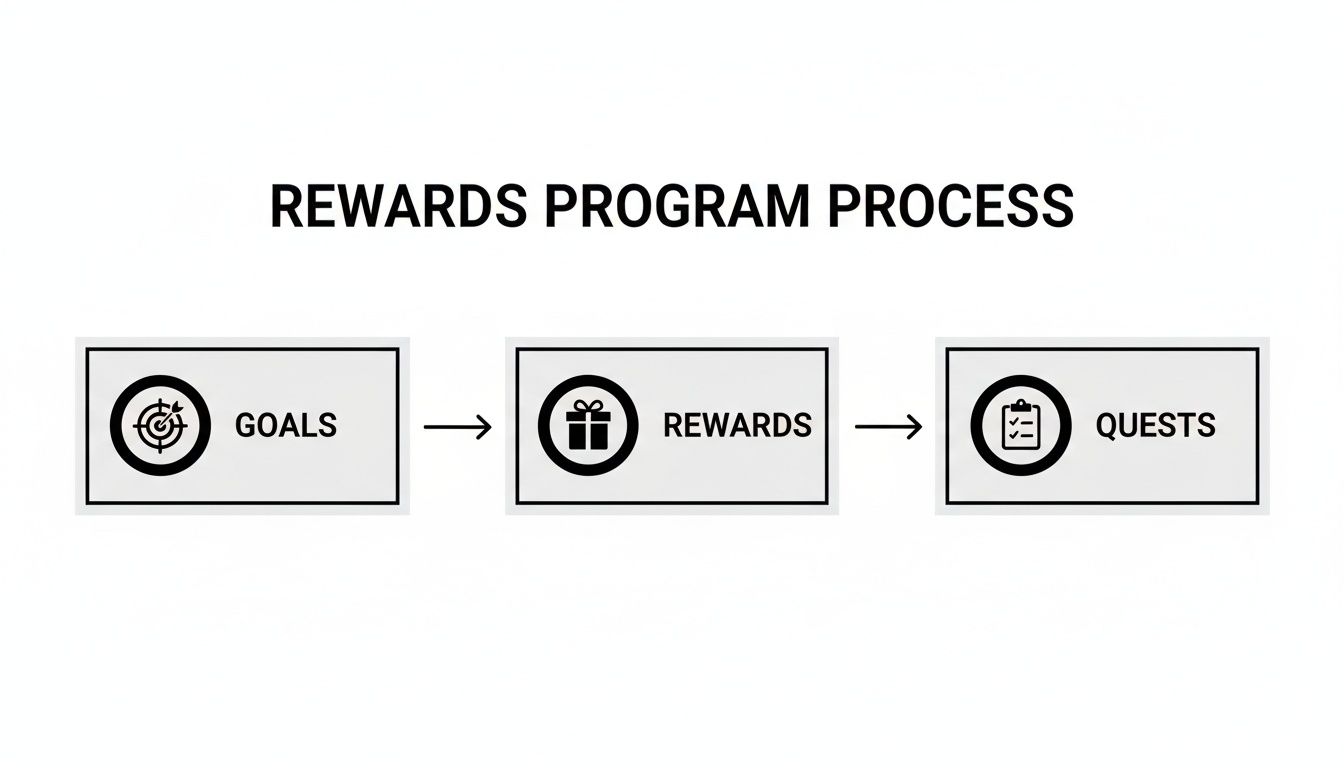
This isn't about just handing out freebies. It's a strategic cycle that starts with a clear "why" and ends with your community taking meaningful action.
Modern platforms like Domino are built to handle all the tedious stuff—like verifying actions and distributing rewards—so you can stay focused on the creative strategy.
Let’s break down the pillars:
- Your Goals: First, define what a "win" looks like for you. Is it boosting the number of active wallets? Growing your Discord by 2,000 members? Driving more liquidity to a specific pool? Get specific.
- The Rewards: You have to offer something your community actually wants. This isn't one-size-fits-all. It could be exclusive NFTs, guaranteed whitelist spots, a share of a token pool, or even stablecoins. Dig into your options by exploring what the best rewards program platforms can offer.
- The Quests: This is where the fun begins. Design tasks that feel more like a game than a chore. The magic happens when you blend easy social tasks (like a retweet) with more involved on-chain interactions (like swapping a token on a DEX).
The best rewards programs feel less like a transaction and more like a game. When users are genuinely enjoying the process of completing quests, their engagement becomes organic and self-sustaining, creating a powerful growth engine for your project.
Your Web3 Rewards Program Starter Kit
To put it all together, here’s a quick-glance table outlining the core components you'll be working with when building your program with a no-code tool like Domino.
| Component | Key Objective | Domino Tool to Use |
|---|---|---|
| Goal Setting | Define clear, measurable outcomes for your campaign. | Campaign Dashboard to track core KPIs like participation and conversion rates. |
| Reward Design | Select incentives that genuinely motivate your target audience. | Rewards Manager to configure token, NFT, or custom rewards. |
| Quest Creation | Build engaging on-chain and off-chain tasks. | Quest Builder with pre-built templates for social and blockchain actions. |
| Workflow Automation | Automate task verification and reward distribution. | Verification Engine to instantly confirm actions without manual checks. |
This kit represents the fundamental building blocks. With these pieces in place, you have everything you need to launch a program that not only attracts users but keeps them coming back.
Setting Goals and Choosing Rewards That Actually Motivate
Look, a rewards program without a clear goal is just an expensive giveaway. Before you even think about which NFTs to mint or how many tokens to airdrop, you have to nail down one critical question: what exactly am I trying to achieve here?
Your answer to that question becomes the North Star for every quest you design and every reward you offer.
Are you trying to pump up your daily active wallet count? Maybe you need to drive liquidity to a newly launched pool. Or perhaps the goal is simpler, like getting your project's name all over social media. Each of these requires a totally different strategy.
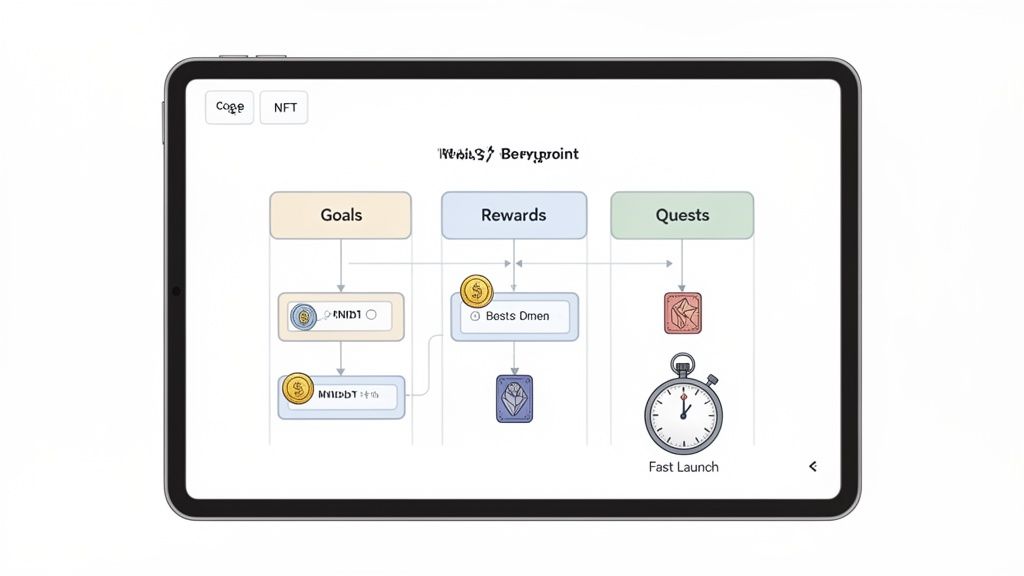
Defining your goals isn’t just some box-ticking exercise; it's what makes your program measurable. Without a specific KPI, you'll have no clue if your investment is paying off. This is step zero if you want a program that genuinely grows your project instead of just draining your treasury.
Aligning Goals with Measurable KPIs
Let's get practical. Vague goals like "increase engagement" are totally useless. You need concrete numbers to aim for. A core objective for most programs is to build customer loyalty, which is the bedrock of any long-term success.
Here’s how to translate common Web3 objectives into real, actionable KPIs:
- Goal: Boost Community Growth
- KPI: Increase Discord members by 20% in the next 30 days.
- KPI: Hit 5,000 new followers on X (formerly Twitter).
- Goal: Drive On-Chain Activity
- KPI: Get 500 more unique wallets to stake our NFT.
- KPI: Generate $1M in new TVL for our V3 liquidity pool.
- Goal: Enhance Brand Awareness
- KPI: Rack up 10,000 retweets on our main announcement post.
- KPI: Secure 1,000 pieces of user-generated content featuring our brand.
Setting these benchmarks from the jump lets you measure success with cold, hard data. And the data doesn't lie. This is what separates professional growth marketers from hobbyists.
The Art of Choosing the Right Rewards
Once your goals are locked in, it’s time for the fun part—picking the rewards. This is more of an art than a science, and it’s all about getting inside your audience's head to figure out what they truly value. Hint: it’s not always about dropping more of your native token.
The best rewards tap into a user's desire for status, exclusivity, or real-world value. It’s a good idea to mix up your incentives to appeal to different corners of your community.
A well-designed reward feels earned, exclusive, and genuinely valuable. It should make people feel like they're on the inside, not just another random participant in a giveaway. That sense of belonging is what turns casual users into die-hard advocates.
A tiered system can work wonders here. It gamifies the whole experience, pushing users to climb the ladder for better and better perks. Think about a structure that starts with simple rewards and escalates to highly coveted prizes.
For example, a beginner tier might unlock a special Discord role, while a top-tier reward could be a 1-of-1 artist-collab NFT or even a hefty stablecoin prize. This creates a powerful incentive loop that keeps people hooked for the long haul.
Budgeting for Maximum Impact
Finally, let's talk money. The great thing about a well-defined program is that it makes budgeting so much clearer. You're not just throwing funds into the void; you're investing in specific, measurable outcomes.
Don't be afraid to start small. Test things out, see what sticks, and then scale what works. The data backs this up—an impressive 83% of loyalty program owners who track their ROI see positive returns, generating 5.2 times more revenue than what they spend. For Web3 teams, that’s a massive signal that smart rewards campaigns drive real value.
Here’s a simple framework to get your budget in order:
- Calculate Cost Per Reward: Figure out the direct cost of each reward type (e.g., minting fees for NFTs, the value of tokens).
- Estimate Participation: Based on your community size, make a realistic projection for how many people will participate.
- Set a Total Pool: Allocate a total rewards pool for the entire campaign.
- Track Your ROI: Keep a close eye on your KPIs versus your spend to make sure you're on the right track.
By tying your budget directly to your goals and carefully picking rewards that motivate, you’re setting the stage for a program that actually delivers a powerful return on your investment.
Designing Quests People Actually Want to Complete
Alright, let's get into the good stuff. This is where your strategy gets real and you start turning lurkers into active, die-hard fans. The whole point is to create a series of tasks—or "quests"—that feel more like a game than a checklist of chores. Striking that balance is what separates a rewards program that pops off from one that just fizzles out.
The trick is to build a well-rounded experience. You need a smart mix of simple, low-effort tasks and more meaningful on-chain actions. This gives everyone, from the casual newcomer to the seasoned degen, a way to get involved and feel rewarded from day one.
Mixing On-Chain and Off-Chain Actions
Think of your quest design like a ladder. The first few rungs have to be ridiculously easy to climb. These are your off-chain tasks, perfect for building early momentum and getting a ton of people in the door.
- Social Engagement: Simple stuff, really. Following your X (formerly Twitter) account, jumping into your Telegram or Discord, or retweeting a big announcement. These are the low-friction actions that take literally seconds.
- Content Interaction: Asking people to like a specific post, drop a comment on a blog, or share some user-generated content with a specific hashtag.
These kinds of tasks are your bread and butter for building top-of-funnel awareness and just getting more eyes on your project.
Once they're warmed up, you can gently nudge them up the ladder toward on-chain quests. These actions are way more valuable because they directly move the needle on your project's core metrics and show a much deeper level of commitment from your users.
- Token & NFT Actions: Prompt users to swap a specific token on a designated DEX, stake an NFT from your new collection, or even provide a little liquidity to a key pool.
- Protocol Interaction: Get them to vote on a governance proposal, mint a free NFT to prove they were there, or bridge some assets over to your native chain.
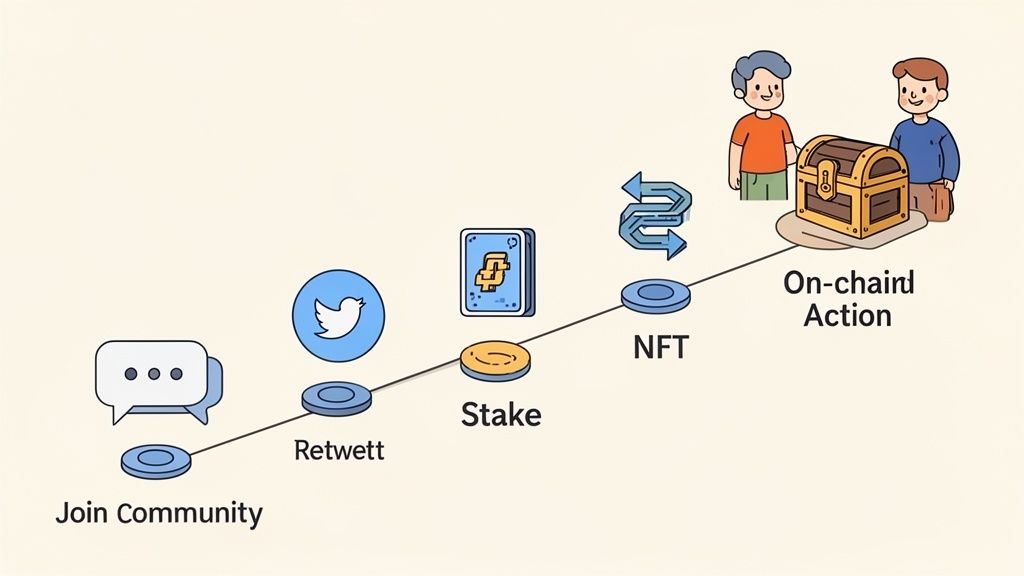
The real magic happens when you string these together into a journey. Start with a simple social follow, which leads them to claim a role in Discord, and culminates in them staking an NFT. You're guiding them deeper into your world, one small, satisfying step at a time.
The Power of Gamification in Quest Design
Look, a successful rewards program isn't just a boring list of tasks. It's an experience. And that's where gamification becomes your secret weapon. By weaving in game-like elements, you tap into some powerful psychological triggers that make participating genuinely fun and rewarding.
The data backs this up, big time. We're talking a potential revenue boost of 15-25% from highly engaged users. And get this: 40% of consumers say they spend more when the experience feels personal—which is exactly what a well-designed quest path delivers. At Domino, we've seen this play out across more than 13,000 campaigns where a simple mix of things like Telegram raids and on-chain actions has fueled insane community growth.
If you want to go deeper, a great starting point is understanding the core principles of gamification in loyalty programs and how to apply them in a Web3 context.
On-Chain vs. Off-Chain Quest Ideas
To get your creative juices flowing, here’s a quick breakdown of different quest types. Think about how you could mix and match these to create a compelling campaign.
| Quest Type | Primary Goal | Example Task | Setup Effort |
|---|---|---|---|
| Off-Chain | Community Growth | "Join our Discord server" | Low |
| Off-Chain | Brand Awareness | "Retweet our launch announcement" | Low |
| On-Chain | Ecosystem Activity | "Stake at least 1 NFT from our collection" | Medium |
| On-Chain | Driving Liquidity | "Add $50 to the ETH/TOKEN liquidity pool" | Medium |
| Hybrid | User Onboarding | "Follow us, join Discord, then mint a free welcome NFT" | Medium |
This table just scratches the surface, but it shows how you can layer complexity and value. Start small, build trust, and then guide users toward the actions that matter most.
Automation Is Your Best Friend
Seriously, just imagine trying to manually verify 10,000 retweets. Or checking thousands of wallets one-by-one to see if they made a token swap. It’s an absolute nightmare. That kind of manual work creates bottlenecks, frustrates your community with delays, and will completely burn you out.
This is why automated verification isn't a "nice-to-have"—it's a must.
No-code platforms are built for this. They plug directly into social media APIs and blockchains to instantly confirm if someone actually completed a quest. No fuss, no spreadsheets.
This completely frees you up from the operational grunt work. Instead of drowning in verification tasks, you can spend your time analyzing what’s working, brainstorming new quests, and actually talking to your community. Automation is what lets you scale from a hundred participants to a hundred thousand without losing your mind.
Getting Ready for Liftoff: Your Pre-Launch Checklist
Alright, you've nailed down your goals and designed some killer quests. Now for the crucial part: sticking the landing. A successful launch isn’t just about having cool rewards; it’s about making sure your community actually knows about the program and can jump in without any hassle.
This is your final, hands-on checklist to make sure you go live without a single snag. Getting these details right before you launch saves you from major headaches later and lets you hit that "go" button with total confidence.
Weave Your Program into Your Community's Home
Your rewards program can't be an island. It needs to be woven directly into the places where your community already hangs out. The less friction, the better.
Think about where your people live online:
- A Dedicated Hub: Using a no-code tool like Domino lets you spin up a white-label portal. This becomes your branded headquarters for all things rewards, which you can link right from your main website navigation. Easy peasy.
- Discord Integration: For most Web3 projects, Discord is the heartbeat of the community. Drop a link to your rewards portal in a dedicated
#questsor#rewardschannel. Use bot announcements to shout out new tasks and keep the energy high. - Meet Them Where They Are: If your crew is already grinding on platforms like Zealy or Galxe, make sure your program is visible there, too. You’re tapping into existing habits, which is always a smart move.
Build the Hype: Your Pre-Launch Announcement Plan
Don't just launch your program out of the blue and hope for the best. You need to build anticipation. A simple, multi-day teaser campaign can make a world of difference for your day-one numbers.
Think of it as a mini-marketing sprint. The goal is to have a chunk of your community already hyped and waiting to pounce the second you go live.
Here’s a simple timeline you can steal:
- T-Minus 3 Days (The Teaser): Post a cryptic message on X and in Discord. Something like, "Something rewarding is coming..." with a cool graphic is all you need. Build that intrigue.
- T-Minus 1 Day (The Reveal): Announce the rewards program is dropping tomorrow. Spill some of the beans—mention the types of rewards up for grabs ("Exclusive NFTs & token prizes await!") and tell people how they can get ready.
- Launch Day (Go Time): Time for a full-court press. Pin posts on X and Telegram, light up your Discord announcements, and fire off an email to your list. Your call-to-action needs to be crystal clear with a direct link to the program.
Your launch day comms should be impossible to misunderstand. Clearly state what the program is, how to join, and what the very first quest is. Hammer home the "why"—the awesome stuff they can earn—to drive that first wave of engagement.
The Final Systems Check
The last few hours before launch are all about double-checking your work. A quick run-through now can catch tiny mistakes that could otherwise kill your momentum.
Make sure you’ve got these locked down:
- Crystal-Clear Instructions: Ask someone who has no idea what you've been working on to read your quest descriptions. If they're confused, simplify your language.
- A Designated Support Channel: Set up a
#quest-supportchannel in Discord. Brief your community mods so they're armed and ready to help anyone who gets stuck. - Test Every Single Link: Seriously. Click everything. Go through the first few quests yourself as a test user. Make sure the automated verifications fire correctly. Nothing stops a launch in its tracks faster than a broken link.
Following these steps means you're not just launching a program—you're orchestrating a community event. And if you're looking to take things even further, our guide on how to launch a campaign dives into more advanced strategies.
Measuring Performance and Scaling for Long-Term Growth
Alright, you’ve launched your rewards program. Pop the champagne, but don't get too comfortable. The launch is just the starting pistol; the real race is won by paying close attention to what happens next. This is where you shift from campaign builder to growth strategist, turning your program into a sustainable engine for your project.
First things first: get cozy with your analytics dashboard. This isn't about getting lost in a sea of spreadsheets. It’s about finding the signal in the noise. Are people flocking to one type of quest while ignoring another? Is there a specific step in your onboarding where everyone seems to drop off? These insights are pure gold.
Identifying Your Core Performance Metrics
To figure out if this thing is actually working, you need to zero in on a handful of key metrics. These are the vital signs of your program's health, and they should tie directly back to the goals you set in the beginning.
Here's what I always keep a close eye on:
- Quest Completion Rate: What percentage of people who start a quest actually see it through to the end? If this number is low, your instructions might be clunky, or maybe the reward just isn't worth the effort.
- Participant Growth: How many new, unique wallets are jumping into your program daily or weekly? This is a raw, honest look at your program's appeal and reach.
- User Acquisition Cost (UAC): This one’s simple but crucial. Divide your total spend on rewards by the number of new, active users you've acquired. This tells you exactly what it costs to bring a new, engaged person into your ecosystem.
- On-Chain Impact: Now for the Web3 magic. Are you seeing more token swaps, new NFT stakers, or a bump in TVL that you can link directly to your program's participants? This is where the real value shows up.
A massive part of measuring performance is learning how to properly calculate marketing return on investment for your rewards program. This is what separates simple activity tracking from proving you're delivering real, tangible business value.
A Framework for Smart Iteration
Having data is one thing; doing something with it is another. The entire point of tracking metrics is to give you clues for your next move. Don't be afraid to tinker and experiment.
I live by a simple "test, measure, learn" philosophy.
- Form a Hypothesis: Start with a "what if..." question based on what you're seeing. For instance, "What if we offered a small stablecoin reward for our social quests instead of project tokens? I bet this will boost completion rates by 20%."
- Run a Small-Scale Test: You don't have to overhaul the whole program. Just launch a new, limited-time quest or run a quick A/B test on a small segment of your audience to see what happens.
- Analyze the Results: Did it work? Compare the performance of your little experiment against your baseline numbers.
- Scale or Scrap: If the test was a winner, roll that change out to the entire program. If it bombed, that’s still a win—you just learned what doesn't work without wasting a ton of time and money.
This constant feedback loop is how you take a program from good to great. You're essentially letting your community guide you with their actions, and you’re responding with smart improvements.
The most successful, long-term rewards programs aren't set in stone. They evolve. Think of them as living, breathing parts of your community that adapt to feedback and market shifts, always delivering value to both the project and its members.
Scaling Your Program for the Long Haul
Once you've proven your program is adding value, it's time to think bigger. Scaling isn't just about piling on more quests or juicing the rewards. It’s about creating deeper engagement and building a self-sustaining ecosystem.
As you start to grow, consider these moves:
- Introduce Tiered Rewards: Create different levels of participation—think Bronze, Silver, Gold—with juicier rewards at each tier. This gamifies the whole experience and gives your most dedicated community members something to strive for.
- Automate Everything Possible: As you scale, trying to do things manually will drive you insane. Lean heavily on your no-code platform's automation to handle verifications and reward payouts. This frees you up to focus on big-picture strategy.
- Empower Your Community: Your top performers are your greatest asset. Turn them into advocates. Create ambassador programs or give special Discord roles to users who are crushing it, and let them help you shape the program's future.
By consistently measuring what works, tweaking your strategy, and scaling thoughtfully, you’ll turn a one-off campaign into a powerful, long-term asset. This is the secret for anyone serious about how to start a rewards program that doesn’t just launch—it actually thrives.
Got Questions About Web3 Rewards Programs? We've Got Answers
Even with the best playbook in hand, you’re bound to have some questions. It’s totally normal. Let's walk through some of the most common "what-ifs" we hear from Web3 marketers, so you can get your program out the door with confidence.

How Much Should I Actually Budget for This?
There’s no magic number, but you can definitely make an educated guess instead of just throwing darts at a board. The smartest way to approach this is to treat your rewards budget like any other performance marketing spend—an investment with a tangible, expected return.
Forget picking a random number. Instead, work backward from your goals. Ask yourself: what's a new, active wallet really worth to our ecosystem? How much value does a user bring when they provide liquidity? Once you have a ballpark figure for those key actions, your budget starts to write itself.
For projects just starting out, a good benchmark is to carve out a small slice of your marketing budget—maybe a few thousand dollars in tokens or stables for a one or two-month pilot campaign. Bigger projects might dedicate a percentage of their token supply. The key is to start with a defined, manageable budget and let the data tell you when (and how much) to scale up.
Pro Tip: Using a no-code tool completely changes the budget game. You're not burning cash on engineering hours. Instead, you can funnel that capital directly into what moves the needle: the rewards themselves.
What are the Biggest Mistakes People Make When Launching?
Oh, we've seen a few. It's easy to get tripped up, especially on your first go. But learning from others' mistakes is one of the best shortcuts to success.
Here are the top three landmines to sidestep:
- Confusing Instructions: If your tasks read like a legal document, people will bail. Your instructions need to be so simple a total beginner could follow them. Get a friend who knows nothing about your project to read them—if they're confused, your users will be too.
- Lame Rewards: This one sounds obvious, but it happens all the time. If the reward isn't worth the effort, you'll hear crickets. Your incentives have to be something your community actually wants. Don't just assume; ask them!
- The Manual Verification Trap: This is a classic rookie mistake that quickly turns into a nightmare. Thinking you can manually check thousands of tweets, Discord memberships, or wallet activities is a fast track to burnout and community frustration. Automate everything you possibly can from day one. Seriously.
How Do I Handle the Legal and Compliance Stuff?
Okay, this is the serious part. You absolutely cannot afford to wing it here. Getting the legal side right is non-negotiable for protecting your project, your team, and your community.
First up, your Terms and Conditions need to be airtight. Spell out exactly who is eligible, what the rules are, and how rewards get distributed. No gray areas. Transparency is your best friend.
Next, you have to be incredibly careful with securities laws, especially if you're rewarding users with your native token. In some places, airdrops and rewards can be seen as securities events. We can't stress this enough: talk to a lawyer who lives and breathes crypto. It's a necessary investment to make sure your program is structured properly.
Finally, be explicit about any geographic restrictions. If your program isn't open to people in certain countries, you have to state that loud and clear, right from the start. It’s all about being proactive and setting your project up for long-term success.
Ready to stop whiteboarding and start building? With Domino, you can design, launch, and automate your entire Web3 rewards program in minutes, not months. Join the thousands of projects driving real growth with our no-code toolkit.