Launch Your Next Web3 Follow on X Quest

A "Follow on X" quest is one of the simplest, yet most effective, tasks you can run in your Web3 marketing playbook. You’re essentially rewarding users for following a specific X (formerly Twitter) account. It’s the foundational first step for building a real, verifiable community and opening up a direct line for all your project's biggest announcements and updates.
Why a Follow on X Quest Is Your Secret Weapon

Let's be real—in the hyper-competitive world of Web3, building a genuine audience is the name of the game. So many marketers get caught up chasing complicated on-chain actions, but the humble "Follow on X" quest is still a rock-solid part of any community growth strategy. And for good reason.
It’s the easiest possible entry point for new people. With just one click, you can turn a passive lurker into an active member of your community.
This isn’t just about pumping up your follower count for vanity’s sake. Every single new follower is a direct line of communication, a potential evangelist for your next big campaign, and a voice that can help spread your message across the ecosystem. For any project just starting out, this early traction is absolutely vital for building social proof and looking credible.
Turning Followers Into a Community
Think of a well-run "Follow on X" quest as the very top of your engagement funnel. It’s the first handshake, the initial "welcome" into your world. Once they're in, you can start guiding them toward getting more involved.
Here’s how that user journey usually plays out:
- Discovery: Someone stumbles upon your quest, maybe through a platform like Zealy or a post you're promoting.
- Action: They complete the super-simple task: follow your X account.
- Engagement: Now they’re part of your audience. They'll start seeing your project updates, big announcements, and future quests right in their daily feed.
- Conversion: As you keep the communication flowing, you can gradually turn these followers into token holders, protocol users, or genuine brand advocates.
This simple quest is also a powerful filter. It helps you zero in on people who have at least some interest in what you're building, giving you a pre-qualified audience to nurture. It’s about more than just numbers; it’s a strategic move for real, sustainable growth.
The Foundation for Deeper Engagement
At the end of the day, this quest sets the stage for everything else you want to do. By building a solid X following first, you’re making sure that when you do launch a more complex quest—like participating in a testnet or a content creation contest—you’ve got an audience ready and waiting to jump in.
This approach is the core of building a successful Web3 community program that actually delivers value over the long haul. It's the first, most crucial step in a much bigger plan to build real user loyalty and create a strong moat around your project in a very, very crowded market.
Alright, you've decided a 'Follow on X' quest is the right move for your campaign. Smart. Now comes the real question: how are you going to make sure people actually followed you?
This isn't a small detail—it's the core of your quest's integrity. Your choice here boils down to two main paths: the high-tech, automated route using the X API, or the good old-fashioned manual approach.
Picking the right one depends on what you're trying to achieve, how many people you expect to join, and what's at stake. Let's break down what that really means for you.
The Automated Route: X API Verification
If you want speed, accuracy, and a smooth user experience, integrating directly with the X API is the way to go. It’s pretty much the gold standard.
Here’s how it works: a user clicks "complete," and your system instantly pings the X API to ask, "Hey, is this person really following our account?" You get a yes-or-no answer in seconds. Done.
For your community, it’s a dream. No clunky screenshot uploads, no waiting for a human to approve them. It just works, which is exactly what you want when you’re running a big campaign like an airdrop where thousands of people are rushing to participate. Manually checking that many entries would be a nightmare.
Of course, there's a bit of technical legwork involved with managing API keys and staying within X's rate limits, especially if you get a huge flood of participants at once. The good news is that platforms like Domino are built to handle all that backend stuff for you, so you don’t need to be a developer to get it right.
Pro Tip: If your quest is tied to anything with real value—an airdrop, a valuable NFT allowlist, or exclusive access—don't even think about skipping API verification. The security and bot protection it offers are non-negotiable. The upfront effort will save you from a world of pain dealing with fraudulent claims later.
The Manual Approach: Off-Chain Verification
The alternative is the classic manual check. This usually means asking users to submit a screenshot as proof that they’ve followed your X account.
The biggest plus here is simplicity. You can spin up a quest like this in minutes with zero technical setup. If you're running a small, low-stakes campaign for, say, a special Discord role for your first 100 supporters, this method can work just fine.
But be warned: the downsides are significant. Screenshots are incredibly easy to fake, and you're relying on someone from your team to eyeball every single submission. This doesn't just eat up time; it opens the door to human error and fraud. It’s manageable for a hundred people, but it completely falls apart once you start talking about thousands. It becomes a massive bottleneck and a huge security risk.
To help you decide, let's put these two methods head-to-head.
On-Chain vs Off-Chain Verification at a Glance
This quick comparison should make it crystal clear which verification method is the right fit for your next 'Follow on X' quest.
| Feature | X API Verification | Off-Chain (Manual) Verification |
|---|---|---|
| User Experience | Seamless & automated | Manual & requires user effort |
| Security | High; real-time & bot-resistant | Low; vulnerable to fraud |
| Scalability | Excellent for large campaigns | Poor; becomes a bottleneck |
| Setup Effort | Moderate; requires API keys | Minimal; easy to implement |
| Best For | Airdrops, large whitelists | Small community events, roles |
Ultimately, for any serious campaign with tangible rewards, the reliability and scalability of X API verification make it the clear winner. For smaller, more intimate community engagement, a manual check can get the job done without the fuss. Choose wisely
Getting Your Quest Set Up in Domino
Alright, you've decided on your verification method. Now for the fun part: actually building your follow on X quest inside the Domino platform. This is where the rubber meets the road, turning your plan into a real, live campaign your community can jump into. It's pretty intuitive, but as with anything, the details are what make or break it.
The quickest way to get going is to grab a pre-built template. Domino has a whole library of them, and honestly, it saves a massive amount of time. Instead of building every little piece from the ground up, you start with a proven foundation. This frees you up to focus on what matters most—the copy, the creative, and the rewards—not the technical nitty-gritty.
Starting with the Right Template
Think of templates as a launchpad. For a straightforward follow quest, you'll want to find something like a "Follow on X" or "Social Engagement" template. It will already have the essential building blocks in place, like a field for your X handle and a spot for user instructions.
This first choice really sets the tone for the entire user experience. A well-designed template naturally guides you through the necessary fields, making it tough to forget something critical. And don't feel locked in—you can easily tweak a template to fit your exact needs. For example, maybe you want users to not only follow but also like and retweet a specific post. For more on that, you can check out our guide on launching a like and retweet Zealy quest.
A little piece of advice from my experience: don't try to boil the ocean with your first quest. A simple, clear "follow us" task is incredibly powerful on its own. You can always roll out more complex, multi-step quests once your community gets the hang of it.
Dialing in the Quest Details
Once you've picked your template, you'll land on the configuration screen. This is where you breathe life into the quest by filling in a few key details that define what your community members will see and do.
- Quest Title: Make it punchy and clear. "Follow Project Z on X for 100 XP" works a lot better than a generic title like "X Task."
- User Instructions: This is your best shot at heading off confusion before it starts. Be super explicit. Instead of just "Follow us," spell it out: "1. Click the button to go to our X profile. 2. Hit the 'Follow' button. 3. Come back here to verify!"
- Target X Handle: Please, please double-check this. A simple typo here will send your entire quest off the rails. You’ll want to enter your project's X handle (like
YourProjectName) without the "@" to make sure the link works correctly.
Getting these small details right has a surprisingly big impact on your completion rates. Crystal-clear instructions mean fewer support tickets and less frustration for your users, which is a win-win for everyone.
Defining the Rewards
Last but not least, you need to figure out what’s in it for your community. The reward is the hook, so it has to be something your audience actually wants. Domino lets you set up all kinds of rewards.
- Experience Points (XP): Perfect for driving long-term engagement and fueling leaderboard rivalries.
- Whitelist Spots: A classic, high-value incentive for upcoming NFT mints or token sales.
- Discord Roles: A fantastic way to grant status, bragging rights, and special access within your server.
- NFTs or Tokens: For high-effort tasks, nothing beats a direct on-chain reward.
The key is to match the reward to the effort required. A simple follow quest is usually a good fit for a smaller reward like XP. A more involved, multi-step quest might justify a coveted whitelist spot. Keeping this balance ensures your community feels appreciated without you giving away the farm for low-impact actions.
Protecting Your Quest from Bots and Fraud
Let's be real: if there's a reward up for grabs in Web3, the bots aren't far behind. A killer 'Follow on X' quest can get swamped by fraudulent accounts in a heartbeat, burning through your budget and flooding your community with fakes. This is how you fight back.
Launching your quest is just the first step. You have to actively protect its integrity from day one. Relying on basic verification is like leaving your front door wide open—it just won't cut it. Today's bots are more sophisticated, so your defense plan needs to be, too.
Advanced Anti-Fraud Techniques
Your first line of defense is creating some smart barriers to entry. The goal here isn't to make it hard for real people to join, but to weed out the low-effort bots that plague these kinds of campaigns.
I always start with these foundational requirements:
- Minimum Account Age: Set a rule that X accounts have to be at least 30 days old. Most bot farms churn through brand-new accounts, so this simple check knocks a lot of them out immediately.
- Minimum Follower Count: Require participants to have at least 10-15 followers. It's another small hurdle that deters the most basic spam accounts.
- CAPTCHA Challenges: Always, always turn on a CAPTCHA. It’s not a silver bullet, but it’s an essential filter that stops a huge number of automated scripts cold.
Think of these settings as the bouncer for your quest—they turn away the obvious troublemakers before they can even get in line. For an even tighter security setup, some projects are even exploring things like biometric approaches to fraud reduction to really lock things down.
The setup process is pretty straightforward. Getting these security details dialed in is a critical part of the whole thing.
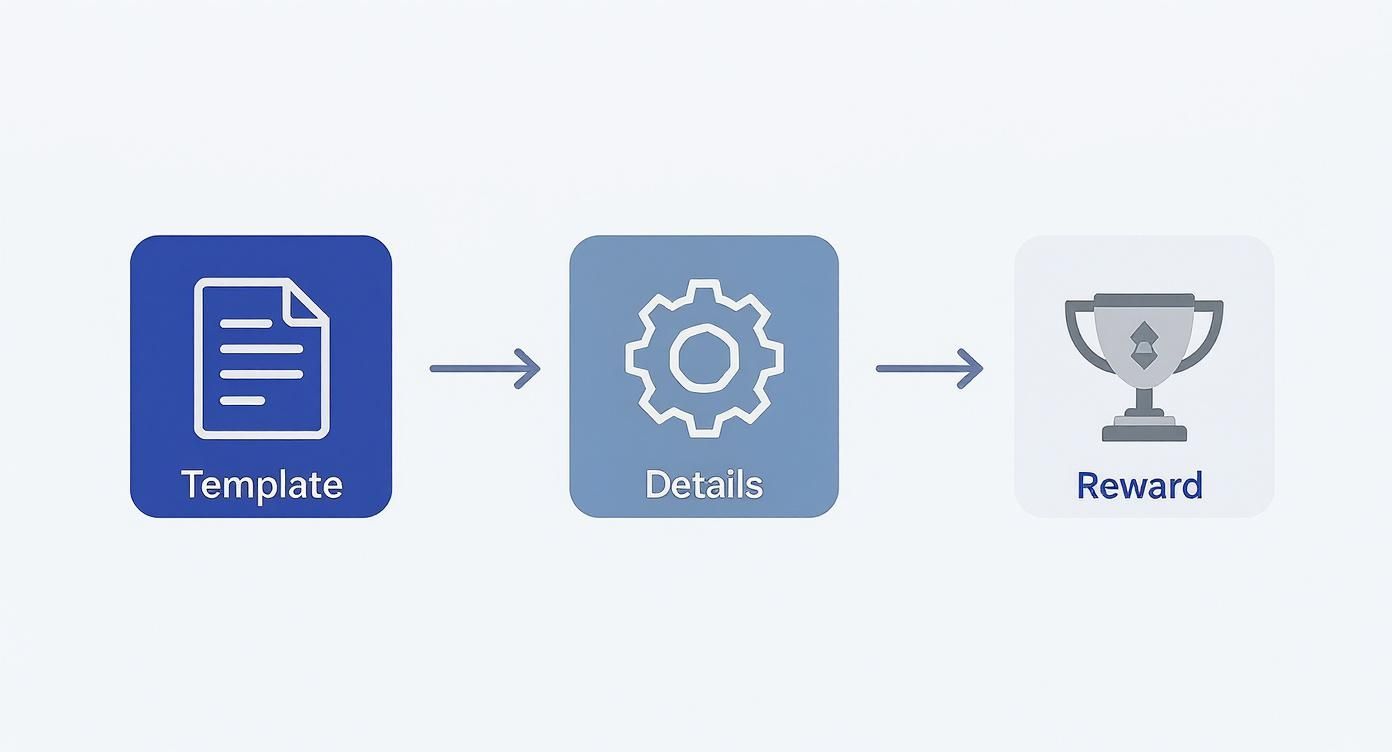
As you can see, configuring the quest's details—which includes all your anti-fraud rules—is a central step before you can even think about rewards.
AI-Powered Verification and Monitoring
For truly next-level protection, you need to lean on AI-powered tools. Platforms like Domino can analyze user behavior in ways that simple, static rules just can't. The AI can spot suspicious patterns, like accounts that only interact with giveaway posts or follow thousands of people with zero genuine activity of their own.
My biggest piece of advice? Don't "set it and forget it." Actively watch the submissions as they roll in, especially in the first 24 hours. If you see a sudden, massive spike in participants from brand-new, sketchy-looking accounts, you've got a problem. Catching these patterns early means you can tighten the rules before the bots completely take over.
At the end of the day, bots are a massive issue everywhere, not just in Web3. Even the biggest players deal with this. As of early 2025, Meta’s platforms were averaging 3.43 billion daily active users—that’s an enormous surface for bots to attack. The goal isn't to catch every single bot (that’s impossible), but to make it so difficult and expensive for them that they can't ruin your results.
By layering these defenses, you ensure your "Follow on X" quest attracts real, valuable community members. If you're running a community on Discord and seeing this problem, we've got a whole guide on handling Twitter bots in Discord communities.
Getting the Word Out: How to Promote Your Quest for Maximum Reach

So you've hit 'launch' on your quest. Great! But that’s just the starting line. Now comes the real hustle: getting your campaign in front of the right people. From my experience, the best promotion always starts with your inner circle—the folks who are already bought into your project.
Your very first move should be to blast the quest out to your core community hubs. I’m talking about dropping the link right into your main Discord announcements channel and your primary Telegram group. And don't just post it once and walk away. Those feeds are a firehose of information, so you need to be persistent.
Automating Your Community Announcements
To make sure your die-hard fans see the quest right away, it's smart to set up some automated announcements. This is a simple trick, but it works wonders.
Here's what you can have a bot do:
- Drop the quest link at a scheduled time in your most poppin' channels.
- Re-share the announcement every few hours on day one to catch people in different time zones.
- Ping key roles like
@everyoneor even a custom@supporterrole to send out notifications and grab immediate attention.
This ensures your most loyal community members get first dibs, which is a great way to reward them and build that crucial early momentum. Trust me, your core community is your most valuable megaphone.
Reaching Beyond Your Inner Circle
Once your community is fired up, it’s time to cast a wider net. This is where dedicated questing platforms like Zealy or Galxe become your best friend. Pinning your quest on these aggregators is a must-do for visibility. They're crawling with "quest hunters" who are actively searching for new projects to support.
Pinning a quest on a major platform is like putting up a massive billboard in a high-traffic area. It tells a huge audience that your project is live, engaging, and has rewards up for grabs, which is a magnet for organic discovery.
Of course, you can't forget about promoting directly on X. Craft a series of posts with slick visuals or short videos that spell out exactly what the quest is and what’s in it for them. If you really want to boost engagement, weaving in some of these 11 effective social media strategies can make a huge difference in how many people see and join your quest.
Another killer tactic is to team up with other Web3 projects for cross-promotion. Find projects that have a similar audience but aren't direct competitors and agree to share each other’s quests. It’s a simple trade that can get your project in front of a whole new, highly relevant audience.
This kind of reach is critical when everyone's fighting for attention. Just look at the XR headset market, where Meta's Quest lineup snagged a massive 74.6% of shipments in 2024. That's the power of brand reach. Building out a solid promotional engine is what will make your follow on x quest really pop off.
Alright, your quest is live and the new followers are trickling in. It's easy to just kick back and watch that follower count go up, but that's only half the story. The real work—and the real insight—starts now.
To figure out if your Follow on X quest actually worked, you have to look past the vanity metric of raw follower numbers.
Did People Actually Finish the Quest?
First things first, check your completion rate. This is your bread and butter. It’s a simple percentage that shows how many people who clicked 'start' actually made it to the finish line. If you're seeing a high completion rate, say 90% or more, give yourself a pat on the back. That means your instructions were clear and the whole process was painless.
But what if that number is low? That's a red flag. It’s time to play detective and figure out where people are dropping off. Was the verification step confusing? Did the link to your X profile go nowhere? Finding that point of friction is your top priority for the next campaign.
Are Your New Followers Legit or Just Bots?
Gaining followers feels good, but gaining the right kind of followers is what will actually move the needle for your project. You're building a community, not just collecting usernames. That's why you need to check out what happens after the quest is over.
Give it a couple of weeks, then dive into the engagement from your new followers. Are they actually liking, reposting, and replying to your posts? If you see a healthy chunk of this new cohort getting involved, you’ve successfully attracted real people who are genuinely interested in what you’re doing.
Look, a quest that pulls in 1,000 followers who stick around and engage is infinitely more valuable than a quest that brings in 10,000 who go silent the second they get their reward. Quality over quantity, every single time.
Listen, Learn, and A/B Test Your Way to Success
The numbers tell you what happened, but your community can tell you why. Don't be shy—ask them directly what they thought of the whole experience.
- Toss up a quick poll in your Discord or Telegram and ask if the quest was too hard or super easy.
- Offer a little something extra (like a special role or a small token reward) for anyone willing to leave detailed feedback.
- Keep an eye on the chat. Are people complaining or seem confused? That's gold right there.
Take all that feedback and mash it up with your performance data. This is how you get smarter with every campaign. Treat each quest as an experiment. Tweak the rewards. Change up the copy in your announcement posts. Try simplifying the instructions. This cycle of measuring, listening, and testing is how you go from running okay campaigns to running killer ones, making sure every Follow on X quest you launch is better than the last.
Ready to stop guessing and start building quests that deliver real, measurable growth? Domino gives you all the tools to design, launch, and analyze your campaigns from start to finish. Start building your community with Domino today.