Gamified Loyalty Programs: Boost Engagement with Web3 Campaigns
Let's be real, traditional loyalty programs are a bit of a snooze. Gamified loyalty programs are the answer. They basically turn customer engagement into a game by weaving in elements like points, badges, leaderboards, and quests. Instead of just racking up points, your users get to actively tackle challenges, unlock cool achievements, and earn way better rewards. It makes the whole thing a lot more fun and interactive.
So, What Exactly Are We Talking About?
At its heart, a gamified loyalty program is about shifting from purely transactional rewards to creating an actual experience. Think about the classic coffee shop punch card. It's fine, I guess. You buy coffee, you get a stamp. It's predictable, but nobody is getting excited about it.
Now, picture that same coffee shop experience, but as a game. Your first purchase snags you a "Newbie" badge. Buy five drinks in a week? You just crushed the "Weekly Warrior" quest and earned a bunch of bonus points. Tell a friend about the place? You get a special reward and climb up a public leaderboard. That's the magic of gamified loyalty. It taps into the same psychological triggers that make video games so addictive—achievement, competition, and progression—and applies them to how people interact with your brand.
It's an Adventure, Not Just a Transaction
The whole point is to change how users see their relationship with you. It’s no longer a simple "I give you money, you give me stuff" exchange. Their journey with your brand becomes an adventure. Every little thing they do, from making a purchase to shouting you out on social media, pushes them forward.
This approach turns boring tasks into fun challenges. It plays on our very human desire to complete sets, hit new levels, and see real proof of our accomplishments. And what's the result? A much deeper, more emotional bond with your community.
A well-designed gamified program makes users feel like they're building status and skill within your ecosystem, not just spending money. It creates a sense of belonging that a simple "10% off" coupon could never touch.
How It All Comes Together
These programs are built on some simple, but incredibly powerful, game mechanics. Here are the building blocks you'll see most often:
- Points and Experience (XP): Users earn XP for doing stuff, which lets them "level up" and unlock new perks and rewards. It's a classic for a reason.
- Quests and Challenges: These are specific, clear tasks you want users to do. Think "Share our latest post" or "Join our Discord." They guide behavior by offering a clear reward for a clear action.
- Badges and Achievements: These are like digital trophies. They act as status symbols that show off a user's dedication and what they've accomplished in your community.
- Leaderboards: This is where you bring in a little friendly competition. Leaderboards encourage users to climb to the top by being more active and earning more points.
Platforms like Domino make it super easy for Web3 teams to build and manage all of this without having to write a single line of code.
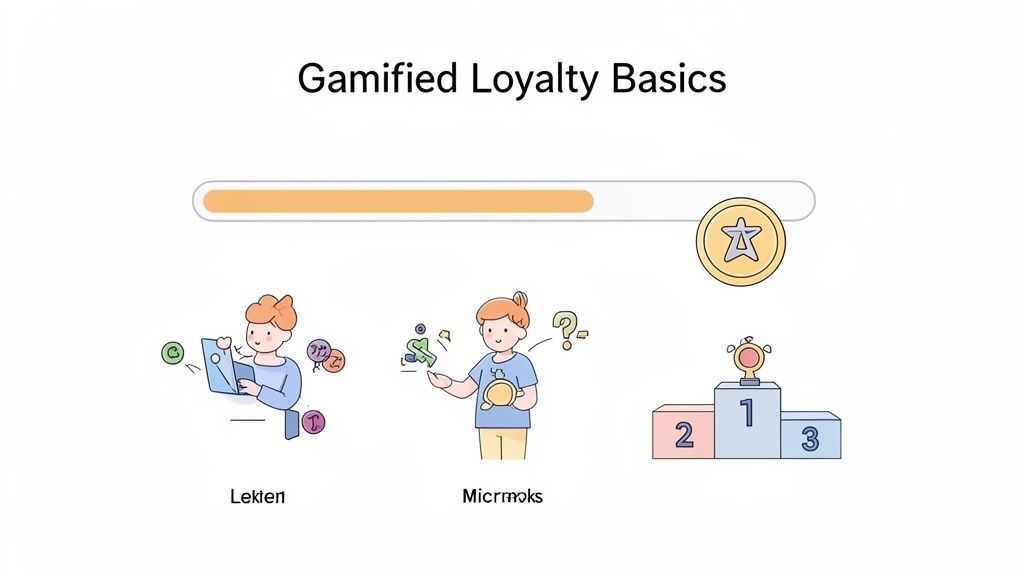
The image above gives you a good sense of how you can visually show users their progress, the rewards they can earn, and where they stand against others. By turning loyalty into something dynamic and interactive, you’re not just building an active community—you’re building one that’s genuinely invested in seeing you succeed.
Why Game Mechanics Are So Dang Addictive
At the end of the day, gamified loyalty programs work because they tap directly into what makes us human. It’s not about some cheap trick; it's about understanding the core psychological drivers that make us feel motivated, accomplished, and part of something bigger. Once you see what's happening under the hood, you'll understand why a simple progress bar or a digital badge can be so powerful.
These systems are all about creating a satisfying feedback loop. You do something, you get a small reward, and your brain gets a little jolt of pleasure. That feeling is tied to dopamine, the chemical messenger in our brains linked to motivation and reward. Every quest you finish or achievement you unlock delivers a tiny dopamine hit, making you want to come back and do it all over again.
Tapping into Our Need to Achieve
One of the most powerful forces in the human psyche is the desire for mastery and achievement. We're hardwired to want to get better at things, finish what we start, and feel competent. Gamified programs are masters at making this journey visible.
Just think about a progress bar. As it inches closer to 100%, it gives you a clear, visual sign that you're almost at the goal. This triggers something psychologists call the "endowed progress effect"—the idea that we’re far more motivated to finish something once we feel like we’ve already made a dent in it. It's the same reason you're more likely to fill that 10-stamp coffee card once you've got the first three stamps.
This is exactly what mechanics like these are designed to do:
- Leveling Systems: Seeing your level jump from 1 to 2 provides a tangible sense of growth.
- Quests: Checking off a list of tasks gives you that satisfying feeling of completion.
Sparking a Little Friendly Competition
Let's be honest—we're all a bit competitive. We have a natural urge to see how we stack up against others. Leaderboards are the most direct and effective way to plug into this, creating a social arena for what would otherwise be an individual journey.
Watching your name climb a list is a surprisingly strong motivator. It pushes people to get more involved, either to overtake the person ahead of them or to protect their spot. This friendly rivalry can turn passive users into active, engaged community members. It’s no surprise that nearly 80% of learners say they’d be more productive if their work felt more like a game.
By adding a competitive layer, you're doing more than just rewarding actions. You're building a dynamic social space where engagement itself becomes a form of status.
This social comparison keeps people hooked, not just for the prizes, but for the recognition that comes with being a top player.
Fulfilling the Desire for Status and Collecting
Finally, gamification taps into our deep-seated instinct to collect things and show off our status. Whether it was collecting baseball cards as a kid or earning a fancy job title as an adult, we love to acquire things that signal who we are and what we’ve accomplished.
In gamified loyalty programs, this plays out with digital rewards that double as status symbols.
- Badges and Achievements: Think of these as digital trophies. Users can display them on their profiles to showcase their dedication and expertise within the community.
- Unique NFTs or Digital Items: This is where Web3 takes it to another level. Earning a rare NFT isn't just getting a reward; it's acquiring a unique, provably scarce asset that signifies your role or achievement.
These digital collectibles satisfy our desire to hoard and categorize, making the whole process of earning them feel worthwhile. A recent study found that 77% of consumers prefer loyalty programs with game-like elements, which just goes to show how well these psychological hooks work at scale. By turning loyalty into a collection game, you give people a compelling reason to stick around, driven by that classic urge to "collect them all." This is how you turn a one-off action into a long-term habit.
How Web3 Supercharges Gamified Loyalty
Let's be honest, traditional loyalty programs are starting to feel a bit stale. Think about that coffee shop punch card or your airline miles—they operate in a walled garden. They're essentially digital IOUs that are completely controlled by the company that issues them. They work, sure, but they often feel restrictive and don't give you anything of real, tangible value.
This is where Web3 completely flips the script.
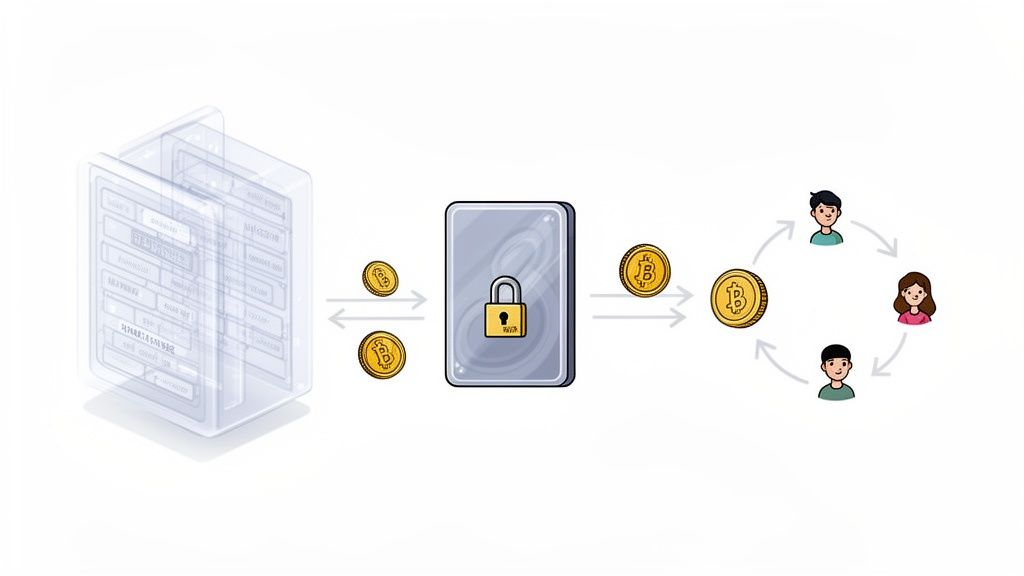
Web3 technologies, particularly blockchain, don't just put a new coat of paint on old loyalty models; they rebuild the entire foundation from the ground up. By moving loyalty programs onto a decentralized ledger, you’re fundamentally shifting the power dynamic from the company to the community. Suddenly, rewards aren't just points in a database—they become genuine digital assets that your users actually own.
From Points to Provable Ownership
The single biggest game-changer Web3 brings to gamified loyalty programs is the concept of true ownership. In a Web2 system, your "points" are just a number sitting on a company's private server. The company can change the rules on a whim, devalue your points overnight, or even wipe out your account. You have no real control.
Web3 turns this on its head by using NFTs (non-fungible tokens) as rewards. When a user earns an NFT for completing a quest or hitting a milestone, that asset is recorded on the blockchain and sent straight to their personal crypto wallet. It’s theirs. They can hold it, show it off, or even sell it on an open marketplace. This simple shift transforms rewards from a simple discount tool into a potential source of real-world value.
A loyalty NFT isn't just a badge; it's a verifiable piece of digital property. This fundamental shift gives rewards real weight and makes the game of earning them far more compelling.
This ownership model creates an incredibly powerful incentive. Users aren't just grinding away for a free coffee; they're investing their time to acquire unique assets that could appreciate in value and grant them special perks within the ecosystem. It changes everything.
Transparency and Trust Through Smart Contracts
Another massive upgrade comes from smart contracts. The best way to think of a smart contract is as a digital agreement that automatically enforces itself when certain conditions are met. All the rules of your loyalty program—like "if a user stakes 100 tokens, then award them this exclusive NFT"—are written directly into the code on the blockchain.
This means the program runs exactly as promised, no central authority or middleman required. Everything is out in the open. Anyone can look at the contract's code and verify that the rules are fair and being followed. This level of transparency builds incredible trust with your community because they know the game isn't rigged. It also automates the entire reward distribution process, saving your team from countless hours of manual work.
Comparing Web2 and Web3 Loyalty Program Features
The differences between the old way and the new way are pretty stark. While Web2 programs are all about locking users into a single ecosystem, Web3 programs are designed to empower them within an open, interconnected one.
This table really highlights the fundamental differences between traditional loyalty programs and the innovative approaches possible with Web3.
| Feature | Web2 Loyalty Programs (e.g., Airline Miles) | Web3 Gamified Loyalty Programs (e.g., NFT Rewards) |
|---|---|---|
| Ownership | Points are controlled and owned by the company. | Rewards (NFTs, tokens) are truly owned by the user in their personal wallet. |
| Transparency | Program rules are hidden and can be changed without notice. | Rules are coded into public smart contracts, making them transparent and unchangeable. |
| Value | Points have a fixed, often declining value, and are not transferable. | Rewards are digital assets with potential market value and can be traded or sold. |
| Interoperability | Rewards are trapped within a single company's ecosystem. | Assets can potentially be used across different platforms and communities. |
| Governance | The company dictates all aspects of the program. | Communities can influence the program's direction through token-based voting. |
As you can see, the shift is less of an evolution and more of a complete reinvention.
Ultimately, Web3 supercharges gamified loyalty programs by turning them into miniature, self-sustaining economies. Instead of just playing a game for points, users are actively participating in—and co-owning a piece of—the very ecosystem they're helping to build. This creates a much deeper, more aligned relationship between a project and its community, fostering a kind of loyalty that’s built on shared success and genuine ownership.
Gamified Loyalty Programs in Action
Theory is one thing, but seeing these ideas come to life in the real world is where it gets exciting. To really get a handle on gamified loyalty programs, let's look at some killer examples from both the Web2 giants and the new wave of Web3 projects. These mini-case studies are perfect illustrations of how simple game mechanics can drive massive results.
Seeing how these programs are built gives you a solid blueprint for what's possible when you stop just asking for engagement and start making it an adventure.
Web2 Masters of the Game
Long before crypto came along, big brands were already proving that gamification could build incredible loyalty and drive sales. They really set the stage by showing that making things fun is just good business.
Starbucks Rewards is a perfect example. It's a masterclass in using progression to keep people coming back. Every time you buy something, you earn "Stars," which you can literally watch fill up a progress bar in their app. That simple visual cue taps right into our desire to finish what we start, nudging us to buy one more coffee just to unlock a free drink.
Starbucks also throws in challenges and "Double Star Days," which are basically limited-time quests. These events create a little urgency and show customers a clear shortcut to earning rewards, turning a routine purchase into something that feels more like a strategic move.
Then you have Domino's Pizza, which went all-in on the "game" part. Back in 2017, they completely changed the game for fast-food loyalty with their 'Piece of the Pie Pursuit' program. Customers could play an actual mobile puzzle game, and if you beat all the levels, you scored 10 extra loyalty points toward a free pizza. The results were wild: Domino's loyalty program ballooned to millions of members, helping them rack up an 11.7% sales surge in Q4 2017 alone. It makes sense when you see stats showing that 77% of consumers prefer loyalty programs that feel like a game. You can discover more loyalty program statistics that really drive this point home.
These Web2 examples prove a simple, powerful truth: when you give users a clear path forward and sprinkle in some fun challenges, their loyalty skyrockets. They stop being just customers and start feeling like players on a mission.
How Web3 Projects Are Raising the Stakes
Web3 projects are grabbing these proven ideas and hitting the turbo button with blockchain technology. The result? Campaigns that drive real on-chain activity and build communities that are genuinely invested.
Instead of just earning points, users in Web3 can earn actual digital assets. Many projects are turning to platforms like Domino to launch quest-based campaigns that are laser-focused on hitting specific growth goals.
Picture a DeFi protocol launching a campaign with a series of quests like this:
- Quest 1: Jump into our Discord and grab a specific role (off-chain task).
- Quest 2: Follow us on Twitter and retweet a big announcement (off-chain task).
- Quest 3: Stake a certain amount of our native token in the protocol (on-chain task).
- Quest 4: Add some liquidity to a specific pool on a DEX (on-chain task).
As users knock out these quests, they earn XP and climb a leaderboard. At the end, the top players might snag an exclusive NFT that unlocks a private channel or get a piece of a token airdrop. This whole model creates a direct line between community engagement and valuable, on-chain actions.
The results speak for themselves. Projects often see huge jumps in key metrics, like a 50% increase in daily active wallets or doubling their Discord community in just a couple of weeks. By gamifying these crucial growth activities, they turn passive users into active players who are helping build the ecosystem. You can even build reward programs for your Telegram community to spark similar levels of engagement.
Ultimately, these Web3 campaigns do more than just attract eyeballs; they educate people. By completing quests, community members learn the ropes of the protocol, understand its value, and become more invested—both financially and emotionally—in where it's headed. It creates this awesome, self-sustaining cycle of engagement and growth.
Launching Your First Web3 Quest Campaign
Okay, enough theory. Let's get practical and talk about how to actually launch your first Web3 quest campaign. The best part? You don't need a team of developers or a month of planning to get going. With a no-code toolkit like Domino, you can spin up a live, scalable gamified loyalty program in just a few minutes.
This isn't about reinventing the wheel. It’s about using a proven playbook to get real results, whether you’re hunting for new users, trying to grow your community, or looking to light a fire under your on-chain activity. Let's walk through it step-by-step.
Define Your Mission Before You Build
Before you start dreaming up quests and rewards, you have to answer one critical question: What are we trying to achieve? A campaign without a clear goal is just making noise. Your objective is the north star that guides every other decision.
And I mean specific. "Growing the community" is way too fuzzy. You need a target you can actually measure.
- User Acquisition: "Get 1,000 new active members in our Discord this month."
- On-Chain Activity: "Boost the number of wallets staking our token by 20%."
- Brand Awareness: "Generate 5,000 retweets on our big partnership announcement."
Once you have that crystal-clear goal, you can design quests that push you directly toward it. This is how you make sure your program has a real, tangible impact.
Choose the Right Tasks and Rewards
With your goal locked in, it’s time for the fun part—designing quests and picking rewards. The secret sauce here is creating a healthy mix of on-chain and off-chain tasks. This way, you can pull in your whole community, from the DeFi degens to the brand-new followers.
A good, well-rounded campaign might look something like this:
- Off-Chain Quests: Easy lifts like joining a Telegram channel, reacting to a Discord announcement, or following a partner on Twitter. These are fantastic for building social buzz.
- On-Chain Quests: Actions that require users to actually interact with your protocol, like staking tokens, minting an NFT, or adding liquidity to a pool. These are the quests that drive deep, meaningful engagement.
Rewards are the fuel that makes the engine run. They have to be good enough to get people to act. XP is a great start for tracking progress and powering leaderboards, but Web3 lets you do so much more. Think about offering unique NFTs with actual utility, airdropping tokens to your top performers, or granting exclusive community roles that come with real status.
The best gamified loyalty programs match the reward to the effort. A simple Twitter follow might earn a sprinkle of XP, but staking a serious amount of tokens should unlock something much more valuable.
Automate and Scale with No-Code Tools
Imagine trying to manually verify thousands of quest submissions. It’s a complete nightmare. This is where a platform like Domino becomes your best friend. With AI-powered verification, you can put the entire process on autopilot, making sure rewards go out instantly and accurately.
This diagram really shows how far loyalty programs have come—from the simple punch cards of Starbucks and Domino's to the powerful, asset-based models we can build in Web3.
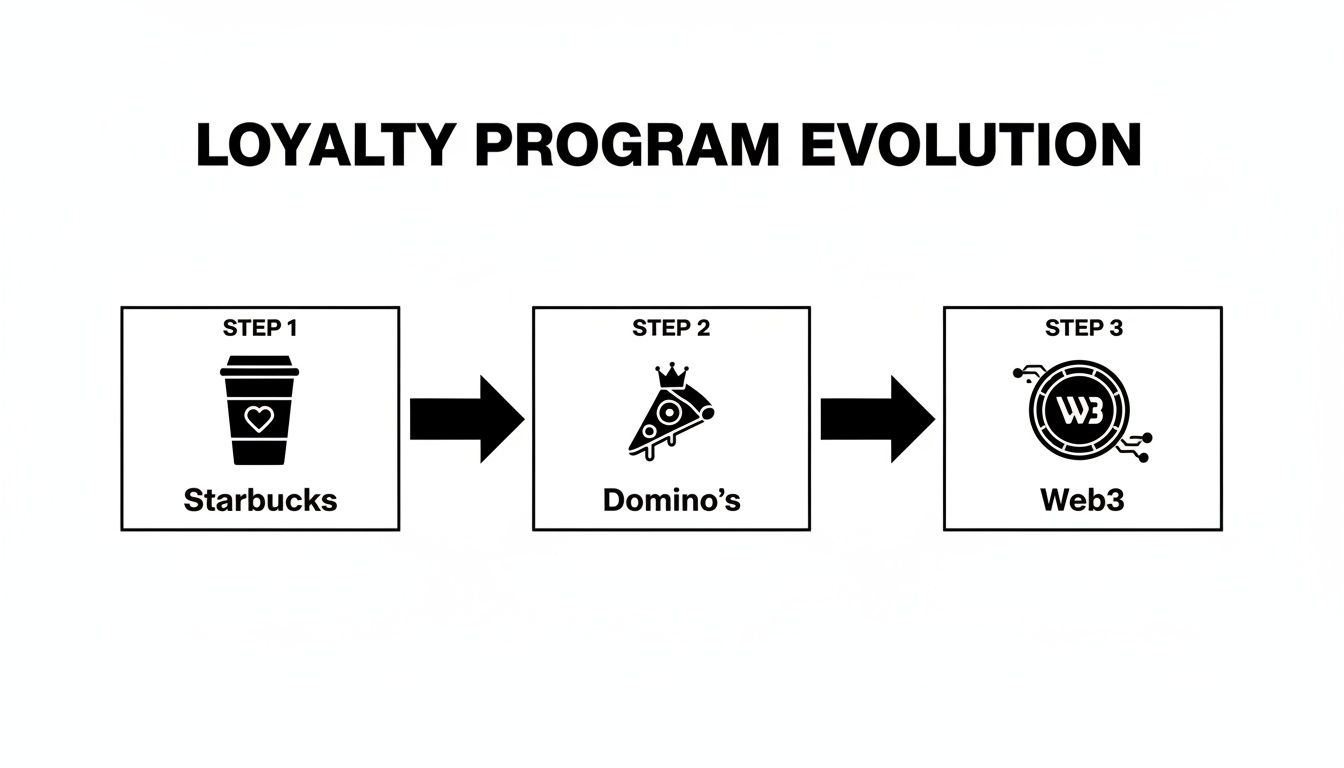
It’s a clear move toward giving users real ownership and value, a trend that Web3 is built to accelerate.
Using pre-built templates for common tasks like social shares or Discord engagement makes setup a breeze. Just connect your project’s social accounts and smart contracts, pick your tasks, set the rewards, and hit "launch." It’s that easy. The global gamification market is expected to rocket to $48.72 billion by 2029, and it’s being driven by accessible tools that open up these powerful strategies to everyone.
By letting automation handle the grunt work, your team can focus on the creative stuff—crafting killer campaigns that your community will love. This is how you scale a gamified loyalty program from a tiny experiment into a core part of your growth machine. It’s not just about saving time; it’s about creating a transparent, trustworthy experience where users know their contributions will be rewarded. For a great example of quest design in action, check out how one project used a Treasure Hunters Quest to boost engagement.
How to Measure Your Program's Success
So you’ve launched your gamified loyalty program. Great start, but the real work has just begun. A program is only as good as the results it drives, so you absolutely need a clear way to measure its impact. Flying blind is just guessing, and guessing doesn’t cut it. Measuring success is how you prove value to everyone involved and get the insights you need to knock the next campaign out of the park.
Think of it like this: your program is a growth engine, and key performance indicators (KPIs) are the gauges on your dashboard. They tell you how fast you're going, if you're burning too much fuel, and when it’s time to steer in a new direction. Nailing down the right metrics is the only way to show a clear return on your investment.
Key KPIs for Your Gamified Loyalty Program
To get the full story, you need to track a mix of community chatter (off-chain) and hard product data (on-chain). This blended approach shows you exactly how social buzz translates into real, tangible activity on your protocol. Don't try to track everything at once; start by focusing on a few areas that tie directly back to your campaign goals.
Here’s a breakdown of the KPIs that really matter:
Essential KPIs for Your Gamified Loyalty Program
Track these key metrics to measure the direct impact of your gamified campaigns on community growth and on-chain activity.
| Metric Category | Key Performance Indicator (KPI) | What It Measures |
|---|---|---|
| Community Growth | New Discord/Telegram/X members | Your program’s reach and ability to attract new users. |
| Follower growth rate | The speed at which your community is expanding. | |
| Community Engagement | Daily/Monthly Active Members | How many people are consistently active, not just lurking. |
| Quest completion rate | Which quests are resonating and which ones are duds. | |
| On-Chain Activity | Daily Active Wallets (DAW) | The number of unique wallets interacting with your protocol. |
| New token holders | How many new people are buying into your ecosystem. | |
| Total Value Locked (TVL) increase | Growth in assets secured within your protocol. | |
| Transaction volume | The level of economic activity your program is generating. |
By connecting these dots, you can see if your off-chain quests are actually getting users to take valuable on-chain actions. To dig in even deeper, you can learn how to measure community engagement with a more detailed framework.
A successful program doesn’t just boost vanity metrics like follower counts. It creates a measurable lift in the on-chain activities that are vital to your project's long-term health and growth.
Iterating and Optimizing for Long-Term Success
Your first campaign is a treasure trove of learning opportunities. All the data and feedback you gather is pure gold for making things better next time. Seeing which quests had the highest completion rates or which rewards got people most excited tells you exactly what your community loves.
For example, did a quest asking users to stake tokens fall flat? Maybe the barrier to entry was too high, or the reward just wasn't compelling enough. Use that insight to tweak your next campaign. You could introduce a lower-stakes version of the quest or offer a more exclusive NFT as a prize. Beyond standard KPIs, you can get a better feel for things by looking into User Experience Metrics, which help gauge how satisfied people really are.
And don't forget to listen! Pay attention to the conversations happening in your Discord and Telegram. What are people saying? Are the quests fun, confusing, or a grind? This direct feedback, combined with your performance data, creates a powerful loop for continuous improvement. This cycle of launching, measuring, and refining is how you turn a good loyalty program into an unstoppable growth machine.
Got Questions About Gamified Loyalty Programs?
When you're diving into gamified loyalty, a few questions always pop up, especially for teams building in Web3. Let's tackle the big ones so you can move forward with confidence.
What's This Going to Cost Me?
The price tag can swing wildly. If you go the custom route and build everything from the ground up, you're looking at a serious investment of time and engineering talent. It’s a huge undertaking.
The alternative? Using a no-code platform. This path makes launching a sophisticated program surprisingly affordable, often with just a straightforward subscription fee. You get to skip the massive upfront development bill and the headache of ongoing maintenance.
What Kind of Rewards Actually Work for Web3?
The best rewards are a smart mix of what feels good (intrinsic) and what has tangible value (extrinsic). Things like XP and climbing a leaderboard are fantastic for keeping people hooked day-to-day, but Web3 unlocks some really unique, valuable prizes.
Think about offering NFTs that unlock special perks, airdropping tokens to your most dedicated contributors, or granting exclusive roles in your Discord server. The trick is to make sure your rewards are things your community actually wants and that they tie back to your project's ecosystem.
How Do I Stop People from Gaming the System?
Keeping things fair is non-negotiable, and that means shutting down bots and cheaters. Top-tier platforms bake in multiple layers of security and automatic checks to handle this. This often includes using AI to validate social media tasks and linking actions directly to on-chain data.
By automating the verification process, you can be sure that your rewards are going to real people who are genuinely helping your community grow.
Ready to create a campaign that gets people buzzing in just a few minutes? With Domino, you can launch powerful Web3 quests without touching a line of code. Start building for free.