Boost Engagement with gamification in loyalty programs: A Proven Approach
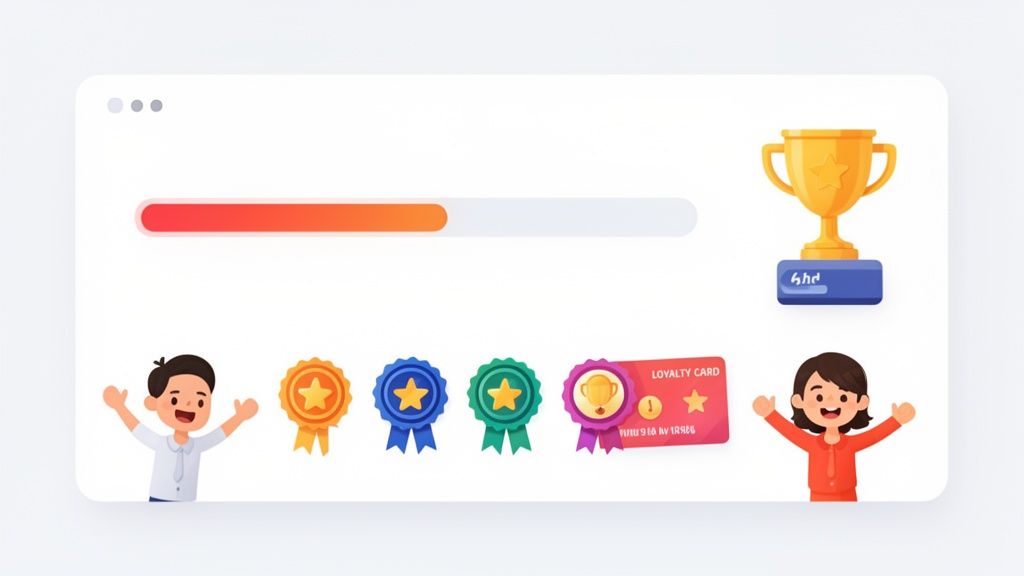
Let’s start with a simple idea: gamification is all about sprinkling game-like fun—think points, badges, and challenges—into things that aren’t traditionally games, like a customer rewards system. The goal? To turn the boring, passive act of collecting points into an active and engaging experience. It’s a powerful way to tap into our natural human desire for achievement and friendly competition, building a much stronger connection with a brand along the way.
Why Traditional Loyalty Programs No Longer Work
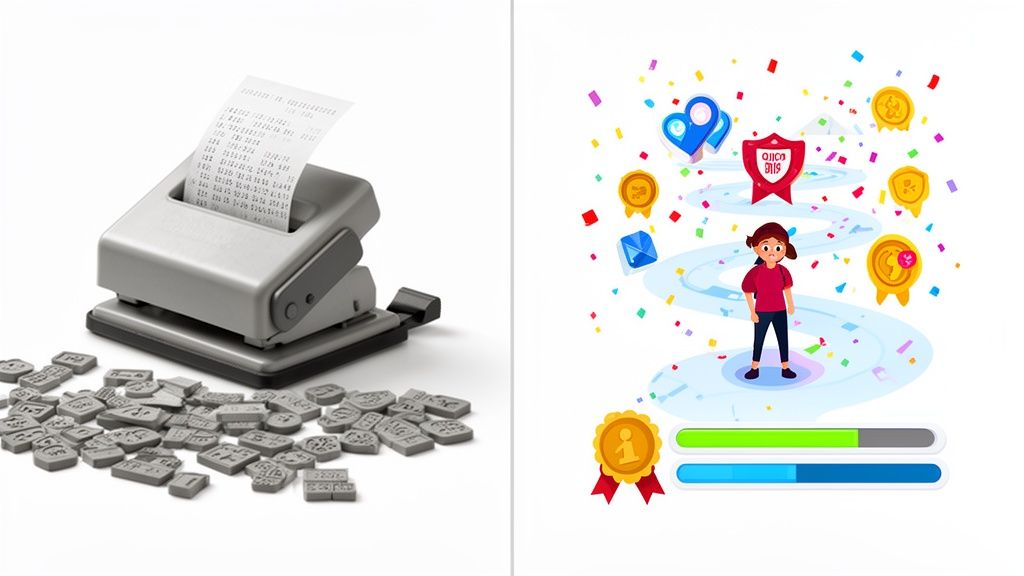
Let’s be honest, the classic 'buy ten, get one free' punch card feels like a relic from a bygone era. It's a transaction, not an interaction. For years, this was the gold standard, but today’s customers want more than just a slow, predictable march toward a free coffee.
Think of it like this: a traditional loyalty program is like a simple board game, maybe Chutes and Ladders. You just roll the dice, move your piece, and passively wait for something to happen. The path is set, the reward is distant, and there’s zero strategy or personal achievement involved. Yawn.
The Shift From Passive to Active Engagement
This is where gamification flips the script entirely. It turns that boring board game into an immersive video game. Suddenly, you’re not just on one linear path. You've got side quests, surprise power-ups, and a leaderboard to see how you stack up against other players. This isn't just about collecting points anymore; it’s about the journey.
This shift to active participation is what builds a genuine, emotional connection. Customers stop being just consumers and become players who are truly invested in their own progress. This approach taps into core human drivers that old-school programs completely miss:
- A Sense of Achievement: Unlocking a new badge or hitting the next level gives you that little jolt of satisfaction—a nice dopamine hit that feels good.
- Social Competition: Leaderboards create a friendly rivalry that keeps people coming back for more. It’s human nature to want to climb the ranks.
- Visible Progress: Progress bars are brilliant. They show you exactly how close you are to the next reward, which motivates you to take that next step and close the gap.
Gamification is the engine that turns a loyalty program from a simple marketing tool into a vibrant, self-sustaining community hub. It gives members a reason to return daily, not just when they need to make a purchase.
The numbers back this up. A staggering 77% of consumers say they're more likely to stick with a brand if its loyalty program has game-like features.
To get a better sense of this transformation, here’s a quick comparison of the old vs. new way of thinking about loyalty.
Traditional Loyalty vs Gamified Loyalty
| Feature | Traditional Loyalty Program | Gamified Loyalty Program |
|---|---|---|
| Customer Role | Passive collector | Active participant |
| Engagement | Transactional (buy to earn) | Interactive (play to earn) |
| Rewards | Predictable, long-term | Immediate, surprising, tiered |
| Motivation | Extrinsic (free stuff) | Intrinsic (achievement, status) + Extrinsic |
| Experience | Linear and slow | Dynamic with multiple paths |
| Outcome | Occasional repeat purchases | Deepened brand affinity and community |
This table really highlights how gamification isn't just a cosmetic change; it's a fundamental shift in how you build and maintain customer relationships.
Beyond just the fun and games, understanding how modern approaches to engagement work is key. For example, looking into modern partner incentive programs that drive revenue and loyalty shows how these same principles can be applied in B2B contexts. By adding layers of challenge and reward, brands build real emotional resilience and keep their customers—and partners—invested for the long haul.
The Psychology That Makes Gamification So Effective
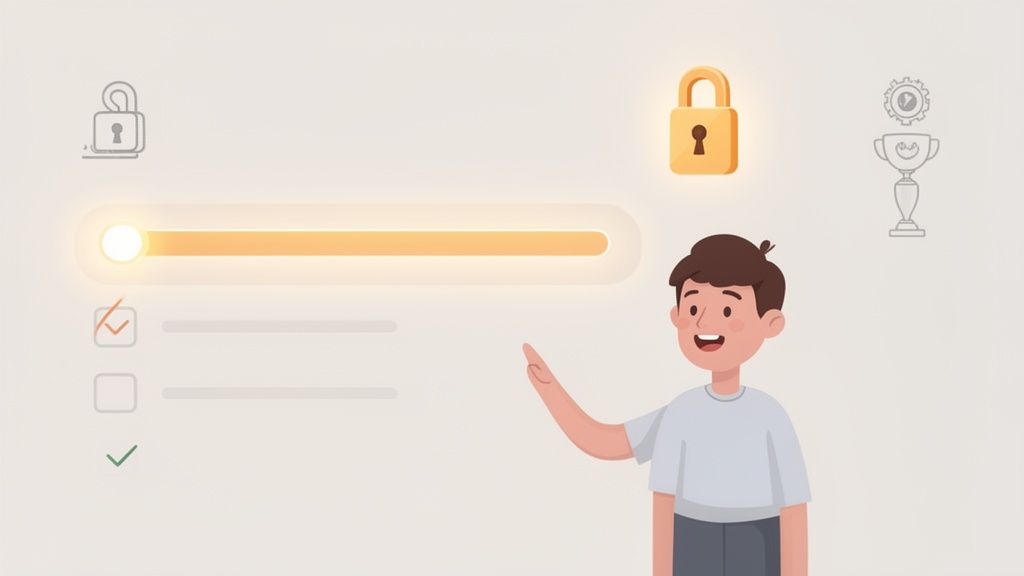
Ever wondered why hitting "level up" in a game or finally filling a progress bar feels so good? It’s not just about the points or the prize at the end. It's a clever bit of brain science at work, and understanding it is the secret to designing loyalty programs that people genuinely want to use.
At its core, gamification in loyalty programs works because it taps into fundamental human desires: our need for achievement, our craving for recognition, and our love for making progress. It turns mundane actions, like making a purchase, into a fun journey with a clear path forward.
The Power of Unfinished Business
One of the most potent psychological tricks up gamification’s sleeve is something called the Zeigarnik effect. In simple terms, our brains are hardwired to obsess over unfinished tasks. That nagging feeling you get when you’ve left a job half-done? That’s the Zeigarnik effect in action.
Gamified loyalty programs are masters at using this to their advantage.
- Progress Bars: A progress bar sitting at 80% full is almost impossible to ignore. It’s an open loop in our minds, screaming to be closed. We feel a powerful urge to take that one last action just to see it hit 100%.
- Quest Lists: A checklist with a few items already ticked off has the same pull. We see the clear path to completion and feel an internal drive to finish the list.
This creates a brilliant feedback loop. Every small action feels like a meaningful step, keeping users hooked and looking forward to the next milestone.
The best gamified systems make you feel like you're always on the verge of the next win. This sense of momentum is what separates a forgettable points program from an addictive experience.
Balancing What You Get with How You Feel
Great gamification design strikes a delicate balance between two types of motivation: extrinsic and intrinsic. Nailing this difference is key to keeping users engaged for the long haul.
Extrinsic motivation is all about external rewards—the tangible stuff you get for participating. Think of it as the "what's in it for me?" factor that gets people to sign up in the first place.
- Points or tokens
- Coupons and discounts
- Exclusive merch
- Digital collectibles or NFTs
Intrinsic motivation, on the other hand, comes from within. It’s the "how you feel" part of the equation—the deep, satisfying feelings that build true loyalty and keep people coming back.
- A Sense of Accomplishment: That jolt of pride after cracking a tough challenge.
- Status and Recognition: Earning a rare badge or climbing to the top of a leaderboard.
- Community and Belonging: Working with other people to hit a shared goal.
While extrinsic rewards are great for getting users in the door, it’s the intrinsic motivators that make them stay. A program that only throws freebies at people will see engagement drop the second the giveaways stop. For a great real-world example of status driving behavior, it's worth understanding Reddit's karma system, where users are motivated by the social capital they accumulate.
Ultimately, a well-built gamified program makes users feel skilled, seen, and connected. The rewards become a happy bonus from an enjoyable experience, not the only reason to play. To dig deeper into applying these ideas, check out our guide on community gamification. By tapping into these deep-seated drivers, you can build a system that turns passive customers into true fans.
Core Mechanics for Your Gamified Loyalty Playbook
Alright, we've covered the psychology. Now let's get our hands dirty and move from theory to action. This is your playbook for building the engine of your gamified loyalty program. Think of these mechanics as proven recipes for engagement that you can mix, match, and tweak to fit the unique vibe of your community.
Each of these patterns hooks into a specific psychological trigger, nudging users to take action and, more importantly, to stick around. By picking the right combination, you can build a loyalty program that feels less like a marketing checklist and more like a real adventure.
The Progression Path
The Progression Path is a classic for a reason. It gives people a clear journey from novice to expert, tapping directly into our innate desire for mastery and status. This mechanic is all about making growth visible and celebrating achievements along the way.
Instead of a flat system where everyone is the same, you create tiered levels. You can go with the classic "Bronze," "Silver," and "Gold," or get creative with titles that tell your brand's story. Each new level unlocks better perks, special access, or simple recognition, making the climb feel totally worth it.
- Psychological Hook: This pattern leans on the Goal-Gradient Effect, a fancy term for a simple idea: people get more motivated the closer they get to a goal. Visible levels and progress bars make that next step feel so close, you can almost taste it.
- Example: A coffee shop's app could take users from "Newbie Brewer" to "Barista Pro" and ultimately to "Coffee Connoisseur." Each tier might unlock early access to new blends, a free birthday pastry, or even an exclusive invite to a private coffee-tasting event.
Surprise and Delight
Let's be honest, predictability is boring. The Surprise and Delight pattern shatters the monotony of a typical points system by injecting a dose of randomness and unexpected rewards. This is how you create those "wow" moments that people can't help but share.
This mechanic can be anything from random prize drops and hidden "easter eggs" for completing certain actions, to a "spin the wheel" feature after a purchase. It’s the not knowing what you'll get that makes participating so much more exciting.
The real magic here is unpredictability. When a reward feels like a lucky win instead of a transaction, it creates a much stronger emotional connection to your brand.
Imagine a user completes a simple quest, like sharing a blog post, and is suddenly awarded a rare digital badge or a huge points bonus. That little gesture can feel way more valuable than a predictable discount simply because it was a complete surprise.
The Social Loop
We're all social creatures. The Social Loop uses our natural instincts for competition and collaboration to drive engagement, effectively turning your loyalty program into a community-building machine. This is where your users can connect, compete, and celebrate their wins together.
This pattern is built around features that get people interacting with each other.
- Leaderboards: These stir up friendly competition by ranking users on points, quests completed, or any other metric you can dream up. A weekly leaderboard that resets gives everyone a fresh shot at the top spot.
- Team Challenges: Instead of always competing against each other, let users join forces to hit a collective goal. For example, "If our community completes 10,000 quests this week, everyone gets a bonus reward!"
- Referral Quests: Reward users for bringing their friends into the fold. This creates a powerful, self-sustaining growth engine. You can even get more sophisticated by racking up points through multi-layered referral systems.
This approach fosters a genuine sense of belonging and shared purpose, transforming a group of individual users into a tight-knit community. The results can be staggering. One brand using hundreds of targeted challenges saw a 60% uplift in app engagement and a 6X boost in purchase frequency among participants. It's no wonder gamification was named the top trend in the 2023 Loyalty Trends Report for the second year in a row. You can learn more about the impactful findings of gamification on loyalty in that report.
By thoughtfully blending these core mechanics—Progression, Surprise, and Social—you're not just building a loyalty program. You're designing an experience that grabs attention, drives the behaviors you want, and forges a lasting, emotional connection with your audience.
How Web3 Changes the Gamification Landscape
Web3, with technologies like blockchain and NFTs, isn't just a minor tweak to loyalty programs—it's a complete paradigm shift. Forget about points trapped in a company database. We're now talking about rewards that are real digital assets, owned entirely by your users. This simple change makes the entire experience more transparent, verifiable, and frankly, a lot more valuable to your community.
This new world lets you weave on-chain actions directly into your loyalty quests. Imagine rewarding a user with an exclusive NFT not just for a tweet, but for something meaningful like providing liquidity to a DEX or voting on a community proposal. The best part? The blockchain verifies these actions automatically, cutting through the noise and building real trust.
True Ownership and Verifiable Achievements
In the old model, your points and status were rented, not owned. They lived and died on one company's platform. Web3 flips that on its head by giving users true ownership. That NFT badge they earned isn't just a pretty picture in your app; it's a verifiable asset sitting in their wallet. They can show it off, trade it, or even use it in other ecosystems.
This creates a permanent, public ledger of a user's journey and contributions. Being an early supporter or conquering a tough challenge is no longer just an internal data point—it's a badge of honor they carry with them across the digital world. That kind of verifiable reputation is a powerful intrinsic motivator.
You can see how platforms like Domino are bridging this gap, allowing teams to create quests tied directly to on-chain activity. This makes every single contribution feel more significant because it's part of a verifiable journey.
Navigating the Unique Challenges of Web3
While the potential is huge, jumping into Web3 comes with its own set of risks you have to plan for. The decentralized and often anonymous nature of the space makes loyalty programs a juicy target for bots and bad actors looking to farm rewards.
You're mainly up against two big hurdles:
- Bots: These are automated scripts that can blow through simple tasks (like following a Twitter account) at a scale that's hard to imagine. They can drain your reward pool and kill the vibe for your real users.
- Sybil Attacks: This is when one person spins up thousands of fake accounts to grab a massive share of rewards or disproportionately influence votes.
Designing a solid Web3 loyalty program means you have to start thinking like a security expert. The goal is to build a system that’s open and inviting for real people but incredibly difficult and expensive for cheaters to game.
Modern platforms are built from the ground up to tackle these problems. By mixing AI-powered checks for off-chain tasks with on-chain requirements (like holding a specific token), you can build a system that's tough to manipulate. For a much deeper look at this, check out our guide on Web3 loyalty programs.
Building a Sybil-Resistant Gamification Engine
The secret to a successful Web3 program isn't a single silver bullet—it's a layered defense. Instead of relying on one check, you combine multiple verification methods. This ensures your quests are being completed by genuine, engaged members of your community, not a farm of bots. This could mean using AI to verify social media activity, requiring users to hold a certain amount of your project's token, or even designing quests that simply require human creativity to solve.
This approach doesn't just secure your program; it actually improves it by making sure rewards land in the hands of people who are genuinely helping your ecosystem grow. The gamification market is exploding—projected to hit $48.72 billion by 2029—precisely because it's so good at creating these deep, meaningful customer journeys. You can discover more insights about the synergies driving gamification's growth and how it’s changing the loyalty game.
By embracing Web3's transparency and ownership while actively defending against its risks, you can build a gamified loyalty program that’s more engaging, rewarding, and resilient than anything that's come before.
A Step-By-Step Gamified Campaign Blueprint
Theory is great, but let's be honest—it all clicks when you see a real plan in action. So, let's walk through building a hypothetical Web3 project from scratch and map out its very first gamified loyalty program. This blueprint will tie all the concepts we've discussed into a practical, step-by-step story.
Our project is "Aura Protocol," a new decentralized finance (DeFi) platform gearing up for its big token launch. Their main mission? To build an active, smart community that will stick around for the long haul.
Phase 1: Define Clear Objectives
Before a single quest gets built, the Aura team needs to know what they're aiming for. They're not just chasing vague "growth"; they want specific, measurable results that lay a solid foundation for their launch.
- Primary Goal: Boost active and engaged Discord members by 30% in the next 60 days.
- Secondary Goal: Get 5,000 users to try out the new staking feature on the testnet.
- Tertiary Goal: Hit 10,000 total verified quest completions to prove people are actually interested.
Having these clear targets means they can actually measure if the program worked and justify the effort later on.
Phase 2: Design the Quest and Reward Structure
With their goals locked in, Aura starts designing a multi-layered quest system. They know they need something for everyone—from the crypto-curious newcomer to the seasoned DeFi pro. They land on a points-based system where "Aura Points" (AP) can be cashed in for rewards.
Onboarding Quests (Easy - Low AP):
These are the hand-holders, designed to be simple and welcoming. They teach new users the ropes and give them a few quick wins to get them hooked.
- Join the Aura Protocol Discord server (+50 AP)
- Follow Aura Protocol on X (formerly Twitter) (+50 AP)
- Read the project’s whitepaper and ace a simple quiz (+100 AP)
Engagement Quests (Medium - Moderate AP):
Now we're asking for a bit more. These tasks are all about encouraging deeper interaction and making the community feel alive.
- React to five official announcements in Discord (+75 AP)
- Jump on a weekly community call and claim a proof-of-attendance code (+150 AP)
- Refer a friend who completes at least one quest (+200 AP)
On-Chain Quests (Hard - High AP):
This is where the real value is. These quests drive users to interact directly with the protocol, helping Aura build a core group of true power users.
- Stake a minimum amount of testnet tokens in the new pool (+500 AP)
- Vote on the first community governance proposal (+400 AP)
This flowchart shows exactly how those valuable on-chain actions get verified and turned into rewards people actually care about.
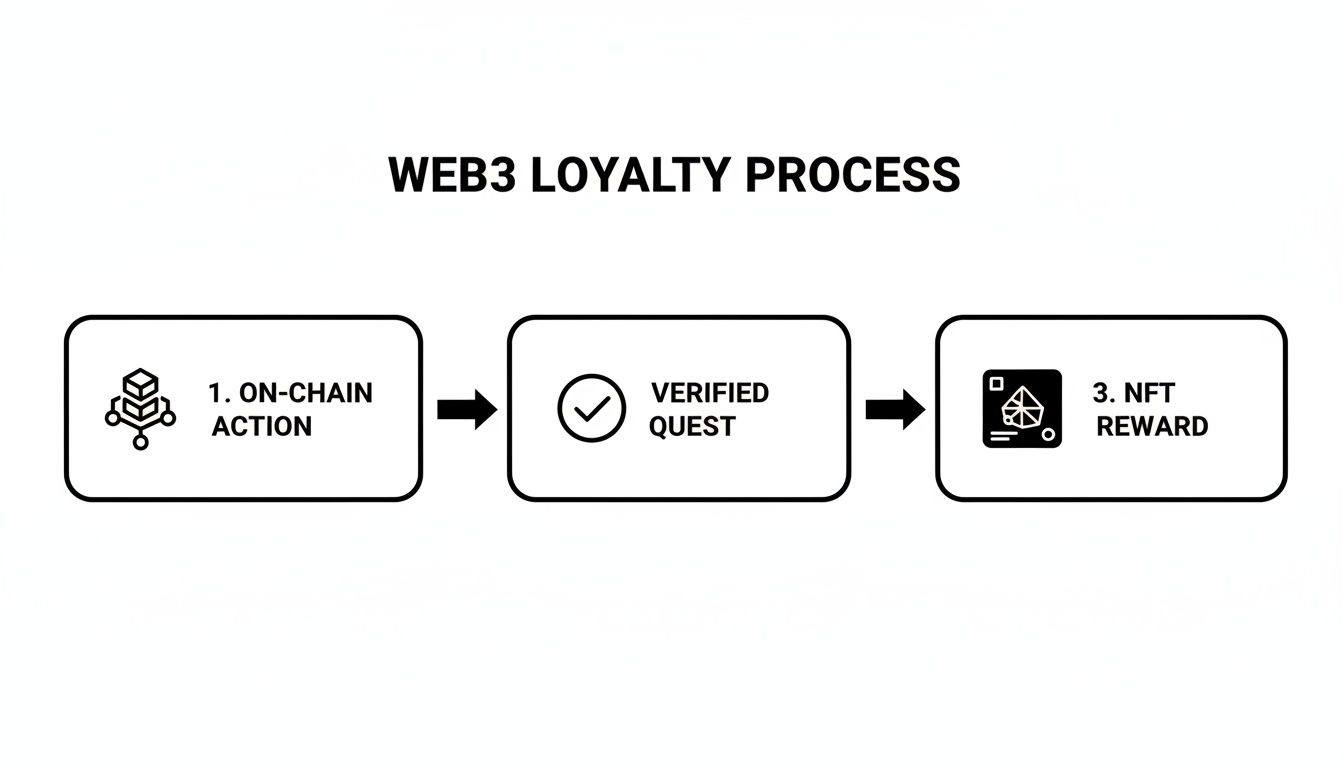
It’s all about creating a trustworthy system where meaningful contributions are automatically seen and rewarded.
Phase 3: Structure a Multi-Level Reward System
Finally, Aura builds a tiered reward system to give everyone a clear path to climb. This taps directly into that powerful human desire for status and achievement, which is key to keeping people engaged over time.
By rewarding both simple social tasks and complex on-chain actions, a project can build a broad, engaged, and highly valuable community from day one.
Reward Tiers:
- Bronze Tier (500 AP): Unlocks a special "Aura Explorer" role in Discord. Simple, but effective.
- Silver Tier (1,500 AP): Grants an exclusive "Early Supporter" NFT badge. A digital trophy.
- Gold Tier (3,000 AP): Secures a guaranteed whitelist spot for the upcoming token sale. The grand prize.
This blueprint gives Aura a clear, actionable game plan from A to Z. It’s a campaign that doesn't just attract eyeballs—it educates users and turns them into loyal advocates. This is a perfect example of how gamification in loyalty programs can transform marketing from a chore into a community-building adventure.
How to Measure the Success of Your Program
Look, fun and games are great, but a gamified loyalty program has to do more than just entertain. It needs to deliver real, measurable results for the business. To prove its value and figure out how to make it even better, you have to look past fluffy vanity metrics like your total member count. The real story is in the key performance indicators (KPIs) that show how your program is actually changing what your customers do.
Think of it this way: launching a gamified program without clear KPIs is like playing a video game without a scoreboard. You might be having a blast, but you have no idea if you’re actually winning. The right metrics are your scoreboard, telling you exactly where your strategy is crushing it and where it needs a little fine-tuning.
Key Metrics That Truly Matter
To get a real sense of your program's health, you need to zero in on KPIs that show genuine customer engagement and a direct impact on your bottom line. These numbers tell a much more interesting story than any surface-level stat.
Active User Rate: This is your program's pulse. Don't just count sign-ups; track the percentage of members who actually complete at least one quest within a given timeframe, like a week or a month. A high active rate is a clear sign that your program is sticky and compelling enough to keep people coming back.
Quest Completion Rate: This metric tells you which of your game mechanics are actually a hit with your audience. If "Refer a Friend" quests are getting completed left and right but "Write a Review" tasks are collecting dust, you know exactly where to shift your focus and your rewards.
Purchase Frequency: Here's where you connect the dots between fun and revenue. You need to measure how often members who participate in your challenges are making a purchase compared to those who don't. The data is pretty compelling here—users who engage with loyalty challenges have been shown to purchase up to seven times more frequently.
The ultimate goal is to see a clear lift in Lifetime Value (LTV) for your engaged members. When your most active players are also your most valuable customers over the long haul, you've proven your program's ROI beyond a shadow of a doubt.
Using A/B Testing to Optimize Your Game
Once you’re tracking the right numbers, you can start running experiments to make your program even more effective. A/B testing is your secret weapon for this. It’s all about creating two slightly different versions of a game mechanic, showing them to different groups of your users, and seeing which one gets better results.
This data-first approach takes all the guesswork out of making improvements.
Simple A/B Test Ideas:
Competition vs. Collaboration: Pit one group against each other with a competitive leaderboard where individuals race to the top. For another group, set up a collaborative team goal where everyone gets the prize if the group hits a collective target. Then, just measure which approach drives more overall quest completions.
Reward Variation: Try testing a quest that offers a guaranteed, fixed reward (like "Complete this for 100 points") against one that offers a small chance at a much bigger prize ("Complete this for a chance to win 10,000 points"). This is a great way to figure out if your audience is motivated more by certainty or by the thrill of the win.
By constantly measuring, testing, and tweaking your mechanics, you can ensure your gamification in loyalty programs isn’t just a fun feature—it’s a powerful engine driving real community growth and business success.
Got Questions? Let's Get Them Answered.
Jumping into gamification, especially with Web3 in the mix, can feel like you're learning a new language. You're bound to have questions. Getting straight answers is the best way to build a program that actually clicks with your community.
Let's clear up some of the most common sticking points, from what this all costs to how you can keep cheaters out.
How Much Will a Gamified Loyalty Program Set Me Back?
The honest answer? It depends. If you go the old-school route and hire a team to build everything from scratch, you could easily be looking at tens or even hundreds of thousands of dollars just in development costs. For most, that's way too slow and way too expensive.
Thankfully, there's a better way. Modern no-code platforms have completely changed the game, letting you launch sophisticated campaigns for a straightforward subscription fee. This moves the cost away from heavy engineering and puts it where it belongs: on great strategy and rewarding your community. The smartest move is to start with a small, focused campaign, see what kind of return it brings, and then build from there.
What's the Single Biggest Mistake People Make With Quests?
Making them a grind. It's that simple. If your quests feel like a boring to-do list and the rewards seem miles away, people will tune out fast. The whole point is to create a sense of "playful work," not just add another chore to their day.
You can dodge this bullet by mixing things up. Offer a good balance of easy wins that new members can score right away, alongside bigger, more satisfying challenges for your super-users. This tiered approach is the secret to keeping everyone, from the newbie to the veteran, hooked.
A great gamified program feels like an adventure, not a checklist. When the quest itself is genuinely fun, the reward is just the cherry on top.
How Do I Stop Bots and Cheaters from Ruining Everything?
This is a huge deal, and your best bet is a defense-in-depth strategy. Just relying on one simple check is asking for trouble—bots are getting smarter all the time. You need to layer your defenses.
Here’s a practical game plan for building a stronger wall:
- Bring in the AI: Use tools that have smart, AI-powered fraud detection built right in. These systems can spot shady patterns and verify social media actions automatically.
- Create On-Chain Hurdles: Make it expensive for bots to operate at scale. Requiring users to hold a specific token or NFT for a set period of time is a classic, effective move.
- Demand Human Creativity: Design quests that bots just can't fake. Things like submitting original fan art or leaving a thoughtful, relevant comment in a discussion forum are incredibly difficult to automate well.
When you weave these tactics together, you create a space where your real community members can thrive and get rewarded for their authentic contributions.
Ready to build a gamified loyalty program that’s engaging, secure, and doesn't require a single line of code? With Domino, you can launch powerful Web3 quests in minutes. Design, automate, and grow your community with our no-code toolkit. Start building with Domino today!