Your Guide to a Follow on X Reward Quest That Actually Works

A "Follow on X reward" quest is one of the simplest, yet most effective, plays in the Web3 marketing book. It’s all about giving users a small incentive to follow your project's official X (formerly Twitter) account. This isn't just about boosting follower counts; it's the first step in converting casual browsers into engaged community members. You're giving them a verifiable and rewarding action that kicks off their journey with you. In the hyper-competitive Web3 world, this is how you build early momentum.
Why Follow on X Quests Are a Web3 Growth Engine

Let's be real: growing a Web3 community on X is a tough grind. You’re not just fighting for attention; you're trying to build a tribe of genuine believers. This is exactly where a ‘Follow on X’ quest shines. It’s way more than just a vanity metric hack.
Think of it as a strategic handshake. You offer a tangible reward—maybe some tokens, an NFT allowlist spot, or access to exclusive content. In exchange, a user takes that first, simple step into your world. It's a low-friction entry point that can turn a passive scroller into an active participant. Essentially, it’s the very top of your community funnel.
Building Beyond Vanity Metrics
The real win here isn't the follower number itself. It’s what that number represents: a pool of people who've raised their hands and shown interest. This audience is now primed for your project announcements, product updates, and more ambitious community campaigns. A well-executed quest gives you a direct line to your earliest adopters. We dive deeper into nurturing these followers in our guide to effective Web3 community building strategies.
This whole dynamic got a major boost when X started rolling out payment-like features in 2023, blurring the lines between social interaction and micro-transactions. With creator revenue sharing now a thing, the economic link between creators and their audience is stronger than ever. This makes an incentivized action like a follow on x reward feel completely natural to users.
Key Takeaway: A 'Follow on X' quest is less about the follow and more about sparking a connection. It's your first chance to deliver value, build trust, and invite someone into your project's journey in a verifiable way.
For a closer look at how to structure incentives, diving into guides on content rewards programs can offer some great insights. At the end of the day, this simple task is a powerful lever that turns a basic social action into a rewarding experience that fuels real, sustainable growth.
Key Elements of a High-Impact Follow Quest
To make sure your quest hits the mark, you need to get a few core components right from the start. Here's a quick rundown of what really matters.
| Component | Why It's Crucial | Top Consideration |
|---|---|---|
| Clear Incentive | This is the hook. It needs to be valuable to your audience. | Is the reward desirable and easy to understand? |
| Simple UX | Any friction will kill your conversion rate. | Can a user complete the quest in less than 60 seconds? |
| Reliable Verification | You need to trust the data and prevent fraud. | Does your tool automatically confirm the follow? |
| Strong Call to Action | Tell users exactly what to do and why. | Is the language direct, exciting, and benefit-driven? |
Nailing these elements is the difference between a quest that drives a trickle of followers and one that opens the floodgates for your community.
Designing a Quest People Want to Complete
Let's be real: a great "Follow on X" quest is way more about the experience than the prize itself. Sure, a juicy reward gets people through the door, but it's the smooth, engaging journey that turns a click into a genuine community member. This is where your strategy makes all the difference.
Before you even start daydreaming about rewards, you have to lock in your goals. What are you actually trying to do here? Are you going for a massive, rapid follower spike right before a big announcement? Or are you trying to attract a very specific, high-value crowd, like DeFi power users or die-hard NFT collectors?
Your answer completely changes how you build the quest. A broad goal might call for a universally appealing reward, while a niche target demands something a bit more exclusive and special.
Setting Clear Goals and Rewards
Once you know your "why," you can figure out the "what." The reward needs to feel right for the action. Following an account is a low-effort task, so the reward shouldn't be over the top, but it still has to be something people actually want.
Here are a few reward structures I’ve seen work well:
- Token Airdrops: These are fantastic for broad appeal and a great way to get users into your project's ecosystem for the first time.
- NFT Allowlist Spots: Perfect for targeting dedicated collectors and building serious hype around an upcoming mint.
- Exclusive Content Access: This is ideal for rewarding users with something they can't get anywhere else, like a deep-dive research report or a sneak peek at a new product feature.
The trick is to offer real value without draining your project’s treasury. It's a fine line to walk between being generous and being sustainable. A big part of this is also understanding proven strategies to increase social media engagement, which helps you maximize how people interact with your quest on X.
A classic mistake I see all the time is over-rewarding simple tasks. You end up attracting mercenaries who just dump your token and vanish. The goal is to hit that sweet spot that pulls in genuine interest, not just airdrop hunters.
Crafting a Frictionless User Experience
Okay, you've got your goal and your reward. Now, let's talk about the user flow—this is critical. Your quest description needs to be more than just a set of instructions; it has to be an exciting call to action.
Ditch the boring "Follow us on X." Try something with more energy, like, "Follow us on X for exclusive alpha and get your hands on 100 $TOKEN instantly!" See the difference?
The journey from seeing the quest to claiming that reward needs to be dead simple. Every extra click, every confusing instruction, every slow-loading page is a point where you'll lose people.
This is where a tool like Domino really shines. It automates the verification, creating that clean "click, follow, verify, claim" flow that feels instant and satisfying. A positive first impression like that goes a long way and makes users much more likely to stick around long after the quest is over.
Bringing Your Quest to Life on Domino
Alright, you've got your plan sketched out. Now it's time to take it from the whiteboard to the real world and build your "Follow on X" quest in Domino. This is where the rubber meets the road, and the choices you make are crucial for your campaign's success and security. It's not just about plugging in text; it's about setting up the right rules for the game.
The very first thing you need to nail down is verification. How are you going to actually know if someone followed your X account? This is a massive decision that directly impacts how users feel about your quest and how well you can fend off bots and farmers. You've got two main ways to go.
This little diagram sums up the whole process perfectly – it's a loop of setting goals, picking the right rewards, and making the user flow smooth as butter.
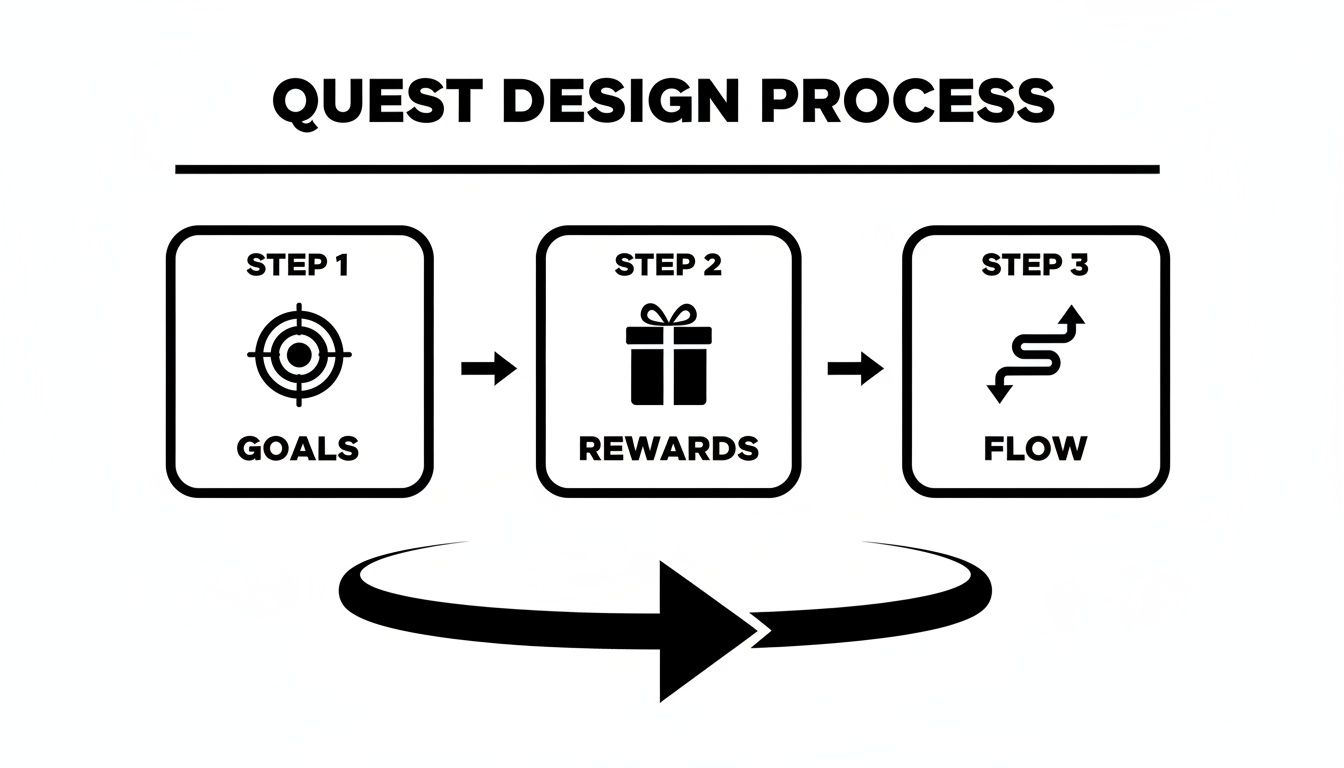
As you can see, the sweet spot is where your goals, the user's reward, and the experience all line up.
API vs. Manual Verification: What's the Right Call?
You've basically got two options on the table, and they're pretty different.
- API-Based Verification: This is the "set it and forget it" option. You connect your project's X account to Domino, and the system automatically checks if a user is following you in real-time. It's lightning-fast, handles huge numbers of participants without a sweat, and gives users that instant "quest complete" dopamine hit.
- Manual Verification: Here, you're asking users to do the work. They have to send you proof, usually a screenshot, and then someone on your team has to sift through submissions one by one. It’s slow and a total time-sink, but it does give you a human set of eyes on every entry, which might make sense for super high-value rewards or if you can't get API access for some reason.
Honestly, for almost every "Follow on X" campaign, API verification is the only way to go. That manual review process adds a ton of friction and creates a delay. In Web3, that delay is a momentum killer and a surefire way to get people to just give up and walk away.
Dialing in the Quest Details
Once you've settled on verification, setting up the quest in Domino is pretty straightforward. You'll link your X account, tell the system exactly which handle users need to follow, and write a killer description of the task and what's in it for them.
Pro Tip: Don't just say, "Follow us on X." Give it some energy! Try something like: "Follow @YourProject right now to instantly unlock your exclusive NFT mint spot!" That simple change in how you frame it can make a huge difference in how many people actually complete the quest.
Don't forget the nitty-gritty of the reward itself. The rules you set can totally change user behavior. Just look at X's own Subscriptions program. They only process payouts after a creator hits a $50 minimum, and even then, there's a 60-day delay. Rules like that directly influence who participates and how engaged they are.
Ready to see how this fits into a bigger strategy? Check out our deep dive on using Domino as your main Web3 growth engine. It covers how to use quests for more than just a quick follower bump. By getting these details right from the start, you're not just launching a quest—you're building a secure, efficient, and seriously effective campaign.
Keeping Your Campaign Safe from Bots and Scammers
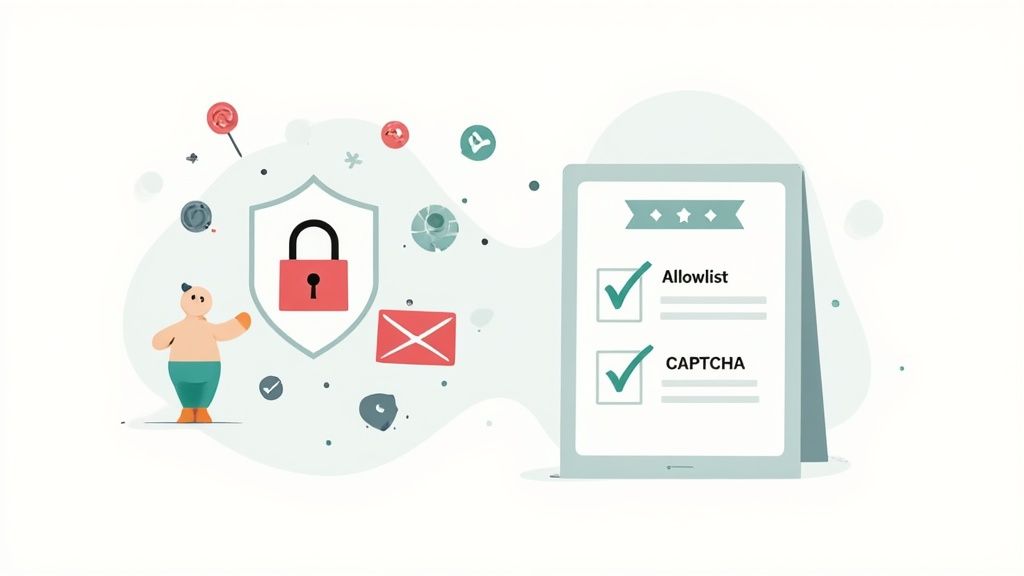
In Web3, if you’re offering free rewards, you’re basically a lighthouse for bots. I’ve seen successful quests get absolutely swarmed in minutes, draining budgets and leaving projects with a follower list full of fakes. This is why having a solid defense plan for your follow on x reward campaign isn't just a nice-to-have; it's essential.
The trick is to create smart barriers. You want to add just enough friction to stop an automated script dead in its tracks, without frustrating a real human user. It's not about building an impenetrable fortress, but about making it more trouble than it's worth for the scammers.
This is how you make sure your rewards are going to people who might actually join your community, not just a bot farm built to bleed you dry. Skip these steps, and you might as well just set your quest budget on fire.
Your First Line of Defense
Let's start with the basics. Your first moves should be all about setting up simple entry rules that can filter out a massive chunk of the low-effort bots and brand-new scam accounts.
Think of these as your foundational tactics:
- Wallet Age & History: This is a big one. Set a requirement for wallets to be a certain age—say, created over 30 days ago—or have a minimum transaction history. This one filter alone knocks out a huge number of freshly created bot wallets.
- CAPTCHA Challenges: It’s a classic for a reason. A simple CAPTCHA stops automated scripts before they even get a chance to try and complete the quest.
- Allowlisting: If you're running a campaign with high-value rewards, an allowlist is your best friend. It means only wallets you've pre-approved can even participate, giving you total control.
Here’s what a bot attack looks like in the wild: a sudden flood of new X accounts, all with no profile pics or activity, completing your quest at the same time. It's a massive red flag. Having these basic checks in place is your best shot at stopping them.
Advanced Tactics for High-Stakes Quests
When you’re dropping valuable tokens or exclusive NFTs, the stakes are higher, and so are the efforts of the scammers. A simple "did they follow?" check just won't cut it. This is where you need to layer your security, blending automated checks with a bit of human intelligence.
For those really high-value campaigns, manual reviews are your secret weapon. I know, it sounds time-consuming, but for verifying the big winners, it's absolutely worth it. You can even bring in some automation to help. For instance, you can use AI to do a deeper dive into user activity. We have a guide on how to review quest tweets with GPT-4 that shows how to spot weird patterns that a simple API check would totally miss.
By mixing automated rules with these strategic manual spot-checks, you build a much stronger security net. It’s the best way to ensure your most valuable rewards end up with real people who are genuinely interested in what you're building.
Measuring What Matters and Scaling Your Success
Alright, your quest is live. The community’s hyped, and you’re seeing that follower count on X climb. It’s tempting to pop the champagne and call it a win, but hold on—the real work is just getting started. How do you actually know if your follow on X reward campaign was a home run?
It’s all about measuring what really matters and using those insights to fuel your next big move.
Honestly, just looking at the raw follower number is a rookie mistake. A bigger audience is nice, of course, but the gold is in the quality and engagement of that audience. You're not just trying to collect followers; you're hunting for future token holders, protocol users, and die-hard evangelists for your project.
Looking Beyond the Follower Count
To get the real story, you’ve got to dig into the metrics that signal long-term value. Start by asking yourself the tough questions. Are these new people sticking around, or are they hitting 'unfollow' the second they get their reward? More importantly, what are they doing on-chain after they join?
Here’s what you should be tracking:
- Participant Retention: Keep an eye on how many new followers are still with you after a week, then a month. A high retention rate is a great sign that your project and content are actually connecting with them.
- On-Chain Activity: This is the big one. Did these new wallets interact with your dApp? Stake some tokens? Mint an NFT? This is the clearest proof you've acquired a high-quality user.
- Completion & Drop-off Rates: Check the analytics in your quest platform. How many people started the quest versus how many actually finished it? A steep drop-off might mean a step is too confusing or you have a technical bug in your flow.
- Engagement on X: Look at more than just the number. Are the new folks actually liking, reposting, and replying to your content? Or did you just add a bunch of silent lurkers?
I’ve seen projects get pumped about gaining 10,000 followers from a quest, only to find out 90% were bots or hit-and-run users who unfollowed immediately. Forget them. Focus on the 1,000 real people who stick around—that’s your actual new community.
This kind of deep-dive analysis gives you the true ROI of your quest. It tells you whether you're attracting the right crowd or just paying for a quick hit of attention.
From a Single Quest to a Growth Flywheel
A killer "Follow on X" quest should never be a one-and-done campaign. Think of it as the first block in your community-building empire. Every campaign you run gives you fresh data and new insights that make the next one even smarter. You start to learn exactly what kind of rewards motivate your audience and which messages cut through all the crypto noise.
A well-designed reward program can even have a direct, measurable impact on market activity. For example, incentives that require users to hold your token can create a temporary supply squeeze and drive up trading volume. We saw this when one project's holder program sparked a 2% price increase and a 12% jump in volume. You can dig into how these mechanics work in this market analysis.
Once you've got this initial base of engaged followers, you can build on that momentum. Your next move could be a quest that asks for a bit more, like trying out your testnet or joining a specific channel in your Discord. Each quest should build on the last, guiding a user on a journey that strengthens their connection to your project. This is how you turn a simple follower into a loyal, active community member who brings real, lasting value.
Got Questions? We've Got Answers.
Even with a straightforward "Follow on X" quest, you're bound to have a few questions pop up. It happens to everyone. I've seen these same queries come up again and again from Web3 marketing teams, so let's get them out of the way right now.
Think of this as your personal FAQ, built from real-world experience.
What’s the Right Reward Size?
Ah, the million-dollar question. The honest, no-fluff answer? It completely depends on what you're trying to achieve.
There's no magic number, but a solid starting point for a simple follow is somewhere in the $0.50 to $2.00 range. This is usually the sweet spot—enough to get someone to click "follow" but not so much that you attract a swarm of mercenaries who just want to dump your token and disappear.
But don't just pick a number and run with it. You need to think about:
- Who you're after: Trying to catch the eye of a DeFi whale? You'll need a much bigger carrot than if you're targeting a broad airdrop audience.
- Your project's maturity: If you're an early-stage project, you can often offer less. Your first believers are there for the vision, not just a quick buck.
- The total ask: A simple follow is easy. But if you start bundling it with other tasks, like joining a Telegram or Discord, you need to bump up the reward to match the extra effort.
How Do I Handle Verification Issues?
Nothing kills the vibe of a campaign faster than verification problems. It’s a huge source of user frustration, and I've seen it derail otherwise great quests.
The most common snag is the lag between when someone follows you and when the system actually confirms it. Your best defense is using a platform with a really solid API connection to X, which cuts down that delay. Something like Domino handles this on the backend so you don't have to worry about it.
Then there's the classic "follow-and-flee." Someone follows, snags the reward, and immediately unfollows. You can't prevent it entirely, but you can disincentivize it. Some platforms let you run periodic checks. A better strategy I've seen work well is to make future, higher-value quests dependent on still following the account. It creates a real reason to stick around.
The goal is to make verification feel instant and invisible to the user. Any delay or error adds friction and damages their first impression of your project. A smooth verification process is non-negotiable for a successful follow on x reward campaign.
Can I Get in Trouble for This?
This is a smart question to ask. X (the platform we all still call Twitter) definitely has rules against "platform manipulation," and you don't want to end up on the wrong side of them.
The secret is to frame your quest around genuine community building, not just artificially pumping your follower count. Avoid any language that sounds spammy or tells people to follow and unfollow.
Be transparent. Be clear about what users need to do and what they get in return. Position it as an invitation to join your community and get the latest updates—not just a transaction. As long as you’re providing real value and being upfront, you’re almost always in the clear.
Ready to build a quest that drives real growth without the headaches? With over 130 templates and AI-powered verification, Domino makes launching a secure and effective "Follow on X" campaign effortless. Get started for free on Domino.run.