Design a Loyalty Program for Web3 That Builds Real Community
If you want to design a loyalty program that actually works, you have to think beyond just giving stuff away. The real goal is to build a system that methodically turns passive users into your biggest champions. This means getting crystal clear on your goals, truly understanding who's in your community, and rewarding the actions that genuinely add value. It's time to graduate from one-off airdrops and start building sustained, on-chain engagement that fuels real growth.
Why Your Web3 Project Needs a Loyalty Program
Forget the old-school punch cards and generic discount codes. In Web3, a loyalty program isn't just a nice-to-have marketing tactic; it's the engine that drives your entire growth loop. Traditional loyalty programs are all about transactions. A Web3 program, on the other hand, is built on co-creation and shared ownership. It’s the very mechanism that can transform a passive token holder into a motivated contributor who actively helps with user acquisition and shouts your brand's name from the rooftops.
The whole idea is to guide your community members along a specific journey. This visual breaks down the ideal progression, moving people from simply holding a token to becoming a true evangelist for your project.
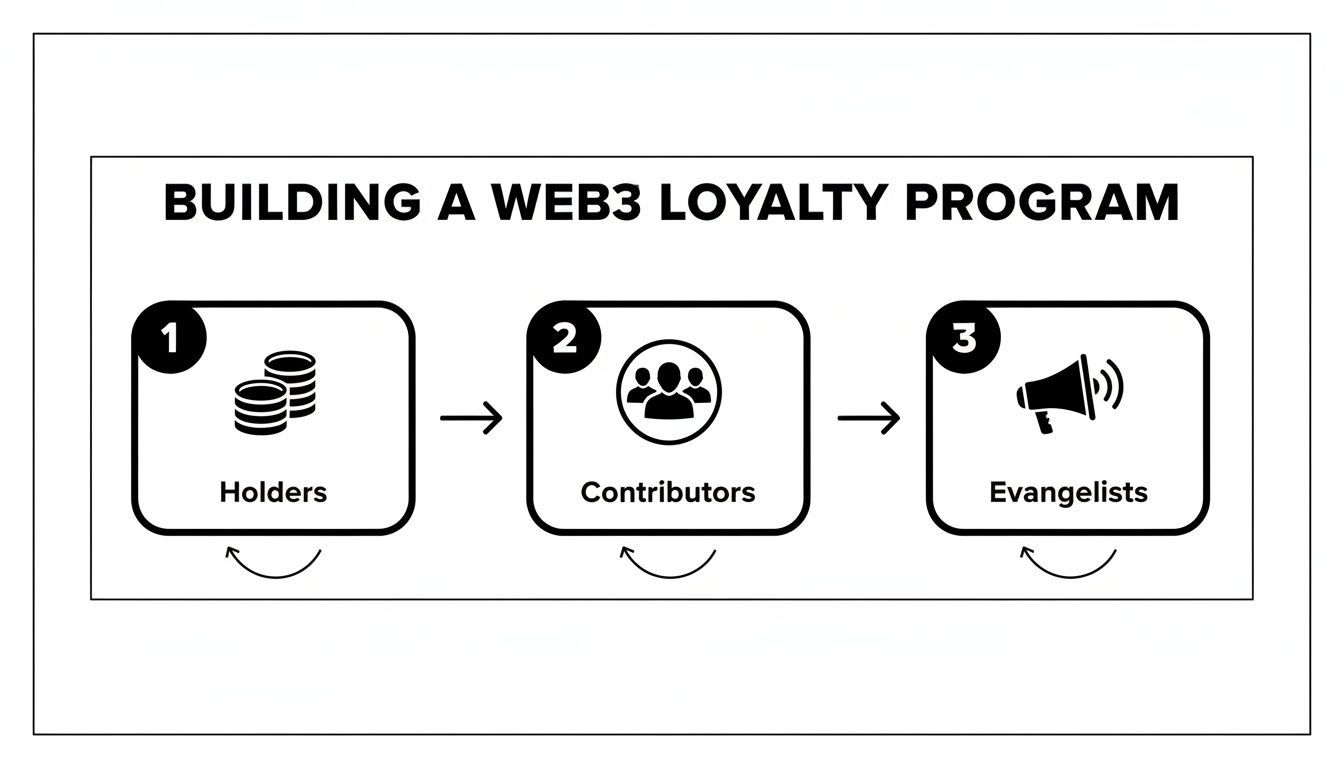
As you can see, a well-thought-out program is all about nurturing your community. You take them from being a simple Holder to an active Contributor, and finally, to a vocal Evangelist.
Shifting from Airdrops to Sustainable Engagement
Let’s be honest, one-off airdrops create a quick buzz but rarely build a lasting community. They attract mercenaries, not missionaries. The future of Web3 growth belongs to programs that reward consistent, valuable activities over the long haul. Think of it less like a one-night stand and more like building a real relationship.
This is where a tool like Domino really changes the game. With a library of over 130 quest templates, you can quickly spin up campaigns that reward the right kind of behaviors, like:
- Social Amplification: Give points for verified retweets, genuine Discord reactions, or participating in Telegram raids.
- On-Chain Actions: Incentivize the stuff that matters, like NFT staking, providing liquidity, or casting a vote in governance.
- Community Contribution: Recognize and reward members who create awesome user-generated content or take the time to onboard newbies.
Here's a powerful stat to remember: a mere 5% increase in customer retention can boost profitability by a staggering 25%. It's a stark reminder that focusing on sustained engagement is one of the highest-impact things you can do for your project.
The Financial and Community Impact
The numbers don't lie. The global loyalty market is on track to blow past $18.2 billion by 2026, a massive wave that Web3 is perfectly positioned to ride. Look at major brands like Sephora—a whopping 80% of their sales come from loyalty members. This proves that a dedicated community isn't just a vanity metric; it's a financial powerhouse.
For Web3 projects using Domino, this translates directly into tangible growth in token holders and active DAO voters. Brushing up on broader customer retention strategies can add even more firepower to your Web3 program. And with Domino having already powered over 25 million completed quests, you know the framework is scalable and proven to work.
Defining Your Goals and Understanding Your Audience
Jumping straight into designing rewards without a solid plan is a classic mistake. It's like navigating the blockchain blindfolded. Before you even think about quests or NFTs, you need a crystal-clear strategy. The very first step in building a loyalty program that actually moves the needle is to define what success looks like for your project.
What are you really trying to achieve? The answer can't just be "more engagement." You've got to get specific and set measurable goals that line up with your overall roadmap. This clarity will guide every single decision you make, from the quests you dream up to the rewards you offer.
Setting Clear and Actionable Goals
Your loyalty program's goals should be tied directly to your project's most critical needs. Are you struggling to keep users around, or is your main priority to get louder on social media? Maybe your real focus is on driving more on-chain activity.
Here are a few common goals I see Web3 projects chasing:
- Increase Daily Active Users (DAU): Boost the number of unique wallets interacting with your dApp or community platforms each day.
- Amplify Social Voice: Grow your reach on platforms like X (formerly Twitter) by sparking genuine user-generated content and shares.
- Boost On-Chain Transactions: Drive specific actions that add real value, like staking, providing liquidity, or getting involved in governance votes.
- Improve User Onboarding: Use the program to walk new members through their first key actions, turning them into active participants faster.
A critical metric to keep in mind here is the Customer Lifetime Value (CLTV). At their core, that's what loyalty programs are designed to do—enhance it. By rewarding repeat actions, you're not just goosing short-term metrics; you're building a more valuable, long-term user base.
To really nail this down, you have to connect your high-level goals to concrete, trackable metrics. A well-defined KPI is the only way to know if your program is actually working or just creating noise.
Matching Loyalty Program Goals with Actionable KPIs
This table pairs common Web3 project goals with specific Key Performance Indicators (KPIs) to effectively track the success of your loyalty initiatives.
| Goal | Primary KPI | Secondary KPI | Sample Domino Quest |
|---|---|---|---|
| Boost User Retention | Monthly Retention Rate (%) | Average Session Duration | "Log in 3 days in a row" |
| Amplify Social Voice | # of Social Shares with Hashtag | Social Media Engagement Rate | "Retweet our latest announcement" |
| Increase On-Chain Activity | # of On-Chain Transactions | Total Value Locked (TVL) | "Stake at least 100 tokens" |
| Grow the Community | # of New Discord Members | Referral Conversion Rate (%) | "Invite 3 friends to the server" |
| Drive Product Adoption | Feature Adoption Rate (%) | # of Active Wallets per Day | "Mint your first NFT on our platform" |
Having this kind of table handy keeps everyone on the same page and makes it way easier to measure your ROI.
Segmenting Your Community for Maximum Impact
Once your goals are locked in, the next step is to figure out who you're trying to motivate. Your community isn't a monolith; it’s a diverse group of people with wildly different motivations and levels of commitment. A one-size-fits-all approach is doomed to fall flat.
The real superpower of a loyalty program is its ability to cater to different user segments. By understanding what drives each group, you can craft incentives that feel personal and truly rewarding.
Think of your community in a few distinct buckets:
- The Superfans (Evangelists): These are your most active and vocal supporters. They're already contributing, so your program should aim to empower them further with exclusive access, recognition, and tools to help them spread the word.
- The Active Contributors: These members pop in regularly but might need a little nudge to take the next step. Gamified quests and tiered rewards can be incredibly effective at encouraging them to deepen their involvement.
- The Casual Lurkers (Holders): This is often your biggest group. They hold your token or follow your project but rarely interact. Your goal here is to activate them with simple, low-effort tasks that give them a taste of what your community has to offer.
- The Whales: These users hold significant on-chain assets. Their motivation is often financial, so rewards tied to governance influence, early investment opportunities, or exclusive on-chain perks will hit the mark.
Getting a handle on these groups is fundamental. For a deeper dive into this, our guide on Web3 community building strategies offers some great frameworks.
By mapping out the user journey for each segment, you can pinpoint the exact moments where a loyalty incentive will make the biggest impact. For instance, a "first transaction" bonus is perfect for a lurker, while an "invite-a-friend-to-stake" quest is tailor-made for a superfan. This targeted approach is how you make sure your program resonates with everyone, turning passive observers into the powerful, dedicated community every Web3 project dreams of.
Crafting Rewards and Quests People Actually Want
Okay, you've figured out your goals and who you're talking to. Now comes the fun part: building the engine of your loyalty program. This is where you design the rewards and quests that will either hook your community or get completely ignored.
An irresistible reward system is what separates a program that dies after a week from one that creates a genuine, self-sustaining army of evangelists.
Forget just tossing out tokens. A truly great Web3 loyalty program mixes on-chain and off-chain rewards to hit on different user motivations. It’s all about understanding the psychology of what makes a reward feel valuable, not just what it costs you to offer.
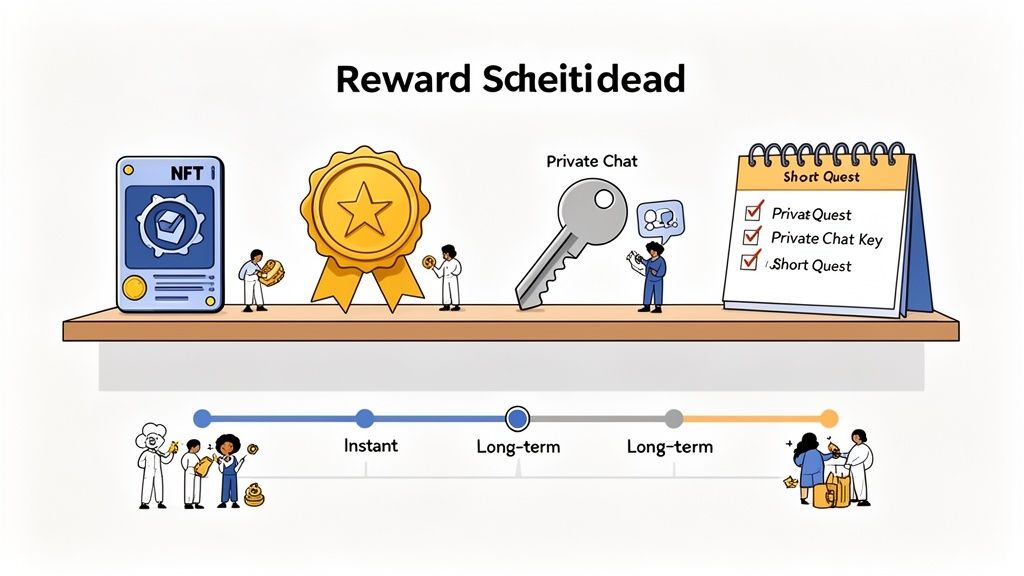
The trick is to balance that instant hit of dopamine with long-term goals that keep people coming back. Not everyone is motivated by the same thing, so a diverse menu of rewards is always your best bet.
Bridging On-Chain and Off-Chain Worlds
A powerful program connects the dots between your digital community spaces and your on-chain ecosystem. Think about rewards that cater to different desires—like status, exclusive access, and true ownership.
- Exclusive On-Chain Assets: These are your crown jewels. Think limited-edition NFTs, soulbound tokens (SBTs) that work like a badge of honor, or even a cut of protocol revenue for your top contributors.
- Special Off-Chain Perks: These rewards are all about status and access. This could be a private role in Discord, early access to new product features, or an invite to an exclusive AMA with the founding team.
The real magic happens when you combine them. For instance, a quest could reward a user with an off-chain "OG" role in Discord for completing an on-chain action like staking a certain number of tokens. This sends a clear message: all contributions matter, whether on or off-chain.
Designing Quests That Actually Drive Action
With your rewards mapped out, it’s time to build the quests that users will complete to earn them. This is where you can get really creative. Using a tool like Domino with its 130+ pre-built templates gives you a massive head start, letting you focus on the strategy instead of building everything from scratch.
Your quests should be a mix of simple, quick wins and more complex, high-value actions.
The psychology behind a great quest is simple: it should feel achievable but meaningful. A user should feel a sense of accomplishment and progression, which keeps them coming back for more.
Here’s a good way to think about structuring your quests into campaigns:
- Onboarding Quests: Guide new users through their first crucial steps. Think "Connect your wallet," "Join our Discord," or "Make your first swap on our DEX." These are low-friction tasks that get people activated quickly.
- Social Amplification Quests: These turn your community into a marketing engine. Tasks like "Retweet our announcement" or "Share our content on Farcaster" are classics for a reason. With Domino’s AI verification, you can make sure the actions are legit.
- On-Chain Engagement Quests: These quests directly impact your core KPIs. You can incentivize actions like "Stake 100 tokens," "Provide $50 in liquidity," or "Vote on the latest governance proposal."
- Community Contribution Quests: Reward users for creating value for you. This could be anything from "Write a thread about our project" to "Create a tutorial video." This kind of user-generated content is pure gold for building social proof.
The goal is to create a journey. You might start a user with simple social tasks and slowly introduce them to more involved on-chain actions as they get more bought into your ecosystem. This natural progression is the key to long-term engagement.
The Power of Gamification and Storytelling
Don't just dump a random list of tasks on your users. The best loyalty programs weave their quests into a compelling story. Structure your quests into campaigns or "seasons" with a clear theme and a big prize at the end. This turns participation from a chore into a game people want to play.
A simple system of daily check-ins can be incredibly effective for building habits and keeping your project top-of-mind.
Plus, the data is overwhelming: well-designed programs create fierce brand loyalty. In fact, 79% of shoppers recommend brands that offer good loyalty programs—a critical insight for Web3 projects where viral growth is everything. When you see that 57% of consumers globally spend more on brands they are loyal to, the ROI of a program that truly connects with people becomes obvious.
By using Domino's toolkit to automate a mix of on-chain and off-chain quests, you tap directly into this dynamic. The platform's AI-powered verification for tasks like tweet engagement ensures fairness and stops bots from ruining the experience for your real community. This is how you design a program that doesn't just reward action, but builds a loyal, engaged, and powerful community around your project.
Making Sure Your Program Fits Into Your World
Let's be real: you can design the most brilliant loyalty program on the planet, but if it’s a pain to find and use, it’s dead on arrival. The slickest quests and most epic rewards mean nothing if they’re buried behind a clunky interface or feel totally disconnected from where your community actually hangs out.
This is where the rubber meets the road. It’s all about making your program feel like a natural extension of your brand, not some bolted-on marketing gimmick.
The goal is to eliminate friction entirely. You want people to stumble upon it, dive in, and start earning rewards without ever feeling like they’re being yanked out of their usual flow. That means embedding your program right where your community already lives and breathes every single day.
Meet Your Community Where They Are
Think about it from your users' perspective. Where do they spend their time? Are they constantly buzzing in Discord? Grinding for roles on Zealy? Firing off messages in your Telegram channel?
Whatever the answer, your loyalty program needs to be there. Forcing everyone to a separate, unfamiliar website is just asking for a massive drop-off in participation.
With a flexible tool like Domino, this becomes much easier. You can push your program out across different fronts, all at once:
- Zealy Integration: If your community is already all-in on gamified quest boards, a direct Zealy integration is a total no-brainer.
- Custom White-Label Portals: Want a fully branded experience that lives on your own turf? A white-label portal gives you complete control over the look and feel.
- Discord and Telegram Bots: You can embed quests and leaderboards right inside your servers. This lets people participate without ever having to leave the conversation.
This isn’t just about convenience. It’s about weaving your program into the very fabric of your community’s daily life.
Just look at how a platform like Zealy presents quests. It’s clean, intuitive, and practically begs users to jump in and get started.
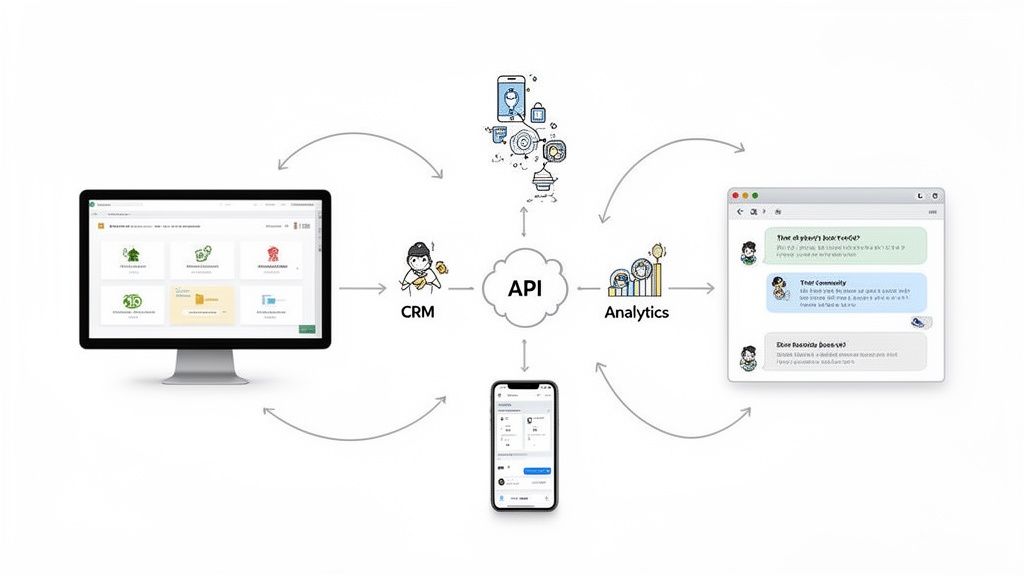
An interface like this makes it incredibly easy for people to see what’s available and start participating immediately.
Hooking Your Program Into Your Marketing Stack
Getting this right isn't just about what the user sees. To really get the most out of your loyalty program, it needs to talk to the other tools you’re already using for marketing and analytics. APIs are your best friend here, transforming your program from a standalone campaign into a deeply connected growth engine.
Imagine this flow:
- A user does something important in your dApp, like making their first trade.
- Your dApp’s backend fires off an API call to your loyalty platform (like Domino).
- The platform instantly verifies it and rewards the user with points or maybe even an on-chain collectible.
- At the same time, this data gets pushed to your CRM, automatically tagging the user as "Activated."
This creates a bit of magic for the user—they get an instant reward for doing something valuable. For your team, it provides ridiculously rich data, helping you pinpoint exactly which actions lead to long-term stickiness. A connected system gives you a level of automation and personalization that's just impossible with a siloed setup.
Key Takeaway: When you integrate your loyalty program with your CRM and analytics tools, you're not just collecting participation data. You're turning it into actionable insights that reveal the true ROI of your efforts.
Building a Journey Without the Bumps
Every extra click, every new tab you force someone to open, is a chance for them to give up and walk away. A properly integrated system smooths out all those bumps. For instance, using single sign-on (SSO) with a user’s wallet or Discord account means they don't have to create yet another username and password.
The ideal experience should feel almost invisible. A user sees a quest in Discord, clicks a link that takes them to a pre-authenticated portal, completes an on-chain task, and sees their points update in Discord just moments later. It’s that kind of seamless journey that makes participation feel easy and fun.
If you’re trying to figure out the right tools to build this kind of experience, checking out a dedicated loyalty program platform can give you a huge head start.
Ultimately, a smart integration strategy is what separates a good loyalty program from a great one. It shows you respect your users' time, makes their experience better, and gives you the connected data you need to make smarter decisions.
Don't Just Launch—Learn, Adapt, and Scale
Getting your Web3 loyalty program live isn't the finish line; it’s the starting gun. A truly great program is never "done." It’s a living, breathing part of your community that needs to evolve to stay interesting. Let’s walk through the playbook for a killer launch and the continuous tweaking that turns a one-off campaign into a real growth engine.
The launch really does set the tone for everything. This is your big shot to make a splash and get that initial wave of momentum going. A solid launch isn’t just about flipping a switch—it’s about building hype, showing people the ropes, and making day one feel like an event they can't afford to miss.
The Pre-Launch and Day-One Playbook
Start teasing what’s coming well before you go live. Drop some hints in your Discord and Telegram, run a countdown on X (formerly Twitter), or even give your most dedicated community members a sneak peek. Little things like this build anticipation and make your core audience feel like insiders.
When launch day arrives, your communication has to be on point. Be ready with:
- Crystal-Clear Announcements: A detailed blog post is great, but you also need punchy summaries for all your social channels. Explain how the program works, what's in it for them, and the "why" behind it all.
- Dedicated Support: Have a specific channel in Discord ready for questions. Trust me, people will have them. A quick, helpful response makes a world of difference in their first impression.
- An Open Feedback Loop: Make it ridiculously easy for users to report bugs or toss ideas your way. This early feedback is pure gold for making quick fixes.
Seriously, you can't skip this part. Capturing feedback helps you squash bugs fast, but more importantly, it shows your community you're actually listening. That builds a ton of goodwill right from the start.
Get Obsessed with the Right Metrics
Once your program is out in the wild, your focus has to shift to the data. You can't improve what you don't measure. Inside a platform like Domino, your dashboard is your command center for seeing what’s clicking and what’s completely flopping.
You need to become obsessed with a few key numbers that tell the real story of your program's health.
Key Takeaway: Data is your best friend for optimization. Don't get distracted by vanity metrics like total sign-ups; dig into the numbers that show real engagement and prove you're creating value.
Here are the metrics I watch like a hawk on every program I run:
- Quest Completion Rate: What percentage of people who start a quest actually finish it? A low rate is a red flag. It could mean the quest is too hard, the instructions are confusing, or the reward just isn't worth the hassle.
- User Retention: Of the people who join in week one, how many are still active four weeks later? This is the ultimate test of your program's stickiness.
- Reward Redemption Rate: Are people actually claiming the rewards they earn? If not, you’ve probably got a mismatch between what you're offering and what your community actually wants.
Looking at these numbers is how you turn raw data into smart decisions. You can start A/B testing different rewards, tweaking quest difficulty, or spinning up new, targeted campaigns to keep things fresh.
Turning Insights into Action
Data is great, but it’s worthless if you don't act on it.
Let's imagine you see your "Retweet our announcement" quests have a 90% completion rate, but your "Provide liquidity" quests are stuck at a measly 10%. That’s a signal you can't ignore. The on-chain task is either too complex for your current audience, or the reward isn't nearly big enough to justify the gas fees and risk.
So, what's your next move? You could create a simple, step-by-step video tutorial for providing liquidity. Then, launch a new quest that rewards people just for watching it. This kind of educational approach can bridge the knowledge gap and start lifting your on-chain metrics. The data points out the problem; your creativity provides the solution.
The numbers also tell a compelling financial story. Research consistently shows that loyalty program members can generate 12-18% more revenue annually than non-members. The best programs can even boost that figure to 15-25%. When you consider that 83% of consumers say loyalty programs make them more likely to stick with a brand, the case for continuous optimization is a no-brainer. You can dig into more of these numbers by checking out the latest loyalty program research and statistics.
This cycle of launching, measuring, and iterating is what separates the forgettable programs from the legendary ones. It’s how you find your true fans, scale your efforts intelligently, and make sure your program remains a powerful growth driver for years to come.
Got Questions About Web3 Loyalty Programs?
Even with the best strategy, you're going to have questions. That's totally normal, especially in Web3 where we're all still figuring things out together. Let's walk through some of the most common questions and roadblocks I see marketers run into.
How Much Should I Actually Budget for This?
When you think about the budget, you're really looking at two buckets: the reward pool and the platform itself.
Your reward pool is completely up to you. I've seen smaller projects get a great pilot campaign off the ground with a $5,000 token allocation. On the flip side, a major protocol might put six figures behind a big launch. It all comes down to matching the reward's value to the action you're asking for.
As for the tooling, a no-code platform like Domino completely changes the math. Instead of a huge, unpredictable custom development bill, you’re looking at a manageable operational expense. A great rule of thumb? Know your current Customer Acquisition Cost (CAC) and make sure your loyalty program can beat it.
What are the Biggest Mistakes People Make?
The number one mistake, hands down, is launching without a crystal-clear goal. If you can't decide if you want more Twitter buzz or a higher Total Value Locked (TVL), your program will just feel scattered and ineffective.
Another classic pitfall is offering rewards your community just doesn't care about. Seriously, don't try to motivate a DeFi power user with a basic PFP NFT; it won't work.
Also, watch out for overly complicated quests. If it feels like a chore, you'll burn out your community fast. And the deadliest mistake of all? Failing to stop bots. If your program is overrun by Sybil attacks, it becomes worthless to your real users and completely shatters trust.
You have to protect your community from day one. Using tools with built-in AI verification and anti-Sybil measures isn't just a nice-to-have, it's a fundamental requirement for any serious Web3 loyalty program.
How Do I Know if This is Actually Working? (ROI)
Measuring your Return on Investment (ROI) is all about tracking the KPIs you chose back in the planning phase.
If your goal was to get more users, you should be tracking new wallet connections or how many new Discord members join through your campaign links. If you were aiming for more engagement, look at the bump in daily active users or social media mentions from people in the program.
For on-chain goals, keep a close eye on the increase in:
- Total Value Locked (TVL)
- Staking participation
- Transaction volume coming from program members
Then, just compare the cost of your rewards and platform fees to the value you created. For instance, if you spend $10,000 on a campaign that brings in $50,000 of sticky, long-term liquidity, the ROI is pretty obvious. A good analytics dashboard makes tracking all this a breeze.
Can I Mix On-Chain and Off-Chain Stuff?
Not only can you, but you absolutely should. The best Web3 loyalty programs are the ones that bridge the gap between community chatter and real on-chain action.
This is where a platform like Domino really shines. You can easily set up rewards for off-chain tasks—like reacting to a Discord message or retweeting something important—and have it all verified automatically. Then, in the very same campaign, you can add on-chain quests like holding a certain NFT, staking tokens, or participating in a DAO vote.
This blended approach ensures you're rewarding every single positive contribution, building a far stronger and more dedicated community in the process.
Ready to build a loyalty program that turns users into die-hard fans, all without writing a single line of code? With Domino, you can design, launch, and manage reward campaigns in minutes. Get started for free today!