8 Unbeatable Customer Loyalty Program Example Designs for 2026
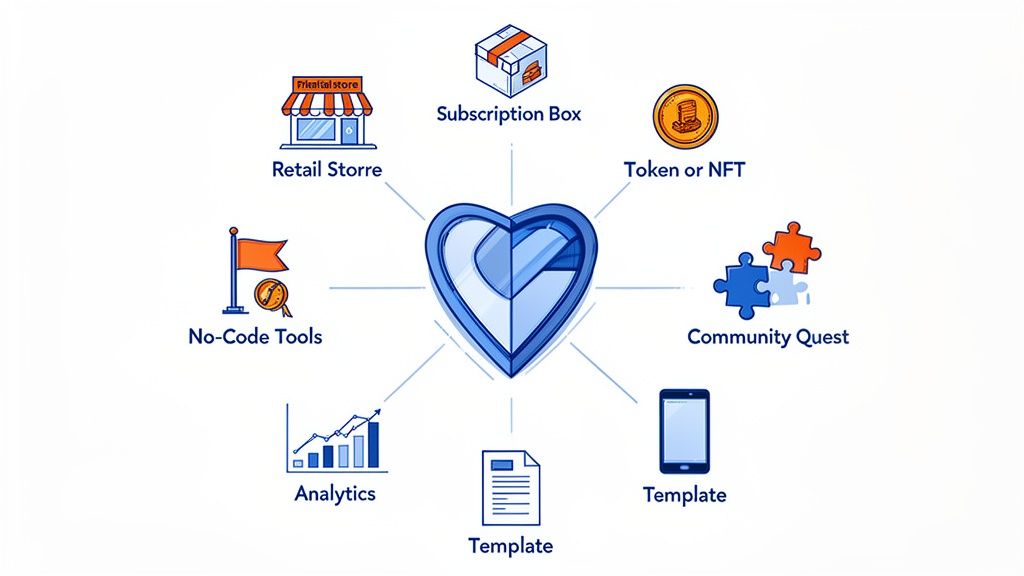
Stale loyalty programs are dead. Today's customers, especially in the Web3 space, expect more than a digital punch card. They demand ownership, community, and real, tangible value that goes beyond simple discounts. This is where a modern customer loyalty program example can provide a powerful blueprint. The goal is no longer just repeat purchases; it's about building a deeply engaged community and consistently improving customer lifetime value.
This article unpacks 8 powerful loyalty models that are crushing it right now, from traditional retail giants to pioneering Web3 communities. We're going beyond surface-level descriptions to dissect the exact mechanics, pros, cons, and strategic takeaways for each approach.
You won’t just see what works; you’ll understand why it works and how to replicate it. We'll explore everything from quest-based engagement campaigns and NFT collectibles to tokenized governance rewards. You’ll get actionable templates and see how no-code tools are making it easier than ever to launch sophisticated campaigns that build lasting loyalty, often without writing a single line of code. Let's dive in and find the perfect model for your brand.
1. Points-Based Reward Systems
Points-based systems are the OG of customer loyalty programs, but with a powerful Web3 twist. The core idea is simple: users perform actions, they earn points. Instead of just tracking purchases, this model can reward everything from social media shares and content creation to on-chain activities like interacting with a testnet or participating in governance votes.
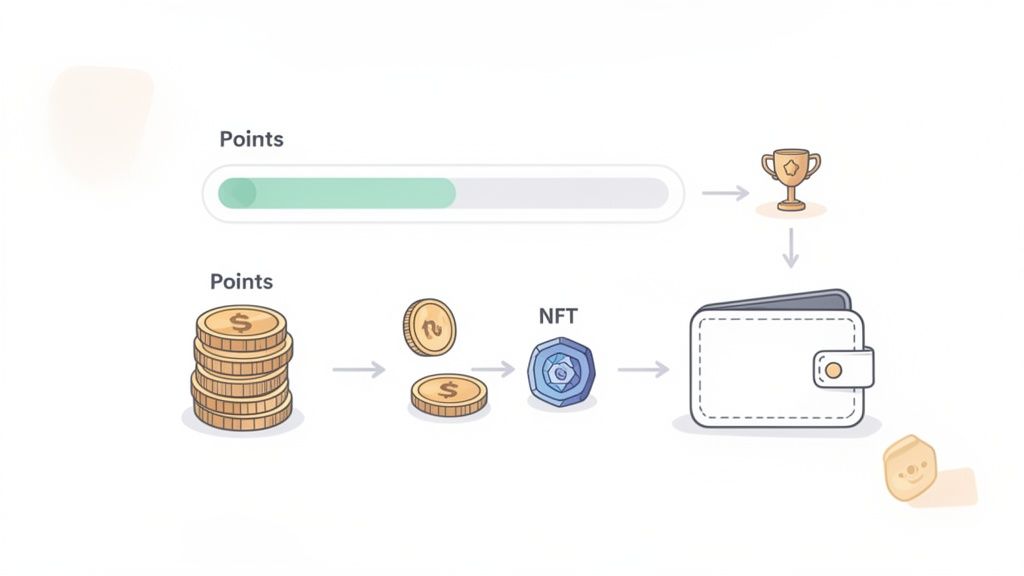
This model gamifies engagement by providing a clear, measurable path to rewards. In the Web3 space, points aren't just for discounts; they often act as a precursor to something more valuable, like a token airdrop, an exclusive NFT mint, or enhanced community roles. This "points-to-payout" mechanic builds long-term anticipation and drives consistent participation.
Key Mechanics & Examples
A great customer loyalty program example using this model is a campaign run on platforms like Zealy. Projects create quests (e.g., "Join our Discord," "Retweet this announcement," "Create a meme") and assign point values to each. Users climb a leaderboard, fostering competition and making engagement feel like a game. Similarly, Layer 2 protocols often use points to track user interactions on their testnet, with the implicit promise that these points will translate into a future token allocation.
Strategic Insight: The power of points in Web3 is their flexibility. They can function as a non-financial, off-chain ledger that tracks valuable contributions, which can later be converted into tangible on-chain assets. This reduces gas fees and complexity during the engagement phase.
How to Replicate This Model
- Define Key Actions: Identify the top 3-5 behaviors you want to encourage. Is it community growth, product testing, or content creation?
- Assign Point Values: Create tiered point multipliers. A high-effort action like writing a detailed product review should be worth more than a simple follow on X (formerly Twitter).
- Choose a Platform: Use a no-code tool like Domino to quickly set up quests and automate point tracking for both on-chain and off-chain activities.
- Visualize Progress: Implement a public leaderboard to create social proof and friendly competition.
- Set Clear Redemption Rules: Define how and when points can be redeemed. This manages user expectations and protects your project's tokenomics. For a deeper dive into structuring these rewards, check out these Web3 loyalty programs that leverage similar mechanics.
2. Tiered Membership Programs
Tiered memberships take the aspirational drive of loyalty programs and put it on steroids. This model creates a ladder of status levels (e.g., Bronze, Silver, Gold) where users unlock progressively better benefits as they climb. In Web3, this isn't just about spending more; tiers can be tied to token holdings, governance participation, or on-chain activity, with NFTs often acting as the verifiable, on-chain membership card.
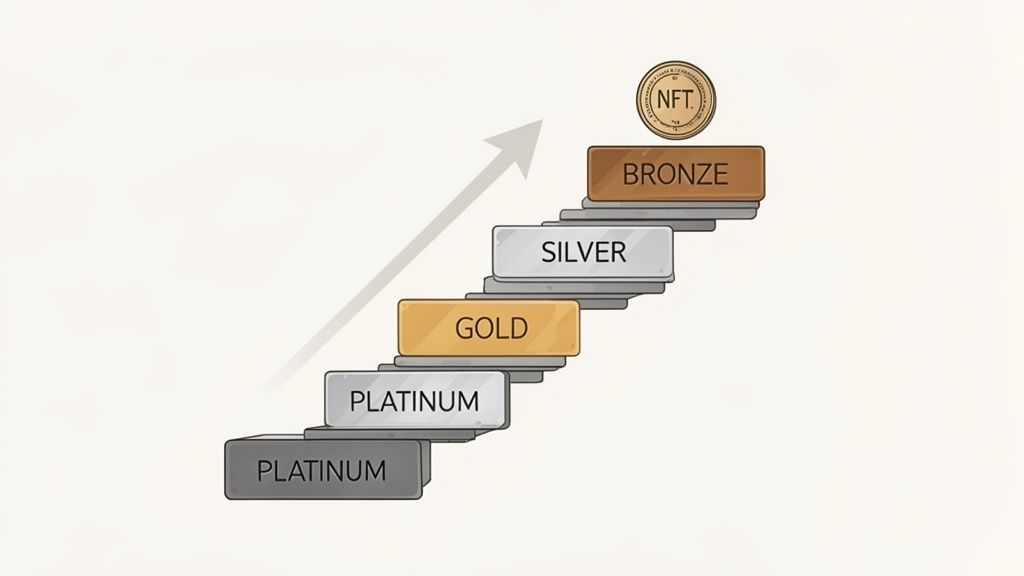
This structure is a powerful customer loyalty program example because it taps into the human desire for status and achievement. It provides a clear progression path, incentivizing users not just to participate, but to deepen their engagement over time. Each new tier feels like a milestone, strengthening the user's connection to the community and making them a more committed stakeholder.
Key Mechanics & Examples
A classic Web3 implementation of this is using Discord roles that are automatically assigned based on a user's wallet contents. A project might grant a "Whale" role to users holding over a certain number of tokens, giving them access to private channels or early product information. NFT projects often use this by creating tiers like Common, Rare, and Legendary, where higher-tiered NFTs grant more significant in-game advantages or larger shares of community rewards.
Strategic Insight: The key to a successful tiered program is making the benefits feel exclusive and valuable. Using soulbound (non-transferable) NFTs to represent tier status prevents users from simply buying their way to the top, ensuring that a high rank is a genuine reflection of loyalty and contribution.
How to Replicate This Model
- Define Tier Thresholds: Establish clear, on-chain or off-chain criteria for each level. For example, Silver requires holding 100 project tokens, while Gold requires 500.
- Scale Benefits Meaningfully: Ensure the perks of a higher tier are a significant step up. This could be moving from a 5% staking bonus at Silver to a 15% bonus at Gold.
- Use NFTs as Keys: Mint NFTs (ideally soulbound) that represent each tier. These can be used to token-gate access to exclusive content, events, or community channels.
- Automate Role Syncing: Use tools like Domino to connect wallet data to platforms like Discord, automatically updating user roles as they move up or down tiers.
- Communicate Progression: Publicly celebrate when users achieve a new tier. A "level-up" announcement in Discord or on X creates social proof and encourages others to climb the ladder.
3. Quest-Based Engagement Campaigns
Quest-based campaigns take the engagement model a step further by packaging desired actions into time-limited, objective-driven tasks. Instead of an open-ended point system, quests create focused bursts of activity around specific goals, like a product launch or a community growth sprint. This customer loyalty program example excels at driving targeted outcomes.
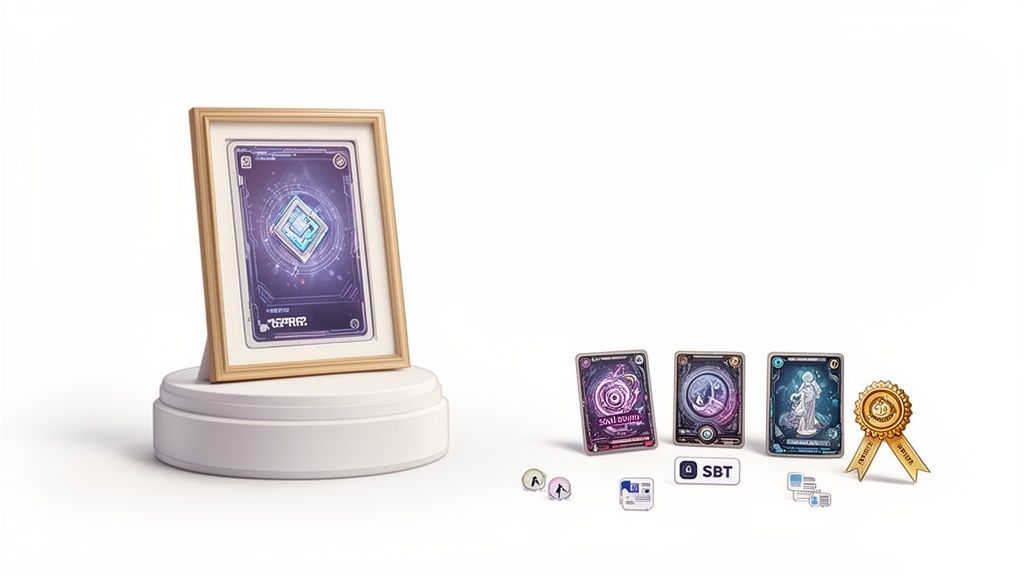
This model combines on-chain tasks (mint an NFT, provide liquidity) with off-chain ones (join a Discord, retweet an announcement) to create a holistic engagement loop. By setting clear deadlines and rewards, quests generate a sense of urgency and FOMO (fear of missing out), concentrating user participation and making community involvement feel like a collective event rather than a solo grind.
Key Mechanics & Examples
Quest-based campaigns are popularized by platforms like Domino and Zealy, which allow projects to quickly deploy tasks. A Layer 2 protocol might run a quest campaign to drive testnet participation, rewarding users for completing transactions and interacting with dApps. Similarly, an NFT project could launch a quest to amplify its mint announcement, rewarding users for sharing content and inviting friends, thereby turning their community into a decentralized marketing engine.
Strategic Insight: Quests are powerful because they measure intent and action, not just presence. A user who completes a multi-step quest involving both social amplification and on-chain interaction is significantly more valuable than a passive follower.
How to Replicate This Model
- Define the Mission: What is the single most important goal of this campaign? (e.g., "Drive 10,000 new testnet users").
- Structure the Quests: Create a series of escalating tasks. Start with low-friction social follows and lead to higher-value actions like using a product feature.
- Use a Questing Platform: Deploy your campaign with a tool like Domino, which offers pre-built templates for common goals like social growth, on-chain activity, and content creation.
- Automate Verification: Leverage AI-powered content review to automatically verify social shares and other off-chain tasks, saving immense administrative overhead.
- Create Urgency: Set clear start and end dates for the campaign. This focuses community attention and maximizes participation within a defined window. For more ideas on structuring these tasks, explore these strategies for Web3 gamification.
4. Referral & Viral Loop Programs
Referral programs are the ultimate growth hack, supercharged by Web3's transparent and automated nature. The concept is simple: reward existing users for bringing new, valuable members into your ecosystem. This creates a powerful, self-perpetuating viral loop where your community becomes your most effective marketing engine.
In Web3, this goes beyond simple affiliate links. Smart contracts can track referrals using wallet addresses, ensuring rewards are distributed instantly and transparently once a new user completes a specific on-chain action, like staking assets or making a trade. This "prove-and-pay" system builds trust and incentivizes authentic, high-quality referrals.
Key Mechanics & Examples
A classic customer loyalty program example of this model in action is dYdX, which offers referrers a percentage of the trading fees generated by the users they bring in. Similarly, protocols like Lido have run campaigns offering stakers referral bonuses. The key is that both the referrer and the new user (the referee) typically receive a reward, creating a win-win that significantly lowers the barrier to entry for the new user. This two-sided incentive is what truly accelerates growth.
Strategic Insight: The most effective Web3 referral programs tie rewards to value-added actions, not just sign-ups. By rewarding referrers based on a new user's trading volume, liquidity provision, or governance participation, you align incentives with long-term ecosystem health rather than vanity metrics.
How to Replicate This Model
- Define the "Win" Condition: What action must a new user take for the referral to be successful? A simple wallet connection, a first trade, or staking a minimum amount?
- Structure a Two-Sided Reward: Decide on the incentive for both the referrer and the referee. This could be a token bonus, a fee discount, or a points multiplier.
- Automate with On-Chain Tracking: Use a tool like Domino to generate unique referral links tied to wallet addresses and set up smart contracts to automatically verify qualifying actions and distribute rewards.
- Create Shareable Assets: Make it easy for users to share their links by providing pre-written social media posts, graphics, and messaging templates.
- Gamify with a Leaderboard: Display a public leaderboard of top referrers to foster competition and reward your most influential advocates. Dive deeper into structuring these incentives by exploring effective crypto affiliate programs.
5. NFT-Based Collectible Rewards
NFT-based collectible rewards transform loyalty from a simple transaction into a verifiable, digital achievement. Instead of a discount code, users receive a unique on-chain token that acts as a permanent badge of honor. These NFTs serve as both the reward and the proof of participation, creating collectible value, social status, and a tangible link between the user and the brand.
This model is a powerful customer loyalty program example because it taps into the human desire for collection and status. Soulbound (non-transferable) tokens can signify personal achievements without introducing speculative markets, while tradeable NFTs can create their own secondary market economies, adding a financial incentive for early and dedicated supporters.
Key Mechanics & Examples
A prime example is Bankless DAO, which issues weekly member badges as soulbound NFTs to active subscribers. These collectibles aren't for flipping; they are a public testament to a member's consistent support and involvement over time. Similarly, platforms like RabbitHole issue NFT certificates for completing on-chain learning quests, turning education into a provable and collectible skill. This mechanic proves a user did something specific at a certain time, creating a verifiable on-chain resume.
Strategic Insight: The key is to treat NFTs as more than just JPEGs. They are programmable digital assets that can unlock future utility. An NFT from an early event could grant access to a private sale later, or collecting a full set of achievement badges could unlock a special community role.
How to Replicate This Model
- Define the Achievement: Identify key milestones you want to memorialize. This could be event attendance, a subscription anniversary, completing a difficult quest, or being an early user.
- Choose a Token Standard: Decide between a soulbound (non-transferable) token for personal achievements or a standard (transferable) NFT for rewards with potential market value.
- Design for Scarcity & Status: Create visually appealing artwork that is distinctive and shareable on social media. Limit the edition size to create a sense of scarcity and exclusivity.
- Automate Distribution: Use a tool like Domino to airdrop NFTs automatically when users complete a specific on-chain or off-chain action. This removes manual work and ensures instant gratification.
- Build in Future Utility: Announce a roadmap for your NFTs. Will holding them grant governance votes, access to exclusive content, or staking rewards? This gives users a reason to hold them long-term.
6. Community Leaderboard & Competitive Gaming
Nothing drives engagement quite like a little friendly competition. This customer loyalty program example leans into human psychology by gamifying participation with visible leaderboards, turning community engagement into a competitive sport where status and recognition are the primary rewards. Users rank based on metrics like points earned, quests completed, or referrals made, creating a dynamic and highly motivating environment.
This model transforms passive community members into active participants. Seeing their username climb a public leaderboard provides powerful social proof and a dopamine hit that encourages repeat engagement. Seasonal resets or "leagues" keep the competition fresh, giving newcomers a fair shot and preventing burnout among top contributors. It’s a powerful loop: compete, get recognized, repeat.
Key Mechanics & Examples
Platforms like Zealy have perfected this model, running weekly and monthly leaderboard sprints where the top participants earn token rewards or exclusive NFTs. Similarly, the "Curve Wars" saw communities competing through gauge voting to direct token emissions, a high-stakes leaderboard with direct financial implications. The recent Blast mainnet launch also used a leaderboard to gamify user deposits and bridge activity, promising a future airdrop based on rank.
Strategic Insight: Leaderboards are not just about rewarding the top 1%. You can create multiple categories (e.g., "Top Meme Creator," "Top Referrer," "Most Helpful Member") to recognize and incentivize diverse types of contributions, ensuring a broader range of users feel valued.
How to Replicate This Model
- Define Competitive Metrics: Choose the key actions you want to track. Will you rank users based on points, referrals, content submissions, or on-chain activity?
- Select a Platform: Use a tool like Domino to instantly create and display a real-time leaderboard that tracks both on-chain and off-chain user actions, automating the entire process.
- Structure the Prize Pool: Avoid a "winner-take-all" system. Tier your rewards so a larger group feels they have a chance to win (e.g., Top 1 gets X, Top 10 get Y, Top 100 get Z).
- Promote Visibly: Display the leaderboard in prominent places like your Discord's main channel, website homepage, and weekly social media updates. Publicly celebrate winners to amplify the social rewards.
- Implement Seasons: Run weekly sprints with smaller prizes and monthly or quarterly "seasons" with larger rewards. This keeps the competition accessible and prevents early leaders from becoming uncatchable.
7. Token & Governance Reward Systems
Token & Governance Reward Systems turn users from passive consumers into active stakeholders. Instead of earning points with limited utility, participants receive the protocol's native or governance tokens for their contributions. This model grants them a direct ownership stake and a voice in the project's future, creating a powerful alignment of incentives.
This approach transforms the traditional loyalty program into a decentralized ownership model. Rewarding users with tokens for activities like providing liquidity, participating in governance votes, or using the platform's core features ensures that the most engaged community members are also the ones guiding its development. This is a prime customer loyalty program example of long-term value creation.
Key Mechanics & Examples
The seminal example is Uniswap's retroactive UNI token airdrop, which rewarded every historical user with governance tokens, effectively decentralizing its ownership overnight. Similarly, protocols like Curve and Lido distribute their native tokens (CRV and LDO) to users who provide liquidity or stake assets, directly tying rewards to a user's contribution to the protocol's health and success. These tokens don't just hold monetary value; they grant voting rights in the DAO.
Strategic Insight: This model's strength is its ability to bootstrap a dedicated and incentivized community from day one. By giving users "skin in the game," you foster a sense of collective ownership that is difficult to replicate with traditional loyalty programs.
How to Replicate This Model
- Design Your Tokenomics: Clearly define the token's utility, total supply, and emission schedule. To effectively design a system like this, a solid grasp of the underlying principles of tokenomics is essential.
- Identify Key Contributions: Pinpoint the actions that add the most value to your ecosystem, such as providing liquidity, active governance participation, or beta testing new features.
- Establish Reward Pools: Allocate a portion of your token supply specifically for community rewards, separate from team, investor, or treasury allocations.
- Implement Vesting & Lockups: Use vesting schedules or vote-escrowed (ve) models to encourage long-term holding and prevent immediate sell-offs from reward recipients.
- Educate and Empower: Create clear guides, host forums, and simplify the voting process to lower the barrier to entry for governance participation, ensuring token holders feel empowered to use their new influence.
8. Dynamic & Behavioral Reward Multipliers
This sophisticated customer loyalty program example moves beyond static rewards by adjusting their value in real-time. Dynamic multipliers change reward rates based on user behavior, contribution type, or strategic project goals. This creates a flexible system that incentivizes high-value actions when they matter most, like attracting liquidity during a launch or boosting governance participation.
This model allows projects to guide their community's focus without constantly launching new campaigns. Instead of a flat "1 vote = 100 points" system, you can implement a "5x multiplier for voting and participating in the forum discussion," directing users toward deeper engagement. It’s about rewarding the quality and timing of participation, not just the action itself.
Key Mechanics & Examples
A prime example is how Layer 2 protocols reward early adopters. They might offer a 10x points multiplier for the first 1,000 users who bridge assets, with the multiplier decaying over time. This creates urgency and rewards the highest-conviction supporters. Similarly, the Blast mainnet used variable multipliers to great effect, rewarding users differently based on their on-chain activity and the applications they used, steering capital and attention across its ecosystem.
Strategic Insight: Multipliers are powerful economic levers. By making the reward logic transparent, you empower users to self-select into the behaviors you want to encourage. This turns your loyalty program into a dynamic, user-driven growth engine rather than a passive reward checklist.
How to Replicate This Model
- Identify High-Value Behaviors: Pinpoint 3-5 actions critical to your current growth stage (e.g., providing liquidity, referring active users, testing a new feature).
- Define Multiplier Categories: Keep it simple. Create categories like "Early Adopter," "Power User," or "Seasonal Bonus." For example, a 3x multiplier for quality referrals (verified wallets) vs. 1x for unverified ones.
- Communicate the Logic: Clearly display active multipliers in your quest descriptions and user dashboards. Transparency is key to motivating users.
- Automate Implementation: Use a tool like Domino to set up customizable multiplier rules that trigger automatically based on on-chain data or user segments.
- Review and Adjust: Monitor the effectiveness of your multipliers monthly. If a behavior isn't being adopted, consider increasing its multiplier or launching a short-term campaign to highlight it.
Comparison of 8 Loyalty Program Examples
| Program | Implementation complexity | Resource requirements | Expected outcomes | Ideal use cases | Key advantages |
|---|---|---|---|---|---|
| Points-Based Reward Systems | Medium — tracking, dashboards, optional smart-contract integration | Moderate — backend, UX, possible on-chain costs | Scalable repeat engagement and measurable progress | Large communities, cross-platform loyalty, ongoing retention | Easy to understand, flexible redemptions, gamifies activity |
| Tiered Membership Programs | High — tier logic, automation, NFT badge integration | High — benefit provisioning, personalization, smart contracts | Higher lifetime value, aspirational progression, stronger retention | Long-term loyalty, VIP experiences, segmented rewards | Motivates progression, social proof, targeted marketing |
| Quest-Based Engagement Campaigns | Medium — campaign templates, multi-step verification | Moderate — campaign design, verification tech, short-term rewards | Rapid acquisition/engagement spikes with clear ROI metrics | Product launches, testnets, event-driven marketing | Fast deployment, measurable results, flexible task mix |
| Referral & Viral Loop Programs | Medium — referral tracking, anti-fraud systems | Low–Moderate — reward budget, monitoring, wallet tracking | Cost-effective organic growth and high-quality user acquisition | User acquisition, viral growth, network effects | Leverages community, efficient CAC, dual-sided incentives |
| NFT-Based Collectible Rewards | High — minting pipeline, metadata, marketplace integration | High — design, minting/gas (or L2), legal/UX overhead | Strong social signaling, collectibility, secondary-market activity | Brand identity, milestone recognition, exclusive access | On-chain proof, collectible value, high shareability |
| Community Leaderboard & Competitive Gaming | Low–Medium — real-time ranking, anti-bot measures | Low — infrastructure and prize pools | Sustained engagement through competition and visibility | Ongoing community engagement, seasonal competitions | Drives participation, public recognition, low operating cost |
| Token & Governance Reward Systems | High — tokenomics, vesting, governance tooling | High — token emission budget, legal, education efforts | Alignment of incentives, protocol participation, long-term commitment | DAOs, protocol growth, contributor incentives | Ownership + voting power, transparent distribution, economic value |
| Dynamic & Behavioral Reward Multipliers | Very high — data pipelines, AI, dynamic smart contracts | Very high — analytics, engineering, monitoring, policy controls | Optimized budget efficiency and targeted behavior change | Strategic growth phases, early-adopter incentives, TVL attraction | Precision targeting, personalization, adaptable incentives |
Ready to Launch Your Loyalty Program? Here's Your Next Move.
We’ve journeyed through a diverse landscape of customer loyalty, from the tried-and-true points systems of retail giants to the cutting-edge, token-gated communities of Web3. The examples we explored, spanning tiered memberships, NFT collectibles, and dynamic quest campaigns, all share a common thread: they succeed by moving beyond simple transactions to foster genuine, active participation.
The old model of passive point collection is fading. Today's most effective programs are built on a foundation of engagement, turning customers into community members and users into advocates. This is the core lesson from every powerful customer loyalty program example we've dissected.
Key Takeaways: From Inspiration to Implementation
So, what are the golden rules for building your own loyalty engine? Let's distill the core strategies:
- Align with Your "Why": Your loyalty program shouldn't be an afterthought. Whether you’re driving user acquisition with a viral referral loop or deepening engagement with a competitive leaderboard, your chosen model must directly support your primary business goals.
- Make Participation Fun: Gamification is your secret weapon. Quests, leaderboards, and collectible rewards transform mundane actions into exciting challenges. This creates a compelling reason for users to return day after day.
- Reward More Than Just Spending: The most innovative programs reward valuable actions like social sharing, content creation, community support, and product feedback. This approach builds a much stronger, more resilient community that contributes value in countless ways.
- Embrace Modularity: You don't have to launch a complex, multi-tiered system from day one. Start with a simple points or quest-based campaign. As you learn what resonates with your audience, you can layer in new mechanics like NFT rewards or behavioral multipliers.
Your Action Plan for Launch
Feeling inspired? Good. Now it's time to turn that inspiration into action. Don't get stuck in analysis paralysis; the key is to start small, test, and iterate.
- Define Your Core Objective: What is the #1 thing you want to achieve? Is it user retention, new sign-ups, or increased product usage? Be specific.
- Choose Your Starting Model: Pick one customer loyalty program example from this article that best fits your objective. A quest-based campaign is often the easiest and most flexible place to start.
- Map Out Your First "Quest": Identify 3-5 high-value actions you want users to take. Design a simple reward structure for completing them. This could be anything from earning points and climbing a leaderboard to unlocking a special Discord role or an NFT.
- Leverage No-Code Tools: The biggest barrier to launching used to be engineering resources. Now, platforms designed for this new era of engagement handle the heavy lifting of tracking, verification, and reward distribution, letting you focus on strategy.
Ultimately, a well-designed loyalty program is more than a marketing tactic; it's a community-building engine. It’s your opportunity to transform a one-way, transactional relationship into a two-way, collaborative partnership. By rewarding the actions that matter most, you’re not just buying loyalty, you’re earning it. You’re building a movement, one quest at a time.
Ready to stop theorizing and start building? With Domino, you can launch your first on-chain quest campaign in minutes using over 130 pre-built templates. See for yourself how easy it is to implement the strategies from any customer loyalty program example discussed today.