affiliate marketing for cryptocurrency: A Proven Guide

Affiliate marketing in the crypto world is pretty straightforward: projects pay partners (we call them "affiliates") a commission when they send new users, trades, or sales their way. It’s a powerful way for new projects to get their name out there and build trust by tapping into well-known voices in the space. Honestly, it works so well because it’s built on real endorsements from people who have already earned their audience's respect.
Why Affiliate Marketing Is a Game Changer for Crypto
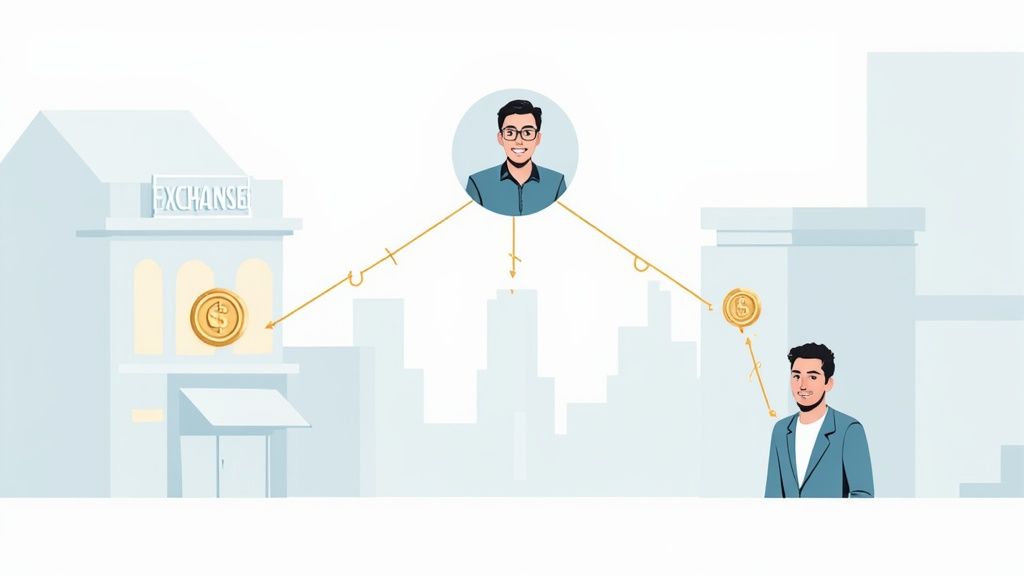
Let's be real—the crypto market can be skeptical. Trust is everything. Standard ads often feel disconnected and just don't land with the savvy crypto crowd. This is exactly where affiliate marketing makes all the difference, becoming a serious engine for both getting new users and building up your project's credibility.
You're not just paying for random clicks. You're building a network of real advocates who can connect with niche communities that generic ad campaigns will never reach.
Think about it from a user's perspective. A recommendation from a crypto educator they follow on YouTube or a deep-dive guide from a trading blogger they trust means a whole lot more than a flashy banner ad. These creators have put in the time to build communities that hang on their every word. So, when they give a nod to a new DeFi protocol, hardware wallet, or exchange, people pay attention.
The Financial Impact of Crypto Affiliate Programs
The numbers don't lie; this isn't just a small-time tactic. The biggest names in crypto credit a huge chunk of their growth to these partnerships.
Major exchanges like Binance and Coinbase, for example, report that up to 25% of their online sales come from their affiliate programs. They pull this off by offering seriously competitive commissions. Some offer affiliates up to a whopping 50% of the trading fees from their referrals, while a hardware wallet company like Ledger might offer a flat 10% on product sales. It's a proven model.
This approach creates a clear win-win:
- For Crypto Projects: You get direct access to your ideal audience, bring down customer acquisition costs, and build social proof through people your potential users already trust.
- For Affiliates: They can earn money from their content and influence by promoting projects they actually use and believe in. It's a perfect match.
A well-designed affiliate program can easily blow traditional marketing out of the water. Why? Because it’s powered by the single most important currency in crypto: trust. It turns a simple marketing transaction into a powerful, community-driven endorsement.
If you're new to this, it’s worth getting a handle on the basic mechanics first. Learning how to start affiliate marketing in a general sense will give you a solid footing before you specialize in the crypto niche.
At the end of the day, this is more than just another sales channel. It’s a core part of the Web3 growth playbook, connecting innovative projects with the communities ready to embrace them. To get a better feel for the assets involved, you can dive deeper into our guide on tokens and cryptocurrency.
So, You Want to Build a Crypto Affiliate Program That Actually Works?
Let's be real—just slapping a high commission rate on a basic referral link won't cut it in the crypto world. The space is too competitive. To get the best partners on board, you need to build a program that feels less like a gig and more like a genuine partnership. It has to be profitable, sure, but it also needs to be dead simple for them to promote.
Your goal is to craft an offer so good that the crypto influencers and community leaders you're trying to attract can't help but say yes.
This all starts with getting inside their heads. Seasoned affiliates see past the big, flashy numbers. They’re digging into the details, looking for long-term value and solid support from your team.
Nailing the Commission Model
The heart of any affiliate program is its commission structure. This is where you align what's good for your business with what gets your partners excited to work. In crypto, it almost always boils down to two main flavors: Revenue Share and Cost Per Acquisition (CPA).
A Revenue Share model is pretty much the gold standard, especially for exchanges and DeFi protocols. With this setup, your affiliates earn a slice of the trading fees from every user they bring in. This could be anywhere from 20% to 50% of the fee revenue, giving them a passive income stream for as long as their referrals stay active. This is the model you want for attracting partners who are in it for the long game.
Then there's the CPA (Cost Per Acquisition) model. It's much more straightforward: an affiliate gets a fixed payout for a specific action. For example, you might pay a flat $100 for every user who completes their KYC check and deposits a minimum amount. This offers predictable, upfront earnings, making it a great fit for partners who run high-volume, short-term campaigns.
My Two Cents: Why not offer a hybrid model? You could give partners a smaller CPA payment upfront to cover their ad spend, plus a smaller lifetime revenue share on the backend. It’s the best of both worlds—they get immediate cash flow and still build long-term income.
How to Keep Your Best People Motivated
Top affiliates are gold. Once you find them, you need to design your program to keep them around. Two of the most effective ways I've seen to do this are lifetime commissions and tiered rewards.
Lifetime commissions are a massive draw. It means the affiliate keeps earning from a user for their entire time on your platform—not just for the first month or two. This one feature tells potential partners you're serious about building a long-term relationship.
Tiered reward structures are brilliant for pushing your partners to do their best work. The concept is simple: the more they deliver, the more they earn. It turns the whole thing into a bit of a game.
Here's a quick example of what that could look like:
- Bronze Tier (1-20 referrals/month): 25% Revenue Share
- Silver Tier (21-50 referrals/month): 35% Revenue Share
- Gold Tier (51+ referrals/month): 50% Revenue Share
This gives your top performers a clear roadmap to boosting their income and makes them more likely to promote your project over someone else's.
Give Them the Tools to Win
Even the best affiliate will fizzle out if they don't have the right tools. Your job is to make promoting your project as frictionless as possible. That means loading them up with a full arsenal of top-notch marketing assets.
Don't just hand them a link and say, "Good luck!" You need to arm them for battle.
Make sure they have:
- Optimized Landing Pages: Build a few different versions for specific audiences. Think one for DeFi degens, another for NFT collectors.
- Professional Banners: A complete set of slick, on-brand banners in all the standard ad sizes.
- Content Templates: Give them blog post outlines, email swipe files, and social media copy they can quickly customize.
- Product Demos: Short, shareable video tutorials that show off your platform's coolest features.
Let's not forget, the crypto affiliate scene is famous for its generous payouts. We're talking commissions that can hit 50% of trading fees or even one-time payments of $1,000 or more for a single qualified referral. These affiliate marketing statistics show just how profitable these partnerships can be. By giving your partners premium assets, you’re helping them tap into that potential. When you invest in their success, they'll turn around and invest in yours. It’s as simple as that.
Finding and Recruiting the Right Crypto Affiliates
Look, having an amazing affiliate program is great, but it's only half the equation. Your success really hinges on the quality of the partners you bring on board. Just opening the floodgates and approving anyone who signs up is a recipe for disaster—think brand damage, garbage traffic, and a whole lot of headaches. You're not building an army of spammers; you're building a network of genuine advocates.
The absolute best partners for affiliate marketing for cryptocurrency aren't hiding out on some massive, generic affiliate network. They're already deeply plugged into the communities you want to reach. You’ve got to go to them.
Scouting for High-Value Crypto Partners
Put on your detective hat for a minute. Your first job is to pinpoint the authentic voices and trusted sources in your corner of the crypto world. Running a DeFi protocol? Go find the top yield farming educators. Launching an NFT project? You need to be talking to the influential artists and collectors.
Here’s where I always start my search:
- YouTube and Podcasts: I look for creators who are putting out detailed tutorials, honest reviews, and solid market analysis. Their audience is there to learn, which means they're engaged and actually trust the creator's recommendations.
- X (Formerly Twitter) and Farcaster: Find the people who are actually driving the conversation and sharing real insights. Forget massive follower counts for a second and focus on high engagement rates. That's where the real influence is.
- Niche Blogs and Newsletters: These are goldmines. You'll find writers who publish deep-dive articles and technical breakdowns. Their audiences might be smaller, but they are incredibly loyal and smart.
- Community Hubs like Discord and Telegram: Just hang out and pay attention. Who are the most helpful, respected members in communities related to your project? These power users can become your most passionate and effective promoters.
My Pro Tip: Don't just stalk your direct competitors. Check out the affiliate programs of projects in adjacent spaces. If a popular hardware wallet has a great group of affiliates, some of them could be a perfect fit to promote your new crypto tax software. It's all about finding that audience overlap.
The Vetting Process You Can't Afford to Skip
Once you've got a shortlist of potential partners, the real work starts. A solid vetting process is your only defense against fraud, brand misalignment, and flushing commissions down the drain. I’ve seen too many projects rush this step, and it almost always ends badly, especially in a space where scams are all too common.
You have to screen for authenticity and alignment before you even think about sending that first outreach email.
Content Quality and Brand Alignment
First thing's first: actually consume their content. Does their vibe match your brand's? If you're building a serious, security-first platform, partnering with a meme-heavy, degen-focused influencer is probably not going to work out.
Ask yourself these questions:
- Is their content educational or just pure hype? You want partners who explain things clearly, not just shill the next supposed "100x coin."
- Do they disclose their partnerships? Honesty builds trust. I always prefer working with affiliates who are upfront about their sponsored content.
- Have they promoted sketchy projects in the past? A quick Google search of their history can tell you a lot. If they've been involved with rug pulls or obvious scams, associating your brand with them is a risk you don't want to take.
Audience Engagement and Health
A huge follower count can be a vanity metric. What really matters is the quality of their audience and how engaged they are. Fake followers and bot engagement are everywhere, so you need to look for signs of a real, breathing community.
Watch out for these red flags:
- Generic Comments: If the comment section is just a wall of "Great video!" or fire emojis, be skeptical. Real engagement looks like questions, debates, and actual conversation.
- Weird Follower-to-Engagement Ratio: A creator with 100,000 followers but only 50 likes and 3 comments per post is a massive red flag. The math just doesn't add up.
- Sudden Spikes in Followers: Pop their handle into a social media analytics tool. Unnatural growth spurts often mean they just bought a batch of fake followers.
The crypto world has its dark corners, with some affiliate-like networks enabling straight-up illicit activities. For instance, investigations have revealed bulletproof hosting services like Zservers providing infrastructure for notorious ransomware groups like LockBit. While that's an extreme case, it drives home the point: you need to know exactly who you're getting into business with.
Your goal here is to assemble a team of partners who add real value and credibility to your brand. By being methodical and selective, you're laying the foundation for an affiliate program that's not just profitable, but sustainable.
Choosing the Right Tech to Manage Your Program
If you can’t track it, you can’t improve it. That old saying is the absolute truth when it comes to running a successful affiliate program. The right technology isn't just a nice-to-have; it's the engine that powers your entire operation. It’s what ensures every referral gets counted, every commission is paid correctly, and every partner stays motivated to send you traffic.
Picking your tech stack can feel like a huge task, but it all comes down to one core principle: transparency builds trust. Your affiliates need a clear, real-time window into their performance. When they can see clicks, conversions, and earnings update instantly, it removes any doubt and keeps them focused on what they do best. This is totally non-negotiable in the world of affiliate marketing for cryptocurrency.
Must-Have Features in Your Affiliate Platform
Not all affiliate software is built the same, especially when you factor in the unique demands of the crypto space. While you'll see names like Post Affiliate Pro and Everflow pop up, you need to look past the brand and dig into the features that actually matter for your program.
Your platform has to be rock-solid. Dropped tracking or wonky data can kill a great partnership overnight.
Here’s what I always tell people to prioritize when they're shopping around:
- Reliable Conversion Tracking: This is the big one. The system must be able to attribute sign-ups, deposits, or trades back to the right affiliate, even if a user clears their cookies or switches devices. Look for SubID tracking, which lets affiliates add their own identifiers to links to see which of their campaigns are hitting the mark.
- A Transparent Affiliate Dashboard: This is your partner's command center. It has to be clean and intuitive, giving them instant access to their performance stats, payment history, and all your marketing assets.
- Crypto-Native Payout Options: Honestly, this is a massive differentiator. The ability to pay commissions in stablecoins like USDT or USDC—or even your own project's token—is a huge plus for crypto-native affiliates. It shows you get it.
- Flexible Commission Structures: Your tech needs to handle whatever model you've landed on, whether it's a lifetime rev-share, a tiered CPA, or some kind of hybrid. Trying to calculate this stuff manually is a recipe for disaster.
The global affiliate marketing industry has exploded, now valued at around $18.5 billion and on track to nearly double. With just the U.S. market projected to hit about $13 billion by 2025, you need a serious tech stack to carve out your slice. You can check out more stats on affiliate marketing's rise on Hostinger.com. This crazy growth just proves you can't get by with spreadsheets anymore.
Comparison of Popular Affiliate Tracking Platforms
Choosing the right software is a make-or-break decision. To help you sort through the options, here’s a quick comparison of some popular platforms and what they bring to the table for a crypto program.
| Platform | Key Feature for Crypto | Pricing Model | Ideal For |
|---|---|---|---|
| Post Affiliate Pro | Robust tracking and flexible commission rules. | Subscription-based (monthly). | Startups to mid-sized projects needing granular control. |
| Everflow | Advanced analytics and click/impression tracking. | Usage-based (clicks/impressions). | Larger programs focused on performance and deep data analysis. |
| PartnerStack | Strong B2B focus and automated partner onboarding. | Subscription + % of partner payouts. | SaaS and FinTech projects looking for a managed marketplace. |
| Tune (HasOffers) | Highly customizable and scalable for enterprise. | Custom/Enterprise pricing. | Established exchanges and large-scale projects needing an API-first solution. |
Each of these has its own strengths, so think carefully about where your program is today and where you want it to be in a year. Don't overbuy, but don't cheap out on the features you'll need to scale, either.
Setting Up Your Tracking Links and Landing Pages
Once you've picked your platform, it's time to get everything set up. This is where the rubber meets the road. Getting your tracking links right is critical. Each affiliate gets a unique referral link with their ID baked in. When someone clicks it, a cookie is dropped in their browser, making sure that affiliate gets credit for any sign-ups or trades that happen later.
This simple infographic breaks down the core stages of recruiting crypto affiliates, from initial scouting to forming a solid partnership.
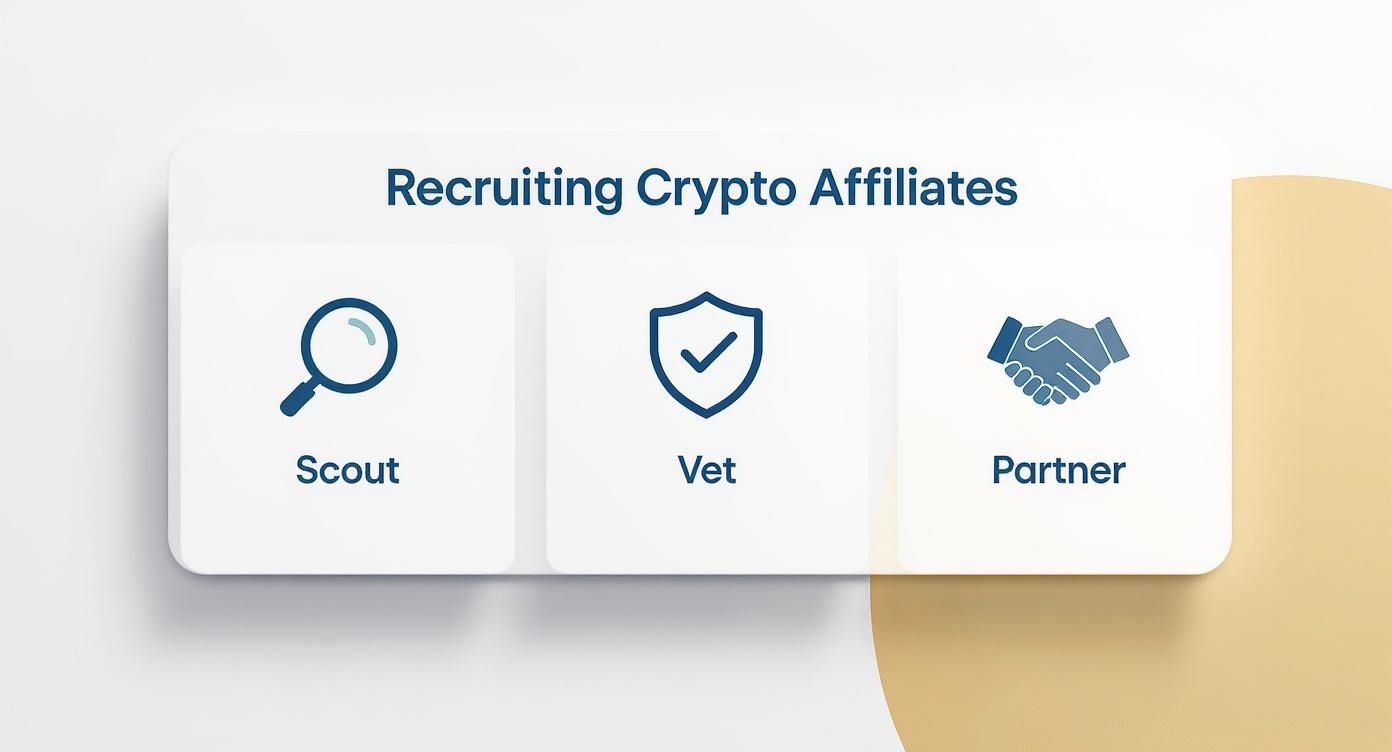
As you can see, it's not just about getting numbers; it's about finding the right people and building a relationship that lasts.
Here's a pro tip: don't just send all that valuable traffic to your homepage. Create dedicated landing pages specifically for your affiliate campaigns. These pages need to be hyper-focused on one thing—conversion. Keep the messaging tight and make sure it lines up perfectly with what the affiliate was promoting. If you need some pointers, our guide to building a no-code landing page has some great tips.
A seamless technical experience is a silent ambassador for your brand. When an affiliate's dashboard works flawlessly and their payouts arrive on time, it tells them you're a professional and reliable partner worth investing their time and energy in.
Ultimately, your tech stack is the invisible architecture holding your program together. Investing in the right tools from day one will save you countless headaches down the road and give your partners the confidence they need to go all-in on promoting you. It's the difference between a program that sputters along and one that becomes a powerful, scalable growth machine.
Turning Your Affiliate Program Into a Growth Engine
Getting your affiliate program off the ground is one thing. Actually turning it into a powerful growth machine for your crypto project? That’s a whole different ballgame. The real work starts after launch. This is where you roll up your sleeves and start optimizing.
Scaling isn't just about throwing more affiliates at the wall to see what sticks. It's about getting more out of the partners you already have, keeping them fired up, and using hard data to make smart moves. You can't just set it and forget it. A well-managed program can become a reliable, high-quality stream of new users.
Treat Your Top Affiliates Like VIPs
It won't take long to see the 80/20 rule play out: a small handful of your partners—maybe 20% of them—will be driving 80% of your results. These people are your all-stars, and they deserve the red-carpet treatment. Their standard commission just isn't enough to keep them from being poached by a competitor.
You have to make them feel like insiders. Give them a direct line to your team, maybe through a private Telegram chat or a dedicated manager. Let them in on your product roadmap and give them a heads-up on upcoming campaigns. This inside knowledge is gold for them, helping them craft content that feels authentic and timely.
Beyond that, here’s how you can make your top performers feel truly valued:
- Create a VIP Commission Tier: Set up an exclusive, higher commission rate that only your best partners can unlock. It’s a powerful motivator.
- Give Them Exclusive Offers: Arm them with special promos for their audience, like a limited-time deposit bonus or a temporary trading fee discount. This makes their content more compelling and drives way more conversions.
- Hook Them Up with Co-Branded Assets: Offer to create custom landing pages or banners that feature their branding alongside yours. It’s a small touch that adds a huge amount of credibility.
Use Data to Find Your Hidden Gems
Data is your crystal ball here. Your affiliate platform is packed with insights just waiting to be uncovered, and digging in will tell you exactly where to focus your efforts. Don't just glance at the total number of referrals; you need to understand the quality of the traffic each partner is sending your way.
Start by digging into these metrics for every single affiliate:
- Conversion Rate: Are their clicks actually turning into sign-ups or, better yet, funded accounts? Tons of clicks with no conversions is a major red flag for low-quality traffic.
- User LTV: Are the users they bring in making one trade and vanishing, or are they sticking around? Tracking the lifetime value (LTV) will show you which affiliates bring in serious, active traders.
- Content That Converts: Is traffic coming from deep-dive YouTube tutorials, quick-hit X threads, or detailed blog posts? Knowing which formats work helps you guide your other affiliates to create content that actually performs.
You might find that a YouTuber with a modest following is actually bringing in higher-value traders than a massive X account with ten times the followers. That's your signal to pour support into that creator and start looking for more partners just like them.
Spark Engagement with Regular Campaigns
While you’re giving your top performers special treatment, you can’t let the rest of your affiliate base go cold. Keeping everyone in the game is key for steady, long-term growth. The best way to do this is to run regular promotional campaigns that give everyone a shot at earning more.
A trading competition is a classic for a reason—it works. You could set up a prize pool for the affiliates who refer the most new trading volume over a 30-day period. This creates a bit of friendly competition and wakes up affiliates who might have gone dormant.
Another great move is to build campaigns around specific events, like a big airdrop or a hot new token listing. This gives your partners fresh, relevant content to talk about. For example, you could give them educational materials on how to claim an airdrop using your platform. If you're looking for fresh ideas, our guide on running a Telegram airdrop campaign has some great inspiration. These kinds of events create a ton of buzz and give your entire affiliate network something to rally around.
Got Questions About Crypto Affiliate Programs? We've Got Answers.
Jumping into the world of crypto affiliate marketing can feel like navigating a maze. You're probably wrestling with questions about tricky regulations, how to handle crypto payouts, and whether your program is even working. Getting a handle on these things early on will save you a ton of grief later.
Let's break down some of the most common questions and sticking points you'll likely run into. This isn't just about dodging bullets; it's about building a solid, trustworthy program that attracts the kind of high-quality partners who really know their stuff in the crypto space.
What Are the Biggest Compliance Risks I Should Know About?
This is the big one. The legal side of promoting crypto is, without a doubt, the number one concern for most projects. The main risks really come down to financial promotion and securities regulations. In places like the US and the UK, you can't just wing it—promoting crypto assets is a regulated activity.
Your affiliates need to be incredibly clear with their audience. That means slapping on prominent disclaimers like "This is not financial advice" and "Crypto assets are volatile." Making wild, unsubstantiated claims about guaranteed profits is the fastest way to get both your project and your affiliate into a world of trouble.
Ultimately, the buck stops with you. It's your job to give your partners crystal-clear guidelines. Your terms of service have to spell out exactly what affiliates can and cannot say. Seriously, work with a legal expert on this to make sure your rules are in line with local advertising standards.
How Do I Actually Handle Payouts in Crypto?
Paying partners in crypto is a massive selling point. The standard practice is to use stablecoins like USDT or USDC, though some projects even pay out in their own native token. This is a huge draw for crypto-native affiliates who'd much rather keep their earnings on-chain.
To pull this off smoothly, you need a good system. First, you'll want to track all the commissions in a stable fiat currency, like USD, just to keep everything consistent. Then, when it’s payout time, you convert that USD amount to the crypto equivalent using the current market rate.
A lot of modern affiliate platforms can plug right into crypto payment gateways and automate the whole thing. If yours can't, you might have to set up a semi-manual process.
Key Takeaway: You absolutely cannot skimp on transparency here. Have a clear, written policy covering the exact conversion source, the payout schedule (like net-30), and who's footing the bill for network or gas fees. This stops disputes before they start and builds serious trust with your partners.
What Key Metrics Should I Be Tracking?
Just counting sign-ups won't tell you the whole story. If you really want to know if your program is healthy and how to make it better, you need to dig deeper into a few key performance indicators (KPIs). These numbers show you the real value your affiliates are bringing in.
Go beyond the basics and make sure your dashboard is tracking these critical data points:
- Conversion Rate (Click-to-Action): This tells you how effective an affiliate's traffic actually is. A ton of clicks but very few conversions? That’s a red flag for low-quality or poorly targeted traffic.
- Customer Lifetime Value (LTV): This one is massive. Are your affiliates bringing in people who make one trade and vanish, or are they attracting loyal, long-term users? A high LTV is the ultimate proof that your program is delivering real, sustainable value.
- Active Affiliates: Out of all the partners you’ve signed up, how many are actually driving results? Keeping an eye on this helps you see how healthy and engaged your affiliate base is.
- Return on Investment (ROI): The bottom line. Are you making more than you're spending? Compare the revenue generated by affiliates to the commissions you're paying out. This tells you if your program is actually profitable.
Focusing on these specific metrics helps you spot your star performers, part ways with those who aren't a good fit, and make smart, data-backed decisions to grow your program. It’s how you turn your affiliate channel from a simple marketing tactic into a predictable growth machine.
Ready to turn your community into a growth engine without the headache? Domino lets you launch and scale reward-based quests in minutes. Automate on-chain and off-chain tasks, engage your users, and drive real results—all without writing a single line of code. Start building your campaign with Domino today!