Reddit referral campaign: Boost Web3 Growth with Incentives
If you're trying to grow a Web3 project, you know it's a grind. Fighting for attention is tough, and the usual marketing playbook often falls flat. This is where a smart Reddit referral campaign can be a game-changer. It’s about turning passionate subreddit members into your best advocates and driving real, word-of-mouth growth that you just can't buy with ads.
Why Reddit Is a Goldmine for Web3 Growth
Let's be real. Redditors are a different breed. Unlike other platforms where people just scroll past content, users here are deep in conversation, actively looking for recommendations, and they trust each other way more than they trust a slick marketing campaign.
That dynamic is exactly what makes Reddit the perfect place to build a referral program. Think about it: people are already hanging out in subreddits like r/DeFi, r/NFT, or r/CryptoCurrency, hunting for the next big thing. When a referral comes from a respected member of that community, it doesn't feel like an ad—it feels like an inside tip from a friend. That's incredibly powerful.
Tapping into Niche Communities
The magic of Reddit is in its 100,000+ active subreddits. These are laser-focused communities where your ideal users already live. Whether you're looking for devs who are obsessed with a specific chain or collectors who nerd out over a certain style of digital art, there's a subreddit for them.
A well-planned Reddit referral campaign lets you:
- Reach High-Intent Users: You’re talking to people actively searching for what you offer, which naturally leads to better conversion.
- Build Authentic Trust: Word-of-mouth from a real person will always beat a branded post. Redditors have a finely tuned radar for anything that feels fake.
- Drive Genuine Engagement: Forget vanity metrics. You can design your campaign to reward actions that actually matter—like joining your Discord, making an on-chain transaction, or even just adding to a discussion.
The heart of a solid Reddit campaign isn't just about driving traffic. It's about starting conversations. When a referral feels like a genuine recommendation between enthusiasts, it becomes your most powerful growth engine.
Making Your Campaign Launch Easy
Okay, so the idea of juggling referral links, checking if people actually completed the tasks, and then sending out all the rewards sounds like a headache, right? Especially if you don't have a dev team on standby.
This is where no-code tools like Domino come in clutch. You can set up and automate your entire Reddit referral campaign without touching any code. Imagine creating a quest that gives users a small reward for sharing your project in a relevant subreddit, with AI automatically confirming they did it. It takes the manual work off your plate so you can focus on the big picture: strategy and community building.
If you’re still figuring out the best ways to connect with your audience, taking a look at the different community platforms out there is a fantastic starting point.
2. Nailing Your Campaign Goals and Incentives
Alright, let's get down to brass tacks. Before you even draft a single Reddit post, you have to ask yourself the most important question: what does a "win" actually look like here?
Seriously. If you don't have a crystal-clear goal, you're just chucking rewards into the crypto void and praying something good happens. A killer Reddit referral campaign is always built on specific, measurable targets.
Are you trying to pack your Discord server before a massive announcement? Or is it something more concrete, like sparking a certain number of on-chain transactions? Maybe you just need more wallets to stake that new NFT collection.
Whatever it is, define that primary KPI first. Get specific. Is it 500 new verified Discord members? A 15% lift in daily active wallets?
Once you’ve got that North Star metric locked in, everything else—your messaging, your creative, and especially your rewards—snaps into focus. It's the difference between a surgical, effective strategy and a chaotic, wallet-draining experiment.
Crafting Web3 Incentives That Actually Work
Okay, with your goal set, we can get to the fun part: the incentives. In the Web3 world, your rewards need to hit different. We’re talking about a sharp, often cynical audience here. A $10 Amazon gift card isn't going to move the needle.
Your incentives have to feel native to the culture and provide real, tangible value to the kind of people you want to attract.
Here’s a look at a few incentive models that I've seen crush it for Web3 projects time and time again.
Web3 Referral Incentive Structures
Thinking through the right reward structure is crucial. Each type has its own vibe and is suited for different campaign goals. This table breaks down some of the most common options to help you decide what fits your project.
| Incentive Type | Pros | Cons | Best For |
|---|---|---|---|
| Token Airdrops | Direct, powerful motivator. Gives users a real stake in your project's success. | Can attract short-term "farmers" who dump tokens. Can dilute your tokenomics. | Driving broad awareness and initial user acquisition. Great for getting a lot of wallets into your ecosystem. |
| NFT Whitelist Spots | Creates genuine exclusivity and FOMO. Highly desirable for hyped projects. | Value is speculative and depends heavily on your project's perceived hype. | Projects with a strong community and a highly anticipated NFT mint. Excellent for rewarding true fans. |
| Exclusive Roles | Low-cost, high-status reward. Appeals to the desire for recognition in a community. | May not motivate users who are purely financially driven. | Building a loyal, engaged core community. Perfect for rewarding top contributors and early adopters. |
| Tiered Rewards | Encourages high-quality referrals by scaling rewards with the value of the action. | Can be more complex to track and manage. | Campaigns with multiple conversion goals (e.g., Discord join vs. on-chain transaction). |
Ultimately, the best rewards feel like a natural extension of your project's ecosystem. They give users something they can't easily get elsewhere.
The most effective incentives aren't always the priciest. They're the ones that tap into what your community genuinely craves—be it early access, a piece of the project, or just some well-earned social clout.
Getting this right often means looking at what’s worked for others. It’s always a good idea to check out examples of powerful referral program incentives to get your own creative juices flowing for structures that deliver results without bankrupting you.
Think about it this way: a simple referral for a Discord join might just need a small token reward. But a referral that results in a significant on-chain deposit? That deserves a much bigger slice of the pie.
This tiered approach keeps your budget focused where it matters most, rewarding high-value actions without overspending on low-impact ones. Your incentive design is the engine of your referral program—make sure you're giving it the right fuel.
Building the Core Mechanics of Your Campaign
Alright, you've got your goals locked in and you know what rewards you're offering. Now comes the fun part: building the engine that makes your whole referral program run. This is where we connect the dots and create a smooth path for users, taking them from the moment they share to the moment they get their reward.
A clunky, confusing process will absolutely torpedo your campaign's momentum. You want this to be frictionless. The first big decision is how people will share. Will you use unique referral links or shareable codes? Links are generally easier to track automatically, but codes can feel a bit more personal and are dead simple to drop in a casual Reddit comment.
This whole initial setup—from defining your goals to picking the right rewards—is the bedrock of a successful campaign. Get this right, and everything else falls into place.
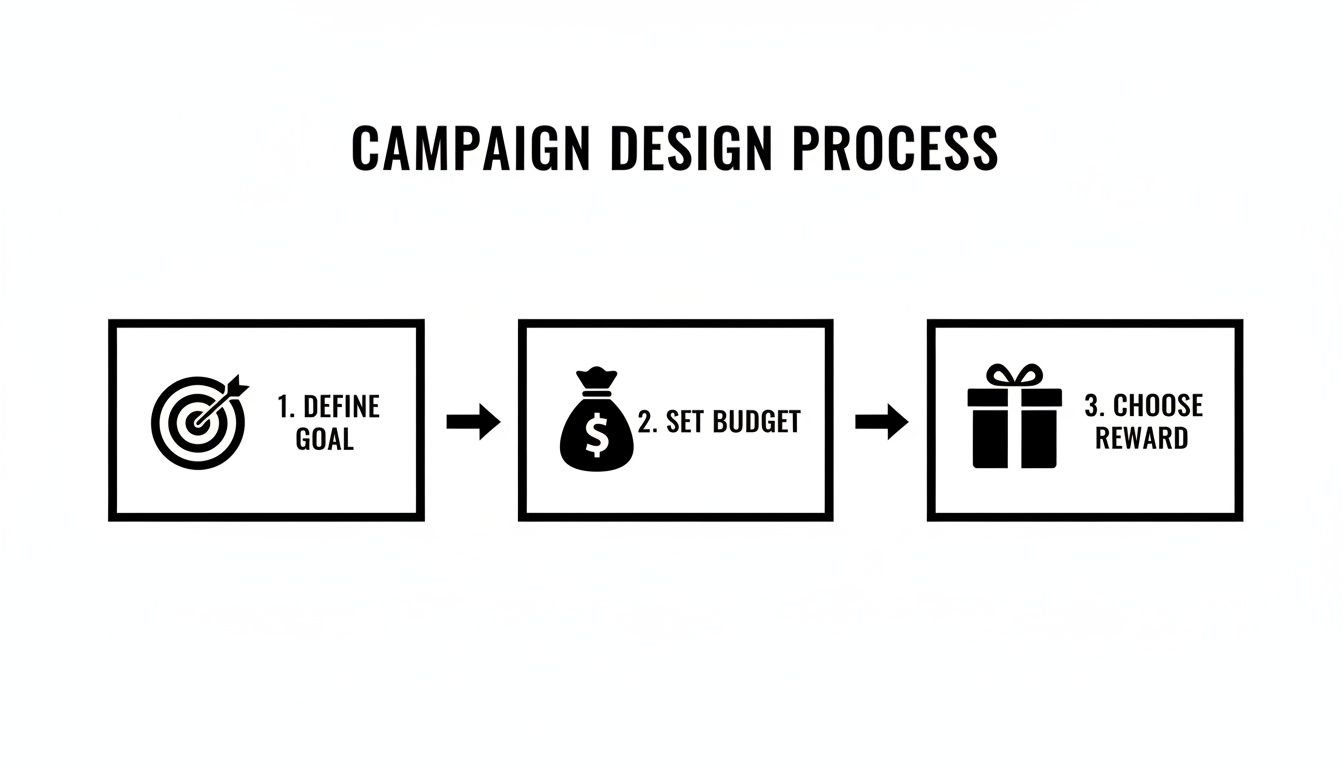
This process really is that simple. A clear goal tells you what you can spend, and your budget determines the rewards you can offer.
Automating the User Journey
Let's be real: nobody has time to manually track referrals, check if people actually completed tasks, and then send out rewards one by one. It’s a logistical nightmare that’s slow, full of potential errors, and impossible to scale. This is exactly why automation tools like Domino are a game-changer for your Reddit referral campaign.
Think of it like setting up a "quest." A user can earn points just for sharing a specific Reddit thread. With Domino, that entire flow is automated:
- A user connects their wallet and social accounts.
- They get a unique link to share on Reddit or wherever.
- The system's AI automatically verifies that the share is legit and complete.
- Boom—points or rewards are instantly sent to their account.
This hands-off approach means you can focus on the important stuff, like engaging with your community and thinking about strategy, instead of getting buried in admin work.
Combining On-Chain and Off-Chain Actions
For any Web3 project, the real magic happens when you mix social engagement with actual on-chain activity. This is how you know you’re bringing in genuine users for your dApp or protocol, not just collecting empty social follows.
A successful Web3 referral program doesn't just track clicks. It validates meaningful participation in your ecosystem, turning social buzz into measurable on-chain growth.
You can create awesome multi-step quests that require both. For example, a user might need to upvote a Reddit post (off-chain) and then stake one of your project's NFTs (on-chain) to unlock a special reward. This kind of layered approach filters for high-quality participants and just makes the whole experience more engaging.
It's also super important to think about how Reddit plays with other platforms. Get this: YouTube drives over 50% of Reddit’s social referral traffic, and Twitter (X) throws in another 20%. That tells you just how critical cross-platform sharing is. You can design quests that reward users for blasting your Reddit content on those sites, seriously amplifying your reach.
At the end of the day, a well-built system should feel effortless for the user and be completely automated for you. If you want more inspiration on structuring these campaigns, take a look at our complete guide to building a Web3 referral program from scratch.
Finding Your Tribe: Choosing the Right Subreddits and Launching
Your campaign’s success isn't just about cool rewards; it all comes down to reaching the right people. Picking the perfect subreddits is a bit of an art, and it's about more than just carpet-bombing massive, generic communities like r/cryptocurrency. Honestly, those places are so noisy your message will likely get buried or dismissed as just another shill.
The real wins are found in niche, highly-engaged communities where your project just clicks. Think smaller and more focused. If you're building on Solana, a place like r/solanadev could be a goldmine. Got a P2E game? Look for subreddits dedicated to specific gaming genres that match yours, not just the broad crypto gaming hubs.
Do Your Homework on Target Subreddits
Before you even think about posting, you need to become a lurker. Seriously. Spend some real time in your target subreddits to get a feel for their unique culture. Every community has its own inside jokes, unwritten rules, and things they absolutely hate.
- Read the Rules (No, Really): The sidebar is your best friend. So many subreddits have strict policies against self-promotion or referral links. Blowing past these is the fastest ticket to getting your post deleted and maybe even your account banned.
- Check the Vibe: Look at the ratio of upvotes to comments on the top posts. A ton of comments is a great sign—it means you’ve found an active, conversational community that's way more likely to jump on your campaign.
- Gauge the Sentiment: What kinds of projects get praised? What gets torn apart? If a subreddit is constantly roasting projects that look a lot like yours, it's probably not your crowd.
This groundwork is absolutely non-negotiable. It’s the difference between being welcomed as a cool new thing and being run out of town as spam.
The goal isn't just to find a subreddit with a lot of subscribers. It's to find the right subscribers—people who will genuinely get excited about what you're building and be motivated to share it.
Nailing the Launch Post
Your launch post is your one shot at a first impression. It has to feel authentic and give the reader immediate value, not just scream, "Join my referral program!" Ditch the corporate jargon and the polished marketing-speak. Just write like a real person who’s genuinely pumped to share something they’ve built.
Lead with value. Maybe it’s a fascinating insight you discovered, a free tool you made, or a deep dive into the problem your project solves. Frame your referral campaign as a way for the community to get in on the ground floor and share in the success, not just as a marketing ploy.
Being present in the comments right after you post is also a huge deal. Be there to answer every question, thank people for their feedback, and actually participate in the discussion. This turns a simple announcement into a real community event. Remember, when you find that perfect community fit, your campaign’s performance can absolutely explode. Brands that get this right have seen insane results. You can read more about it in these Reddit ads case studies.
Using tools to help manage the process can also be a lifesaver. You can find some great resources for your Reddit referral campaign that help streamline everything from the initial launch to getting rewards out the door. Check out these ready-to-go Reddit apps and templates to see how you can automate the grunt work and focus on having real conversations.
Alright, let's get into the nitty-gritty. You’ve launched your campaign, the links are out there, and referrals are starting to trickle in. This is where the real fun begins.
Getting a campaign live is one thing, but turning it into a growth engine that consistently brings in high-quality community members? That’s an entirely different ballgame. It's less about "set it and forget it" and more about being a detective, constantly looking for clues in the data. Simply counting new sign-ups is a vanity metric; we need to dig deeper.
The goal is to understand the entire journey. What happens after someone clicks that referral link? Do they stick around? Do they actually use your protocol? Answering these questions is how you win.
What to Measure: Your Campaign's Vitals
To really get a handle on performance, you need to track a few key metrics. Forget drowning in spreadsheets. A good dashboard, especially one built into a platform like Domino, is your best friend here. It pulls everything together so you can see what’s actually moving the needle.
Here’s what I keep my eyes glued to:
- Conversion Rate: Of all the people who clicked a referral link, how many actually did the thing you wanted them to do? Whether that’s connecting a wallet, joining Discord, or completing their first on-chain task, this tells you if your messaging and user flow are working.
- Cost Per Acquisition (CPA): This is your efficiency score. How much are you paying out in rewards to get one new, active member? It puts your spending into perspective.
- On-Chain Activity: This is the ultimate test for any Web3 project. Are these new users just farming rewards, or are they genuinely participating? Track things like staking, transaction volume, or smart contract interactions to separate the wheat from the chaff.
- Referral Velocity: How fast are new referrals coming in? A sudden surge could mean a post is going viral, while a slow drip might be a sign that your incentives are getting stale.
Ultimately, you're trying to figure out your return on investment. A huge part of this involves understanding what is ROAS in digital marketing and applying that concept to your campaign rewards. Are you spending $1 in tokens to get $5 in value? That's the question.
Find Your Champions and Treat Them Like Royalty
In every single campaign I've ever run, the Pareto principle holds true: a small handful of people will drive the majority of the results. These are your super-advocates, your true believers. Finding and empowering them is the highest-leverage activity you can do.
Don't treat all referrers the same. Your top 1% of advocates can often drive 20% or more of your results. Identify them, reward them, and turn them into long-term partners.
Once your dashboard helps you pinpoint who these people are, roll out the red carpet. Create a private, token-gated channel in Discord just for them. Give them early access to new features, offer them exclusive rewards, and—most importantly—ask for their feedback. Making them feel like insiders is the best way to keep them motivated.
Pouring Gas on the Fire: How to Scale Smartly
Once you’ve got a system that’s humming along and you understand your numbers, it's time to scale. But scaling isn’t just about increasing the rewards budget. It’s about being strategic.
One of the best ways to do this is by introducing tiered rewards. Maybe the first five referrals earn a user a standard reward, but hitting 25 unlocks a rare NFT or a massive token bonus. This gamifies the whole process and gives your top performers something to strive for.
You should also use your data to expand intelligently. See a lot of high-quality users coming from r/DeFi? Find five other subreddits just like it and run targeted mini-campaigns.
It’s also interesting to see where Reddit fits in the grand scheme of things. It's a beast for sending traffic out, but only 1.54% of its own traffic comes from referrals. For Web3 projects, this is a golden opportunity. You can use Reddit to pull high-intent users directly into your ecosystem, whether it's a quest platform or your main community hub. This targeted approach is how you turn a small, successful campaign into a powerful, compounding growth loop.
Got Questions About Your Reddit Referral Campaign? I've Got Answers.
Jumping into Reddit's unique world can feel like a minefield, but trust me, a few key insights can make all the difference. I've seen countless Web3 projects tackle this, and the same questions pop up every time. Here's my take on the most common hurdles you'll face.
How Do I Stop People From Gaming the System?
Protecting your campaign from fraud is your top priority. If you don't, you'll burn through your budget rewarding bots and sybil attackers. The best defense is a layered one.
First off, use a platform with built-in anti-fraud tools. Think AI verification for social tasks and solid bot detection—this is your baseline. Then, you need to set some clear, simple rules. Things like limiting rewards to one per person or IP address are basic but effective at stopping the laziest attempts at cheating.
The real secret sauce, though, is bringing things on-chain.
Requiring a referred user to connect a wallet that has at least some transaction history is a massive roadblock for bots. It's a simple check that proves you're dealing with a real person, not a script. Lastly, get in the habit of manually spot-checking your top referrers. You want to make sure they're bringing in quality people, not just driving empty numbers.
A smart referral campaign doesn’t just reward any action; it filters for genuine intent. By mixing simple off-chain tasks with light on-chain requirements, you’re not just acquiring users—you’re acquiring the right users and making sure your budget is well spent.
What Are the Classic Mistakes I Should Avoid on Reddit?
The absolute biggest blunder is treating Reddit like any other social platform. It’s not Twitter. It’s not Instagram. It's a collection of communities, and if you treat it like your personal billboard, you'll get torched. Redditors can smell a corporate shill from a mile away and will downvote you into oblivion.
Steer clear of these classic face-plants:
- Shameless Self-Promotion: Don't just dump a link to your project and bail. Your post has to offer real value on its own—be it through a great story, a funny meme, or a useful insight.
- Ignoring the Rules: Every subreddit has its own culture and, more importantly, its own set of rules. Break them, and you're getting your post deleted and maybe even your account banned. It's the quickest way to fail.
- Posting and Ghosting: Never, ever just post your announcement and then vanish. You have to stick around. Hang out in the comments, answer questions, and actually talk to people. This is how you build real trust.
Another rookie error is picking the wrong subreddit. Don't just go for the biggest, most generic crypto forum. You'll get far better results from a smaller, niche community that's already deep into your specific ecosystem.
Can I Actually Pull This Off on a Shoestring Budget?
You bet. On Reddit, smarts and creativity will always beat a fat wallet. You don't need to throw massive token airdrops around to get people excited.
The key is to think beyond money. What incentives would your core community actually value? Get creative with non-monetary rewards.
We're talking about things like:
- Exclusive roles in your Discord that come with bragging rights.
- Guaranteed whitelist spots for that hot NFT mint everyone's talking about.
- Early access to a new feature or a closed beta test.
These kinds of rewards tap into real FOMO and are incredibly motivating for your true fans. You can also set up tiered rewards, so you only pay out for top-tier performance. And by using a no-code tool, you sidestep all the expensive development costs, letting you launch a pretty sophisticated, automated campaign for pennies on the dollar.
Ready to turn Reddit's die-hard communities into your secret weapon for growth? With Domino, you can map out, launch, and automate a full-blown Web3 referral campaign in just a few minutes, with zero coding needed. Start building your campaign today.